44
EXPERIMENTAL STUDIES ON THE FERTILITY OF THE EUTRIC
PSAMOSOIL IN POIANA MARE – DOLJ
BUZATU CLAUDIU, GRECU FLORINA
University of Craiova - Faculty of Agriculture, Craiova Keywords: sandy soil, fertilization, economical efficiency
INTRODUCTION
The sands and sandy soils are very difficult to cultivate because of their special features. This way, because of their high content of thick size particles (over 85-90%) these lands are light as regard tillage, even during raining periods which is a positive feature. All other features are negative as regard plant development. These soils have a low colloidal complex, the compactity and adhesivity of these soils are very low and that is why they do not keep water and nutrients, for increasing their fertility there are needed irrigation and complex fertilization.
MATERIAL AND METHOD
In order to evaluate the productive capacity of sandy soils from Poiana Mare and the way these soils respond to several methods of fertilization there was set up an experiment on an eutric sandy soil located on the top of a dune.
The experimental treatments were: V1= not fertilized (Ctrl.);
V2= fertilized by N100;
V3= fertilized by N100 P60;
V4= fertilized by N100 P60 K40;
V5= fertilized by manure, 30 t/ha, once every 3 years.
The experiment was kept three years in a biennial crop rotation, wheat – corn. The dune where the experiment was located is of average height and wider platform.
Table 1.
The main physical and chemical features of eutric sandy soil from Poiana Mare, District Dolj S oi l Dept h
Cm San
d 2 - 0,2 mm Loam 0,02 -0,0 0 2m m Cl ay < 0,0 0 2m m HUMU S
% Nt %
P K
pH (H2O)
SB me/mg sol Ppm EUTRIC SANDY SOIL
0- 20 83.7 6.1 10.2 1.58 0.079 30.0 101 7.9 9.8
20- 40 86.1 5.2 8.7 0.91 0.046 14.6 96 8.1 11.5
The soil has a high content of sand (over 90%) and a low content of loam and clay (under 10%). The reaction is low alkaline. The humus content is low and the soil is weakly supplied by nutrients (table 1).
Results obtained from culture of maize production on eutric psamosoil
Corn is the second cash crop, after wheat that is cropped by farmers from sandy soil area. Being a crop that requires water and taking account that the summer months are rather droughty, in rainfed conditions the yields are low and very low, and in latest years, on the top of dunes, they are compromised.
45
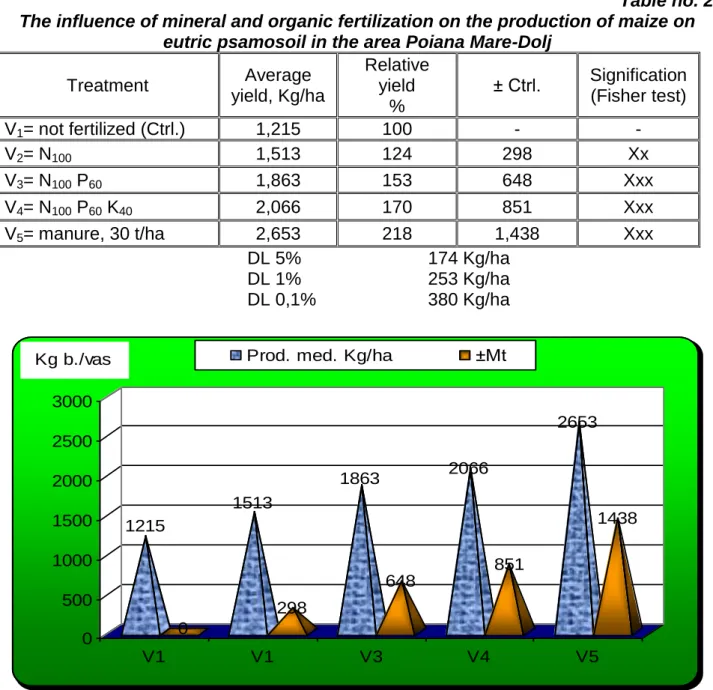
By fertilizing with ammonium nitrate in a rate of 300 kg/ha raw substance (V2) (table 2, figure 1) the yield reached 1,513 kg/ha, the nitrate fertilizer applied alone bringing an yield increase of 298 kg/ha which represents 24% increase, distinctly significant, after Fisher test.
Table no. 2. The influence of mineral and organic fertilization on the production of maize on
eutric psamosoil in the area Poiana Mare-Dolj
Treatment Average yield, Kg/ha
Relative yield
%
± Ctrl. Signification (Fisher test)
V1= not fertilized (Ctrl.) 1,215 100 - -
V2= N100 1,513 124 298 Xx
V3= N100 P60 1,863 153 648 Xxx
V4= N100 P60 K40 2,066 170 851 Xxx
V5= manure, 30 t/ha 2,653 218 1,438 Xxx
DL 5% 174 Kg/ha DL 1% 253 Kg/ha DL 0,1% 380 Kg/ha
Figure no. 1. Evolution of production of maize after mineral and organic fertilization on eutric psamosoil of the area Poiana Mare (the average grainproduction (Kg/ha/2006, 2007, 2008)
By fertilizing with 300 kg/ha ammonium nitrate and 125 kg/ha concentrated superphosphate (V3), the average yield on three years of experimentation has increased to 1,863 kg/ha, recording a percentual output of 53% against the control variant and an yield output of 648 kg/ha which is very significant.
With the fourth variant, where there was fertilized by 300 kg/ha ammonium nitrate, 125 kg/ha concentrate superphosphate and 100 kg/ha KCl, the yield has been of 2,066 kg/ha, almost double over the control treatment. The relative output for this variant has been of 70% and the yield output was of 851 kg/ha, very significant.
Making the interpretation of the yields from V3 and V4 variants there can be noticed that the mineral fertilizer based on potassium has determined a percentual output of 17%
1215
0
1513
298
1863
648
2066
851
2653
1438
0 500 1000 1500 2000 2500 3000
V1 V1 V3 V4 V5
Prod. med. Kg/ha ±Mt
46
and an yield output of 103 kg/ha, so, much lower than the ones determined by nitrogen and phosphorus which conclude that potassium is less efficient on eutric sandy soil.
The manure amount applied has been of 30 t/ha once every three years (V5) and the yield was 2,653 kg/ha, higher than double of the control treatment (V1). The percentual output with this treatment has been of 118 % and the yield difference over the control variant (V1) has been of 1,438 kg/ha, very significant.
In conclusion, with the corn crop on the eutric sandy soil, the results have shown that on these low productive soils, by fertilization, there can be obtained increased yields. Calculating the yield output on one kg of active ingredient of fertilizer (table 3) there can be noticed that only with nitrogen fertilization the yield output was the lowest (2.98 kg corn/kg of nitrogen), this fact meaning that the nitrogen determines mostly a vegetative growth and less a productive one.
Table no. 3. The specific yield output on eutric psamosoil in Poiana Mare-Dolj (kg corn / Kg
active ingredient)
Specification Treatment
V1 V2 V3 V4
Kg corn/Kg a.i. - 2.98 4.05 4.26
The applying of concentrated superphosphate along with nitrogen determine an yield output of 4.05% kg corn/kg active ingredient and the adding of KCl the yield output reaches 4.26 kg corn/kg a.i. With the corn crop there is observed that the yield output with the V4 treatment has been slightly higher, when this fertilizer, KCl, has been added; this fact shows that the corn crop does capitalize better potassium fertilizer.
After interpreting the yield results after the system every to every (table 4) there can be noticed that, taking as control the V1 treatment, the yield difference over the V2 treatment that has been fertilized by ammonium nitrate (298 kg/ha) has been distinctively significant and the yield differences between V3 (648 Kg/ha), V4 (851 Kg/ha) and V5 (1438 Kg/ha)
have been very significant.
Table 4 Calculation of multiple comparisons on culture of maize on eutric psamosoil in
the area Poiana Mare-Dolj
Nr. Yield
(Kg/ha) Treatment 1,513 1,863 2,066 2,653
1 2,653 V5 1438*** 1140*** 790*** 587 ***
2 2,066 V4 851*** 553*** 203* -
3 1,863 V3 648*** 350** - -
4 1,513 V2 298** - - -
5 1,215 V1 - - - -
DL 5% = 174 Kg/ha DL 1%=253 Kg/ha DL 0,1% =380 Kg/ha
Taking as control the V2 treatment that has an yield of 1,513 kg/ha, the difference of yield over V3 (350 kg/ha) has been distinctively significant and the differences over V4
(553 Kg/ha) and V5 (1140 Kg/ha) have been very significant.
47
Taking as control the V4 treatment that has recorded an yield of 2,066 kg/ha, the yield difference over the V5 treatment (587 kg/ha) was distinctly significant.
The economic efficiency of maize culture on eutric psamosoil
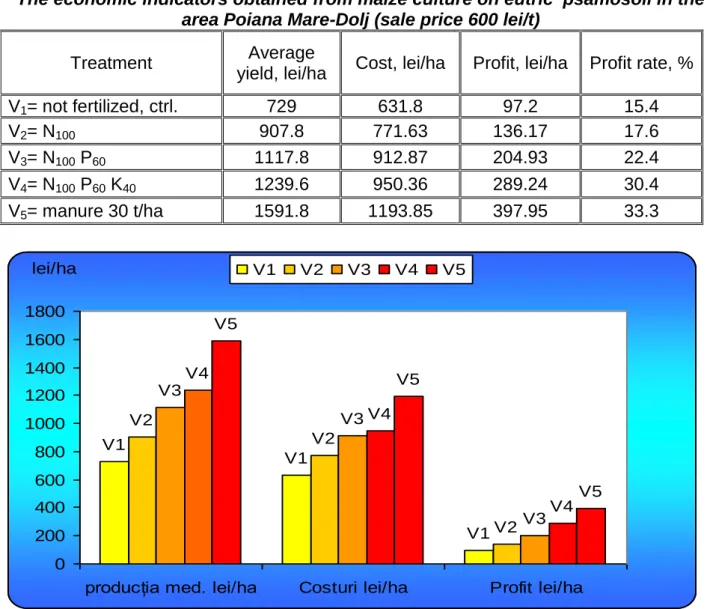
The corn yields have been slightly higher; therefore, the economical parameters had higher values, too. This way, on the eutric sandy soil, with the not fertilized treatment (V1), at a selling price of 600 lei/ton, the yield selling value has been of 729 lei/ha and the production cost was 631.8 lei/ha resulting a profit of 97.2 lei/ha with a profit rate of 15.4% (table 5, figure 2).
Table no. 5. The economic indicators obtained from maize culture on eutric psamosoil in the
area Poiana Mare-Dolj (sale price 600 lei/t)
Treatment Average
yield, lei/ha Cost, lei/ha Profit, lei/ha Profit rate, %
V1= not fertilized, ctrl. 729 631.8 97.2 15.4
V2= N100 907.8 771.63 136.17 17.6
V3= N100 P60 1117.8 912.87 204.93 22.4
V4= N100 P60 K40 1239.6 950.36 289.24 30.4
V5= manure 30 t/ha 1591.8 1193.85 397.95 33.3
Figure no. 2.The economic indicators obtained from maize culture on eutric psamosoil in the area Poiana Mare-Dolj
By fertilizing with N100 (V2), the value of the yield has been of 907.8 lei/ha and the cost of production of 771.3 lei/ha which determined a profit of 136.17 lei/ha, with a profit rate of 17.6%.
When phosphorus was added as fertilizer, along nitrogen, N100P60 (V3), the value of the yield has been of 1117.8 lei/ha and cost of production was 912.87 lei/ha. By difference has been obtained a profit of 204.93 lei/ha and a profit rate of 22.4%.
When complete mineral fertilization has been applied, N100P60K40 (V4), the value of the yield reached 1,239.6 lei/ha and the production cost was 950.36 lei/ha. The profit obtained with this treatment has been of 289.24 lei/ha with a profit rate of 30.4%.
V1
V1
V1 V2
V2
V2 V3
V3
V3 V4
V4
V4 V5
V5
V5
0 200 400 600 800 1000 1200 1400 1600 1800
producția med. lei/ha Costuri lei/ha Profit lei/ha
V1 V2 V3 V4 V5
48
With the V5 treatment, when manure was added to complete mineral fertilization there were obtained the best economical results, with a profit of 397.95 lei/ha and a profit rate of 33.3%.
CONCLUSIONS
After economic analysis of the production results there can be observed that the experiments performed on sandy eutric soil from Poiana Mare emphasize the fact that these soils are low productive. In order for this soil to be efficient there is need of complex works of reclamation as organic and mineral fertilization as well as irrigation.
BIBLIOGRAPHY
1. Canarache, A., 1990 - Fizica Solurilor Agricole, Editura Ceres Bucureşti.
2. Filipov F., 2005 - Pedologie. Ed. „Ion Ionescu de la Brad”, Iaşi.
3. Mihalache M., Ilie L., 2008 - Pedologie-Solurile României. Ed. Domino, Bucureşti.
4. Obrejanu, Gr. şi colab., 1972 - Valorificarea nisipurilor şi solurilor nisipoase din România. Editura Ceres, Bucureşti.
5. Paulette Laura, 2007 - Pedologie, studiul solului în teren şi laborator. Ed. Todesco,
Cluj-Napoca.