ECG Signal Compression Technique based on DWT & QRS
Complex Estimation
Pragati S. Kharate,Ruchika D. Raghorte, Sakshi B. Gabhane, Samrudhi R. Khasare, Komal D. Nikhar, Priyanka Chauke Electronics & Telecommunication, SRMCEW, Nagpur, India
[email protected], [email protected], [email protected]
[email protected], [email protected], [email protected]
Miss. Nilu Mishra
Ass. Prof. in Department of ETC Engg SRMCEW, Nagpur, India
ABSTRACT
An Electrocardiogram (ECG) signal is compressed based on discrete wavelet transform (DWT) and QRS-complex estimation .The electrocardiogram (ECG) is widely used for diagnosis of heart diseases. Generally, the recorded ECG signal is often contaminated by noise. In order to extract useful information from the noisy ECG signals, the raw ECG signal has to be processed. The baseline wandering is significant and can strongly affect ECG signal analysis. The detection of QRS complexes in an ECG signal provides information about the heart rate, the conduction velocity, the condition of tissues within the heart as well as various abnormalities. It supplies evidence for the diagnosis of cardiac diseases. An algorithm based on wavelet transforms (WT's) has been developed for detecting ECG characteristic points. Although digital storage media is not expensive and computational power has exponentially increased in past few years, the possibility of electrocardiogram (ECG) compression still attracts the attention, due to the huge amount of data that has to be stored and transmitted The
main features of this compression algorithm are the use of less memory due to compression, high efficiency and high speed.
Keywords— ECG, QRS-complex, Wavelet Transform, Compression, QRS Detection, DWT.
I. INTRODUCTION
The “Electrocardiogram” (ECG) is an invaluable tool for diagnosis of heart diseases. The volume of electrocardiogram data produced by monitoring systems can be quite large over a long period of time and electrocardiogram data compression is often needed for efficient storage of such data. Similarly, when ECG data need to be transmitted for telemedicine applications, data compression needs to be utilized for efficient transmission. While ECG systems are found primarily in hospitals, they find use in many other locales also. ECG systems are used by paramedics responding to
accident scenes in emergency vehicles. They are also used by clinicians at remote sites. Certain military or space missions also employ ECG. A growing area of use for ECG is the 24-hour halters that are leased by consumers. These portable ECG devices record and store the data for subsequent interpretation by a doctor.
II. ELECTROCARDIOGRAM (ECG)
An electrocardiogram is simply a measure of voltage changes in the body. Any large electrical event can be detected. The electrically-active tissues in the body are the muscles and nerves. Small brief changes in voltage can be detected as these tissues „fire‟ electrically. The heart is a muscle with well-coordinated electrical activity, so the electrical activity within the heart can be easily detected from the outside of the body.
Figure 1 Schematic Representation of Normal ECG[5]
III. BLOCK DIAGRAM
An ECG is used to measure the heart‟s electrical conduction system[4]. It picks up electrical impulses generated by the polarization and depolarization of cardiac tissue and translates into a waveform.
Figure 2 Block diagram of ECG compression[1]
PRE-PROCESSING
The aim of pre-processing steps is to improve the general quality of ECG for more accurate analysis and measurement. Noises may disturb ECG to such an extent that measurement from original signals are unreliable. The objective of ECG signal processing is to improve the measurement accuracy. Though the extraction of information is not readily available from visual, pre-processing of ECG signal is very important.
DWT (Discrete wavelet Transform)
The discrete wavelet transform (DWT) is an implementation of the wavelet transform using a discrete set of the wavelet scales and translations obeying some defined rules. In other words, this transform decomposes the signal into mutually orthogonal set of wavelets, which is the main difference from the continuous wavelet transform (CWT), or its implementation for the discrete time series sometimes called discrete-time continuous wavelet transform (DT-CWT). The wavelet can be constructed from a
scaling function which describes its scaling properties. The restriction that the scaling functions must be orthogonal to its discrete translations implies some mathematical conditions on them which are mentioned everywhere.
QRS-Complex Detection
Figure 3 The Normal ECG Waveform[1]
A typical ECG tracing of electrocardiogram baseline voltage is known as the isoelectric line. It is measured as the portion of the tracing following the T wave and preceding the next P wave. The aim of the QRS-complex estimation is to produce the typical QRS-complex waveform using the parameters extracted from the original ECG signal. The estimation algorithm is a Matlab based estimator and is able to produce normal QRS waveform. A single heartbeat of ECG signal is a mixture of triangular and sinusoidal wave forms. The QRS-complex wave can be represented by shifted and scaled versions of these waveforms. The ECG waveform contains, in addition to the QRS-complex, P and T waves, 60-Hz noise from power line interference, EMG signal from muscles, motion artifact from the electrode and skin interface, and possibly other interference from electro surgery equipments[1].
Optimal Energy Packing Efficiency and Thresholding
The QRS-complex estimator is tested on the first 1000 sample of record 100 from the MIT-BIH arrhythmia database. It illustrates the original signal, the resulting estimated QRS-complex signal and the difference between them. After applying the DWT on the error signal, the resulted wavelet coefficients are divided into the subbands[1].
Thresholding Process
The wavelet coefficients representing the error signal are threshold according to the energy packing efficiency principle. The intent of this part is to investigate the optimal values of EPE that achieve maximum CR and minimum PRD. To encounter this, the error signal is coded without thresholding for all subbands[1]. CR and PRD Determination
Compression ratio is the ratio of bit data of original ECG signal by bit rate of compressed ECG signal. All data compression algorithm used to minimize the data storage by eliminating the redundancy whenever possible to increase the compression ratio.
CR = bit rate of original ECG signal
bit rate of compressed ECG signal Percentage root mean difference is measures
the distortion between original and reconstructed signal.
Post Processing
The reconstructed ECG signal is obtained from decoded signal by adding the decoded mean value and multiply it by the maximum value[1].
RESULTS
Figure 4 Input ECG signal for 1000 samples
In ECG Noise Filtering, we use Savitzky Golay Filter to remove the noise. Savitzky Golay filter is a digital filter that can be applied to set of digital data point for the purpose of smoothing the data and it is used to increase the signal to noise ratio without greatly distorting the signal.
Figure 5 Output ECG signal for 1000 samples
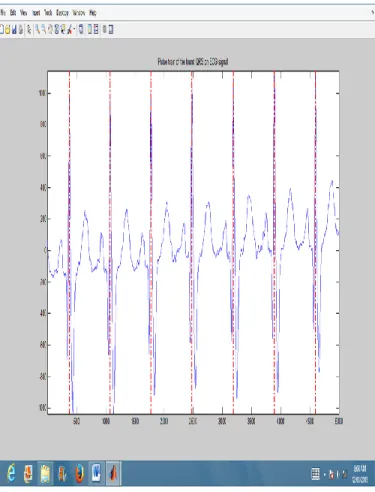
In QRS Detection, we use PAN
TOMPKINS Algorithm. The PAN
TOMPKINS Algorithm recognizes QRS complexes based on analysis of slope, amplitude and width. PAN TOMPKINS algorithm is real time algorithm and this algorithm detect 99.3% of QRS complex. The red line in the waveform indicates QRS pulses.
Figure 6 Output of QRS Detection using Pan-Tompkins Algorithm
After QRS-Detection, we apply the DWT (Discrete Wavelet Transform) for compression and IDWT (Inverse Discrete Wavelet Transform) for reconstructing the original signal.
Fig 7 Output of DWT and IDWT
This is the final output obtained by applying discrete wavelet transform (DWT), first wave form shows the original signal second shows the filtered ECG signal third signal is a pulse train of the QRS on ECG signal four wave form is a DWT of ECG signal and fifth wave is a reconstructed ECG signal obtained by applying inversed discrete transform IDWT last wave form is shows the error of original signal and reconstructed of ECG signal. The compression ratio of DWT is 95%.
CONCLUSION
In present work, an effective ECG Data Compression algorithm to be implemented using Discrete Wavelet Transformation (DWT). The basics of ECG and an overview of various ECG compression technique and algorithm. As we have taken more number of samples so we are obtaining highest CR with acceptable PRD.
REFERENCES
[1] Mohammed Abo-Zahhad “ECG Signal Compression Technique Based on Discrete Wavelet Transform and QRS-Complex Estimation” Signal Processing - An International Journal (SPIJ), Volume (4), Issue (2)
[2] V. Viknesh & P. Ram Prashanth “Matlab implementation of ECG signal processing IOSR Journal of VLSI and Signal Processing (IOSR-JVSP) Volume 3, Issue 1 (Sep. – Oct. 2013), PP 40-47 e-ISSN: 2319 – 4200, p-ISSN No. : 2319 – 4197”
[3] Er. Abdul Sayeed “ECG Data Compression Using DWT & HYBRID” International Journal of Engineering Research and Applications (IJERA), ISSN: 22489622 Vol. 3, Issue 1, January -February 2013, pp.422-425
[4] Priyanka Mehta and Monika Kumari “Qrs Complex Detection of Ecg Signal Using Wavelet Transform” International Journal of Applied Engineering Research, ISSN 0973-4562 Vol.7 No.11 (2012)
[5] Anubhuti Khare, Manish Saxena, Vijay B. Nerkar “ECG Data Compression Using DWT International Journal of Engineering and Advanced Technology (IJEAT) ISSN: 2249 – 8958, Volume-1, Issue-1, October 2011”
[6] Anamitra Bardhan Roy” Comparison of FFT, DCT, DWT, WHT Compression Techniques on Electrocardiogram” Special Issue of International Journal of Computer Applications (0975 – 8887) International Conference on Computing, Communication and Sensor Network (CCSN) 2012
[7] Abenstein JP, Tompkins WJ. Anew Data- Reduction Algorithm for Real-Time ECG Analysis. IEEE Transactions on Biomedical Engineering.
[8] B. A. Rajoub, “An efficient coding algorithm for the compression of ECG signals using the wavelet transform” IEEE Transactions on Biomedical Engineering, 49 (4): 355–362, 2002.
[9] www.ptb.de/cms.com [10] www.ecglearncenter.com
[11] htpp://www.books.google.com/books [13] Pan. J. Tompkins. W.J,"A Real-Time QRS Detection Algorithm" IEEE %Transactions On Biomedical Engineering, Vol. Bme-32, No. 3, March 1985.
![Figure 1 Schematic Representation of Normal ECG[5]](https://thumb-us.123doks.com/thumbv2/123dok_us/8222006.2179826/2.918.488.886.116.443/figure-schematic-representation-normal-ecg.webp)