Geschke Center
Doctor of Nursing Practice (DNP) Projects Theses, Dissertations, Capstones and Projects
Fall 12-16-2011
RN Transition to Practice Program in the Primary
Care and School Settings: Development,
Implementation, and Evaluation
Maria-Idalia O. LensUniversity of San Francisco, [email protected]
Follow this and additional works at:https://repository.usfca.edu/dnp Part of thePublic Health and Community Nursing Commons
This Project is brought to you for free and open access by the Theses, Dissertations, Capstones and Projects at USF Scholarship: a digital repository @ Gleeson Library | Geschke Center. It has been accepted for inclusion in Doctor of Nursing Practice (DNP) Projects by an authorized administrator of USF Scholarship: a digital repository @ Gleeson Library | Geschke Center. For more information, please [email protected].
Recommended Citation
Lens, Maria-Idalia O., "RN Transition to Practice Program in the Primary Care and School Settings: Development, Implementation, and Evaluation" (2011).Doctor of Nursing Practice (DNP) Projects. 2.
RN Transition to Practice Program in the Primary Care and School Settings:
Development, Implementation, and Evaluation
Maria-Idalia O. Lens, RN, PHN, MSN, FNP-BC, DNPc
University of San Francisco
A comprehensive exam submitted in partial satisfaction of
The requirements for the degree of
Doctor of Nursing Practice in Healthcare Systems Leadership
Table of Contents
Page
Section I: Introduction... 1
Section II: Review of the Evidence... 3
Residency Programs... 4
Theoretical Framework... 5
Characteristics of New Nurse Graduates... 7
Section III: Implementation of the Program ... 7
Aim of the Program... 8
Participants... 8
Methods and Instruments... 9
Data Collection... 11
Data Analysis... 12
Demographics... 12
Skills... 13
Stressors... 13
Role Transition... 14
Competency... 15
Preceptorship Experience... 17
Section V: Evaluations ... 18
Section VI: Continuous Quality Improvement ... 19
Section VII: Implications for Nursing ... 20
Funding... 20
Lessons Learned... 21
Dissemination Plan... 22
Section VIII: Conclusion ... 22
References ... 24
Appendix A: Appraise the Evidence ... 27
Appendix B: IRB Approval... 28
Appendix C: Casey-Fink Graduate Nurse Experience Survey (revised) ... 29
Appendix D: Brief QSEN Evaluation ... 37
Appendix E: California Institute for Nursing and Health Care San Francisco Bay Area New Graduate RN Transition Program ... 40
Appendix F: Patient Centered Care Evaluation ... 41
Appendix G: Evidence Based Care Practice Evaluation... 43
Appendix H: Informatics Evaluation ... 45
Appendix I: Quality Improvement Evaluation... 47
Appendix J: Safety Evaluation ... 49
Appendix K: Title ... 51
Appendix L: Preceptorship Experience Questionnaire ... 53
Appendix M: PDSA/SPDA Cycle ... 60
Acknowledgments
All faculties at the University of San Francisco for the support throughout the program: Judith F.
Karshmer, PhD, APRN, BC, KT Waxman, DNP, MBA, RN, CNL, Kia James, Ed.D, MPH,
MSN, RN, Susan Prion, Ed.D, MSN, MA, BSN, RN, and Jessie Bell, RN, PHN, MSN. Would
like to thank the California Institute of Nursing and Health Care: Deloras Jones, RN, MSN,
Abstract
New graduate registered nurses (RN) are facing a difficult time finding jobs since the economy
of the United States has declined. Since then the California Institute of Nursing and Health Care,
along with funding from the Betty Moore Foundation, have developed RN transition programs.
These programs were developed to increase skills, confidence, and experience among new RN
graduates to promote their transition into the nursing workforce. The programs also were
designed to retain newly licensed nurses in the nursing profession while engaging competencies
that could be transferred to both acute and outpatient care settings. In addition, the programs are
intended to increase the employability of new nurses finding it difficult to secure a nursing
position. This was a pilot program conducted in an ambulatory patient care setting as opposed to
an acute care setting. This study used two cohorts of RN graduates to participate in a
transition-to-practice program using qualitative analysis to measure the experiences and skills of new RN
graduates during the program. Most residents in the program felt more confident after
participation in the program and most were able to find employment as well. There were
positive results from this study; however, more transition programs need to be developed and
evaluated in different health care settings such as school and community health care settings.
Section I: Introduction
It has been estimated that the United States (U.S.) will experience a growth of registered
nurses (RNs) by 22% from 2008 to 2018 (Bureau of Labor Statistics, 2011). In 1998, reports of
nursing shortages emerged in the United States (Buerhaus, Auerbach, & Staiger, 2007). As a
result of previous nursing shortages, wages increased, working conditions began to improve, and
the enrollment of nursing students increased. After the year 2000, nursing job salaries and
benefits became competitive, and an interest in nursing careers peaked (Rother &
Lavisso-Mourey, 2009). In 2001, 13% of nursing vacancies and over 120,000 nursing jobs remained
unfilled. As a result, in 2005 funding was increased to support the nursing workforce in the state
of California (Khazan, 2010). In the United States, baccalaureate-nursing programs turned away
more than 30,000 applicants between 2007-2008 (American Association of Colleges of Nursing
[AACN], 2007). Nursing schools continue to have high numbers of student applicants even
though there are fewer jobs as a result of (a) the economic turmoil currently being experienced in
the United States and (b) changes that have occurred in reimbursement for inpatient care since
the development of diagnostic related grouping (DRG; Averil et al., 2003).
In the state of California, RNs are having a difficult time finding a job (California
Institute of Nursing and Health Care [CINHC], 2010). According to data collected from a new
graduate hiring survey conducted by CINHC from January 2009 to March 2010, 43% of nursing
graduates in California currently are not working as RNs (CINHC, 2010). The major reasons
given for not hiring new nurse graduates were no experience (93%), and no positions available
(67%). The study also revealed that 37% were told a baccalaureate prepared nurse graduate was
preferred. When the graduates were asked if they would be interested in participating in a
participate in an internship to increase skills and competency. Eighty-five percent of them were
willing to be unpaid, while others (46.8%) were willing to pay tuition to be in an internship
program. In 2009, the Hospital Association of Southern California stated that 40% of new
graduates could not find jobs. The survey conducted by employers stated that there were
positions in non-acute areas, but they do not have the resources to hire and train new RN
graduates (CINHC, 2010). This failure to hire new nurses is due to an immediate funding crisis,
but if new nurses are not hired, will lead to a more severe nursing shortage in the years to
come—a shortage that is already being felt—as the baby-boom generation nurses retire and the
baby-boom generation ages and needs more frequent healthcare. Buerhaus (2008) estimated the
nursing shortage is likely to reach a deficit of 500,000 registered nurses by 2025. The current
number of RNs must increase by 90% to meet demands of the next decade (American
Association of Colleges of Nursing, 2007).
In order to ensure a sufficient supply of RNs for the future, there needs to be a force in
place to help increase the RN workforce (Buerhaus, 2008). In addition, nurses need to
participate in health care policymaking in order for their voices to be heard and develop
innovative solutions to help prevent an ongoing shortage of nurses in the United States. Nurses
need to develop strategies to keep our current new RN graduates engaged and connected to their
profession while developing their professional role as an RN. Programs that support RN
transition-to-practice help decrease high turn-over rates by providing a framework in which the
new RN graduate can further develop skills, safety, and quality of patient care (Institute of
Medicine [IOM], 2010). The IOM supports the idea of RN residency programs; however, the
programs need to be created and evaluated for effectiveness in non-acute care settings not just
significant change in skill competency, professional role development, and job acquisition, as
well as how it can be applied today while nurses are not able to find jobs.
Section II: Review of the Evidence
Many institutions have created ways to help new nursing graduates become more skilled,
attract nurses with higher education degrees, and retain them in the workforce (Williams, Goode,
Krsek, Bednash, & Lynn, 2007). In 2000, the Chief Nursing Officers Council of the University
Health System Consortium, a working group of nurse executives, along with deans from nursing
schools in the American Association of Colleges of Nursing (AACN) designed a yearlong
residency program in acute care university hospitals across 24 states (Williams et al., 2007). The
residency came about to address the increase of patient acuity level, the rising complexity of the
acute care setting, and high turnover rate among nurses in their first year of work (Beecroft,
Kunzman, & Krozek, 2001; Hamilton, Murray, Lindholm, & Myers, 1989; Mathews & Nunley,
1992). In one study, William, Goode, Krsek, Bednash, and Lynn (2007) found that turnover
after the first year had decreased in a residency program to 16.5% compared to current literature
that reported turnover rates at 35% to 61% after the new RNs first year of practice (Halfer &
Graf, 2006; PricewaterhouseCoopers’ Health Research Institute, 2007). A literature search was
conducted for studies pertaining to RN residency programs. The tool used to evaluate the
research studies was Appraise the Evidence (see Appendix A) used from the Northern California
nursing pathways website for the Kaiser Permanente® Northern California research division.
The literature presented in this section consists of the highest quality studies according to the
Appraise the Evidence tool.
Bowles and Candela (2005) surveyed new RN graduates and found that turnover was
stressors included lack of support and guidance, hospital management, and too much
responsibility for the new RN. In another residency program research project, Fink, Krugman,
Casey, and Goode (2008) found that residents became more confident over time, experienced
similar stressors in the work environment, but felt more supported towards the end of the
residency. RN residency programs have been shown to help with nurse retention, job
satisfaction, and improved returns on investment by decreasing costs of training through a
program, as compared to not having a program. The Methodist Hospital of Texas found that a
residency program was cost effective with a savings of $823,680 (Pine & Tart, 2007). Residency
programs can help increase the nursing workforce by reducing turnover, increasing nurse
satisfaction, and providing a cost-effective way of developing the professional role of the new
RN graduate.
Residency Programs
RNresidency programs were designed to provide new nurse graduates with new learning
opportunities through mentorships within a framework that supported the advancement from
beginner nurse to advanced beginner nurse role, while promoting increased competency in the
RN role (Benner, 2010; Williams, Goode, Krsek, Bednash, & Lynn, 2007). RN residency
programs consist of a curriculum, guidance from a preceptor, and access to a facilitator who
guides the residents in professional role development (Williams, Goode, Krsek, Bednash, &
Lynn, 2007). A majority of residency programs currently occur in acute-care setting
environments. Unlike nursing students, nursing residents can work in areas such as community
health, school, and ambulatory clinics. They are allowed to practice as nurses without being
Williams, Goode, Krsek, Bednash, and Lynn (2007) evaluated a nurse residency program
at six sites in 2002, which then expanded into 34 sites in 24 states. The committee decided to
collect data to evaluate the effectiveness of the residency program in addressing stress, skill
development, retention, and job satisfaction for new RNs. The data collected by Goode et al.
(2007) showed a positive effect on the RN residents. The Casey-Fink Graduate Nursing
Experience Survey® (CFGNES®), Gerber’s Control Over Practice (GCOPS), and
McCloskey-Mueller Satisfaction (MMS) surveys were used to evaluate the residents’ experiences. Data were
collected using these tools at the beginning, at 6 months during the program, and at 12 months at
the end of the program. The researchers found that RN turnover rates dropped to 12% compared
to the national average of 36% to 55%. Stress also declined from the beginning to end of the
program. At 6 months there was more stress. At this time residents were engaged in classes
related to their work environment, such as critical care, fetal heart monitoring, and chemotherapy
classes. This was expected as learning new material can be a stressor. According to the
residents, they were able to be more organized with care, communicate with others, and provide
leadership as a result of the program (Williams, Goode, Krsek, Bednash, & Lynn 2007).
Until recently, residency programs have only been evaluated in acute care settings. With
changes occurring in our healthcare delivery system and a shift in acute care to ambulatory care
settings, there is a need to evaluate RN residency programs in ambulatory care and community
health care settings.
Theoretical Framework
Through education and research, a model was created on how students acquire skills
through instruction and practice. This model, known as the Dreyfus model of skill acquisition,
learner is set on rules and plans, following tasks as a list, with no judgment. The second stage is
advanced beginner, at which time judgment is beginning to develop but still with a limitation on
perception. The third stage is competent, at which time the learner now can multitask, has more
perception, and has planning skills. The fourth stage is proficient, at which time the learner has
more recognition of the learning in a holistic way rather than as a task. The fifth stage is the
expert stage, where the rules or guidelines no longer apply and the learner has more analytical
ways of dealing with situations.
Since the development of this theory, nursing has adapted the theory into nursing as well.
Benner (1982) developed the fived stages of skills from novice to expert. The novice stage
consists of the beginner nurse who learns to follow rules to perform tasks, has no experience, and
needs to be told what to do. In the next stage the advanced beginner has more experience but
principles are based on past experiences that have developed. The third stage, competent, is a
nurse with 2 to 3 years of experience, who has obtained more analytical and abstract manners in
thinking. The fourth stage is proficient, which the nurse sees everything as a whole, learned
from past experiences and knows what to expect given the situation. The last stage is expert, this
is when the nurse no longer needs the rules, has intuition, and is more proficient.
The Dreyfus and Benner model of acquisition is the learning process in which
learners/students progress through the stages. This can be applied to any type of learner/student
in any new job setting. During this pilot program the researcher hypothesized that participants in
the program would be more competent once experience was obtained and would follow a
Characteristics of New Nurse Graduates
A new nurse graduate is not yet fully effective in assessing, observing, recognizing
patterns and deviations, or seeking information. He or she takes an unfocused approach to
organizing data and requires assistance in diagnosing problems, planning interventions, and
carrying out skills. A new nurse graduate often shows hesitance in communicating and
responding to clinical scenarios. In developing competency, the nurse in a residency program
captures obvious patterns, makes attempts to monitor a variety of data, but overlooks some
important information. He or she performs basic assessment and clinical skills, but still requires
some guidance and direction. The developing resident may show a solid foundation in
leadership and communication abilities, though remain disorganized and hesitant in some aspects
of clinical situations. In the accomplished competency level the resident effectively assesses,
seeks information, recognizes patterns and deviations, plans interventions, displays confidence
and leadership ability, communicates effectively, and requires guidance only in complicated
cases. He or she demonstrates proficiency in most nursing skills and requires minimal
prompting in responding to clinical scenarios.
Section III: Implementation of the Program
The state of California has to keep new nursing graduates in the workforce to care for the
people of California despite the current economic situation in healthcare. New RN graduates are
not being hired due to their lack of experience in an RN role. The associated cost to train a new
RN in the workforce has affected their employability (CINHC, 2010). In response to this,
CINHC allocated grant funds provided by the Gordon and Betty Moore Foundation to help
develop new graduate RN transition programs. The RN transition programs were developed to
workforce. A multisite pilot program comparing and contrasting the various transition programs
was developed to include the various schools of nursing transition to practice programs in the
five counties of the San Francisco Bay Area (SFBA), which includes San Francisco, San Mateo,
Alameda, Santa Clara, and Marin.
The evaluation of the program discussed in this article consisted of two cohorts of 20 new
graduates. The program was conducted in an ambulatory patient care setting as opposed to an
acute care setting. Impact on participant knowledge, attitudes, skills, and ability to secure
employment was measured. Permission was obtained from the university’s institutional review
board (IRB; see Appendix B)
Aim of the Program
1. To increase skills, confidence, and experience among new RN graduates to develop
their transition into the nursing workforce.
2. Retain new nurses in the profession while engaging competencies that can be
transferred to both acute and outpatient care settings.
3. To increase employability of new nurses who find it difficult to secure a nursing
position.
Participants
Eligible participants of the program had to (a) be graduates of a school of nursing
certified by the board of registered nursing (BRN) and certified by the National League of
Nursing (NLN), and (b) have received their baccalaureate or masters degree during or after 2008.
All participants had to be from the five SFBA counties, currently unemployed as an RN, and a
U.S. citizen or have documentation to work in the United States. All participants had to
simulation or seminar 1 day a week at the university campus. After completion, RN residents
received a certificate of completion with a concentration in ambulatory care setting. In order to
participate in the RN transition program, the applicant had to (a) send an application with
resume; (b) describe what ambulatory care meant to the resident; and (c) send copies of their RN
license, CPR card, and public health certificate if applicable. The applicant was required to
describe a learning outcome that the resident wanted to achieve. If the applicant was admitted,
he or she had to submit (a) preclinical requirements for health and security screening since he or
she would be working with children in school districts or in the community, (b) proof of
malpractice and workers compensation insurance (provided by the program), and (c) any other
site requirements. No tuition was charged for the program and the residents were not paid for
their participation in the program. Applicants accepted into the program were selected from a
grid developed by the program facilitator to assess the applicant’s resume and application
information. There were selective telephone interviews conducted by the program coordinator to
clarify information with applicants. As part of the program contract and as stipulated in the
programs grant language, residents could no longer participate in the program if they obtained
employment as an RN during the program. Residents also had to agree to fill out a tracking tool
that notified the program coordinator when they obtained an RN job whether pre, during, or post
RN transition program.
Methods and Instruments
The investigators used data collected from survey tools both approved and developed by
the RN transition program collaborative members from CINHC. These instruments and the
CFGNES®. The Casey-Fink Graduate Nurse Experience Survey® 2006 (CFGNES®;
see Appendix C) was used to measure skill and competence. The CFGNES® has a reliability
factor of .71 to .90 with an internal consistency of α = .89. This survey was taken during the
program after a week of completion of clinical residency and at the completion of the program.
The survey consists of five sections: demographics, skills/procedures performance, comfort and
confidence, job satisfaction, and five open-ended questions that allowed the residents to express
their experiences. Permission was obtained for both the Casey-Fink Graduate Nurse Experience
Survey®.
QSEN. Questions in the survey use anchors of strongly agree to strongly disagree and
not applicable. A tool to assess participant development of knowledge attitudes and skills—as
outlined by the Quality and Safety Education for Nurses (QSEN) competencies for preparing
future nurses (QSEN, 2010)—was developed by a team of experts. The tool was created to help
evaluate nurses in patient-centered care, teamwork and collaboration, evidence-based practice,
quality improvement, safety, and informatics. The CINHC-sponsored expert panel developed a
brief QSEN transition program competency assessment tool (see Appendix D). The Lasater
Clinical Judgment Rubric was used to score the QSEN evaluation tool and rate the participant as
beginning, developing, or accomplished (see Appendix E).
QSEN (brief version). In addition, six more extensive QSEN competency assessment
tools were also used for self-analysis in the middle of the program (see Appendix F-K). The
brief QSEN tools measured competencies on a Likert scale from 1-3 and not applicable. The
preceptors used the QSEN material as guides in filing out the shorter brief assessment tools at the
beginning 2 weeks of the program and 1 week before the program ended. The RN participants
This helped the participant understand the area for self-development of their professional role in
the program. Participants were encouraged to discuss these with their preceptors in guiding their
plan for transitioning to their professional RN role as an advanced beginner nurse. The extensive
versions of the assessment competency tools were also rated on the same type of scores as the
brief assessment tool, though in more detail.
PES. Another tool used as part of the evaluation included the Preceptorship Experience
Questionnaire (PES), which evaluated the residents’ account of their perceptorship by allowing
them to score the effectiveness of their preceptor (Kim, 1992; see Appendix L). The PES tool
has three sections: section one is a rating by the resident on a Likert scale from not important to
very important (1-5), section two rates his or her own competency level from less competent to
very competent (1-5), and section three asks for demographic information. The PES survey has
a Cronbach’s alpha of .97, with validity and reliability not yet determined. Permission was
obtained for use of the Preceptorship Experience Questionnaire.
Data Collection
The convenience sample consisted of 20 participants from the new RN transition program
in ambulatory care between September 2010 to December 2010 and 20 participants in the second
cohort from February 2011 to May 2011. Participants were asked to complete the CFGNES®
online voluntarily through SurveyGizmo to maintain confidentiality. The preceptor completed
the brief QSEN competency assessment tool. Completed data was then entered into excel by the
researcher. The PES was completed by the residents then collected by the program coordinator
Data Analysis
Data analysis was conducted using pre and post data from the CFGNES® and comparing
the answers and evaluating the differences from pre and post data to determine Cohen’s d to
evaluate effectiveness of the program. The PES brief competency assessment tool was evaluated
to measure confidence in the preceptee from pre and post data. The long competency assessment
tools were used to help measure the growth in competency between the brief competency
assessment tool done pre and post residency as perceived by the RN participant.
Section IV: Project Outcomes
Demographics
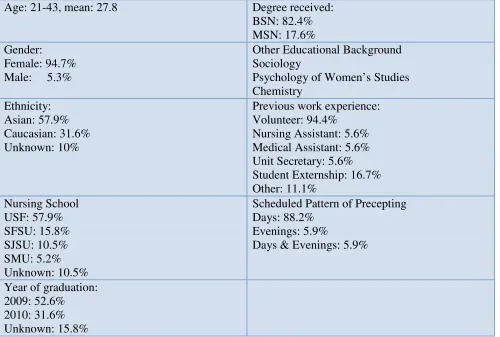
Demographics collected from the first CFGNES® in cohort 1 showed that (a)
participants’ mean age was 27.8; (b) 95% were female; and (c) 57.9% were Asian, 31.6% were
Caucasian, and 10.5% chose not to disclose their ethnicity. The majority of participants were
from the University of San Francisco (57.9%), followed by San Francisco State University
(15.8%), San Jose State University (10.5%), Samuel Merritt University (5.2%), and (10.5%)
unknown or not reported. The majority of participants graduated in 2009 (52.6%), in 2010
(31.6%), and (15.8%) reported unknown. Eighty-four percent were baccalaureate prepared
nurses and 18% were masters prepared. Other educational backgrounds included degrees in
sociology, psychology, women’s studies, and chemistry. Clinical placements for the RN
residents included ambulatory care clinics (71.4%) and school nurse setting (28.6%). For more
detailed demographic data see Table 1.
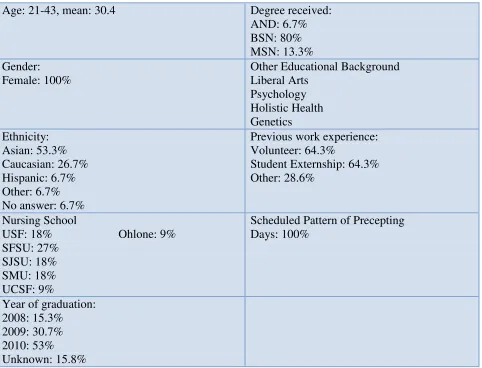
The second cohort mean age was 30.4 and 100% were female. Most of the residents
were Asian (53.3%), Caucasian (26.7%), Hispanic (6.7%), other (6.7%), and a few who did not
first cohort, 2009 (30.7%), and 2008 (15.3%). The majority of residents in the second group
were from a baccalaureate program (80%), masters program of nursing (13.3%), and 6.7% from
an associates program. The residents ranged in education from liberal arts, psychology, holistic
health, and genetics. Most of the residents were volunteers (64.3%) and from student
externships (64.3%). For more detailed demographic data see Table 2.
Skills
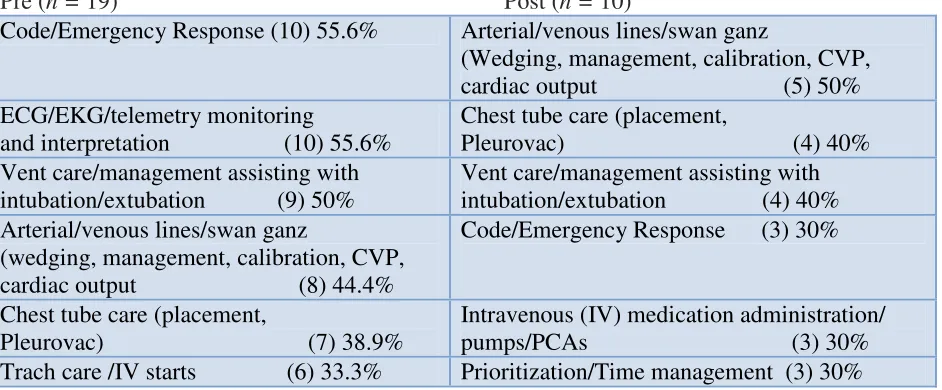
The residents were asked to identify the top three skills and procedures they felt
uncomfortable performing independently. The most uncomfortable skills/procedures identified
for the first cohort included codes and emergencies 55.6% in the pre-assessment, which then
decreased to 30% in the CFNGNES survey, even though codes were not practiced during the
program. Other skills that residents felt uncomfortable with included ECG/EKG, telemetry
monitoring and interpretation (55.6%), vent care and management (50%), and arterial line
management (44.4%), opposed to an acute care transition program or residency one (see Table
3).
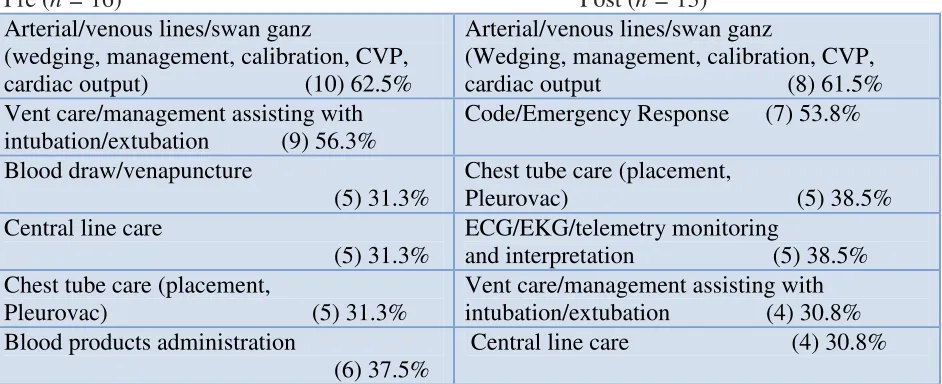
The second cohort felt that arterial and venous lines (62.5%) were at the top of their list
as skills that were uncomfortable, which still remained at the top as shown by scores in the
post-CFNGNES. Vent care was second (56.3%) and blood venapuncture was third (31.3%) for the
pre- CFNGNES. The post CFNGENS had code emergencies as second (53.8%) and chest tube
care (38.5%) for third (see Table 4).
Stressors
Respondents also completed a question regarding the most common stressor in their
lives. Pre data showed personal stress was caused by finances (84.6%) and living situation
common stressor among residents followed by their personal relationships (42.9%), which
increased from 7.7%. For the second cohort, finances (90.9%) and personal relationships and job
performances (36.4%) tied for the second most common stressors.
Role Transition
In response to nurses having difficulties with transitioning from student nurse to advance
beginning RN (first cohort), most experienced difficulties after the first week of starting the
program in lack of confidence (76.5%), fears (64.7%), orientation issues (64.7%), and role
expectations (35.5%). After completion of the program, difficulties in transition included role
expectations (60%), lack of confidence (50%), orientations issues (50%), and fears (30%). There
were consistencies among the categories; even though confidence and fears decreased, role
expectations increased. This may be due to reality; the residents were no longer students so it is
not surprising that the expectation of responsibility in the RN role would increase. Residents
also reported in pre-program data that they felt more satisfied in their work environment when
they had peer support (83.3%), ongoing learning (83.3%), patient and family support (55.6%),
and a positive work experience (55.6%). Post data from the CFNGNES survey showed lack of
confidence and role expectations remained high but patient and family support increased to 70%
after completion of the program.
The second cohort had difficulties in transitioning with lack of confidence (78.6%), role
expectations (57.1%), and fears (42.9%). For the post CFNGNES, lack of confidence decreased
(58.3%), role expectation increased slightly (58.3%), and fears as well (58.3%). Again, similar
to the first cohort, the changes in percentages may be due to the reality that the residents are no
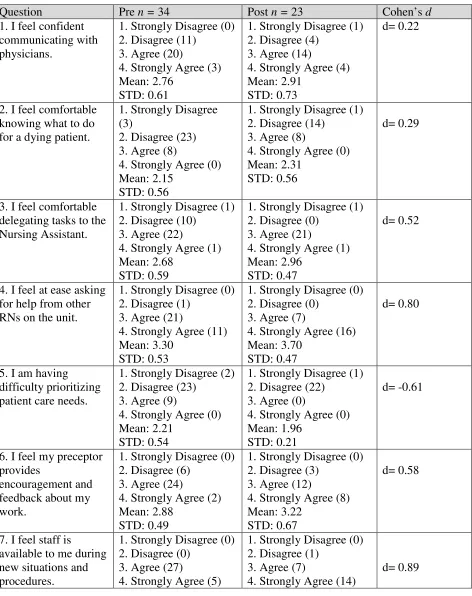
Results for the CFGNES individual questions were analyzed using Cohen’s d for the first
and second cohort using pre (n = 34) and post data (n = 20). After completion of the program,
residents felt at ease with asking help from other RNs, with a large difference from pre to post
with a Cohen’s d of 0.80. Residents also felt staff was available during a new situation or
outcome (Cohen’s d = 0.89). The residents felt very supported by the nurses at their preceptor
site with a large difference in pre and post data with a Cohen’s d of 1.07. Other questions in the
CFNGNES showed a small or medium difference. There was a difference in feeling comfortable
delegating tasks to nursing assistants (Cohen’s d = 0.52), feeling encouragement and feedback
from their preceptor (Cohen’s d = 0.58), feeling able to communicating with patients and their
family (Cohen’s d = 0.60), and feeling able to complete their work assignment on time (Cohen’s
d = 0.54). There were also good outcomes. For example, there was a reverse in answers to some
questions. There was a small decrease in feeling overwhelmed in the resident’s responsibilities
(Cohen’s d = -0.38). There was also a moderate inverse difference in residents having a difficult
time organizing care (Cohen’s d = -0.48) and a feeling of causing harm to patients (Cohen’s d =
-0.50). The Casey-Fink tool helped evaluate the experiences during a residency program before
and after the program. There were many significant differences in certain areas, but not on other
questions, which can help in making changes to the program in that particular area for future RN
transition programs. Since many participants had to leave the program once they found a job, the
post-program data are limited. For complete data analysis for the CFNGNES, see Table 5.
Competency
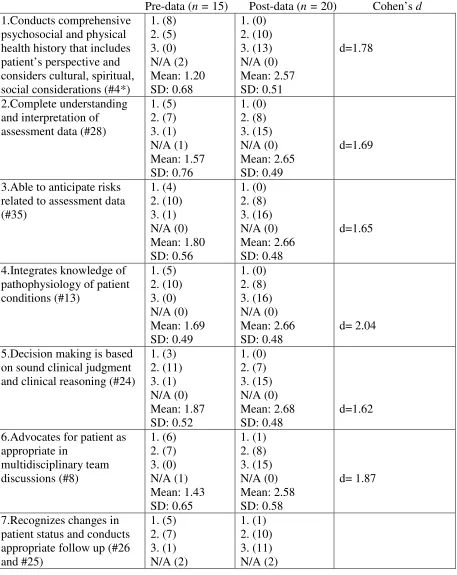
There were a total of 35 QSEN brief competency surveys completed by the preceptors;
34 answered the pre QSEN and 23 the post QSEN survey (both cohorts). The competencies
mentioned before. The data for the QSEN competency was analyzed using Cohen’s d to
determine program effectiveness by measuring the differences. In the category of
patient-centered care, all questions showed a significant difference with a Cohen’s d ranging from 1.32
to 2.04, meaning that many preceptors thought that many of the residents had evolved since the
beginning of the program. The highest difference seen by preceptors was that their residents
were able to integrate knowledge of pathophysiology of patient conditions (with a Cohen’s d of
2.04). Also, residents were able to advocate for patients in multidisciplinary discussions (with a
Cohen’s d of 1.887). For questions in regards to safety, Cohen’s d ranged from 0.20 to 1.80,
again making the results statistically significant, except for one regarding the use of equipment
using IV pumps (with a Cohen’s d of 0.20). Highest difference was seen with residents being
able to demonstrate safe practices at their site related to medication administration (with a
Cohen’s d of 1.80). Due to this being an ambulatory care program, questions that related to
acute care nursing skills did not show any difference. In the category for evidence-based
practice, the results also were medium to large significance with Cohen’s d of 0.73 to 1.03, with
a large difference seen in residents being able to use the library, intranet, and colleagues for
information (Cohen’s d = 1.03). Team and collaboration had the highest difference (Cohen’s d
of 1.46) for residents being receptive from others and not being defensive and being able to work
as part of the team. Professionalism was showed the highest significance with a Cohen’s d of
3.07) for residents being able to work autonomously and being accountable. Informatics was the
category in which no significant changes were found. Overall pre clinical competence was
significant with a Cohen’s d of 1.08. The QSEN evaluation also had the same problem with data
collection in that residents had to leave the program once they have received jobs, which does
Preceptorship Experience
As discussed earlier, the PES addressed the relation with the preceptor and was
completed at the end of the residency. Questions 1-12 addressed the importance of the
experience. A majority of both cohorts thought it was important to have one primary preceptor
(first cohort 66.7% with this response and second cohort with 44.4%; question 1). Both groups
were able to develop a trusting relationship with their preceptors (first cohort 91.7% and second
cohort 88.9%; question 5). For the second part of the survey, in addressing their own
competence, the residents determined how competent they felt with certain skills. In both
cohorts most residents felt moderately to very competent in identifying and assessing patient
health care needs (first cohort at 41.7% [moderate] and second cohort at 62.5% [very]; question
13). Both cohorts felt very competent with checking action and side effects of medications (first
cohort at 66.7% and second cohort at 62.5%; question 19). There were in some instances in
which the residents did not feel competent. For instance there was a wide range in the
competency of maintaining a parenteral intravenous infusion (first cohort not competent at 9.1%
and second cohort at 12.5% not competent as well not competent; question 27). The residents
also felt less competent in inserting a nasogastric tube (first cohort responded not competent at
9.1%, less competent at 45.5%, while the second cohort responded less competent at 37.5%,
competent at 62.5%; question 28). The residents scored not competent or less competent in skills
that are more common for acute care nursing. Because residents were in an ambulatory care
Section V: Evaluations
The RN residency program was developed to provide both a classroom and precepted
clinical experience to inexperienced nurses. This program aided current graduates in finding
jobs and provided a transition from student to RN. From both cohorts, 90% of our participants
were able to find employment in acute, non-acute, and school settings. The results of this
ambulatory RN transition program help add to the body of literature, since most residency
programs are focused in acute care settings. The results of this study were from a small number
of participants, but differed compared to other studies that were in a different geographic
location and setting. The length of the program was limiting due to funding as previously
mentioned.
There were similarities and differences with previous studies for the CFGNES®. Like
previous studies, most participants were female and were baccalaureate prepared (Williams,
Goode, Krsek, Bednash, & Lynn, 2007; Fink, Krugman, Casey, & Goode, 2008). However,
most residents in the ambulatory transition program were Asian, compared to Caucasian, which
can be due to the study’s geographic region. Most skills with which residents felt uncomfortable
were skills performed in acute care settings, which remained high after the residency due to the
type of residency. The stressors of the residents differed compared to other studies. In other
studies stressors were due to waiting for results of licensure, moving, and expectations of work
(Williams, Goode, Krsek, Bednash, & Lynn, 2007; Fink, Krugman, Casey, & Goode, 2008).
Residents from our program stated that finances and living situations were their stressors, which
can be due to the economic differences in the location and timeframe of the studies. Currently
graduate RNs are having a difficult time in finding jobs. Role transition difficulties in studies
orientation issues and fears (Williams, Goode, Krsek, Bednash, & Lynn, 2007; Fink, Krugman,
Casey, & Goode, 2008), which were similar to the residents in this pilot program.
At this time the data is still being collected from other study sites, so comparisons cannot
be analyzed at the present time. Analyses are still being done for the other measuring tools (PES
and brief QSEN). Once collection and analysis is complete, a thorough detailed report will be
published.
Section VI: Continuous Quality Improvement
The RN residency program has had changes since the beginning of the program start
date. From reviewing data from different study sites, the program director has decided to change
the surveys to electronic format in order to capture data quickly for different study sites. It is
recommended for all program coordinators involved to review all policies and data gathering
procedures for study sites and choose one way for sites to review and gather data. Once the
committee has approved all policies and procedures, then all coordinators will make changes at
all study sites. The plan, do, study, act/standardize, do, study, and act model (PDSA/SDSA) is a
more detailed outline of what the project looks like (see Appendix M & N). In order for this
project to continue, the PDSA/SDA method can be used to make changes to the program as it
continues to grow and change. Implementing a method of change in the program can aid in
assisting all sites in agreement instead of each site following different procedures for the
multi-site program.
For this RN transition program, the coordinators can utilize the PDSA/SDSA tool to
demonstrate how the project will function. The PDSA/SDSA tool will help in displaying the
team members and the functions of all team members. The tool also describes the measures that
show how the PDSA/SDSA cycle has affected the project as well as the ongoing cycle of trying
different strategies in reviewing best practices, evidence-based practice, review of the literature,
and best results from the project. A budget is still being analyzed for each individual program
and also for the entire program at all sites. By implementing this PDSA/SDSA model program,
coordinators can duplicate the process to start new programs for the future.
Section VII: Implications for Nursing
The aims of the RN transition program were accomplished for the participants in the
present study. The residents had an increase in confidence, remained in the RN profession, and
the majority were able to find RN positions. This program has helped change how RN graduates
can be introduced into the workforce. A transition program can help in many different areas that
have shortages and teach RN graduates other areas of nursing not taught in nursing schools.
Nursing schools mainly teach how to be acute care nurses unless a master’s degree or advanced
training is pursued. This program can help explore other transition programs for those interested
in a change in specialty, for example to school nursing, home health, hospice, and ambulatory
care. Since the results of this program show it to be successful, the University of San Francisco
plans to expand the program to home health and hospice once funding is secured. Currently
there has also been expansion in advanced practice.
Funding
Starting in January of 2012, the Santa Rosa Community health center will offer a nurse
practitioner (NP) residency program due to the shortage of primary care providers. This program
was made possible by a grant from the federal government, as part of the Affordable care Act of
2010, in an attempt to increase the nursing workforce (Verel, 2011). This NP residency program
increase competence and workforce, this can help the nursing profession in adapting residency
programs into the practice.
In addition, nurses should be made partners in health care along with other providers.
This includes in all types of settings such as schools and community health centers. With current
recommendations from the IOM, it is time that RNs and APRNs unite and help change
legislation impacting the future of nursing in addition as well as funding for the millions of
Americans who might have insurance by 2014 according to current national goals for healthcare
reform.
Lessons Learned
This was a program evaluation project. As with all programs, sometimes there are
aspects that should be modified. Due to the nature of the program goals, there was a high
attrition rate during the residency program since most acquired jobs during the program. With
that as a focus, it is key to put into place mechanisms that will allow for participants to complete
evaluation requirements even after employment as a professional nurse is secured. The transition
to practice residency program was conceptually different from previously implemented residency
programs that were implemented to address the nursing shortage. The cost and time related to
recruiting, orienting, and reducing turnover in the nursing workforce was the paramount concern.
The focus of this program was not on retention of nurses but on an intervention to keep new
graduates linked to the profession. The goal was not to keep them from leaving a job, but
increasing their employability by providing additional practice experience and opportunities to
develop competence in clinical decision-making, priority setting, and professionalism.
Traditional programs were 12 months, while this program was only 3 months. The residents
questions and lower amount of participant data. There were also no monetary benefits for the
residents and/or elective college credit earned by the resident. In the beginning of the program it
was very difficult to find preceptors, which showed the need to have trained preceptors ready to
participate at the start of any residency program.
Dissemination Plan
A manuscript is currently being written in the process of this project. The information
will be submitted to a peer-reviewed journal for publication. In addition, the material presented
will be submitted to a poster presentation for a conference next year. The project will also
continue, and data will continue to be gathered and be disseminated as well. The program has
extended also to Southern California.
Section VIII: Conclusion
Hospital emergency rooms are filled in part because clinics and community-based health
centers are not utilized to their full potential for management of chronic diseases and preventive
care, contributing to cost increases and poor patient and system outcomes (Rother &
Lavisso-Mourey, 2009). This is why chronically ill people continue to seek care in acute care settings.
In order for health care reform to work, models of care are being developed to promote increased
access, improved quality care, safety, and reduced costs for clinics and community-based health
centers (Rother & Lavisso-Mourey, 2009). These models in public health care systems can aid
in caring for those chronically ill patients by preventing costly admissions in acute care settings.
Community health centers provide high quality care for patients, provide care to millions of
Americans, and care for vulnerable populations (HealthCare, 2010). In 2011 there was $250
million to establish 350 new community health care centers. This money will help in expanding
help provide quality care to an additional 2.5 million people, and create jobs (HealthCare, 2010).
With the Affordable Care Act 2010, emphasis is being applied to community health care clinics
to provide primary care and prevention services for populations with health disparities. The
clinics will be able to provide comprehensive care, managed care, and have a team-based
approach for care (HealthCare, 2010). With expansion of new clinics, RNs will be needed in
community health care clinics. Currently RN programs do not focus on ambulatory care but
acute care. Expanding the nursing role to ambulatory care can help in increasing the work force
in clinics. Having an ambulatory care residency program can help add additional training to the
outpatient setting compared to traditional training such as acute care. According to the Institute
of Medicine (IOM) report, nurses should practice to their fullest capacity and achieve higher
education (IOM, 2010). Nurses can work in many settings such as schools, homes, retail clinics,
and community health care centers. Nurses have different educational backgrounds and
competency levels. The IOM recommends changes in nursing leadership and in expanding
nursing (IOM, 2010). The IOM recognizes that there are high levels of job turnover among
nurses. This study holds significance for transition programs and residency programs for nurses,
because they traditionally have been in acute care settings. The ambulatory RN transition
program was able to meet the goals. New RN graduates gained confidence, maintained their
skills, and 90% were able to find jobs, during or after completion. RN transition programs can
References
American Association of Colleges of Nursing. (2007). Despite Surge of interest in nursing
careers: New AACN Data confirm that too few nurses are entering the healthcare
workforce. Retrieved from www.aacn.nche.edu/Media/NewsReleases/2009
/workforcedata
Averill, R. F., Goldfield, N., Hughes, J. S., Bonazelli, J., McCullough, E. C., Steinbeck, B. A.,
Gay, J. (2003). All patient refined diagnosis related groups. Retrieved from
http://www.hcup-us.ahrq.gov/db/nation/nis/APR-DRGsV20MethodologyOverview
andBibliography.pdf
Beecroft, P. C., Kunzman, L., & Krozek, C. (2001). RN internship: Outcomes of a one-year pilot
program. Journal of Nursing Administration, 31(20), 575-582.
Benner, P. (1982). From novice to expert. American Journal of Nursing, 82(3), 402-407.
Benner, P. (2010). The Cambridge handbook of situated cognition. Nursing Philosophy, 11, 215.
doi: 10.1111/j.1466-769X.2010.00446.x
Bowles, C., & Candela, L. (2005). First job experiences of recent RN graduates: Improving the
work environment. Journal of Nursing Administration, 35(3), 130-137.
Buerhaus, P. I. (2008). Current and future state of the U.S. nursing workforce. Journal of
the American Medical Association, 300(20), 2422-2424.
Buerhaus, P. I., Auernach, D. I., & Staiger, D. O. (2007). Recent trends in the registered
nurse labor market in the U.S.: Short-run swings on top of long-term trends. Nursing
Economics, 25(2), 59-66. Retrieved from http://www.medscape.com/viewarticle/556417
Bureau of Labor Statistics. (2011). Registered nurses. Retrieved from
California Institute for Nursing and Health Care. (2010). 2009-2010 new graduate hiring
survey. Retrieved from
http://www.cinhc.org/wordpress/wp-content/uploads/2010/11/CINHC-Survey-Summary-of-findings-100310_v4.pdf
Dreyfus, S. E., & Dreyfus, H. L. (1980). A five-stage model of the mental activities involved in
the directed skill acquisition. Washington, DC: Storming Media.
Fink, R., Krugman, M., Casey, K., & Goode, C. (2008). The graduate nurse: Qualitative
residency program outcomes. Journal of Nursing Administration, 38(7), 341-348.
Halfer, D., & Graff, E. (2006). Graduate nurse perceptions of the work experience. Nursing
Economic$, 24(3), 150-155.
Hamilton, E. M., Murray, M. K., Linholm, L. H., & Myers, R. E. (1989). Effects of mentoring on
job satisfaction, leadership behaviors and job retention of new graduate nurses. Journal of
Nursing Staffing and Development, 5(2), 159-165.
Mathews, J. J., & Nunley, C. (1992). Rejuvenating orientation to increase nurse satisfaction and
retention. Journal of Nursing Staffing and Development, 8(4), 159-164.
Pine, R., & Tart, K. (2007). Return on investment: Benefits and challenges of a baccalaureate
nurse residency program. Nursing Economics, 25(1), 13-18.
PricewaterhouseCoopers’ Health Research Institute. (2007). What works: Healing the healthcare
staffing shortage. Retrieved from
http://pwchealth.com/cgi-local/hregister.cgi?link=reg/pubwhatworks.pdf
Rother, J., & Lavizzo-Mourey, R. (2009). Addressing the nursing workforce: A critical element
for health reform. Health Affairs, 28(2), w620-w624.doi:10.1377/hlthaff.28.4.w620
Verel, D. (2011). Santa Rosa health centers to start nurse practitioner residency program.
Williams, C. A., Goode, C. J., Krsek, C., Bednash, G. D., & Lynn, M. R. (2007).
Postbaccalaureate nurse residency: 1-year outcomes. Journal of Nursing Administration,
Appendix A: Appraise the Evidence
The first step to appraise the evidence is to summarize the evidence accumulated in your search. The evidence table below is designed to assist the reader in extracting the most important
information from each article needed to assess the reliability and validity of the results.
First Author Year ID
Study
Characteristics
Population Interventions Outcome
Results
Appendix B: IRB Approval
August 2, 2010
Dear Ms. Lens:
The Institutional Review Board for the Protection of Human Subjects (IRBPHS) at the University of San Francisco (USF) has reviewed your request for human subjects approval regarding your study.
Your application has been approved by the committee (IRBPHS #10-068). Please note the following:
1. Approval expires twelve (12) months from the dated noted above. At that time, if you are still in collecting data from human subjects, you must file a renewal application.
2. Any modifications to the research protocol or changes in instrumentation (including wording of items) must be communicated to the IRBPHS. Re-submission of an application may be required at that time.
3. Any adverse reactions or complications on the part of participants must be reported (in writing) to the IRBPHS within ten (10) working days.
If you have any questions, please contact the IRBPHS at (415) 422-6091.
On behalf of the IRBPHS committee, I wish you much success in your research.
Sincerely,
Terence Patterson, EdD, ABPP
Chair, Institutional Review Board for the Protection of Human Subjects ---
IRBPHS – University of San Francisco Counseling Psychology Department Education Building – Room 017 2130 Fulton Street
San Francisco, CA 94117-1080 (415) 422-6091 (Message) (415) 422-5528 (Fax) [email protected]
Appendix C: Casey-Fink Graduate Nurse Experience Survey (revised)
© 2006 University of Colorado Hospital. All rights reserved
I. List the top three skills/procedures you are uncomfortable performing independently at this time? (Please select from the drop down list) list is at the end of this Appendix.
1.
2.
3.
II. Please answer each of the following questions by placing a mark inside the circles:
STRONGLY
DISAGREE DISAGREE AGREE
STRONGLY AGREE
1. I feel confident communicating with physicians.
2. I am comfortable knowing what to
do for a dying patient.
3. I feel comfortable delegating tasks to
the Nursing Assistant.
4. I feel at ease asking for help from
other RNs on the unit.
5. I am having difficulty prioritizing
patient care needs.
6. I feel my preceptor provides encouragement and feedback about my work.
7. I feel staff is available to me during
new situations and procedures.
8. I feel overwhelmed by my patient
care responsibilities and workload.
9. I feel supported by the nurses on my unit.
10. I have opportunities to practice skills
and procedures more than once.
11. I feel comfortable communicating
STRONGLY
DISAGREE DISAGREE AGREE
STRONGLY AGREE
12.I am able to complete my
patient care assignment on time.
13.I feel the expectations of me in this job are realistic.
14.I feel prepared to complete my job responsibilities.
15.I feel comfortable making
suggestions for changes to the nursing plan of care.
16.I am having difficulty
organizing patient care needs.
17.I feel I may harm a patient due to my lack of knowledge and experience.
18.There are positive role models for me to observe on my unit.
19.My preceptor is helping me to develop confidence in my practice.
20.I am supported by my
family/friends.
21.I am satisfied with my chosen nursing specialty.
22.I feel my work is exciting and challenging.
23.I feel my manager provides encouragement and feedback about my work.
24.I am experiencing stress in my personal life.
25.If you chose agree or strongly agree, to #24, please indicate what is causing your stress. (You may circle more than once choice.)
a. NCLEX
b. Finances
c. Child care
d. Living situation
e. Personal relationships
f. Job performance
g. Graduate school
III. How satisfied are you with the following aspects of your job:
VERY DISSATISFIED
MODERATELY DISSATISFIED
NEITHER SATISFIED
NOR DISSATISFIED
MODERATELY SATISFIED
VERY SATISFIED
Salary
Vacation
Benefits package
Hours that you work
Weekends off per month
Your amount of
responsibility
Opportunitie s for career advancement
Amount of encourageme nt and feedback
Opportunity to work straight days
IV. Transition (please circle any or all that apply)
1. What difficulties, if any, are you currently experiencing with the transition from the "student" role to the "RN" role?
a. Role expectations (e.g. autonomy, more responsibility, being a preceptor or in charge) b. Lack of confidence (e.g. MD/PT communication skills, delegation, knowledge deficit, critical thinking)
c. Workload (e.g. organizing, prioritizing, feeling overwhelmed, ratios, patient acuity) d. Fears (e.g. patient safety)
e. Orientation issues (e.g. unit familiarization, learning technology, relationship with multiple preceptors, information overload)
2. What could be done to help you feel more supported or integrated into the unit?
a. Improved orientation (e.g. preceptor support and consistency, orientation extension, unit specific skills practice)
b. Increased support (e.g. manager, RN, and educator feedback and support, mentorship)
c. Unit socialization (e.g. being introduced to staff and MDs, opportunities for staff socialization)
d. Improved work environment (e.g. gradual ratio changes, more assistance from unlicensed personnel, involvement in schedule and committee work)
3. What aspects of your work environment are most satisfying?
a. Peer support (e.g. belonging, team approach, helpful and friendly staff)
b. Patients and families (e.g. making a difference, positive feedback, patient satisfaction, patient interaction)
c. Ongoing learning (e.g. preceptors, unit role models, mentorship)
d. Professional nursing role (e.g. challenge, benefits, fast pace, critical thinking, empowerment)
e. Positive work environment (e.g. good ratios, available resources, great facility, up-to- date technology)
4. What aspects of your work environment are least satisfying?
a. Nursing work environment (e.g. unrealistic ratios, tough schedule, futility of care) b. System (e.g. outdated facilities and equipment, small workspace, charting,
paperwork)
c. Interpersonal relationships (e.g.gossip, lack of recognition, lack of teamwork, politics) d. Orientation (inconsistent preceptors, lack of feedback)
V. Demographics: Circle the response that represents the most accurate description of your
individual professional profile.
1. Age: _______ years
2. Gender:
a. Female
b. Male
3. Ethnicity:
a. Caucasian (white)
b. Black
c. Hispanic
d. Asian
e. Other
f. I do not wish to include this information
4. Area of specialty:
a. Adult Medical/Surgical b. Adult Critical Care
c. OB/Post Partum
d. NICU
e. Pediatrics
f. Emergency Department
g. Oncology
h. Transplant i. Rehabilitation
j. OR/PACU
k. Psychiatry
l. Ambulatory Clinic
m. Other:
5. School of Nursing Attended (name, city, state located):
6. Date of Graduation:
7. Degree Received: AD: ________ Diploma: ________ BSN: ________ ND: ________
8. Other Non-Nursing Degree (if applicable):
9. Date of Hire (as a Graduate Nurse):
10.What previous health care work experience have you had:
a. Volunteer
c. Medical Assistant d. Unit Secretary
e. EMT
f. Student Externship
g. Other (please specify):
11.Have you functioned as a charge nurse?
a. Yes
b. No
12.Have you functioned as a preceptor?
a. Yes
b. No
13.What is your scheduled work pattern?
a. Straight days b. Straight evenings c. Straight nights
d. Rotating days/evenings e. Rotating days/nights f. Other (please specify):
14.How long was your unit orientation?
a. Still ongoing b. ≤ 8 weeks
c. 9 – 12 weeks
d. 13 – 16 weeks
e. 17 - 23 weeks f. ≥ 24 weeks
15.How many primary preceptors have you had during your orientation? _________ number of preceptors
Drop down list of skills
Arterial/venous lines/swan ganz (wedging, management, calibration, CVP, cardiac output) Assessment skills
Bladder catheter insertion/irrigation Blood draw/venipuncture
Blood product administration/transfusion
Central line care (dressing change, blood draws, discontinuing) Charting/documentation
Chest tube care (placement, pleurovac) Code/Emergency Response
Death/Dying/End-of-Life Care
Dobhoff/NG care/suctioning/placement
ECG/EKG/Telemetry monitoring and interpretation Intravenous (IV) medication administration/pumps/PCAs Intravenous (IV) starts
Medication administration MD communication
Patient/family communication and teaching Prioritization/Time Management
Trach care
Vent care/management/assisting with intubation/extubation Wound care/dressing change/wound vac
Appendix D: Brief QSEN Evaluation
New Graduate RN Transition Program Competency Assessment Tool: [School/Program Name]
Participant Name: _____________________________
Evaluator Name: _______________________________Date: ___________
Evaluation period: Initial Final
COMPETENCIES Beginning Developing
Accomp - lished
Not
Applic-able PATIENT CENTERED CARE
1. Conducts comprehensive psychosocial and
physical health history that includes patient’s perspective and considers cultural, spiritual, social considerations.
1 2 3 N/A
2. Complete understanding and interpretation of
assessment data. 1 2 3 N/A
3. Able to anticipate risks related to assessment
data. 1 2 3 N/A
4. Integrates knowledge of pathophysiology of
patient conditions. 1 2 3 N/A
5. Decision-making is based on sound clinical
judgment and clinical reasoning. 1 2 3 N/A
6. Advocates for patient as appropriate in
multidisciplinary team discussions. 1 2 3 N/A
7. Recognizes changes in patient status and
conducts appropriate follow up. 1 2 3 N/A
8. Prioritizes actions related to patient needs and
delegate’s actions if appropriate. 1 2 3 N/A
9. Establishes rapport with patients and family. 1 2 3 N/A
SAFETY
10. Demonstrates safe practices related to
medication administration including rights, verification of allergies, two patient identifiers, read-back process, and independent double checks for high alert medications.
1 2 3 N/A
11. Demonstrates the safe use of equipment
appropriate to setting such as IV set up, pumps. 1 2 3 N/A
12. Educates patient on safety practices when
starting and IV, using PCAs.
13. Communicates observations or concerns
related to hazards to patients, families and the health care team and uses the organizational reporting system for errors.
1 2 3 N/A
14. Applies basic principles and practices of sterile
asepsis while administering injections, placing urinary catheters, performing open wound care.
1 2 3 N/A
EVIDENCE BASED PRACTICE
15. Uses library, internet, and colleagues to
efficiently manage information. 1 2 3 N/A
16. Locates, critically reviews and applies
scientific evidence and medical literature. 1 2 3 N/A
17. Understands the principles of evidence based
practice and applies to pain management. 1 2 3 N/A
TEAMWORK AND COLLABORATION
18. Establishes rapport with patients and family. 1 2 3 N/A
19. Communicates with inter-professional team. 1 2 3 N/A
20. Asks questions to appropriate team member
when unsure about any aspect of care. 1 2 3 N/A
21. Is receptive to input from others, not becoming
defensive. 1 2 3 N/A
COMPETENCIES Beginning Developing
Accomp - lished
Not
Applic-able
22. Documents patient assessment data in complete
and timely fashion. 1 2 3 N/A
23. Able to interpret physician and
inter-professional orders. 1 2 3 N/A
24. Able to work as part of a team. 1 2 3 N/A
25. Uses appropriate language and tone when
resolving conflict. 1 2 3 N/A
PROFESSIONALISM
26. Able to keep track of multiple responsibilities
and complete tasks within expected time frames.
1 2 3 N/A
27. Recognizes and reports unsafe practice by self
and others. 1 2 3 N/A
28. Able to work autonomously and be accountable
29. Behavior is ethical & honest as judged by ANA
ethical principles. 1 2 3 N/A
30. Expresses importance and demonstrates habits
for life-long learning. 1 2 3 N/A
31. Complies with legal and regulatory
requirements relevant to nursing practice. 1 2 3 N/A
QUALITY
32. Evaluates and implements
systems-improvement based on clinical practice data. 1 2 3 N/A
33. Understands quality improvement
methodologies. 1 2 3 N/A
INFORMATICS
34. Navigates the electronic health record. 1 2 3 N/A
35. Utilizes clinical technologies (e.g. Smart
Pumps, monitors). 1 2 3 N/A
OVERALL CLINICAL COMPETENCE
[RATE] 1 2 3
Comments
Appendix E: California Institute for Nursing and Health Care
San Francisco Bay Area New Graduate RN Transition Program
Definition of RN Post-Grad Competency Levels
Beginning: Not yet effective in assessing, observing, recognizing patterns and deviations, or seeking information. Takes unfocused approach to organizing data, and requires assistance in diagnosing problems, planning interventions, and carrying out skills. Shows hesitance in communicating and responding to clinical scenarios.
Developing: Captures obvious patterns, makes attempt to monitor a variety of data, but overlooks some important information. Performs basic assessment and clinical skills, but still requires some guidance and direction. Shows solid foundation in leadership and communication abilities, though remains disorganized and hesitant in some aspects of clinical situations.
Accomplished: Effectively assesses, seeks information, recognizes patterns and deviations, and plans interventions. Displays confidence and leadership ability, communicates effectively, and requires guidance only in complicated cases. Demonstrates proficiency in most nursing skills, and requires minimal prompting in responding to clinical scenarios.