DEMOGRAPHIC RESEARCH
VOLUME 35, ARTICLE 20, PAGES 557
−
580
PUBLISHED 31 AUGUST 2016
http://www.demographic-research.org/Volumes/Vol35/20/ DOI: 10.4054/DemRes.2016.35.20
Research Article
Marriage of matching doors: Marital sorting on
parental background in China
Yang Hu
©2016 Yang Hu.
This open-access work is published under the terms of the Creative Commons Attribution NonCommercial License 2.0 Germany, which permits use, reproduction & distribution in any medium for non-commercial purposes, provided the original author(s) and source are given credit.
1 Introduction 558
2 Background 559
2.1 The tradition of marriage of matching doors 559
2.2 Marital sorting in contemporary China 560
2.3 The current study 562
3 Data and methods 563
3.1 Data 563
3.2 Sample 563
3.3 Measurement 564
3.4 Analytic strategy 566
4 Results 569
4.1 Absolute marital mobility rates 569
4.2 Log-linear models 573
5 Conclusions and discussion 575
Marriage of matching doors: Marital sorting on
parental background in China
Yang Hu1
Abstract
BACKGROUND
Who marries whom has important implications for the (re-)production of social inequalities. Whereas previous studies on marital sorting have mainly focused on the husband’s and the wife’s traits, in this research I assess the importance of parental background in marital sorting in contemporary China in light of the tradition of marriage of matching doors.
METHODS
Drawing on data from the 2006 China General Social Survey, I use log-linear models to explore the extent to which couples sort based on their parents’ occupational status and
hukou (household registration), and the interaction between the two.
RESULTS
The results show a significant association between the occupational status of an individual’s father and of his or her spouse, net of the intergenerational mobility between parents and children and the assortative mating between the husband and the wife. Furthermore, there is a significant net association between the occupational status of an individual’s father and father-in-law. Parents’ hukou status also plays a pivotal role in marital sorting, in that an individual’s father and father-in-law tend to have the same rural or urban hukou. Nevertheless, the interaction between the father’s occupational status and hukou is not found to play a significant role in shaping the pattern of marital sorting.
CONCLUSIONS
Given the persistence of the tradition of marriage of matching doors, it is important to conceptualize marriage in contemporary China as a family affair, rather than a de-institutionalized, privatized, or individualized practice.
1. Introduction
Who marries whom has important implications for the production and reproduction of social inequalities (Becker 1973). The study of marital sorting by parental background in particular has important implications for a number of questions that have long interested scholars: namely, whether and, if so, how marriage serves as a key mechanism of social mobility, and the extent to which ascribed traits determine an individual’s social outcomes. These questions may be especially relevant in China, where ‘marriage of matching doors’ (men dang hu dui), i.e., marriage between families rather than individualsof equal social standing, is considered to be a traditional tenet of spouse selection (Croll 1981; Xu and Whyte 1990). Moreover, it was widely believed that the practice of matching doors tends to enhance a couple’s marital satisfaction and well-being (Lu 2009). Nevertheless, against the backdrop of the societal “individualization” (Yan 2009), “de-institutionalization” (Cherlin 2004), and “privatization” (Davis 2014) of marriage, recent research on assortative mating has increasingly focused on the traits of the husband and the wife, rather than those of their respective families (Han 2010; Kalmijn 1991; Qian and Qian 2014; Xu, Ji, and Tung 2000). Less attention has been paid to the role played by the partners’ parental backgrounds in configuring the pattern of marital sorting (for recent exceptions, see Charles, Hurst, and Killewald 2013; Ermisch, Francesconi, and Siedler 2006), particularly in supposedly individualized contexts.
Although it was traditionally believed that parental background can determine an individual’s marital mobility in China, the issue of whether this has continued to be the case in the contemporary era remains an open empirical question. Following the founding of the People’s Republic of China (PRC) in 1949,2 the country’s socialist regime and left-wing revolutions forcefully attacked the feudal and imperial social hierarchies that undergirded privileges associated with family background (Wu and Treiman 2007; Xu and Whyte 1990). Scholars such as Yan (2009) also reported a trend toward individualization in Chinese society. However, there is evidence supporting the persistence of traditional values pertaining to marriage, patrilineality, and intergenerational relations (Hu and Scott 2016; To 2013). The reinstatement of China’s
hukou household registration systemin 1951 by the Chinese Communist Party (CCP)
added a new dimension to the complexity of marital sorting in China (Li, Han, and Zhao 2010). Against the backdrop of these dramatic social changes and the inconsistent existing evidence, I am motivated in this research by the need to empirically describe
2 The People’s Republic of China (PRC) is a socialist regime founded in 1949 under the administration of the
the pattern of marital mobility and to assess the salience of marital sorting by parental background in contemporary China.
Drawing on data from the 2006 China General Social Survey − the only nationally representative dataset containing information on both spouses and their parentsat the time of first marriage3 – I focus on the roles played by occupational status and hukou in the practice of marriage of matching doors in contemporary China. Log-linear models are used to examine the extent to which husbands and wives sort based on their parents’ occupational status and hukou, as well as the interaction between the two.
2. Background
2.1 The tradition of marriage of matching doors
Marriage of matching doors has long been a common marital practice in China. In the feudal and imperial eras, when marriage was largely a familial arrangement rather than the result of an individual choice, marriage was intended to represent a balanced “mutual exchange of ritual obligations and material wealth” between two families, which is inferred and recognized by the wider public through visible signs such as occupational status and the presentation of a dowry (Mann 2011: 57). In many respects, the tradition of marriage of matching doors resembled the prevailing assortative mating in Western societies, which has been extensively discussed in previous research (e.g., Becker 1973; Fernandez and Rogerson 2001; Kalmijn 1991; Qian and Qian 2014): It sanctioned marriage between two parties of equal social standing, which in turn served to reinforce preexisting social hierarchies. However, the practice of marriage of matching doors also had unique characteristics derived from Chinese traditions. In this section, I will focus on the distinctive features of marriage of matching doors, and their implications for this research.
The first feature of marriage of matching doors is the involvement of the couples’ parents and extended families in the process of marital sorting. This process is vividly represented by the concept of ‘doors’ symbolizing clans of extended families. Based on a foundation of close kinship ties and patrilineal traditions, Chinese parents and extended families played active roles in the spouse selection and marriage of their adult children (Croll 1981) − from arranging matchmaking events to explicitly stating their preferences regarding their potential son- or daughter-in-law (Mann 2011; Xu and Whyte 1990; Xu, Ji, and Tung 2000). As it was traditionally believed that a marriage of matching doors was happier, more stable, and longer-lasting than heterogamy (Lu
2009), the Chinese parents who followed this practice tended to select a mate whose parents matched their own social status. At the same time, an individual’s parental background may limit the scope of his or her education, work, and socialization experiences; thus, an adult child’s opportunities to meet potential spouses may be restricted to these contexts.
The second prominent feature of marriage of matching doors lies in its social visibility. As a key component of social exchange is its legitimization in the marketplace (Homans 1958), a marriage of matching doors was not only based on the implicit logic of marital sorting; it was also a form of explicit display in the social milieu in which the marriage would be blessed and recognized by relatives and acquaintances (Croll 1981). It was traditionally seen as essential that the ‘matching doors’ be made as explicitly visible as possible. Scholars who have studied marital sorting in Western societies have tended to focus on factors such as income, wealth, and human capital (e.g., Becker 1973; Charles, Hurst, and Killewald 2013; Kalmijn 1991). However, given the importance of visible display in marriage of matching doors, I focus on parental occupation as a clear and comprehensive indicator of an individual’s social, economic, and cultural standing in the Chinese context (Bian 2002; Mann 2011).
2.2 Marital sorting in contemporary China
While acknowledging the baseline tradition of marriage of matching doors in feudal and imperial China, there has been an ongoing debate among scholars about whether and, if so, how the social changes that have taken place in China under the regime of the PRC have changed Chinese families in general, and traditional marital practices in particular. In an effort to uphold the ideal of egalitarianism, the country’s socialist revolutions attacked privileges associated with family background (Johnson 1985). The Cultural Revolution, a left-wing socialist movement that dominated the country between 1966 and 1976, further advanced such socialist ideals, valorizing individual choice in spouse selection (zi you lian ai) (Yan 2009). The 1950 Marriage Law rejected arranged marriages and promulgated instead the ideal of a ‘love marriage.’ Under the law, men and women were granted equal rights to individual autonomy over marriage and divorce (Davis 2014; Xu and Whyte 1990).4 Following China’s economic reforms in the late 1970s and the early 1980s, the CCP no longer enforced the socialist ideal of egalitarianism, but instead focused on building a market-oriented economy. This shift led to a renewed emphasis on socioeconomic status in the marriage market.
Against the backdrop of these dramatic social changes in China, scholars such as Davis (2014) and Yan (2009), drawing mainly on qualitative evidence, have argued that
the institution of marriage has become increasingly “privatized” and “individualized” in China and that individuals’ marital decisions may have lifted anchor from the traditional mooring of marriage of matching doors. There is, however, mounting evidence that the Chinese family has been resilient to social changes. Chow and Chen (1994), for example, found that Chinese women turned to the marriage market and the domestic sphere to seek social mobility after the 1978 economic reforms. Hu and Scott (2016) and To (2013) also found that values pertaining to marriage and intergenerational relations have remained largely traditional across distinct generations since the establishment of the PRC.
Furthermore, China’s hukou household registration system, which was first established in the feudal era and was disrupted during the first half of the 20th century, was reinstated by the CCP in 1951 (Chan and Zhang 1999). The hukou system provides individuals with access to welfare benefits, such as education, health care, and unemployment subsidies. Under this system, individuals are assigned either a rural or an urban status. As socioeconomic development is much more advanced and social resources are much more abundant in urban than in rural China, having an urban hukou
carries a higher symbolic status than having a rural hukou (Chan and Zhang 1999). Because having a rural hukou had blocked rural residents’ mobility up the urban chain until these restrictions were relaxed in the 1980s, it also limited individuals’ opportunities to meet and marry across the rural–urban divide. As a result, Li, Han, and Zhao (2010) noted that inter-hukou marriage was rare, and identified a pattern of hukou
homogamy whereby men and women tend to marry within their own rural or urban
hukou category. Although the ban on rural-to-urban migration was lifted in the 1980s
(Hu 2016), the socioeconomic and the symbolic distinctions between having a rural or an urban hukou persist up to today. This is vividly reflected in urban families’ reluctance to marry ‘downward’ into rural families (Li, Han, and Zhao 2010). As adult children and their parents usually share a hukou before marriage, the parents’ hukou, in addition to their occupations,may provide a crucial point of reference in perceptions of whether the ‘doors’ of the families of the partners match. Moreover, the effects of occupational status and hukou on marital sorting may not operate independently. Indeed, it has been reported in a number of qualitative studies that hukou closely intersects with occupational status in determining an individual’s social standing, particularly in urban areas (e.g., Chen and Hoy 2011; Wang and Fan 2012). Therefore, it is important to consider the possibility that the parents’ occupational status and hukou
2.3 The current study
Given the social changes China has undergone in recent decades, the salience of marriage of matching doors cannot be taken for granted in the contemporary era. New contingencies imposed by hukou also add to the complexity of marital sorting under the regime of the PRC. A main objective of this research is therefore to provide an empirical assessment of the extent to which couples in contemporary China sort based on their parents’ occupational status and hukou. If the tradition of marriage of matching doors indeed persists, we would expect to observe that an individual’s parental background (i.e., occupational status, hukou, and the interaction between the two) would play a significant role in determining the occupational status of his or her spouse (H1), net of the assortative mating between the husband and wife and the intergenerational mobility between parents and children:
H1a: There is a net association between the occupational status of an individual’s parents and of his or her spouse.
H1b: There is a net association between the hukou of an individual’s parents and the occupational status of his or her spouse.
H1c: There is a significant interaction between occupational status and hukou of an individual’s parentsin determining the occupational status of his or her spouse.
Moreover, based on the preceding discussions of marriage of matching doors, we would expect to observe a further net association between the backgrounds of an individual’s parents and parents-in-law (H2):
H2a: There is a net association between the occupational status of an individual’s parents and parents-in-law.
H2b: There is a net association between the hukou of an individual’s parents and parents-in-law.
3. Data and methods
3.1 Data
This research draws on data from the 2006 China General Social Survey (CGSS).5 Although there are more up-to-date waves of the CGSS available, the 2006 wave is the only dataset that contains information on both spouses and their parents at the time of first marriage. Given the rapid changes in the Chinese labor market and the potential impact of marriage on individuals’ occupational and hukou mobility, it is important that we examine couples’ occupational status and hukou at the time of marriage.
Led by China Renmin University and the Hong Kong University of Science and Technology, the CGSS is one of the largest-scale national social surveys in China. In the 2006 CGSS, multi-stage stratified probability-proportional-to-size sampling was used to survey 10,151 individuals randomly selected from each household from 500 street areas in 125 cities and towns across China. The general response rate to the 2006 CGSS was 51.1%. The survey had a wide geographic coverage, ranging from major cities to remote villages, and from the eastern coast to the western hinterland.
3.2 Sample
For the analytical sample, I first exclude respondents who have never been married, are not in a first marriage, or were first married before 1951 (step 1: N = 8,193(10,151– 1,958)). I then eliminate respondents with missing information on their own or their spouse’s occupational status, or on their parents’ or parents-in-law’s occupational status
or hukou at the time of marriage (step 2: N = 7,339(8,193–854)). Correlation analysis
and t-test show that the cases eliminated at step 2 tend to be slightly older rather than younger (r = .06; t = 5.49, p < .001). This means that the analytical sample slightly underrepresents the older population. If previous research is correct in asserting that recent generations are more “individualized” than their predecessors (Yan 2009), then the results may underestimate the strength of the tradition of marriage of matching doors in contemporary China. Finally, I exclude respondents who reported an inactive occupational status (e.g., unemployed) at the time of first marriage for themselves, their spouse, their parents, or their parents-in-law (step 3: N = 6,831 (7,339–508)).6 The
5 See http://www.chinagss.org for more information.
6 Although some of the cases deleted at step 2 and at step 3 provided valid information on the occupational
respondents reporting inactivity on the occupational measures tend to be women (χ2
= 5.59, p < .05) or members of the older cohorts (r = .05; t = 4.43, p < .001), which may lead to an underestimation of the strength of marriage of matching doors. The final analytical sample contains 6,831 randomly selected individuals (Mage = 45, SD = 12),
one from each household, who entered a first marriage after the reinstatement of hukou
in 1951 (Myear-married = 1985, SD = 12) and who provided valid information on their
own, their spouse’s, their parents’, and their parents-in-law’s occupational status as well as on their parents’ and parents-in-law’s hukou status at the time of marriage. A dataset containing 6,831 couple dyads is constructed based on this sample.
3.3 Measurement
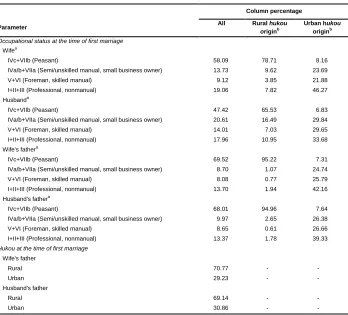
Table 1 presents the descriptive statistics of the key variables. Following previous research on marital and social mobility (Wu and Treiman 2007; Xu, Ji, and Tung 2000), I have chosen to focus on occupational status and hukou as the key (visible) indicators of the socioeconomic and symbolic standing (i.e., doors) of individuals and families in contemporary China. The 2006 CGSS asked the questions: “What was your (alternatively, your spouse’s/father’s/father-in-law’s) occupation (alternatively, hukou
status) at the time of marriage?” Although Beller (2009) urges scholars to include mothers’ occupation in social mobility research, the 2006 CGSS did not collect information on the occupation of the mother and the mother-in-law at the time of marriage. Nevertheless, as patrilineality is key to the tradition of marriage of matching doors, it is appropriate to focus on the father’s occupational status. It is, however, worth noting that the omission of the mother’s occupation usually leads to an underestimation of the strength of intergenerational occupational mobility (Beller 2009).
Table 1: Sample characteristics (N = 6,831)
Column percentage
Parameter All Rural hukou originb
Urban hukou originb
Occupational status at the time of first marriage
Wifea
IVc+VIIb (Peasant) 58.09 78.71 8.16
IVa/b+VIIa (Semi/unskilled manual, small business owner) 13.73 9.62 23.69
V+VI (Foreman, skilled manual) 9.12 3.85 21.88
I+II+III (Professional, nonmanual) 19.06 7.82 46.27
Husbanda
IVc+VIIb (Peasant) 47.42 65.53 6.83
IVa/b+VIIa (Semi/unskilled manual, small business owner) 20.61 16.49 29.84
V+VI (Foreman, skilled manual) 14.01 7.03 29.65
I+II+III (Professional, nonmanual) 17.96 10.95 33.68
Wife's fathera
IVc+VIIb (Peasant) 69.52 95.22 7.31
IVa/b+VIIa (Semi/unskilled manual, small business owner) 8.70 1.07 24.74
V+VI (Foreman, skilled manual) 8.08 0.77 25.79
I+II+III (Professional, nonmanual) 13.70 1.94 42.16
Husband's fathera
IVc+VIIb (Peasant) 68.01 94.96 7.64
IVa/b+VIIa (Semi/unskilled manual, small business owner) 9.97 2.65 26.38
V+VI (Foreman, skilled manual) 8.65 0.61 26.66
I+II+III (Professional, nonmanual) 13.37 1.78 39.33
Hukou at the time of first marriage
Wife's father
Rural 70.77 - -
Urban 29.23 - -
Husband's father
Rural 69.14 - -
Urban 30.86 - -
Note: a Difference between rural and urban hukou origin is significant at the 1% level, two-tailed tests. b For the wife and the wife’s
father, hukou origin refers to wife’s father’s hukou. For the husband and the husband’s father, hukou origin refers to the
husband’s father’s hukou. Column percentages may not add up to 100% due to rounding.
considerations, I further combine the six EGP categories into the following four categories based on the proximity of occupational categories reported by Wu and Treiman (2007):7
(1) Peasant (VIIb, IVc);
(2) Semi/unskilled manual worker or small business owner (VIIa, IVa, IVb);
(3) Foreman/skilled manual worker (V, VI);
(4) Professional/managerial class or routine nonmanual worker (I, II, III).
I include the hukou of the individual’s father and father-in-law at the time of marriage, distinguishing between rural and urban types. I do not include the husband’s and the wife’s hukou at the time of marriage for two major reasons. First, an individual who has never been married usually has the same type of hukou as his or her father (Chan and Zhang 1999; Li, Han, and Zhao 2010). Second, premarital change in an individual’s hukou status is usually related to his or her occupational mobility (Hu 2016; Wu and Treiman 2007), which may have already been captured by the individual’s occupational status. It is clear from Table 1 that the distribution of occupational categories differs significantly depending on the father’s hukou status.
3.4 Analytic strategy
I utilize log-linear models to examine the associations between the husband’s, the wife’s, the husband’s father’s and the wife’s father’s occupational status, as well as the
hukou status of both spouses’ fathers at the time of marriage. Figure 1 below illustrates
the modeling strategies. The equation for the baseline model is also specified below, in which log Fijklmnis the predicted frequency count for cell ijklmn and λ is the grand mean
cell count.8 As depicted in Figure 1 (Panel A), the baseline model includes the main effects of all variables (λHocc
i, λWoccj, λHFocck, λWFoccl, λHFhukoum and λWFhukoun), the
occupational assortative mating between the husband and his wife (λHocc-Woccij) and the
intergenerational occupational mobility between the husband and his father (λ
Hocc-HFocc
ik), and the intergenerational occupational mobility between the wife and her father
(λWocc-WFoccjl). Based on the research of Wu and Treiman (2007), the baseline model also
7 In their research, Wu and Treiman (2007) used sorted logistic regression models to produce a scale rank of
the EGP occupational status as follows: professional and manager (I, II): .45; routine non-manual worker (III): .33; foremen and skilled manual worker (V, VI): .13; semi- and unskilled manual worker (VIIa): .069; small business owner (IVa, IVb): –.20; peasant (IVa, VIIb): –.79. The sampling strategy for the data Wu and Treiman used in their analysis is similar to that of the 2006 CGSS.
8
assumes that the father’s hukou is associated with his own (λHFocc-HFhukoukm and λ WFocc-WFhukou
ln) and his adult children’s occupational status (λHocc-HFhukouim and λWocc-WFhukoujn),
respectively. As the associations in the baseline model are not the primary focus of this research, I apply the full interaction (FI) specification to all baseline associations.
log Fijklmn = λ + λHocci + λWoccj + λHFocck + λWFoccl + λHFhukoum + λWFhukoun +
λHocc-Wocc
ij + λHocc-HFoccik + λWocc-WFoccjl + λHFocc-HFhukoukm +
λWFocc-WFhukou
ln + λHocc-HFhukouim + λWocc-WFhukoujn
As shown in Panel B of Figure 1, I first test Hypothesis 1a by examining whether there is an association between the occupational status of an individual’s father and of his or her spouse, net of all baseline associations. I then test Hypothesis 1b regarding the net association between the hukou of an individual’s father and the occupational status of an individual’s spouse, above and beyond the occupational status of his or her father (Panel C). Furthermore, I test Hypothesis 1c by examining whether the occupational status and hukou of an individual’s father interact with each other in determining the occupational status of an individual’s spouse (Panel D).
Next, as depicted in Panel E, I test Hypothesis 2a regarding the net association between the occupational status of an individual’s father and his or her father-in-law, net of all associations depicted in Panel C. Please note that the interaction terms between the father’s occupational status and hukou depictedin Panel Dare not included in Panel E because the interactions are not statistically significant according to preliminary tests. As delineated in Panel F, I then include the association between the
hukou of an individual’s father and his or her father-in-law in order to test Hypothesis
2b. Finally, I test Hypothesis 2c regarding the interaction between occupational status
and hukou in the association between the backgrounds of an individual’s father and his
or her father-in-law (Panel G).
Table 2: Parameters for occupational crossings model
Occupational status of the husband/the husband’s father Occupational status of the wife/the wife’s father IVc+VIIb IVa/b+VIIa V+VI I+II+III
IVc+VIIb (peasant) 1 λ1 λ1 + λ2 λ1 + λ2 + λ3
IVa/b+VIIa (semi/unskilled manual, small business owner) λ1 1 λ2 λ2 + λ3
V+VI (foreman, skilled manual) λ2 + λ3 λ2 1 λ3
I+II+III (professional, nonmanual) λ1 + λ2 + λ3 λ1 + λ2 λ3 1
Figure 1: Illustration of modeling strategies and hypotheses
Note: HF = Husband’s father, WF = Wife’s father, H = Husband, W = Wife, occ = occupation. Red dashed arrow-headed lines
indicate additional tests that build on the preceding models. All models include the main effects of all six variables to net out any difference in the marginal distribution of each variable.
For the associations in occupational status depicted in Panels B and G, I test four model specifications to find a conceptually plausible and statistically parsimonious solution to explain the observed data in the contingency table. First, I assume full interaction (FI) for the associations. Second, in line with previous research on assortative mating (Xu, Ji, and Tung 2000), the occupational homogamy specification limits the associations to the diagonal cells of the contingency table. Third, because Chow and Chen (1994) found that Chinese women actively seek upward social mobility in the marriage market in contemporary China, the female occupational hypergamy specification limits the associations to the cells in the contingency tables in which (a) the husband had a higher occupational status than his wife’s father, (b) the wife had a lower occupational status than her husband’s father, and (c) the wife’s father had a lower occupational status than the husband’s father at the time of marriage. Finally, as Table 2 shows, the odds of marriage across distinct occupational status categories may depend on how many levels of difference an individual crosses (Qian and Qian 2014). As it may be less difficult for individuals to marry a partner in an adjacent occupational status category than across two or more categories, the occupational crossings specification assumes that the odds of an individual crossing each (additional) occupational barrier in the contingency table differ (see Qian and Qian [2014] for further information on the crossings model).
4. Results
4.1 Absolute marital mobility rates
The upper panel of Figure 2 shows that the total mobility rates for men (24.7%) and women (25.2%) with a peasant father are substantially lower than those of people with a father who had a nonagricultural occupation (> 40%), if the father had a rural rather than an urban hukou at the time of marriage. Among the individuals with a father who had a rural hukou, the men had considerably lower upward mobility rates and higher downward mobility rates than the women (upper panel of Figure 2). However, the gender gaps were less stark for individuals with a father who had an urban hukou
(lower panel of Figure 2). It therefore appears that among Chinese men, having a father with a rural hukou hinders both their marital and their occupational upward mobility (Wu and Treiman 2007). This is not surprising, as compared to having an urban hukou,
having a rural hukou is associated with a lack of socioeconomic resources, limited access to social welfare benefits, and low symbolic status. Moreover, because rural residents had been strictly prohibited by the hukou policy from moving up the urban chain before these restrictions were relaxed in the 1980s (Chan and Zhang 1999), having a rural hukou also limited the opportunities of rural residents to meet a partner who (or whose father) worked in a nonagricultural sector. Indeed, the results show that among 87.3% of the respondents, their father and father-in-law had the same type of rural or urban hukou at the time of marriage. Furthermore, the observation that rural
hukou-origin women have higher upward mobility rates than rural hukou-origin men
concurs with the findings of Chow and Chen (1994) that Chinese women actively seek upward social mobility in the marriage market in the cotemporary era.
Figure 2: Marital mobility rates of men and women by the father’s occupational status and hukou
Note: For men, F = Husband’s father; for women, F = Wife’s father. IVc+VIIb = Peasant; IVa/b+VIIa = Semi/unskilled manual, small
business owner; V+VI = Foreman, skilled manual; I+II+III = Professional, nonmanual. Calculation based on the husband’s
Figure 3: Outflow rates of men and women to spouses by the father’s occupational status and hukou
(A) Men (father rural hukou) (B) Men (father urban hukou)
(C) Women (father rural hukou) (D) Women (father urban hukou)
Note: WF = Wife’s father, HF = Husband’s father, H = Husband, W = Wife. IVc+VIIb = Peasant; IVa/b+VIIa = Semi/unskilled manual,
small business owner; V+VI = Foreman, skilled manual; I+II+III = Professional, nonmanual.
0 20 40 60 80 100
HF=I+II+III HF=V+VI HF=IVa/b+VIIa HF=IVc+VIIb HF=I+II+III HF=V+VI HF=IVa/b+VIIa HF=IVc+VIIb HF=I+II+III HF=V+VI HF=IVa/b+VIIa HF=IVc+VIIb HF=I+II+III HF=V+VI HF=IVa/b+VIIa HF=IVc+VIIb H = I+ II+ III H = V+ VI H = IV a /b + V II a H = IV c + V IIb
W=IVc+VIIb W=IVa/b+VIIa W=V+VI W=I+II+III
0 20 40 60 80 100
HF=I+II+III HF=V+VI HF=IVa/b+VIIa HF=IVc+VIIb HF=I+II+III HF=V+VI HF=IVa/b+VIIa HF=IVc+VIIb HF=I+II+III HF=V+VI HF=IVa/b+VIIa HF=IVc+VIIb HF=I+II+III HF=V+VI HF=IVa/b+VIIa HF=IVc+VIIb H = I+ II+ III H = V+ VI H = IV a /b + V II a H = IV c + V IIb
W=IVc+VIIb W=IVa/b+VIIa W=V+VI W=I+II+III
0 20 40 60 80 100
WF=I+II+III WF=V+VI WF=IVa/b+VIIa WF=IVc+VIIb WF=I+II+III WF=V+VI WF=IVa/b+VIIa WF=IVc+VIIb WF=I+II+III WF=V+VI WF=IVa/b+VIIa WF=IVc+VIIb WF=I+II+III WF=V+VI WF=IVa/b+VIIa WF=IVc+VIIb W = I+ II+ II I W= V +V I W = IV a /b + V IIa W = IV c + V IIb
H=IVc+VIIb H=IVa/b+VIIa H=V+VI H=I+II+III
0 20 40 60 80 100
WF=I+II+III WF=V+VI WF=IVa/b+VIIa WF=IVc+VIIb WF=I+II+III WF=V+VI WF=IVa/b+VIIa WF=IVc+VIIb WF=I+II+III WF=V+VI WF=IVa/b+VIIa WF=IVc+VIIb WF=I+II+III WF=V+VI WF=IVa/b+VIIa WF=IVc+VIIb W = I+ II+ II I W= V +V I W = IV a /b + V IIa W = IV c + V IIb
4.2 Log-linear models
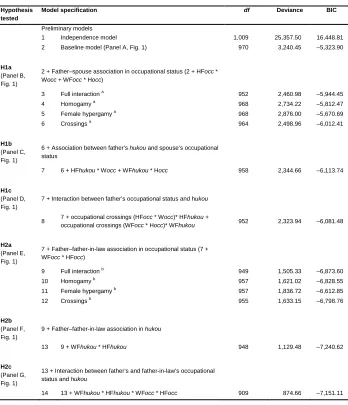
Table 3 presents the model fit indices − the deviance and the Bayesian Information Criterion (BIC) statistics − from the log-linear models that examine the patterns of marital sorting based on paternal occupation and hukou. Model selection is a key component of log-linear models. The goal of model selection is to find the most parsimonious model with the lowest degree of deviance from the observed pattern in the data. In this context, a smaller deviance statistic and a smaller (i.e., more negative) BIC statistic indicate a better fitting model.
Model 1 is an independence model that includes only the marginal distributions of the occupational status of the wife, the wife’s father, the husband, and the husband’s father, as well as the hukou status of the wife’s father and the husband’s father, assuming there is no association between these variables. With a deviance of 25,357.50 and a BIC of 16,448.81, the model fits poorly with the data. Building on Model 1, Model 2 includes the occupational assortative mating between the husband and wife, the intergenerational occupational mobility between the husband and his father and between the wife and her father, and the associations between the father’s hukou and his own and his adult children’s occupational status. As may be expected, the inclusion of these associations significantly increases the model fit, reducing the deviance to 3,240.45 and the BIC to −5,323.90.
Table 3: Fit statistics for log-linear models (N = 6,831)
Hypothesis tested
Model specification df Deviance BIC
Preliminary models
1 Independence model 1,009 25,357.50 16,448.81
2 Baseline model (Panel A, Fig. 1) 970 3,240.45 –5,323.90
H1a
(Panel B, Fig. 1)
2 + Father–spouse association in occupational status (2 + HFocc *
Wocc + WFocc * Hocc)
3 Full interaction a 952 2,460.98 –5,944.45
4 Homogamy a 968 2,734.22 –5,812.47
5 Female hypergamy a 968 2,876.00 –5,670.69
6 Crossings a 964 2,498.96 –6,012.41
H1b
(Panel C, Fig. 1)
6 + Association between father’s hukou and spouse’s occupational
status
7 6 + HFhukou * Wocc + WFhukou * Hocc 958 2,344.66 –6,113.74
H1c
(Panel D, Fig. 1)
7 +Interaction between father’s occupational status and hukou
8 7 + occupational crossings (HFocc * Wocc)* HFhukou +
occupational crossings (WFocc * Hocc)* WFhukou 952 2,323.94 –6,081.48
H2a
(Panel E, Fig. 1)
7 + Father–father-in-law association in occupational status (7 +
WFocc * HFocc)
9 Full interaction b 949 1,505.33 –6,873.60
10 Homogamy b 957 1,621.02 –6,828.55
11 Female hypergamy b 957 1,836.72 –6,612.85
12 Crossings b 955 1,633.15 –6,798.76
H2b
(Panel F, Fig. 1)
9 + Father–father-in-law association in hukou
13 9 + WFhukou * HFhukou 948 1,129.48 –7,240.62
H2c
(Panel G, Fig. 1)
13 + Interaction betweenfather’s and father-in-law’s occupational
status and hukou
14 13 + WFhukou * HFhukou * WFocc * HFocc 909 874.66 –7,151.11
Note: a Model specification for the association between the occupational status of an individual’s father and spouse. b Model
specification for the association between the occupational status of an individual’s father and father-in-law. BIC
Building on the best fit model (Model 6) for the net association between the occupational status of an individual’s father and spouse, the inclusion of the association between the hukou of an individual’s father and the occupational status of an individual’s spouse in Model 7 further reduces the deviance (2,344.66) and the BIC (−6,113.74) indices. This finding supports Hypothesis 1b, as it underlines the significant role played by the father’s hukou in an individual’s marital mobility above and beyond the father’s occupational status. Putting Hypothesis 1c to test, Model 8 assumes that the occupational status and hukou of an individual’s fatherinteract with each other in determining the occupational status of an individual’s spouse. However, this hypothesis is not supported by the results, as Model 8does not improve on Model 7.
Expanding on Model 7, Models 9 to 12 further test Hypothesis 2a regarding the net association between the occupational status of an individual’s father and father-in-law. Model 9 assumes full interaction for the association, which substantially decreases the deviance (1,505.33) and the BIC (−6,873.60) indices. Therefore, the results support Hypothesis 2a, which asserts that there is a strong net association between the occupational status of an individual’s father and father-in-law. In addition, the specifications of occupational homogamy, hypergamy, and crossings, respectively, for the association in Models 10 to 12 do not improve the model fit further to Model 9 (the FI model).
Building on Model 9, Model 13 tests Hypothesis 2b, and further includes the association in hukou status between an individual’s father and father-in-law, which substantially reduces the deviance (1,129.48) and the BIC (−7,240.62) indices. This finding confirms that the parents’ hukou plays a pivotal role in marital sorting, in addition occupational status. Building on Model 13, Model 14 tests Hypothesis 2c regarding the interaction between occupational status and hukou in the association between the backgrounds of an individual’s father and father-in-law, which substantially reduces the deviance (874.66) statistic. However, the BIC (−7,151.11) statistic for Model 14 is larger (less negative) than that for Model 13, which indicates that Model 14 provides a less parsimonious fit for the data than Model 13. Therefore, the results do not support Hypothesis 2c, which asserts that the father’s occupational status and hukou interact with each other in shaping the pattern of marital sorting.
5. Conclusions and discussion
studies to provide nationally representative evidence of the persistence of the tradition of marriage of matching doors in contemporary China. My results confirm the assumption that both the occupational status and the hukou of an individual’s father play significant rolesin determining the occupational status of his or her spouse, net of the occupational assortative mating between the husband and wife, as well as the intergenerational mobility between parents and children. The findings further indicate that there is a significant net association between the backgrounds (i.e., occupational status and hukou) of an individual’s father and father-in-law. However, the father’s occupational status and hukou do not seem to interact with each other in configuring an individual’s marital mobility.
First, the findings call into question the conceptualization of marriage as an individualized and privatized institution in contemporary China (Davis 2014; Yan 2009). In recent research on marital mobility, there has been a growing tendency to focus on the couple’s own characteristics, rather than on their family backgrounds (Kalmijn 1991; Han 2010; Qian and Qian 2014). A key rationale underlying the assumption that assortative mating is occurring and that the spouses’ parental backgrounds can be neglected is that marriage has become increasingly “de-institutionalized” (Cherlin 2004), “privatized” (Davis 2014), and “individualized” (Yan 2009) in modern societies and, thus, that individuals are entitled to autonomy in choosing their spouse, even if they continue to be constrained by the preferences and opportunities conferred by their own social position. In this research, the finding of a strong net association between individuals’ parental backgrounds and their levels of marital mobility indicates that marriage is a family affair as well as an individual matter in contemporary China. Therefore, the results clearly show that the influence of (extended) families and kinship persists, despite changes in the structure and function of the Chinese family in the past few decades (Davis 2014; Yan 2009).
Furthermore, the failure of the analysis to find empirical support for the hypothesis that the father’s occupational status and hukou interact in determining who marries whom may not be surprising. This result may be explained in part by the high degree of correlation of rural and urban hukou status with distinctive sets of occupations, particularly asa large proportion of the individuals with a rural hukou are peasants. The correlation between hukou and occupation may also lead to an underestimation of the net effect of hukou after the association between occupations is modeled as reported in this research. Indeed, the initial aim of the CCP in reinstating hukou in 1951 was to tie the labor force to distinct sectors of production (e.g., agricultural, industrial) (Chan and Zhang 1999). Although the CCP lifted the ban on geographic mobility between rural and urban areas in the 1980s, changes in an individual’s hukou status are still closely associated with his or her occupational and educational mobility(Hu 2016). To obtain an urban hukou, rural Chinese are usually required to secure a job in certain urban occupations and to have high educational qualifications (Chan and Zhang 1999). However, changes may be underway: the diversification of the occupational structure and the increase in the number of nonagricultural entrepreneurs in rural China (Li 2015) may have important implications for future research on the intersectionality between
hukou and occupational status in marital sorting.
References
Becker, G.S. (1973). A theory of marriage: Part I. The Journal of Political Economy
81(4):813–846. doi:10.1086/260084.
Beller, E. (2009). Bringing intergenerational social mobility research into the twenty-first century: Why mothers matter. American Sociological Review 74(4): 507– 528. doi:10.1177/000312240907400401.
Bian, Y. (2002). Chinese social stratification and social mobility. Annual Review of
Sociology 28: 91–116. doi:10.1016/S0276-5624(02)80047-6.
Chan, K.W. and Zhang, L. (1999). The hukou system and rural-urban migration in China: Processes and changes. The China Quarterly 160: 818–855.
doi:10.1017/S0305741000001351.
Charles, K.K., Hurst, E., and Killewald, A. (2013). Marital sorting and parental wealth.
Demography 50(1): 51–70. doi:10.1007/s13524-012-0144-6.
Chen, Y. and Hoy, C. (2011). Explaining migrants’ economic vulnerability in urban
China. Asian Population Studies 7(2): 123–136.
doi:10.1080/17441730.2011.576816.
Cherlin, A.J. (2004). The deinstitutionalization of American marriage. Journal of
Marriage and Family 66(4): 848–861. doi:10.1111/j.0022-2445.2004.00058.x.
Chow, E.N. and Chen, K. (1994). The impact of the one-child policy on women and the patriarchal family in the People’s Republic of China. In: Chow, E.N. and Bersheide, C.W. (eds.). Women, the family, and policy: A global perspective. New York: State University of New York Press: 71–98.
Croll, E. (1981). The politics of marriage in contemporary China. Cambridge: Cambridge University Press.
Davis, D. (2014). Privatization of marriage in post-socialist China. Modern China
46(6): 551–577. doi:10.1177/0097700414536528.
Ermisch, J., Francesconi, M., and Siedler, T. (2006). Intergenerational mobility and marital sorting. The Economic Journal 116(513): 659–679. doi:10.1111/j.1468-0297.2006.01105.x.
Fernandez, R. and Rogerson, R. (2001). Sorting and long-run inequality. Quarterly
Han, H. (2010). Trends in educational assortative marriage in China from 1970 to 2000.
Demographic Research 22(24): 733–770. doi:10.4054/DemRes.2010.22.24.
Homans, G.C. (1958). Social behavior as exchange. American Journal of Sociology
63(6):597–606. doi:10.1086/222355.
Hu, Y. (2015). Gender and children’s housework time in China: Examining behavior modeling in context. Journal of Marriage and Family 77(5): 1126–1143.
doi:10.1111/jomf.12225.
Hu, Y. (2016). Impact of rural-to-urban migration on family and gender values in China. Asian Population Studies. doi:10.1080/17441730.2016.1169753.
Hu, Y. and Scott, J. (2016). Family and gender values in China: Generational, geographic, and gender differences. Journal of Family Issues 37(9): 1267–1293.
doi:10.1177/0192513X14528710.
Johnson, K.A. (1985). Women, the family, and peasant revolution in China. Chicago: University of Chicago Press.
Kalmijn, M. (1991). Status homogamy in the United States. American Journal of
Sociology 97(2): 496–523. doi:10.1086/229786.
Li, T., Han, L., and Zhao, Y. (2010). How intergenerational status transmission affects marital sorting: Evidence from China. Hong Kong: Hong Kong University of Science and Technology, HKUST working paper series.
Li, P. (ed.) (2015). Great changes and social governance in contemporary China. New York: Springer.
Lin, N. and Xie, W. (1988). Occupational prestige in urban China. American Journal of
Sociology 93(4): 793–832. doi:10.1086/228825.
Lu, Y. (2009). Is ‘marriage’ of matching doors more stable? An empirical analysis of marital sorting and risk of divorce in China (original in Chinese:门当户对的婚
姻更稳定吗?婚姻匹配和离婚风险分析). Population Research (人口研究)
33(2): 81–91.
Mann, S.L. (2011). Gender and sexuality in modern Chinese history. Cambridge: Cambridge University Press. doi:10.1017/CBO9781139013307.
To, S. (2013). Understanding sheng nü (‘leftover women’): The phenomenon of late marriage among Chinese professional women. Symbolic Interaction 36(1): 1–20.
doi:10.1002/symb.46.
Wu, X. and Treiman, D.J. (2007). Inequality and equality under Chinese socialism: The
hukou system and intergenerational occupational mobility. American Journal of
Sociology 113(2): 415–445. doi:10.1086/518905.
Xie, Y. and Zhou, X. (2014). Income inequality in today’s China. Proceedings of the
National Academy of Sciences 111(19): 6928–6933. doi:10.1073/pnas.
1403158111.
Xu, X. and Whyte, M.K. (1990). Love matches and arranged marriages: A Chinese replication. Journal of Marriage and the Family 52(3): 709–722.
doi:10.2307/352936.
Xu, X., Ji, J., and Tung, Y. (2000). Social and political assortative mating in urban
China. Journal of Family Issues 21(1): 47–77.
doi:10.1177/019251300021001003.
Wang, W.W. and Fan, C.C. (2012). Migrant workers’ integration in urban China: Experiences in employment, social adaptation, and self-identity. Eurasian
Geography and Economics 53(6): 731–749. doi:10.3736/jcim20121005.
Yan, Y. (2009). The individualization of Chinese society. Oxford: Berg Publishers.