www.ijper.org
DOI: 10.5530/ijper.53.3s.103
Correspondence:
Mr. Pukar Khanal, Department of
Pharmacology, KLE College of Pharmacy, KAHER, Belagavi- 590010, Karnataka, INDIA. Phone: +91 7026072065 E-mail: pukarkhanal58@ gmail.com
Submission Date: 18-09-2018; Revision Date: 28-12-2018; Accepted Date: 18-03-2019 ABSTRACT
Introduction: Thiazolidinedione’s are widely used synthetic antidiabetic agents. These agents affect the pumping power of heart muscle due to the formation of edema; limiting their usage in patients with congestive heart failure. The current study was aimed to perform in silico docking study of bioactive phytoconstituents from Cissus quadrangularis Linn. against the target Peroxisome proliferator-activated gamma (PPAR-γ). Materials and Methods: The docking study was performed by using AutoDock 4.2. The chemical constituents were retrieved from the PubChem database. The pharmacokinetic and toxicological parameters of each compound were predicted using PreADMET online server. The drug-likeness character of each compounds were predicted using Molsoft. Results: Quercetin scored highest drug-likeness character. Among the seven compounds, four compounds scored positive drug-likeness score. Qaudrangularin A showed highest binding affinity with the target protein. Discussion: All the compounds showed the binding affinity with the target protein suggesting that the compounds from
Cissus quadrangularis can be utilized to target PPAR-γin the management of diabetes. The study suggests supporting the current study by performing wet lab experiments. Key words: Cissus quadrangularis, Diabetes Mellitus, Lipinski rule of five, Molecular Docking, PPAR-γ.
In silico Docking Analysis of Active Biomolecules
from Cissus quadrangularis L. against PPAR-
γ
Vishal Shivalingappa Patil, Prakash Rajashekhar Biradar, Vasim Attar, Pukar Khanal* Department of Pharmacology, KLE College of Pharmacy, KAHER, Belagavi, Karnataka, INDIA.
INTRODUCTION
Diabetes mellitus is a metabolic disorder characterized by insulin resistance, defects in insulin secretion and high hepatic gluconeo-genesis.1 Peroxisome Proliferator Activated Receptor-gamma (PPAR-γ) regulates lipid
and glucose metabolism.2-5 Thiazolidinedi-one compounds have a high affinity for the PPAR-γ receptors and used in the treatment of Diabetes Mellitus (DM). PPAR-γ agonist opposes the effect of TNF-α, improve the
insulin resistance6 and adiponectin level and
insulin sensitivity.7,8 They also enhance the
expression of a number of genes encod-ing proteins involved in glucose and lipid metabolism.9 However the
thiazolidin-edione pharmacotherapy is associated with various side effects4,10 leading to the search
of new molecules.
Cissus quadrangularis L. belongs to the
fam-ily Vitaceae. That contains polyphenols, flavonoids and stilbenes as active biomol
-ecules.11-13 Among them, Quadrangularin
A, Kaempferol, Piceatannol, Resveratrol, Quercetin, Luteolin and Asarone are used in various medicinal purposes i.e. metabolic syndrome, weight loss, jaw fracture injuries and neuropharmacological effects.13-17
According to a review of the literature, there
is no evidence to show the binding affinity
of biomolecules from Cissus quadrangularis with PPAR-γ. Hence current study includes in silico docking analysis of active
biomol-ecules from Cissus quadrangularis against the PPAR-γ.
MATERIALS AND METHODS
Ligand Preparation
All wo-dimensional (2D) and three dimen
-sional (3D) structures of seven ligands were
were also collected. Each ligand was viewed in Discov-ery studio 2017 and saved into the PDB format. All the ligand molecules were minimized using Marvin sketch
mmff94 force field. 2D images of all the selected ligand
are shown in Figure 1.
Protein Preparation
Three-dimensional crystallographic structure of
peroxi-some proliferators-activated receptor-γ (PDB ID: 4Y29)
was retrieved from Protein Data Bank (www.rcsb.org).
Discovery Studio 2017 was used to remove the water molecules and heteroatoms. A pocket of protein was analyzed using castP, Procheck and quality of protein
were assessed using Errat online server. The first Pocket
of protein molecule was chosen to dock the ligand against the protein. The protein was viewed in Ram-achandran plot to understand the phi and psi scatter of amino acid residues shown in Figure 2.
Pharmacokinetic (ADME) and Toxicological Predictions
ADME and toxicological parameters of bioactive mol-ecules were predicted by online PreADMET server (http://preadmet.bmdrc.org). This PreADMET server
calculates pharmacokinetic and toxicological parameters based on the structure of the compound as BBB (Cbrain/
Cblood), human intestinal absorption (%) plasma protein binding (%), mutagenic and carcinogenic effects.
Drug likeness Score of Bioactive Phytoconstituents
Drug likeness of each compound was predicted via an
online server, Molsoft (http://molsoft.com/mprop/)
which is based on molecular weight, total number of hydrogen bond donors, the total number of hydrogen bond acceptors and logP.
Ligand-Protein Docking
The molecular docking was performed using AutoDock 4.2. The protein was added with hydrogen atoms and Kollman charges. The grid box was set and docking was carried using Lamarckian Algorithm. After
dock-ing the dlg file was used to identify the best pose of
ligand based on the binding energy. Finally, the pose having lowest binding energy was selected to visualize the ligand-protein interaction.
RESULTS AND DISCUSSION
The current study was carried out to understand the drug-likeness character of phytoconstituents from Cis-sus quadrangularis and their binding affinity with PPAR- γ. The Lipinski Rule of five states that compounds have
poor absorptivity and bioavailability if their molecular
weight is > 500g/mol, >5 hydrogen bond donors, >5
log P and >10 hydrogen bond acceptors.18 Among the
selected compounds, Quercetin scored highest drug-likeness score i.e. 0.93 and Quadrangularin A scored lowest i.e. 0.48. However, Quadrangularin A violated
two rules of Lipinski of five based on its log P and num -ber of hydrogen bond donor. Compounds Piceatannol, Resveratrol and Asarone scored non-drug-likeness char-acter of -0.43, -0.94 and -1.72 respectively. Although they scored non-drug likeness character, they did not
violate any Rule of five (Table 1).
The ADMET parameters were predicted by PreAD-MET online server. All the seven compounds showed
60 to 100% of human intestinal absorption, 89 to 100% plasma protein binding, CYP2C19, CYP2C9 and CYP3A4 inhibition. All seven compounds were a
mutagen and have a medium risk on hERG inhibition. Quadrangularin A and Asarone showed carcinogenicity in mice, whereas Quadrangularin A, Kaempferol, Quer-cetin, Luteolin and Asarone showed carcinogenicity in
Figure 2: a) Ramachandran Plot of Protein Molecules b) 3D Structure of PPAR-γ protein molecule with its pocket c)
Qual-ity of the protein molecule.
Figure 1: 2D Chemical Structures of a) Quadrangularin A, b) Kampferol, c) Piceatannol, d) Resveratrol, e) Quarcetin, f)
the rat. The pharmacokinetic and toxicological param-eters of all seven compounds are shown in Table 2.
In docking studies, Binding Energy (BE) of each bioac -tive molecule with the protein molecule was calculated by, BE = A + B + C – D where, A denotes
desolva-tion energy +final intermolecular energy + hydrogen
bonds + van der Walls energy + electrostatic energy, B
denotes final total internal energy, C denotes torsional
free energy and D denotes unbound system’s energy.
Table 1: Druglikeness Score of Bioactive Phytoconstituents.
Compounds Molecular weight (g/mol) Log P No. of hydrogen bond donor No. of hydrogen bond acceptor Druglikness score
Acceptable Values < 500 < 5 < 5 < 10 0.48
Kampferol 286.05 2.49 4 6 0.77
Piceatannol 244.07 3.27 4 4 -0.43
Resveratrol 228.08 3.65 3 3 -0.94
Quarcetin 302.04 2.11 5 7 0.93
Luteolin 286.05 2.68 4 6 0.86
Asarone 208.11 3.23 0 3 -1.72
Log P: Octanol/water partition coefficient.
Table 2: Pharmacokinetic and Toxicological Parameters.
ADME Quadrangularin Compounds
A Kampferol Piceatannol Resveratrol Quercetin Luteolin Asarone
BBB (logBB) 2.12
30 0.2860 1.0139 1.7381 0.1727 0.3675 1.2299
CaCO2 p (nm/sec) 19.4829 9.5774 2.3774 5.1917 3.4129 4.5397 58.0986
BS (mg/L) 0.0588 22.0776 100.621 33.995 64.479 220.694 263.651
CYP2C19 I I I I I I I
CYP2C9 I I I I I I I
CYP2D6 NI NI NI NI NI NI NI
CYP3A4 I I I I I I I
HIA (%) 86.6317 79.4392 81.9615 88.4794 63.4852 79.4272 100.00
P-gp I NI NI NI NI NI NI
SP (logKp, cm/h) -2.80 -4.32 -3.40 -3.15 -4.43 -4.28 -1.68
PPB (%) 100.00 89.60 100.00 100.00 93.23 99.71 93.39
Water solubility (mg/L) 14.15 127.30 260.26 338.98 96.43 121.50 126.66
Toxicity parameters
Ames Test M M M M M M M
Carcinogenicity (Mouse) + ve - ve - ve - ve - ve - ve + ve
Carcinogenicity (Rat) + ve + ve - ve - ve + ve + ve + ve
hERG Inhibition MR MR MR MR MR MR MR
FAT (Medika) 0.000161 0.064253 0.018625 0.016774 0.077880 0.032988 0.066864
FAT (Minnow) 0.000120 0.029488 0.011938 0.011265 0.033502 0.016905 0.061897
BBB: Blood-Brain Barrier, CaCO2p: the Predicted value of intestinal absorption through CaCO2 p: CaCO2 permeability, BS: Buffer Solubility, hERG Inhibition: the Predicted
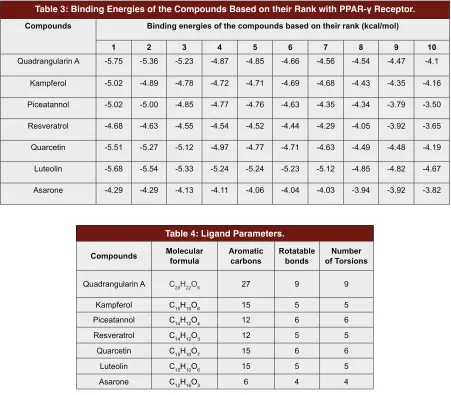
Among the selected compounds, Quadrangularin
A showed the highest binding affinity with PPAR-γ
whereas Asarone showed the least (Table 3). On looking to the hydrogen bond interaction, Kaempferol scored the highest number of hydrogen bond interaction
towards PPAR-γ receptor via six bonds. Amino acid
residues of the protein that interact with Kaempferol
are GLN A: 410, SER A: 394, ARG A: 443, GLU A: 324, GLN A: 437 and THR A: 440. Asarone scored low -est hydrogen bond interaction to the protein molecule
via one hydrogen bond interaction i.e. ARG A: 443. The amino acid residues of PPAR-γ i.e. GLU A: 324, ASP A: 396, SER A: 394 interact with Quadrangularin A via three bonds. GLN A:437, GLU A:324 are the amino
acid residues of the protein that interact with
Piceatan-nol. Similarly SER A: 394, GLU A: 324, ARG A:443
are the amino acid residues of protein molecule that
interact with Resveratrol. GLU A: 324, MET A:439 are
the amino acid residues of the protein that interact with Quercetin. Luteolin interacts with two amino acid
resi-Table 3: Binding Energies of the Compounds Based on their Rank with PPAR-γ Receptor.
Compounds Binding energies of the compounds based on their rank (kcal/mol)
1 2 3 4 5 6 7 8 9 10
Quadrangularin A -5.75 -5.36 -5.23 -4.87 -4.85 -4.66 -4.56 -4.54 -4.47 -4.1
Kampferol -5.02 -4.89 -4.78 -4.72 -4.71 -4.69 -4.68 -4.43 -4.35 -4.16
Piceatannol -5.02 -5.00 -4.85 -4.77 -4.76 -4.63 -4.35 -4.34 -3.79 -3.50
Resveratrol -4.68 -4.63 -4.55 -4.54 -4.52 -4.44 -4.29 -4.05 -3.92 -3.65
Quarcetin -5.51 -5.27 -5.12 -4.97 -4.77 -4.71 -4.63 -4.49 -4.48 -4.19
Luteolin -5.68 -5.54 -5.33 -5.24 -5.24 -5.23 -5.12 -4.85 -4.82 -4.67
Asarone -4.29 -4.29 -4.13 -4.11 -4.06 -4.04 -4.03 -3.94 -3.92 -3.82
Table 4: Ligand Parameters.
Compounds Molecular formula Aromatic carbons Rotatable bonds of TorsionsNumber
Quadrangularin A C28H22O6 27 9 9
Kampferol C15H10O6 15 5 5
Piceatannol C14H12O4 12 6 6
Resveratrol C14H12O3 12 5 5
Quarcetin C15H10O7 15 6 6
Luteolin C15H10O6 15 5 5
Asarone C12H16O3 6 4 4
dues of protein molecule i.e. GLU A:324, SER A:394
via two bonds.
On comparing all seven compounds, Luteolin can be choice of compound to bind with the PPAR-γ receptor.
This is because Quadrangularin A fails to obey the Rule
of Five and Quercetin has a less binding affinity with PPAR-γ compared to Luteolin. Although the docking
study of Piceatannol, Resveratrol and Asarone showed
binding affinity with PPAR-γ, the compounds were rejected by Lipinski rule of five. Hence, these phyto -chemicals may not be considered as drug molecules. The
binding energy of individual compounds with PPAR- γ
is shown in Table 3. The ligand parameters of individual molecules are shown in Table 4. The interaction of each
ligand with PPAR-γ is shown in Figure 3.
PPAR-γ agonist promotes adipogenesis and accelerates
adipocytes differentiation by promoting the uptake of
Free Fatty Acid (FFA) in subcutaneous adipose tissues. An agonist of PPAR-γ decreases circulating FFA and
Com-Figure 3: Interaction of a) Quadrangularin A, b) Kaempferol, c) Piceatannol, d) Resveratrol, e) Quercetin, f) Luteolin and g)
Asarone with the PPAR-γ receptor.
parison of docked phytochemical constituents has a
dif-ferent binding affinity, hydrogen bond interaction and
drug-likeness property. These chemical constituents
may play important role in the regulation of PPAR-γ
receptor and helpful in the treatment of diabetes mel-litus.
CONCLUSION
The result obtained from the study confirms the hypoth -esis that seven chemical constituents of Cissus quadrangu-laris interact with the PPAR-γ receptor, may bring about
the physiological changes in the patient suffering from diabetes mellitus. The binding energies of the
protein-ligand interactions also confirm that the protein-ligand fit into
the active pockets. Further in vitro and in vivo study of
these phytoconstituents may replace the thiazolidinedi-one molecules could help in the development of novel anti-diabetic molecules.
ACKNOWLEDGEMENT
The authors are thankful to Dr. B. M. Patil, Principal of KLE College of Pharmacy, Belagavi and Dr. N. A. Khatib, Head of Department of Pharmacology for the encouragement of work.
CONFLICT OF INTEREST
The authors declare no conflict of interest.
ABBREVIATIONS
ADMET: Absorption Distribution Metabolism Distri-bution Excretion Toxicity; BE: Binding energy; DM: Diabetes Mellitus; FFA: Free Fatty Acid; SMILES:
Simplified Molecular-Input Line-Entry System; TNF: Tumour necrosis factor; DM: Diabetes Mellitus; FFA:
Free Fatty Acid; SMILES:Simplified Molecular-Input
Line-Entry System; TNF: Tumour necrosis factor.
REFERENCES
1. Jia Z, Sun Y, Yang G, Zhang A, Huang S, Heiney KM. New insights into
the PPAR γ agonists for the treatment of diabetic nephropathy. PPAR Res.
2014;43:818530.
2. Grygiel-Górniak B, Mosor M, Marcinkowska J, Przysławski J, Nowak J.
Impact of the PPAR gamma-2 gene polymorphisms on the metabolic state of postmenopausal women. J Bio Sci. 2016;41(3):427-37.
3. Pattanayak AK, Bankura B, Balmiki N, Das TK, Chowdhury S, Das M. Role of peroxisome proliferator-activated receptor gamma gene polymorphisms in type 2 diabetes mellitus patients of West Bengal, India. J Diabetes Investig. 2014;5(2):188-91.
4. Picard F, Auwerx J. PPAR-γ and glucose homeostasis. Annu Rev Nutr.
2002;22(1):167-97.
5. Christodoulides C, Vidal-Puig A. PPARs and adipocyte function. Mol Cell Endocrinol. 2010;318(1-2):618.
6. Kim H, Ahn Y. Role of peroxisome proliferator–activated receptor-γ in the
glucose-sensing apparatus of liver and β-cells. Diabetes. 2004;53(Suppl
1):1-6.
7. Variya BC, Modi SJ, Savjani JK, Patel SS. In silico molecular docking and pharmacokinetic prediction of gallic acid derivatives as ppar-γ agonists. Int J Pharm Pharm Sci. 2016;9(1):102.
8. Murphy GJ, Holder JC. PPAR-γ agonists: Therapeutic role in diabetes, inflammation and cancer. Trends Pharmacol Sci. 2000;21(12):469-74.
9. Tyagi S, Sharma S, Gupta P, Saini A, Kaushal C. The peroxisome proliferator-activated receptor: A family of nuclear receptors role in various diseases. J Adv Pharm Technol Res. 2011;2(4):236.
10. Yki-j H. Thiazolidinediones. N Engl J Med. 2004;351(11):1106-18. 11. Meenambiga SS, Rajagopal K. In silico studies on plant derived components
of Cissus quadrangularis against COX-2 enzyme. Int J Pharm Pharm Sci. 2014;6(8):483-7.
12. Nagani K, Kevalia J, Chanda S. Pharmacognostical and Phytochemical evaluation of stem of Cissus quadrangularisL. IJPSR. 2011;2(11):2856-62. 13. Mukherjee T, Saha N, Palbag S. Ethnopharmacology, phytochemistry and
pharmacology of ayurvedic plant hadjod - Cissus quadrangularis L. Int J Res Ayurveda Pharm. 2016;7(4):78-83.
14. Adesanya SA, Boukamcha N, Montagnac A, Pai M. Stilbene Derivatives from
Cissus quadrangularis. J Nat Prod. 1999;62(12):1694-5.
15. Taylor P, Singh G, Rawat P, Maurya R. Formerly Natural Product Letters Constituents of Cissus quadrangularis. Natural Product Research. 2007;21(6)37-41.
16. Kaur R, Malik CP. Cissus quadrangularis L - Its Botany, Chemistry and Medicinal Importance : A Review. IJPCR. 2014;6(1):27-35.
17. Prabhavathi RM, Prasad MP, Jayaramu M. Studies on Qualitative and Quantitative Phytochemical Analysis of Cissus quadrangularis. Adv Appl Sci Res. 2016;7(4):11-7.
18. Roy N. Recent trends in drug-likeness prediction: A comprehensive review of
Cite this article: Patil VS, Biradar PR, Attar V, Khanal P. In silico Docking Analysis of Active Biomolecules from
Cissus quadrangularis L. against PPAR-γ. Indian J of Pharmaceutical Education and Research. 2019;53(3 Suppl 2):s332-s337.
In the current study, six active biomolecules were
screened against the PPAR-γ to assess the binding affinity, followed by the prediction of the ADMET. All
the active biomolecules were predicted for the safety
and efficacy under the various models to understand
their pharmacokinetic and pharmacokinetic param-eters. Toxicity of each compound was also predicted under various biological models. The outcome of the
current study reflects to perform the wet lab experi
-ments and the further confirmations are to be made
via in vitro and in vivo studies.
SUMMARY PICTORIAL ABSTRACT
Vishal Shivalingappa Patil is currently M. Pharm second-year student, Department of Pharma-cology at KLE College of Pharmacy, KAHER, Belagavi. His area of interest includes Neurophar-macology and Metabolic disorders. He is currently working on Neuropharmacological evaluation of herbal plants. Further, his area of interest is reverse Pharmacology.
About Authors
Prakash Rajashekhar Biradar has eleven years of teaching experience and currently working as Asst. Professor, at Department of Pharmacology, KLE College of Pharmacy, KAHER, Belagavi. His area of interest includes Aphrodisiac activity and Metabolic Disorders.
Vasim Attar is M. Pharm second year student, Department of Pharmacology at KLE College of Pharmacy, KAHER, Belagavi. His area of interest is the Evaluation of phytoconstituents for Metabolic Disorders. Further, he is interested in Aphrodisiac, Neuropharmacology and molecular dynamics.
Pukar Khanal has been awarded with two times gold medal for his academic performance in B. Pharm and M. Pharm; currently working as Ph.D Research Scholar at KLE Academy of Higher Education and Research, Belagavi. His area of interest covers gene set enrichment analysis of lead
molecule modulated pathway identification, protein-protein network interaction, in silico molecular
docking, protein modeling and utilizing Danio rerio as a preliminary animal model. Further, he
interests to utilize regression models for the evaluation of PKPD profiles and data correlation with