Open Access
Research
Activity of telithromycin and comparators against bacterial
pathogens isolated from 1,336 patients with clinically diagnosed
acute sinusitis
Joseph Dohar*
1, Rafael Cantón
2, Robert Cohen
3, David John Farrell
4and
David Felmingham
4Address: 1Department of Pediatric Otolaryngology, Children's Hospital of Pittsburgh, Pittsburgh, USA, 2Hospital Ramon y Cajal, Madrid, Spain, 3Department of Microbiology, Intercommunal Hospital of Creteil, Creteil, France and 4GR Micro Limited, London, United Kingdom
Email: Joseph Dohar* - [email protected]; Rafael Cantón - [email protected]; Robert Cohen - [email protected]; David John Farrell - [email protected]; David Felmingham - [email protected]
* Corresponding author
Abstract
Background: Increasing antimicrobial resistance among the key pathogens responsible for community-acquired respiratory tract infections has the potential to limit the effectiveness of antibiotics available to treat these infections. Since there are regional differences in the susceptibility patterns observed and treatment is frequently empirical, the selection of antibiotic therapy may be challenging. PROTEKT, a global, longitudinal multicentre surveillance study, tracks the activity of telithromycin and comparator antibacterial agents against key respiratory tract pathogens.
Methods: In this analysis, we examine the prevalence of antibacterial resistance in 1,336 bacterial pathogens, isolated from adult and paediatric patients clinically diagnosed with acute bacterial sinusitis (ABS).
Results and discussion: In total, 58.0%, 66.1%, and 55.8% of S. pneumoniae isolates were susceptible to penicillin, cefuroxime, and clarithromycin respectively. Combined macrolide resistance and reduced susceptibility to penicillin was present in 200/640 (31.3 %) of S. pneumoniae
isolates (128 isolates were resistant to penicillin [MIC >= 2 mg/L], 72 intermediate [MIC 0.12–1 mg/L]) while 99.5% and 95.5% of isolates were susceptible to telithromycin and amoxicillin-clavulanate, respectively. In total, 88.2%, 87.5%, 99.4%, 100%, and 100% of H. influenzae isolates were susceptible to ampicillin, clarithromycin, cefuroxime, telithromycin, and amoxicillin-clavulanate, respectively. In vitro, telithromycin demonstrated the highest activity against M. catarrhalis (MIC50 = 0.06 mg/L, MIC90 = 0.12 mg/L).
Conclusion: The high in vitro activity of against pathogens commonly isolated in ABS, together with a once daily dosing regimen and clinical efficacy with 5-day course of therapy, suggest that telithromycin may play a role in the empiric treatment of ABS.
Published: 02 August 2004
Annals of Clinical Microbiology and Antimicrobials 2004, 3:15 doi:10.1186/1476-0711-3-15
Received: 15 April 2004 Accepted: 02 August 2004
This article is available from: http://www.ann-clinmicrob.com/content/3/1/15
Introduction
The incidences of both the acute and chronic forms of sinusitis have been increasing, and between 10 and 15% of the population of central Europe are affected annually [1]. There are an estimated 30 million cases of ABS in the USA each year [2-4]. Acute sinusitis accounts for 0.5–2.0% of all upper respiratory tract infections in adults and between 5–10% in children and therefore is a common reason for visits to primary care physicians [5]. Although usually mild in severity, complications can be life threat-ening, including meningitis, brain abscess, orbital celluli-tis and abscess, subempyema, osteomyelicelluli-tis, and nasal polyposis [6-9].
S. pneumoniae is the most common pathogenic bacterium responsible for ABS, isolated in 30–50% of cases,
fol-lowed by H. influenzae, isolated in 20–40% of cases.
Moraxella catarrhalis is isolated in 5–10% of cases, beta haemolytic streptococci in less than 5%, and Staphylococ-cus aureus in less than 10% although it is often found co-infecting with other bacteria [10].
Treatment options for ABS are controversial as up to 40% of patients recover spontaneously, however, studies have shown that treatment with an antibacterial reduces the time to recovery from sinusitis, improves symptoms, and helps to prevent complications [11,12]. Guidelines on antibacterial use for ABS vary, possibly because of differ-ent regulations, antibacterial resistance patterns, and eti-ology in different countries, however, the choice of first-line antibacterial is similar across treatment guidefirst-lines [3,13-17]. Nearly all recommend amoxicillin, as it is active against the major causative pathogens of AMS and is generally well tolerated. For patients with penicillin allergy, the recommended first-line agents vary in differ-ent countries. Trimethoprim or trimethoprim-sulfameth-oxazole is commonly recommended [3,14]. In addition, the French guidelines have recently been reviewed and tel-ithromycin has been included as an alternative first-line agent [15]. Macrolides are not included in the French guidelines due to the high macrolide resistance prevalence in France [15,18].
Second line, or alternative antibacterial agents of choice, are clarithromycin or second-generation cephalosporins such as cefuroxime and cefpodoxime, third-generation cephalosporins such as cefdinir, and trimethoprim-sul-phamethoxazole [3,5,16,17]. Telithromycin has been rec-ommended as an alternative agent in Germany [13,16]. High-dose amoxicillin-clavulanate should be used if the patient does not improve [3,16,17]. In France, anti-pneu-mococcal fluoroquinolones are recommended after bacte-rial confirmation or if the patient is at high risk of complications [15]. A single dose of ceftriaxone can be
used in a child who cannot be treated orally, i.e. vomiting [17].
However, due to increasing levels of resistance in bacterial respiratory tract pathogens to these commonly used anti-bacterials (particularly the rapid emergence of penicillin-and macrolide-resistant strains of pneumococci), new agents are required that have high in vitro activity and demonstrated clinical efficacy against bacterial pathogens causing community-acquired respiratory tract infections (RTI's) [19-22]. Telithromycin is the first ketolide approved for clinical use. The ketolides are semisynthetic derivatives of the 14-membered ring macrolide erythro-mycin and have high in vitro activity against the common community-acquired RTI pathogens [23]. Clinical trials have demonstrated the efficacy and tolerability of telithro-mycin therapy in ABS [24-26].
The PROTEKT (Prospective Resistant Organism Tracking and Epidemiology for the Ketolide Telithromycin) study is a longitudinal, global multicentre surveillance study designed in part to determine the activity of telithromycin against community-acquired RTI isolates, in relation to the frequency of prescribing, in the regions where the study is conducted [27]. The aim of this paper is to focus on the data gathered in the PROTEKT surveillance study to determine the in vitro efficacy of the new ketolide telithro-mycin and comparator agents against bacterial pathogens isolated from the subset of patients with clinically diag-nosed ABS collected in PROTEKT (2000–2001, and 2001–2002).
Materials and Methods
Patients and bacterial isolates
Detailed study design, including patient selection and methodology for isolate identification and storage in the PROTEKT study has been described previously [27]. The isolates in this sub-study of PROTEKT were selected from those patients presenting with clinically diagnosed ABS in which the isolates were determined clinically to be the pathogenic organism and the specimen type was sinus aspirate or nasopharyngeal swab/aspirate only. Method-ology for sinus aspiration was that used routinely by the investigator.
Antimicrobial testing
is susceptible, 2 µg/ml is intermediate, and ≥ 4 µg/ml is resistant; for Haemophilus influenzae, ≤ 4 µg/ml is suscepti-ble, 8 µg/ml is intermediate, and ≥ 16 µg/ml is resistant [29].
Statistical analysis
Statistical analysis was performed using a χ2 test.
Results
A total of 1,336 bacterial pathogens in all were collected
from 25 countries within Western Europe (n = 652),
North America (n = 14), Latin America (n = 207), Asia (n
= 464), Eastern Europe (n = 68), Australia (n = 2), and
South Africa (n = 126) in the PROTEKT study from years
2000–2001 and 2001–2002 for analysis of the suscepti-bility of bacterial pathogens isolated from patients with acute sinusitis. Gender distribution was 52.2% male (695 patients), 46.7% female (624 patients); gender was not provided for 1.3% of patients. Almost two thirds (66.3%) of patients were in the 0–12 year age group, one third (29.7%) in the 13–65 year age group, 2.7% in the over 65 year age group and age was not specified in 1.3% of patients. S. pneumoniae was the pathogen most frequently
isolated (47.9% of isolates) followed by H. influenzae
(24.6% of isolates) (Table 1).
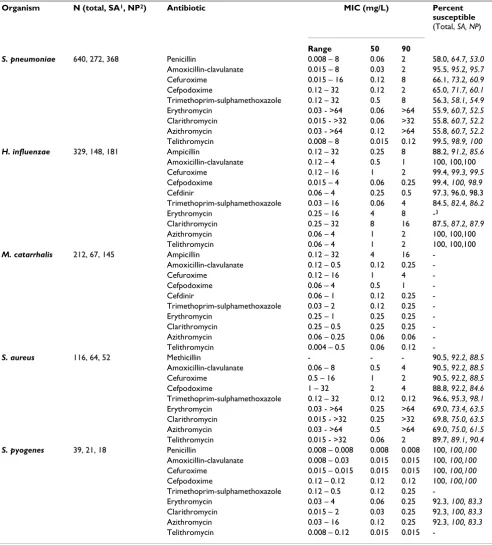
MIC data for isolates from patients with ABS demon-strated that the in vitro activity of telithromycin against gram-positive cocci was similar to amoxicillin-clavulanate and was higher and more potent than clarithromycin and beta-lactams tested such as cefuroxime (Table 2). In total, 99.5 % of streptococcal isolates were susceptible to tel-ithromycin. With the exception of S. aureus isolates more than 90% of gram-positive cocci were inhibited at a tel-ithromycin MIC of 0.25 mg/L (Table 2).
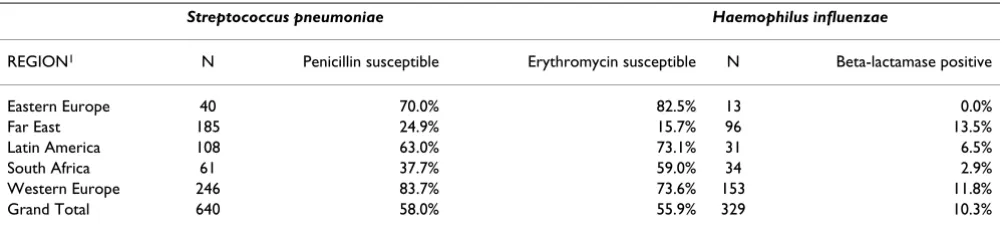
Resistance to most antibiotics was slightly greater in nasopharyngeal specimens than sinus aspirates (Table 2). Considerable variation in in vitro antibiotic activity was apparent between geographical regions as observed in the key examples shown in Table 3. Insufficient data were available for analysis by country.
Combined macrolide resistance and reduced
susceptibil-ity to penicillin was present in 200/640 (31.3 %) of S.
pneumoniae isolates (128 isolates were resistant to penicil-lin [MIC >= 2 mg/L], 72 intermediate [MIC 0.12–1 mg/ L]). Of note, 3 isolates of S. pneumoniae were non-suscep-tible to telithromycin (2 isolates intermediate with an MIC of 2 mg/L, 1 isolate resistant with an MIC of 8 mg/L). This represented 0.5% of isolates, a value that is signifi-cantly (p < 0.001) lower than those obtained by erythro-mycin (44.1%), clarithroerythro-mycin (44.2%) and cefuroxime (33.9%).
Of the 329 H. influenzae isolates, 34 (10.3 %) were posi-tive for β-lactamase production. All isolates of H.
influen-zae were susceptible to amoxycillin-clavulanate and
telithromycin with an MIC90 of 1 and 2 mg/L, respectively. Amoxycillin-clavulanate and telithromycin were more potent and had greater activity than clarithromycin
(MIC90 = 16 mg/L, 87.5% susceptible). This activity was
comparable to azithromycin (MIC90 = 2 mg/l, 100%
susceptible).
Although the number of S. aureus isolated from the total number of specimens was small (116/1366 isolates), tel-ithromycin was as efficacious as comparators. Of the 116 isolates, 11 were resistant to methicillin (MRSA) and 105 were methicillin susceptible (MSSA). Ninety-nine (94.3%) of the MSSA isolates and 5 of the 11 MRSA iso-lates were susceptible to telithromycin. Of note, all of the
S. pyogenes isolates were inhibited by ≤ 1 mg/L telithromy-cin, despite 17.7% resistance to erythromycin and clarithromycin.
Telithromycin was the most potent antimicrobial against
M. catarrhalis with an MIC50 of 0.06 mg/L and MIC90 of
0.12 mg/L. β-lactamase production was detected in 97.6%
of these isolates.
Discussion
The data in this analysis demonstrates that telithromycin has high in vitro activity against bacterial pathogens iso-lated from a large, globally distributed population of
Table 1: Distribution of species by specimen type for the 1336 bacterial pathogens causing acute sinusitis [n (%)]
Specimen S. pneumoniae H. influenzae M. catarrhalis S. aureus S. pyogenes Total
Sinus 272 (47.5) 148 (25.9) 67 (11.7) 64 (11.2) 21 (3.7) 572 (42.8) Nasopharynx1 368 (48.1) 181 (23.7) 145 (19.0) 52 (6.8) 18 (2.4) 764 (57.2)
Total 640 (47.9) 329 (24.6) 212 (15.9) 116 (8.7) 39 (2.9) 1336 (100)
patients diagnosed with ABS. Telithromycin was the most active and potent agent against all isolates of the patho-gens isolated from patients with ABS with 99.4% of
iso-lates susceptible. Not surprisingly, high levels of penicillin resistance, macrolide resistance, and combined penicillin and macrolides resistance were prevalent in S. pneumoniae
Table 2: In vitro activity of antibacterial agents and percent susceptible against 1336 bacterial pathogens isolated from patients with clinically diagnosed acute sinusitis
Organism N (total, SA1, NP2) Antibiotic MIC (mg/L) Percent susceptible (Total, SA, NP)
Range 50 90
S. pneumoniae 640, 272, 368 Penicillin 0.008 – 8 0.06 2 58.0, 64.7, 53.0 Amoxicillin-clavulanate 0.015 – 8 0.03 2 95.5, 95.2, 95.7 Cefuroxime 0.015 – 16 0.12 8 66.1, 73.2, 60.9 Cefpodoxime 0.12 – 32 0.12 2 65.0, 71.7, 60.1 Trimethoprim-sulphamethoxazole 0.12 – 32 0.5 8 56.3, 58.1, 54.9 Erythromycin 0.03 - >64 0.06 >64 55.9, 60.7, 52.5 Clarithromycin 0.015 - >32 0.06 >32 55.8, 60.7, 52.2 Azithromycin 0.03 - >64 0.12 >64 55.8, 60.7, 52.2 Telithromycin 0.008 – 8 0.015 0.12 99.5, 98.9, 100
H. influenzae 329, 148, 181 Ampicillin 0.12 – 32 0.25 8 88.2, 91.2, 85.6 Amoxicillin-clavulanate 0.12 – 4 0.5 1 100, 100,100
Cefuroxime 0.12 – 16 1 2 99.4, 99.3, 99.5
Cefpodoxime 0.015 – 4 0.06 0.25 99.4, 100, 98.9 Cefdinir 0.06 – 4 0.25 0.5 97.3, 96.0, 98.3 Trimethoprim-sulphamethoxazole 0.03 – 16 0.06 4 84.5, 82.4, 86.2
Erythromycin 0.25 – 16 4 8 -3
Clarithromycin 0.25 – 32 8 16 87.5, 87.2, 87.9
Azithromycin 0.06 – 4 1 2 100, 100,100
Telithromycin 0.06 – 4 1 2 100, 100,100
M. catarrhalis 212, 67, 145 Ampicillin 0.12 – 32 4 16 -Amoxicillin-clavulanate 0.12 – 0.5 0.12 0.25
-Cefuroxime 0.12 – 16 1 4
-Cefpodoxime 0.06 – 4 0.5 1
-Cefdinir 0.06 – 1 0.12 0.25
-Trimethoprim-sulphamethoxazole 0.03 – 2 0.12 0.25
-Erythromycin 0.25 – 1 0.25 0.25
-Clarithromycin 0.25 – 0.5 0.25 0.25 -Azithromycin 0.06 – 0.25 0.06 0.06 -Telithromycin 0.004 – 0.5 0.06 0.12
-S. aureus 116, 64, 52 Methicillin - - - 90.5, 92.2, 88.5 Amoxicillin-clavulanate 0.06 – 8 0.5 4 90.5, 92.2, 88.5
Cefuroxime 0.5 – 16 1 2 90.5, 92.2, 88.5
Cefpodoxime 1 – 32 2 4 88.8, 92.2, 84.6
Trimethoprim-sulphamethoxazole 0.12 – 32 0.12 0.12 96.6, 95.3, 98.1 Erythromycin 0.03 - >64 0.25 >64 69.0, 73.4, 63.5 Clarithromycin 0.015 - >32 0.25 >32 69.8, 75.0, 63.5 Azithromycin 0.03 - >64 0.5 >64 69.0, 75.0, 61.5 Telithromycin 0.015 - >32 0.06 2 89.7, 89.1, 90.4
S. pyogenes 39, 21, 18 Penicillin 0.008 – 0.008 0.008 0.008 100, 100,100 Amoxicillin-clavulanate 0.008 – 0.03 0.015 0.015 100, 100,100 Cefuroxime 0.015 – 0.015 0.015 0.015 100, 100,100 Cefpodoxime 0.12 – 0.12 0.12 0.12 100, 100,100 Trimethoprim-sulphamethoxazole 0.12 – 0.5 0.12 0.25
-Erythromycin 0.03 – 4 0.06 0.25 92.3, 100, 83.3 Clarithromycin 0.015 – 2 0.03 0.25 92.3, 100, 83.3 Azithromycin 0.03 – 16 0.12 0.25 92.3, 100, 83.3 Telithromycin 0.008 – 0.12 0.015 0.015
although prevalence varied widely between geographical regions.
Amoxicillin has been the treatment of choice in ABS because of its general effectiveness, safety, tolerability, low cost and narrow spectrum [17]. The high prevalence of beta-lactamase in H. influenzae and M. catarrhalis found in the present study demonstrate compromised in vitro effi-cacy of amoxicillin against these isolates. Although the cephalosporins (cefuroxime, cefpodoxime and cefdinir) showed high activity against H. influenzae (including beta-lactamase positive strains), resistance to these agents was high in S. pneumoniae: >30% for cefuroxime and cefpo-doxime – cefdinir was not tested against pneumococci in PROTEKT, however susceptibility is usually similar to the other cephalosporins reported here [30].
Similarly, macrolides are prescribed in various countries for ABS and an overall resistance rate for S. pneumoniae of 44.1% to erythromycin, azithromycin, and clarithromy-cin was found. Trimethoprim-sulfamethoxazole activity
was low for S. pneumoniae (56.3% susceptible) and
decreased for H. influenzae (84.5% susceptible).
Respiratory fluoroquinolones are recommended second-line treatment options in some countries (references needed to support this statement). However, recent evi-dence suggests that resistance to fluoroquinolones is rap-idly developing in pneumococci and other pathogens (including gram-positive and gram-negative [31-34]. To preserve the long-term utility of fluoroquinolones, including their use in the treatment of serious non-respi-ratory infections, it has been recommended that respira-tory fluoroquinolones be reserved for treating severe (e.g. hospitalized) community-acquired RTIs only [35,36].
The high prevalence of beta-lactam, macrolide, TMP-SMX resistance demonstrated in the large number of isolates from patients with clinically diagnosed sinusitis in our study demonstrates the need to be exploring new
thera-peutic options, especially in geographical regions of high prevalence such as the Far East.
The high in vitro activity of telithromycin against ABS
pathogens reported in this study, regardeless of geograph-ical region, also demonstrates its potential as an empiric therapeutic option for ABS. There are several other reasons to consider this option – 1) High rates of clinical cure and bacteriological eradication have been demonstrated using telithromycin against sinus isolates of S. pneumoniae, H. influenzae, M. catarrhalis and S. aureus [24-26]. 2) Telithro-mycin has been shown to have a targeted spectrum of activity against the major bacterial respiratory tract patho-gens and has less effect on normal bacterial ecology [37-39]. 3) The pharmacokinetic profile of oral telithromycin allows it to be prescribed with a dosing regime of 800 mg once daily for 5 days [40,41]. This contrasts favourably with its comparators, where a 10 – 14 day course with administration either 2 or 3 times daily, depending on the chosen antibacterial, is generally prescribed. Studies have shown that the once daily dosing regime affords greater patient treatment compliance, thereby avoiding clinical failure and the ensuing development of antibacterial resistance [41-43]. 5) Telithromycin has been shown to have high penetration levels in paranasal sinuses, and it is preferentially absorbed by polymorphonuclear neu-trophils (PMNs) within the azurophil granules allowing effective delivery to phagocytized intracellular bacteria [44,45].
Although this study provides valuable information on the overall antimicrobial profile of bacteria causing ABS care should be taken when interpreting data related to specific demographics. A major limitation of this study, inherent to most surveillance studies, is the requirement for collect-ing centers to fulfill a specified quota of isolates over a defined time period (1 year). If, for instance, 1 center manages to fulfill their quota for S. pneumoniae isolates from patients with community-acquired pneumonia, they
may then only send H. influenzae from patients with ABS
Table 3: Key example of regional variation in in vitro antibiotic activity
Streptococcus pneumoniae Haemophilus influenzae
REGION1 N Penicillin susceptible Erythromycin susceptible N Beta-lactamase positive
Eastern Europe 40 70.0% 82.5% 13 0.0%
Far East 185 24.9% 15.7% 96 13.5%
Latin America 108 63.0% 73.1% 31 6.5%
South Africa 61 37.7% 59.0% 34 2.9%
Western Europe 246 83.7% 73.6% 153 11.8%
Grand Total 640 58.0% 55.9% 329 10.3%
to fulfill their quota for this organism. Thus, the potential exists to over or under estimate the prevalence of a species in a particular disease. A further limitation of this study is it is restricted to the major bacterial pathogens causing sinusitis and does not therefore assess anaerobic bacteria, which are also known to be involved in this disease. How-ever, a recent study of sinus puncture specimens demon-strated that telithromycin had good in vitro activity against anaerobes involved in sinusitis [46].
The inclusion of nasopharyngeal specimens is a potential limitation of this study and the higher rate of resistance compared to sinus aspirates may indicate some isolates were nasopharyngeal flora rather than pathogens. How-ever, the difference in resistance prevalence between nasopharyngeal specimens and sinus aspirates was not great for any species/antibiotic combination, and assum-ing the majority of isolates were the responsible pathogen, significant bias of resistance patterns is unlikely. The treat-ment of ABS is complicated by a difficulty in establishing the causative pathogen(s). Sampling of infected fluid using sinus puncture is a painful and rare procedure [47]. Nasopharyngeal culture is a painless and reliable method that can help identify patients that may benefit from anti-bacterial therapy [48] and hence, could be useful in deter-mining antibiotic resistance implicated in sinusitis –
particularly Streptococcus pneumoniae and Haemophilus
influenzae. Additionally, there are regional differences in the susceptibility patterns observed and, as therapy is usu-ally empirical, choosing an effective therapy can be chal-lenging [18,20,49].
In summary, the data presented here demonstrates that telithromycin has good in vitro activity against S. pneumo-niae, H. influenzae, M. catarrhalis and S. aureus respiratory pathogens commonly isolated in ABS. It is as active as or more active than antibacterial agents that are currently used in this clinical setting. The development of resistance will always be a threat to the usefulness of antibacterial compounds, however surveillance studies such as PRO-TEKT allow the rapid detection and characterization of resistance mechanisms and highlight the need for and examine the in vitro efficacy of newer antibacterial agents. Providing careful surveillance for the development of resistance is maintained telithromycin currently offers a useful therapeutic option in the treatment of AS.
Authors' contributions
JD, RCa and RCo reviewed the data and provided clinical and microbiological interpretation and discussion. DF and DJF participated in the design of the study, supervised the scientific testing, and provided data analysis, micro-biological interpretation and discussion. All authors drafted the manuscript. All authors read and approved the final manuscript.
Acknowledgements
We are grateful to our colleagues worldwide for the supply of bacterial iso-lates as part of the PROTEKT study and the GR Micro PROTEKT team who performed the testing. Aventis is acknowledged for their financial sup-port of the PROTEKT study.
References
1. Grevers G, Klemens A: [Rhinosinusitis. Current diagnostic and therapeutic aspects]. MMW Fortschr Med 2002, 144:31-35. 2. Schwartz R: The diagnosis and management of sinusitis. Nurse
Pract 1994, 19:58-63.
3. Antimicrobial treatment guidelines for acute bacterial rhi-nosinusitis. Sinus and Allergy Health Partnership. Otolaryngol Head Neck Surg 2000, 123:5-31.
4. National health survey: prevalence of selected chronic con-ditions, United States 1983-1985. U.S Department of Health and Human Services. US Department of Health and Human Services, Hyattsville, Md 1987.
5. Fagnan LJ: Acute sinusitis: a cost-effective approach to diagno-sis and treatment. Am Fam Physician 1998, 58:1795-802, 805-6. 6. Cohen JT, Hochman II,II, DeRowe A, Fliss DM: Complications of
Acute Otitis Media and Sinusitis. Curr Infect Dis Rep 2000, 2:130-140.
7. Jones RL, Violaris NS, Chavda SV, Pahor AL: Intracranial compli-cations of sinusitis: the need for aggressive management. J Laryngol Otol 1995, 109:1061-1062.
8. Clairmont AA, Per-Lee JH: Complications of acute frontal sinusitis. Am Fam Physician 1975, 11:80-84.
9. Wang WH, Hwang TZ: Extensive subgaleal abscess and epi-dural empyema in a patient with acute frontal sinusitis. J For-mos Med Assoc 2003, 102:338-341.
10. Roos K: The pathogenesis of infective rhinosinusitis. Rhinosi-nusitis : current issues in diagnosis and management Edited by: V Lund and J Corey. London, The Royal Society of Medicine Press Ltd; 1999:11 -119.
11. Corey J: Non-antibiotic treatment options. Rhinosinusitis: current issues in diagnosis and management Edited by: V Lund and J Corey. Lon-don, The Royal Society of Medicine Press Ltd; 1999:33 -338. 12. de Ferranti SD, Ioannidis JP, Lau J, Anninger WV, Barza M: Are
amoxycillin and folate inhibitors as effective as other antibi-otics for acute sinusitis? A meta-analysis. Bmj 1998, 317:632-637.
13. Vogel F, Scholz H, al-Nawas B, Elies W, Kresken M, Lode H, Muller O, Naber KG, Petersen E, Shah P, Sorgel F, Stille W, Tauchnitz C, Trautmann M, Ullmann U, Wacha H, Wiedemann B: [Rational use of oral antibiotics. Findings of an expert commission of the Paul Ehrlich Society for Chemotherapy.]. Med Monatsschr Pharm 2002, 25:193-204.
14. PRODIGY Guidance. Sinusitis (updated 2002). Accessed at http://www.prodigy.nhs.uk/guidance.asp?gt=sinusitis on 2nd February 2004. .
15. Agence Francaise de Sécurité Sanitaire des Produits de Santé. Mise au point sur l’antibiothérapie par voie générale en pratique courante (2002). Accessed at http://afss-aps.sante.fr/htm/10/filltrpsc/antibio.pdf on 2 Feb 2004. . 16. Federspil P: Leitlinien zur antibiotika-therapie der
bakteriel-leninfektionen an kopf und hals. Arzniemitteltherapie 2003, 21:162-175.
17. Subcommittee on Management of Sinusitis and Committee on Quality Improvement: Clinical Practice Guideline: Management of Sinusitis. Pediatrics 2001, 108:798-808.
18. Felmingham D, Reinert RR, Hirakata Y, Rodloff A: Increasing prev-alence of antimicrobial resistance among isolates of Strepto-coccus pneumoniae from the PROTEKT surveillance study, and comparative in vitro activity of the ketolide, telithromycin. J Antimicrob Chemother 2002, 50 Suppl S1:25-37. 19. Felmingham D, Washington J: Trends in the antimicrobial
sus-ceptibility of bacterial respiratory tract pathogens--findings of the Alexander Project 1992-1996. J Chemother 1999, 11 Suppl 1:5-21.
Publish with BioMed Central and every scientist can read your work free of charge "BioMed Central will be the most significant development for disseminating the results of biomedical researc h in our lifetime."
Sir Paul Nurse, Cancer Research UK
Your research papers will be:
available free of charge to the entire biomedical community
peer reviewed and published immediately upon acceptance
cited in PubMed and archived on PubMed Central
yours — you keep the copyright
Submit your manuscript here:
http://www.biomedcentral.com/info/publishing_adv.asp
BioMedcentral 21. Hoban D, Felmingham D: The PROTEKT surveillance study:
antimicrobial susceptibility of Haemophilus influenzae and Moraxella catarrhalis from community-acquired respiratory tract infections. J Antimicrob Chemother 2002, 50 Suppl S1:49-59. 22. Mandell LA, Bartlett JG, Dowell SF, File T. M., Jr., Musher DM,
Whit-ney C: Update of practice guidelines for the management of community-acquired pneumonia in immunocompetent adults. Clin Infect Dis 2003, 37:1405-1433.
23. Felmingham D: Microbiological profile of telithromycin, the first ketolide antimicrobial. Clin Microbiol Infect 2001, 7 Suppl 3:2-10.
24. Luterman M, Tellier G, Lasko B, Leroy B: Efficacy and tolerability of telithromycin for 5 or 10 days vs amoxicillin/clavulanic acid for 10 days in acute maxillary sinusitis. Ear Nose Throat J 2003, 82:576-80, 82-4, 586 passim.
25. Roos K, Brunswig-Pitschner C, Kostrica R, Pietola M, Leroy B, Ranga-raju M, Boutalbi Y: Efficacy and tolerability of once-daily ther-apy with telithromycin for 5 or 10 days for the treatment of acute maxillary sinusitis. Chemotherapy 2002, 48:100-108. 26. Buchanan PP, Stephens TA, Leroy B: A comparison of the efficacy
of telithromycin versus cefuroxime axetil in the treatment of acute bacterial maxillary sinusitis. American Journal of Rhinology 2003, 17:369-377.
27. Felmingham D: The need for antimicrobial resistance surveillance. J Antimicrob Chemother 2002, 50 Suppl S1:1-7. 28. NCCLS: Methods for dilution antimicrobial susceptibility
tests for bacteria that grow aerobically; Approved Standard - Sixth edition. NCCLS document M7-A6. Wayne, Pennsylvania 19087-1898, USA, NCCLS; 2003.
29. NCCLS: Performance standards antimicrobial susceptibility testing; Twelfth information supplement. NCCLS docu-ment M100-S14. Wayne, Pennsylvania 19807 - 1898, USA, NCCLS; 2004.
30. Sader HS, Fritsche TR, Mutnick AH, Jones RN: Contemporary evaluation of the in vitro activity and spectrum of cefdinir compared with other orally administered antimicrobials tested against common respiratory tract pathogens (2000-2002). Diagn Microbiol Infect Dis 2003, 47:515-525.
31. Quale J, Landman D, Ravishankar J, Flores C, Bratu S: Streptococ-cus pneumoniae, Brooklyn, New York: fluoroquinolone resistance at our doorstep. Emerg Infect Dis 2002, 8:594-597. 32. Morrissey I, Farrell DJ, Bakker S, Buckridge S, Felmingham D:
Molec-ular Characterization and Antimicrobial Susceptibility of Fluoroquinolone-Resistant or -Susceptible Streptococcus pneumoniae from Hong Kong. Antimicrob Agents Chemother 2003, 47:1433-1435.
33. Chen DK, McGeer A, de Azavedo JC, Low DE: Decreased suscep-tibility of Streptococcus pneumoniae to fluoroquinolones in Canada. Canadian Bacterial Surveillance Network. N Engl J Med 1999, 341:233-239.
34. Mandell LA, Peterson LR, Wise R, Hooper D, Low DE, Schaad UB, Klugman KP, Courvalin P: The battle against emerging antibi-otic resistance: should fluoroquinolones be used to treat children? Clin Infect Dis 2002, 35:721-727.
35. BTS Guidelines for the Management of Community Acquired Pneumonia in Adults. Thorax 2001, 56:1iv-64. 36. Heffelfinger JD, Dowell SF, Jorgensen JH, Klugman KP, Mabry LR,
Musher DM, Plouffe JF, Rakowsky A, Schuchat A, Whitney CG: Man-agement of community-acquired pneumonia in the era of pneumococcal resistance: a report from the Drug-Resistant Streptococcus pneumoniae Therapeutic Working Group. Arch Intern Med 2000, 160:1399-1408.
37. Cremieux AC, Muller-Serieys C, Panhard X, Delatour F, Tchimichkian M, Mentre F, Andremont A: Emergence of Resistance in Normal Human Aerobic Commensal Flora during Telithromycin and Amoxicillin-Clavulanic Acid Treatments. Antimicrob Agents Chemother 2003, 47:2030-2035.
38. Edlund C, Beyer G, Hiemer-Bau M, Ziege S, Lode H, Nord CE: Com-parative effects of moxifloxacin and clarithromycin on the normal intestinal microflora. Scand J Infect Dis 2000, 32:81-85. 39. Low DE, Brown S, Felmingham D: Clinical and bacteriological
efficacy of the ketolide telithromycin against isolates of key respiratory pathogens: a pooled analysis of phase III studies. Clin Microbiol Infect 2004, 10:27-36.
40. Aventis Pharma 2001. KetekTM. Telithromycin. Briefing document for the FDA Anti-infective DrugProducts
Advisory Committee Meeting, April 2001. :p62-63 [Section 5.6-Dose Determination].
41. Nicolau DP: Pharmacodynamic rationale for short-duration antibacterial therapy. J Infect 2002, 44 Suppl A:17-23.
42. Claxton AJ, Cramer J, Pierce C: A systematic review of the asso-ciations between dose regimens and medication compliance. Clin Ther 2001, 23:1296-1310.
43. Sclar DA, Tartaglione TA, Fine MJ: Overview of issues related to medical compliance with implications for the outpatient management of infectious diseases. Infect Agents Dis 1994, 3:266-273.
44. Miossec-Bartoli C, Pilatre L, Peyron P, N'Diaye EN, Collart-Dutilleul V, Maridonneau-Parini I, Diu-Hercend A: The new ketolide HMR3647 accumulates in the azurophil granules of human polymorphonuclear cells. Antimicrob Agents Chemother 1999, 43:2457-2462.
45. Miyamoto N: Pharmocokinetic study of a new ketolide antimi-crobial telithromycin (HMR3647) in otorhinolaryngology. 40th Interscience Conference on Antimicrobial Agents and Chemotherapy Toronto; 2000.
46. Goldstein Ellie J. C., Citron Diane M., Merriam C. Vreni, Warren Yumi, Tyrrel Kerin L., Fernandez Helen: In Vitro Activities of Tel-ithromycin and 10 Oral Agents against Aerobic and Anaero-bic Pathogens Isolated from Antral Puncture Specimens from Patients with Sinusitis. Antimicrob Agents Chemother 2003, 47:1963-1967.
47. Brooks I, Gooch W. M., 3rd, Jenkins SG, Pichichero ME, Reiner SA, Sher L, Yamauchi T: Medical management of acute bacterial sinusitis. Recommendations of a clinical advisory committee on pediatric and adult sinusitis. Ann Otol Rhinol Laryngol Suppl 2000, 182:2-20.
48. Kaiser L, Morabia A, Stalder H, Ricchetti A, Auckenthaler R, Terrier F, Hirschel B, Khaw N, Lacroix JS, Lew D: Role of nasopharyngeal culture in antibiotic prescription for patients with common cold or acute sinusitis. Eur J Clin Microbiol Infect Dis 2001, 20:445-451.
![Table 1: Distribution of species by specimen type for the 1336 bacterial pathogens causing acute sinusitis [n (%)]](https://thumb-us.123doks.com/thumbv2/123dok_us/8913711.1837985/3.612.52.556.100.163/table-distribution-species-specimen-bacterial-pathogens-causing-sinusitis.webp)