Author for Correspondence:
1Final year ME, Velalar College of Engineering and Technology, Erode, Tamilnadu, India.
MAY-2015
International Journal of Intellectual Advancements
and Research in Engineering Computations
AN NEURAL NETWORK BASED EFFICIENT RESOURCE
UTILIZATION IN CLOUD
1
S. Sriemimapriya,
2S. N. Sangeethaa.
ABSTRACT
Cloud computing is the long dreamed vision of computing as a utility, where users can remotely store their data into the cloud so as to enjoy the on-demand high quality applications and services from a shared pool of configurable computing resources. Collaborative Cloud Computing operates in a large-scale environment involving thousands or millions of resources across disparate geographically distributed areas, and it is also inherently dynamic as entities may enter or leave the system on Cloud environment for resource utilization owned by different parties and partitioned in arbitrary ways rather than a single way of partition. In this work to improve resource utilization based on optimal time period to allocate resources by proposing neural network training and to calculate load factor by using dynamic priority for the nodes based on which the virtual machines are scheduled. It schedules the VMs to the nodes depending upon their priority value, which varies dynamically based on their load factor. This dynamic priority concept leads to better utilization of the resources. Priority of a node is assigned depending upon its capacity and the load factor. This algorithm strikes the right balance between performance and power efficiency. Once the highest and next highest priority nodes have been identified, then the scheduling is very quick. It prevents a particular node from being overloaded by considering the load factor.
INTRODUCTION
Cloud computing is the long dreamed vision of computing as a utility, where users can remotely store their data into the cloud so as to enjoy the on-demand high quality applications and services from a shared pool of configurable computing resources. By data outsourcing, users can be relieved from the burden of local data storage and maintenance. The fact that users no longer have physical possession of the possibly large size of outsourced data makes the data integrity protection in cloud computing a very challenging and potentially formidable task, especially for users with constrained computing resources and capabilities.
Cloud computing is the delivery of computing as a service rather than a product,
whereby shared resources, software and
information are provided to computers and other devices as a metered service over a network. Cloud
computing provides computation, software
applications, data access and storage resources without requiring cloud users to know the location and other details of the computing infrastructure. End users in cloud based application access through a web browser or a light weight desktop or mobile app while the business software and data are stored on servers at a remote location. Cloud application providers strive to give the same or better service and performance as if the software programs were installed locally on end-user computers.
Platform-as-a-Service (PaaS) concept, with the specific use case of a cloud service provides which hosts sites in a cloud environment. A cloud tenant running a collection of virtual appliances that are hosted on the cloud infrastructure, with services provided to end users through the public Internet. Distributed Management system often use gossip protocols to solve problems that might be difficult to solve in other ways, either because the underlying network has an inconvenient structure,
is extremely large or because gossip solutions are the most efficient ones available.
Data centers are crucial to provide the large volumes of compute and storage resources needed by today’s Internet businesses including web search, content distribution and social networking. To achieve cost efficiencies and on demand scaling, cloud data centers are highly multiplexed shared environments, with VMs and tasks from multiple tenants coexisting in the same cluster. Since these applications come from unrelated customers, they are largely uncoordinated and mutually untrusting.
Network flexibility must adapt in real-time to changing requirements, while optimizing efficiencies & minimizing cost. Cloud computing is the ability to share and multiplex resources across users. One critical resource is the network, as an application’s performance can be significantly impacted by the share of network capacity it receives. Cloud networks are shared in a best-effort manner making it hard for both users.
PUBLIC CLOUD
Applications, storage, and other resources are made available to the general public by a service provider. Public cloud services may be free or offered on a pay-per-usage model.
HYBRID CLOUD
Hybrid cloud is a composition of two or more clouds that remain unique entities but are bound together, offering the benefits of multiple deployment models.
PRIVATE CLOUD
Private cloud is infrastructure operated solely for a single organization, whether managed internally or by a third-party and hosted internally or externally. They have attracted criticism because users still have to buy, build, and manage them and
thus do not benefit from less hands-on
management, essentially lacking on the economic model that makes cloud computing such an intriguing concept.
RELATED WORK
Characterizing workload in production clouds has received much attention in recent years, as both scheduler design and capacity upgrade require a careful understanding of the workload
characteristics in terms of arrival rate,
requirements, and duration. For example, Mishra et al. have analyzed the workload of a Google compute cluster, and proposed an approach to task classification using k means clustering. Following the same line of research, Chen et al. provided a characterization of Google cluster workload at job-level applying the k-means algorithm. Sharma et al. and Zhang et al. studied the problem of finding
accurate workload characterizations through
benchmark generation and validation. Recently, Reiss et al. provided a comprehensive analysis of the heterogeneity and dynamism found in Google cluster traces, and found that both machine configurations and workload composition are highly heterogeneous and dynamic over time. They also pointed out the importance of considering workload heterogeneity for designing adaptive schedulers. The goal of these studies was to understand the workload composition in production clouds, rather than using workload characterization for resource allocation and capacity provisioning.
There is a large body of literature on energy-aware dynamic capacity provisioning in data centers. pMapper [11] is a migration-aware workload placement framework for optimizing application performance and power consumption in data centers. It does not consider the cost of turning on and off machines when making provisioning decisions, nor does it consider task arrival rate and scheduling delay objectives. Mistral is a framework that dynamically adjusts VM placement to find a tradeoff between power consumption, application performance, and reconfiguration costs. It does not consider the arrival rate of task requests in its formulation. More recently, Ren et al. studied the
problem of scheduling heterogenous batch
TRUSTWORTHY
RESOURCE
SHARING
PLATFORM
FOR
COLLABORATIVE
CLOUD
COMPUTING
Cloud computing has become a popular computing paradigm, in which cloud providers offer scalable resources over the Internet to customers. Currently, many clouds, such as Amazon’s EC2, Google’s AppEngine, IBM’s Blue-Cloud, and Microsoft’s Azure, provide various services. Amazon [1] provides Dropbox [2] the simple storage service (S3). Cloud customers are charged by the actual usage of computing resources, storage, and bandwidth.
The demand for scalable resources in some applications has been increasing very rapidly. For example, Dropbox currently has five million users, three times the number last year. A single cloud may not be able to provide sufficient resources for an application. Also, researchers may need to build a virtual lab environment connecting multiple clouds for petascale supercomputing capabilities or for fully utilizing idle resources. Indeed, most desktop systems are underutilized in most organizations; they are idle around 95 percent of the time [3]. Thus, advancements in cloud computing are inevitably leading to a promising future for collaborative cloud computing (CCC),
where globally- scattered distributed cloud
resources belonging to different organizations or individuals are collectively pooled and used in a cooperative manner to provide services [4], [5].
A CCC platform interconnects physical resources to enable resource sharing between clouds, and provides a virtual view of a tremendous amount of resources to customers. This virtual organization is transparent to cloud customers. When a cloud does not have sufficient resources demanded by its customers, it finds and uses the resources in other clouds.
Importance of Resource and Reputation Management, CCC operates in a large-scale environment involving thousands or millions of
resources across disparate geographically
distributed areas, and it is also inherently dynamic as entities may enter or leave the system and
resource utilization and availability are
continuously changing [4], [6]. This environment makes efficient resource management a non-trivial
task. Further, due to the autonomous and individual characteristics of entities in CCC, different nodes provide different quality of service (QoS) in resource provision. A node may provide low QoS because of system problems or because it is not willing to provide high QoS in order to save costs. Also, nodes may be attacked by viruses and Trojan horse programs. This weakness is revealed in all the cloud platforms built by Google, IBM, and Amazon [7], and security has been recognized as an important factor in grids. Thus, resMgt needs reputation management to measure resource provision QoS for guiding resource provider selection [4], [7]. As in eBay and Amazon, a repMgt system computes each node’s reputation value based on evaluations from others about its performance in order to provide guidance in selecting trustworthy resources.
To ensure the successful deployment of CCC, the issues of resMgt and repMgt must be jointly addressed for both efficient and trustworthy resource sharing in three tasks:
1. Efficiently locating required trustworthy
resources.
2. Choosing resources from the located options.
3. Fully utilizing the resources in the system while avoiding overloading any node.
Previous Methods and Challenges The three tasks must be executed in a distributed manner since centralized methods are not suitable for large-scale CCC. However, though many distributed res Mgt and rep Mgt systems for grids have been proposed previously, and cloud resource orchestration [6] has been studied in recent years, these two issues have typically been addressed separately. Simply building and combining individual res Mgt and rep Mgt systems in CCC will generate doubled, prohibitively high overhead. Moreover, most previous res Mgt and rep Mgt approaches are not sufficiently efficient or effective in the large-scale and dynamic environment of CCC.
issues. Similarly, a node that performs well for computing services does not necessarily perform well for storage services. Thus, previous repMgt systems are not effective enough to provide correct guidance for trustworthy individual resource selection. In task (1), RepMgt needs to rely on resMgt for reputation differentiation across multiple resources.
Previous resMgt approaches only assume a single QoS demand of users, such as efficiency or security. Given a number of resource providers (i.e., servers), the efficiencyoriented resMgt policy would choose the one with the highest available resource, while the security-oriented repMgt policy would choose the one with the highest reputation. The former may lead to a low service success rate while the latter may overload the node with many resource requests. Thus, uncoordinated deployment of repMgt and resMgt will exhibit contradictory behaviors and significantly affect the effectiveness of both, finally leading to degraded overall performance. The results of the single-QoS-demand assumption and contradictory behaviors pose two challenges. First, in task (2), how can we jointly consider multiple QoS demands such as reputation, efficiency, and available resources in resource selection? Second, in task (3), how can we enable each node to actively control its reputation and resource supply so that it avoids being overloaded while gaining high reputation and profit?
Our Proposed Method By identifying and understanding the interdependencies between resMgt and repMgt, we introduce Harmony, a CCC platform with harmoniously integrated resMgt and repMgt. It can achieve enhanced and joint management of resources and reputation across distributed resources in CCC. Different from the previous resMgt and repMgt methods, Harmony enables a node to locate its desired resources and also find the reputation of the located resources, so that a client can choose resource providers not only by resource availability but also by the provider’s reputation of providing the resource. In addition, Harmony can deal with the challenges of large scale and dynamism in the complex environment of CCC. The contributions of this work can be summarized as below:
1. Preliminary study on real trace and experimental results. We analyzed the transaction and feedback rating data we collected from an online trading platform. We found that some sellers
have high QoS in providing some merchandise but offer low QoS in others, and buyers tend to buy merchandise from high-reputed sellers. The findings verify the importance of multi-faceted reputation and the drawback of the highest-reputed node selection policy.
2. Integrated multi-faceted
resource/reputation management. Relying on a distributed hash table overlay (DHT), Harmony offers multi-faceted reputation evaluation across multiple resources by indexing the resource information and the reputation of each type of resource to the same directory node. In this way, it enables nodes to simultaneously access the information and reputation of available individual resources.
3. Multi-QoS-oriented resource selection. Unlike previous resMgt approaches that assume a single QoS demand of users, Harmony enables a client to perform resource selection with joint consideration of diverse QoS requirements, such as reputation, efficiency, distance, and price, with different priorities.
4. Price-assisted resource/reputation
control. In a resource transaction, a resource requester pays a resource provider for its resource. The transactions are conducted in a distributed manner in Harmony. Harmony employs a trading model for resource transactions in resource sharing and leverages the resource price to control each node’s resource use and reputation. It enables each node to adaptively adjust its resource price to maximize its profit and maintain a high reputation while avoiding being overloaded, in order to fully and fairly utilize resources in the system.
We have conducted extensive trace-driven experiments with Planet Lab [14] and simulations. Experimental results show the superior performance of Harmony in comparison with previous res Mgt and rep Mgt systems, and the effectiveness of its three components. This work is the first to integrate rep Mgt with res Mgt for multi-faceted node reputation evaluation to provide precise guidance for individual resource selection. In addition to CCC, Harmony can also be applied to other areas such as large-scale distributed systems, grids and P2P systems.
efficient and locality- aware resource management system. In this paper, we combine the two systems and identified CCC as an example of large-scale distributed systems for the application area of this combined system. We propose a new system
component called “price-assisted
resource/reputation control.” We also present new trace analysis results to prove the necessity of the proposed algorithms. We further extensively evaluate the performance of the system through many experiments.
PROBLEM STATEMENT
Given a number of resource providers, the
efficiency oriented res Mgt policy would choose the one with the highest available resource, while the security-oriented rep Mgt policy would choose the one with the highest reputation. A CCC platform with harmoniously integrated res Mgt and repMgt. It can achieve enhanced and joint management of resources and reputation across distributed resources in CCC. Different from the previous res Mgt and rep Mgt methods, Harmony enables a node to locate its desired resources and also find the reputation of the located resources, so that a client can choose resource providers not only by resource availability but also by the provider’s reputation of providing the resource. The single QoS demand of users, such as efficiency or security.
The drawback of the highest-reputed node selection policy.The uncoordinated deployment of either one will exhibit contradictory behaviours and significantly reduce the effectiveness of both. Lowest reputation for the new joined nodes. The allocation of jobs is always static. The resource utilization is very low.
RESOURCE
SELECTION
AND
PRICING SCHEMES FOR CLOUDS
Each stage of resource marketing:
location, selection and transaction. Below, we describe the motivations of the components.
INTEGRATED
MULTI-FACETED
RES/REP MGT
We first study whether a high-reputed node provides high QoS for every type of resource. There are no resource markets with a reputation system. We thus studied an online merchandise trading platform, where each seller sells a variety
of merchandise. The sellers and merchandise are regarded as nodes and resources, respectively. The data analytical results, to a certain extent, reflect the selling and buying behaviours.
Zol is a top online trading platform in China similar to Amazon and eBay. Zol is chosen for market data analysis because neither Amazon nor eBay provides the historical rating record of each transaction. Zol provides the historical reputation record of each transaction, which enables to calculate the reputation for each type of a seller’s merchandise for the multi-faceted reputation study. We collected trace data including 1,562,548 transaction records from Zol covering the period from 9/20/2006 to 6/26/2010. In addition to the overall reputation values of sellers, Zol provides the ratings within (0, 100) for five QoS attributes for each transaction: 1) price, 2) distance, 3) quality, 4) service, and 5) efficiency. The number of transactions versus the seller’s overall reputation from this entire trace data set. The figure shows that clients tend to choose higher-reputed nodes for transactions. Thus, if the resource a node possesses is limited, the highest-reputed nodes can easily become overloaded.
Na is used to denote the set of transactions of low ratings in a QoS attribute a, and Nt to denote the set of transactions of low individual reputation. A higher coherence value for a QoS attribute means that a low rating of this QoS attribute is more likely
to lead to low individual reputation.The
MULTI-QOS-ORIENTED RESOURCE
SELECTION AND PRICE-ASSISTED
CONTROL
Simply combining multi-resMgt and repMgt will lead to a few problems. First, resMgt and repMgt always have their own infrastructures. For example, Mercury partitions nodes into groups based on resources for resMgt and PowerTrust builds a P2P system with links connecting interacting nodes for repMgt. Maintaining two
infrastructures generates high maintenance
overhead. Second, most resMgt approaches are driven by either efficiency or security through choosing the highest-reputed or highest-capacity node. Hence, a direct combination will lead to contradictory behaviors. Third, since a node refers to the overall reputation in selecting individual resources, it may receive incorrect guidance because a high-overall-reputed node may provide low QoS for individual resources.
With the assumption that there is a single resource bottleneck, an experiment on two node selection policies was conducted: MaxTrust and MaxCap each of which chooses the node with the highest reputation and highest available capacity, respectively. The simulation assumed three types of nodes: altruistic, neutral and egotistic, each of which provides its service successfully with a probability 1, 0.5, and 0.1, respectively. Each node is randomly assigned to one of the three types, and every request has 10 servers that are able to satisfy the request. The utilization of a node is defined as the ratio of its load to its capacity. The maximum utilization value of each node during the experiment was recorded. QoS attributes referred to as the 99.9th percentile maximum utilization. A service failure occurs when the selected node is unwilling to provide a service. The number of service failures and the 99.9th percentile maximum utilization of different policies. It show that the efficiency-oriented policy, MaxCap, performs best in controlling node utilization but incurs a high service failure rate; in contrast, the trust-oriented
policy, MaxTrust, performs the best in controlling service failure rate but leads to high node utilization. The fundamental reason for these severe problems is the neglect of the interdependencies between repMgt and resMgt; the uncoordinated deployment of either one will exhibit contradictory behaviors and significantly reduce the effectiveness of both. Therefore, a method is needed to jointly consider efficiency and trust in resource selection, and also need a method to avoid overloading nodes with resource requests.
NEURAL
NETWORK
BASED
RESOURCE
UTILIZATION
SCHEME FOR CLOUDS
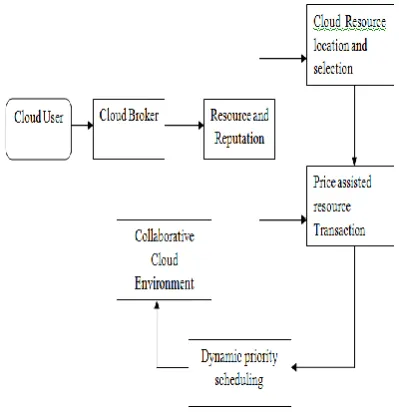
To improve resource utilization based on optimal time period to allocate resources propose neural network training and for load factor propose dynamic priority for the nodes based on which the virtual machines are scheduled. It schedules the VMs to the nodes depending upon their priority value, which varies dynamically based on their load factor. This dynamic priority concept leads to better utilization of the resources. Priority of a node is assigned depending upon its capacity and the load factor. This algorithm strikes the right balance between performance and power efficiency.
Once the highest and next highest priority nodes have been identified, then the scheduling is very quick. It prevents a particular node from being overloaded by considering the load factor.
Figure 6.1 Neural Network Based Resource Utilization Scheme for cloud
CREATION
OF
CLOUD
ENVIRONMENT
translated to a network address through a global directory service, such as DNS. A request to a site is routed through the internet to a machine inside the data enter that either processes the request or forwards it. Clouds are shared environments where multiple cloud users utilize the same equipment. Cloud user is request the resource from service provider.
Multiple cloud users can request number of cloud services simultaneously. So there must be a provision that all resources are made available to requesting user in efficient manner to satisfy their need. Cloud networks are shared in a best-effort manner making it hard for both users and cloud operators to reason about how network resources are allocated.
MULTI
FACED
RESOURCE
/
REPUTATION MANAGEMENT
In CCC operates in a large-scale environment involving thousands or millions of
resources across disparate geographically
distributed areas, and it is also inherently dynamic as entities may enter or leave the system and
resource utilization and availability are
continuously changing. This environment makes efficient resource management (resMgt) a non-trivial task. Due to the autonomous and individual characteristics of entities in CCC, different nodes provide different quality of service (QoS) in resource provision.
A node may provide low QoS because of system problems or because it is not willing to provide high QoS in order to save costs. Relying on a distributed hash table overlay (DHT), Harmony offers multi-faceted reputation evaluation across multiple resources by indexing the resource information and the reputation of each type of resource to the same directory node. In this way, it enables nodes to simultaneously access the information and reputation of available individual resources.
MULTI-QOS-ORIENTED RESOURCE
SELECTION
A single QoS demand of users, Harmony enables a client to perform resource selection with joint consideration of diverse QoS requirements, such as reputation, efficiency, distance, and price, with different priorities. The problem is how to consider individual or combined QoS attributes,
and a user’s desired priorities of the attributes in provider selection. Harmony solves the problem by unifying all attribute values and a client’s considered attribute priority into an overall QoS metric. EBay’s reputation system asks users to provide feedback on different aspects such as item
description and shipping charge. Similarly,
Harmony utilizes a list of QoS attributes.
It requires nodes to give ratings for each QoS attribute and overall QoS for a resource service in addition to the reputation for a server. As the reputation feedback, the QoS ratings are also collected at the directory node of the provided resource of the server. The overall QoS is actually a result of the combined influence from the QoS attributes. It is not easy to detect how the different attributes influence the overall QoS.
Harmony depends on a neural network to find out the influence weight of each attribute on the overall QoS value, and further considers users attribute consideration priority. A neural network can be used to derive meaning from complicated or imprecise data, and extract patterns and detect trends. It uses adaptive learning to learn how to do tasks based on the data given for training, and then functions as an expert on the data it has been given to analyze.
DYNAMIC PRIORITY SCHEDULING
A dynamic scheduling algorithm is proposed with dynamic priority for the nodes based on which the virtual machines are scheduled. It schedules the VMs to the nodes depending upon their priority value, which varies dynamically based on their load vector. This dynamic priority concept leads to better utilization of the resources. Priority of a node is assigned depending upon its capacity and the load factor.
This algorithm strikes the right balance between performance and power efficiency. Once the highest and next highest priority nodes have been identified, then the scheduling is very quick. It prevents a particular node from being overloaded by considering the load vector.
{
Flag=0;
If (P =/0)
If (load vector of P1<0.8)
Assign VM to P1;
If (P2 is set AND load vector of P2<0.8 AND
Swap P1 and P2;
Assign VM to P2;
Else if
P2=P1
P1=current max available resource node
Assign VM to P1;
}
ALGORITHM SCHEDULING PRIORITY
PRICE
ASSISTED
RESOURCE/
REPUTATION MANAGEMENT
In a resource transaction, a resource
requester pays a resource provider for its resource. The transactions are conducted in a distributed manner in Harmony. Harmony employs a trading model for resource transactions in resource sharing and leverages the resource price to control each node’s resource use and reputation. It enables each node to adaptively adjust its resource price to maximize its profit and maintain a high reputation while avoiding being overloaded, in order to fully and fairly utilize resources in the system.
A provider normally specifies the price of
its resources according to the reputation value, load, and the desirability of the resources. Resources with higher reputations, lower loads, and higher demand frequently requested should have high prices. In order to earn more income, each node is motivated to provide high QoS to maintain high reputation, while avoiding being
overloaded. The price-assisted resource/
reputation control scheme prevents uncooperative behaviours, encourages nodes to provide high QoS and allows nodes to adaptively adjust their load to offer high QoS. All resources in the system are fully and fairly utilized, nodes are not overloaded, and a node’s reputation can truly reflect its QoS in offering resources without the influence of the overloaded status. To address the problem of low reputation for newly joined nodes, Harmony assigns the nodes a certain amount of starting virtual credits that can be used for building initial reputation.
CONCLUSION
To improve resource utilization based on
optimal time period to allocate resources propose neural network training and for load factor propose dynamic priority for the nodes based on which the virtual machines are scheduled. It schedules the VMs to the nodes depending upon their priority value, which varies dynamically based on their load factor. This dynamic priority concept leads to better utilization of the resources. Priority of a node is assigned depending upon its capacity and the load factor. This scheme is used in terms of simulation time, total allocation. Based on the comparison and the results from the experiment show the proposed approach works better than the other existing system.
REFERENCES
[1]. Amazon Elastic Compute Cloud (EC2),
http://aws.amazon.com, 2013.
[2]. Dropbox, www.dropbox.com, 2013.
[3]. P. Suresh Kumar, P. Sateesh Kumar and S.
Ramachandram, “Recent Trust Models In Grid,” J. Theoretical and Applied Information Technology, vol. 26, pp. 64-68, 2011
[4]. J. Li, B. Li, Z. Du and L. Meng,
“CloudVO: Building a Secure Virtual
Organization for Multiple Clouds
Collaboration,” Proc. 11th ACIS Int’l
Conf. Software Eng. Artificial
Intelligence Networking and
Parallel/Distributed Computing (SNPD), 2010.
[5]. C. Liu, B.T. Loo and Y. Mao,
“Declarative Automated Cloud Resource Orchestration,” Proc. Second ACM Symp Cloud Computing (SOCC ’11), 2011
[6]. C. Liu, Y. Mao, J.E. Vander Merwe, and M.F. Fernandez, “Cloud Resource
Orchestration: A Data Centric
Approach,” Proc. Conf. Innovative Data Systems Research (CIDR) , 2011.
[7]. K. Hwang, S. Kulkarni and Y. Hu, “Cloud
Autonomic and Secure Computing (DASC), 2009
[8]. Zol, http://www.zol.com.cn/, 2013.
[9]. PlanetLab, http://www.planet-lab.org/,
2013.
[10]. H. Shen and G. Liu, “Harmony: Integrated
Resource and Reputation Management for Large-Scale Distributed Systems,” Proc. 20th Int’l Conf. Computer Comm. and Networks (ICCCN), 2011.
[11]. H. Shen and C.-Z Xu, “Leveraging a
Compound Graph Based DHT for
Multi-Attribute Range Queries with