www.ijper.org
Comparative Study of Various Non-Nucleoside
Reverse Transcriptase Inhibitors on Different
Reverse Transcriptase Enzyme
Shital Manoj Patil*, Kalyani Dhirendra Asgaonkar, Trupti Sameer Chitre, Aditi Kinikar, Chaitali Kharat, Vaibhavi Bhoirekar, Madhura Athavale, Mitali Katkar
Department of Pharmaceutical chemistry, All India Shri Shivaji Memorial Society’s College of Pharmacy, Kennedy, Pune, INDIA.
ABSTRACT
Context: Acquired immunodeficiency Syndrome (AIDS) is caused by Human immunodeficiency virus type 1 (HIV-1). 4-Thiazolidone nulecus is the target pharmacophore which have diverse biological activities including anti HIV activity. Aim: To study binding behavior of thiazolidinone derivatives on four different crystal structures of HIV- 1RT. Material and Method: Binding pattern of some thiazolidinone derivatives was gauged by molecular docking studies on four different receptors bearing PDB code 1ZD1, 1RT2, 1KLM, 1FKP of HIV–RT enzyme using V. Life MDS software. Result and Discussion: The studies revealed hydrogen bonds, hydrophobic interaction and pi-pi interactions playing significant role in binding of the molecules to the enzyme.
Conclusion: Interactions, binding energy and dock score of molecule 6 was comparable with the standard drugs.
Key words: Molecular Docking, Thiazolidinone, HIV, NNRTI.
DOI: 10.5530/ijper.51.4s.104 Correspondence:
Dr. Shital M Patil,
Department of Pharmaceuti-cal chemistry, All India Shri Shivaji Memorial Society’s College of Pharmacy, Kennedy Road, Pune, INDIA. Phone no: 9881203150 E-mail: [email protected]
INTRODUCTION
Acquired immunodeficiency Syndrome (AIDS) is caused by Human immunode
-ficiency virus type 1 (HIV-1) in which in built defence system of body breaks down completely. Drug treatment comprises of a combination of nucleoside/nucleotide reverse transcriptase inhibitors (NRTIs/ NTRIs) and non-nucleoside reverse tran
-scriptase inhibitors (NNRTIs), protease inhibitors and HIV integrase inhibitors. But in spite of the highly active antiretroviral therapy (HAART) complete eradication of retrovirus is still not achieved.1
In view of the increasing incidence of resis
-tance to current drug regimens and the frequency of adverse events, the development of novel, selective, potent, safe, inexpensive antiviral agents, that are also effective against mutant HIV strains such as Y188C, Y181C, K103N, L1001remains a high priority for medical research.2
Submission Date: 23-08-2017;
Revision Date: 14-09-2017;
Accepted Date: 09-10-2017
4-Thiazolidone derivatives have attracted continuing interest over the years because of their diverse biological activities including anti HIV activity.3-9 these derivatives acts on HIV-1 reverse transcriptase (HIV-1 RT) enzyme. RT inhibitors are of two types: nucleoside reverse transcriptase inhibitors (NRTIs), which act as chain terminators to block the elongation of the HIV-1 viral DNA strand, and non-nucleoside reverse transcriptase inhibitors (NNRTIs), which directly inhibit RT enzyme by binding to the allosteric site near the polymerase active site. In this regard, NNRTIs are more specific and less toxic than NRTIs because they do not affect the activity of cellular poly
NRTIs inhibit RT selectively but are considerably toxic to cellular and mitochondrial DNA synthesis.6
In the present work a library of synthesized thiazolidi
-none based New chemical entities (NCE’s) with anti HIV activity were used for pharmacophore optimization by studying their binding behavior with four different crystal structures of HIV- 1RT i.e. 1KLM, 1FKP, 1RT2, 2ZD1. The types of interactions, amino acids involved were analyzed along with the docking score and binding energy. This analysis by comparing with the standard existing drugs helped to gauze the structural requirement of the NCE’s for effective anti HIV activity.
METHODOLOGY
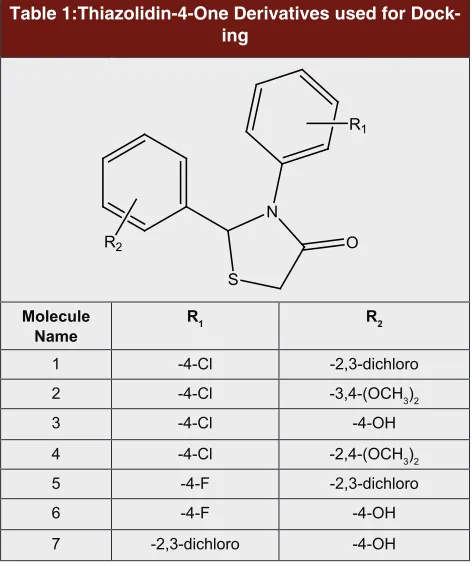
A library of Thiazolidin-4-one derivatives as anti HIV agents was synthesized,10,11,12 and was used for the docking study Table 1. The four crystal structures of HIV- 1RT i. e. 1KLM, 1FKP, 1RT2, 2ZD1 were obtained from protein data bank (PDB). The docking study was carried out using V-Life Molecular Design Suite (MDS) Software 4.3.
Ligand structures were drawn using Chemdraw software and converted to 3D.This was followed by energy optimization using Merck Molecular Force Field (MMFF) method.
The protein crystal structures preparation was carried out in two steps, preparation and refinement. After ensuring chemical correctness, hydrogen was added where hydrogen atoms were missing. Water molecules in the crystal structures were deleted. Protein structures were checked for any incomplete, missing residues, crisscross geometry and Ramchandran plot. Incomplete residues were mutated and missing residues were inserted in the loop. Co crystallized ligand was identified and extracted and other unwanted ligands and ions were removed. Exact Cavity and channel were identified based on hydrophobic surface area of residue within cavity, Ramchandran plot and local geometry analysis. The protein was then optimized and minimum energy conformer was generated by MMFF method. The ligands were docked into a specific cavity protein structure using Genetic algorithm(GA) based for rapid flexible docking technique based on the residues of active site. The protein ligand docked complex was optimized and then checked for various interaction of ligand with receptor like hydrogen bonding, hydrophobic bonding and van der Waal’s. After docking, each ligand and receptor was merged and their complex was then energetically optimized. The binding affinity was evaluated by the binding free energy, hydrogen bonding interaction, hydrophobic interaction and RMSD values. Minimum
dock score is an indication of stable ligand receptor complex.13,14,15,16
RESULT AND DISCUSSION
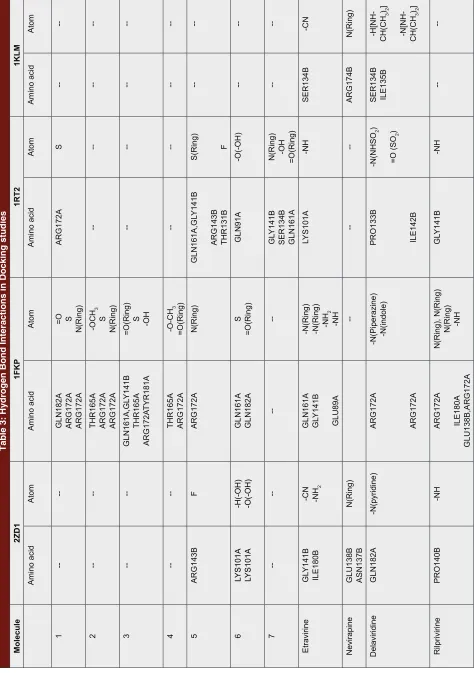
The molecular docking studies were carried out on four crystal structures of RT enzyme (PDB code 1FKP, 1RT2, 2ZD1, 1KLM). The Molecules were ranked on the basis of Docking score and binding energy Table 2. The molecular basis of interaction with the non nucleoside inhibitory binding pocket of HIV-1RT was analyzed. Table 3
Molecule 1
Molecule 1showed binding only with 1FKP and 1RT2 receptors. Groups such as =O, S and N (Ring) were bound through hydrogen bonds with amino acids such as GLN182A (2.384Å), ARG172A (2.419Å), ARG172A (1.475Å) respectively. Similarly with 1RT2, S atom was bound to ARG172A (2.006Å).
Molecule 2
Molecule 2 showed binding only with 1FKP binding site using -OCH3, S (Ring), N (Ring) to bind THR165A (2.558 Å), ARG172A (1.674 Å), ARG172A (2.343 Å) through hydrogen bonds.
Molecule 3
Module 3 showed hydrogen bond binding with GLN161A (2.533 Å), GLY141B (2.103Å), through =O, THR165A (2.523Å) with S atom and ARG172A (2.258 Å), TYR181A (1.608Å) with –OH group in the binding pocket of 1FKP. It did not show any hydrogen bond interactions with other receptors.
Molecule 4
Module 4 also showed hydrogen bonding only with 1FKP to the THR165A (2.569Å) and ARG172A (2.459 Å) through –OCH3 and =O atoms respectively.
Molecule 5
Molecule 5 has shown hydrogen bond interactions with three receptors 2ZD1, 1FKP and 1RT2. With 2ZD1, F atom was found to form hydrogen bond with ARG143B (2.139Å). N atom of the thiazolidinone ring has formed hydrogen bond with ARG172A (1.823Å) in 1FKP receptor. With 1 RT2 receptor the S atom of thiazolidinone ring has shown interaction with GLN161A (2.053 Å), GLY141B (2.424Å) and F atom has shown interaction with ARG143B (1.759 Å) and THR131B (1.625Å).
Figure 1: Docking pose of molecule 6 in 1FKP receptor - a) H-Bond interaction b) Aromatic interaction (pi-pi stacking).
Figure 2: Docking pose with H-bond interaction of molecule 6 in 2ZD1 receptor.
Figure 3: Docking pose of molecule 6 in 1RT2 receptor - a) H-Bond interaction b) Aromatic interaction (pi-pi stacking).
Module 6 showed hydrogen bond interactions with 2ZD1, 1FKP and 1RT2 Figure 1, 2, 3.In 2ZD1 receptor LYS101A (1.705 Å) interacted with hydrogen of –OH group and also with oxygen of –OH group at2.033 Å distance. Sulphur and carbonyl group of thiazolidinone ring interacted with GLN161A (2.501 Å), GLN182A (2.356 Å) respectively in 1FKP receptor cavity. In
Table 1:Thiazolidin-4-One Derivatives used for Dock-ing
S N
O R2
R1
Molecule
Name R1 R2
1 -4-Cl -2,3-dichloro
2 -4-Cl -3,4-(OCH3)2
3 -4-Cl -4-OH
4 -4-Cl -2,4-(OCH3)2
5 -4-F -2,3-dichloro
6 -4-F -4-OH
7 -2,3-dichloro -4-OH
Table 2: Dock Score and Binding Energies for the Derivatives
2ZD1 1FKP 1RT2 1KLM
Molecule Dock score Binding
energy scoreDock Binding energy scoreDock Binding energy scoreDock Binding energy
1 -0.913 -29.13 -1.066 -30.48 -0.914 -21.92 -1.194 -19.13
2 -0.690 -22.54 -0.104 -21.68 -0.210 -16.48 -0.345 -12.54
3 -1.160 -31.73 -1.116 -34.84 -1.531 -33.24 -1.553 -23.73
4 -0.948 -29.83 -1.029 -30.62 -0.918 -22.05 -1.076 -19.83
5 -0.712 -26.76 -0.970 -27.82 -0.853 -18.38 -0.680 -16.76
6 -1.940 -32.15 -1.828 -38.99 -1.463 -34.00 -1.758 -27.15
7 -0.610 -21.17 -0.047 -17.06 -0.053 -15.80 -0.047 -11.17
Etravirine -1.703 -32.45 -0.819 -39.02 -1.942 -34.49 -0.868 -27.12
Nevirapine -0.698 -33.12 -1.370 -39.15 -2.363 -33.06 -3.912 -28.12
Delaviridine -3.175 -32.39 -0.629 -39.10 -2.021 -34.40 -1.797 -28.39
Table 3: Hydrogen Bond Interactions in Docking studies Molecule 2ZD1 1FKP 1RT2 1KLM Amino acid Atom Amino acid Atom Amino acid Atom Amino acid Atom 1
--GLN182A ARG172A ARG172A =O S N(Ring) ARG172A S --2
--THR165A ARG172A ARG172A
-OCH 3 S N(Ring) --3 --GLN161A,GL Y141B THR165A ARG172A TYR181A
=O(Ring) S -OH
--4 --THR165A ARG172A -O-CH 3 =O(Ring) --5 ARG143B F ARG172A N(Ring) GLN161A,GL Y141B ARG143B THR131B S(Ring) F --6 LYS101A LYS101A -H(-OH) -O(-OH) GLN161A GLN182A S =O(Ring) GLN91A -O(-OH) --7 --GL Y141B SER134B GLN161A N(Ring) -OH =O(Ring)
--Etravirine GL Y141B ILE180B -CN -NH 2
GLN161A GLY141B GLU89A
-N(Ring) -N(Ring) -NH
--1RT2 the oxygen of –OH formed hydrogen bond with GLN91A (2.506 Å)
Molecule 7
Module 7showed interaction only with 1RT2 receptor via hydrogen bonds between, N atom of thiazolidinone ring with GLY141B (2.206 Å),-OH group with SER134B (2.546 Å) and =O in the ring with GLN161A (2.131 Å). Standard drug Etravirine showed interactions with all the receptors. In 2ZD1 it showed interaction with GLY141B (1.782 Å), ILE180B (1.811 Å) through –CN group and –NH2 group respectively. In 1KLM again the –CN group showed interaction with SER134B (2.405 Å). In 1RT2 the NH group formed bond with VAL90A (2.403 Å).With 1FKP there were multiple interaction using –NH group with GLU89A (1.841 Å), -NH2 group with GLY141B (1.313 Å) and –N of the ring formed two hydrogen bonds with GLN161A (2.589 Å) and GLY141B (2.064 Å).Neverapine interacted with 2ZD1 and 1KLM through the ring N atom to GLU138B (2.658 Å), ASN137B (2.491 Å) and ARG174B (2.332 Å) respectively. Rilprivirine drug showed binding with 2ZD1, 1FKP and 1RT2.The interactions were seen between –NH group and PRO140B (2.567 Å) of 2ZD1 and GLY141B (2.504 Å) of 1RT2. Multiple interactions were seen in 1FKP receptor via GLU138B (2.109 Å), ARG172A (1.917 Å) to the –NH group. Both the N atoms in the ring showed interaction with ARG172A (2.004 Å, 2.095 Å), and one N with ILE180A (1.953 Å). Delaviridine drug interacted well with all the four receptors. In 2ZD1 it formed hydrogen bond through the Pyridine nitrogen to GLN182A (1.390 Å), with 1 FKP two hydrogen bonds were noted with -N (Pipera
-zine) and-N (Indole) through their interaction with ARG172A (1.658 Å), ARG172A (1.213Å) respectively. Incase of 1RT2 the amino acids PRO133B (1.395 Å), ILE142B (2.014 Å) were involved in interaction with nitrogen of -NHSO2- group and =O of -SO2 group. In 1KLM hydrogen and nitrogen of [NH-CH (CH3)2]
group interacted with SER134B (2.558 Å), ILE135B (2.004 Å) respectively.
Significant Hydrophobic interactions were also seen in the binding studies of majority of the Molecules. Molecules 1-3 showed such interactions in the 1KLM with ARG 172A, THR 139 B, ILE 142B which were comparable with the standard drugs Etraverinze and Neverapine. Several interactions were noted in the 2ZD1 pocket for all the Molecules 1-6 along with the standard drugs. The interactions were majorly to THR 165A, VAL 90A, PRO 140B, GLN 161A, TYR 181A, GLN 91A, LEU168A. In 1RT2 receptor all the Mole
-cules showed hydrophobic binding and the main amino
acids involved in the interaction were ARG 172 A,VAL 90A, GLN 91A, GLN 161A,PRO140B,GLY141B and ASN 137B. In the 1FKP receptor Molecules1, 2, 4 and 7 have shown hydrophobic interactions with TYR181A, GLN161A, THR1651A, and ARG172A in the similar to the standard drugs.
Aromatic(pi-pi) interactions were significantly observed between aromatic ring substituted on nitrogen of thia
-zolidinone nucleus and TYR 181 A for molecules 2, 4, 6 similar to the standard drugs Etravirine, Nevirapine in 1FKP binding pocket.
Molecule 6 showed good binding energy of -32.15, -38.99, -34.00, -27.15 with 2ZD1, 1FKP 1RT2, 1KLM, respectively as compared to the other molecules. Binding energy of molecule 6 was found to be significantly comparable with the standard co-crystallised ligands.
CONCLUSION
In the present work molecular docking study was focused on understanding the binding mode of molecules on different crystal structures of HIV-1RT enzyme. The studies have indicated that thiazolidinone ring plays a crucial role for producing biological activity through hydrogen bond interactions in the binding pocket. Amongst the different substituents –OH group has shown the best hydrogen bonding as in Molecule 3, 6, 7 which would probably contribute to the biological activity. Aromatic interactions are observed with TYR 181, an important active residue for binding affinity of the inhibitor. Molecule 6 can be consider as a lead for further studies due to better docking score, more number of hydrogen bonds, minimum binding energy and key interaction with important amino acid residue (TYR 181A) only with 1FKP.
ACKNOWLEDGEMENT
Authors are thankful to Dr. A R Madgulkar, Principal AISSMS College of Pharmacy, and Pune for providing necessary research facilities and support.
CONFLICT OF INTERST
The authors declare no conflicts of interest.
ABBREVIATIONS USED
AIDS: Acquired Immunodeficiency Syndrome;
HIV-1: Human Immunodeficiency Virus type 1; NRTIs/
NTRIs: Nucleoside/Nucleotide Reverse Transcriptase
Inhibitors; NNRTIs: Non-nucleoside reverse tran
-viral Therapy; RT: Reverse Transcriptase; NCE’s: New Chemical Entities; PDB: Protein Data Bank; MDS:
Molecular Design Suite; MMFF: Merck Molecular Force Field.
REFERENCES
1. Nagalakshmi G, Maity TK, Maiti BC. Synthesis, Characterization and Anti-HIV Evaluation of Some Novel N-[2-(substitutedphenyl)-5-methyl-4-oxo-1,3- thiazolidin-3-yl] benzamides. International Journal of Chemtech Research. 2013;5(5):2057-67
2. Das K, Bauman JD, Clark AD, Frenkel YV, Lewi PJ, Shatkin AJ, et al. High-resolution structures of HIV-1 reverse transcriptase/TMC278 complexes:
strategic flexibility explains potency against resistance mutations. Proc Natl
Acad Sci U.S.A. 2008;105:1466-71.
3. Barreca ML, Balzarini J, Chimirri A, Clercq ED, Luca LD, Holtje HD. et al. Design, synthesis, structure-activity relationships, and molecular modeling studies of 2,3-diaryl-1,3-thiazolidin-4-ones as potent anti-HIV agents. J Med Chem . 2002;45(24),5410-5413.
4. Gupta A, Singh R, Sonar PK, Saraf SK.Novel 4-thiazolidinone derivatives as anti-infective agents: Synthesis characterisation and antimicrobial evaluation. Biochemistry Research International. 2016;2016:1-8.
5. Murugesan V, Tiwari V, Saxena R, Tripathi R, Paranjape R, Kulkarni S, et al. Lead optimization at C-2 and N-3 positions of thiazolidin-4-ones as HIV-1 non-nucleoside reverse transcriptase inhibitors. Bioorganic and Medicinal Chemistry. 2011;19(22):6919-26.
6. Murugesan V, Makwana N, Suryawanshi R, Saxena R, Tripathi R, Paranjape R,
et al. Rational design and synthesis of novel thiazolidin-4-ones as nonnucleoside HIV-1 reverse transcriptase inhibitors, Bioorganic and Medicinal Chemistry. 2014;22:3159-70.
7. Rao A, Balzarini J, Carbone A, Chimirri A, Clercq ED, Monforte AM, et al. 2-(2,6-Dihalophenyl)-3-(pyrimidin-2-yl)-1,3-thiazolidin-4-ones as non-nucleoside HIV-1 reverse transcriptase inhibitors. Antiviral Research. 2004;63(2):79-84. 8. Samadhiya P, Sharma R, Srivastava SK, Srivastava SD. Synthesis and
Biological Evaluation of 4 thiazolidone derivatives as Anti tubercular and anti microbial agents. Arabian Journal of Chemistry . 2014;7(5):657-5.
9. Tripathi AC, Gupta SJ, Fatima G, Sonar PK, Verma A, Saraf SK. 4-Thiazolidinones: The advances continue. European Journal of Medicinal Chemistry. 2014;72:52-77.
10. Deep A, Jain S, Sharma PC, Mittal SK, Phogat P, Malhotra M. Synthesis, characterization and antimicrobial evaluation of 2, 5-disubstituted-4-thiazolidinone derivatives. Arabian Journal of Chemistry. 2014;7:287-91. 11. Desai N, Dodiya AM. Synthesis, characterization and antimicrobial screening
of quinoline based quinazolinone-4-thiazolidinone heterocycles. Arabian Journal of Chemistry. 2014;7:906-13.
12. Murugesan V, Makwana N, Suryawanshi R, Saxena R, Tripathi R, Paranjape R,
et al. Rational design and synthesis of novel thiazolidin-4-ones as non-nucleoside HIV-1 reverse transcriptase inhibitors. Bioorganic and Medicinal Chemistry. 2014;22:3159-70.
13. Chourasiya RK, Rao AR, Agrawal RK.QSAR and docking studies of novel β-carboline derivatives as anticancer. Medicinal Chemistry Research. 2012;22:2991-3001.
14. Gunjegaonkar MB, Fegade SA, Kulkarni AA, Nanda RK. Docking, synthesis, antimicrobial screening and beta lactamase inhibitory
activity of 3-(4-fluorophenylimino) indolin-2-one and 5- 3, 4 chloro-3-(4-fluorophenylimino) indolin-2-one derivatives. IOSR Journal of Pharmacy.
2012;2(5):18-22.
15. V Life MDS; Molecular Design Suite version 3.5. V-life Sciences Technologies Pvt. Ltd., Pune, India, 2004. www.vlifesciences.com
16. Noolvi MN Patel HM.A comparative QSAR analysis and molecular docking studies of quinazoline derivatives as tyrosine kinase (EGFR)inhibitors: A rational approach to anticancer drug design. Journal of Saudi Chemical Society. 2013;17:361-79.
SUMMARY PICTORIAL ABSTRACT
• In order to study the Anti HIV potential and to gauge the possible binding mode, a library of thiazolidinone analogues was docked into the active site of four different crystal structures of HIV -1 RTviz; 2ZD1, 1RT2, 1KLM, 1FKP. These analogues were evaluated based on their binding interactions, binding energy and dock score. The studies revealed the crucial role of thiazolidinone ring, Hydroxyl substituent in contributing to the anti HIV activity resulting from hydrogen bond interactions, aromatic interactions with the key amino acid residue.
Kalyani Asgaonkar- M.Pharm: Assistant Professor in Dept. of Pharmaceutical chemistry. Her area of research includes drug design, synthesis of Anti HIV and Anti TB entities.
About Authors
Cite this article: Patil SM, Asgaonkar KD, Chitre TS, Kinikar A, Kharat C, Bhoirekar V, Athavale M, Katkar M. Comparative Study of Various Non-Nucleoside Reverse Transcriptase Inhibitors on Different Reverse Transcriptase Enzyme. Indian J of Pharmaceutical Education and Research. 2017;51(4S):S722-S8.
Vaibhavi Bhoirekar: Undergraduate student of AISSMS College of Pharmacy.
Chaitali Kharat: Undergraduate student of AISSMS College of Pharmacy.
Aditi Kinnikar: Undergraduate student of AISSMS College of Pharmacy.
Madhura Athavale: Undergraduate student of AISSMS College of Pharmacy.
Mitali Katkar: Undergraduate student of AISSMS College of Pharmacy.