Parneet Kaur
et al
, International Journal of Computer Science and Mobile Applications,
Vol.2 Issue. 12, December- 2014, pg. 79-86 ISSN: 2321-8363
©2014, IJCSMA All Rights Reserved, www.ijcsma.com 79
Implementation of a Novel Approach to Make NLP
Predictive and Non-Ambigious in Punjabi Language
Parneet Kaur
*Vandana Pushe
*Student of master Technology Assistant Professor Department of CSE Department of CSE
Desh Bhagat University Desh Bhagat University Mandi Gobindgarh, Punjab, India Mandi Gobindgarh, Punjab, India [email protected] [email protected]
Abstract— Natural language learning is the process of learning the semantics of natural language with respect to relevant perceptual inputs. Toward this goal, computational systems are trained with data in the form of natural language sentences paired with relevant but ambiguous perceptual contexts. With such ambiguous supervision, it is required to resolve the ambiguity between a natural language (NL) sentence and a corresponding set of possible logical meaning representations (MR) in Punjabi Language in which two words have same pronunciation but different meaning. My research focuses on devising effective models for simultaneously disambiguating such supervision and learning the underlying semantics of language to map NL sentences into proper logical forms. Specifically, this research present two probabilistic generative models for learning such correspondences in which there is a reduction in ambiguous data and it can predict the results based upon the history of the data that is searched.
Keywords- computational systems, ambiguous supervision, logical meaning representations, Punjabi Language, Homonyms
I. INTRODUCTION
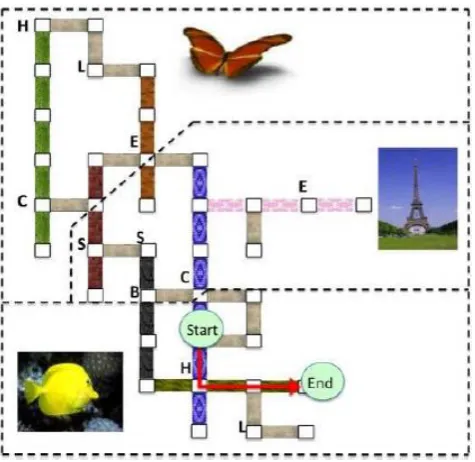
An important application of natural language processing is the interpretation of human instructions. The ability to parse instructions and perform the intended actions is essential for smooth interactions with a computer or a robot. Some recent work has explored how to map natural-language instructions into actions that can be performed by a computer (Branavan et al. 2009; Lau, Drews, and Nichols 2009). In particular, we focus on the task of navigation (MacMahon, Stankiewicz, and Kuipers 2006; Shimizu and Haas 2009; Matuszek, Fox, and Koscher 2010; Kollar et al. 2010; Vogel and Jurafsky 2010). The goal of the navigation task is to take a set of natural language directions, transform it into a navigation plan that can be understood by the computer, and then execute that plan to reach the desired destination. Route direction is a unique form of instructions that specifies how to get from one place to another and understanding them depends heavily on the spatial context. The earliest work on interpreting route directions was by linguists (Klein 1982; Wunderlich and Reinelt 1982). While this domain is restricted, there is considerable variation in how different people describe the same route. Below are some examples from our test corpus of instructions given for the route shown in Figure 1:Paper proposed a semantic parser that is not restricted to a predefined ontology. Instead, we use distributional semantics to generate the needed part of an on-the-fly ontology. Distributional semantics is a statistical technique that represents the meaning of words and phrases as distributions over context words (Turney and Pantel, 2010; Landauer and Dumais, 1997). In particular, Chen and Mooney (2008) introduced the problem of learning to sportscast by simply observing natural language commentary on simulated Robocup robot soccer games. The training data consists of natural language (NL) sentences ambiguously paired with logical meaning representations (MRs) describing recent events in the game extracted from the simulator. Most sentences describe one of the extracted recent events; however, the specific event to which it refers is unknown. Therefore, the learner has to figure out the correct matching (alignment) between NL and MR before inducing a semantic parser or language generator. Based on an approach introduced by Kate and Mooney (2007), Chen and Mooney (2008) repeatedly retrain both a supervised semantic parser and language generator using an iterative algorithm analogous to Expectation Maximization (EM). However, this approach is somewhat ad hoc and does not exploit a well-defined probabilistic generative model or real EM training.
Parneet Kaur
et al
, International Journal of Computer Science and Mobile Applications,
Vol.2 Issue. 12, December- 2014, pg. 79-86 ISSN: 2321-8363
©2014, IJCSMA All Rights Reserved, www.ijcsma.com 80
Networks (MLN) (Richardson and Domingos, 2006) and Probabilistic Soft Logic (PSL) (Kimmig et al., 2012). They are Statistical Relational Learning (SRL) techniques (Getoor and Taskar, 2007) that combine logical and statistical knowledge in one uniform framework, and provide a mechanism for coherent probabilistic inference. We implemented this semantic parser (Beltagy et al., 2013; Beltagy et al., 2014) and used it to perform two tasks that require deep semantic analysis, Recognizing Textual Entailment (RTE), and Semantic Textual Similarity (STS).
Figure 1: This is an example of a route in our virtual world. The world consists of interconnecting hallways with varying floor tiles and paintings on the wall (butterfly, fish, or Eiffel Tower.) Letters indicate objects (e.g. ‟C‟ is a chair) at a location.
II.RELATED WORK
Parneet Kaur
et al
, International Journal of Computer Science and Mobile Applications,
Vol.2 Issue. 12, December- 2014, pg. 79-86 ISSN: 2321-8363
©2014, IJCSMA All Rights Reserved, www.ijcsma.com 81
Liang et al. (2009) with the generative semantic parsing model of Lu et al. (2008) in order to fully exploit the NL syntax and its relationship to the MR semantics. Therefore, unlike Liang et al.‟s simple Markov + bag-of-words model for generating language, it uses a tree-based model to generate grammatical NL from structured MR facts.
III. BACKGROUND
A.
Logical SemanticsLogic-based representations of meaning have a long tradition (Montague, 1970; Kamp and Reyle, 1993). They handle many complex semantic phenomena such as relational propositions, logical operators, and quantifiers; however, they can not handle “graded” aspects of meaning in language because they are binary by nature. Also, the logical predicates and relations do not have semantics by themselves without an accompanying ontology, which we want to replace in our semantic parser with distributional semantics. To map a sentence to logical form, we use Boxer (Bos, 2008), a tool for wide-coverage semantic analysis that produces uninterpreted logical forms using Discourse Representation Structures (Kamp and Reyle, 1993). It builds on the C&C CCG parser (Clark and Curran, 2004). Distributional Semantics Distributional models use statistics on contextual data from large corpora to predict semantic similarity of words and phrases (Turney and Pantel, 2010; Mitchell and Lapata, 2010), based on the observation that semantically similar words occur in similar contexts (Landauer and Dumais, 1997; Lund and Burgess, 1996). So words can be represented as vectors in high dimensional spaces generated from the contexts in which they occur. Distributional models capture the graded nature of meaning, but do not adequately capture logical structure (Grefenstette, 2013). It is possible to compute vector representations for larger phrases compositionally from their parts (Landauer and Dumais, 1997; Mitchell and Lapata, 2008; Mitchell and Lapata, 2010; Baroni and Zamparelli, 2010; Grefenstette and Sadrzadeh, 2011). Distributional similarity is usually a mixture of semantic relations, but particular asymmetric similarity measures can, to a certain extent, predict hypernymy and lexical entailment distributionally (Lenci and Benotto, 2012; Kotlerman et al., 2010).
B. Markov Logic Network
Markov Logic Network (MLN) (Richardson and Domingos, 2006) is a framework for probabilistic logic that employ weighted formulas in firstorder logic to compactly encode complex undirected probabilistic graphical models (i.e., Markov networks). Weighting the rules is a way of softening them compared to hard logical constraints. MLNs define a probability distribution over possible worlds, where a world‟s probability increases exponentially with the total weight of the logical clauses that it satisfies. A variety of inference methods for MLNs have been developed, however, their computational complexity is a fundamental issue.
C. Probabilistic Soft Logic
Probabilistic Soft Logic (PSL) is another recently proposed framework for probabilistic logic (Kimmig et al., 2012). It uses logical representations to compactly define large graphical models with continuous variables, and includes methods for performing efficient probabilistic inference for the resulting models. A key distinguishing feature of PSL is that ground atoms have soft, continuous truth values in the interval [0, 1] rather than binary truth values as used in MLNs and most other probabilistic logics. Given a set of weighted inference rules, and with the help of Lukasiewicz‟s relaxation of the logical operators, PSL builds a graphical model defining a probability distribution over the continuous space of values of the random variables in the model. Then, PSL‟s MPE inference (Most Probable Explanation) finds the overall interpretation with the maximum probability given a set of evidence. It turns out that this optimization problem is second-order cone program (SOCP) (Kimmig et al., 2012) and can be solved efficiently in polynomial time. Recognizing Textual Entailment Recognizing Textual Entailment (RTE) is the task of determining whether one natural language text, the premise, Entails, Contradicts, or not related (Neutral) to another, the hypothesis.
D. Semantic Textual Similarity
Semantic Textual Similarity (STS) is the task of judging the similarity of a pair of sentences on a scale from 1 to 5 (Agirre et al., 2012). Gold standard scores are averaged over multiple human annotations and systems are evaluated using the Pearson correlation between a system‟s output and gold standard scores.
IV. APPROACH
Parneet Kaur
et al
, International Journal of Computer Science and Mobile Applications,
Vol.2 Issue. 12, December- 2014, pg. 79-86 ISSN: 2321-8363
©2014, IJCSMA All Rights Reserved, www.ijcsma.com 82
Generative Model
Like Liang et al. (2009)‟s generative alignment model, our model is designed to estimate P(w|s), where w is an NL sentence and s is a world state containing a set of possible MR logical forms that can be matched to w. However, our approach is intended to support both determining the most likely match between an NL and its MR in its world state, and semantic parsing, i.e. finding the most probable mapping from a given NL sentence to an MR logical form.
Our generative model consists of two stages:
• Event selection: P(e|s), chooses the event e in the world state s to be described.
• Natural language generation: P(w|e), models the probability of generating natural-language sentence w from the MR specified by event e.
Formal Language: first-order logic Natural sentences are mapped to logical form using Boxer (Bos, 2008), which maps the input sentences into a lexically-based logical form, in which the predicates are words in the sentence. For example, the sentence “A man is driving a car” in logical form is:
We call Boxer‟s output alone an uninterpreted logical form because predicates do not have meaning by themselves. They still need to be connected with an ontology.
Parneet Kaur
et al
, International Journal of Computer Science and Mobile Applications,
Vol.2 Issue. 12, December- 2014, pg. 79-86 ISSN: 2321-8363
©2014, IJCSMA All Rights Reserved, www.ijcsma.com 83
input Navigation instructions and the corresponding navigationplans (e1, p1), . . . , (en, pn)
output Lexicon, a set of phrase-meaning pairs 1: main
2: for n-gram w that appears in e = (e1, . . . , en) do 3: for instruction ei that contains w do
4: Add navigation plan pi to meanings(w) 5: end for
6: repeat
7: for every pair of meanings in meanings(w) do 8: Add intersections of the pair tomeanings(w)
9: end for
10: Keep k highest-scoring entries ofmeanings(w)
11: until meanings(w) converges
12: Add entries of meanings(w) with scores higher than threshold t to Lexicon
13: end for 14: end main
V. IMPLEMENTATION
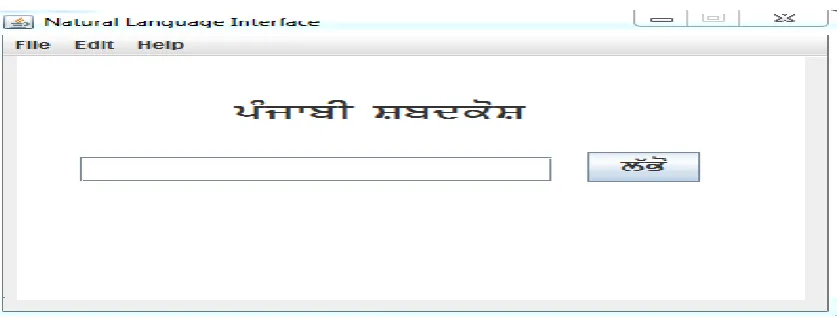
1.FIGURE GUI
Figure1 GUI
Parneet Kaur
et al
, International Journal of Computer Science and Mobile Applications,
Vol.2 Issue. 12, December- 2014, pg. 79-86 ISSN: 2321-8363
©2014, IJCSMA All Rights Reserved, www.ijcsma.com 84
2.WORD FEEDED
Figure 2: Word Feeded
In the above defined figure 2 the query is displayed in the gurmukhi script and the word is entered which has different meanings. Now all the synonyms of the above defined words will produce same results as this word is producing.
3.RESULT
Figure 3: Result
In the above defined figure 3 the query is displayed in the gurmukhi script and the word is entered which is a homonyms of some of the words.
VI. WORD TESTING
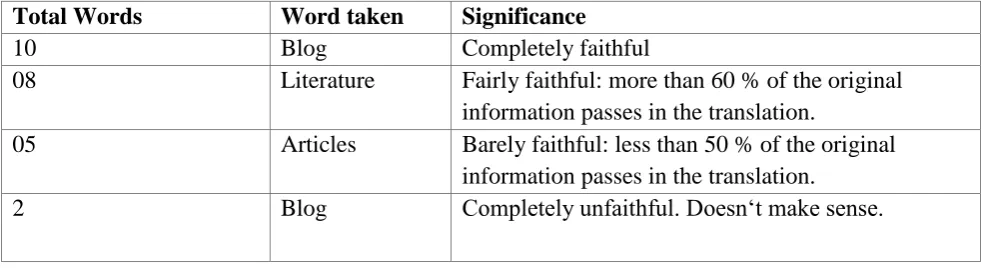
In word testing we take a words from articles, blog, and literature by different authors. We take a words in Punjabi language in which words of meaning different and pronunciation different. And finally get the output with good accuracy.
Total Words
Word taken
Significance
10
Blog
Completely faithful
08
Literature
Fairly faithful: more than 60 % of the original
information passes in the translation.
05
Articles
Barely faithful: less than 50 % of the original
information passes in the translation.
2
Blog
Completely unfaithful. Doesn„t make sense.
Parneet Kaur
et al
, International Journal of Computer Science and Mobile Applications,
Vol.2 Issue. 12, December- 2014, pg. 79-86 ISSN: 2321-8363
©2014, IJCSMA All Rights Reserved, www.ijcsma.com 85
VII. CONCLUSION
We have presented a novel system that learns a semantic parser for interpreting navigation instructions by simply observing the actions of human followers without using any prior linguistic knowledge or direct supervision. We demonstrated the need to model landmarks when executing longer, more complex instructions. We also introduced a plan refinement algorithm that fairly accurately infers the correct navigation plan specified in the instructions by using a learned semantic lexicon to remove extraneous information. Overall, our approach demonstrates an interesting and novel form of grounded language learning for a complex and useful task.
REFERENCES
[1]. Karl Pichotta, Raymond J. Mooney, "Statistical Script Learning with Multi-Argument Events", Proceedings of the 14th Conference of the European Chapter of the Association for Computational Linguistics (EACL 2014). [2]. Islam Beltagy, Katrin Erk, and Raymond Mooney. 2014. Probabilistic soft logic for semantic textual similarity.
In Proceedings of Association for Computational Linguistics (ACL-14).
[3]. Shruti Bhosale, Heath Vinicombe, Raymond Mooney, "Detecting Promotional Content in Wikipedia", Proceedings of the 2013 Conference on Empirical Methods in Natural Language Processing (EMNLP 2013), 1851--1857, Seattle, WA, October 2013.
[4]. Dan Garrette, Jason Mielens, Jason Baldridge, "Real-World Semi-Supervised Learning of POS-Taggers for Low-Resource Languages", Proceedings of the 51st Annual Meeting of the Association for Computational Linguistics (ACL-2013), 583--592, Sofia, Bulgaria, August 2013.
[5]. Niveda Krishnamoorthy, Girish Malkarnenkar, Raymond Mooney, Kate Saenko, Sergio Guadarrama, "Generating Natural-Language Video Descriptions Using Text-Mined Knowledge", Proceedings of the NAACL HLT Workshop on Vision and Language (WVL '13), 10--19, Atlanta, Georgia, July 2013.
[6]. Sindhu Raghavan, Raymond J. Mooney, "Online Inference-Rule Learning from Natural-Language Extractions", Proceedings of the 3rd Statistical Relational AI (StaRAI-13) workshop at AAAI '13, July 2013.
[7]. Danqi Chen, Richard Socher, Christopher D. Manning, Andrew Y. Ng, "Learning New Facts From Knowledge BasesWith Neural Tensor Networks and SemanticWord Vectors", Proceedings of the International Conference on Learning Representations (ICLR, Workshop Track), 16 March 2013.
[8]. Will Y. Zou, Richard Socher, Daniel Cer, Christopher D. Manning, "Bilingual Word Embeddings for Phrase-Based Machine Translation", Proceedings of the 2013 Conference on Empirical Methods in Natural Language Processing (EMNLP 2013)
[9]. Stephen Roller, Sabine Schulte im Walde, "A Multimodal LDA Model Integrating Textual, Cognitive and Visual Modalities", Proceedings of the 2013 Conference on Empirical Methods in Natural Language Processing (EMNLP 2013), 1146--1157, Seattle, WA, October 2013.
[10]. Sergio Guadarrama, Niveda Krishnamoorthy, Girish Malkarnenkar, "YouTube2Text: Recognizing and Describing Arbitrary Activities Using Semantic Hierarchies and Zero-shot Recognition", Proceedings of the 14th International Conference on Computer Vision (ICCV-2013), 2712--2719, Sydney, Australia, December 2013
[11].Karl Pichotta, John DeNero, "Identifying Phrasal Verbs Using Many Bilingual Corpora", Proceedings of the 2013 Conference on Empirical Methods in Natural Language Processing (EMNLP 2013), 636--646, Seattle, WA, October 2013.
[12].Jonathan Berant, Andrew Chou, Roy Frostig, and Percy Liang. 2013. Semantic parsing on Freebase from question-answer pairs. In Proceedings of Conference on Empirical Methods in Natural Language Processing (EMNLP-13).
[13].Juri Ganitkevitch, Benjamin Van Durme, and Chris Callison-Burch. 2013. PPDB: The paraphrase database. In Proceedings of North American Chapter of the Association for Computational Linguistics: Human Language Technologies (NAACL-HLT-13).
[14].Eneko Agirre, Daniel Cer, Mona Diab, and Aitor Gonzalez-Agirre. 2012. Semeval-2012 task 6: A pilot on semantic textual similarity. In Proceedings of Semantic Evaluation (SemEval-12).
[15].Marco Baroni and Roberto Zamparelli. 2010. Nouns are vectors, adjectives are matrices: Representing adjective-noun constructions in semantic space. In Proceedings of Conference on Empirical Methods in Natural Language Processing (EMNLP-10).
Parneet Kaur
et al
, International Journal of Computer Science and Mobile Applications,
Vol.2 Issue. 12, December- 2014, pg. 79-86 ISSN: 2321-8363
©2014, IJCSMA All Rights Reserved, www.ijcsma.com 86
[17].Johan Bos. 2008. Wide-coverage semantic analysis with Boxer. In Proceedings of Semantics in Text Processing (STEP-08).
[18].Stephen Clark and James R. Curran. 2004. Parsing the WSJ using CCG and log-linear models. In Proceedings of Association for Computational Linguistics (ACL-04).
[19].Rajendra Akerkar and Monish Joshi. Natural Language Interface Using Shallow Parsing International Journal of Computer Science and Applications, Techno mathematics Research FoundationVol. 5, No. 3, pp 70 – 90. [20]. Eman Othman Khaled Shaalan Ahmed Rafea. Towards Resolving Ambiguity In Understanding Arbic
Sentences.
[21]. Jun-Su Kim Wang-Woo Lee Chang-Hwan Kim Cheol-young Ock. A Korean Homonym Disambiguation System Based on Statistical Model Using weights.
[22].Ronan Collobert, Jason Weston, Leon Bottou ,Michael Karlen. Natural Language Processing (almost) from Scratch, Journal of Machine Learning Research 1 (2000).
[23].Tae Yano Moonyoung Kang. Taking advantage of Wikipedia in Natural Language Processing, Language Technologies Institute Language Technologies Institute Carnegie Mellon University Carnegie Mellon University Pittsburgh, PA 15213, USA.
[24].Daniel Sonntag. Assessing the quality of natural language text data , DaimlerChrysler Research and Technology, Ulm Germany.
[25].Olga Nevzorova, Julia Zin‟kina, Nicolaj Pjatkin. applied problems of functional homonymy resolution for russian language.
[26].Prakash M Nadkarni, Lucila Ohno-Machado,Wendy W Chapman . Natural language processing: an introduction.
[27].Zhaohui Luo, Contextual Analysis of Word Meanings in Type-Theoretical Semantics, Dept of Computer Science, Royal Holloway, Univ of London Egham, Surrey TW20 0EX, U.K.
[28].Harjit Singh, Providing Inferential Capability to Natural Language Database Interface, Assistant Professor: Department of Computer Science Punjabi University Akali Phoola Singh Neighbourhood Campus, Dehla Seehan (Sangrur), Punjab, India.
[29].Anagha Kulkarni, Michael Heilman, Maxine Eskenazi and Jamie Callan, Word Sense Disambiguation for Vocabulary Learning, Language Technologies Institute Carnegie Mellon University , Pittsburgh, PA, USA 15213.