_____________________________________________________________________________________________________ *Corresponding author: E-mail: [email protected];
Optimization of IBA for Efficient Survival of
Micropropagated
Garcinia indica
Choisy Shoots
Using
in-vitro
and
ex-vitro
Rooting Techniques
Gauri Mulik
1, Shubha Manvi
1, Gauri Ingale
1and Varsha A. Parasharami
1*1Plant Tissue Culture-Biochemical Sciences Division, CSIR-National Chemical Laboratory, Pune,
Maharashtra, India.
Authors’ contributions
This work was carried out in collaboration among all authors. Authors GM, SM and GI have carried out the standardization experiments of the parameters and analysed the data. Author VP has planned the experiment and designed the manuscript systematically. All authors read and approved the final manuscript.
Article Information
DOI: 10.9734/APRJ/2019/v2i430050 Editor(s): (1)Dr. Langa Tembo, Lecturer, Department of Agriculture Production, Makerere University, Kampala, Uganda And Department of Plant Science, University of Zambia, Lusaka, Zambia. (2)Dr. Nesreen Houssien Abou- Baker, Associate Professor, Department of Soil and Water Use, Division of Agricultural and Biological Research, National Research Centre, Giza, Egypt. Reviewers: (1) Aruna Rai, Smt. C. H. M. College, India. (2)Nyong Princely Awazi, University of Dschang, Cameroon. (3)Ufuoma Bigila Shemishere, Federal University Birnin Kebbi, Nigeria. Complete Peer review History:http://www.sdiarticle3.com/review-history/48890
Received 22 February 2019 Accepted 29 April 2019 Published 04 May 2019
ABSTRACT
Aims: The study focuses on optimization of concentration and time of rooting hormone exposure of IBA (Indole-3-Butyric Acid) for efficient survival of tissue culture raised Garcinia indica Choisy plantlets for in-vitro and ex-vitro rooting techniques.
Study Design: The subcultured microshoots of Garcinia indica were subjected to in-vitro and ex-vitro rooting trials by treating them with IBA of varying concentration and time, to standardize these particular parameters required by this auxin to induce rooting.
Place and Duration of Study: Rooting trials were carried out in Plant tissue culture-Biochemical Sciences Division of CSIR- National Chemical Laboratory, Pune 411008 between June 2018 and April 2019.
Methodology: Regularly subcultured five to six years old shoots from female trees of Garcinia indica were used for the study. Various concentrations of IBA in correlation with time were used for in-vitro and ex-vitro root induction. The rooted plantlets were then transferred to polyhouse for acclimatization and will further be planted in open field locations in June 2019.
Results: Induction of rooting was observed within thirty days of treatment with IBA. It was observed that 500ppm of IBA gave 30% rooting for in-vitro rooting trials whereas 2000ppm of IBA induced 80% rooting for shoots given ex-vitro rooting treatments. An interesting phenomenon that was observed for 70% of the shoots which failed to induce rooting by in-vitro treatment was that they survived with 100% rooting success under ex-vitro rooting conditions. The hardened plantlets were successfully acclimatized in the polyhouse with survival rate of 90% and were further transferred to polythene bags with rooting mixtures of sand: farmyard manure: coco peat (1:1:2). These plantlets have been healthy for the last 6 to 9 months and will be transported for field trials in June 2019.
Conclusion: Ex-vitro rooting technique was found to be more effective than in-vitro rooting. Thus, by optimizing the rooting hormone parameters, female plants of Garcinia indica can be successfully grown using tissue culture technology and can be propagated in large numbers to increase the female plant number in plantations.
Keywords: Garcinia indica; IBA; optimization; in-vitro; ex-vitro; hardening.
1. INTRODUCTION
Garcinia indica: A fruit bearing tree species commonly known as ‘kokam’ or ‘Indian butter tree’, is one of the native underexploited tree species for research and development found in the Western Ghats of Maharashtra, Coastal Karnataka and Goa [1]. Rind and seeds of the fruits are used in preparations of beverages and kokam butter respectively. Kokam butter is used as an essential ingredient in many beauty and cosmetic products owing to its soothing and smoothing properties. It is a saturated fat which is solid at room temperature and liquid when heated [2]. The fruit rind of kokam is rich in Garcinol, Anthocyanins and (–) Hydroxycitric acid (-HCA), which is an important biologically active plant metabolite used as an antiobesity drug [3,4,5,6]. Being a tree species, it is cross-pollinated and polygamodioecious in its natural population i.e. 50% would be female and 50% would be male trees which can be differentiated only after flowering and fruiting stage. In nature it takes seven to eight years for the tree to start bearing flowers [7]. The seeds are recalcitrant and are quick to lose viability. Therefore, it is difficult to raise seedlings throughout the year. However, greater variability among the genotypes which differ in production and quality, dioecious nature of plants, dominance of tropism in vegetative phase and harvesting of fruits at the onset of rainy season are a few of the obstacles faced in commercial cultivation of kokum.
Protocols of micropropagation using seed explants have been developed for this recalcitrant tree species [8,9,10]. The ultimate
success of micropropagation depends on the ability of successful rooting of in-vitro shoots. As, in-vitro grown shoots are adapted to growing in 80% relative humidity and in specialized nutrient media components supplied with sugar and other growth regulators, direct transfer of in-vitro grown shoots to ex-vitro conditions is a critical step. The present paper describes the protocol for optimizing the rooting parameters to ensure the efficient survival of G. indica by in-vitro and ex-vitro rooting techniques. The in-ex-vitro grown shoots which were used for these rooting trials were subcultured shoots of the last five to six years developed from female tree shoot buds collected during 2014-15 between January-May. Shoots were regularly sub-cultured in multiplication media standardized previously [11]. This medicinal plant is listed as endangered species of Southern India [12,13]. Due to increasing importance for traditional medicine in recent years, reintroduction of Garcinia indica in locations where it is endangered along with its in-situ conservation is very essential for human race. Thus, using biotechnological tools for ensuring the survival of rare species is necessary. Various protocols for in-vitro propagation of threatened species are standardized and can be used for conserving plants facing the threat of extinction [14]. Rapid in-vitro multiplication and conservation of
Garcinia indica offer the only safe and cost effective method for long term conservation of such species [15]. Root explants of Garcinia indica could also be effectively used for direct shoot regeneration and large scale multiplication [16].
Since G. indica is an economically important tree and endangered in southern part of India, for in-vitro conservation by micropropagation to become a reality in future, in-vitro and ex-vitro rooting methods have been standardized using various concentrations of IBA during present study.
2. MATERIALS AND METHODS
2.1 Location of Study
The research work was carried out at Plant Tissue Culture-Biochemical Science Division in CSIR-National Chemical Laboratory, Pune, India. The G. indica shoots used during the study were collected five to six years ago from a village in the Raigad district named ‘Sarole’ which is around 56km away from Pune in Maharashtra state. The village is located near the Mulshi dam with a Mean Sea Level (MSL) of 646. The geographical co-ordinates of Sarole are longitude of 18º28’37.34” N and latitudes of 73º26’ 31.38”E. Collection was done once every month from January to June in 2013-14. As this tree does not occur in Pune, Sarole village was the nearest collection site for initiation of G. indica in culture. The shoot buds were collected only from fruiting trees to ensure propagation of only female plants.
2.2 In-vitro Shoots for Rooting
Regularly subcultured microshoots of five to six years old Garcinia indica Choisy cultures incubated at 25±1°C and 16/8 photoperiod were used to carry out rooting experiments (Fig. 1a).
2.3 Subculturing
Shoots were regularly subcultured in autoclaved jam bottles of dimensions 55mm x 125mm with autoclavable polyvinyl caps containing multiplication WPM media (Woody Plant Medium, Lloyd and McCown, 1982) supplemented with growth hormones like BAP 2 mg/L, KIN 1mg/L, IBA 1 mg/L along with 3% sucrose (w/v) and 0.4% phytagel (w/v). All growth regulators were incorporated into medium before autoclaving. In order to avoid contamination, 50 mg/L of antifungal agent Bavistine (BAIF, India) was added. Medium was autoclaved at 120°C for 20 mins at 105 kPa. Sterile 100mg/L of antibacterial agent Cefotaxim (Alkem, India) were added to the autoclaved medium as a maintenance dose.
2.4 In-vitro Rooting
For in-vitro root induction, in-vitro grown shoots of length 4-5 cm long from which lower leaves were removed were used and a slanting cut was given to the base of each shoot. Varying concentrations of filter sterilized IBA (Sigma, Cat No. 094K1713) of 300, 400, 500, 700, 800, 2000 mg/L with varying time periods of 24, 48 and 72 hours were used for root induction. IBA was filter sterilized to eliminate contamination and maintain aseptic conditions. The shoots were then dipped into 5 ml of each WPM basal liquid rooting medium in test tubes of 25 mm x 150 mm. Each tube was fortified with these concentrations of filter sterilized IBA and incubated for 24, 48 and 72 hours in dark at 25±1ºC. The treated
shoots were shifted to G. indica rooting media containing WPM basal medium, 1.5%
Sucrose, 0.4% Phytagel devoid of growth
hormones in test tubes and incubated in culture room at 25±1ºC and 24 hrs light
conditions. The shoots were regularly observed for rooting.
2.5 Ex-vitro Rooting
In-vitro grown, elongated shoots of G. indica
were tested for ex-vitro rooting response. The shoots were washed carefully with water to remove traces of stuck agar and treated with 0.1% bavistin for 10 min. Slanting cuts were given at 1.5 cm from the basal portion of the shoots. They were dipped in aqueous solution of IBA of different concentrations ranging from 400, 1000, 2000, 3000 and 4000 mg/L for 5, 15, 20, 25 and 30 mins. These were then planted in plastic cups containing pre sterilized fine sand and sealed with another cup on top using cling wrap/paraffin to minimize the loss of moisture and maintain high humidity during rooting and hardening. Cups were maintained at 25±1ºC in 24 hrs light with watering after every third day by dipping the base of the cups (in which holes were made previously), using autoclaved water.
2.6 Hardening
0% 10% 20% 30% 40%
300 400 500 700 800 1000
R
o
o
ti
n
g
p
e
rc
e
n
ta
g
e
(%
)
b. Conc. of IBA (mg/L)
plantlets were maintained in moist sand for more than 30 days. After 2 months plants were shifted to plastic pots and kept in the polyhouse at 27±1ºC. Water was given to the plants every morning and evening by a sprayer and also the pots were dipped in water as done for ex-vitro shoots. After 4 months the plants were shifted into the polythene bags and were ready for field trials.
The same procedure was carried for ex-vitro rooted plantlets but the cups were maintained for more than 2 months as both rooting and hardening took place simultaneously and the data was recorded every 15th day for each concentration of IBA. Minimum of 30 plants were used for the standardization experiments and repeated thrice; and the data was analyzed by Standard deviation for both in-vitro and ex-vitro rooting experiments.
3. RESULTS AND DISCUSSION
3.1 In-Vitro Rooting
In-vitro root induction was noticed between 20-30 days at 300-400 mg/L of IBA treated shoots. Callus formation was not seen in these shoots at any of the IBA concentrations. Only 15-20% of shoots demonstrated rooting at these said concentrations of IBA. However, shoots which were treated with 500 mg/L of IBA for 48 hours, root induction was observed within 15-20 days directly from the shoot base (Fig. 2a). Out of 24, 48 and 72 hours incubation with IBA, shoots treated for 48 hours were healthier and showed rooting. Hence, 48hours incubation time was seen to be optimum for the present study (Fig. 2a). Maximum of 30% rooting was observed for shoots supplemented with 500 mg/L IBA concentration (Fig. 2b). Shoots supplemented
Fig. 1. a. 5-6 years old elongated in-vitro shoots of Garcinia indica regularly subcultured on Multiplication media b. In-vitro rooting on medium supplemented with WPM + 1.5% Sucrose + 0.4% Phytagel with 500 mg/L IBA dip for 48 hrs. c. Adventitious root system after in-vitro root
induction
Fig. 2. a. Effect of time parameter on rooting percentage. Dipping the shoots for 48 hours in IBA solution gave maximum rooting of 30%
b. Effect of different IBA concentrations on in-vitro rooting of shoots, 500 mg/L was found to be most effective
0 10 20 30 40
24 48 72
R
o
o
ti
n
g
p
e
rc
e
n
ta
g
e
(%
)
a. Time of
Table 1. Effect of varying IBA concentrations on ex-vitro shoots for rooting
IBA Conc. (mg/L)
No. of Shoots inoculated
Rooting % of shoots after 30 days
(%±SD)
Average root length (cm) after 60 days (cm±SD)
Average root length (cm) after 80 days (cm±SD)
Average shoot length after 60 days(cm) (cm±SD)
400 40 24±0.57 2.5±0.63 5.5±0.50 3.5±0.50
1000 40 50±2.30 3.5±0.41 5.3±0.43 3.5±0.40
2000 40 80±4.61 3.7±0.25 5.4±0.52 5.0±0.50
3000 40 65±2.30 3.1±0.35 5.5±0.50 3.6±0.28
4000 40 60±3.45 3.4±0.28 5.2±0.32 3.2±0.25
Table shows the percent rooting at different IBA concentrations and average root and shoot length at different IBA concentrations during present study
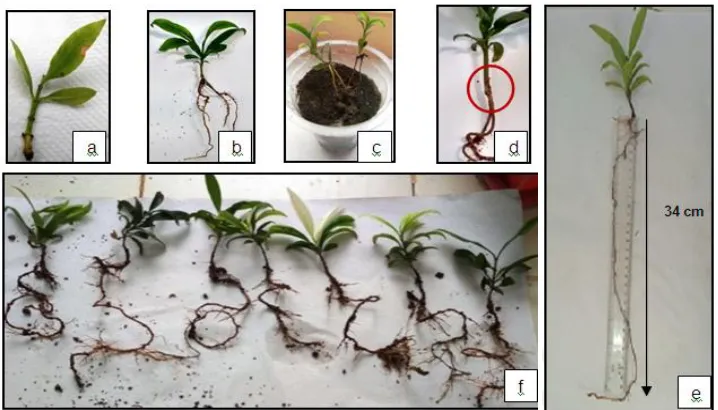
Fig. 3. a. Ex-vitro rooting with 2000 mg/L IBA dip for 15mins, close view of root initiation, shoot base swollen. b. After 4 months length of roots 4-6 cm. c. Roots pushing the shoots above
sand d. Root- Shoot junction as seen in the plants after removing from pot. e. length of hardened plant when removed from pots after 120 days(with scale- 34cm), f. Ex-vitro rooting of
unrooted in-vitro shoots after four months- 100% rooting seen
with more than 700 mg/L of IBA concentration dried and failed to induce roots, may be due to excess concentration of IBA for shoots.
3.2 Ex-vitro Rooting
For ex-vitro rooting, 80% of the shoots which were treated with dipping in 2000 mg/L of IBA for 15 minutes were rooted within 30 days (Fig. 3a). However, there was a decline in rooting success with the further increase in IBA concentration. We have tried IBA dip from varying time range of 5 mins to 30 mins for all concentrations of IBA and found that dipping of shoots for 15 mins was an optimum time to induce rooting in 80% of the
Fig. 4. a. Shows shoots planted in cups after rooting treatment. b. Survived, rooted plants transferred from cups to pots to enhance root growth. c. Successfully rooted plants transferred to black polythene bags and maintained in Low-cost polyhouse, ready to be
supplied for field trials in natural locations around Konkan region of Maharashtra
polyhouse in plastic cups (Fig. 4a). After 2 months of hardening in humidity controlled normal polyhouse the plantlets were shifted to bigger pots (Fig. 4b) and they were transferred to low cost polyhouse (data will be discussed in next paper) for further acclimatization. After 8 months the length of these roots ranged from 20 to 34cm and these acclimatized plants in pots were shifted to black polythene bags (Fig. 4c). It has been planned to transport these plantlets for the field trials at their native locations once the monsoon set-in in June 2019 in India.
An interesting observation made during this present study was how the shoots which were given in-vitro rooting treatment initially showed a greater success in rooting after ex-vitro rooting treatment. Around 70% of the unrooted in-vitro grown healthy shoots whose leaves were turning dark green in color but had not shown any signs of root induction even after 30 days, were given ex-vitro rooting treatment with 2000 mg/L IBA. On observation after 15 days, rooting had been
induced and on observation after 90 days demonstrated 100% rooting. These plants are much more healthy in appearance as compared to both in-vitro and ex-vitro rooted shoots (Fig. 3f). All the results have been analysed for Standard Deviation and Standard Error using MS-Excel.
For 40 shoots that were inoculated, it was seen that 2000 mg/L of IBA induced rooting in 80% of the shoots; as seen after 30 days. The average root length was 3.7cm and 5.4cm, as seen after 60, 80 days respectively. The average shoot length after 60 days was seen to be 5cm
(2018) for Tinospora cordifolia, Jaime et al. (2018) for Smoke tree propagation has also shown such results [18,19]. Thus in the present study, by optimizing the concentration of IBA rooting was successfully obtained in the female shoots of G. indica plants. Carbohydrate concentration plays a major role in acclimatization as plantlets are transferred from heterotrophic to autotrophic conditions. Therefore, in order to increase the survival percentage it is necessary to transfer the plants to field gradually through various hardening stages with high light intensity and low humidity conditions [20]. In-vitro rooting and hardening of plantlets from immature seed culture of G. indica
have been developed This implies on the fact that the ratio of male and females in the population of these raised seedlings would again be Polygamodioecious, which is not encouraged as female trees hold more importance in the Kokum cottage industries due to their fruit bearing capacity. Synthetic rooting mixtures like Keradex, Rootex-1 and Rootex-3 were shown to produce secondary branches and the appearance root was like natural root system [8]. During present study no synthetic rooting
mixture tried but the normal root system with root hair were noticed during hardening
stage.
As compared to many other tree species studied in this laboratory in the last 40 years, hardening of G. indica seems to be a multi-step and laborious as compared to other tree species. Only survival in soil is not enough unless field trials are performed for next 3-6 years till fruiting occurs in the tissue culture raised female plants. Our main objective is to supply the tissue culture raised plants of this laboratory in various kokam growing regions in Konkan with the help of foresters and Konkan Agriculture University for field trials.
When rooting was induced by IBA in G. indica
under in-vitro and ex-vitro rooting trials during the present study, adventitious roots system was initially observed. However, when the plantlets were shifted to pots from cups, natural tap root system had developed in the plants with healthy root hair, growing upto 34cm in length. Plantlets developed through in-vitro and ex-vitro methods have roots without any callus at the base of micro-cuttings similar to the natural root system. It has higher rooting percentage root length and survival rate and is economical in terms of labor and time saving. Deodhar et al. (2014) discussed about 60% plantlets survival in greenhouse after
their transfer to soil [11]. There are several reports on in-vitro and vitro rooting and ex-vitro survival of medicinal plants but field trials of the survived plants have not been mentioned by any of them [21], [22]. Being Polygamodioecious in nature, G. indica plants tend to be 50% males and 50% females. However, the male plant is economically non-beneficial as only females bear fruits which can be used in kokum industries to produce various kokum products; as mentioned in the Introduction. However, It is recommended that a particular plantation has atleast 1 male tree among 10 female trees, so as to promote natural pollination [23,24].
4. CONCLUSIONS
G. indica is a tree of great economic and medicinal importance. The present study focuses on two major issues faced currently in the horticulture sector- firstly, by micropropagation of female rooted plants; it is assured that only fruit bearing trees can be raised and the population ratio of 10 males: 90 females can be maintained in desired plantations. Secondly, by establishing a strong root system using IBA and ensuring hardening of the female plants with adequate parameters, the mortality rates of tissue culture raised seedlings can be reduced. Using the method reported in this study 90% survival of acclimatized plantlets is achieved. Development of well-formed and functional root system is one of the essential steps for water and mineral uptake and the plants to get acclimatized in the soil, which has been achieved during present study. Such plants when transported for field trials at natural locations will give a good survival rate.
ETHICAL APPROVAL
No animal studies have been carried out in during the course of this study.
ACKNOWLEDGEMENTS
National Medicinal Plant Board (NMPB) of India for sponsoring the project and recognizing the importance of Garcinia indica and listing it as one of the 32 priority tree species of the country for R&D. The Director of CSIR-National Chemical Laboratory, India for providing facilities and setting up of low cost polyhouse for this project.
COMPETING INTERESTS
REFERENCES
1. Parthasarathy U, Babu KN, Kumar RS, Ashis GR. Diversity of Indian Garcinia – A medicinally important spice crop in India. Acta horticulturae. 2013;979:467-476.
2. Jagtap P, Bhise K, Prakya V. A phyto-pharmacological review on Garcinia indica. International Journal of Herbal Medicine. 2015;3(4):2-7.
3. Kulkarni MD, Deodhar MA. In vitro
regeneration and hydroxycitric acid productin in tissue culture of Garcinia indica Chois. Indian Journal of Bio-technology. 2002;1:301-304.
4. Chatterjee A, Yasmin T, Bagchi D, Stohs SJ. The bactericidal effects of
Lactobacillus acidophilus, garcinol and Protykin compared to clarithromycin, on
Helicobacter pylori. Molecular and Cellular Biochemistry Journal. 2003;243:29-35. 5. Elumalai A, Eswaraiah MC. A
pharmaco-logical review on Garcinia indica
Choisy. International Journal of Universal Pharmacy and Life Sciences. 2011;1:2249-6793.
6. Ramachandran HD. Plant profile,
phytochemistry and pharmacology of
Garcinia indica: A review. International Journal of Pharmaceutical Sciences. 2014; 27(2):376-381.
7. Thatte KS, Deodhar MA. Study of flowering behavior and sex determination in Garcinia indica (Thomas-Du Pettite) choisy by means of molecular markers biotechno-logy. 2012;11(4):232-237.
8. Chabukswar MM, Deodhar MA. Rooting and hardening of in vitro plantlets of
Garcinia indica Chois. Indian Journal of Biotechnology. 2005;4:409-413.
9. Thengane SR, Deodhar SR, Bhaosale SV, Raval K. Repetitive Somatic Embryo-genesis and plant regeneration in Garcinia indica Choiss. In Vitro Cellular and Developmental Biology—Plant. 2006;42: 256-261.
10. Joshi PN, Hedge AN, Hedge VK. In-vitro
propagation of Garcinia indica Chiosy from seedling explants. International Journal of Current Research. 2015;7:24676-24678. 11. Deodhar S, Pawar K, Singh N, Thengane
RJ, Thengane SR. Clonal propagation of female plants of Garcinia indica Choiss: A tree species of high medicinal value. Journal of Applied Biology and Biotechno-logy. 2014;2:8-25.
12. Rajasekharan PE, Ganeshan S. Conservation of medicinal plant bio-diversity—An Indian perspective. Journal of Medicinal and Aromatic Plants. 2002; 24:132-147.
13. Parasharami V, Kunder G, Desai N. Recent pharmacological advances of endangered species of southern India:
Garcinia indica Choisy. Journal of Scientific Research & Reports. 2015; 8(5):1-10.
14. Deb CR, Rout GR, Mao AA, Nandi SK, Singha RK, Vijayan D, Langhu T, Kikon ZP, Pradhan S, Tariq SM, Swain D. In vitro propagation of some threatened plant species of India. Current Science. 2018; 114:567-575.
15. Malik SK, Chaudhury R, Kalia RK. Rapid in vitro multiplication and conservation of
Garcinia indica: A tropical medicinal tree species. Scientia Horticulturae. 2005;106: 539–553.
16. Deodhar SR, Thengane RJ, Thengane SR.
De nova shoot regeneration from root cultures of Garcinia indica Chioss. Indian Journal of Experimental Biology. 2008; 46:482-486.
17. Lamaoui M, Chakchar A, Kharrassr YE, Wahbir S, Ferradous A, Mousabik AE. Selection and multiplication of Argan
(Argania spinosa L.) Superior clones for conservation purposes. Acta Scientific Agriculture. 2019;3:116-123.
18. Panwar D, Patel AK, Shekhawat NS. An improvised shoot amplification and ex vitro rooting method for offsite propagation of
Tinospora cordifolia (Willd.) Miers: A multi-valued medicinal climber. Indian Journal of Plant Physiology. 2018;1:169–178. 19. Jaime A, Teixeira D, Pacholczak A, Jlczuk
A. Smoke tree (Coyinus coggygria Scop.) Propagation and biotechnology: A mini-review. South African Journal of Botany. 2018;114:232-240.
20. Chandra S, Bandopadhyay R, Kumar V, Chandra R. Acclimatization of tissue cultured plantlets: From laboratory to land. Biotechnol Lett. 2010;32:1199–1205. 21. Yan H, Liang C, Yang L. In vitro and ex
vitro rooting of Siratia grosvenorii, a traditional medicinal plant. Acta Physiol Plant. 2010;32:115–120.
23. Thatte KS, Deodhar MA. Study of flowering behavior and sex-determination in Garcinia indica (Thomas-Du Pettite) Choisy by means of molecular markers. Biotechno-logy, Asian network for scientific informa-tion. 2012;11(4):232-237.
24. Braganza M, Shirodhar A, Bhat DJ, Krishnan S. Resource Book of kokum (Garcinia indica Choisy). Western Ghats Kokum Foundation, Panji; Goa, India; 2012.
_________________________________________________________________________________ © 2019 Mulik et al.; This is an Open Access article distributed under the terms of the Creative Commons Attribution License (http://creativecommons.org/licenses/by/4.0), which permits unrestricted use, distribution, and reproduction in any medium, provided the original work is properly cited.
Peer-review history: