International Journal of Education and Social Science Research
ISSN 2581-5148
Vol. 1, No. 03; 2018
BASIC SCIENCE TEACHERS’ COMPETENCIES IN USING SIMULATIONS AND GAMES IN UPPER BASIC SCHOOLS IN JOS, NIGERIA.
Dr Ephraim J. Gongden1, Mrs Esther E.Gongden2
1Department of Science and Technology Education, University of Jos
P.M.B 2084 Jos – Plateau state Nigeria: Email Address: [email protected]
2St. Piran’s High School, P.O.Box 611, Jos – Plateau state Nigeria
Email Address: [email protected]
ABSTRACT
The study was an assessment of basic science teachers’ competencies in using simulations and games in schools in Jos - Nigeria. Simulations and games have been found to be effective in the teaching and learning of science. However, it is not clear whether basic science teachers in Jos are competent in using these strategies. Descriptive survey design was used. A questionnaire administered to a sample of sixty basic science teachers drawn from thirty schools was analyzed using percentage. Results showed that even though the effectiveness of simulations and games has been established, yet basic science teachers were not competent in its usage. The strategy was not popular amongst the teachers. The few who had knowledge of the strategies found it difficult to use them in class hence the strategies were not in frequent use. The study recommended that efforts be made by the ministry of education to organize seminars, workshops and conferences to enable teachers acquire the skills and competences for simulations and games. Teachers should enroll for online studies to improve their use of games and simulations. Finally, the study recommended that teaching strategies be made a course to be taken in the first two years of teacher training.
KEYWORDS: Assessment, Basic Science, Games and Simulations, Competencies, Basic School
1. INTRODUCTION
education possible.
Generally, the state of science teaching and learning in Nigerian secondary schools has been a source of concern to all (Sowunmi and Aladejana, 2013). At a time when scientific and technological competence is vital to the nation's future, the weak performance of students in science examinations at the secondary schools reflects the uneven quality of current science education at the secondary (upper basic) level of education. Many experts have called for a new approach to science education based on ongoing research on teaching and learning. These efforts were aimed at improving science teaching and learning. Gabel (2003a) said that the main reason why students are unable to perform well in science education lies with the method of instruction. Various instructional strategies have emerged through researches and have proved effective for learning science especially at the basic school level. Among these approaches are simulations and games which have been found to play a significant role in improving students' performance in examinations. Such strategies are also called active learning strategies. Active learning techniques shift the focus of instruction from the teacher and his/her delivery of course content to the student and his/her active engagement where there is interaction between student with student, teacher with student and student with the materials. Basically, teachers are seen in this context as helpers and organizers (Oyelekan & Adewale, 2014). When students learn actively, they retain more course content for a longer time and are able to apply that material in a broader range of contexts (Morable, 2000; Pierre, 2011). A typical teaching and learning actively in an active learning class could involve the simulation of essential basic science course content delivered via computers in a puzzle gaming format.
Because of this close relationship, the recent rapid advances in computer hardware and software that have led to improvements in computer modeling and in the fidelity of simulations have enhanced games as well as simulations (National Research Council, 2011). Both simulations and games allow the user to interact with them, and they also provide at least some degree of user control. Simulation is a recreation of a real –world situation designed to explore key element of a situation. It is a simplification of a concept or process that allows learners to experience and understand it. Research has shown that simulations and games designed for science learning allow the learner some control over the pacing and content of the learning. Simulations allow users to observe and interact with representations of processes that would otherwise be invisible (National Research Council, 2011). Games on the other hand, are a form of play that provide an environment in which game players can learn about themselves, interact with one another and develop some social skills, and develop some mental, thinking and problem solving skills (Moursund, 2006). Game play is voluntary, non productive and separate from the real world. Simulations and games can be video or computer games that are concerned with playing out realistic situations in game settings. Examples of simulations and games include: computer games, video games, board games, role-playing games, flash cards, game show competitions, gaming, etc. While simulation provides students with graphical model that unites phenomenon and principles in physics, game on the other hand, which is an exercise that has a winner, provides the strengths to appeal and to motivate physics students (Huang, Cheng & Chan, 2007, 2007; Connolly, Boyle, Mac Arthur, Hainey & Boyle, 2012).
propounds that appropriate and relevant tools be provided for students (learners) to enable them play active roles in learning. This will lead to the achievement of higher comprehension and thinking skills. Essentially, simulations and games are interactive and can capture the attention of students thereby placing them in charge of what they do. The students in their various groups interact with the program playing simulations and games through exploration, manipulation, questionings, In this case, the learners actively construct knowledge to make sense of the world, interpret ing new information in terms of existing cognitive structures.
However, as good and effective as games and simulations seem, what remains unclear however is the extent to which basic science teachers employ the use of games and simulations in teaching. Specifically, the basic science teachers’ competencies in using simulations and games have not been documented especially in Jos North LGA. It is also not known if they implement the game or simulation in the manner intended by its designers. Therefore the problem of this study is to assess teachers' competencies in the use of simulations and games in teaching basic science.
2. OBJECTIVES OF THE STUDY
The main purpose of the study is to assess the competencies of basic science teachers in the use of simulations and games in teaching students basic science at the upper basic level. Specifically, it shall:
i. Find out the if the teachers are familiar with of simulations and games as teaching strategies ii. Find out the extent to which they use simulations and games for teaching and learning
iii. Find out if teachers do implement the game or simulation in the manner intended by its designers
iv. Find out the difficulties (if any) that basic science teachers experience when using simulations and games
Three null hypotheses were formulated and tested using relevant statistical tools. They were:
i. Basic science teachers in Jos North LGA are not familiar with games and simulations as teaching strategies.
ii. Basic science teachers in Jos North LGA are not competent in the use of games and simulations in teaching basic science.
iii. Basic science teachers in Jos North LGA do not experience difficulties when using games and simulations in teaching basic science
3. RESEARCH DESIGN
The study was a descriptive survey in which basic science teachers were studied by collecting and analyzing data from only a sample of them. In this study, the population of the study is the basic science teachers in all the Upper Basic Schools in Jos North Local Government Area of Plateau state (Nigeria). The sample consisted of sixty teachers selected from thirty schools. The thirty schools were sampled using stratified random sampling, the schools being grouped into voluntary agencies, government owned and private schools respectively.
4. MATERIALS AND METHOD
simulations, frequency of use of games and simulations, difficulties encountered in the use of games and simulations, contribution of games and simulations to effective teaching and learning, recommendation, etc. The questionnaire was validated and its reliability established appropriately. The researcher visited the schools to administer the questionnaire thereby collecting the necessary data. It took the researcher two weeks to administer and collect the questionnaire.
5. ANALYSES OF DATA
A total of sixty teachers were sample for the study. The statistics is as follows: Total number of teachers used to collect data 60 Number of teachers with teaching qualifications 24 Number of teachers without teaching qualifications 36 Number of teachers with basic science qualifications 14
Teachers with 0 – 3 years experience 38
Teachers with 4 – 7 years experience 12
Teachers with 8 years and above experience 10
The data collected was analyzed appropriately using frequency and percentage statistical tool. The result of the analysis was used to answer the research questions and test the hypotheses.
Table 1: Response of teachers to questionnaire -1
S/No Item Yes % No %
1
Have you ever heard of the terms “simulations and games”? 25 672
Have you been taught how to use simulations and games to teachstudents? 19 78
3
Have you ever used simulations and games to teach basic science? 17 754
Do you consider yourself competent in the use of simulationsand games for teaching? 18 77
5
Do other teachers in your school use simulations and games intheir classrooms? 20 76
6
Would you recommend the use of simulations and games to other 18 40 teachers?7
Do you consider the strategies (simulations and games) effective forTable 2: Response of teachers to questionnaire -2
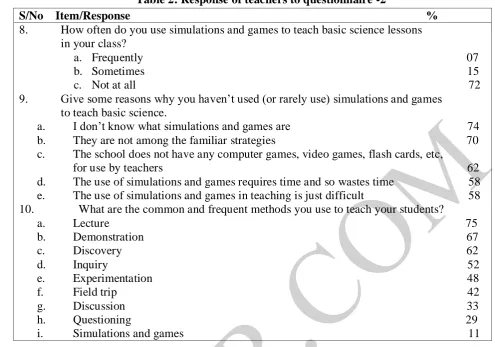
S/No Item/Response % 8. How often do you use simulations and games to teach basic science lessons in your class?
a. Frequently 07
b. Sometimes 15
c. Not at all 72
9. Give some reasons why you haven’t used (or rarely use) simulations and games to teach basic science. a. I don’t know what simulations and games are 74
b. They are not among the familiar strategies 70
c. The school does not have any computer games, video games, flash cards, etc, for use by teachers 62
d. The use of simulations and games requires time and so wastes time 58
e. The use of simulations and games in teaching is just difficult 58
10. What are the common and frequent methods you use to teach your students? a. Lecture 75
b. Demonstration 67
c. Discovery 62
d. Inquiry 52
e. Experimentation 48
f. Field trip 42
g. Discussion 33
h. Questioning 29
i. Simulations and games 11
Analysis of items 1,3, 5, 6, 7 and 10 as presented in table 1 show that the basic science teachers are not familiar with the strategy. The very few that claim to have knowledge about it do not even use it. 67% of the respondents have never heard about it while 75% claimed never to have used it.
In table 2, analysis of responses to item 2, 4 and 8 reveal that basic science teachers are not competent in the use of simulations and games for teaching basic science lessons. 78% of the respondents said they were never taught anything about simulations and games. Furthermore 77% of them said they are not competent in the use of simulations and games. 72% of the respondents agreed they do not use it at all, possibility due to their lack of competence.
The responses to item 9 show that the teachers have reasons for their incompetence and failures to use simulation and games in the class for teaching basic science. Some of the reasons include lack of knowledge and familiarity with the strategy, difficulty of using the simulations and games to teach, lack of teaching aids in the school, etc.
The analyses were used to test the hypotheses and the following were established:
Ho1 - The basic science teachers in Jos North LGA are not familiar with games and simulations a s teaching strategies.
Ho2 - The basic science teachers in Jos North LGA are not competent in the use of games and simulations in teaching basic science.
6. RESULTS AND DISCUSSION
The study revealed that the basic science teachers are not competent in the use of games and simulations for teaching basic science in the classes. This became clear with their overwhelming expression of their lack of familiarity (ignorance) with the strategy. This result is not surprising seeing that out of 60 teachers, only 24 had teaching qualifications – an indication that 36 (60%) might not have heard about simulations and games in a curriculum and instruction class. Of the 24 teachers that possessed teaching qualifications, only 14 of them read integrated science. It is therefore not surprising that majority of them are not familiar with the strategy and also find it difficult to use it even when they wish to do so. This is very sad considering the effectiveness of games and simulations as reported by previous studies. Several reasons were given for their incompetence which includes their not being taught, not being trained to be teachers and the difficulties they encounter in the use of games and simulations. This finding agrees with that of University of Colorado (2011) which reported that the National Center for Education Statistics in the US show shortages for all sciences – with these shortages being larger at the middle school level (corresponding to junior secondary or upper basic school in Nigeria). When learning about physical science, 92% of all middle school students are taught by teachers without a major in a physical science. The result also agrees with that of Dede (2009c) who identified several constraints on the use of educational games and simulations in formal classroom settings. Some of the constraints are closely related to the reasons respondents gave in this study. A chronic problem in implementing the strategy has been teachers’ lack of access to an adequate, reliable technology infrastructure. Quellmalz et al., (2009) also observed that teachers experienced constraints in the use of games and simulations. He cited assessment methods and said that high-stakes science tests do not accurately measure the complex understandings and skills developed by high-quality simulations and games. Teachers therefore do not like using them.
The use of simulations and games can be counter-productive if students are assigned simulations with no support. Podolefsky, Perkins and Adams (2010) concluded that scaffolding with appropriate affordances is essential to support student engagement in science simulations. This requires that the teacher ensures that the students are prepared with some level of understanding of the topics or basic vocabulary before embarking on the simulation exercise.
One issue that can be derived from the lack of use of simulations and games by basic science teachers is that technology is affected. Simulations are one way to incorporate an innovative use of technology into the learning environment.
have shown that the teacher is among the many factors influencing student’s learning and problem solving in particular (Danjuma, 2005).
7. CONCLUSIONS
The study was assessed basic science teachers’ use simulations and games in upper basic schools in Jos North LGA. The purpose was to find out whether the basic science teachers are competent in the use of games and simulations or not. The results show that the teachers are not competent in the use of the strategies. However, in view of the great effect and importance of the strategies, there is every need to help teachers embrace the strategies. The study show that games and simulations as teaching strategies are not yet known and embraced by teachers as it is widely believed. There is some work to be done to make teachers familiar with it and be competent in using same. For now, topics that are supposed to be taught better with games and simulations are being taught with other strategies due to teachers’ incompetence.
Gaming and simulations are activities that are enjoyed by many students, and when used for educational purposes, games can improve student motivation towards learning, particularly when used in the creation of constructivist learning opportunities. Applying the social constructivist learning theory by Vygotsky (1978) to educational game-based learning activities yields an approach that puts students in the role of active learners and content creators. Creating games using computer simulations can be an effective way to get students interested in learning more about a topic. Unfortunately, this is missing or absent altogether in schools in Jos, Nigeria.
8. RECOMMENDATIONS
The study recommended that teacher training institutions should take the training of the would-be teachers seriously. They should expose such trainees to all the necessary teaching strategies and where possible, train them in their usage. The study recommends that teaching strategies should be a course on its own to be offered at least for two years. This is in view of the great role teaching strategies play in teaching – learning. The study also recommended the need for periodic workshops, refresher courses or seminars for teachers on teaching strategies, seeing that teaching strategies are key to learning. It also recommends that school proprietors invest in technological gadgets such as computers, video and computer games and other equipment that are necessary for technological break-through and lessons at the secondary schools levels.
REFERENCES
Chen, C. and Howard, B. (2010). Effect of live simulation on middle school students attitudes and learning toward science. Journal of Educational Technology and society 13(1) 133-139. Connolly, T. M., Boyle, E. A., Mac Arthur, E., Hainey, T., & Boyle, J. M. (2012). A systematic literature review of empirical evidence on computer games and serious games. Computers and Education, 59(2), 661-686
Danjuma, I. M. (2005). An investigation of pre-service NCE teachers’ numerical chemical problem solving behaviours. Unpublished doctoral thesis, A.T.B.U Bauchi.
Dede, C. (2009c). Learning context: Gaming, gaming simulations, and science learn-- ing in the classroom. Paper commissioned for the National Research Council Workshop on Gaming and Simulations, October 6-7, Washington, DC.
Gabel, D. (2003a). Problem solving in chemistry: Research matters to the science tea cher. Retrieved June, 12 2013 from www.narst.org/publications/research/problem.cfm
Gongden, E.J. (2015). Comparative effects of two metacognitive instructional strategies on
gender and students’problem-solving abilities in selected chemistry concepts. Unpublished doctoral thesis, Abubakar Tafawa Balewa University, Bauchi
Huang, O. W. S., Cheng, H. N. H., & Chan, T. W. (2007). Number jigsaw puzzle: a
mathematical puzzle game for facilitating players’ problem solving strategies. Proceedings of the first IEEE international workshop on digital game and intelligent toy enhanced learning. doi:
10:1109/Digitel 2007.37 Morable, L. (2000). Using active learning techniques. Texas: Texas Higher Education
Moursund, D. (2006). Introduction to using games in education: A guide for teachers and parents. Eugene, Oregon: University of Oregon
National Research Council. (2011). learning science through computer games and simulations. Committee on science learning: computer games, simulations, and education, Margaret A. Honey and Margaret L. Hilton, Eds. Board on science education, division of behavioral and social sciences and education. Washington, DC: The National Academies Press.
Oak, M. (2011). Importance of science and technology. Retrieved July 17, 2014 from http://www.buzzle.com/articles/importance-of-science-and-technology.html
Oyelekan, O. T. & Adewale, G. J. (2014). Effects of self-assessment on students’ achievement in senior secondary school physics. Journal of Educational Review, 7(3), 425-431
Pierre, E. J. (2011). Using active learning in a technology classroom. Retrieved on March 3 2011 from http://www.slideshare.net/katlivingstone/using-active-learninginatechnologyclassroom
Podolefsky, N.S.; Perkins, K. K.; & Adams, W. K. (2010). “Factors Promoting Engaged
Exploration with Computer Simulations”, Physical Review Special Topics: Physics Education Research. 6
Quellalz, E.S., Timms, M.J., and Schneider, S.A. (2009). Assessment of student learning in
science simulations and games. Paper commissioned for the National Research Council Workshop on Gaming and Simulations, October 6-7, Washington, DC. Available: http://www7.nationalacademies.org/bose/Schneider_Gaming_CommissionedPaper.pdf [accessed March 23, 2010]
Sowunmi, O. & Aladejana, F. (2013) Simulation Games and Improved Basic Science Teaching in the Nigerian Lower Primary Schools,
University of Colorado (2011). PhET Interactive Simulations, Retrieved from https://phet
-downloads.colorado.edu/publications/tech-award-2011-resources/PhET_TechAwards_Application.pdf