Closed Sets for Labeled Data
Gemma C. Garriga [email protected]
Helsinki Institute for Information Technology Helsinki University of Technology
02015 Helsinki, Finland
Petra Kralj [email protected]
Nada Lavraˇc [email protected]
Department of Knowledge Technologies Joˇzef Stefan Institute
Jamova 39, 1000 Ljubljana, Slovenia
Editor: Stefan Wrobel
Abstract
Closed sets have been proven successful in the context of compacted data representation for associ-ation rule learning. However, their use is mainly descriptive, dealing only with unlabeled data. This paper shows that when considering labeled data, closed sets can be adapted for classification and discrimination purposes by conveniently contrasting covering properties on positive and negative examples. We formally prove that these sets characterize the space of relevant combinations of fea-tures for discriminating the target class. In practice, identifying relevant/irrelevant combinations of features through closed sets is useful in many applications: to compact emerging patterns of typical descriptive mining applications, to reduce the number of essential rules in classification, and to ef-ficiently learn subgroup descriptions, as demonstrated in real-life subgroup discovery experiments on a high dimensional microarray data set.
Keywords: rule relevancy, closed sets, ROC space, emerging patterns, essential rules, subgroup discovery
1. Introduction
Subgroup discovery is a learning task directed at finding subgroup descriptions that are char-acteristic for examples with a certain property (class) of interest. Special rule learning algorithms for subgroup discovery include Apriori-SD (Kavˇsek and Lavraˇc, 2006), CN2-SD (Lavraˇc et al., 2004) or SD (Gamberger and Lavraˇc, 2002). The goal of these descriptive mining algorithms is to find characteristic rules as combinations of features with high coverage. If there are several rules with the same coverage, most specific rules (with more features) are appropriate for description and explanation purposes. On the other hand, the closely related task of contrast set mining aims at capturing discriminating features that contrast instances between classes. Algorithms for contrast set mining are STUCCO (Bay and Pazzani, 2001), and also an innovative approach presented in the form of mining emerging patterns (Dong and Li, 1999). Basically, Emerging Patterns (EP) are sets of features in the data whose supports increase significantly from one class to another. Interestingly, also good classifiers can be constructed by using the discriminating power of the mined EPs, for example, see Li et al. (2000). A condensed representation of EPs, defined in terms of a support growth rate measure, has been studied in Soulet et al. (2004).
Indeed, we can see all these tasks on labeled data (learning classification rules, subgroup dis-covery, or contrast set mining) as a rule induction problem, that is, a process of searching a space of concept descriptions (hypotheses in the form of rule antecedents). Some descriptions in this hy-pothesis space may turn out to be more relevant than others for characterizing and/or discriminating the target class. The question of relevance has attracted much attention in the context of feature selection for propositional learning (Koller and Sahami, 1996; Liu and Motoda, 1998). This is an important problem since non-relevant features can be excluded from the learning process, thus facil-itating the search for the final solution and increasing the quality of the final rules. Feature filtering can be applied during the learning process, or also, by pre-processing the set of training examples (Lavraˇc et al., 1999; Lavraˇc and Gamberger, 2005).
Searching for relevant descriptions for rule construction has been extensively addressed in de-scriptive data mining as well. A useful insight was provided by closure systems (Carpineto and Romano, 2004; Ganter and Wille, 1998), aimed at compacting the whole space of descriptions into a reduced system of relevant sets that formally conveys the same information as the complete space. The approach has successfully evolved towards mining closed itemsets (see, for example, Pasquier et al., 2001; Zaki, 2004). Intuitively, closed itemsets can be seen as maximal sets of items/features covering a maximal set of examples. Despite its success in the data mining community, the use of closed sets is mainly descriptive. For example, they can be used to limit the number of association rules produced without information loss (see, for example, how to characterize rules with respect to their antecedent in Cr´emilleux and Boulicaut, 2002).
To the best of our knowledge, the notion of closed sets has not yet been exported to labeled data, nor used in the learning tasks for labeled data described above. In this paper we show that raw closed sets can be adapted for discriminative purposes by conveniently contrasting covering properties on positive and negative examples. Moreover, by exploiting the structural properties and the feature relevancy theory of Lavraˇc et al. (1999) and Lavraˇc and Gamberger (2005), we formally justify that the obtained closed sets characterize the space of relevant combinations of features for discriminating the target class.
patterns (Section 6.1), to compress the number of essential rules (Section 6.2), and finally, to learn descriptions for subgroup discovery on potato microarray data (Section 6.3).1
2. Background
Features, used for describing the training examples, are logical variables representing attribute-value pairs (called items in the association rule learning framework of Agrawal et al., 1996). If
F={f1, . . . ,fn}is a fixed set of features, we can represent a training example as a tuple of features f ∈F with an associated class label. For instance, Table 1 contains examples for the simplified
problem of contact lens prescriptions (Witten and Frank, 2005). Patients are described by four attributes: Age, Spectacle prescription, Astigmatism and Tear production rate; and each tuple is labeled with a class label: none, softorhard. Then, F is the set of all attribute-value pairs in the data, that is, F={Age=young, . . . ,Tear=normal}(the class label is not included in F), and each example (a patient) corresponds to a subset of features in F with an associated class label. This small data set will be used throughout the paper to ease the understanding of our proposals.
We consider two-class learning problems where the set of examples E is divided into positives (P, target-class examples identified by label +) and negatives (N, labeled by −), and E=P∪N.
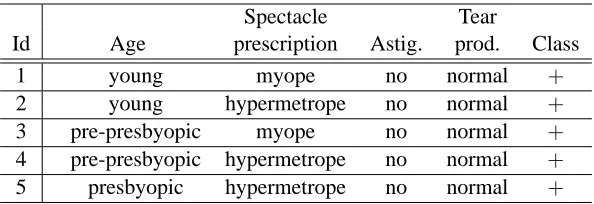
Multi-class problems can be translated to a series of two-class learning problems: each class is once selected as the target class (positive examples), while examples of all the other classes are treated as non-target class examples (thus, negative examples). For instance, when classsoftof Table 1 is the target class, all examples with labelsoftare considered as positive, as shown in Table 2, and all examples labelednoneandhardare considered as negative.
Given a rule X →+formed from a set of features X⊆F, true positives (TP) are those positive
examples covered by the rule, that is, p∈P such that X ⊆p; and false positives (FP) are those
negative examples covered by the rule, that is, n∈N such that X⊆n; reciprocally, true negatives
(TN) are those negative examples not covered by X . Later, we will see that some combinations of features X⊆F produce more relevant antecedents than others for the rules X→+. Our study will focus specifically on the combinations of features from the universe F which best define the space of non-redundant rules for the target class. We will do it by integrating the notion of closed itemsets and the concept of feature relevancy proposed in previous works.
2.1 Closed Itemsets
From the practical point of view of data mining algorithms, closed itemsets are the largest sets (w.r.t. set-theoretic inclusion) among those other itemsets occurring in the same examples (Bastide et al., 2000a; Cr´emilleux and Boulicaut, 2002; Pasquier et al., 2001; Taouil et al., 2000; Zaki, 2000a, 2004; Zaki and Ogihara, 1998). Formally, let support of itemset X⊆F, denoted by supp(X), be the number of examples in the data where X is contained. Then: a set X⊆F is said to be closed when
there is no other set Y ⊆F such that X ⊂Y and supp(X) =supp(Y).
In the example of Table 2, the itemset corresponding to{Age=young}is not closed because it can be extended to the maximal set{Age=young,Astigmatism=no,Tear=normal}that has the same support in this data. Notice that by treating positive examples separately, the positive label will be already implicit in the closed itemsets mined on the target class data. So, here we will work by
Spectacle Tear
Id Age prescription Astig. prod. Lens
1 young myope no normal soft
2 young hypermetrope no normal soft
3 pre-presbyopic myope no normal soft 4 pre-presbyopic hypermetrope no normal soft 5 presbyopic hypermetrope no normal soft
6 young myope no reduced none
7 young myope yes reduced none
8 young hypermetrope no reduced none
9 young hypermetrope yes reduced none 10 pre-presbyopic myope no reduced none 11 pre-presbyopic myope yes reduced none 12 pre-presbyopic hypermetrope no reduced none 13 pre-presbyopic hypermetrope yes reduced none 14 pre-presbyopic hypermetrope yes normal none
15 presbyopic myope no reduced none
16 presbyopic myope no normal none
17 presbyopic myope yes reduced none
18 presbyopic hypermetrope no reduced none 19 presbyopic hypermetrope yes reduced none 20 presbyopic hypermetrope yes normal none
21 young myope yes normal hard
22 young hypermetrope yes normal hard
23 pre-presbyopic myope yes normal hard
24 presbyopic myope yes normal hard
Table 1: The contact lens data set, proposed by Witten and Frank (2005).
Spectacle Tear
Id Age prescription Astig. prod. Class
1 young myope no normal +
2 young hypermetrope no normal +
3 pre-presbyopic myope no normal +
4 pre-presbyopic hypermetrope no normal +
5 presbyopic hypermetrope no normal +
Table 2: The set of positive examples when classsoftof the contact lens data of Table 1 is selected as the target class. These examples form the set P of positive examples, while instances of classesnoneandhardare considered non-target, thus treated together as negative examples
N. Note that examples are represented here in a simplified tabular form instead of the
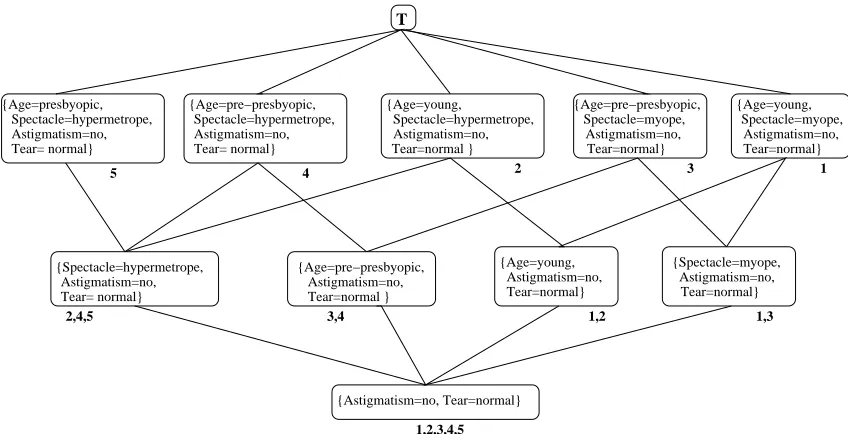
4 Astigmatism=no, Tear=normal} {Age=young, Astigmatism=no, Tear=normal} {Age=pre−presbyopic, Astigmatism=no, Tear=normal } {Age=pre−presbyopic, Spectacle=hypermetrope, Astigmatism=no, Tear= normal} {Age=presbyopic, Astigmatism=no, Tear= normal} Spectacle=hypermetrope, Tear=normal} Astigmatism=no, Spectacle=myope, {Age=young, {Age=young, Tear=normal } Spectacle=hypermetrope, Astigmatism=no, {Age=pre−presbyopic, Spectacle=myope, Astigmatism=no, Tear=normal} Astigmatism=no, Tear= normal} {Spectacle=hypermetrope, T {Astigmatism=no, Tear=normal} 1,3
5 2 3 1
2,4,5 3,4 1,2
1,2,3,4,5
{Spectacle=myope,
Figure 1: The lattice of closed itemsets for data in Table 2.
constructing the closure system of items on our positive examples and use this system to study the structural properties of the closed sets to discriminate the implicit label. Many efficient algorithms have been proposed for discovering closed itemsets over a certain minimum support threshold; see a compendium of them in Goethals and Zaki (2004).
The foundations of closed itemsets are based on the definition of a closure operator on a lattice of items (Carpineto and Romano, 2004; Ganter and Wille, 1998). The standard closure operator Γfor items acts as follows: the closure Γ(X)of a set of items X ⊆F includes all items that are
present in all examples having all items in X . According to the classical theory, operatorΓsatisfies the following properties: Monotonicity: X ⊆X0 ⇒Γ(X)⊆Γ(X0); Extensivity: X ⊆Γ(X); and Idempotency:Γ(Γ(X)) =Γ(X).
From the formal point of view ofΓ, closed sets are those coinciding with their closure, that is, for X ⊆F, X is closed iffΓ(X) =X . Also, whenΓ(Y) =X for a set Y 6=X , it is said that Y is a generator of X . By extensivity ofΓwe always have Y ⊆X for Y generator of X . Intensive work has
focused on identifying which collection of generators is good to ensure that all closed sets can be produced. The namedδ-free sets in Boulicaut et al. (2003) are minimal generators whenδ=0, and these are equivalent to key patterns in Bastide et al. (2000b). Different properties of theseδ-free sets generators in Boulicaut et al. (2003) have been studied for different values ofδ.
Considering Table 2, we have the followingΓ({Age=young}) ={Age=young,Astigmatism=no,
Tear=normal}. Then,{Age=young}is a generator of this closed set. Note that forΓ(Y) =X , both Y and X are sets with exactly the same support in the data, but X being a largest set of items,
that is, Y ⊂X for all Y such thatΓ(Y) =X . This property is ensured by the extensivity of this
Closed itemsets are lossless in the sense that they uniquely determine the set of all frequent itemsets and their exact support (cf. Pfaltz, 1996; Zaki and Ogihara, 1998, for more theoretical details). Closed sets of items can be graphically organized in a Hasse diagram, where each node corresponds to a closed itemset, and there is an edge between two nodes if and only if they are comparable (w.r.t. set-theoretic inclusion) and there is no other intermediate closed itemset in the lattice. In this partial order organization, ascending/descending paths represent the subset/superset relation. Typically, the top of this lattice is represented by a constant T corresponding to a set of items not included in any example.
Figure 1 shows the lattice of closed itemsets obtained from data from Table 2. Each node is depicted along with the set of example identifiers where the closed set occurs. Notice that all closed itemsets with the same support cover a different subset of transactions of the original data. In practice, such exponential lattices are not completely constructed, as only a list of closed itemsets over a certain minimum support suffices for practical purposes. Therefore, instead of closed sets one needs to talk about frequent closed sets, that is, those closed sets over the minimum support constraint given by the user. Also notice the difference of frequent closed sets from the popular concept of maximal frequent sets (see, for example, Tan et al., 2005), which refers to those sets for which none of their supersets are frequent.
Obviously, imposing a minimum support constraint will eliminate the largest closed sets whose support is typically very low. The impact of such constraint depends on the application. In general, there exists a trade-off between quality and speed up of the process. In the following we consider a theoretical framework with all closed sets; in practice though, we will need a minimum support constraint to consider only the frequent ones.
2.2 Relevant Features for Discrimination
The main aim of the theory of relevancy, described in Lavraˇc et al. (1999) and Lavraˇc and Gam-berger (2005), is to reduce the hypothesis space by eliminating irrelevant features from F in the pre-processing phase. Other related work, such as Koller and Sahami (1996) and Liu and Motoda (1998), eliminate features in the model construction phase. However, here we concentrate on the elimination of irrelevant features in the preprocessing phase, as proposed by Lavra ˇc and Gamberger (2005):
Definition 1 (Coverage of features) Feature f ∈F covers another feature f0∈F if and only if true positives of f0are a subset of true positives of f , and true negatives of f0 are a subset of true negatives of f . In other words, TP(f0)⊆TP(f) and TN(f0)⊆TN(f)(or equivalently, TP(f0)⊆
TP(f)and FP(f)⊆FP(f0)).
Using the definition of feature coverage, we further define that f0∈F is relatively irrelevant if
there exists another feature f ∈F such that f covers f0. To illustrate this notion we take the data of Table 1: if examples of classnoneform our positives and the rest of examples are considered negative, then the featureTear=reducedcoversAge=young, hence making this last feature irrelevant for the discrimination of the classnone.
3. Closed Sets on Target-class Data
Given a set of examples E=P∪N it is trivial to realize that for any rule X→+with a set of features
X⊆F, the support of itemset X in P (target class examples) exactly corresponds to the number of
true positives (TP) of the rule; reciprocally, the support of X in N (non-target class examples) is the number of false positives (FP) of the rule. Also, because of the anti-monotonicity property of support (i.e., Y⊆X implies supp(X)≤supp(Y)) the following useful property can be easily stated.
Proposition 2 Let X,Y ⊆F such that Y ⊆X , then TP(X)⊆TP(Y)and FP(X)⊆FP(Y).
Proof The anti-monotonicity property of support on the set of positive examples ensures that |TP(X)| ≤ |TP(Y)|. Since Y⊆X , we necessarily have TP(X)⊆TP(Y). The same reasoning applies to the set of negative examples.
For convenience, let supp+(X) denote the support of the set X in the positive set of examples
P, and supp−(X)the support in the negative set of examples N. Notice that for a rule X→+we indeed have that supp+(X) =|TP(X)|and supp−(X) =|FP(X)|. In the following we will use one notation or the other according to the convenience of the context.
Following from the last proposition, the next property can be readily seen.
Lemma 3 Feature f ∈F covers another feature f0 ∈F (as in Definition 1), iff supp+({f0}) =
supp+({f,f0})and supp−({f}) =supp−({f,f0}).
Proof That f covers f0can be formulated as TP(f0)⊆TP(f)and FP(f)⊆FP(f0). Because all the true positives of f0 are also covered by f , it is true that TP(f0) =TP(f,f0); similarly, because all the false positives of f are also covered by f0we have FP(f) =FP(f,f0). These two facts directly imply that supp+({f0}) =supp+({f,f0})and supp−({f}) =supp−({f,f0}).
The other direction is proved as follows. The anti-monotonicity property of Proposition 2 ap-plied over{f0} ⊆ {f,f0}leads to TP(f,f0)⊆TP(f0). Indeed, from supp+({f0}) =supp+({f,f0})
we have|TP(f0)|=|TP(f,f0)|, which along with TP(f,f0)⊆TP(f0)implies an equivalence of true positives between these two sets: that is, TP(f,f0) =TP(f0). From here we deduce TP(f0)⊆TP(f). Exactly the same reasoning applies to the negatives. Proposition 2 ensures that FP(f,f0)⊆FP(f)
because {f} ⊆ {f,f0}. But from supp−({f}) =supp−({f,f0}) we have |FP(f)|=|FP(f,f0)|, which together with FP(f,f0)⊆FP(f)leads to the equivalence of the false positives between these two sets: that is, FP(f) =FP(f,f0). Then, we deduce FP(f)⊆FP(f0). That is f covers f0 as in Definition 1.
Indeed, this last result allows us to rewrite, within the data mining language, the definition of relevancy proposed by Lavraˇc et al. (1999) and Lavraˇc and Gamberger (2005): a feature f is
more relevant than f0when supp+({f0}) =supp+({f,f0})and supp−({f}) =supp−({f,f0}). For instance, the support of {Age=young} over the class none of data from Table 1 is equal to the support of{Age=young,Tear=reduced}in this same classnone; at the same time, the support of
{Tear=reduced}is zero in the negatives (formed here by the classes softandhardtogether), thus equal to the support in the negatives of{Age=young, Tear=reduced}. So, the feature Age=young
irrelevant with respect to f if the occurrence of f0always implies the presence of f in the positives, and at the same time, f always implies the presence of f0in the negatives.
To the effect of our later arguments it will be useful to cast the result of Lemma 3 in terms of the formal closure operatorΓ. This will provide the desired mapping from relevant sets of features to the lattice of closed itemsets constructed on target class examples. Again, because we need to formalize our arguments against positive and negative examples separately, we will useΓ+ orΓ− for the closure of itemsets on P or N respectively.
Lemma 4 A feature f is more relevant than f0 iff Γ+({f0}) = Γ+({f,f0}) and Γ−({f}) = Γ−({f,f0}).
Proof It follows immediately from Lemma 3 and the formalization of operatorΓ. A feature f is more relevant than f0when f covers f0 according to Definition 1. Then, by Lemma 3 we have that supp+({f0}) =supp+({f,f0})and supp−({f}) =supp−({f,f0}). By construction ofΓ, this means that the sets{f0}and{f,f0}have the same closure on the positives, and the sets{f}and{f,f0}
have the same closure on the negatives. That is: becauseΓis an extensive operator, we can rewrite it asΓ+({f0}) =Γ+({f,f0})andΓ−({f}) =Γ−({f,f0}).
Interestingly, operator Γ is formally defined for the universe of sets of items, so that these relevancy results on single features can be directly extended to sets of features. This provides a proper generalization, which we express in the following definition.
Definition 5 (Relevancy of feature sets) Set of features X ⊆F is more relevant than set Y ⊆F iff
Γ+(Y) =Γ+(X∪Y)andΓ−(X) =Γ−(X∪Y).
To illustrate Definition 5 take the positive examples from Table 2, with negative data formed by classesnoneandhardtogether. FeatureSpectacle=myopealone cannot be compared to feature
Astigmatism=noalone with Definition 1 (becauseAstigmatism=nodoes not always imply Specta-cle=myopein the negatives). For the same reason,Spectacle=myopecannot be compared to feature
Tear=normalalone. However, when considering these two features together, thenSpectacle=myope
turns out to be irrelevant w.r.t. the set {Astigmatism=no, Tear=normal}. So, the new semantic notion of Definition 5 allows us to decide if a set of features is structurally more important than another for discriminating the target class. In the language of rules: rule Y →+is irrelevant if there exists another rule X→+satisfying two conditions: first,Γ+(Y) =Γ+(X∪Y); and second,
Γ−(X) =Γ−(X∪Y). E.g., when soft is the target class: the ruleSpectacle=myope →+ is not relevant because at least the rule{Astigmatism=no,Tear=normal} →+will be more relevant.
Finally, from the structural properties of operatorΓand from Proposition 2, we can deduce that the semantics of relevant sets in Definition 5 is consistent.
Lemma 6 A set of features X⊆F is more relevant than set Y ⊆F (Definition 5) iff TP(Y)⊆TP(X) and FP(X)⊆FP(Y).
Proof That X is more relevant than Y meansΓ+(Y) =Γ+(X∪Y)andΓ−(X) =Γ−(X∪Y). Propo-sition 2 ensures that TP(X∪Y)⊆TP(Y)because Y ⊆X∪Y . Then, fromΓ+(Y) =Γ+(X∪Y)we
naturally have that|TP(Y)|=|TP(X∪Y)|(by formalization ofΓ), which together with TP(X∪Y)⊆
From here, TP(Y)⊆TP(X). On the other hand, it is implied by the definition of relevancy that
Y ⊆X , thus directly from Proposition 2 we have that FP(X)⊆FP(Y).
The other direction is proved as follows. Let X and Y be two sets such that TP(Y)⊆TP(X)and FP(X)⊆FP(Y). As all the true positives of Y are also covered by X , it is true that TP(Y) =TP(X∪ Y); similarly, as all the false positives of X are also covered by Y we have that FP(X) =FP(X∪Y). This directly implies that supp+(Y) =supp+(X∪Y)and supp−(X) =supp−(X∪Y). By construc-tion ofΓ, this means we can directly rewrite this asΓ+(Y) =Γ+(X∪Y)andΓ−(X) =Γ−(X∪Y). That is: set X is more relevant than Y by Definition 5.
In the language of rules, Lemma 6 implies that when a set of features X ⊆F is more relevant
than Y ⊆F, then rule Y →+is less relevant than rule X →+for discriminating the target class. Moreover, Lemma 6 proves the consistency of Definition 5. If we consider X={f}and Y ={f0}, then the definition is simply reduced to the coverage of Definition 1. Yet, the interestingness of Definition 5 is that we can use this new concept to study the relevancy of itemsets (discovered in the mining process) for discrimination problems. Also, it can be immediately seen that if X is more relevant than Y in the positives, then Y will be more relevant than X in the negatives (by just reversing Definition 5).
Next subsection characterizes the role of closed itemsets to find relevant sets of features for discrimination. Notice that the first condition to consider a set X more relevant than Y in the dis-crimination of target class examples is thatΓ+(Y) =Γ+(X∪Y). So, the closure system constructed
on the positive examples will be proved to be structurally important for inducing target class rules.
3.1 Closed Sets for Discrimination
Together with the result of Lemma 6, it can be shown that only closed itemsets mined in the set of positive examples suffice for discrimination.
Theorem 7 Let Y ⊆F be a set of features such thatΓ+(Y) =X and Y 6=X . Then, set Y is less relevant than X (as in Definition 5).2
Proof By the extensivity property ofΓwe know Y ⊆X . Then, Proposition 2 ensures that TP(X)⊆
TP(Y)and FP(X)⊆FP(Y). However, by hypothesis we haveΓ+(Y) =X , which by construction
ensures that|TP(Y)|=|TP(X)|; but because Y ⊆X , it must be true that TP(Y) =TP(X). In all, we obtained that TP(Y) =TP(X)and FP(X)⊆FP(Y), and from Lemma 6 we have that X is more relevant than Y .
Typically, in approaches such as Apriori-C (Jovanoski and Lavra ˇc, 2001), Apriori-SD (Kavˇsek and Lavraˇc, 2006) or RLSD (Zhang et al., 2004), frequent itemsets with very small minimal support constraint are initially mined and subsequently post-processed in order to find the most suitable rules
for discrimination. The new result presented here states that not all frequent itemsets are necessary: as shown in Theorem 7 only the closed sets have the potential to be relevant.
To illustrate this result we use again data in Table 2, where Γ+({Astigmatism=no}) =
{Astigmatism=no,Tear=normal}. Thus, ruleAstigmatism=no→+can be discarded: it covers ex-actly the same positives as{Astigmatism=no,Tear=normal}, but more negatives. Thus, a rule whose antecedent is{Astigmatism=no,Tear=normal}would be preferred for discriminating the classsoft.
However, Theorem 7 simply states that those itemsets which are not closed in the set of positive examples cannot form a relevant rule to discriminate the target class, thus they do not correspond to a relevant combination of features. In other words, closed itemsets suffice but some of them might not be necessary to discriminate the target class. It might well be that a closed itemset is irrelevant with respect to another closed itemset in the system.
As illustrated above, when considering classsoftas the target class (identified by+), we had that featureSpectacle=myopeis irrelevant with respect to set{Astigmatism=no,Tear=normal}; yet, set {Spectacle=myope, Astigmatism=no, Tear=normal} is closed in the system (see the lattice of Figure 1). Indeed, this latter closed set is still irrelevant in the system according to our Definition 5 and can be pruned away. The next section is dedicated to the task of reducing the closure system of itemsets to characterize the final space of relevant sets of features.
4. Characterizing the Space of Relevant Sets of Features
This section studies how the dual closure system on the negative examples is used to reduce the lattice of closed sets on the positives. This reduction will characterize a complete space of relevant sets of features for discriminating the target class. First of all, we raise the following two important remarks following from Proposition 2.
Remark 8 Given two different closed sets on the positives X and X0 such that X*X0 and X0*
X (i.e., there is no ascending/descending path between them in the lattice), then they cannot be compared in terms of relevancy, since they cover different positive examples.
We exemplify Remark 8 with the lattice in Figure 1. The two closed sets:{Age=young, Astigma-tism=no,Tear=normal}and{Spectacle=myope,Astigmatism=no,Tear=normal}, are not comparable with subset relation: they cover different positive examples and they cannot be compared in terms of relevance.
Remark 9 Given two closed sets on the positives X and X0with X ⊂X0, we have by construction that TP(X0)⊂TP(X) and FP(X0)⊆FP(X) (from Proposition 2). Notice that because X and X0 are different closed sets in the positives, TP(X0)is necessarily a proper subset of TP(X); however, regarding the coverage of false positives, this inclusion is not necessarily proper.
To illustrate Remark 9 we use the lattice of closed itemsets in Figure 1. By construction the closed set{Spectacle=myope,Astigmatism=no,Tear=normal}from Figure 1 covers fewer positives than the proper predecessor{Astigmatism=no,Tear=normal}. However, both closed sets cover ex-actly one negative example. In this case {Astigmatism=no, Tear= normal} is more relevant than
{Spectacle=myope,Astigmatism=no,Tear=normal}.
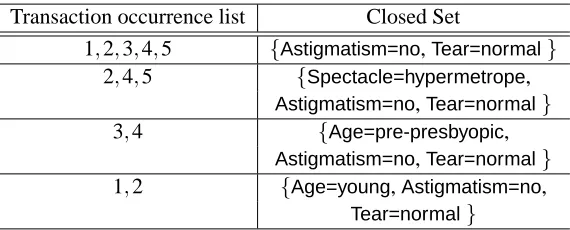
Transaction occurrence list Closed Set
1,2,3,4,5 {Astigmatism=no,Tear=normal}
2,4,5 {Spectacle=hypermetrope,
Astigmatism=no,Tear=normal}
3,4 {Age=pre-presbyopic,
Astigmatism=no,Tear=normal}
1,2 {Age=young,Astigmatism=no,
Tear=normal}
Table 3: The four closed sets corresponding to the space of relevant sets of features for data in Table 2.
to discard the closed set covering less true positives. Because of the anti-monotonicity property of support, the smaller one will be the most relevant.
From these two remarks we obtain the following result.
Theorem 10 Let X ⊆F and X0⊆F be two different closed sets in the positives such that X⊂X0. Then, we have that X0is less relevant than X (as in Definition 5) iffΓ−(X) =Γ−(X0).
Proof That X0is less relevant than X is defined as:Γ+(X0) =Γ+(X0∪X)andΓ−(X) =Γ−(X0∪X). Since X⊂X0by hypothesis, we always have that X0=X0∪X , so that the above two conditions can
be rewritten asΓ+(X0) =Γ+(X0)(always true) andΓ−(X) =Γ−(X0), as we wanted to prove. In the backward direction we start fromΓ−(X) =Γ−(X0), where X⊂X0as stated by hypothesis of the theorem. Because X⊂X0 it is true that X0=X0∪X . Then, we can rewriteΓ−(X) =Γ−(X0) asΓ−(X) =Γ−(X0∪X), thus satisfying already the first condition of Definition 5. Also,Γ+(X0)is simply the same asΓ+(X0) =Γ+(X0∪X), thus satisfying the second condition of Definition 5.
Thus, by Theorem 10 we can reduce the closure system constructed on the positives by discard-ing irrelevant nodes: if two closed itemsets are connected by an ascenddiscard-ing/descenddiscard-ing path on the lattice of positives (i.e., they are comparable by set inclusion⊂), yet they have the same closure on the negatives (i.e., they cover the same false positives, or equivalently, their support on the negatives is exactly the same), then just the shortest set is relevant.
Finally, after Theorem 7 and Theorem 10, we can characterize the space of relevant sets of features for discriminating the selected target class as follows.
Definition 11 (Space of relevant sets of features) The space of relevant combinations of features for discriminating the target class is defined as those sets X for which it holds that:Γ+(X) =X and there is no other closed setΓ+(X0) =X0such thatΓ−(X0) =Γ−(X).
It is trivial to see after Remarks 8 and 9, that by construction, any two sets in this space always cover a different set of positives and a different set of negatives. These final sets can be directly interpreted as antecedents of rules for classifying the target class (i.e., for each relevant X⊆F in
the space, we have a relevant rule X→+for classifying the positives).
rule whose antecedent corresponds to the closed set in the first row of Table 3. On the other hand, Ripper (Cohen, 1995) would obtain the most specific relevant rules, that is, those corresponding to the three last rows from Table 3. Finally, other algorithms such as Apriori-C would also output rules whose antecedents are not relevant as such, for example,Astigmatism=no→Lenses= soft.
To complete the example of the contact lenses database: the lattice of closed itemsets on the classhardcontains a total of 7 nodes, which is reduced to only 3 relevant sets; on the other hand, the lattice of closed itemsets on the classnonecontains a total of 61 nodes, which is reduced to 19 relevant sets.
The space of relevant combinations defines exhaustively all the relevant antecedents for dis-criminating the target class. Not to generate this space completely, in large sets of data a minimum support threshold will be usually imposed (see more details in the experimental section). As ex-pected, too large relevant sets will be naturally pruned by the minimum support constraint, which might have an undesired effect depending on the application. Still, it is known that very long closed sets, that is, too specific sets of features in our contribution, tend to overestimate when constructing a classifier or learning a discriminative model. In general, it will be up to the user to find a proper trade off between quality of the results and speed up of the process.
4.1 Shortest Representation of a Relevant Set
Based on Theorem 7 we know that generators Y of a closed set X are characterized to cover exactly the same positive examples, and at least the same negative examples. Because of this property, any generator will be redundant w.r.t. its closure. That is:
Remark 12 Let Y be a generator of X in the closure system on the positives; then, Γ+(Y) =X always implies TP(Y) =TP(X)and FP(X)⊆FP(Y) (from Lemma 6 and Theorem 7). However, note that the inclusion between the set of false positives is not necessarily proper.
However, we have FP(X)⊆FP(Y)for Y generator of X ; so, it might happen that some generators
Y are equivalent to their closed set X in that they cover exactly the same true positives and also the
same false positives.
Definition 13 (Equivalent generators) LetΓ+(Y) =X and Y 6=X . We say that a generator Y is equivalent to its closure X iff FP(X) =FP(Y).
The equivalence between true positives of Y and X is guaranteed becauseΓ+(Y) =X . Therefore,
it would be only necessary to check if generators cover the same false positives than its closure to check equivalence. Generators will provide a more general representation of the relevant set (because Y ⊂X by construction). So, Y →+is shorter than the rule X →+and it is up to the user to choose the more meaningful to her or to the application. For example, this may depend on a minimum-length criterion of the final classification rules: a generator Y equivalent to a closed set X satisfies by construction that Y ⊂X , so Y→+is shorter than the rule X→+. Then, the minimal equivalent generators of a closed itemset X naturally correspond to the minimal representation of the relevant rule X →+.
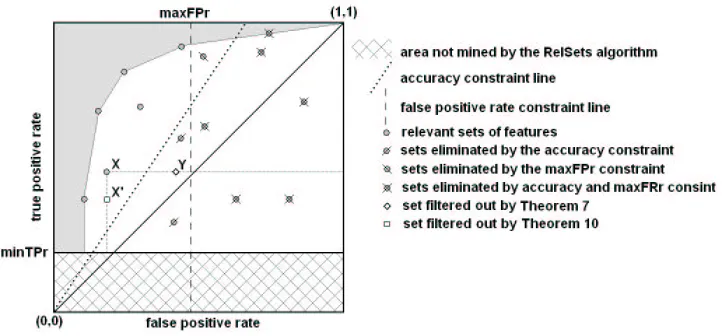
Figure 2: The evaluation of relevant combinations of features in the ROC space.
Proposition 14 LetΓ+(Y) =X and Y 6=X . Then Y is an equivalent generator of X iff Γ−(X) =
Γ−(Y).
Proof It is defined that the generator Y is equivalent to its closure X when FP(X) =FP(Y), which directly implies Γ−(X) =Γ−(Y) by construction of Γ. On the other direction: Γ−(X) =Γ−(Y)
implies |FP(Y)|=|FP(X)|, but because Y ⊆X by the extensivity of Γ, we necessarily have that FP(Y) =FP(X).
It is well-known that minimal generators of a closed set X can be computed by traversing the hypergraph of differences between X and their proper predecessors in the system (see, for example, Pfaltz and Taylor, 2002). In practice, efficient algorithms have been designed for computing free sets and their generalizations (see, for example, Calders and Goethals, 2003).
5. Evaluation of Relevant Sets in the ROC Space
The ROC space (Provost and Fawcett, 2001) is a 2-dimensional space that shows a classifier (rule/ ruleset) performance in terms of its false positive rate (also called ‘false alarm’), FPr= |TN|FP|+||FP| =
|FP|
|N| plotted on the X -axis, and true positive rate (also called ‘sensitivity’) TPr= |TP| |TP|+|FN| =
|TP| |P| plotted on the Y -axis. The ROC space is appropriate for measuring the quality of rules since rules with the best covering properties are placed in the top left corner, while rules that have similar distribution of covered positives and negatives as the distribution in the entire data set are close to the main diagonal.
A set of features from Definition 5 can be interpreted as a condition part of a rule or also as a subgroup description. A set of relevant sets of features from Definition 11 can therefore be visualized and evaluated in the ROC space as a ruleset.
Sometimes, depending on the application, additional filtering criteria are applied. In such cases a maximum false positive rate constraint can be imposed (in Figure 2 this constraint is represented by a dashed line, rules eliminated by this constraint are shown as circles with backslash), or we can apply a minimum confidence constraint (represented by a dotted line, rules eliminated by this constraint are shown as slashed circles in Figure 2). Alternatively we may simply select just the rules on the convex hull.
Let us interpret and visualize Theorems 7 and 10 in the ROC space. According to Theorem 7, sets of features Y , s.t. Y ⊂X , that cover the same positives as X (i.e., T P(Y) =T P(X)), are filtered out. Since Y and X have the same true positive rate (i.e., T Pr(Y) =T Pr(X)), both lie on the same horizontal line in the ROC space. Since Y is a subset of X , which in rule learning terminology translates into “rule X is a specialization of rule Y ”, FPr(X)≤FPr(Y)so Y is located at the right hand side of X . In Figure 2, a sample feature set filtered out according to Theorem 7 is depicted as a diamond. Note that this captures exactly the notion of relevancy defined by Lavra ˇc and Gamberger (2005) and Lavraˇc et al. (1999).
According to Theorem 10, sets of features X0, s.t. X ⊂X0, that cover the same negatives as
X (i.e., FP(X0) =FP(X)), are filtered out. Since X0 and X have the same false positive rate (i.e.,
FPr(X0) =FPr(X)), both lie on the same vertical line in the ROC space. Since X is a subset of X0, which in rule learning terminology translates into “rule X0 is a specialization of rule X ”,
T Pr(X)≥T Pr(X0), therefore X is located above X0in the ROC space. In Figure 2, a sample feature set filtered out according to Theorem 10 is depicted as a square.
Note that the feature sets filtered out by the relevancy filter are never those on the ROC convex hull. Furthermore, it can be proved that there are no sets of features outside the convex hull (grey area on Figure 2 denotes an area without sets/rules).
6. Experimental Evaluation
The results presented above lead to the concept of closed sets in the context of labeled data. In practice, closed sets can be discovered from labeled data as follows.
1. First, mining the set S={X1, . . . ,Xn}of frequent closed itemsets from the target class (The-orem 7). This requires a minimum support constraint on positives. For our experiments we will use the efficient LCM algorithm by Uno et al. (2004).
2. Second, reducing S to the space of relevant set of features by checking the coverage in the negatives (Theorem 10). Schematically, for any closed set Xi ∈S, if there exists another
closed set Xj∈S such that both have the same support in the negatives and Xj⊂Xi, then Xiis
removed.
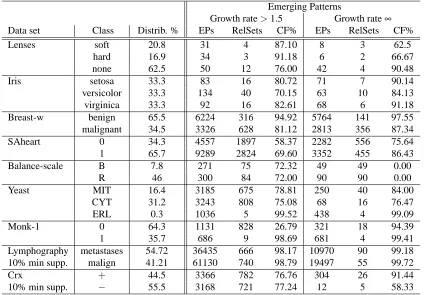
Emerging Patterns
Growth rate>1.5 Growth rate∞ Data set Class Distrib. % EPs RelSets CF% EPs RelSets CF%
Lenses soft 20.8 31 4 87.10 8 3 62.5
hard 16.9 34 3 91.18 6 2 66.67
none 62.5 50 12 76.00 42 4 90.48
Iris setosa 33.3 83 16 80.72 71 7 90.14
versicolor 33.3 134 40 70.15 63 10 84.13
virginica 33.3 92 16 82.61 68 6 91.18
Breast-w benign 65.5 6224 316 94.92 5764 141 97.55
malignant 34.5 3326 628 81.12 2813 356 87.34
SAheart 0 34.3 4557 1897 58.37 2282 556 75.64
1 65.7 9289 2824 69.60 3352 455 86.43
Balance-scale B 7.8 271 75 72.32 49 49 0.00
R 46 300 84 72.00 90 90 0.00
Yeast MIT 16.4 3185 675 78.81 250 40 84.00
CYT 31.2 3243 808 75.08 68 16 76.47
ERL 0.3 1036 5 99.52 438 4 99.09
Monk-1 0 64.3 1131 828 26.79 321 18 94.39
1 35.7 686 9 98.69 681 4 99.41
Lymphography metastases 54.72 36435 666 98.17 10970 90 99.18 10% min supp. malign 41.21 61130 740 98.79 19497 55 99.72
Crx + 44.5 3366 782 76.76 304 26 91.44
10% min supp. − 55.5 3168 721 77.24 12 5 58.33
Table 4: Compression factor (CF% = (1−|RelSets|EPs||)×100) of EPs in several UCI data sets. Note that we did not impose any minimum true positive threshold on any data set, except for Lymphography and Crx, where all EPs and RelSets were discovered with a 10% threshold on true positives.
As discussed above, the minimum support constraint on the first phase will tend to prune too long closed sets and this might have an impact in the application. In practice however, it is known that the longest sets of features are sometimes too specific, thus leading to overfitting problems. It is up to the user to trade off between the specificity of the closed sets and the speed up of the process. Also notice that the lowest the minimum support constraint, the largest the number of closed sets, and thus, the most expensive it becomes to compute the second phase of the approach. Our goal is not to present efficient algorithms but to illustrate the concept of relevancy.
6.1 Emerging Patterns on UCI data
Emerging Patterns (EP) (Dong and Li, 1999; Li et al., 2000; Dong et al., 1999) are sets of features in the data whose supports change significantly from one class to another. More specifically, EPs are itemsets whose growth rates (the ratio of support from one class to the other, that is, TPrFPr of the pattern) are larger than a user-specified threshold. In this experimental setting we want to show that some of the EPs mined by these approaches are redundant, and that our relevant sets correspond to the notion of compacted data representation for labeled data. Indeed, EPs are a superset of the result returned by RelSets.
In our comparisons we calculate relevant sets over a certain growth rate threshold (1.5 and infinite), and we compare this with the number of EPs by using the same growth rate constraint. Numerical attributes in the data sets are discretized when necessary by using four equal frequency intervals. Although being a very simple discretization scheme, we want to point out that our goal in this experiment is to compare the number of EPs with our relevant sets, and thus, any preprocessing decision on the original data will affect in the same way the two methods we wish to compare.
Results are shown in Table 4. We observe that compression factor may vary according to the data set. When data is structurally redundant, compression factors are higher since many frequent sets are redundant with respect to the closed sets. However, in data sets where this structural redundancy does not exist (such as the Balance-scale data), the compression factor is zero, or close to zero.
A set of relevant properties of EPs have been studied in Soulet et al. (2004). This latter work also identifies condensed representations of EPs from closed sets mined in the whole database. Our approach is different in that we deal with pieces of the data for each class separately, and this allows for a reduction phase given by Theorem 10. Indeed, the amount of compression that this second phase provides in our approach depends on the distribution of the negative examples in the data, but at least, the number of relevant sets obtained by RelSets will be always smaller than the number of condensed EPs from Soulet et al. (2004).
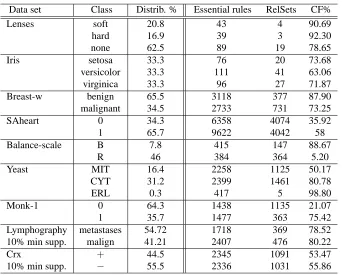
6.2 Essential Rules on UCI Data
Essential rules were proposed by Baralis and Chiusano (2004) to reduce the number of association rules to those with nonredundant properties for classification purposes. Technically, they correspond to mining all frequent itemsets and removing those sets X such that there exists another frequent
Y with Y ⊂X and having both the same support in positives and negatives. This differs from our
proposal in the way of treating the positive class with closed sets. The compression factor achieved for these rules is shown in Table 5. Note that essential rules are not pruned by growth rate threshold, and this is why their number is usually higher than the number of emerging patterns shown in previous subsection.
6.3 Subgroup Discovery in Microarray Data Analysis
Data set Class Distrib. % Essential rules RelSets CF%
Lenses soft 20.8 43 4 90.69
hard 16.9 39 3 92.30
none 62.5 89 19 78.65
Iris setosa 33.3 76 20 73.68
versicolor 33.3 111 41 63.06
virginica 33.3 96 27 71.87
Breast-w benign 65.5 3118 377 87.90
malignant 34.5 2733 731 73.25
SAheart 0 34.3 6358 4074 35.92
1 65.7 9622 4042 58
Balance-scale B 7.8 415 147 88.67
R 46 384 364 5.20
Yeast MIT 16.4 2258 1125 50.17
CYT 31.2 2399 1461 80.78
ERL 0.3 417 5 98.80
Monk-1 0 64.3 1438 1135 21.07
1 35.7 1477 363 75.42
Lymphography metastases 54.72 1718 369 78.52
10% min supp. malign 41.21 2407 476 80.22
Crx + 44.5 2345 1091 53.47
10% min supp. − 55.5 2336 1031 55.86
Table 5: Compression factor (CF% =(1−|RelSets|EPs||)×100) of essential rules in UCI data sets. Note that essential rules and RelSets are not pruned by any growth rate threshold.
Microarray data analysis problems are usually addressed by statistical and data mining/machine learning approaches (Speed, 2003; Causton et al., 2003; Parmigiani et al., 2003). State-of-the-art machine learning approaches to microarray data analysis include both supervised learning (learning from data with class labels) and unsupervised learning (such as conceptual clustering). A review of these various approaches can be found in Molla et al. (2004). It was shown by Gamberger et al. (2004) that microarray data analysis problems can be approached also through subgroup discovery, where the goal is to find a set of subgroup descriptions (a rule set) for the target class, that preferably has a low number of rules while each rule has high coverage and accuracy (Lavra ˇc et al., 2004; Gamberger and Lavraˇc, 2002).
The goal of the real-life experiment addressed in this paper is to investigate the differences between virus sensitive and resistant transgenic potato lines. For this purpose, 48 potato samples were used, leading to 24 microarrays. The laboratory experiment was carried out at the National Institute of Biology, Ljubljana, Slovenia.
Data set Class Num. of rules AUC Time RelSets RelSets-ROC SD RelSets SD RelSets SD
potatoes sensitive 1 1 20 100% 100% <1s >1h
resistant 1 1 20 100% 91% <1s >1h
Table 6: Comparison of algorithms RelSets and SD on the potato microarray data. Column RelSets-ROC shows the number of RelSets rules on the RelSets-ROC convex hull.
to the difference between gene expression levels 12 and 8 hours after infection (feature numbers
∈[24966,37559]).
We used the RelSets algorithm to analyze the differences between gene expression levels char-acteristic for virus sensitive potato transgenic lines, discriminating them from virus resistant potato transgenic lines and vice versa. We ran it twice: once the sensitive examples were considered pos-itive and once the resistant ones were considered pospos-itive. In both cases the constraint of minimal true positive count was set to 4, and in the first phase the algorithm returned 22 closed sets on pos-itives. Rule relevancy filtering according to Definition 5, filtered the rules to just one relevant rule with a 100% true positive rate and a 0% false positive rate for each class. The results gained are shown below, where features are represented by numbers.
Twelve features determine the virus sensitive class for the potato samples used:
{13031, 13066, 19130, 23462, 24794, 25509, 29938, 33795, 33829, 35003, 35190, 36266} → sensitive
Sixteen features determine the virus resistant class for the potato samples used:
{16441, 20474, 20671, 24030, 25141, 29777, 30111, 32459, 33225, 33248, 33870, 34108, 34114, 34388, 37252, 37484} →resistant
When comparing our results with the SD algorithm for subgroup discovery (Gamberger and Lavraˇc, 2002), we observe that the running time of SD degrades considerably due to the high di-mensionality of this data set. Moreover, SD obtains a larger set of rules which are less interpretable and do not have the same quality as the rules obtained with RelSets. Table 6 shows the numbers of discovered rules, area under ROC curve and the running time of both algorithms.
The results obtained with RelSets were validated by the experts from the National Institute of Biology, Ljubljana, Slovenia, and evaluated as insightful. Based on the tested samples, the experts have observed that the response to the infection after 8 hours is not strong enough to distinguish between resistant transgenic lines and sensitive ones. None of the gene expression changes after 8 hours appeared significant for the RelSets algorithm. However, selected gene expression levels after 12 hours and the comparison of gene expression difference (12-8) characterize the resistance to the infection with potato virus for the transgenic lines tested.3
7. Conclusions
We have presented a theoretical framework that, based on the covering properties of closed itemsets, characterizes those sets of features that are relevant for discrimination. We call them closed sets for labeled data, since they keep similar structural properties of classical closed sets, yet taking into account the positive and negative labels of examples. We show that these sets define a nonredundant set of rules in the ROC space.
This study extends previous results where the notion of relevancy was analyzed for single fea-tures (Lavraˇc and Gamberger, 2005; Lavraˇc et al., 1999), and it provides a new formal perspec-tive for relevant rule induction. In practice the approach shows major advantages for compacting emerging patterns and essential rules and solving hard subgroup discovery problems. Thresholds on positives make the method tractable even for large databases with many features. The application to potato microarray data, where the goal was to find differences between virus resistant and virus sensitive potato transgenic lines, shows that our approach is not only fast, but also returns a small set of rules that are meaningful and easy to interpret by domain experts.
Future work will be devoted to adapting efficient algorithms of emerging patterns by Dong and Li (1999) for the discovery of the presented relevant sets.
Acknowledgments
This work was partially funded by the Pascal Network of Excellence through a visit of the first author to the Joˇzef Stefan Institute, Ljubljana, Slovenia, and the Slovenian Research Agency grant Knowledge Technologies (2004–2008). We wish to thank Ana Rotter, Nataˇsa Toplak and Kristina Gruden from the National Institute of Biology, Ljubljana, Slovenia, for the biological data and the joint research on the application of closed sets in functional genomics.
References
R. Agrawal, H. Mannila, R. Srikant, H. Toivonen, and A.I. Verkamo. Fast discovery of association rules. Advances in Knowledge Discovery and Data Mining, pages 307–328, 1996.
J.L. Balc´azar and J. Baixeries. Discrete deterministic datamining as knowledge compilation. In
SIAM Int. Workshop on Discrete Mathematics and Data Mining, 2003.
E. Baralis and S. Chiusano. Essential classification rule sets. ACM Trans. Database Syst., 29(4): 635–674, 2004.
Y. Bastide, N. Pasquier, R. Taouil, G. Stumme, and L. Lakhal. Mining minimal non-redundant association rules using frequent closed itemsets. Lecture Notes in Computer Science, 1861:972– 986, 2000a.
Y. Bastide, R. Taouil, N. Pasquier, G. Stumme, and L. Lakhal. Mining frequent patterns with counting inference. SIGKDD Explor. Newsl., 2(2):66–75, 2000b.
S.D. Bay and M.J. Pazzani. Detecting group differences: Mining contrast sets. Data Min. Knowl.
J.F. Boulicaut, A. Bykowski, and C. Rigotti. Free-sets: A condensed representation of boolean data for the approximation of frequency queries. Data Min. Knowl. Discov., 7(1):5–22, 2003. ISSN 1384-5810.
S. Brin, R. Motwani, J.D. Ullman, and S. Tsur. Dynamic itemset counting and implication rules for market basket data. In Proceedings ACM SIGMOD Int. Conference on Management of Data, pages 255–264, 1997.
T. Calders and B. Goethals. Minimal k-free representations of frequent sets. In Proceedings of the
7th European Conference on Principles and Knowledge Discovery in Data mining, pages 71–82,
2003.
C. Carpineto and G. Romano. Concept Data Analysis. Theory and Applications. Wiley, 2004.
H.C. Causton, J. Quackenbush, and A. Brazma. Microarray Gene Expression Data Analysis: A
Beginner’s Guide. Blackwell Publishing, Oxford, United Kingdom, 2003.
P. Clark and T. Niblett. The CN2 induction algorithm. Machine Learning, 3(4):261–283, 1989.
W. W. Cohen. Fast effective rule induction. In Proceedings of the 12th International Conference on
Machine Learning, pages 115–123, 1995.
B. Cr´emilleux and J. F. Boulicaut. Simplest rules characterizing classes generated by delta-free sets. In Proceedings of the 22nd Annual International Conference Knowledge Based Systems and
Applied Artificial Intelligence, pages 33–46, 2002.
G. Dong and J. Li. Efficient mining of emerging patterns: discovering trends and differences. In
Proceedings of the 5th Int. Conference on Knowledge discovery and data mining, pages 43–52,
1999.
G. Dong, X. Zhang, L. Wong, and J. Li. CAEP: classification by aggregating emerging patterns. In
Proceedings of the 2nd In. Conference on Discovery Science, pages 30–42, 1999.
D. Gamberger and N. Lavraˇc. Expert-guided subgroup discovery: Methodology and application.
Journal of Artificial Intelligence Research, 17:501–527, 2002.
D. Gamberger, N. Lavraˇc, F. ˇZelezn´y, and J. Tolar. Induction of comprehensible models for gene expression datasets by subgroup discovery methodology. Journal of Biomedical Informatics, 37 (4):269–284, 2004.
B. Ganter and R. Wille. Formal Concept Analysis. Mathematical Foundations. Springer, 1998.
G.C. Garriga, P. Kralj, and N.Lavraˇc. Closed sets for labeled data. In Proceedings of the 10th Int.
Conference on Principles and Knowledge Discovery on Databases, pages 163–174, 2006.
B. Goethals and M. Zaki. Advances in frequent itemset mining implementations: report on FIMI’03.
SIGKDD Explor. Newsl., 6(1):109–117, 2004.
J. Han and J. Pei. Mining frequent patterns by pattern-growth: methodology and implications.
V. Jovanoski and N. Lavraˇc. Classification rule learning with APRIORI-C. In Proceedings of
the10th Portuguese Conference on Artificial Intelligence on Progress in Artificial Intelligence, Knowledge Extraction, Multi-agent Systems, Logic Programming and Constraint Solving (EPIA ’01), pages 44–51. Springer-Verlag, 2001.
B. Kavˇsek and N. Lavraˇc. APRIORI-SD: Adapting association rule learning to subgroup discovery.
Applied Artificial Intelligence, To appear, 2006.
D. Koller and M. Sahami. Toward optimal feature selection. In Proceedings of the 13th Int.
Con-ference on Machine Learning, pages 284–292, 1996.
P. Kralj, A. Grubeˇsiˇc, K. Gruden N. Toplak, N. Lavraˇc, and G.C. Garriga. Application of closed itemset mining for class labeled data in functional genomics. Informatica Medica Slovenica, 2006.
N. Lavraˇc and D. Gamberger. Relevancy in constraint-based subgroup discovery. Constraint-Based
Mining and Inductive databases, 3848:243–266, 2005.
N. Lavraˇc, D. Gamberger, and V. Jovanoski. A study of relevance for learning in deductive databases. Journal of Logic Programming, 40(2/3):215–249, 1999.
N. Lavraˇc, B. Kavˇsek, P. Flach, and L. Todorovski. Subgroup discovery with CN2-SD. Journal of
Machine Learning Research, 5:153–188, 2004.
J. Li, G. Dong, and K. Ramamohanarao. Instance-based classification by emerging patterns. In
Proceedings of the 4th European Conference on Principles of Data Mining and Knowledge Dis-covery, pages 191–200, 2000.
B. Liu, W. Hsu, and Y. Ma. Integrating classification and association rule mining. In Proceedings
of the 4th Int. Conference on Knowledge Discovery and Data Mining, pages 571–574, 1998.
H. Liu and H. Motoda. Feature Selection for Knowledge Discovery and Data Mining. Kluwer Academic Publishers, 1998.
M. Molla, M. Waddell, D. Page, and J. Shavlik. Using machine learning to design and interpret gene-expression microarrays. AI Magazine, 25(1):23–44, 2004.
G. Parmigiani, E.S. Garrett, R.A. Irizarry, and S.L. Zeger, editors. The Analysis of Gene Expression
Data: Methods and Software. Springer-Verlag, New York, 2003.
N. Pasquier, Y. Bastide, R. Taouil L., and Lakhal. Closed set based discovery of small covers for association rules. Networking and Information Systems, 3(2):349–377, 2001.
J.L. Pfaltz. Closure lattices. Discrete Mathematics, 154:217–236, 1996.
J.L. Pfaltz and C.M. Taylor. Scientific knowledge discovery through iterative transformations of concept lattices. In SIAM Int. Workshop on Discrete Mathematics and Data Mining, pages 65– 74, 2002.
A. Soulet, B. Cr´emilleux, and F. Rioult. Condensed representation of eps and patterns quantified by frequency-based measures. In Proceedings of Knowledge Discovery in Inductive Databases
Workshop, pages 173–190, 2004.
T.P. Speed, editor. Statistical Analysis of Gene Expression Microarray Data. Chapman & Hall/CRC, Boca Raton, 2003.
L. Taiz and E. Zeiger. Plant Physiology. Sinauer Associates, second edition (372:374) edition, 1998.
P-N. Tan, M. Steinbach, and V. Kumar. Introduction to Data Mining. Addison-Wesley Longman Publishing Co., Inc., Boston, MA, USA, 2005.
R. Taouil, Y. Bastide, N. Pasquier, and L. Lakhal. Mining bases for association rules using closed sets. In Proceedings of the 16th Int. Conference on Data Engineering, page 307. IEEE Computer Society, 2000.
T. Uno, T. Asai, Y. Uchida, and H. Arimura. An efficient algorithm for enumerating closed patterns in transaction databases. In Discovery Science, pages 16–31, 2004.
I.H. Witten and E. Frank. Data Mining: Practical Machine Learning Tools and Techniques with
Java Implementations. Morgan Kaufmann, 2005.
M. Zaki. Generating non-redundant association rules. In Proceedings of the 6th Int. Conference on
Knowledge Discovery and Data Mining, pages 34–43, 2000a.
M. Zaki. Mining non-redundant association rules. Data Mining and Knowledge Discovery: An
International Journal, 4(3):223–248, 2004.
M. Zaki. Scalable algorithms for association mining. IEEE Transactions on Knowledge and Data
Engineering, 12(3):372–390, 2000b.
M. Zaki and M. Ogihara. Theoretical foundations of association rules. In SIGMOD-DMKD Int.
Workshop on Research Issues in Data Mining and Knowledge Discovery, 1998.