http://go.warwick.ac.uk/lib-publications
Original citation:Ma, L. and Staunton, R. C. (2012). Analysis of the contour structural irregularity of skin lesions using wavelet decomposition. Pattern Recognition, 46(1)
Permanent WRAP url:
http://wrap.warwick.ac.uk/49978
Copyright and reuse:
The Warwick Research Archive Portal (WRAP) makes the work of researchers of the University of Warwick available open access under the following conditions. Copyright © and all moral rights to the version of the paper presented here belong to the individual author(s) and/or other copyright owners. To the extent reasonable and practicable the material made available in WRAP has been checked for eligibility before being made available.
Copies of full items can be used for personal research or study, educational, or not-for-profit purposes without prior permission or charge. Provided that the authors, title and full bibliographic details are credited, a hyperlink and/or URL is given for the original metadata page and the content is not changed in any way.
Publisher’s statement:
“NOTICE: this is the author’s version of a work that was accepted for publication in Pattern Recognition. Changes resulting from the publishing process, such as peer review, editing, corrections, structural formatting, and other quality control mechanisms may not be reflected in this document. Changes may have been made to this work since it was submitted for publication. A definitive version was subsequently published in Pattern Recognition, [VOL:46, ISSUE:1, January 2013)]
DOI:10.1016/j.patcog.2012.07.001” A note on versions:
The version presented here may differ from the published version or, version of record, if you wish to cite this item you are advised to consult the publisher’s version. Please see the ‘permanent WRAP url’ above for details on accessing the published version and note that access may require a subscription.
1
PRE-PRINT Accepted version, before formatting and proof reading. Final article
is in Pattern Recognition 46 (2013) 98–106
Analysis of the contour structural irregularity of skin lesions
using wavelet decomposition
Li Ma1 and Richard C. Staunton2 1
College of Life Information Science & Instrument Engineering, Hangzhou Dianzi University,
310018, China.
Email: [email protected] 2
School of Engineering, University of Warwick, Coventry CV4 7AL, U. K.
Email: [email protected]
Corresponding author: R.C. Staunton. Phone: +44 2476 523980, Fax: +44 2476 418922
Abstract
The boundary irregularity of skin lesions is of clinical significance for the early detection of
malignant melanomas and to distinguish them from other lesions such as benign moles. The
structural components of the contour are of particular importance. To extract the structure from
the contour, wavelet decomposition was used as these components tend to locate in the lower
frequency sub-bands. Lesion contours were modeled as signatures with scale normalization to
give position and frequency resolution invariance. Energy distributions among different wavelet
sub-bands were then analyzed to extract those with significant levels and differences to enable
maximum discrimination.
Based on the coefficients in the significant sub-bands, structural components from the original
contours were modeled, and a set of statistical and geometric irregularity descriptors researched
that were applied at each of the significant sub-bands. The effectiveness of the descriptors was
measured using the Hausdorff distance between sets of data from melanoma and mole contours.
The best descriptor outputs were input to a back projection neural network to construct a
combined classifier system. Experimental results showed that thirteen features from four
sub-bands produced the best discrimination between sets of melanomas and moles, and that a
small training set of nine melanomas and nine moles was optimum.
Keywords: melanoma detection, structural irregularity of contours, wavelet decomposition,
2
1. Introduction
Melanomas are malignant tumors comprised of epidermal or mucosal cells and have a high
possibility of lymphatic metastasis resulting in unfavorable prognosis. Early detection of
melanomas in clinics depends on a well-known ABCD rule to determine the benign or
malignant nature of skin lesions [1]. That is, Asymmetry of the lesion’s boundaries, Boundary
irregularity, Color distributions and lesion Diameters. Alternative classifications based on color
texture appearance has been researched recently [2, 3], and by employing a biopsy and electron
tomography, a classification from 3D cell images has been reported [4]. The technique of
dermoscopy used polarized light or oil coverage to make more of a lesion’s structure visible [5].
CAD systems have been researched to aide the clinician. These oftencomprise image
acquisition, artifact detection, lesion segmentation, feature extraction and lesion classification
stages [6].
In the previous decade, there have been many studies concerningthe boundary irregularity of
lesions using both geometric [7,8,9,10] and local fractal [11] measures. There are two types of
irregularities found on boundaries: textual and structural, these correspond to fine changes and
obvious convex and concave features respectively [7]. The structural irregularity has clinical
importance for melanoma diagnosis. The first task of boundary irregularity analysis is to
identify and extract the boundary as a 1D signal from the 2D image. The contours of skin
lesions can be considered as a mixture of structural and textural irregularity as can be seen by
following those in Fig.1. The benign mole is smooth with little variation on its contour, while
that of the melanoma contains many indents and protrusions in its structure, and has an obvious
visual roughness. However, for measurements of structural irregularity, multi-scale analysis of
skin lesion boundaries is an important technique for correctly isolating the structural from the
textural information. Wavelet transforms are useful multi-resolution analytical tools for
revealing object information at a defined scale or to select particular frequency bands of interest
[12]. A requirement for the design of structural irregularity descriptions is to explore ways of
extracting features not only from structural variations along the original contour, but also to
separate the scaled information in the significant sub-bands and thus with this extra information
to improve the accuracy of the diagnosis.
Previously T. K. Lee proposed an irregularity measure based on a deduced scale level using a
curvature model of multi-scaled boundaries [7]. However it involved heavy computation as the
proposed irregularity index was evaluated from a hierarchical structure with its roots as global
curve segments and leaves as local segments for each of the consecutive smoothed contours.
The Gaussian smoothing-scale increases on the original lesion contour indicated the evolution
of the curve’s indented and protruding segments.
The motivation for this study is to show that the filtered information in the sub-bands can be
used by structural irregularity descriptors to provide a good separation between melanomas and
3
followed by the selection of significant sub-bands can be an appropriate approach for the
evaluation of structural irregularity. The novelty of the proposed structural irregularity features
is:- (1) The extracted structural components of the contours are reconstructed by the summation
of the approximate wavelet coefficients at the selected maximum scale and only those detail
coefficients that are from structurally significant sub-bands; (2) Two classes of statistical and
geometric irregularity descriptors are defined and used. These were evaluated in each of the
significant sub-band to determine firstly that they were independent and did not correlate with
other features, and secondly their effectiveness in distinguishing between melanomas and moles
was measured. Features were discarded if they did not separate sets of moles and melanomas
sufficiently in order to maintain a compact feature space.
The steps in the procedure to reconstruct just the structural components of the contours are:-
Perform a 1D wavelet decomposition to produce a series of detailed contour signals for all the
lesion contours in the data set; Calculate energy measures for each of the detail, that is high
frequency, sub-bands; Perform a Hausdorff Distance (HD) [13,14] analysis based on energy
values in each sub-band to determine which detail coefficients are significant for distinguishing
the two sets; Select the significant sub-bands; Label the sub-bands with scales below these as
containing the textural component of the contour and rejected them from further consideration;
Sum the approximation coefficients and the remaining detail coefficients to generate the
connected structural component of the contour. This procedure approximately isolates the
structural portion of the original contour, and then the irregularity descriptors are used to refine
this and partition the lesions appropriately.
(a) (b)
Fig.1 Images of skin lesions (a) mole (b) melanoma
Section 2 describes the procedure to extract the structural components of the lesion contours
including the wavelet decomposition, the scale normalization necessary to process contours of
different length, and the selection of the significant sub-bands. Section 3 discusses the design of
the statistical and geometric descriptors of contour irregularity that are applied at multi-scales.
4
feature vector is compact. Section 5 provides the experimental results for the significant
structural component extraction and feature evaluation. A combined classifier using a back
projection neural network is described together with issues concerning training and the
evaluation of the structure of the feature vector. Finally Section 6 provides conclusions.
2. Extraction of the structural components of the skin lesion contours 2.1 Wavelet decomposition of a lesion contour
The contour of a skin lesion in an image is described by the points. C={x1,y1,x2,y2,…,xN,yN}. There are two ways of to represent this 2D data as a 1D signal: 1) The contour is split into two
1D sub-vectors Cx={x1,x2,…,xN} and Cy={y1,y2,…,yN}; or 2) The contour is modeled as a signature Cr={r1,r2,…,rN} where the radial distance from the geometric center,
2 ' 2 ' ) ( )
(x x y y
ri = i− + i− , i=1,2,…n and (x',y') is the coordinate of the geometric center of
the closed contour. The signature representation was adopted in the paper as it provided the
advantage of position invariance.
2.1.1 Scale normalization
It was noted that many moles have a shorter contour for a given nominal area than do
melanomas. Together with size variability between the samples in the database, this can lead to
variations in estimated frequency and resolution in the frequency domain. Scale normalization is
required to enable a comparison between moles and melanomas in this domain. The proposed
normalization was modified from [15] to give radius:
<
+
=
′
otherwise
N
n
i
r
T
i
r
N
n
i
r
r
i)
(
)
(
-)
(
µ
1µ
2i=1,2,…,N (1)
Where i is an integer used to resample the contour points with a spacing distance of (n/N) and
the ceiling function
is used to produce an integer index to r. The values µ1 and µ2 are the averaged radial distances of all the melanomas and benign moles respectively in the data base.Their inclusion provides a mean value platform on to which the lowest level approximation
coefficients will be superimposed. T is a threshold used to determine if a mole has a small value of r. If so, r is increased to reach a similar size to that of a melanoma. For melanomas and large
moles, the value of r is never increased.
r
i′
is the radial distance of the ith point of a contour5
2.1.2 Wavelet decomposition
Wavelet decomposition is a powerful tool for multi-scale signal analysis. By using a pair of
low-pass and high-pass filters, an original signal is decomposed into approximation and detail
coefficients with the approximations feeding into the next level of decomposition, and thus
creating a decomposition tree [16]. The tree structure of such a 1D wavelet decomposition is
shown in fig 2.
Fig.2 Tree structure of wavelet decomposition
A 1D wavelet decomposition is performed on a contour signature Cr. The approximate and
detail coefficients at scale i are given by
A
i=
{
a
1i,
a
i2,
a
iM}
andD
i=
{
d
1i,
d
2i,
d
Mi}
respectivelywhere M = N / 2i. As the scale increases, the approximate coefficients are further decomposed into low and high frequency components at the next higher scale. Generally the
textural components of a contour occupy the lower scale, higher frequency bands, with the
energy distributed evenly between bands to give a relatively small total energy within each.
However the structural components generally have a larger energy and occupy the lower
frequency bands. By using wavelet decomposition to level s, an original contour signature Cr is
transformed to a series of sub-band signals As,Ds,Ds−1,D1covering the whole signal
frequency space at [0,1/2s fmax],[1/2ifmax,1/2i−1fmax],i=s,s−1,,2,1 and fmax is half the sampling frequency. This represents a concatenation of the frequency bands from the lowest
to the highest. The task is to identify at which decomposition levels the structural components of
a lesion contour can be extracted and which sub-bands in the frequency domain are significant
6
2.2 Sub-band descriptions of contour structural components
For a 1D contour signal, the FFT provides the magnitude and phase against frequency. The
weakness of the FFT is that the spectral profiles are unrelated to the position of an event in the
boundary and the resolution is fixed throughout the frequency band. On the other hand the
discrete wavelet transform (DWT) presents the capability of confining signal components to
dyadically increasing width frequency bands with different resolutions. The left two columns of
Fig.3 present mole, and the right two melanoma data. The plot in the first row of the first
column is the FFT spectrum of a mole where the zero frequency component has been translated
to the center. The plot on the right indicates the sub-band division in the frequency domain
when two levels of wavelet decomposition are implemented. A1, A2, D1, D2, refer to approximate and detail signals. The plots in the rows below show the signals in each band. Similarly the two
columns on the right are for a melanoma. Differences can be seen between the mole and the
melanoma signals in the D1 and D2 bands. We continue to describe the selection of the bands
which enable the best discrimination between moles and melanomas.
Fig.3 Spectral and wavelet comparisons between a mole and a melanoma. Mole: (a) FFT, (b) A1,
A2, D1, D2 wavelet coefficient frequency map, (c) A1, (d) D1, (e) A2, (f) D2; Melanoma: (g) FFT, (h) A1, A2, D1, D2 wavelet coefficient frequency map, (i) A1, (j) D1, (k) A2, (l) D2;
2.2.1 Significant sub-band selection
To obtain justthe contour’s structural components, several lower frequency sub-bands need to
be identified from which to reconstruct that portion of the original contour using both
multi-scale approximate and detail coefficients. The evaluation of the significant sub-band range
was performed between each of the sample sets by HD distribution analysis at each level of
wavelet decomposition [17]. When analyzing the decomposition of a contour signal, the total
energy at any decomposition level indicates the significance of that sub-band frequency to the
7
2
) (
∑
=
i j i
j D
E j=1,2,…n (2)
2.2.2 Procedure for investigating significant sub-band selection
An algorithm was developed to identify those sub-bands which enabled the largest
discrimination between moles and melanomas. Given a set of p benign mole contours,
}
,
,
,
{
1b 2b bpb
=
x
x
x
Ω
where xkb was the kth contour,and a set of q melanoma contours,}
,
,
,
{
1m 2m qmm
=
x
x
x
Ω
where xkm was the kth contour.Step1. For a preset maximum level of wavelet decomposition n, calculate the wavelet energy for
every contour xbk and xkmwithin each set Ωb and Ωm. First perform wavelet decomposition to
obtain the detail sub-band signals, Dn, Dn-1, … D1, for each lesion contour, and then calculate the
energy for either xkbor xkmin each band, Elkb and Elkm, where sub-band
l
=
1
,
2
,
,
n
using Eq.(2).
Step2. Form energy sets
E
b=
{
E
lb1,
E
lb2,
,
E
lpb}
andE
m=
{
E
lm1,
E
lm2,
,
E
lqm}
from theindividual energies calculated for each transformed benign and melanoma contour at each
sub-band l=1,2,,n.
Step3. Compute the HDl value between energy sets of moles
E
band melanomasE
m foreach band l,l=1,2,,n. This measures the discrimination between the two classes for each
sub-band.
Step4. Plot the distribution of
HD
l with respect to sub-band number l. The sub-bands withthe highest HD are considered as the most significant and used in the final classification.
Step5. The sub-bands with the higher HDs are considered as significant bands for use in
classification.
2.2.3 Extraction of the structural component of a lesion contour
Based on the theory of wavelet reconstruction, the structural component of a lesion contour is
8
threshold st so that:t
s s
s s
s A D D D
C = + + −1++ (3)
1
2
1 D D
D
C st st
t = − + − ++ (4)
Where Cs contains lower-frequency information and represents the structural component of the contour, and Ct contains higher-frequency information and represents the textural component. Choosing both s and stare difficult tasks, as a large s generates many narrow sub-bands close to zero frequency. Although these will contain structural information that will be relatively free of
textural irregularity, there is an extra cost in increased computational complexity. A small s can lead to structural contours contaminated with textural irregularity. The value of stchosen is crucial to obtain useful structural and textural contour information. The significant sub-band
selection process described in Section 2.2.2 was run on the test data and in practice the HD
distribution (Fig. 4) produced had a single peak that lead to the straightforward selection of a
single, general value for st as described in Section 5.1.
3. Descriptors of contour irregularity at multiple scales
Irregularity measures of object boundaries are key components for shape related classifications.
They are used after the contour structural components have been extracted. There are two
categories of irregularity descriptors, with one based on statistical measures, and the other on
geometry. The descriptors are only extracted at the previously determined significant levels
Ω ∈
j
j, , where Ω is a significant level set formed by the sub-band selection procedure of Section 2.2.2.
3.1 Statistical measures
Together with the mean and variance of the energy of Dj at each significant level [9], the following features related to contour irregularity were defined:-
1) Entropy of wavelet energy,
( )
ijN
i j i
j p p
w log
1
∑
=
−
= (5)
where pij =Eij Ej is the energy probability of the ith component of Dj , Ejis the total energy
of the coefficients in band j as calculated by eqn (2),and Eij = Dij2. The energy entropy measures the magnitude of signal fluctuations.
2) Ultimate width. For any signalX =
{
x1,x2,...xN}
, the ultimate width is defined as µσ
× =2
9
Where µ and σ are the mean and variance of signal X. A large width indicates sharp variations.
3.2 Geometric based irregularity measures
At each significant level j, a supposed structural component Cj, s ≥ j ≥ st of a contour is reconstructed from the wavelet coefficients, Cj = A
s
+ Ds + Ds-1 + … + Dj. In addition to a simple variance measure [11], the other irregularity measures of the reconstructed contours are
evaluated as:-
Radial Deviation, 1 |( )|
1
∑
= − = N i i r r NRD (7)
where r is the mean radius of the contour signature.
Contour Roughness [8],
=
∑
−
= +
N
i i i
r
r
N
Ro
1 1|
|
1
(8) Irregularity Measure, ) ( ) ( s s j S Area S C AreaIM = ⊕ (9)
where Ss is reconstructed from the approximate data, A s
, at the significant level s, and ⊕ is the exclusive-or operator.
4. Feature selection
Feature selection was performed to remove some measures that were too similar to others and to
identify those that were most independent for inclusion in an efficient feature vector. Initially 25
features were identified from six irregularity descriptors at four scales plus IM at the threshold scale st. Then a correlation analysis followed by a performance based feature selection was performed as detailed below.
4.1 Correlation analysis
Correlation analysis is a popular tool for removing those redundant features that have a strong
relationship to others within a feature vector [18]. Given a feature vector
F
{
t
1,
t
2,
,
t
n}
and a10
(
)(
)
(
) (
∑
)
∑
∑
= = = − − − − = m p j pj m p i pi m p i pj i pi ij z t z t z t z t 1 2 1 2 1ρ (10)
where zi is the mean value of feature ti in the sample set and tpi is the value of ti for the sample xp. The absolute value of ρij indicates the correlation between ti and tj, so a redundant feature will have a large ρij.
The following is the procedure for removing redundant features using correlation analysis:-
Step 1. Given an original feature vector F and a sample set S, Calculate a matrix of correlation
coefficients,
ρ
ij,
i
≠
j
,
1
≤
i
,
j
≤
n
using Eq.(10). ;Step 2. Given a preset threshold T, split the pairs of features (ti,tj ), where (i ≠ j, 1 ≤ i, j ≤ n),into
two sets, where
F
1=
F
|
ρ
ij<
T
,
i
≠
j
,
1
≤
i
,
j
≤
n
is a set that does not contain redundantfeatures in F, and
F
2=
{
t
p,
p
∈
{
i
,
j
})
|
ρ
ij≥
T
}
is generated by choosing either feature of ahighly correlated pair. Selection can equally be random, or we kept the one that computed most
efficiently.
Step 3 The final feature set after removing redundant components is given by
F
′
=
F
1∪
F
2.4.2 Performance based feature selection
After removing the redundant features from the vector, those remaining are largely independent.
Further analysis is then performed to select the best features based on their discrimination
performance. To evaluate the discrimination, the contribution to the correct classification for
each feature is evaluated [7]. Given a sample set of skin lesions with manually labeled classes
w1 and w2, representing benign moles and malignant melanomas respectively, the probability
distributionsP
(
ti|w2)
, andP
(
t
i|
w
1)
are evaluated for each feature. Suppose the priorprobabilities p(w1) and p(w2) are equal, then the posterior probabilities p
(
w1|ti)
and(
w ti)
p 2| will be closely related to
p
(
t
i|
w
1)
and p(
ti|w2)
. The classification is perfectlyseparable when any value of p
(
t |w2)
≠0 has the corresponding value of p(
t |w1)
=0, andis absolutely inseparable when p
(
t|w2) (
= pt|w1)
at any point [19].However, medically, the probability of a benign mole p(w1) is larger than that of a melanoma
11
)
(
)
|
(
)
(
)
|
(
x
w
1p
w
1p
x
w
2p
w
2p
>
, thenx
∈
w
1. Here this is simplified to be)
|
(
)
|
(
x
w
1p
x
w
2p
>
usingp
(
w
1)
=
p
(
w
2)
. This proposed simplification is justified when)
|
(
x
w
1p
is located to the left side ofp
(
x
|
w
2)
. This is true as the features, measuring contourroughness, take smaller values in moles than that in melanomas. In addition, our rule has the
same averaged error probability as the Bayesian, because if
)
|
(
)
|
(
x
w
1p
x
w
2p
>
,p
(
w
1)
>
p
(
w
2)
, then)
(
)
|
(
)
(
)
|
(
)
(
)
|
(
x
w
1p
w
1p
x
w
2p
w
1p
x
w
2p
w
2p
>
>
⇒
p
(
x
|
w
1)
p
(
w
1)
>
p
(
x
|
w
2)
p
(
w
2)
Generally conditional probabilities of the feature ti for two classes will be overlapped. The degree of overlapping of the two probability distributions was used as a measure of
classification error for any single feature ti.
Suppose
F
′
=
{
t
1,
t
2,
,
t
r}
was the feature vector after redundancy removal. The steps usedfor performance based feature selection were:-
Step 1: Conditional probability distributions. For each feature ti ∈F′, calculate the
conditional probability distributions
p
(
t
i|
w
1)
andp
(
t
i|
w
2)
for benign and malignantlesions in the sample sets;
Step 2: Accumulated probabilities. Given a threshold T, find an appropriate value of k to
compute the accumulated probabilities Pbi =∑kj=1pbj≥Tand Pmi =∑Nj=k+1pmj for each
feature ti . Where
p
bjandp
mj are the jth values ofp
(
t
i|
w
1)
andp
(
t
i|
w
2)
.Step 3: Feature verification. For each feature
t
i∈
F
′
(1≤i≤ p), IfP
bi ≥ T and Pmi ≥ T,the feature ti is verified with a classification error of less than 1-T, otherwise ti is discarded. Where T is a preset value that is chosen to be large enough to secure a sufficient classification
accuracy. The final feature set is then
F
*=
{
t
1*,
t
2*,
,
t
q*}
, ti*∈F′(1≤i≤q,q≤ p).5. Experimental results
Three experiments were performed:- Significant wavelet sub-band selection; Reconstruction of
skin lesion contour from wavelet decompositions; And an evaluation of the proposed
multi-scale descriptors of contour irregularity using a combined classifier based on a back
projection neural network
12
They were downloaded from the Dermnet Skin Disease Image Atlas database at
http://www.dermnet.com/. The images were randomly selected from the database, after viewing
to remove some images that contained defocussed patches. Most images were of size 120x120
pixels, and if not, they were converted to this size by resampling. Each was converted from
color to gray level before processing. For the purpose of classification, a training set was formed
by randomly selecting 31 moles and 36 melanomas from the sample set, with the remaining
samples being used as test samples. The experiments were implemented using MATLAB 7.6.
5.1 Significant level selection and reconstruction of the structural component of a contour
Based on the procedure for significant sub-band selection described in Section 2.2.2, the
significant levels were identified using the training set and the ‘db3’wavelet. The maximum
level of decomposition was preset to 10.Then the HD between the averaged sub-band energies
of the wavelet detail coefficients for each class was measured at each level. The distribution is
shown in Fig.4 where it can be seen that levels 1 to 5 have a low flat distribution, levels 6 to 9
have a monotonically increasing HD, and that the HD at level 10 has decreased again.
The coefficients in levels D1 to D5 cover the higher frequencies where there are similar small textural variations for both moles and melanomas. The detail coefficients in D10 locate at the
low frequencies where there is somebasic structure, but for computational efficiency it was
found to be better to use this when included in the approximation set A9. Therefore, as expected, with HDs up to 3.1, the middle-frequency bands represented by D6 to D9 have been shown to contain significant discrimination information, and these were selected as the significant levels.
Fig.4 HD distribution of wavelet detail signals v. level
It is simple to reconstruct the structural components of the contour after the significant levels in
the wavelet decomposition stack have been determined. Fig.5 shows the extracted contours of a
13
and e) are the corresponding contours reconstructed from A9 and D1 to D5. The approximation coefficient, A9 has been included to give the basic structure of the contour onto which the more complex textural part has been superimposed. Fig.5 c) and f) are reconstructed from A9 and D6
to D9(s = 9, st= 6), that is the boundaries representing the structural portion of the original lesion. With the textural information removed, these have the property of the highest
discrimination between different lesion classes. In the remainder of the paper these significant
sub-bands will be referred to as the structural sub-bands.
Fig.5 Contours after wavelet reconstruction. (a) Mole - original, (b) Mole - textural, (c) Mole – structural, (d) Melanoma – original, (e) Melanoma – textural, (f) Melanoma – structural. (Angle
in degrees and Radius in pixels, with inner dotted circle at 100 and solid circle at 200).
5.2 Results of feature selection
As described in Section 4, the original feature vector consisted of 25 irregularity features that
were formed from seven measures, six of which were applied at each of four significant
sub-bands. At the first stage of feature selection, correlation analysis, nine of these features were
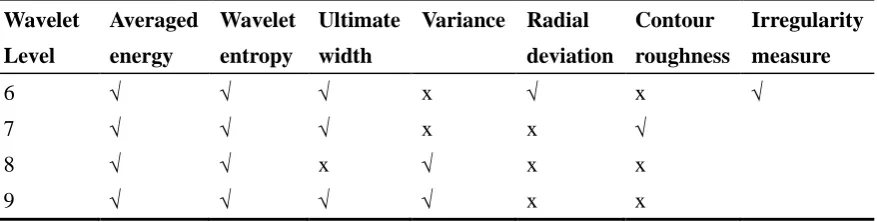
removed to decrease redundancy. Table 1 shows the retained (tick) and removed (cross) features.
The average energy, wavelet entropy and ultimate width were reliable features at most levels of
the significant sub-bands. The other independent features retained included the variance at the
two higher levels (8 and 9), the radial deviation at level 6, the contour roughness at level 7, and
14
Wavelet Level Averaged energy Wavelet entropy Ultimate widthVariance Radial deviation
Contour roughness
Irregularity measure
6 √ √ √ x √ x √
7 √ √ √ x x √
8 √ √ x √ x x
[image:15.595.78.517.91.202.2]9 √ √ √ √ x x
Table 1. Results of feature selection after correlation analysis
After removal of the redundant features identified by the correlation analysis, selection was
taken further for the remaining 16 features by a classification performance analysis of each
feature. As discussed in Section 4.2, the cumulative probability distribution of each feature was
calculated for both the benign,
=
∑
= k i b i b
p
P
1, and the melanomas,
=
∑
+ = N k i m i m
p
P
1, in the sample
sets, where N was the largest observed value for that feature and k was a value satisfying
T p P k i b i b =
∑
≥=1
. A threshold T = 0.75 was chosen experimentally that indicated correct
classification for every feature when applied to the benign samples in the training set. Then the
feature had to meet the requirement Pm > T to be retained within the overall feature vector. Fig.6 presents the results of the final feature selection.
Fig.6 Plot of accumulated probabilities:- (a) Pb ; (b) Pm, for each of the 16 features
[image:15.595.149.438.508.641.2]15
further classification. It was noticed that some Pm values approached 1.0, signifying there was little overlap between the probability distributions of the benign and melanoma sets for these
features.
5.3 Combined classification results
The results of selections and tests on the individual features have been presented in Sections 5.1
and 5.2. In this section a Back Projection (BP) neural network is described that was used to
perform classification of skin lesions based on a combination of the 13 selected features. The
neural network had a structure of three layers:- input layer with 13 nodes; hidden layer with 3
nodes; and output with one node [20]. The training parameters were a preset training error of
0.01 and a maximum training number of 1000 iterations. As before, the main training set was
formed by randomly selecting 31 moles and 36 melanomas from the sample set, with the
remaining samples forming the testing set. A sub-set of the large training set was randomly
formed to produce an alternative small training set of 9 moles and 9 melanomas. To study the
discrimination ability of the proposed multi-scale based feature vector and to refine its operation,
some classification experiments were performed to compare firstly single-scale with multi-scale
features, and then multi-scale feature either before feature selection (25 features), or after (13
features). This was performed with both the small and large sized training sets to see which gave
the best results.
5.3.1 Before feature selection
Four experimental schemes were tried for training the BP network:- (1) Multi-scale, with all 25
features and the small training set; (2) Single scale, with 7 features at level 9 and the small training
set; (3) Multi-scale features and the large training set; and (4) Single scale features and the large
training set. After each training and processing of the test data, their corresponding Receiver
Operating Characteristic (ROC) plots were generated and are shown in Fig.7.
The input layer of the neural network has m values, where m is the number of features calculated
from each sample in the test data set. The output of the network produces a single real value between
0 and 1 to indicate which class the sample belongs to for each of the S samples in the test data set.
Overall the network produces an output vector with dimension S. Given a threshold value between 0
and 1, the output vector is converted to a binary vector with elements 0 and 1 indicating the class
estimations. Each sample in the set has previously been classified by a clinician and so the TP and
FP values for this threshold can be calculated. This process is repeated for a range of thresholds
between 0 and 1 and the resulting FP,TP pairs plotted as an ROC curve that spans from the bottom
left (1,0) to the top right corner (0,1).
The nearer the ROC trace is to the top left corner, the better the discrimination of a scheme
[21,22,23]. Fig.7 shows that the worst plot, is the single scale with a small training set, and the
16
small training set. This had a better classification power than the multi-scale scheme using the
large training set. The multi-scale features were always found to perform better than the single
scale features. In addition, the multi-scale features provided a way of improving the
discrimination when only a small sized training set was available.
Fig.7 ROC plots of the different training schemes before feature selection.
5.3.2 After feature selection
In this section the classification performances of the features selected by the different schemes
have been compared. Feature selection has only been reported for the multi-scale case as the
results of Section 5.3.1 have already confirmed multi-scale processing to be superior. The
following experiments were designed to compare the multi-scale features before and after
selection using both the large and small training sets. In order to reach a generality for the small
training set, an averaged ROC plot has been generated from 15 randomly selected possible
small training sets of 9 moles and 9 melanomas. In effect this was achieved by providing 15
parallel neural networks, averaging their real valued outputs, converting this to binary at each
threshold value from 0 to 1 and then plotting the TP, FP rates accumulated from all the test
samples on the ROC. The number of combination of all possible sets was too big to test
at
(
C369 ×C319)
.17
Results are with and without feature selection, and for large and small training image sets. From
Fig.8 the best classification performance is for 13 selected multi-scale features with a small
training set. It should be noted that this ROC plot has resulted from the averaged outputs of the
15 separately trained neural network classifiers using the test set. The next best is for the 13
selected multi-scale features with a large training set, followed by the 25 original multi-scale
features using the large training set, and finally the 25 original multi-scale features using the
small training set.
Fig.8 ROC plots for feature selection using multi-scale features
5.3.3 Design of parallel classifiers using small training sets
The results in Fig 8 have indicated that the averaged output of 15 neural classifiers using small
training sets can outperform a single classifier using a large training set.However a single
classifier using a small training set may or may not outperform that with a large training set. The
following experiments were performed to ascertain the optimum size of the training set.
For the many neural networks produced by training using randomly chosen small data sets, an
ROC plot from their averaged outputs was compiled after feeding the test data to each of them
18
plus moles were chosen at 3+3, 6+6, 9+9, 16+16, 23+23, 30+30, and tested together with the
large training set of 36+36. In the experiments 15 training sets were randomly selected for each
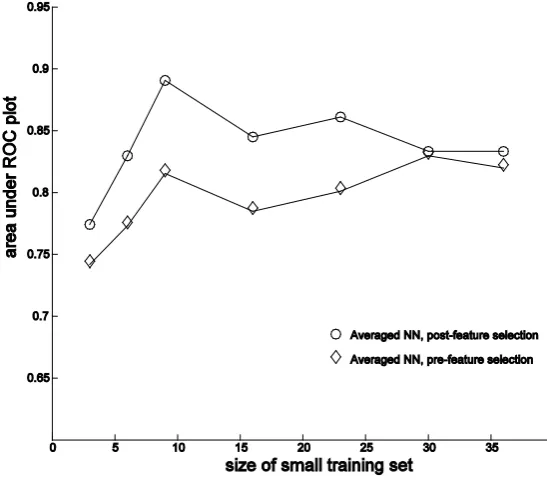
size from the full set of training data. Fig.9 presents the performance using the area under the
ROC plot against training set size for the pre- and post-selection schemes. The trace marked by
diamonds is for a ROC plot from the averaged outputs of the 15 classifiers before feature
selection whereas that marked by circles is post feature selection.
As indicated in Fig.9, the scheme using the averaged outputs of the 15 classifiers post-feature
selectionperforms best. It was noticed from the experiments that the averaged output value of all
networks, using a combination model of many parallel network classifiers, may overcome the
weakness of any single classifiers in the case of small training sets. The peak area of the ROC for
the averaged outputs of the neural network classifiers, post-feature selection was for a training
set of 9 melanomas plus 9 moles, indicating this to be the optimum size.
Fig.9 Performance against size of training set
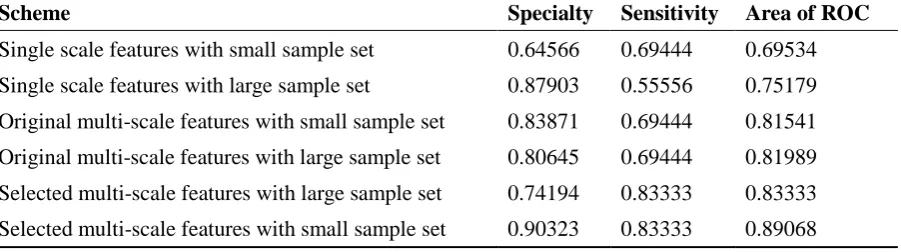
Table 2 lists the ROC performances for each of the two single scale and the four multi-scale
schemes tested. The performance is indicated by the measures of the sensitivity, specialty and
area covered by each ROC plot, where the paired values of sensitivity and specialty are the True
Positive Rate (TPR) and False Positive Rate (FPR) coordinates of the point on each ROC plot
closest to the top left corner [21,22,23]. With the lowest values, the single scale features with the
small training set have the worst results, and the multi-scale features after feature selection and
[image:19.595.127.401.312.553.2]19
Scheme Specialty Sensitivity Area of ROC
Single scale features with small sample set 0.64566 0.69444 0.69534
Single scale features with large sample set 0.87903 0.55556 0.75179
Original multi-scale features with small sample set 0.83871 0.69444 0.81541
Original multi-scale features with large sample set 0.80645 0.69444 0.81989
Selected multi-scale features with large sample set 0.74194 0.83333 0.83333
[image:20.595.86.537.76.202.2]Selected multi-scale features with small sample set 0.90323 0.83333 0.89068
Table 2. Comparison of classification performances
5.3.4 Discussion
In general, Fig.8 and Table 2 indicate that multi-scale features have better discrimination than
single scale features, and that, after feature selection, multi-scale schemes have better
performances than schemes without selection. The best ROC plot was for multi-scale selected
features using the small training set. It outperformed the corresponding scheme using the large
training set. There are two reasons for this in that each of the 13 selected multi-scale features
had a good individual performance when used for skin contour irregularity measurement and so
a small training set was probably sufficient. Secondly the performance of a neural network with
a BP training algorithm can be degraded by using a large training set that may cause a solution
to become stuck in a local minimum [24].
6 Conclusions
A method that examines the structural content of the contour of skin lesion images has been
proposed that determines if the lesion is a melanoma or a benign mole. The contour contained
both structural and textural information, but it was demonstrated that the structural information
was most important in the determination.
The 1D contour signal was filtered into sub-bands using the discrete wavelet transform (DWT)
down to level 9. The structural information was found to lie mostly at the lower frequencies, in
the detail levels from 6 to 9 plus the approximation at level 9. These were denoted as significant
levels, and the information within them was shown to provide the best classification separation
between sets of melanomas and moles. The DWT was found to enable efficient processing of
the signals.
A number of statistical and geometric feature descriptors of contour irregularity were developed.
These were computed in each of the significant sub-bands. To enable an efficient system, these
features were selected using a two stage process. Firstly correlation analysis was used to remove
redundant features, and secondly the performance of each feature in separating sets of
20
A classifier using a combination of features was designed using a back-projection neural
network. The system was optimized to obtain the maximum true positive rate and minimum
false positive rate for separation. Issues of training were explored, and a small, randomly chosen,
sub-set of 9 melanoma and 9 mole images found to provide the best results. Of the seven
available features, six were applied in four significant sub-bands and one in a single sub-band,
forming twenty five measurements in total. As described above these had been ranked in order
of effectiveness, and it was found the best combined classifier resulted when just the best
thirteen measures were used.
Acknowledgement:
This work is supported by National Scientific foundation of China (60775016).
References
[1] C. Grana, G. Pellacani, R. Cucchiara, S. Seidennari. A new algorithm for border description
of polarized light surface microscopic images of pigmented skin lesions, IEEE Transactions on
Medical Imaging 22 (8) (2003) 959-964.
[2] C. Serrano, B. Acha, Pattern analysis of dermoscopic images based on Markov random
fields, Pattern Recognition 42 (6) (2009) 1052-1057.
[3] A. Chiem, A. Al-Jumaily, R. N. Khushaba, A Novel Hybrid System for Skin Lesion
Detection, in: Proceedings of the 3rd International Conference on Intelligent Sensors, Sensor Networks and Information, ISSNIP, Melbourne, Australia, 2007, pp. 567-572.
[4] R. Narasimha, H. Ouyang, A. Gray, S. W. McLaughlin, S. Subramaniam, Automatic joint
classification and segmentation of whole cell 3D images, Pattern Recognition, 42 (6) (2009)
1067-1079.
[5] M. E. Vestergaard, P. Macaskill, P. E. Holt, S. W. Menzies, Dermoscopy compared with naked
eye examination for the diagnosis of primary melanoma: a meta-analysis of studies performed
in a clinical setting, British Journal of Dermatology 159 (3) (2008) 669-676.
[6] P. Wighton, T. K. Lee, H. Lui, D. I. McLean, M. S. Atkins, Generalizing common tasks in
automated skin lesion diagnosis, IEEE Transactions on Information Technology in Biomedicine
15 (4) (2011) 622-629.
[7] T. K. Lee, D. I. McLean, M. S. Atkins, Irregularity Index: A new border irregularity
measure for cutaneous melanocytic lesions, Medical Image Analysis 7 (1) (2003) 47-64.
[8] S. V. Patwardhan, A. P. Dhawan, P. A. Relue, Classification of melanoma using tree
structured wavelet transforms, Computer Methods and Programs in Biomedicine 72 (3) (2003)
223 – 239.
[9] K. M. Clawson, P. Morrow, B. Scotney, J. McKenner, O. Dolan, Analysis of pigmented skin
21
2009, pp. 18-23.[10] X. Yuan, N. Situ, G. Zouridakis, A narrow band graph partitioning method for skin lesion
segmentation, Pattern Recognition 42 (6) (2009) 1017-1028.
[11] Li Ma, W. Xu, L. Zhu, Description of Boundary Irregularity On Multi-Scale Local FD for
Melanomas, in: Proceedings of the 3rd International Conference on Bioinformatics and Biomedical Engineering, Beijing, China, 2009, pp. 1-4.
[12] Y. C. Liao, K. C. Hung, C. T. Ku, C. F. Tsai, S. M. Guo, Wavelet octave energy for breast
tumor classification on sonography : A new shape feature, in: Proceedings of the IEEE
International Conference on Networking, Sensing and Control, Okayama, Japan, 2009, pp.
388-392
[13] D. P. Huttenlocher, G. A. Klanderman, W. J. Rucklidge, Comparing Images using the Hausdorff
Distance, IEEE Transactions on Pattern Analysis and Machine Intelligence 15 (9) (1993) 850-863.
[14] E. Yoruk, E. Konukoglu, B. Sankur, J. Darbon, Shape-based hand recognition, IEEE
Transactions on Image Processing 15 (7) (2006) 1803-1815.
[15] L. Yang, C. Y. Suen, T. D. Bui, P. Zhang, Discrimination of similar handwritten numerals
based on invariant curvature features, Pattern Recognition 38 (7) (2005) 947-963.
[16] G. Strang, T. Nguyen, Wavelets and Filter Banks, Wellesley-Cambridge Press, MA, USA,
1997.
[17] K. H. Lin, B. Guo, K. M. Lam, W. C. Siu, Human face recognition using a spatially
weighted modified hausdorff distance, in Proceedings of the International Symposium on
Intelligent Multimedia, Video and Speech Processing, Hong Kong, China, 2001, pp. 477-480.
[18] Y. Li, Z. F. Wu, J. M. Lui, Y. Y. Tang, Efficient feature selection for high-dimensional data
using two-level filter, in: Proceedings of the International Conference on Machine Learning and
Cyberntics, Shanghai, China, 2004, volume 3, pp. 1711-1716.
[19] D. T. Lin, C. R. Yan, W. T. Chen, Autonomous detection of pulmonary nodules on CT
images with a neural network-based fuzzy system Computerized Medical Imaging and Graphics
29 (6) (2005) 447-458.
[20] R. T. J. Bostock, E. Claridge, A. J. Harget, P. N. Hall, Towards a neural Network Based
System for Skin Cancer Diagnosis, in: Proceedings of the Third International Conference on
Artificial Neural Networks, Brighton, UK, 1993, pp. 215-219.
[21] T. Fawcett, ROC Graphs: Notes and practical considerations for researchers,
home.comcast.net/~tom.fawcett/public_html/papers/ROC101.pdf , HP Laboratories, Palo Alto, CA, USA, 2004
[22] T. Fawcett, An introduction to ROC analysis”, Pattern Recognition Letters 27 (8) (2006)
861-874.
[23] T. Fawcett, P. A. Flach, A response to Webb and Ting's On the application of ROC analysis
to predict classification performance under varying class distributions, Machine Learning 58 (1)
22
[24] W. Jin, Z. J. Li, L. S. Wei, H. Zhen, The improvements of BP neural network learning
algorithm, in: Proceedings of the 5th International Conference on Signal Processing, volume 3, Beijing, China, 2000, pp. 1647-1649.
About the Author ─ Li Ma received the B. S. and PhD degrees in Electrical Engineering from
Central South University, P. R. China, in 1976 and 1998 respectively. She is currently a
professor at the College of Life Information Science & Instrument Engineering, Hangzhou
Dianzi University, P. R. China. She has been an academic visitor to the College of Cardiff,
University of Wales, U.K. during 1993-1994, and a senior visiting fellow at the University of
Warwick in 2003. Her research interests include industrial and medical image processing, video
based monitoring systems, and pattern recognition.
About the Author─ Richard Staunton received the B.Sc. (honours) degree in electronic
engineering from the City University, UK, in 1973, and the Ph.D. degree in engineering from
the University of Warwick, UK, in 1992. He is currently an Associate Professor in the School of
Engineering at The University of Warwick, UK. From 1973 to 1977 he worked for the
aerospace industry and from 1977 to 1986 for the UK National Health Service, where he
engaged in research and development of medical image processing systems. His current
research interests include depth from defocus, industrial image processing, hexagonal sampling