http://www.sciencepublishinggroup.com/j/pamj doi: 10.11648/j.pamj.20170606.14
ISSN: 2326-9790 (Print); ISSN: 2326-9812 (Online)
A Study of Five Parameter Type I Generalized Half Logistic
Distribution
Bello Olalekan Akanji
1, Sule Ibrahim
1, Awodutire Phillip Oluwatobi
2, Olapade Akintayo Kehinde
11Department of Mathematics, Obafemi Awolowo University, Ile-Ife, Nigeria 2
Department of Statistics, Federal Polytechnic of Oil and Gas, Bonny, Nigeria
Email address:
[email protected] (Bello O. A.), [email protected] (Sule I.), [email protected] (Awodutire P. O.), [email protected] (Olapade A. K.)
To cite this article:
Bello Olalekan Akanji, Sule Ibrahim, Awodutire Phillip Oluwatobi, Olapade Akintayo Kehinde. A Study of Five Parameter Type I Generalized Half Logistic Distribution. Pure and Applied Mathematics Journal. Vol. 6, No. 6, 2017, pp. 177-181.
doi: 10.11648/j.pamj.20170606.14
Received: October 29, 2016; Accepted: October 23, 2017; Published: January 4, 2018
Abstract:
In this paper, we obtained a generalized half logistic distribution which is called a five-parameter type I generalized half logistic distribution. The distributional properties of the model such as the cumulative distribution function (cdf), moment, skewness, kurtosis, the median and the mode of the generalized distribution were established and finally a theorem that relate the distribution to pareto distribution was stated and proved.Keywords: Characterizations, Continuous Distribution, Exponential, Kurtosis, Skewness
1. Introduction
Probability distribution assigns chance of occurrence of an event to random variables. This can be discrete or continuous and the Logistic and half logistic distributions are both continuous.
The half logistic distribution which is also known as folded logistic is derived from logistic distribution by truncating the interval (-∞,∞) at point x=0 of the probability density function (pdf) of logistic distribution. The pdf of half logistic distribution is given as
= ^, x ≥ 0. (1)
And its cumulative density function is given as
= , x ≥ 0. (2)
One of the attractions of this distribution in the context of reliability theory is that it has a monotonically increasing hazard rate for all parameter values, a property shared by relatively few distributions which have support on the positive real line. In terms of tail behavior, the half-logistic distribution provides a degree of flexibility as its tail thickness lies between those of the normal and
half-Cauchy distributions. The half-logistic distribution has also been used successfully to model records.
using the method of moments, maximum likelihood and the new method of maximum spacing distance estimator based on complete data. They also evaluated the properties of the maximum likelihood estimators through the mean squared error (MSE), relative absolute bias and relative error and finally carried out simulation of results to show the precision of the maximum likelihood estimates for the parameters involved [12]. Olapade proved some theorems that characterized the half logistic distribution [8]. The half logistic distribution has not received much attention from researchers in terms of generalization. Olapade (2011) obtained a four parameter type I generalized half logistic distribution as
= ^^ , x ≥ 0, p > 0. (3)
He also obtained the cumulative distribution function (CDF), the survival function and the hazard function, moments, the 100p-percentage point and the mode of the distribution [10]. Olapade (2014) obtained a probability density function of the Type I generalized half logistic distribution as
= ^ , x ≥ 0, p > 0. (4)
He obtained the cumulative distribution function, moments, median, mode, 100p-percentage point and order statistics of the distribution and estimates the parameter of the distribution using maximum likelihood method [11].
Many authors have studied various estimators of the half logistic distribution for both censored and uncensored data. For example, see Balakrishnan and Chan [3], and Adatia [1] [2].
The rest of the paper is arranged as follows: in section 2, we presented the pdf and cdf of the five parameter type I generalized half logistic distribution. In section 3, we derived the moments, skewness and kurtosis of the distribution and presented the results in a table. In section 4, we presented the median of the distribution. In section 5, we presented the mode. In section 6, we presented the 100k-percent which can be used in Acceptance Sampling. In section 7, we stated and proved a theorem that characterizes the generalized half logistic distribution with generalized pareto distribution and finally, in section 8, we make concluding remark.
2. The Five Parameter Type I
Generalized Half Logistic Distribution
Theorem 1: The random variable = ln has a type I generalized half-logistic distribution, if Y has an exponential distribution with parameter p, where λ and β > 0 are constant.
Proof: If Y is exponentially distributed with parameter p,
= , x ≥ 0, p > 0. (5) Let
= ln 2 # $− "
by transformation of the random variable
= ln " + #2 $
Then,
&
& = , (6)
; ", #, = )&& ) , (7)
; ", #, = *^ , (8)
The value of k that makes equation (8) a probability density function is
+ = " + # ^ , Therefore
; ", #, = ^^ . x ≥ 0, λ, β, p > 0 (9)
If we introduce the location parameter µ and the scale parameter σ in equation (9) we have
; -, ., ", #, = ^
/0 1
23 /01 4^ , x ≥ 0, λ, β, p > 0 (10)
The pdf in equation (10) is the five parameter type I generalized half logistic distribution.
Without loss of generality, we shall assume that =1 and µ=0.
The cdf of the five parameter type generalized half logistic distribution is given as
; ", #, = 1 − ^ , x ≥ 0, λ, β, p > 0 (11)
3. Moment of the Five Parameter Type I
Generalized Half Logistic Distribution
The moment generating function is given as
6 = 7 , ", #, 8 (12) Considering equation (9),
6 = # " + # ^ 7:9 ^ (13)
The first moment of x is given as
6 = # " + # ^ 7 ln 3= > ;; 4 ;; <^ ; &;;
: (14)
Similarly, the second moment of x is given as
6 = # " + # 7 3?@= > ;; 4 ;;
: < ; &;; (15)
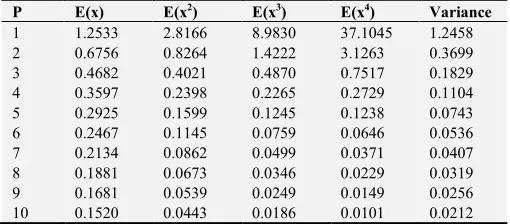
Equations (14) and (15) can be evaluated numerically for various values of λ, β and p.
Hence the mean of the five-parameter type I generalized half-logistic distribution can be computed using equation (14) and the variance of the distribution can be evaluated for each given value of λ, β and p.
Table 1 gives the moments E(xn) of the five-parameter type I generalized half logistic distribution for n = 1, 2, 3, 4 and the variance while table 2 gives the values of skewness and kurtosis using the following relation.
. AB , C AB B , CDEFD/DBF BD , CGABG/GFDB HFB IBG (16)
Where v1is the i th
moment, µ1= the mean, µ2= the variance.
β =KD
KD (17)
# A0G
0 (18)
Where β1 is the skewness and β2 is the kurtosis.
Table 1. Moment of the five-parameter type I generalized half-logistic distribution when λ = 1.5, β = 2.5.
P E(x) E(x2) E(x3) E(x4) Variance
1 1.2533 2.8166 8.9830 37.1045 1.2458
2 0.6756 0.8264 1.4222 3.1263 0.3699
3 0.4682 0.4021 0.4870 0.7517 0.1829
4 0.3597 0.2398 0.2265 0.2729 0.1104
5 0.2925 0.1599 0.1245 0.1238 0.0743
6 0.2467 0.1145 0.0759 0.0646 0.0536
7 0.2134 0.0862 0.0499 0.0371 0.0407
8 0.1881 0.0673 0.0346 0.0229 0.0319
9 0.1681 0.0539 0.0249 0.0149 0.0256
10 0.1520 0.0443 0.0186 0.0101 0.0212
Table 2. The skewness and kurtosis of the five-parameter type I generalized half logistic distribution when λ = 1.5, β = 2.5.
P µ3 Skewness µ4 Kurtosis
1 2.3301 2.8080 11.2143 7.2256
2 0.3639 2.6164 0.9211 6.7319
3 0.1275 2.6569 0.2244 6.7080
4 0.0608 2.7473 0.0829 6.8017
5 0.0342 2.9578 0.0383 6.9378
6 0.0212 2.9186 0.0204 7.1007
7 0.0142 2.9908 0.0118 7.1235
8 0.0099 3.0192 0.0074 7.2179
9 0.0072 3.0899 0.0049 7.4768
10 0.0054 3.0604 0.0033 7.3425
4. The Median of the Five Parameter
Type I Generalized Half Logistic
Distribution
The median of the distribution is xmsuch that
7 L 8 =
9 (19)
# " + # 7 L
: 8 = (20)
1 − M NPM NQR OO = (21)
By solving equation 21 to get xm, we have
M NO
M NPQR O= (22)
M N
M NPQR=O√ (23)
√2
O
λ + β = λ + βeVR (24)
eVR=O√ M N M
N (25)
Then,
WA?@ √ $ (26)
5. The Mode of the Five Parameter typeI
Generalized Half Logistic Distribution
The mode of a probability density function is obtained by equating the derivative of the density function to zero and solve for the variable. Therefore, for five parameter type I generalized half logistic distribution,
f x; λ, β, p = N[ M NM NPQ OOPQ (27)
f\ x; λ, β, p = βp λ + β []M NPQ O PQ PQ[ M NPQ ONPQ M NPQ O ^ (28)
By equating the derivatives to zero, we have
λ + βeV − p + 1 βeV= 0 (29)
λ = pβeV (30)
eV= M
[N (31)
x = ln [NM (32)
6. 100k-Percentage Point of the Five
Parameter type I Generalized Half
Logistic Distribution
We obtain the 100k-percentage point from
= +
Where F(x) is the cdf of the five parameter type I generalized half logistic distribution.
This implies
M NO
M NPQa O= 1 − k (34) M N
M NPQa = c 1 − k
O
(35)
λ + βeVa= M N c d
O (36)
βeVa= M N
c d
O − λ (37)
eVa=
Ne M N c d
O − λf (38)
xd= ln NeOcM Nd − λf$ (39)
7. Characterization of Five Parameter
typeI Generalized Half Logistic
Distribution
Theorem 2: The random variable = ln is a generalized half logistic variable, if x follows a generalized Pareto distribution with parameter p, where λ and β are positive constants.
Proof: If x follows a generalized Pareto distribution with parameter p, then
; = , x > 1, p > 0 (40)
Since the random variable
= ln ⇒ = (41)
Hence,
; ", #, = ^^ , x ≥ 0, λ, β, p > 0 (42)
Where " + # ^ = +
Conversely, if Y has a five-parameter type I generalized half logistic distribution with distribution shown in equation (27), then the cdf of the random variable x is
= h ] i≤ ^ = ]ln ^ (43)
= 1 − ^ (44)
And
= ^ (45) By omitting the constant in equation (30) the density of x can be written as
k ∝ (46)
Since any density function proportional to the right hand side of equation (46) is that of a generalized Pareto random variable.
8. Conclusion
This paper deals with a typeI generalized half logistic distribution. In this paper, we presented a five parameter type I generalized half logistic distribution and proved that it is a pdf. We established the moments and used it to obtain the mean, variance, skewness and kurtosis by presenting the results in tables 1 and 2. We obtained the median, mode and 100p-percent point which can be applied in acceptance sampling. We also stated and proved a theorem that relates this distribution to pareto distribution.
From equation (9) when β = 1, it reduces to equation (3) of Olapade 2011, when λ = β = 1, it reduces to equation (4) of Olapade 2014 and when λ = β = p = 1 it reduces to the standard logistic distribution. Further research can be to characterize the distribution with other statistical distributions and the area of applications can also be taken in to account.
References
[1] Adatia, A. (1997). Approximate BLUE’s of the parameters of the half logistic distribution based on fairly large doubly censored samples. Computational Statistics and Data Analysis 24, 179-191.
[2] Adatia, A. (2000). Estimation of the parameters of the half-logistic distribution using generalized rank set sampling. Computational Statistics and Data Analysis 33, 1-13.
[3] Balakrishnan, N., Chan, P. S. (1992). Estimation for the scaled half logistic distribution under type II censoring. Computational Statistics and Data Analysis 13,123-131. [4] Balakrishnan, N. and Hossain, A. (2007), Inference for the
Type II generalized logistic distribution under progressive Type II censoring, Journal of Statistical Computation and Simulation, 77 (12), pp1013–1031.
[5] Balakrishnan, N. (1985). Order statistics from the half logistic distribution, Journal of statistical computation and simulation. vol. 20, pp.287-309.
[6] Balakrishnan, N and Puthenpura, S. (1986). Best linear unbiased estimation of location and scale parameters of the half logistic distribution, J. Statist. Comput. Simul. VOL 25. pp193-204.
[7] Balakrishnan, N. and Wong, K. H. T. (1991). Approximate MLEs for the location and scal eparameters of the half logistic distribution with Type-II right censoring, IEEE Trans. On Reliab. Vol 40. pp140-145.
[8] Olapade, A. K. (2003). On Characterizations of the Half Logistic Distribution. InterStat, February Issue, Number 2. [9] Olapade, A. K. (2009). On a four parameter type II
generalized half logistic distribution. Proc. Jangjeon Math. Soc. Korea, Volume 12 (1), pp.21-30.
[10] Olapade, A. K. (2011). On a four-parameter type I generalized half logistic distribution. Proceeding of the Jangjeon Mathematical KOREA. Vol 14. pp189-198.