Int. J. Industrial Mathematics Vol. 2, No. 2 (2010) 105-113
Constrained Consumable Resource Allocation in
Uncertain Project Networks with Fuzzy Activity
Duration
S.S. Hashemin ∗
Department of Industrial Engineering, Islamic Azad University, Ardabil Branch, Ardabil, Iran
Received 3 April 2010; accepted 5 September 2010.
———————————————————————————————-Abstract
This paper studies the constrained consumable resource allocation in an uncertain project network. The project network is a directed and acyclic graph in the fuzzy environment. It is supposed that the activity duration is a positive trapezoidal fuzzy number (TFN). Parameters of the activity duration depend on the amount of resource allocated to it. By ranking the paths and activities an algorithm is developed for allocating the constrained resource to activities in such a way that the completion time of project is decreased. The proposed algorithm is illustrated by an example.
Keywords : Fuzzy project, constrained resource allocation, completion time, trapezoidal fuzzy number.
————————————————————————————————–
1
Introduction
In many real world projects, the duration of activities is deterministic. A non-deterministic character may be stochastic or fuzzy. When the activity durations are a random variable, optimal constrained consumable resource allocation to the activities is a complex problem. Optimal solution of these problems can be obtained in small projects by using a hybrid method [11]. Some of recent works define the fuzzy characters for the project networks because the fuzzy models are closer to reality and simpler to use [8]. On the other hand, completion of project on time has significant effect on its cost, revenue and usefulness. Therefore, the main objective of project managers is to avoid any delay. To achieve this goal, the duration of each individual activity can be shortened by consuming extra resources. However, due to the limitation, allocation of the resources among the activities is vital.
Many of the recent works are related to the fuzzy PERT-type networks. Project completion time is presented as a fuzzy set in [1]. [2,6,9] proposed different methods for identifying the critical path when the activity durations are fuzzy numbers. Calculating the fuzzy completion time for project planning in large scale is described based on fuzzy Delphi method in [3]. The criticality in project network is measured by fuzzy method in [4]. Statistical confidence interval estimates are used to define the fuzzy critical path [7]. [15] proposed fuzzy probability instead of Beta distribution in PERT-type network and estimated fuzzy expected completion time. A new approach based on linear programming is developed for backward pass calculation. This method can compute the latest times and slack times [16].
Resource constrained project scheduling when the resources are renewable has been stud-ied in some recent papers. A fuzzy simulation annealing approach is developed to solve the renewable resource constrained project scheduling problem with fuzzy data [12]. [13] presents the hybrid method of a fuzzy genetic algorithm combined with tabu mechanism for fuzzy renewable resource constrained scheduling in order to obtain an approximate optimal solution. A hybrid fuzzy goal programming approach for solving multiple objec-tives in fuzzy multi-mode project scheduling has been described in [14]. A novel method to renewable resource constrained project scheduling problems in fuzzy environment is presented in [17]. In the proposed model, duration of each activity, resource availability and demands of each activity on resources are uncertain. So, ranking fuzzy numbers is used to generate priority the list.
However, this paper studies the constrained consumable resource allocation in fuzzy project networks. The project network is a directed and acyclic graph in the fuzzy environment. It is supposed that the activity duration is a positive TFN. Parameters of the activity duration depend on the amount of resource allocated to it. An algorithm as a heuristic is developed for allocating the constrained resource to the activities such that the completion time of project is decreased.
This paper has been organized as follows. Section 2 introduces the basic definitions. Section 3 describes the fuzzy project network. Section 4 discusses the structural matrix of a project network. Section 5 is about the calculation of fuzzy completion time of network. Section 6 introduces the assumptions of the effect of constrained resource on fuzzy activity duration. Section 7 develops the algorithm for allocating consumable resource among the activities. In this section, first, motivations are described. Then, a selected method is introduced for comparing length of network paths. Finally, the steps of a proposed algorithm are cited. Section 8 solves an example by using the proposed algorithm. Section 9 is devoted to conclusions and recommendations.
2
Definitions
In this section, some basic definitions of the area of the fuzzy theory that have been cited in [5, 18], are introduced.
Definition 1. Let R be the space of real numbers. A fuzzy set A˜ is a set of ordered pairs
{(x, µA˜(x))|x∈R}, where µA˜(x) :R→[0,1]. Function µA˜(x) is called the membership of
the fuzzy set.
µA˜(x) =
0, x≤a,
x−a
b−a, a < x≤b,
1, b < x≤c,
x−d
c−d, c < x≤d,
0, x≥d,
For convenience, TFN is represented by four real parameters(a, b, c, d).
Definition 3. A fuzzy set A˜ is called positive if and only if its membership function is such that µA˜(x) = 0,∀x≤0.
Definition 4. A trapezoidal fuzzy number A˜ = (a, b, c, d) is called positive TFN if and only if0≤a≤b≤c≤d.
Definition 5. Let A˜ = (a1, b1, c1, d1)and B˜ = (a2, b2, c2, d2) be any two TFNs, then
˜
A+ ˜B = (a1+a2, b1+b2, c1+c2, d1+d2)
˜
A−B˜ = (a1−a2, b1−b2, c1−c2, d1−d2).
Definition 6. Let A˜= (a1, b1, c1, d1)andB˜ = (a2, b2, c2, d2) be any two TFNs, then
M ax( ˜A,B˜) = (M ax(a1, a2), M ax(b1, b2), M ax(c1, c2), M ax(d1, d2)) ,
M in( ˜A,B˜) = (M in(a1, a2), M in(b1, b2), M in(c1, c2), M in(d1, d2)) .
3
Fuzzy Project Network
Fuzzy project network is a directed and acyclic graph. It is identified withF = (N, C,D˜). N is the set of nodes and C ⊂ N ×Nis the set of activities. The set N = {1,2, ..., h} is labeled in such a way that∀(i, j) ∈ C, i < j. It is supposed that the duration of activity (i, j) is a positive TFN and represented by ˜Dij = (d1ij, d2ij, d3ij, d4ij)and ˜Dij ∈ D˜.
Pis the set of network paths. We suppose that these paths are labeled with 1,2, ..., mi.e. P = {1,2, ..., m}. In other words, m is the number of paths(m = |P|). Activity set of rth path is shown byPr,r = 1,2, ..., m. Set of start nodes of activities with end nodej is
shown bySource(j).
4
Project Network Matrix
Each project network can be defined with a matrix. Suppose that the project network hasm paths andnactivities. Then, the matrix of project network is a matrix withmrows and n columns. Let us show it with Am×n = [ar,(i,j)]m×n such thatar,(i,j) = 1 if activity
(i, j)has been lied on rth path and otherwisear,(i,j)= 0.
5
Fuzzy Completion Time
Suppose that the project network has one source (start) node and one target (end) node. This node is labeled with 1. By defining the below notations:
˜
Ej Earliest occurrence time of nodej
ES˜ij Earliest start time of activity (i, j)
EF˜ij Earliest finish time of activity (i, j)
˜
T Fuzzy Completion time of project network
Fuzzy forward calculations can be done by below relations:
˜
E1 = (0,0,0,0)
˜
Ej = (e1j, ej2, e3j, e4j) = M ax i∈Source(j){
˜
Ei+ ˜Dij}
ES˜ij = (es1ij, esij2, es3ij, es4ij) = ˜Ei
EF˜ij = (efij1, efij2, efij3, efij4) =ES˜ij + ˜Dij
˜
T = (t1, t2, t3, t4) = ˜Eh
˜
Talso, defines the length of critical path (longest path).
6
Effect of Constrained Resource on Activity Duration
Suppose that we need one kind of resource to execute the activities. The amount of resource is limited and represented byRs. Parameters of the activity durations de-pend on the amount of the resource, allocated to it. Clearly, the amount of resource which can be allocated to each activity is limited to some specific levels. D˜ij(Sij) =
(d1ij(Sij), d2ij(Sij), d3ij(Sij), d4ij(Sij)) shows the duration of activity (i, j) when the resource
allocated to it, is Sij. Sij = sij1, sij2, . . . , sijkij, sij1 < sij2 < · · · < sijkij. The number
of specific levels of resource allocation for activity (i, j) is shown by kij . The aim is
the resource allocation to project activities such that the completion time of project is minimized.
7
Proposed Algorithm
7.1 Motivation in Designing the Algorithm
In designing the algorithm steps, first, it is supposed that the resource is unlimited. So, by allocating the maximum resource to the activities, the completion time of project will be shortened. But, in fact, the resource allocated to the project is more than the available resource and we must decrease the resource allocated to some activities such that the increasing completion time of project is minimum. In each stage, an activity will be selected for decreasing the resource allocated to it. In a suitable selection, the selected activity must
II) lie on the fewest number of paths
If the activity which can be selected on I and IIis non-unique, then
III)the activity which is selected will have the least effect on increasing the length of the shortest path.
Therefore, we will need the suitable fuzzy ranking numbers for defining the shortest path because based on our assumptions, the length of each path is TFN.
7.2 A Selected Fuzzy Ranking Number
Here, the length of the project network paths must be compared based on due date of the project. So the method described in [10] is selected. In this method, the fuzzy numbers are compared based on a special selected number. This number can be due date in our paper.
In selected method, it is supposed that, A,Bare any two fuzzy numbers with arbitrary continuous membership functions µA(x), x ∈ ΩA , µB(x), x ∈ ΩB. Also, suppose that
Ω = ΩA
∪
ΩBand α ∈ Ωis a given number. GA(α)and GB(α)for fuzzy numbers A,Bare
defined as
GA(α) =
∫UA
α µA(x)dx
∫UA
LA µA(x)dx
And GB(α) =
∫UB
α µB(x)dx
∫UB
LB µB(x)dx
Where LA = min{x|x ∈ ΩA},UA = max{x|x ∈ ΩA},LB = min{x|x ∈ ΩB},UB =
max{x|x∈ΩB}
Definition 7. (A≥B)if and only if GA(α)≥GB(α).
Above definition can be extended for more than two fuzzy numbers.
In proposed algorithm that will be described in 7.3 αwill show the due date of project. Also, length of project network paths will be compared using the above selected method. Then, the shortest path of project network can be identified.
7.3 Steps of Proposed Algorithm
The steps of proposed algorithm are as follow.
Step 1: Set Sij =sijkijfor all (i, j)∈C.
Step 2: If∑(i,j)∈CSij ≤Rsthen, stop otherwise go to the step 3.
Step 3: Let the completion time ofrth path be presented by ˜ur =
∑
(i,j)∈Prar,(i,j)
˜ Dij(Sij)
wherePris the activity set ofrth path. Compute the ˜urfor all values ofr(r = 1,· · · , m) . Step 4: by setting the α =due date of project, order the ˜ur,r = 1,· · · , m ascending by
using the selected method introduced in section7.2and show them with ˜u[1],u˜[2], ...,u˜[m]( If the vth path be the tth path in ordered paths, we will write [t] =v).
Step 5: Compute theqij =
∑m
r=12[r]ar,(i,j) for all (i, j)∈C.
Suppose thatqll′ = M in
(i,j)∈C,kij̸=1
{qij}, If (l, l′) is unique then set (ρ, ρ′) ← (l, l′) and go to
Step 6: LetL be the set of (l, l′) obtained in step5. Suppose that ∑
z∈{1,2,3,4}(dzρρ′(sρρ′k
ρρ′ −1)−d z ρρ′(sρρ′k
ρρ′))
sρρ′kρρ′−sρρ′kρρ′ −1 =(l,l′)∈minL,k
ll′̸=1 {
∑
z∈{1,2,3,4}(dzll′(sll′k ll′ −1)−d
z ll′(sll′k
ll′))
sll′kll′−sll′kll′ −1 }
If (ρ, ρ′)is non-unique. We select it arbitrary. By defining the (ρ, ρ′)using the above relation, we select the activity which the decreasing of the resource allocated to it, will have the least effect on increasing the length of paths.
Step 7: Setkρρ′ ←kρρ′−1 and return to step 1.
Proposed algorithm starts with infeasible solution that generates the best completion time. Then, by decreasing the resource allocated to some suitable activities, the total resource allocated to the project decreases. This operation continues while the total resource allo-cated to project is equal or smaller thanRs i.e. ∑(i,j)∈CSij ≤Rs.
8
example
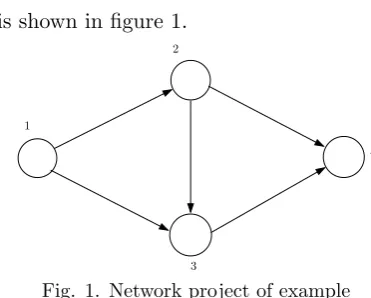
A network of a project is shown in figure 1.
4 1
2
3
Fig. 1. Network project of example
The values of allocable resource to each activity and activity duration respect to the value of allocated resource are shown in table 1. Total amount of available resource which can be allocated is 13 unit (Rs= 13) and due date is 11(α= 11).
Table 1
Information of project example. (i, j) kij Sij D˜ij(Sij)
In these small networks all feasible solutions can be defined. Therefore, the optimal resource allocation can be determined.
Table 2 shows the completion time of project for all feasible solutions where (Rs= 13).
Table 2
all feasible solutions for example.
No. s12 s24 s23 s13 s34 Completion time
1 1 2 2 5 3 (6,9,12,15)
2 1 3 1 5 3 (7,10,13,16)
3 1 3 2 4 3 (6,9,12,15)
4 1 3 2 5 2 (7,10,13,16)
5 1 4 1 4 3 (7,10,13,16)
6 1 4 1 5 2 (8,11,14,17)
7 1 4 2 3 3 (6,9,12,15)
8 1 4 2 4 2 (7,10,13,16)
9 2 2 1 5 3 (6,9,12,15)
10 2 2 2 4 3 (5.5,8,11,14) *
11 2 2 2 5 2 (6,9,12,15)
12 2 3 1 4 3 (6,9,12,15)
13 2 3 1 5 2 (7,10,13,16)
14 2 3 2 3 3 (6,8,11,14)
15 2 3 2 4 2 (6.5,9,12,15)
16 2 4 1 3 3 (6,9,12,15)
17 2 4 1 4 2 (7,10,13,16)
18 2 4 2 3 2 (6,9,12,15)
Astriferous solution is optimal. Now, we are going to solve the problem with the proposed algorithm.
Step 1: S12= 2, S24= 4,S23= 2, S13= 5,S34= 3.
Step 2: ∑(i,j)∈CSij = 16≥Rs. So, we must go to step3. Step 3: u˜1 = (3,5,7,9), ˜u2 = (5,8,11,14), u3 = (4,6,8,10).
Step 4: u˜[1] = ˜u1,˜u[2]= ˜u3,˜u[3] = ˜u2.
Step 5:
q24 = M in{q12 = 10, q24 = 2, q23 = 8, q13 = 4, q34 = 12}(l, l′) = (2,4) is unique. So we
must set (ρ, ρ′) = (2,4)and go to step7.
Step 7: k24←k24−1 = 3−1 = 2.
Step 1: S12= 2, S24= 3,S23= 2, S13= 5,S34= 3.
Step 2: ∑(i,j)∈CSij = 15≥Rs. So, we must go to step3. Step 3: u˜1 = (4,6,8,10), ˜u2 = (5,8,11,14), u3 = (4,6,8,10).
Step 4: u˜[1] = ˜u1= ˜u3,˜u[2] = ˜u2.
Step 5:
q24 =M in{q12 = 6, q24 = 2, q23 = 4, q13 = 2, q34 = 6} two (l, l′) exist. (l, l′) = (2,4) and
(l, l′) = (1,3). Then, we must go step 6.
Step 6: L={(2,4),(1,3)}.
M in{(3−2)+(4−3)+(53−2−4)+(6−5),(3.5−2)+(4−3)+(55−4−4)+(6.5−5)}=M in{4,5}= 4
Step 7: k24←k24−1 = 2−1 = 1.
Step 1: S12= 2, S24= 2,S23= 2, S13= 5,S34= 3.
Step 2: ∑(i,j)∈CSij = 14≥Rs. So, we must go to step3. Step 3: u˜1 = (5,7,9,11), ˜u2 = (5,8,11,14), u3 = (4,6,8,10).
Step 4: u˜[1] = ˜u3,˜u[2]= ˜u1,˜u[3] = ˜u2.
Step 5:
q13 = M in{q12 = 12, q24 = 4, q23 = 8, q13 = 2, q34 = 10}(l, l′) = (1,3) is unique. So we
must set (ρ, ρ′) = (1,3)and go to step7.
Step 7: k13←k13−1 = 3−1 = 2.
Step 1: S12= 2, S24= 2,S23= 2,S13= 4,S34= 3.
Step 2: ∑(i,j)∈CSij = 13 =Rs. So, we stop.
Final values ofSij, (i, j)∈C are obtained as below.
S12= 2, S24= 2, S23= 2, S13= 4, S34= 3
This solution is the same astriferous optimal solution in table 2.
9
Conclusions and Recommendations
This paper studied the constrained consumable resource allocation in an uncertain project network when the network is a directed and acyclic graph in the fuzzy environment and the activity duration is a positive TFN. Parameters of activity duration depend on the amount of resource allocated to it. An algorithm as a heuristic is developed for allocating the constrained resource to activities. This algorithm is created based on ranking the paths and activities of project network.The aim is to shorten the completion time of project. This algorithm obtains the optimal solution or solutions that are near to optimal solutions. In the future researches, the activity durations can be shown by other fuzzy numbers. Also, similar research can be done when the activities need multiple kinds of resources.
References
[1] S.Chanas and J. Kamburowski, ” The use of fuzzy variables in PERT” Fuzzy Sets and Systems, Vol. 5, No. 1, pp. 11-19, 1981.
[2] S. Chanas and P. Zielinski, “Critical path analysis in the network with fuzzy activity times” Fuzzy Sets and Systems, Vol. 122, No. 2, pp. 195-204, 2001.
[3] S. Chang, Y. Tsujimura, M. Gen and T. Tozawa, ”An efficient approach for large scale project planning based on fuzzy Delphi method’Fuzzy Sets and Systems, Vol. 76, No. 3, pp. 277-288, 1995.
[4] C.T. Chen and S.F. Hung, “Applying fuzzy method for measuring criticality in project network”Information Science, Vol. 177, No. 12, pp. 2448-2458, 2007.
[6] D. Kuchta, “Use of fuzzy numbers in project risk (criticality) assessment” Interna-tional Journal of Project Management, Vol. 19, No. 5, pp. 305-310, 2001.
[7] F.T. Lin and J.S. Yao, “Fuzzy critical path method based on signed-distance ranking and statistical confidence interval estimates”Journal of super computing, Vol. 24, No. 3, pp. 305-325, 2003.
[8] F. A. Lootsma, “Theory and Methodology stochastic and fuzzy PERT” European Journal of Operational Research, Vol. 143, No. 2, pp. 174-183, 1989.
[9] C. S. McCahon and E. S. Lee, “Project network analysis with fuzzy activity times” Computer and Mathematics with Applications, Vol. 15, No. 10, pp. 829-838, 1988.
[10] M. Modarres and S. Sadi-Nezhad, “Ranking fuzzy numbers by preference ratio”Fuzzy Sets and Systems, Vol. 118, No. 3, pp. 429-436, 2001.
[11] M. Modarres, S.S. Hashemin and S.M.T. Fatemi Ghomi, ’Optimal constrained re-source allocation in PERT: a hybrid approach”International Journal of Engineering Science,vol. 17, No. 1,pp. 61-68,2006.
[12] H. Pan and C. H. Yeh, “A metaheuristic approach to fuzzy project scheduling”Lecture Notes in Artificial Intelligence, Vol. 2773, pp. 1081-1087, 2003.
[13] H. Pan and C. H. Yeh, “Fuzzy Project scheduling” The IEEE International Confer-ence on Fuzzy Systems, pp. 755-760, 2003.
[14] H. Pan and C. H. Yeh, “Fuzzy Project scheduling with multiple objectives”Lecture Notes in Artificial Intelligence, Vol. 3157, pp. 1011-1012, 2004.
[15] M. F. Shiply, A. D. Korvin and K. Omer, “BIFPET methodology versus PERT in project management: fuzzy probability instead of the beta distribution”Journal of Engineering and Technology Management, Vol. 14, No. 1, pp. 49-65, 1997.
[16] A. Soltani and R. Haji, “A project scheduling method based on fuzzy theory”Journal of Industrial and System Engineering, Vol. 1, No. 1, pp. 70-80, 2007.
[17] A. Yousefli, M. Ghazanfari, K. Shahanaghi and M. Heydari, “A new heuristic model for fully fuzzy project scheduling” Journal of Uncertain Systems, Vol. 2, No. 1, pp. 75-80, 2008.