957
ANALYSIS AND PERFORMANCE OF BACK PROPAGATION
NEURAL NETWORK FOR IDENTIFICATION RANGE OF
MOTION USING BACKGROUND SUBTRACTION AND
FEATURE EXTRACTION
1 2FAUZIAH, 3 EP WIBOWO 4 HUSTINAWATY 5 S. MADENDA
1Information Technology Doctoral Programme in Universitas Gunadarma
2Lecturer in Faculty of Informatics and Communication Technology, Universitas Nasional, Indonesia *[email protected], [email protected]
3Microelectronic & Images Processing Studies, Universitas Gunadarma 4 Head Laboratory of Application and Programming, Universitas Gunadarma
5Professor in Universitas Gunadarma, Indonesia
ABSTRACT
The current image processing is used to identify, classification of other process related to the two, can represent the characteristics of creature image optimal for the analysis by algorithm that enable large computing power for it also a combination of computational processing in the image and related computer algorithm or methods used. The human being is the field done by adapting the ability of the method to take information. In the research to get an analysis and performance of hybrid method with Artificial Neural Network for identification of motion the human array the Range of Motion (ROM) in Coronal Plane, the extract is done by background method on binary image. Identification human movement, in each frame extraction results then performed image processing to detect type of the human body motion. Image segmentation is done using background subtraction method to get result into binary image with morphological operation against binary image in the form filling holes and opening area to eliminated noise and improve the result of segmentation, skeleton process and perform extraction. Feature extracted is used to distinguish motion between body object one with the other object body is done through the analysis of morphological forms based on seven grades of moment invariant previously been extracted last step can performed to identifying using Neural Network and to produce the great accuracy and exactly the Range of Motion with 1000 epoch for training. Being in BPNN by combining Moment Invariant for feature extraction whose performance is the highest accuracy about 97.8666%.
Keywords: Back Propagation, Background Subtraction, Range of Motion
1. INTRODUCTION
Man is a living creature that has the main characteristics of moving, appropriate motion is done when receiving nerve simulation to certain organs in the body, normal body shape can facilitate human to perform activities such as walking, running, sitting, dancing, eating, drinking and other activities. The human body is designed to be able to perform various types of daily activities of muscle mass weighting almost more than half the load body, allows us to be able to perform activities and do work. One of the simplest human movement and the widening of movements performed by human hands, the human hand movement is a combination of relationship, in which motion of the upper limbs, in which the upper limb have the function of the
958 used also separate the movement with digital background image body and the other object. The movement of the body focused on a more specific range of motion such a movement on walking, shoulder movement, foot movement. The type of input used in the research is a collection of frame image obtained from the recorded video and contains representation of the type of human movement using the feature extraction. Feature extraction is performed by counting the number of points or pixels encountered in the checking, where checks are performed in various direction of tracking check checks on Cartesian coordinates of the digital imagery analyzed. The last research which connection by motion analysis using human muscle uses Computer Vision, that system which design Physiotherapy for diagnosis rehabilitation process from limit motion (Ahmad S, MB Abdel Halim, AmrBdr, 2012), the analysis detection human motion using image segmentation not only for static and dynamic also use Radial Based Function Neural Network for the best accurate result while training process and the motion analysis (Shih-Chia Huang and Ben-Hsiang Do, 2014) analysis processing with range of motion can use by instructor for the exercise to rehabilitate and measure getting accident to predict normal motion (Kelly A.Larkin-Kaiser,Jefry J.Parr, Paul A Borsa, 2015). The research by George G 1994 about Artificial Neural Network can differ many motion with another motion. Artificial Neural Network to identification of human motion and can help doctor for analysis. The research of shoulder motion, there are scapular, coronal, and sagittal to get center of rotation 61% (Celia Amabile, Anthony M.J. Bull, Angela E.Kedgley, 2015). Research for the human motion analysis using Artificial Neural Network can be used to process classification, design, prediction process and identification (Tunyanoot Prasertsakul, Yodechanan Wongsa Wat, Warakom Charoensuk, 2014). The research for the motion identification use neural network with combination moment invariant and back propagation neural network and background subtraction and feature extraction (Fauziah, Wibowo E.P, Hustinawaty, Madenda, S, 2018). The research for identification use convolution neural network by feature extraction to get identification fix result, and to get the best result (Niall McLaughlin, Jesus Martinez del Rincon, Paul Miller, 2016).
2. LITERATURE RIVIEW
Physiotherapy of motion is part of medical science of non- pharmacological physical intervention, the main purpose of curative and rehabilitative health
959 an object, the object is distinguished from its background. The division of the segmentation process depends on the problem to be solved. Segmentation is a very important step or method used to change the image input into the output image in the process based on the attributes taken from the image. Background subtraction is usually used in the desired object segmentation technique of a screen, and is generally used for surveillance system. The purpose of using background subtraction generates the frame sequence of the video and detects all foreground objects. (Weifeng Ge, Yuhan Dong, Zhenhua Guo, Youbin Chen, 2014). Research conducted by (Arno HA, Arvid QL, 2015) the visualization process on flexion movement, abduction and adduction which not used an algorithm that identifies motion and the value of accuracy not mentioned. Research by (Kaveri V Sonani, Mukesh A Zaveri, Sanjay Garg, 2016), performs image segmentation process with skeleton foreground extraction process using vector feature and motion recognition with LCS algorithm. Extraction movement on hand and foot movement used for physiotherapy process, accuracy value has not been mentioned. Research conducted by (Tae Soo Kim, 2017), using Temporal Convolution Network (TCN) algorithm, extraction movement performed on the ankle and pelvis. An accuracy 0f 83.1 % uses dataset. Research done by (Tavipia Rumambi, Hustinawaty, Sarifuddin Madenda, Eri Prasetyo Wibowo,2017) skeleton tracking process with gray depth, extraction process for low back pain at waist with accuracy 94%. The research done by (Thiago Bruno Caparelli, Eduardo Larazo Martins Navaes, 2017) uses Artificial Neural Network (ANN) and Pearson Correlation for data validation process. extraction process of movement on the foot. Extraction of movement, in frame rate 30 fps. Validation value is 75%. Research by Ahmad Sedky Adly, 2012), perform analysis of ROM (Range of Motion) on the anatomical field of ROM (Range of Motion) body done by human shoulder on flexion movement, abduction and adduction the visualization process of movement for program rehabilitation process to help, the process of healing human shoulder using skeleton determining erosion value and thinning algorithm. Using Euclidean distance but the classification value and accuracy are not mentioned. Research by (Kelly A.Larkin-Kaiser,Jefry J.Parr, Paul A Borsa, 2015) uses ROM (Range of Motion), the motion of abduction, flexion, internal rotation, external rotation, but not explained the result of identification and accuracy, using ANN (Artificial Neural Network) for the process of classification
and pattern recognition with fps value of 100 result by human postural experiments especially in the ankle joint, but have not mentioned the value of accuracy. The process performed in the field of Coronal clearly visible balance of motion. Based on previous research on previous research on motion analysis on human body the data used generally dataset and algorithm not yet combined with moment invariant. So research on identification of human shoulder motion with several different algorithm and methods can be done using skeleton model. Feature extraction it is a technique used to capture an existing object from the image captured during the acquisition process. Feature extraction is a feature taking or feature from a later from when the acquired will be analyzed for the next process, feature extraction is performed by counting the number of dots or pixels encountered in the checking at the Cartesian coordinates of digitized imagery moment invariant represents a group representing try from the image form and provide information on the types of image geometry. Moment invariant was introduced by Hu in 1961(Hu, 1961) Hu introduces the moment invariant for digital images with the size of M x N pixels. Then the equation of moment invariant can be written as the following 1 equation:
M1 = 𝜂20 + 𝜂02
M2 = (𝜂20 + 𝜂02) 2 + 4𝜂 2 11
M3 = (𝜂30- 3𝜂12) 2 + (3𝜂 21- 𝜂03) 2
M4 = (𝜂30+ 𝜂12) 2 + (𝜂21+ 𝜂03) 2
M5 = (𝜂30- 3𝜂12)(𝜂30+ 𝜂12) [(𝜂30+ 𝜂12) 2- 3 (𝜂21+ 𝜂03) 2]
+ (3𝜂 21- 𝜂03) (𝜂21+ 𝜂03)[3(𝜂 30+ 𝜂 12)2- (𝜂21+ 𝜂 03)2]
M6 = (𝜂20– 𝜂02)[(𝜂30+ 𝜂12) 2- 3(𝜂21+ 𝜂 03) 2] +
(4𝜂11(𝜂30+ 𝜂12)(𝜂21+ 𝜂03)
M7 = (3𝜂21– 𝜂03)(𝜂30+ 𝜂12)[(𝜂30+ 𝜂12)2
- 3(𝜂21+ 𝜂03)2]- (𝜂30+3𝜂12) (𝜂21+ 𝜂03)[3(𝜂30+ 𝜂12)2-
(𝜂21+ 𝜂03)2] (1)
3. ARTIFICIAL NEURAL NETWORK
The Artificial Neural Network (ANN) is a learning algorithm commonly used by multiple layers of perceptron to alter the weight associated with its hidden neurons. Artificial Neural Network is one of representation of the human brain to process simulation on learning. Artificial are used and implemented using computer programs to sort out of a number of calculation process learning. Artificial neural network is determined 3 points: a. Pattern of neural relationship
b. Method for determining the weights of connectors
960
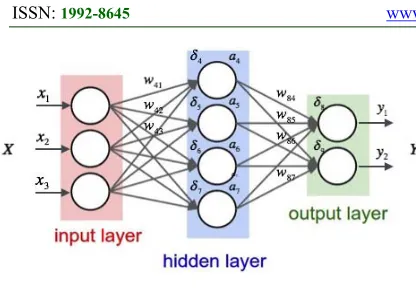
Figure 1: Description of the Artificial Neural Network
From the figure1, the information processing in the Artificial Neural Network can be abbreviated as follows: Potential appears as a unit input layer, the effect of each signal is expressed as a multiplication with a weighted value to indicated of the input, all signals are weighted, are summed one another to produce an activation unit is compared to a threshold value, the result is inserted into the transfer function (the produces an output). In summary, the process can be describes in the signal with hidden layer and the result output layer.
3.1 Artificial Neural Network Component
Neural Network Components there are several types of neural networks almost all of the same components have their components. These neurons will transform in formation receive through the connections to other neurons. In Neural Networks, relationships are known by weights. The information is stored at a certain value on the neuron. The artificial neural network works in the same way as a biological neuron. The information (input) is sent to the neuron with the arrival weight certain. This input will be processed by a propagation which adds up the value of all the weights. The result is compared to a certain threshold value by activation function of each neuron. If the input passes a certain threshold value, the neuron will be activated, but otherwise the neuron will be not be activated, the neuron will infect the output through the weight of its output all the neurons associated with neural networks. In Neural Network, neuron will be collected in layers called of layers of neurons (layer neurons). The neuron on the neuron in one layer will be connected to the layer before and after (except the input layer and the output layer), information provided on the neural network will be propagated layer to another layer. Starting from to input layer to output layer which is called as hidden layer (SMN Arosha
Senanayake, 2014), offering neural network with a single layer.
Artificial Neural Network
(ANN) is
learning
algorithm commonly used by perceptron with multiple layers to alter the weight of the weights connected with neurons present in the artificial neural lines. The figure 2 explain about the activation function for binary sigmoid
Figure 2: Description of Binary Sigmoid
From the Figure 2, the information training with back propagation neural network, the function have range 0 until 1
3.2 Back Propagation Neural Network Method
Artificial neural network can be given the connection that human try to make the original neural networks whereas the purpose of BPNN is a model computational system, that can be transferred network. Back propagation is a supervised learning algorithm. Algorithm uses output error to change the value of weight to backward hidden layer name back propagation backward neuron is activated by an aquatic function.
Structure of Back propagation Neural Networks are attracted to a set of elements of neurons or nodes or cells interconnected and organized in layers. Each cell processes with it activation function sigmoid. Then the equation of function sigmoid can be written as the following 2 equation:
f(x)=1/(1-e-x) (2)
961
[image:5.612.89.542.65.393.2]
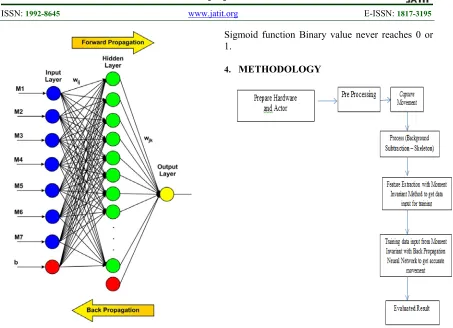
Figure 3: Description of Structure Back Propagation Neural Network
From the figure 3 the back propagation neural network algorithm is used as follows:
1. Initial weight
2. Set maximum epoch target and learning rate
3. In socialize epoch value with targeted epoch data and targeted MSE (Mean Square Error) wear appropriate steps as long as the value Maximum Mean Square Error > Target Error. The source figure from the (Fauziah, et. al,2018)
3.3Normalization on Artificial Neural Network
On Artificial Neural Network normalization is scaling of values into a certain range it is done input and output targets correspond to the range of activation functions used in network. Then the equation of Normalization can be written as the following 3 equation:
𝑥 ′ = 0.8𝑥 – 𝑎 + 0.1 (3)
𝑏 – 𝑎
From the equation 3 𝑥 ′is: result of normalization, x is: data input, a is: minimum data, b is: maximum data. From the normalization is done to get the data are in the interval 0 to 1. This is because the value of the sigmoid activation function in Binary is between 0 and 1. But it would be better if transformed into smaller intervals. For example on the interval [0.1 until 0.9], because given the
Sigmoid function Binary value never reaches 0 or 1.
4. METHODOLOGY
Figure 4: Description of research methodology
[image:5.612.94.308.68.393.2]962 Completed using background subtraction method separate from foreground/human body motion object from anatomical field with background/the other object than human). The next step is convert grayscale image of subtraction result into binary image through threshold operation perform morphology operation on binary image such as filling holes and opening area to eliminate noise to improve segmentation result for silhouette making process, then do skeleton, against the binary image of the segmentation result. After the object in the image separate with background, then performed the feature extraction step. Extracted are used to distinguish the type motion between one body object such as motion in the anatomical position of the body based on frontal/coronal plane. In this research feature extraction is done through morphological analysis based on seven moment invariant values. The values are extracted from each image to distinguish the 8 output classes (in temporary test data) are: no object class, flexion motion class, extension motion class, abduction motion class, adduction motion class, hyperextension motion class, and the other motion. The seven values of the moment do not change with translation, scales change, reflection and rotation. The extracted moment invariant is then used as input in the identification algorithm. The identification process is done to recognize the type based on input value in the form of seven moment invariant values previously extracted. The last step is to perform the identification process using Artificial Neural Network algorithm (Back Propagation ) will be seen from the characteristics or type of data processed, so that the resulting method or algorithm ANN hybrid with Moment invariant as input data resulting from the formation of skeleton characteristic formed through 1443 frames (after the video extraction process) it is clear, there is change of movement from the previous frame to the frame afterwards, the result of combination and processing of moment invariant to try and get identification human movement and motion and produce the best and maximum result with accuracy percentage and get best value.
5. RESULT AND DISCUSSION
Stages of research conducted are as follows: 1. Preparing from the human as an actor who will
provide example of body movement based on
the anatomical position of the body on frontal/coronal plane. Perform process are preprocessing from:
a. Image acquisition process when taking data in video with 47 seconds duration.
[image:6.612.313.528.213.434.2]b. The next step process of video extraction to form 1443 frames the anatomical position of the body based on frontal/coronal plane, in each frame the extraction result are then process can perform of identification the type movement
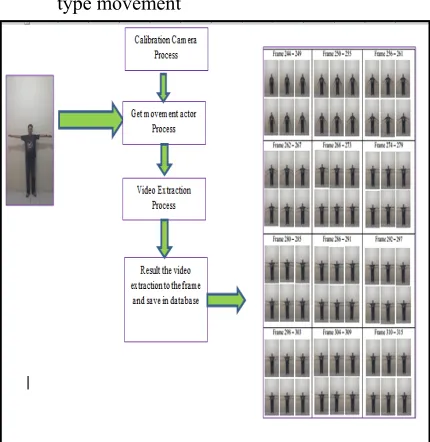
Figure 5: Description Image acquisition process and feature extraction process
From figure5, the result video extraction being frame store are: the moving human object, motion acquisition process, extraction result from motion frame.
2. Image segmentation, the segmentation stage in this research is very important step to get the silhouette of the object of gestures of the human body. The form of motion is based on the anatomical position of the body in frontal/coronal plane. Stages in the process of segmentation consist of preprocess stages and silhouette formation. Each process is describes in full as follows:
963
Figure 6: Description Preprocessing stages: grayscale current frame, background subtraction and Cropping
[image:7.612.312.521.452.625.2]From the figure6, consists of stages of acquisition of human body motion image in according with the anatomical field of the body with measurement of Range of Motion with stage grayscale current frame and background subtraction and the cropping process.
Figure 7: Description Preprocessing stages: grayscale
From the figure7, the Preprocess for grayscale stages it is a step to convert the color space of the original image RGB (Red, Green and Blue) to grayscale to frame selected, the equations used to convert the RGB color space into grayscale image can be seen in equation following 6:
(6)
The next steps from the preprocess steps is background subtraction, in figure8, can be seen the background subtraction process.
The next steps from the preprocess steps is background subtraction, in figure13, can be seen the background subtraction process.
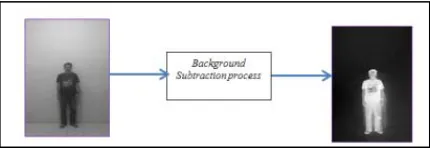
Figure8 Background Subtraction Process
From the figure8, the preprocess for background subtraction or foreground detection is one of the technique in digital image processing and computer vision to perform the process of detecting an image that is or take the according to the object motion position direction foreground from the background based on frontal or coronal plane. Background subtraction one of the usually an input to be processed at a further level such as a motion object that can be used from background subtraction to generate frame sequence from video and detect all foreground reduction process is done by subtracting each pixel from the background image frame with the human body motion image, where P[F(t)] is the resulting image, P[I(t)] is the background image, P[B] is the image gestures in anatomical position of the body based on frontal/coronal plane can be seen equation following 7:
[F (t) = P [It)] – P [B] (7)
The next step is cropping, in figure14, can be seen the stage of cropping. The cropping process is used to execute the resulting image size.
b. Stages Performed on the silhouette process, the process of conversion of binary image with threshold, performing morphological operation on binary image in the form of filling holes and opening area to eliminate the result of segmentation, and the result is formed the appropriate silhouette.
The process performed at the silhouette stage can be explained in figure9.
Figure 9: Description Silhouette process: filling holes and opening area
[image:7.612.87.302.631.705.2]964
Figure 10: Description Filtering Process
The next step from silhouette process is step 2, to convert the binary image with threshold from the given input is the background subtraction image is the binary image of the threshold resulted, the threshold result value of conversion process binary image with threshold can be seen in figure11.
Figure 11: Description Threshold Process
From the figure11, threshold process is a process that has been done after process background subtraction on threshold is an existing method of image segmentation process that can separate the motion of the anatomical body based on frontal/coronal plane, as a foreground with a background that is at a brightness level or a dark and light level. The intensity value of the region of an image will be perfectly black, than the intensity 0 and the region of an image will be perfectly bright or white the intensity value being 1. At the threshold stages is a process after done the stage of background subtraction and filtering, the process of obtaining done by partial cutting of the existing image, the cutting done on the part of the background located on the image stage of morphological operation with filling holes. The next process is using a morphological operation is a common operation used in binary image operations(black and white) in order to alter the structure of the object shape contained in the image. For example, on human objects when performed anatomical position of the body based on frontal/coronal planes, there are holes or holes contained in the human image and can be closed by morphological operation The erosion and dilation operation is use morphological processed, the operation is used to obtain a widening of 0 pixels (Gonzales& Woods, 2002), where erosion has the effect of reducing the image structure. The process performed to produce a better image. The opening operation is to smooth the contour of the objects
and remove all the pixels in the area too small to be occupied by the structural element, means that with all the foreground structures smaller than the structure elements will be eliminated by erosion. The equation applied to the opening operation seen equation following 8:
(8)
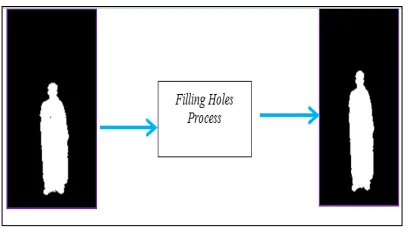
[image:8.612.313.518.214.331.2]The next step is filling holes, can be seen in figure 12.
Figure 12: Description Filling Holes Process
c.Skeleton process, in the process there are several way used for skeleton represented for skeleton represented for the introduction of the structure of the human body shape structure of motion based on the anatomical body of frontal/coronal plane, in MATLAB skeleton can be obtained which can be with using function in MATLAB to produce skeleton. The skeleton process can be seen in figure13.
Figure 13: Description Skeleton Process
From the figure13, the following picture is the skeleton process from frame silhouette image, the process are results of morphological operation stage by black-white morph function to produce skeleton model.
d. Feature extraction, is a technique used to obtain the existing object from the image captured during the acquisition process. Feature extraction is a feature retrieval or feature of a later form when the value obtained will be analyzed for the next process, feature extraction is done by counting the
S
S
A
S
[image:8.612.94.294.266.350.2]965 number of points or pixels encountered in the checking process, where checks are performed in various direction of tracking checking at Cartesian coordinates of digital image analyzed. The feature image used in this research is feature extraction with moment invariant based on anatomical body plane. Moment invariant is used in feature extraction process in image processing step for shape recognition and classification.
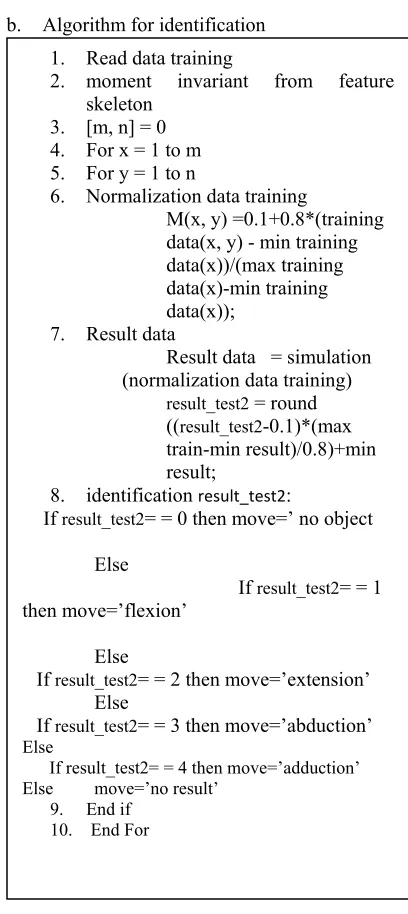
Algorithm for identification movement human shoulder:
a. Algorithm for Feature extraction
b. Algorithm for identification
[image:9.612.328.532.101.558.2]Result feature skeleton for identification with Moment Invariant Method
Table 1: Skeleton for M1-M2
M1 M2
274,427,278,255,838 261,144,010,653,257 204,040,558,174,623 119,381,620,988,461 391,360,967,840,061 518,861,498,286,783 642,397,883,167,108 404,943,777,048,395 719,718,311,451,100 504,483,530,859,288 904,434,592,242,624 784,915,210,310,877 294,403,442,245,223 324,884,180,499,187 272,314,566,153,067 251,387,136,973,507 295,400,212,724,850 233,883,930,561,192
1 .Read result skeleton 2. Process M:
M-1 N-1 M pq = Xp Yq f(x,y)
x=0 y=0 3. If M = M’
Feature1 =Cell (7, 2)
Feature 1(1, 1) = ‘M1’; Feature1 (1, 2) = num2str (M1));
Feature1 (2, 1) = ‘M2; Feature 1(2, 2) = num2str (M2));
Feature1 (3, 1) = ‘M3; Feature1 (3, 2) = num2str (M3));
Feature1 (4, 1) = ‘M4’; Feature1 (4, 2) = num2str (M4));
Feature1 (5, 1) = ‘M5’; Feature1 (5, 2) = num2str (M5));
Feature1 (6, 1) = ‘M6’; Feature1 (6, 2) = num2str (M6));
Feature1 (7, 1) = ‘M7’; Feature1 (7, 2) = num2str (M7));
Row1 = cell (7, 1) For I = 1 to 7
Row1 (I) =num2str (I) Else M’
End if End for
1. Read data training
2. moment invariant from feature skeleton
3. [m, n] = 0 4. For x = 1 to m 5. For y = 1 to n
6. Normalization data training
M(x, y) =0.1+0.8*(training data(x, y) - min training data(x))/(max training data(x)-min training data(x));
7. Result data
Result data = simulation (normalization data training)
result_test2 = round ((result_test2-0.1)*(max train-min result)/0.8)+min result;
8. identification result_test2:
If result_test2= = 0 then move=’ no object
Else
If result_test2= = 1 then move=’flexion’
Else
If result_test2= = 2 then move=’extension’ Else
If result_test2= = 3 then move=’abduction’
Else
If result_test2= = 4 then move=’adduction’ Else move=’no result’
966
Table 2: Skeleton for M3-M4
M3 M4
0.612884921225619 0.466832913438374 0.300512340491790 0.252719050352068 964,971,699,882,234 795,513,401,827,724 603,119,874,054,366 422,998,795,991,744 108,664,054,443,013 678,777,265,056,298 348,954,767,422,277 132,822,756,310,644 101,370,714,040,605 115,176,515,054,050 270,312,215,848,624 267,393,275,211,574 263,389,266,707,933 316,616,855,692,833
Table 3: Skeleton for M5-M6
M5 M6
-0.312719693434416 -0.0488739030192988 0.0710544299966920 0.268837600952026
509,338,031,066,001 120,886,441,007,497 179,465,156,324,330 266,691,699,522,096 490,470,642,149,905 470,273,494,649,951 309,695,482,566,366 785,415,443,632,268 127,741,973,086,592 203,934,354,184,601 736,654,608,574,010 410,718,948,840,904 104,075,225,245,380 476,719,301,446,193
Table 4: Skeleton for M7-Result
M6 Result
0.273922835266494 0 -0.00828729155105925 0 669,550,036,022,559 0 0.979838471874154 1 377,734,898,769,074 1 273,013,995,492,621 1 0.103829937484812 2 -0.335064614101787 2 -0.828743253973176 2
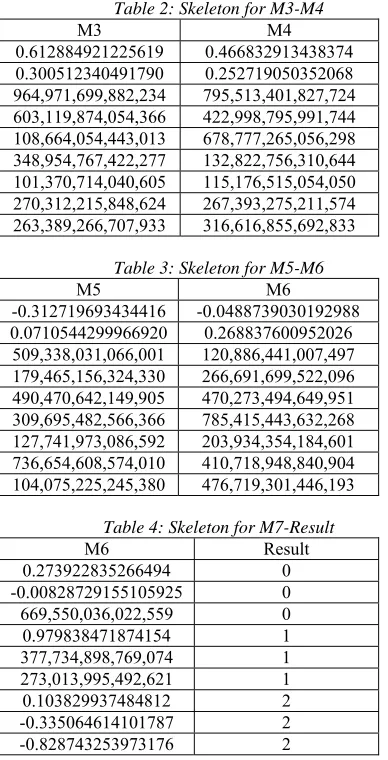
From table1 to table4, explain the result feature skeleton with moment invariant, M1-M7 feature of skeleton can result identification of the motion. The value moment invariant to get input data for training in back propagation neural network.
The accuracy value 97.8666% with the Back Propagation Neural Network, training epoch for 1000 however the training process stops at the epoch to 299 and error train 2.1334% from the training with back propagation neural network algorithm.
6. CONCLUSION
1. Using back propagation neural network method for identification Range of Motion and using moment invariant method at feature extraction process as with basic inputs for training on ANN and can result in the classification of
objects and the identification of the resulting objects with the characteristic of motion (the class no object, flexion motion class, extension motion class, abduction motion class, adduction motion class, hyperextension motion class). 3. Algorithm Back Propagation Neural Network
and Moment Invariant whose performance is the highest accuracy is 97.8666% for this research. 4. Each method is used is seen, it the data used as
input has a suitability or accuracy of the method and the type of characteristic of data process, especially for the Back Propagation Neural Network method and with moment invariant for feature extraction.
5. Future work can be tasted with various movements not only in the anatomical body for frontal/coronal plane it can be implemented also for the sagittal and transversal plane.
REFERENCES:
[1] Ahmad S, MB Abdel Halim, AmrBdr, “Analyzing and Measuring Human Joints Movement Using Computer Vision” International Journal of Computer Application 0975-8887, Volume 45- No.20, May 2012, pp.21-29.
[2]Arno HA, Arvid QL, “Visualization of Shoulder Range of Motion for Clinical Diagnostics and Device Development”, IEEE International Conference on Rehabilitation Robotic (ICORR), 2015, pp. 816-821, DOI: 10. 1109 / ICORR 2015. 7218303.
[3]Celia Amabile, Anthony M.J. Bull, Angela E.Kedgley, “The center of rotation of the shoulder complex and the effect of normalization”, Journal of Biomechanics Volume : 49, 2016, pp.1938-1943.
[4] Fauziah, Wibowo E.P, Hustinawaty, Madenda, S., “Identification of hand motion using background subtraction method and extraction of image binary with back propagation neural network on skeleton model”, 2nd International Conference on Computing and Applied Informatics 2017, IOP Conference Series: Journal of Physic: Conference .Series 978(2018) 012020 1-14, DOI:10.1088/1742-6596/978/012020.
967 Athletic Training, 2015, pp.289-294, DOI: 10.4085/1062-6050-49.0.05.
[6] Kaveri V Sonani, Mukesh A Zaveri, Sanjay Garg, 2016 “ Human Gesture Analysis For Action Recognition”, IEEE International Conference on Advances in Electronics Communication and Computer Technology (ICAECCT), Pune India, December 2-3, pp.
144-149, 2016, DOI:
10.1109/ICAECCT.2016.7942571.
[7] Niall McLaughlin, Jesus Martinez del Rincon, Paul Miller, “Recurrent Convolutional Network for Video-based Person Re-Identification”, IEEE conference on computer vision and pattern recognition CVPR, pp.1-11 2016.
[8] Patriacia Potter Anne, Perry Patricia Stockert Amy Hal, “ Fundamental Of Nursing 8th
Edition”, Mosby Publishing, eBook ISBN: 9780323091916, 9780323293969, 22 March 2012, p. 1329
[9] Shih - Chia Huang and Ben - Hsiang Do, “Radial Based Neural Network For Motion Detection Dynamic Scenes”, IEEE Transaction on Cybernetics (Volume:44, Issue:1, January 2014), pp. DOI: 10.1109/TCYB. 2013.2248057. [10]Tae Soo Kim Johns Hopkins University
Baltimore, “Interpretable 3D Human Action Analysis with Temporal Convolutional Networks”, IEEE Conference on Computer Vision and Pattern Recognition Workshops, 2017,pp.1623-1631,DOI: 10.1109/CVPRW. 2017.207
[11] Tavipia Rumambi, Hustinawaty, Sarifuddin Madenda, Eri Prasetyo Wibowo, “ Measurement Straight Leg Raise for Low Back Pain Based Grayscale Depth, TELKOMNIKA, Vol.15, No.1, March 2017, pp. 471~477 ISSN: 1693-693.
[12] Thiago Bruno Caparelli, Eduardo Larazo Martins Navaes, “Reconstruction of gait
biomechanical parameters using cyclogram and artificial neural networks”, Research on Biomedical Engineering, Volume 33 Number 3 p.229-236, 2017
[13] Tunyanoot Prasertsakul, Yodechanan Wongsa Wat, Warakom Charoensuk, “Human Postural
Stability Model and Artificial Neural Network for Prediction the Center Posture”, Proceedings of the international Electrical Engineering Congress, 2014, pp. 1-4.
[14 Weifing Ge, Yuhan Dong, Zhenhua Guo, You Bin Chen, “Background Subtraction with
Dynamic Noise Sampling and Complementary Learning”, 22nd International Conference On