Research Paper:
Immediate Effect of Respiratory Muscle
Sprint-Interval Training (RMSIT) on the Plantar Pressure
Variables in Athletes with Chronic Low Back Pain: A
Randomized Controlled Trial
Behnam Gholami Borujeni1 , Ali Yalfani1*
1. Department of Corrective Exercises and Sport Injury, Faculty of Physical Education and Sport Sciences, Bu-Ali Sina University, Hamadan, Iran.
* Corresponding Author: Ali Yalfani, PhD.
Address: Department of Corrective Exercises and Sport Injury, Faculty of Physical Education and Sport Sciences, Bu-Ali Sina University, Hamadan, Iran. Tel: +98 (813) 8381422
E-mail: [email protected]
Objectives: The respiratory function is often overlooked in people with Low Back Pain (LBP), while it is one of the factors for the continuation and recurrence of lumbar spine injury. Aim
of this study was survay the immediate effect of Respiratory Muscle Sprint-Interval Training (RMSIT) on the plantar pressure variables of athletes with LBP.
Methods: This randomized controlled trial was conducted on two groups with LBP, one experimental group (24 patients) and one control group (23 patients). The plantar pressure variables were recorded using a plantar pressure measurement device. The experimental group performed the RMSIT protocol. The RMSIT was fulfilled as six sets of 30-second deep breathing exercises (with two minutes of rest between sets) with constant tidal volume, maximum breathing rate, and added resistance. The paired t-test and one-way covariance tests
were used to analyze the data.
Results: The results of (95%) confidence ellipse showed that RMSIT caused a significant decrease in the amount area of sway, but the exercise did not make a significant difference in the length of minor axis and length of the major axis. The results of the Center of Presure (COP) factors showed that the training program significantly reduced the amount of path length, the standard deviation in the Y axis, but the results did not show a significant difference in the velocity and standard deviation in the X axis in the experimental group. The results demonstrated no significant difference between the experimental and control group in the
plantar pressure symmetry indices.
Discussion: It can be concluded that, these exercises can be used to reduce some postural
oscillation indices in athletes with LBP.
A B S T R A C T
Article info:
Received: 27 Dec 2019 Accepted:25 May 2019 Available Online: 01 Sep 2019
Keywords:
Respiratory muscle, Sprint-interval training, Plantar
pressure, Low back pain, Athlete
Citation: Gholami Borujen B, Yalfani A. Immediate Effect of Respiratory Muscle Sprint-Interval Training (RMSIT) on the Plantar Pressure Variables in Athletes With Chronic Low Back Pain: A Randomized Controlled Trial. Iranian Rehabilitation Journal. 2019; 17(3):271-278. http://dx.doi.org/10.32598/irj.17.3.271
: http://dx.doi.org/10.32598/irj.17.3.271 Use your device to scan
Highlights
● Immediate respiratory training changed some the plantar pressure variables.
● Immediate respiratory training reduced the center of pressure sway.
● Respiratory training not affects on plantar pressure symmetry indices.
● Immediate respiratory training improves postural control.
Plain Language Summary
The people with Low back pain are suffering from impaired coordination between the trunk and the lower extremity, as well as balance defects. In this study, respiratory muscle training was used to reduce postural sway. The results of this study showed that respiratory training can reduce balance defects. Therefore this training method can be used for
the rehabilitation of people with LBP and can be used for the balance improvement.
1. Introduction
ow Back Pain (LBP) is one of the most
common diseases caused by exercise [1,
2]. The people with LBP are suffering
from impaired coordination between the
trunk and the lower extremity [2]. as well
as postural control changes [3]. Among the symptoms of
chronic LBP disability, abnormal respiratory patterns and
its various methods are of the most common symptoms that are often underestimated [4]. In general, movements of the chest and ribs are interconnected with spine[4].
Imbalance in the muscles that attached to spinal leads to spinal malalignment and these changes in most people cause pain in the cervical, thoracic and lumbar region
[4]. The Chest Wall Expansion (CWE) is due to the
co-contraction or bracing of erector spinae and abdominal
muscles. The respiratory function is often overlooked in people with LBP, while it is one of the factors for the
continuation and recurrence of lumbar spine injury [4].
Respiratory exercises have the advantage for posture because, facilitating the uplift and rotation of the ribs and this develops favorable conditions for the CWE and is related to the length of the muscles, hereby provid-ing a mechanical advantage for postural alignment [5].
Activating respiratory muscles causes an increase in in-tra-abdominal pressure caused by transverse abdominis
muscles contraction and thus reduces LBP [6].
Squat is an important component of strengthening training in athletes. In addition, the squat as a movement pattern is necessary in many movements, such as sitting, lifting and many exercises. The National Academy of
Sports Medicine (NASM) has proposed overhead squat as a useful indicator for the quality of movement [7].
Given the theoretical foundations, it can be conclud
-ed that probably activating respiratory muscles through effecting local stabilizers, especially Transverse Ab -dominis (TVA) and diaphragm as important respiratory muscles, and changing posture have different effects on plantar pressure and postural control. Investigations in this problem are limited, and no study was found on the effect
of these exercises on plantar pressure. Therefore, the pres
-ent study was conducted to evaluate the immediate effect
of Respiratory Muscle Sprint-Interval Training (RMSIT)
on plantar pressure variables of athletes with chronic LBP
when implementing overhead squat. The study examined the impact of immediate respiratory training to be able to
introduce a protocol that reduces the likelihood of injury
in each training session or competition.
2. Methods
This randomized controlled trial was conducted on two
groups, one experimental group and one control group. The statistical population of this study was strength ath-letes in Hamadan, Iran, with an age range of 18 to 25 years old. This study was conducted in March 2018. Those who
had more than three months of LBP with an undetectable
etiology were selected as the subjects with chronic non-specific LBP [8]. According to the G*power software, 47 people were selected as the statistical sample available in
accordance with the inclusion criteria [9].Of these 47,
ran-domly simple, 24 patients were selected as experimental group and 23 patients as control group (Figure 1).
It should be noted that the subjects were selected af-ter taking the necessary examinations to participate in this study. The athletes in this study were selected from individuals who had at least three years of continuous and regular attendance in resistance and weight training exercises, and had at least three training sessions each
week with duration of each session more than an hour.
Participants had no history of surgery, fracture, burn,
neuromuscular problems and injury in spine and lower
extremity, and had no malalignments in the lumbar or pelvic region and the lower limbs.
The plantar pressure variables were recorded using a
plantar pressure measurement device (model Foot press
-ing FDM-S, Zebris Co. Germany) [10]. For respiratory
muscles strengthening was used of Power breathe
Spi-rometer (Figure 2).
Before the test, the participants performed warming up for 6 minutes, including 3 minutes of warming up with an ergometer at a constant speed and resistance, and 3 minutes of full-body stretching movement.
To perform the test, the subjects stood as the feet shoul-der width apart and straight to the front. The ankle and
foot were in a neutral position. The participant was asked to hold the hands up and extend the elbows completely,
placing the arms symmetrically beside of head. The per-son was in the overhead squat position (the knee angle was 90 degrees), the feet were forward and the knees were aligned with the feet (second and third toes). The tibia and arms were aligned with the trunk. The heels were in contact with the ground, the feet were also at
10° Foot Progression Angle (FPA) (the angle between
the heel center and the second toe) [7]. The duration of
the test was 30 seconds.
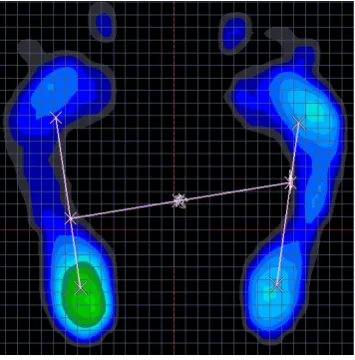
Figure 2. Average force distribution and COP Sway Figure 1. Sample selection diagram
Assessed for Eligibility (n=791) Male= 399 Female= 392
n=47 Male= 22 Female= 25
Traning Grpup n=24 Male= 11 Female=13
Control Grpup n=23 Male= 11 Female=12 Randomized
Excluded (n=744) Not Meeting inclusion criteria (n=302)
After recording the pre-test data, the participants of the experimental group performed the RMSIT protocol, fol-lowed by post-test after two minutes. The RMSIT was fulfilled as six sets of 30-second deep breathing exercise (with two minutes rest between sets) with constant tidal volume, maximum breathing rate and added resistance [11]. In the control group, they had no activity for 15 minutes after pre-test (similar to the protocol performed by the experimental group) and then the post-test was
completed. The plantar pressure variables were analyzed
using the Win FDM-S stance (version 01.02.09)
soft-ware. The symmetry index between two feet was calcu
-lated by the equation of , and symmetry index between
forward and backward of foot calculated by [10].
SI= right force right force + left force
SI= forward force
forward force + backward force
Shapiro-Wilk test was used to determine the normal dis-tribution of data. Paired t-test and one-way covariance tests were used to analyze the effect of RMSIT on plantar pressure variables. Data were analyzed by SPSS V. 20 software and the significance level was α=0.05.
3. Results
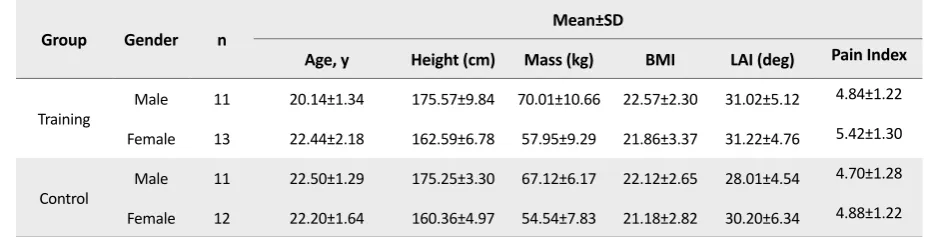
The Shapiro-Wilk test results in each group showed that the distribution of data in the research variables in that group was normal (p>0.05). Demographic informa-tion including: age, Height, Mass, BMI, Lumbar Arch Index and Pain index are listed in Table 1.
The paired t-test results (Table 2) showed that the
RMSIT among the (95%) confidence ellipse (Figure 3) parameters only caused a significant decrease in area of sway from the pre-test to post-test in the experimental group. The paired t-test results showed no significant dif-ferences in length of minor axis and length of major axis between pre-test and post-test in the experimental group. The paired t-test results between the pre-test and
post-Table 1. Demographic information
Group Gender n Mean±SD
Age, y Height (cm) Mass (kg) BMI LAI (deg) Pain Index
Training Male 11 20.14±1.34 175.57±9.84 70.01±10.66 22.57±2.30 31.02±5.12
4.84±1.22
Female 13 22.44±2.18 162.59±6.78 57.95±9.29 21.86±3.37 31.22±4.76 5.42±1.30
Control Male 11 22.50±1.29 175.25±3.30 67.12±6.17 22.12±2.65 28.01±4.54
4.70±1.28
Female 12 22.20±1.64 160.36±4.97 54.54±7.83 21.18±2.82 30.20±6.34 4.88±1.22
LAI: Lumbar Arch Index Figure 3. 95% Confidence ellipse
Major axis Minor axis
test scores in the (95%) confidence ellipse parameters in the control group found no significant difference. The one-way covariance test results revealed a significant
dif-ference in the area of way index between the control
and the experimental group. However, the one-way co-variance test results exhibited no significant difference in the length of major axis and length of minor axis be-tween the control and experimental group.
The paired t-test results (Table 3) reported that the RM-SIT significantly reduced some of the center of pressure oscillation factors including path length and standard deviation in Y axis in the experimental group from pre-test to post-pre-test, but the paired t-pre-test results underlined no significant difference in the velocity and standard devia-tion in X axis between pre-test and post-test in the experi-mental group. The paired t-test showed no significant
dif-ference in the scores of the center of pressure oscillation
factors between pre-test and post-test in the control group. Moreover, one-way covariance test results showed sig-nificant differences in path length and standard deviation in Y axis between control group and experimental group,
but one-way covariance test results found no significant difference in scores of velocity and standard deviation in X axis between the control and the experimental groups.
According to the paired t-test results (Table 4) in the
experimental and control groups, there was no signifi-cant difference in the plantar pressure symmetry be-tween pre-test and post-test. Based on one-way covari-ance test results, there was no significant difference in
plantar pressure symmetry between experimental and
the control groups.
4. Discussion
The results of this study showed that respiratory mus-cle training changed some the plantar pressure variables in athletes with LBP. The present study is consistent with some of the previous studies in terms of the effect of respiratory training and activation of these muscles, which are mainly local muscles of core region [12,13].
The postural control and respiration are mechanically
and neuromuscularly dependent on each other, both
Table 2. Paired t-test and One-Way Covariance Analysis in results of (95%) confidence ellipse
Partial Eta Squared Sig F Sig (t-Paired) Mean±SD Group Variable AT BT 0.090 0.155 2.16 0.153 16.25±12.25 22.33±15.32 Training Length of minor
axis (mm) Control 19.11±12.17 23.20±14.91 0.321
0.00 0.990 0.00 0.702 45.68±29.45 51.38±24.07 Training Length of major
axis (mm) Control 46.28±27.01 49.94±30.37 0.467
0.242 0.015* 7.03 0.011* 303.63±129.35 928.73±240.06 Training Area (mm^2) 0.270 967.83±288.08 839.12±207.59 Control
*Indicates significant difference (P<0.05); BT: Before Training; AT: After Training
Table 3. Paired t-test and one-way covariance analysis in results of (COP) sway
Partial Eta Squared Sig F Sig (t-Paired) Mean±SD GROUP Variable AT BT 0.330 0.003* 10.84 0.011* 484.08±218.78 906.45±253.48 Training Path Length (mm)
0.301 795.45±110.34 767.81±252.89 Control 0.033 0.396 0.75 0.929 33.35±18.18 34.20±17.61 Training Velocity (mm/ sec)
0.252 42.30±19.80 32.90±11.14 Control 0.013 0.596 0.29 0.719 37.10±23.99 55.18±26.06 Training Standard Diviation X (mm)
0.109 52.87±18.65 45.48±15.21 Control 0.176 0.041* 4.71 0.013* 37.10±23.99 55.18±26.06 Training Standard Diviation Y (mm)
0.263 56.17±28.31
51.95±26.40 Control
systems involve diaphragm, TVA, intercostal muscles, internal oblique muscles and pelvic floor muscle [14].
These muscles play a special role in voluntary breathing, which means that the TVA along with multifidus is ac-tive in stabilizing the lumbar region [12, 15].
As well as Vostatek, et al. (2013) stated that the dia-phragm has both respiratory and postural functions [16].
Focus of the respiratory training in the present study was the deep and local muscles of the core region. Hodges and Gandevia (2000) also argued that inspiratory mus-cles, especially the diaphragm, play a key role in con-trolling the spine, which are vital during postural control [14]. Janssens et al. (2015) also found that inspiratory muscle training improved postural control in people with LBP and decreased LBP severity significantly [13].
Our results demonstrated no significant difference be-tween the experimental and control group in the plantar pressure symmetry indices. No found study that survey the effect of respiratory training on plantar pressure variables. But according to the results of studies, entire movement system covers many body parts, and that a proper alignment to the line of gravity ensures good posture; any irregularity in this alignment can cause changes in the adjacent segments and other components or even changes in the activity of body systems and or-gans[17,18]. Studies have shown that deep muscles ac-tivity improves body alignment, but the exercises used in the above studies were long-term and effective on spinal alignment [19].
Also, the alteration in the alignment of the body affects
the plantar pressure [20]. Anukoolkarn et al. (2015)
stat-ed that the pressures on the plantar surface were unequal-ly distributed in subjects with chronic non-specific low
back pain [21]. In the present study, the RMSIT had no
effect on right-left plantar pressure symmetry and also
fore and back plantar pressure symmetry, probably due
to short duration of exercise that did not have an impact
on body alignment. It is likely that long-term training of
these muscles will improve plantar pressure symmetry
by improving posture.
One of the limitations of the research was that every-one had 10° Foot Progression Angle (FPA), whereas people may put feet at different angles while training at the gyms. Therefore, the same FPA and squat angle were considered for all athletes in the present study to homog-enize the conditions in all subjects in both pre-test and post-test. Another limitation of this study was to investi-gate the immediate effect of this training, whereas long-term exercises may provide better effects. Therefore, it is suggested to evaluate the long-term effects of these
ex-ercises in order to accurately introduce these exex-ercises in
the postural control and improving the plantar pressure
symmetry. To introduce a protocol that reduces the like
-lihood of injury in each training session or competition this study survay the effect of immediate training instead of a long-term training protocol.
5. Conclusion
RMSIT protocol in the athletes with chronic LBP could have positive effects on the some of the center of
pres-sure oscillation factors, but had no impacts on other cen
-ter of pressure oscillation factors and plantar pressure symmetry parameters. As a result, these exercises can
be used to reduce some postural oscillation indices in athletes. However, given the insignificant effect of these exercises on many study factors, as well as limited report in this problem, further studies are needed to examine the effect of these exercises (as both long-term and
im-mediate) on plantar pressure variables.
Table 4. Paired t-test and one-way covariance analysis in results of symmetry of plantar pressure
Partial Eta Squared Sig(F) F Sig (t-Paired) Mean±SD GROUP Variable AT BT 0.128 0.086 3.22 0.833 0.481±0.07 0.487±0.102 Training S of Left & Right
0.214 0.569±0.10 0.519±0.09 Control 0.038 0.363 0.86 0.145 0.457±0.264 0.570±0.28 Training S of F & B (Right)
0.668 0.485±0.302 0.478±0.29 Control 0.038 0.36 0.87 0.194 0.614±0.22 0.668±0.28 Training S of F & B (Left)
0.372 0.573±0.26
0.499±0.29 Control
Ethical Considerations
Compliance with ethical guidelines
Before entering the lab, the subjects studied the writ-ten consent form and then signed it. This study was ap-proved and registered at the Ethics Committee of Hama-dan University of Medical Sciences (Code: IR.UMSHA. REC.1396.844). The data extract center was Bu-Ali Sina University Sport Rehabilitation Lab.
Funding
This research is extracted from PhD dissertation of First
Author, Departemant of Corrective Exercises & Sport
Injury, Faculty of Physical Education and Sport Sciences at Bu-Ali Sina University, Hamadan. This research did not receive any specific grant from funding agencies in the public, commercial, or not-forprofit sectors.
Authors' contributions
Reading and approve the final version of the manu-script, agreeance with the order of presentation of the authors: Behnam Gholami Borujeni, Ali Yalfani.
Conflict of interest
The authors declared no conflict of interest.
References
[1] Dehkordi F, Khankeh HR, Hassani Mehraban A, Hosseini
SA. The impact of chronic low back pain on daily occupations: A qualitative study in Iranian context. Iranian Rehabilitation
Journal. 2016; 14(1):15-22. [DOI:10.15412/J.IRJ.08140103]
[2] Herndon CL, Horodyski M, and Vincent HK. Acute effects
of anesthetic lumbar spine injections on temporal spatial
pa-rameters of gait in individuals with chronic low back pain: A pilot study. Gait & Posture. 2017; 58(1):369-73. [DOI:10.1016/j. gaitpost.2017.08.016] [PMID]
[3] Schelldorfer S, Ernst MJ, Rast FM, Bauer CM, Meichtry A,
Kool J. Low back pain and postural control, effects of task dif
-ficulty on centre of pressure and spinal kinematics. Gait & Pos
-ture. 2015; 41(1):112-8. [DOI:10.1016/j.gaitpost.2014.09.004]
[PMID]
[4] Babina R, Mohanty PP, Pattnaik M. Effect of thoracic mo
-bilization on respiratory parameters in chronic non-specific low back pain: A randomized controlled trial. Journal of Back and Musculoskeletal Rehabilitation. 2016; 29(3):587-95.
[DOI:10.3233/BMR-160679] [PMID]
[5] Lee M, Lau H, Lau T. Sagittal plane rotation of the pelvis
during lumbar posteroanterior loading. Journal of Manipu
-lative and Physiological Therapeutics. 1994; 17(3):149-55.
[PMID]
[6] Hodges PW, Gandevia S. Activation of the human dia
-phragm during a repetitive postural task. The Journal of Phys
-iology. 2000; 522(1):165-75. [DOI:10.1111/j.1469-7793.2000.
t01-1-00165.xm] [PMID] [PMCID]
[7] Bishop C, Edwards M, Turner A. Screening movement dys
-functions using the overhead squat. The Journal of Strength and Conditioning Research. 2016; 42:22-30.
[8] Last AR, Hulbert K. Chronic low back pain: Evaluation and
management. American Family Physician. 2009;
79(12):1067-74. [DOI:10.1080/20786204.2010.10873969]
[9] Faul F, Erdfelder E, Lang A-G, Buchner A. G* Power 3: A
flexible statistical power analysis program for the social, be
-havioral, and biomedical sciences. Behavior Research Meth
-ods. 2007; 39(2):175-91. [DOI:10.3758/BF03193146] [PMID]
[10] Braun BJ, Veith NT, Hell R, Döbele S, Roland M, Rollmann
M, et al. Validation and reliability testing of a new, fully in
-tegrated gait analysis insole. Journal of Foot and Ankle Re
-search. 2015; 8(54):1-7. [DOI:10.1186/s13047-015-0111-8]
[PMID] [PMCID]
[11] Wüthrich TU, Marty J, Benaglia P, Eichenberger PA,
Spengler CM. Acute effects of a respiratory sprint-interval session on muscle contractility. Medicine and Science in
Sports and Exercise. 2015; 47(9):1979-87. [DOI:10.1249/
MSS.0000000000000627] [PMID]
[12] Szczygieł E, Blaut J, Zielonka-Pycka K, Tomaszewski K,
Golec J, Czechowska D, et al. The impact of deep muscle training on the quality of posture and breathing. Journal of
Motor Behavior. 2018; 50(2):219-27. [DOI:10.1080/00222895.2
017.1327413] [PMID]
[13] Janssens, L, McConnell AK, Pijnenburg M, Claeys K,
Goossens N, Lysens R, et al. Inspiratory muscle training af
-fects proprioceptive use and low back pain. Medicine & Sci
-ence in Sports & Exercise. 2015; 47(1):12-9. [DOI:10.1249/ MSS.0000000000000385] [PMID]
[14] Hodges PW, Gandevia SC. Changes in intra-abdominal
pressure during postural and respiratory activation of the
human diaphragm. Journal of Applied Physiology. 2000;
89(3):967-76. [DOI:10.1152/jappl.2000.89.3.967] [PMID]
[15] Hodges P, Sapsford R, Pengel L. Postural and respira
-tory functions of the pelvic floor muscles. Neurourology and
Urodynamics. 2007; 26(3):362-71. [DOI:10.1002/nau.20232]
[PMID]
[16] Vostatek P, Novák D, Rychnovský T, Rychnovská S. Dia
-phragm postural function analysis using magnetic resonance
imaging. PlOS One. 2013; 8(3):e56724. [DOI:10.1371/journal.
pone.0056724] [PMID] [PMCID]
[17] Hadała M, Gryckiewicz S. Movement pattern and muscle
balance as a source of lumbar spine health according to the
concept of kinetic control. Polish Annals of Medicine. 2014;
21(2):152-7. [DOI:10.1016/j.poamed.2014.06.001]
[18] Claeys K, Dankaerts W, Janssens L, Pijnenburg M, Goos
-sens N, Brumagne S. Young individuals with a more
ankle-steered proprioceptive control strategy may develop mild
non-specific low back pain. Journal of Electromyography
and Kinesiology. 2015; 25(2):329-38. [DOI:10.1016/j.jele
[19] Tsao H, Hodges PW. Persistence of improvements in pos -tural strategies following motor control training in people
with recurrent low back pain. Journal of Electromyography
and Kinesiology. 2008; 18(4):559-67. [DOI:10.1016/j.jele
-kin.2006.10.012] [PMID]
[20] Anbarian M, Esmaeili H. Effects of running-induced fatigue
on plantar pressure distribution in novice runners with
differ-ent foot types. Gait & Posture. 2016; 48:52-6. [DOI:10.1016/j.
gaitpost.2016.04.029] [PMID]
[21] Anukoolkarn K, Vongsirinavarat M, Bovonsunthonchai S,
Vachalathiti R. Plantar pressure distribution pattern during
mid-stance phase of the gait in patients with chronic
non-specific low back pain. Journal of the Medical Association of