Research Paper:
Comparison of Effects of Bilateral Versus
Unilateral Quadriceps Training on Balance, Functional
Mobility and Functional Gait in Patients With Stroke
Snigdha Rastogi1, Nusrat Hamdani2*
1. Department of Rehabilitation Sciences, Neurology and Sleep Center, New Delhi, India.
2. Department of Rehabilitation Sciences, Hamdard Institute of Medical Sciences and Research, New Delhi, India.
* Corresponding Author:
Nusrat Hamdani, PhD
Address: Department of Rehabilitation Sciences, Hamdard Institute of Medical Sciences and Research, New Delhi, India. Tel: +98 (919) 810885625
Objectives: Motor weakness is a notable symptom after stroke. Hence, the aim of this
study was to find out the effect of bilateral quadriceps training compared to that of unilateral quadriceps training on balance, functional mobility and functional gait in patients with stroke. Subjects: Male and female hemiparetic patients between 40-60 years of age with post-stroke of 1-6 months were included in the study. Study Design: Test re-test was performed.
Methods: Data was obtained through strain gauge, Berg balance scale, dynamic gait index and timed up and go test, and then again, data was obtained with the help of the above-mentioned instruments 6 weeks after providing the patient with strength training.
Results: Functional mobility and isometric strength of unaffected side gave significant values and balance, functional gait and isometric strength on affected side gave insignificant values.
Discussion: The findings of the present study suggested that bilateral quadriceps training is good to improve functional performances like timed up and go test and isometric strength on the unaffected side. However, to improve further, the Berg balance scale, dynamic gait index and isometric strength scores of affected side, for both the bilateral quadriceps and unilateral quadriceps training, are equally effective.
A B S T R A C T
Article info: Received: 10 Sep. 2016 Accepted:26 Dec. 2016
Keywords:
Progressive resistive training,
Quadriceps, Stroke
Citation: Rastogi S, Hamdani N. Comparison of Effects of Bilateral Versus Unilateral Quadriceps Training on Balance, Functional Mobility and Functional Gait in Patients With Stroke. Iranian Rehabilitation Journal. 2017; 15(1):43-48. https://doi. org/10.18869/nrip.irj.15.1.43
:
: https://doi.org/10.18869/nrip.irj.15.1.43 Use your device to scan
and read the article online
1. Introduction
tudies have been conducted on the rela
-tionship between whole lower extremity muscle strength, balance, functional gait
and functional mobility [1-3]. However, only a few studies have focused on knee extensor muscle strength correlation
with functional performances like balance, mobility
and gait. The knee extensor muscle is an important contributor to human locomotor efficiency and stabil
-ity and is crucial to a variety of other ADL too. So, the extension of the leg is an important movement in
-volved in daily life [4-6] .
Few researches have been conducted on the effects of unilateral quadriceps training on balance, functional mo
-bility, and functional gait in patients with stroke [7,8].
S
Specifically, deficits are well recognized in both paretic and non-paretic limbs. Bilateral training in which the pa
-tient practices identical activities with both of the limbs has been proposed to improve hemiplegic limb control and function. Regulation of bilateral, identical, and syn
-chronous movements appears to be coordinated centrally through bilaterally distributed neural networks connected via the corpus callosum, involving cortical and subcorti
-cal areas. These networks stipulate a shared facilitatory drive to both motor cortices, contributing to a sound spa
-tial coupling of limb movement noticed during bilateral, identical, synchronous, and voluntary movements.
Hence, the beneficial effects of bilateral training in stroke are assumed to arise from this coupling effect in which the nonparetic limb provides a template for the paretic limb in terms of movement characteristics, facilitating restora
-tion of movement [9,10]. This study is aimed to find out the effect of bilateral quadriceps training compared to the unilateral quadriceps training on balance, functional mo
-bility, and functional gait in patients with stroke.
2. Methods
A total of 30 subjects were selected by random sam
-pling based on inclusion and exclusion criteria. All the
patients were recruited from the inpatient and outpatient
department of HAHCH, Jamia Hamdard New Delhi.
Subjects
Inclusion criteria: Male/female between 40-60 years of
age; hemiparetic patients with post-stroke of 1-6 months; patients having ischemic stroke or hemorrhagic stroke (Unilateral stroke); patients who were able to follow verbal
commands or demonstrated directions, which ensured that
each patient was trainable (MMSE>=24); Berg balance scale less than 45/56; motricity index of score as 25 points, i.e. movement against gravity was taken into account.
Exclusion criteria: Brain tumors associated with CVA; patients having another mobility limiting neurological condition (e.g. dementia or Parkinson’s disease) or any etiology of trauma or any identified orthopedic condi
-tion (Osteoporosis, RA, OA); and patient having serious
uncontrolled medical complications.
Procedure
Subjects were selected according to the inclusion and exclusion criteria. Informed consent was obtained from each patient before confirming their participation in the study. On the first visit, data in the form of scores was ob
-tained through Berg balance scale, dynamic gait index, timed up and go test, and strain gauge. Then data was obtained with the help of the above-mentioned scales and strain gauge 6 weeks after providing the patient with strength training. Group A consisted of patients who got unilateral training, and Group B consisted of patients who got bilateral training. Firstly, the isometric muscle strength was measured with strain gauge.
The patients were made to sit in a high sitting position on quadriceps table and made to push one side of distal arm of quadriceps table in the forward direction (exten
-sion of leg). The other side of the distal arm of quadriceps table was attached to the ring of chain. The chain was at
-tached to strain gauge’s ring through a hook. Finally, the strain gauge’s other ring was attached to a hook, which
was further attached by a chain to the rod that was tied
to the posterior legs of quadriceps table. The subject was allowed 5 seconds to develop the maximum contraction. This was done to prevent a sudden snatching effort and also prevent a prolonged effort of more than 5 seconds at
the end of which the subject merely would maintain his
maximum effort rather than increase it. The average of three successive measurements was taken at intervals of one minute and again after 6 weeks of successful com
-pletion of the treatment protocol. Three other successive measurements were also taken accordingly.
Training program
The subjects were made to participate in a supervised strength training three times a week for 6 weeks. In each training session, the knee extension progressive resis
-tance exercises were performed. In one-half of the sub
-jects, bilateral training was performed while in another group, exercises were performed unilaterally. In bilateral training, the affected one was first trained followed by training of the unaffected one.
During the first 2 weeks of the training, the subjects were trained with the loads of 50% of 1 RM. Twelve repeti -tions were performed per set and total sets were four.
Dur-ing the second two weeks of trainDur-ing, the subjects were trained with the loads of 70% of 1 RM. Eight repetitions were performed per set, and the total sets were five. Dur
-ing the last two weeks of the train-ing, the subjects were trained with the loads of 80% of 1RM. Six repetitions were performed per set, and the total sets were six [11].
Data Analysis
bi-lateral against unibi-lateral quadriceps training on balance, functional mobility, and functional gait of the patients with stroke. Student’s t-test was used to compare iso
-metric strength, Berg balance scale, dynamic gait index and timed up and go test values in both of the groups after training of 6 weeks. A significance level of 0.05
was used for all statistical comparisons.
3. Results
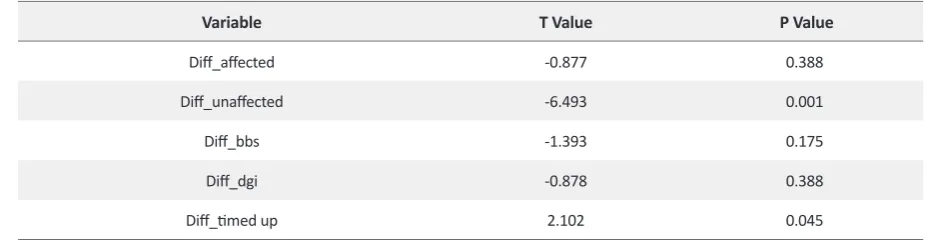
The study consisted of two groups. Group 1 comprised of unilateral training patients, which had 10 males and 3 females with a mean age of 52.62 years while group 2 had 12 males and 3 females with a mean age of 49.60 years. Each patient’s age, duration since onset, MMSE, and weight was recorded. Table 1, 2 gives the details of the mean and standard deviations of these scores. These variables had no significant difference between the two groups. Increase in pre values to post values for isomet
-ric strength of affected side, Berg balance scale and dy
-namic gait index showed no significant difference while timed up and go test and isometric strength of unaffected side showed a significant difference (Table 3 and 4).
4. Discussion
Every parameter in the demographic data like age, gender, duration since onset, MMSE, and weight in both the group’s analysis showed homogeneity.
Age
Age showed non-significant results. The mean age was 52.62 years with a standard deviation of 5.2 in the
uni-lateral training group, and the mean age was 49.60 years with a standard deviation of 6.4 in the bilateral training group (Table 1). In the present study, the age for both the groups was homogeneous, indicating there was no differ
-ence in both the groups (the distribution was equal in both
of them) (Table 1).
Duration since onset
Duration since onset showed non-significant results. The mean duration was 118.15 with a standard deviation of 44.6 in the unilateral training group, and the mean duration was 101.33 with a standard deviation of 47.5 in the bilateral training group (Table 1). The duration since onset for both of the groups came out to be of equal
means with no difference in their distribution.
MMSE
MMSE showed non-significant results while the mean cognitive values for unilateral training group was 26.92 with a standard deviation of 1.3 and for the bilateral training group was 26.33 with a standard de
-viation of 1.7. MMSE values for both the groups were equally distributed (Table 1).
Table 1. Comparison of unilateral training group versus bilateral training group
Variable Unilateral (n=13)Mean±SD Bilateral (n=15)Mean±SD
Age (y) 52.62±5.2 49.60±6.4 Duration (days) 118.15±44.6 101.33±47.5
MMSE 26.92±1.3 26.33±1.7 Weight (kg) 70.92±11.10 78.53±12.78
Table 2. Comparison of isometric strength, Berg balance scale, dynamic gait index and timed up and go test between two groups
T-Value P-Value
Weight
Weight also showed non-significant results. The unilat
-eral training group showed a mean of 70.92 kg with a stan
-dard deviation of 11.10, and the bilateral training group showed a mean of 78.53 kg with a standard deviation of 12.78. The weight of the patients was in uniformity in both the groups. An increase in particular variables from pre values to post values was observed (Table 1 and 2).
Isometric strength on the affected side showed non-sig
-nificant results. Isometric strength on affected side after bilateral training was not much improved as compared to after unilateral training (Table 3 and 4). Previous stud
-ies have also shown significant gains in the strength of affected side after 6 weeks of intervention by isokinetic strength training. Others have shown significant gains in the strength of paretic limb knee extensors when PRT was
applied [5,6,9].
Regardless of the resistance training mode employed, the resistance exercise should focus on other impair
-ments like non-paretic limb.11 Interestingly, in the contra lateral side, both changes in intrinsic muscle characteris
-tics and impaired neural activation seemed responsible.
In the unilateral side, reduced rate of torque development seemed primarily related to neural activation changes. Hence, strengthening regimens of the paretic as well as
non-paretic limbs are important [12-14].
Isometric strengthening of the unaffected side showed significant results. Isometric strength on the unaffected side for bilateral training was more effective than unilat
-eral training (Table 3 and 4). Previous studies have also shown significant improvement on the non-paretic side strength after stroke by stating that beneficial effects in bilateral training given on unaffected side in stroke also gave a coupling effect. The non-paretic limb provided a template for paretic limb in terms of movement charac
-teristics, facilitating restoration of movement [9].
According to this study, functional performances were found to be correlated with both of the limbs and served as indicators of impairment. Berg balance scale for bilat
-eral training was no more effective than unilat-eral train
-ing. Dynamic Gait Index (DGI) showed non-significant results in both unilateral and bilateral training groups, suggesting that DGI for bilateral training was no more effective compared to unilateral training. Timed up and
Table 3. Comparison of post test values of isometric strength (Diff affected & Diff unaffected), Berg balance scale, dynamic gait index and timed up and go test between two groups unilateral training group versus bilateral training group
Variable Unilateral (n=13)Mean±SD Bilateral (n=15)Mean±SD
Diff_affected 1.24±0.46 1.49±0.93 Diff_unaffected 0.14±0.15 1.83±0.92 Diff_bbs 1.46±0.87 2.07±1.335 Diff_dgi 1.08±0.86 1.40±1.05 Diff_timed up -1.77±1.16 -3.03±1.87
Table 4. Comparison of their levels of significance
Variable T Value P Value
go test showed significant results, suggesting its effec
-tiveness for bilateral training than for unilateral training.
According to the results obtained in this study, two pa
-rameters, i.e., isometric strength of unaffected side and timed up and go test showed significant results in which bilateral training showed to be good. The other three pa
-rameters, i.e., isometric strength of affected side, Berg balance scale and dynamic gait index, showed insignif -icant results (Table 3 and 4). This proved that bilateral quadriceps training is not much effective than unilateral quadriceps training.
5. Conclusion
The findings of the present study suggested that bilat
-eral quadriceps training is good for improving functional performance like timed up and go test and isometric strength on the unaffected side. For further improve
-ment, the Berg balance scale, dynamic gait index and isometric strength scores of affected side, both for the bi
-lateral quadriceps or uni-lateral quadriceps training, have been proved to be equally effective.
Acknowledgments
We appreciate all the financial support provided by
Hamdard Institute of Medical Sciences and Research,
New Delhi.
Conflict of Interest
The authors declared no conflicts of interest.
References
[1] Akbari A, Karimi H. The relationship between lower ex-tremity muscle strength and functional performance in hemi-paretic patients. Journal of Medical Sciences. 2006; 6(3):327-331. doi: 10.3923/jms.2006.327.331
[2] Kligyte I, Lundy-Ekman L, Medeiros JM. Relationship be-tween lower extremity muscle strength and dynamic balance in people post stroke. Medicina. 2003; 39(2): 122-8. PMID: 12626864
[3] Daubney ME, Culham EG. Lower extremity muscle force and balance performance in adults aged 65 years and older. Physical Therapy. 1999; 79(12):1177-85. PMID: 10630286
[4] Fukagawa NK, Wolfson L, Judge J, Whipple R, King M. Strength is a major factor in balance, gait, and the occurrence of falls. The Journals of Gerontology Series A: Biological Sci-ences and Medical SciSci-ences. 1995; 50A(Special):64–7. doi: 10.1093/gerona/50a.special_issue.64
[5] Ada L, Dorsch S, Canning CG. Strengthening interventions increase strength and improve activity after stroke: A sys-tematic review. Australian Journal of Physiotherapy. 2006; 52(4):241-8. doi: 10.1016/s0004-9514(06)70003-4
[6] Teixeira-Salmela LF, Olney SJ, Nadeau S, Brouwer B. Mus-cle strengthening and physical conditioning to reduce impair-ment and disability in chronic stroke survivors. Archives of Physical Medicine and Rehabilitation. 1999; 80(10):1211–8. doi: 10.1016/s0003-9993(99)90018-7
[7] Sharp SA, Brouwer BJ. Isokinetic strength training of the hemiparetic knee: Effects on function and spasticity. Archives of Physical Medicine and Rehabilitation. 1997; 78(11):1231–6. doi: 10.1016/s0003-9993(97)90337-3
[8] Flansbjer U, Miller M, Downham D, Lexell J. Progressive resistance training after stroke: Effects on muscle strength, muscle tone, gait performance and perceived participation. Journal of Rehabilitation Medicine. 2008; 40(1):42–8. doi: 10.2340/16501977-0129
[9] Ouellette MM, LeBrasseur NK, Bean JF, Phillips E, Stein J, Frontera WR, et al. High-intensity resistance training im-proves muscle strength, self-reported function, and disabil-ity in long-term stroke survivors. stroke. Ovid Technologies. 2004; 35(6):1404-9. doi: 10.1161/01.str.0000127785.73065.34
[10] Bohannon RW, Andrews AW. Limb muscle strength is
impaired bilaterally after stroke. Journal of Physical Therapy Science. 1995; 7(1):1–7. doi: 10.1589/jpts.7.1
[11] Kennedy WR. The development and comparison of an
electrical strain gauge dynamometer and a cable tensiometer for objective muscle testing. Archives of Physical Medicine and Rehabilitation. 1965; 46(12):793-803. PMID: 5855041
[12] Horstman AM, Gerrits KH, Beltman MJ, Koppe PA,
Jans-sen TW, De Haan A. Intrinsic properties of the knee exten-sor muscles after subacute stroke. Archives of Physical Medicine and Rehabilitation. 2010; 91(1):123–8. doi: 10.1016/j. apmr.2009.09.008
[13] Munn J. Contralateral effects of unilateral resistance
train-ing: A meta-analysis. Journal of Applied Physiology. 2004; 96(5):1861-6. doi: 10.1152/japplphysiol.00541.2003
[14] Gerrits KH, Beltman MJ, Koppe PA, Konijnenbelt H, Elich