CCET JOURNAL OF SCIENCE AND ENGINEERING EDUCATION
(ISSN 2455-5061)
Vol. – 4, Page-20-25, Year-2019
20
An Efficient Ranking Based Fraud Detection Method Based on
Ranking,
Rating and Review
D. Janet* *
Assistant Professor, Computer Science & Engineering, CCET, Chhattisgarh, India, [email protected]
Abstract
The world is changing rapidly and thetechnology is getting changed with the same speed or at an even greater speed. In the fast life of the present day, smart-phones with android application functionality have become a part of our real life. It has become an important part of our day to day life. Various useful tasks are performed by these smart phones, for which, users need different applications to be installed on these smart phones, as per their need. These apps are available through the Google app store or Apple store. Therefore, these app stores have become targets for fraud application developers. As it is known, the higher ranked apps are downloaded by many users. So these apps stores or leader boards are mainly targeted by the fraud applications developed by fraud apps developers. Our previous paper, reviewed different work and ideas of ranking fraud detection. In the present paper, the implementation of the proposed method mentioned in our review paper has been discussed.
The app is ranked in three ways i.e. ranking, rating and review for detecting fraud by analyzing these three evidences. An optimal aggregation method has been used to join together all the evidences for fraud detection. Finally, the proposed system with real-world app data composed from the Google App Store for a long time period has been estimated. In the experiments, the effectiveness of the proposed system has been validated, and the scalability of the detection algorithm as well as some regularity of ranking fraud activities has been shown.
Index Terms:
Mobile Apps, Ranking Fraud Detection, Evidence Aggregation, Historical Ranking Records, Ratingand Review.
1. INTRODUCTION
In this modern world everyone is using smart phone. In this smart phone we need to install many kinds of different apps in day to day life. This requirement of App’s downloads also get fulfilled through the App’s store of Google and Apple’s. Due to this rising popularity of app download from this kind of store the fraud app developer target this app store. And these fraud app developers make marketing in this leader board of app stores by releasing the fraud apps for boosting their app.
At last, they also misrepresent the chart rankings on an App store. This is frequently applied by using so-called “internet bots” or “human water armies” to raise the App downloads, ratings and reviews in a very little time. For example, Venture Beat described, when an App was promoted or published using ranking manipulation,
It could be triggered from number 1,800 to the upmost 25 in Apple’s top free leader board and more than 50,000- 100,000 new users could be assimilated within a couple of days. In certainty, such ranking fraud promotes great worries to the mobile App industry. For example, Apple
has reported of exceedingly down on App developers who commit ranking fraud in the App store.
Leading actions of mobile Apps forms different leading sessions. The mobile Apps not always ranked high in the leader boards of Apps stores, but it frequently happens in the leading sessions. So, perceiving ranking fraud of mobile Apps is actually the procedure to detect it within the leading session of the mobile Apps.
Specifically, this paper recommends a simple and effective algorithm to distinguish the leading sessions of each mobile App based on its historical ranking records. This is one of the fraud evidence. Also, three kinds of fraud evidences are anticipated based on App’s ranking, rating and review history, which provides some irregularity patterns from App’s historical ranking, rating
and review records. In addition, I recommend an
unsupervised evidence aggregation method to associate these three types of evidences for considering the integrity of leading sessions from mobile App’s.
CCET JOURNAL OF SCIENCE AND ENGINEERING EDUCATION
(ISSN 2455-5061)
Vol. – 4, Page-20-25, Year-2019
21
. MOTIVATION
Now a day, in the mobile App business ranking fraud introduces to false or complicated exercises which have an inspiration behindhand thumping up the Apps in the leader board chart. To be definite, it turns out to be more ceaseless for App designers to exploit shady means, for example, intensifying their Apps business or sending false App estimations, to deliberate positioning falsification.
B. CHALLENGES
1) Detect Fraud ranking in daily App leader boards App’s
stores.
2)Avoid ranking influence.
In this paper learning about the related work done, in section II, the implementation details in section III where see the system construction, modules explanation, mathematical models, algorithms and experimental setup. In section IV deliberate about the predictable results and at last provide a conclusion in section V.
2
. RELATED WORK
In this section, the previous work concerning this specific theme was cooperate with each other and studied. An observed study has been accompanied considering the relationship between the presentation of a feature based language model in terms of mystification and the corresponding information retrieval performance acquired in [1], but this did not deliver higher performance.
The learning over all the associations and models were misplaced due to space constrictions. This paper recognized the association between the language model mystification and IR exactitude call measures. However, this model did not offer superior IR performance.
Given the vigorous nature of the Web, where data sources are persistently changing, it is critical to spontaneously discover these resources [2]. In this paper, a new skulking strategy is proposed to spontaneously locate concealed-Web databases which aim to accomplish a balance between the two conflicting requirements of this problem: the need to perform a broad search while at the same time.
The proposed strategy does that by concentrating the crawl on a given subject; by thoughtfully choosing links to follow within a subject and by commissioning suitable
stopping principles. However, this model was not promising to physically check all the forms that are being repossessed. In [3], the fraud detection system for mobile apps has been deliberate and it is provided a universal view. The three types of evidences namely the ranking, rating and the review were analysed and aggregated to discover the fraud measures. The leading sessions and the leading events of the app were studied using the mining leading session’s algorithm. But, this model unsuccessful to explain the relationship between the three evidences and it also failed to provide a secure means of downloading and using the app. In it proposed Facebook’s Rigorous Application Evaluator (FRAppE). It disastrous to recommend to the website the hackers.
3. PROPOSED WORK PLAN
Suspicious observation apparent that mobile Apps are not always ranked higher in the leader board or App’s stores, but in some leading events, which is form different leading sessions. I can say that, ranking fraud frequently occurs in these leading sessions. So, distinguishing ranking fraud of mobile Apps is accurately to discover ranking fraud within leading sessions of mobile Apps.
Precisely, I first recommend a modest yet conclusive algorithm to categorize the leading sessions of each App established on its historical ranking records. At that time, with the investigation of Apps’ ranking comportments, we discovered that the fraudulent Apps frequently have different ranking patterns in respective leading session liken with normal Apps.
Thus, here illustrate some evidences which is fraud from App's historical ranking records that we have collected, and cultivate three assignment to extract such ranking based fraud evidences. Nevertheless, the evidences of ranking based can be pretentious by App developers’ standing and some appropriate marketing campaigns, such as “limited period discount and more”. As a conclusion, it is not satisfactory to only custom ranking based evidences.
CCET JOURNAL OF SCIENCE AND ENGINEERING EDUCATION
(ISSN 2455-5061)
Vol. – 4, Page-20-25, Year-2019
22
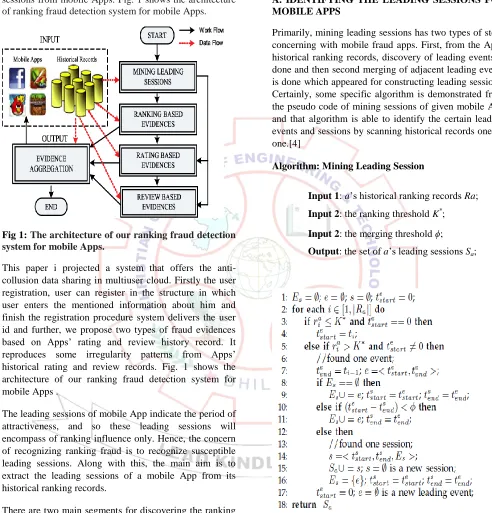
sessions from mobile Apps. Fig. 1 shows the architecture of ranking fraud detection system for mobile Apps.
Fig 1: The architecture of our ranking fraud detection system for mobile Apps.
This paper i projected a system that offers the anti-collusion data sharing in multiuser cloud. Firstly the user registration, user can register in the structure in which user enters the mentioned information about him and finish the registration procedure system delivers the user id and further, we propose two types of fraud evidences based on Apps’ rating and review history record. It reproduces some irregularity patterns from Apps’ historical rating and review records. Fig. 1 shows the architecture of our ranking fraud detection system for mobile Apps .
The leading sessions of mobile App indicate the period of attractiveness, and so these leading sessions will encompass of ranking influence only. Hence, the concern of recognizing ranking fraud is to recognize susceptible leading sessions. Along with this, the main aim is to extract the leading sessions of a mobile App from its historical ranking records.
There are two main segments for discovering the ranking fraud:
I) Identifying leading sessions for mobile apps.
II)Identifying evidences for ranking fraud
detection. Let us see them in brief
A. IDENTIFYING THE LEADING SESSIONS FOR MOBILE APPS
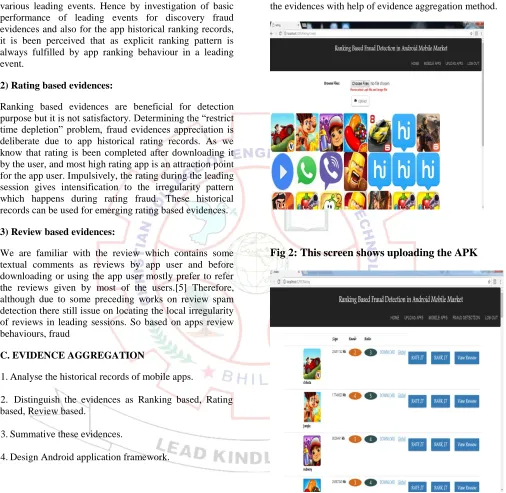
Primarily, mining leading sessions has two types of steps concerning with mobile fraud apps. First, from the Apps historical ranking records, discovery of leading events is done and then second merging of adjacent leading events is done which appeared for constructing leading sessions. Certainly, some specific algorithm is demonstrated from the pseudo code of mining sessions of given mobile App and that algorithm is able to identify the certain leading events and sessions by scanning historical records one by one.[4]
Algorithm: Mining Leading Session
Input 1: a’s historical ranking records Ra; Input 2: the ranking threshold K*; Input 2: the merging threshold ϕ;
Output: the set of a’s leading sessions Sa;
B. IDENTIFYING EVIDENCES FOR FRAUD DETECTION
CCET JOURNAL OF SCIENCE AND ENGINEERING EDUCATION
(ISSN 2455-5061)
Vol. – 4, Page-20-25, Year-2019
23
It accomplishes that leading session encompasses of various leading events. Hence by investigation of basic performance of leading events for discovery fraud evidences and also for the app historical ranking records, it is been perceived that as explicit ranking pattern is always fulfilled by app ranking behaviour in a leading event.2) Rating based evidences:
Ranking based evidences are beneficial for detection purpose but it is not satisfactory. Determining the “restrict time depletion” problem, fraud evidences appreciation is deliberate due to app historical rating records. As we know that rating is been completed after downloading it by the user, and most high rating app is an attraction point for the app user. Impulsively, the rating during the leading session gives intensification to the irregularity pattern which happens during rating fraud. These historical records can be used for emerging rating based evidences.
3) Review based evidences:
We are familiar with the review which contains some textual comments as reviews by app user and before downloading or using the app user mostly prefer to refer the reviews given by most of the users.[5] Therefore, although due to some preceding works on review spam detection there still issue on locating the local irregularity of reviews in leading sessions. So based on apps review behaviours, fraud
C. EVIDENCE AGGREGATION
1.Analyse the historical records of mobile apps.
2. Distinguish the evidences as Ranking based, Rating based, Review based.
3.Summative these evidences.
4.Design Android application framework.
4. EXPERIMENTAL RESULTS
Here, main consideration is on accessing different evidences such as reviews, ratings, ranking and download related information from historical records of data set. Data set encompasses the historical reviews, ratings of
mobile apps. In the result parts calculates and amalgamate the evidences with help of evidence aggregation method.
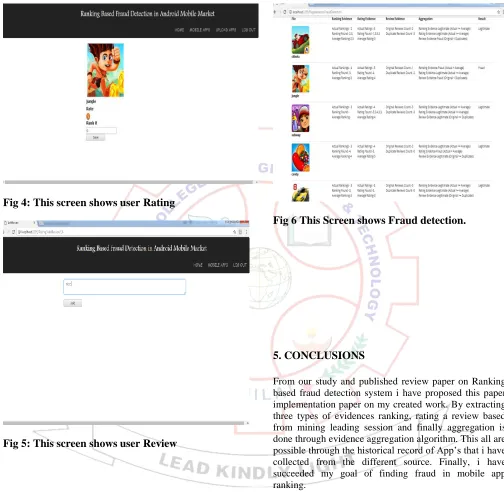
Fig 2: This screen shows uploading the APK
CCET JOURNAL OF SCIENCE AND ENGINEERING EDUCATION
(ISSN 2455-5061)
Vol. – 4, Page-20-25, Year-2019
24
Fig 4: This screen shows user Rating
Fig 5: This screen shows user Review
Fig 6 This Screen shows Fraud detection.
5. CONCLUSIONS
From our study and published review paper on Ranking based fraud detection system i have proposed this paper implementation paper on my created work. By extracting three types of evidences ranking, rating a review based from mining leading session and finally aggregation is done through evidence aggregation algorithm. This all are possible through the historical record of App’s that i have collected from the different source. Finally, i have succeeded my goal of finding fraud in mobile app ranking.
REFERENCES
CCET JOURNAL OF SCIENCE AND ENGINEERING EDUCATION
(ISSN 2455-5061)
Vol. – 4, Page-20-25, Year-2019
25
[2] L Barbosa, J Freire, Siphoning Hidden-Web Data
through Keyword-Based Interfaces. In Proc. of SBBD, 2004; 309–321.
[3] Z Hengshu, X Hui, et al. Discovery of ranking fraud
for mobile apps. IEEE Transactions on knowledge and data engineering, 2014.
[4] Rahman, S Huang, HV.Faloutsos. Detecting malicious Facebook applications. IEEE transactions on networking volume, 2015