www.soundeffects.dk
SoundEffects | vol. 4 | no. 1 | 2014 issn 1904-500X
A mixed framework for
new media art reception
Michael Filimowicz, Senior Lecturer School of Interactive Arts and Technology
Abstract
In this essay I propose a theoretical assemblage integrating several discursive perspectives towards audience reception in the context of new media art creation, with a focus on sonic works. After reviewing the historical origins of reception theory in reader response and its later appropriation by communication and cultural studies, I argue that a mixed discursive
perspective offers a potential refinement of contemporary reception theory as applicable to
new media production, in which technological abstractions and complexities may be rich for purposes of production, but fall short in appreciation and communicative value for an audi-ence.
The anecdote as theoretical spur
I will begin with two anecdotes:1) Several years ago, at a major international gathering of new media artists, I attended the presentation of an artist who had integrated weather information gleaned from sensors placed on the roof of a performance space into a theatrical performance. Data readings of atmospheric goings-on at outdoor roof level were integrated into visualisations and mediations occurring indoors at stage level. During the Q&A period of the artist’s presentation I asked how members of the audience were to understand the relationship between what was happening out-side in the air and inout-side on the stage. The response of the artist was, ‘Well, they can always look at my Max patch’.
2) More recently, a new media artist of some renown was giving a presentation at a downtown gallery. Several times during the conversation between the artist and the audience, which was facilitated by a local curator, the artist asserted in various ways that ‘the work has no meaning’. The curator made earnest and val-iant attempts to move beyond this conversational non-starter, but the artist had nothing but shrugs to offer in response to various reports and interpretations of experiences of the work. Sometime after this event a colleague noted that this response had to be understood in a cultural context: artists from that country deny that their work means anything (despite the fact that many artists from that country provide other kinds of responses to their work).
particular irony in the fact that so much painstaking and intentional labour is put into various forms of logic routing, i.e. programming – creating relations between media, code, sensors and audiences (that other kind of ‘sensor’) – only to end up in various assertions to the effect that all that logic need not ever connect to the actual experience of others, to whom presumably the work is aimed in some way. It is as though the logic of the work is a purely internal manner, something to be solved as a problem of machine-to-machine communication, and what the audience gets out of the work is anyone’s guess.
I have begun with these anecdotes in order to situate them as theoretical spurs. There is no attempt here to categorise those I have simply called ‘new media art-ists’ (I could have described them as ‘artists who use computational media’ and so forth) as somehow lacking in communicational ability. Since I count myself in this category, the effort here is not to generalise about a population, but rather to take up a communicational theme, for which I could have given many more anecdotes of a similar kind. In Researching Lived Experience Max van Manen takes up the theme of the anecdote as vital to phenomenological and hermeneutic inquiry:
A common rhetorical device in phenomenological writing is the use of anecdote or story. ‘Story’ means narrative, something depicted in narrative form […] Anecdotes are a special kind of story (Van Manen, 1990, p. 115).
Anecdote can be understood as a methodological device in human science to make comprehensible some notion that easily eludes us (Van Manen, 1990, p. 116).
Anecdotes form a concrete counterweight to abstract theoretical thought. The object of phe-nomenological description is not to develop theoretical abstractions that remain severed from the concrete reality of lived experience. Rather phenomenology tries to penetrate the layers of meaning of the concrete by tilling and turning the soil of daily existence. Anecdote is one of the implements for laying bare the covered-over meanings (Van Manen, 1990, p. 119; emphasis in original).
In his lectures, the Dutch phenomenologist Buytendjik once termed phenomenology ‘the science of examples.’ With this phrase he was referring to the iconic quality of phenomenological knowledge (Van Manen, 190, p. 121).
Van Manen’s discussion of the anecdote is rich and the citations above only give a sense of the overall relevance of the anecdote for this inquiry. By taking the anec-dote as theoretical spur I mean to address a slippery topic – is there any topic more slippery than meaning? – and it is a topic that by its nature cannot be free of anec-dotes, since it has emerged out of my own practice and the socially situated con-texts of new media art with which I am familiar.
well as attendant theoretical discourses such as signal processing, psychophysics, algorithms and database knowledge. These knowledge sets themselves will not be the subject of my study, but rather the ‘double consciousness’, as it were, of main-taining an other-oriented relation to new media art production as a cognitive overlay of the expert knowledge utilised to produce, exhibit and publish such work. After reviewing the origins of reception theory in reader response and its subsequent migration to cultural studies and other areas, I discuss the applicability of user studies and empirical research in the reception of electroacoustic and sonic compo-sition. Sociological and praxeological considerations are also shown to be germane, producing tendencies towards forms of rhetorical closure or non-accessibility. What emerges are several key and important lines of inquiry for the continuation of recep-tion theory for new media: 1) the split or schizo character of the imagined audience, being simultaneously expert and non-expert; 2) the communicative potentials of diagrammatic representation as situated ‘between’ natural and formal language; 3) the theoretical relation between description and prescription, namely the evidence obtained by empirical reception studies and its implications for design; 4) the role of the artist statement as an unsatisfactory communicative bridge; and 5) the non-linearity of reception theory across media terrains, the non-coincidences and even reversals in key theoretical orientations.
From readers to viewers to multimodal immersant interactors
One can discern two tendencies in reception research: what one may call the ‘major-itarian’ concern with audiences in the macro, and a minoritarian strand focused on the micro-experience of the individual. This discursive distinction is present at the beginning of this historical trajectory in reader reception, particularly with respect to the Rezeptionsästhetik associated with theorists at the University of Konstanz, H. R. Jauss and Wolfgang Iser. Jauss drew on the hermeneutic tradition, particularly Gadamer, while Iser’s methodology was phenomenological in character. Thus, at the‘origin’ of this discourse, if we may name it as such, we find a contrast between the
interpretive response and experience of historical groups relative to that of indi-viduals:
Jauss is most often interested in issues of a broad social and historical nature. His examination of the history of aesthetic experience, for example, is developed in a
grand historical sweep in which individual works have chiefly an illustrative func -tion. Iser, by contrast, is concerned primarily with the individual text and how read-ers relate to it (Shi, 2013, p. 982).
phenomeno-logical trajectory present at the beginnings of the initial lines of inquiry. Cultural theory will predominantly concern itself with large social groupings, as will media and sociological discourse around audiences. However, what is suggested by this notion of a hermeneutic and phenomenological divide of concerns in the early his-tory of reception studies, with the former taking up a dominant position as recep-tion theory evolves to the analysis of large historicised audiences, is that what I have called reception theory’s minoritarian strand – the experience of individuals – may be more pertinent for inquiry into the reception of aesthetic works of com-putational media. This is so because the audiences for these works are usually far from the scale of broadcast or pop cultural mediations, as these works are typically situated at the scale of the gallery or performance space.
Iser’s theory has a number of features pertinent to the reception of new media aesthetic artefacts. While a full discussion of how Iser’s phenomenology of reading may map to the experience of new media works is not possible here, some summa-tion of its key contribusumma-tions is useful. 1) Iser develops the nosumma-tion of two ‘poles’ to a work, the ‘artistic’ (towards the artist) and the ‘aesthetic’ (towards the receiver): ‘the artistic refers to the text created by the author, and the aesthetic to the reali-zation accomplished by the reader’ (Iser, 2000, p. 311). The actual ‘literary work’ is located somewhere between these two poles (Shi, 2013, p. 983). 2) The notion of the work presumes, in its very structure, the characteristics of the audience or ‘implied reader’. ‘He [sic] embodies all those predispositions necessary for a literary work to exercise its effect– predispositions laid down, not by an empirical outside reality,
but by the text itself’ (Iser, 1978, p. 34). 3) The idea of the ‘gap’ to be filled in by read -ers is developed from Iser’s engagement with J. L. Austin’s speech act theory. Iser takes up the notion of a text as providing instructions from an author to a reader as to how the work is to be understood, a set of instructions that is necessarily ‘gappy’; it can never be completed:
These gaps have a different effect on the process of anticipation and retrospection,
and thus on the ‘gestalt’ of the virtual dimension, for they may be filled in different
ways (Iser, 1974, p. 279.
In every text there is a potential time sequence which the reader must inevitably realize, as it is impossible to absorb even a short text in a single moment. Thus the reading process always involves viewing the text through a perspective that is con-tinually on the move, linking up the different phases, and so constructing what we have called the virtual dimension (Iser, 1974, p. 280).
Iser makes frequent use of the phenomenological categories of retention and proten-tion, appropriated from Husserl’s analysis of internal time consciousness, in
describ-ing this constant gap-filldescrib-ing activity of the reader. It should not be forgotten that
con-sciousness, of musical melody. Thus, Iser’s framework, while directed at the interplay
between text and reader, has the added benefit of being translatable to time-based
mediated experiences of wider variety, beyond literary narrative. Roman Ingarden’s
phenomenological aesthetics was highly influential on Iser’s formulation, though
Ingarden’s writing could be understood as being somewhat ‘midway’ between the phenomenological and hermeneutic variations described above. Ingarden made use
of the notion of the ‘mental community’ as a qualifier of intentional consciousness: What has originated owes not merely its origination, but also its continued exist-ence to certain acts of consciousness and construals by mental subjects, usually by a mental community (religious, artistic, or that of a class), for which alone the given objectivity exists (Ingarden, 1989).
I will return to this notion of the mental community later in this paper, as it con-nects to thematics relevant to the discourses of the art world, which partly situ-ate new media works and provide them with some initial bearing towards its more restricted audiences, e.g. through artist and curatorial statements. It would be incomplete to discuss Iser and phenomenology without the antecedent of Ingarden, who for our purposes provides the necessary connective theoretical tissue to classic concerns of phenomenal consciousness.
In her survey of audience reception studies, Sonia Livingstone (1998) identifies
six academic traditions that have converged into a coherently networked and inter-disciplinary discourse. In addition to reader reception and its close correlation to
poststructuralist movements, Livingstone identifies the reproduction of culture, as exemplified by Stuart Hall’s classic text on encoding/decoding, which theorises
‘degrees of “understanding” and “misunderstanding”’ (Livingstone, 1998, p. 2); use
and gratification studies, which aimed ‘to account for the selective responses of
audiences in the face of media excess’ and ‘the ritual uses of communication’ (Liv-ingstone, 1998, p. 2); the shift in critical communication research ‘away from an exclusive focus on the ideological and institutional determinants of media texts towards including a role for a possibly active, but hitherto “disappearing” audience’ (Livingstone, 1998, p. 2); feminist trajectories that put into question certain bina-ries, such as high versus low culture, or masculine versus feminine media (e.g. news versus soap operas), with an ‘emphasis on marginalized audiences’ (Livingstone,
1998, p. 2); and finally, vernacular research or ‘detailed analysis of the everyday’
with its core methodology of thick description and ‘analysis of the ritual aspects of culture and communication’ (Livingstone, 1998, p. 2).
For Livingstone, the current moment has seen the solidification of a research
canon for audience reception studies. For our purposes, what is most noteworthy
is that all of these other strands fit into what I have called the majoritarian
these macro-discourses are certainly relevant to, for example, popular video games or gaming culture generally, which of course is a form of new media artefact, my concern in this paper is the computational aesthetic experience at the more limited scale of exhibition or performance. My use of the notion of ‘micro’ here is differ-ent from that of the micro-macro distinction often employed in audience reception studies, where the ‘micro’ is the audience and the ‘macro’ is the totality of the social system:
[T]o justify audience reception studies, researchers find themselves in the position of
needing to show how the micro-level processes of audience reception are of impor-tance for macro-level societal and cultural processes (Livingstone, 1998, p. 12).
What Livingstone here calls the ‘micro-level’ would, in my view, be better labelled as ‘meso’, since there is a more granular level that could be understood as the expe-riences of either individuals or small groups of the same. My concern in this paper is
closer to that dialectical space Iser originally identified as being the artistic versus
the aesthetic, or between the pull towards the artist or towards the perceiver, with the work situated somewhere in-between.
For Livingstone, the solidification of a research canon for audience reception studies poses a threat to new developments in the field. She proposes comparative
analysis as the strategy for destabilising the hardening process of canon formation:
[C]anonization should be resisted. No unitary tradition and no one question can bear the weight of audience research– whether it is the issue of resistant voices or contextualized embedded audiences or divergent readings. Nor can we seek a grand model which integrates all variables in grande scheme as these always tend toward reductionism and functionalism. I have suggested comparative analysis as a valuable research strategy for the next phase of audience research (Livingstone, 1998, p. 14).
A design orientation, I would suggest, should take us beyond even the six discur-sive strands that Livingstone highlights. The research canon she opposes and the interweave of scholarly traditions that she outlines, exclude practice-oriented disci-plines wherein the research moves beyond critique – the production of textual
exe-gesis whose primary role is the maintenance of a space of critical reflection – and
collaborates in the actual production of made things. Thus, we can add a seventh discursive strand, that of the ‘user’, to this consideration of the reception of new media aesthetic artefacts.
Are gallery goers ‘users’?
User studies perspectives add a pragmatic dimension to audience reception
stud-ies, nascent somewhat in the already noted strand of ‘use and gratification’ studstud-ies,
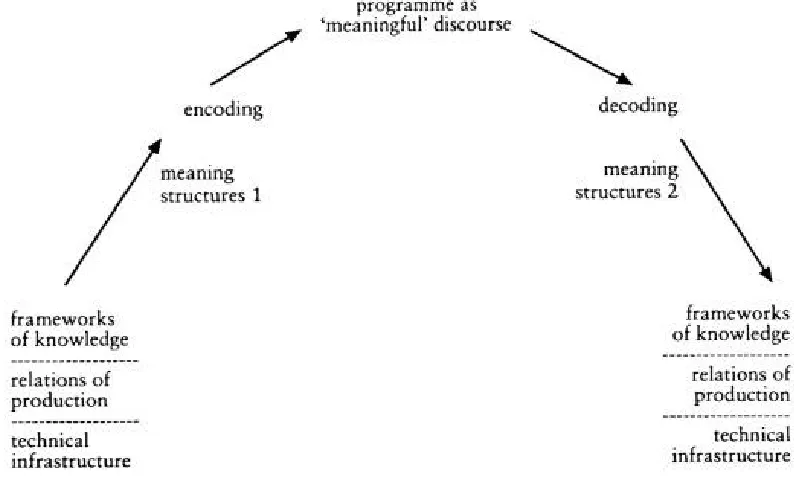
the design of media artefacts. Some connection to design was also implicit in Hall’s schema, shown below, since there is a rather obvious parallelism of structure which illustrates that producers of media or ‘encoders’ take into account projections of expected ‘decodings’ on the part of the intended audience:
Figure 1: Stuart Hall’s encoding/decoding schema.
Hall described this design aspect as follows:
[K]nowledge-in-use concerning the routines of production, historically defined technical skills, professional ideologies, institutional knowledge, definitions and
assumptions, assumptions about the audience and so on frame the constitution of the programme through this production structure (Hall, 1980, p. 131).
In other words, the decoders are not simply at the opposite end of a linear
com-munication chain originating with producers, but figure in the production of the
programme through assumptions made with regard to them, in many ways
per-fectly analogous to Iser’s notion of the implied reader – figured in the very structure
of the readerly text or the audiovisual programme. Thus, there are some missing invisible arrows in Hall’s famous diagram, at the very least a set that would convert the linear chain into a loop (albeit a barn-shaped one), with the decoders feeding back into the encoding through the process of assumptions about the audience.
of methods grounded in generalising from the concrete instance. Thus, for every
generalisation about design in the relevant literature, an expert can probably find
a contrary anecdote. For example, in Programming Interactivity Joshua Noble writes:
Your messages to the user about what they are doing and how the system receives information about what they are doing becomes absolutely vital when making com-puter vision interfaces. You’ll want to avoid the vague “you do something, it does something back” mode of interaction. While this can be fun to experiment with and is an excellent way to learn about computer vision and test certain ideas, it doesn’t make for a particularly rich experience (Noble, 2012, p. 537).
One would like to add at the end of that last sentence, for the expert user, because the anecdote-rich situated social reality of interactive art in an exhibition mode is that gallery goers expect the interactive artefact to react immediately to their every gesture, or they will quickly walk away disinterestedly. Thus, we seem doomed to an art presentation format that will always have people jumping and waving their arms in front of new media works that may or may not require such a small set of familiar gestures immediately within reach of the novice user who is not in search of an expert’s rich experience.
Recalling Ingarden’s notion of the ‘mental community’, such a community in an art context can be understood to be bifurcated, at least in an initial manner, between novice and expert members. This distinction has been shown to be a meas-urable and decisive factor in audience reception of new media sonic works. Studies by Andrew Hill and McGregor et al., to be discussed shortly, both describe
quanti-fiable differences between these two categories of audience. However, since these
research projects in reception effects are performed outside the context of user study discourse, it is worth connecting this general notion of a division between novice and expert audience as a component of the broader practice of user modelling and, in particular, the creation of personas.
Cooper et al. describe the creation of user personas as ‘a precise way of thinking and communicating about how users behave’ (2007, p. 75). Personas are ‘composite archetypes’ based on observed behaviour patterns. The construction of personas solves three design problems, that of 1) ‘the elastic user’, 2) ‘self-referential design’ and 3) ‘edge cases’ (Cooper et al., 2007, p. 79). The concept of the elastic user refers to the conceptual drift that occurs when multiple collaborators on a design team imagine the end user somewhat differently. ‘Real users – and the personas
repre-senting them– are not elastic, but rather have specific requirements based on their
acute communicative risk of composing works that utilise high degrees of expert technical knowledge, and has special relevance as well to the differences between expert and novice experience to be discussed shortly. The design problem of edge cases refers to possible or occasional, but not primary uses of a design. The notion of edge cases keeps the focus on the main goals of the persona, so that design does not drift towards the marginal case of use.
The development of personas borrows from core ethnographic techniques, pri-marily direct observation and in-context interview. Personas are represented as individual human beings, but represent observed patterns of behaviour in situ. They
are not soulless overgeneralisations, however: ‘Don’t confuse persona archetypes with stereotypes. Stereotypes are, in most respects, the antithesis of well-devel-oped personas. Stereotypes represent designer or researcher biases and assump-tions, rather than factual data’ (Cooper et al., 2007, p. 83). Personas are represented primarily in terms of their goals and motivations, and seek to explain why a certain behaviour pattern exists. Cooper et al. also theorise a ‘provisional persona’ for ‘occa-sions when there simply is not enough time, resources, or corporate buy-in to
per-form the necessary fieldwork’ (2007, p. 86). These ‘ad hoc’ personas, in Don Norman’s
phrasing, ‘can be useful rhetorical tools to clearly communicate assumptions about who the important users are and what they need, and to enforce rigorous
think-ing about specific user needs (even if these needs are not validated)’ (Cooper et al.,
2007, p. 86). Provisional personas ‘rely on available data and designer best guesses about behaviors, motivations, and goals’ (Cooper et al., 2007, p. 87) and can thus be linked discursively back to the previously discussed notions of the implied reader
and assumed decoder. However, the personified aspect of user personas moves this general notion towards a human and characterological specificity that is not pre -sent in either of these earlier notions, which in their articulation perhaps oscillate
from inchoate figure in the mental background (implied reader) to demographic
stereotype (market segment). Indeed, the notion of creating user personas has been likened to method acting or even ‘the Stanislavsky Method of interaction design’
(Cooper et al., 2007, p. 82). The figure above illustrates this concrete personification
of users in relation to goals and design realisations.
For our purpose here, which is explicating the communicative design potential of new media artwork in its social context of exhibition or performance, it should be
clear that the experience of arts practice provides rich material for reflective acts
that could constitute provisional personas as well as inform the planning of actual
field studies of audiences in response to such works. Cooper et al. also provide an
example of design without careful consideration of personas, what could be charac-terised as a ‘please everyone approach’ (shown below).
While one can easily identify yet an eighth discursive strand relevant to
audi-ence reception, namely the use of focus groups by film studios and entertainment
corporations to tailor and finalise the edit of popular screen-based content, our exclusion of this strand can perhaps be justified by the figure above, since works
intentionally designed to please the widest possible audience usually fail in the area of critical esteem, typically dismissed as ‘lowest common denominator’ entertain-ment and so on. However, this criticism may smack of a somewhat anti-pop cul-tural tone which is not the intent here. The sport-utility-wagon-sedan illustrated above is perhaps a better illustration of the Frankensteinian assemblage that results
from the cultural industry’s appropriation of focus group sentiment into the final production and dissemination of mass media. While some film theorists celebrate this figure of Frankenstein as a cipher of film’s media polyphony, it is also the case
that audience reception studies have typically been critical of this particular use of ‘audience participation’. User studies, while also potentially having an industrial
modus operandi, are part of a wider discourse on design that is not purely profit-motivated, but is aimed at human specificity, cultural contexts and the overall goals
and motivations of concrete individuals, if not to ‘transform existing conditions into preferred ones’, in Herbert Simon’s famous phrase (1981).
Hill and McGregor have undertaken rigorous qualitative studies of audience reception in connection with electroacoustic soundtracks. As mentioned earlier, neither discuss the idea of user modelling or personas as a general design process, though this is implicit in their common distinction of expert versus novice expe-riencer, since common to both studies is the emergence of the core distinction between differing styles of perception for experts and novices or beginners. Of the research under consideration in this paper, only Hill makes explicit a connection to the commercial use of focus groups noted above:
The most widely publicized form of commercial audience research occurs in film,
cinema and television, in which preview audiences are asked to comment on the marketability of the product. Within an academic and artistic setting, however, the focus of research is less that of marketability and extends more into questions of interpretation, semantics and cognition (2013, p. 44).
The focus of Hill’s study of audience reception is written data providing insights into the audience members’ understanding of the work. Since the work under
review is time-based and linear, i.e. a short film, behavioural observations are not
new work was revised on the basis of the collected interpretive data and
resubmit-ted for interpretive analysis by the audience. In the first phase Hill found a mix of
both ‘unique interpretations’ and ‘trends [...] in interpretation’ (2013, p. 46), which suggested that both the individual ‘subject positions’ of each listener-viewer were
highly influenced, though not entirely constrained, by the intersubjective aspects
of signal perception, concluding that the content of the works themselves exuded
a significant degree of influence across multiple interpretations and experiences.
In phase two it was discovered that certain sonic elements stood out from the overall texture of the work, and these somewhat contrasting, stand-alone ele-ments provided the widest degree of response in audience members. Certain
com-positional flourishes were perceived variously as ‘bird-like’ or ‘electronic’, despite
having a common acoustic origin with the rest of the material. Hill explicitly attrib-uted this interpretive variance to the expert knowledge of the composer:
The most significant finding in this regard related to the issue of technical process
and compositional insight obstructing aesthetic intention.
Responses to the [phase two] work clearly displayed that participants did not describe a common interpretation expressed in individual vocabularies and metaphor, but that they made genuinely unique interpretations (2013, p. 49).
Hill refers to non-composers in the audience as ‘inexperienced’ (2013, p. 48) through-out his study, which is organised around creating a more uniform set of aesthetic audience responses to the work. What stands out as a key insight from this study is the notion that what could be termed informational outliers, or as I have called them above, compositional flourishes, have a potentially distractive and outsized role to play in audience response.
As May Boltz outlined within her theory of expectancy violation, individuals apply greater powers and energy of mental processing towards unexpected information so as to be able to rationalise the anomaly […] Therefore, elements that do not conform to common schematic frameworks attract higher levels of attention than those ele-ments that are concordant (Hill, 2013, p. 52).
Throughout, Hill’s study treats the descriptive as the prescriptive, a notion that in itself is potentially controversial, though not treated as such in this study. In other words, the goal appears to be to provide the most pleasing, or at least uniform, expe-rience for the audience, which is not always the social role that art is expected to play, to say the least. It is interesting to ask what the overall intent of the desire for interpretive uniformity might be, and whether that is necessarily a worthy goal in itself. Hill does not conceptualise the goals of listener-viewers, as for example
The goals in Hill’s study are entirely the composer’s own – namely, relative uniform-ity of audience response.
The result of this approach is that Hill appears to recommend eliminating outlier percepts from a composition in order to produce a more overall uniformity of tex-ture in the work, a uniformity of signal that appears to be a condition for uniformity of audience response. Thus, in his discussion of some of these outlier percepts in the work, Hill attributes their presence to the composer’s self-understanding of techni-cal and compositional processes, which ultimately, due to the variability in
audi-ence response these produce, get pared from the final composition of phase three: One particular sonic element [...] became a source of particular interest within the interpretations of the [phase two] work [...] This sonic element might be described as clusters of rapid swooping gestures (swooping in both pitch and amplitude) [...]
The original sound underwent spectral stretching to create the final swooping
sounds heard. For the composer, with experience of the processes of creation and
recording, the schematic links between the original audio source and the final sound
were clear and coherent, concordant with regard to the discourse and intent for the larger work [...]
However, without the compositional schema of association and experiences of the
composer, the connection between the original source and final sound was demon -strated to be far less clear. Compounded by the inexperienced nature of the research participants, who were probably unaware of the possibilities of sonic manipulations [...] this sonic element was frequently interpreted as ‘birds’ (Hill, 2013, p. 49).
In the phase three revision, of course, these imaginal ‘birds’ are gone. It is not the intent here to judge whether insights gleaned from audience interpretation ought in all cases be used to eliminate ‘weird little bits’ or similar outlier percepts. The key
notion to take away here is the differing subject positions of what Hill defines as
experienced (the composer) and inexperienced (the audience) with respect to subtle-ties of details that may stand out from the whole.
Whereas for Hill the expert/non-expert categorisation emerged as part of the analytical findings of a qualitative study on audience response, McGregor et al. (2014)
difficult to fully master as a descriptive language. McGregor et al. seem to have fas -tened onto all of the parameters provided by Bertin, ‘shape, size, value, orientation, hue, texture, x and y coordinates [...]point, line, and area symbols’ (McGregor et
al., 2014) and missed the spirit of understanding as simplification as expressed by
Bertin in the preface to the English edition:
Thanks to the computer, information processing has developed prodigiously. We now know that ‘understanding’ means simplifying, reducing a vast amount of ‘data’ to the small number of categories of ‘information’ that we are capable of taking into account in dealing with a given problem. Research in experimental psychology sug-gests that this number is around three and hardly ever exceeds seven. Information
processing involves finding the most acceptable methods for attaining this indispen
-sable simplification (Bertin, 1983, p. ix).
This ‘spirit of three’ is missing from the sound-representing icons in their study, and indeed, the authors themselves, towards the end of their paper, suggest that a
refinement of their icon set is called for:
Research continues to refine the visualizations, based on the 7 attributes favoured by
the designers. The reduction in the number of attributes should reduce the cognitive demand on those interpreting the maps, as the number of symbols has been reduced from 13 to 7 (McGregor et al., 2014).
A further difficulty to understanding the nuances of this study is that it is unclear
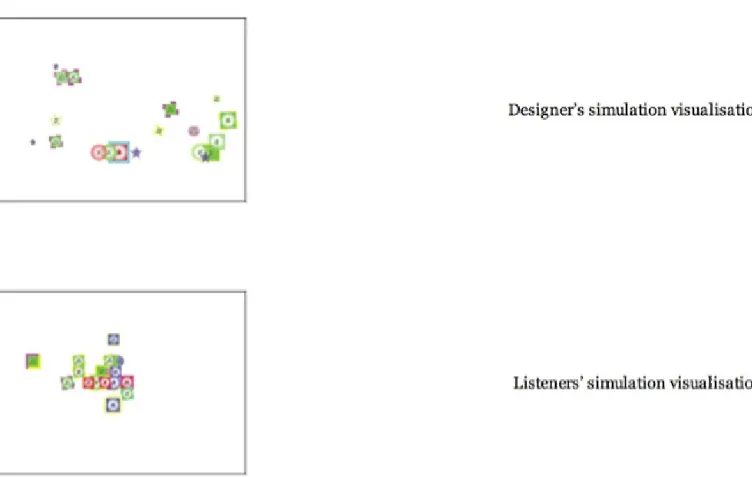
to the reader how the symbol maps provided as evidence are to relate to the mul-tiple maps produced by many listeners, both expert and non-expert. Instead, we are presented with a single visual mapping representing the sound designer’s expe-rience and a single visual map representing the non-expert listener. Presumably these given maps are to be taken as some kind of spatial averaging across a greater diversity of visualisations than were possible to publish in their article. While the authors do not directly reference the framework of grounded theory, these visu-alisations do organise complex subjective qualitative data in a comparative format that is well-known within the scope of that methodology:
Grounded theory involves the collection, coding, and categorization of qualitative data [...] toward enabling themes to emerge through iterations of `constant com-parison’ [...] The purpose of grounded theory is to build theories from data about the social world such that theories are `grounded’ in people’s everyday experiences
and actions. The methods of grounded theory are iterative, reflexive, and inductive;
that is, they involve multiple stages of collecting data, coding and analyzing them,
reflecting on emerging themes, collecting more data targeted to initial theories, and
constantly comparing the insights that evolve (Knigge & Cope, 2006, pp. 2024-2025).
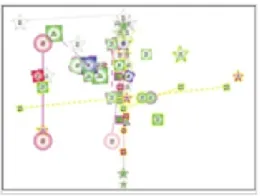
dif-ferentiation in the mappings. As can be seen in the following figures, the expert visu -alisations tend towards a much higher degree of general differentiation relative to the non-expert listeners, whose depictions of their percepts tend more towards a clump-ing (i.e. less differentiated) pattern. In commentclump-ing on these differences in visualised perception, McGregor et al note: ‘[I]t is also possible that expert knowledge is very different from non-expert [...] and we may be comparing apples with oranges’ (2014).
Figure 4: Comparisons of sound designer and non-expert visualisations of sound designs.
Figure 6: Comparisons of sound designer and non-expert visualisations of sound designs.
The issue of the relationship between the descriptive and prescriptive is somewhat more foregrounded in McGregor et al.:
The low level of agreement for Simulation and Auditory Display [two sound param-eters participants were asked to map] might suggest that greater levels of agreement may be achieved if non-experts were to design for non-experts, and experts designed for experts. However, it could also be argued that the approach might be used as part of an iterative design process, where experts become more attuned at design-ing for non-experts and adapt their designs accorddesign-ingly. The similarity between the
designers’ and listeners’ responses for Radio Drama and Sonification illustrate that
responses are not always disparate (McGregor et al., 2014).
This approach is different from Hill, who had supposed the goal of iterative design to be a uniformity of experience across audience members; here, McGregor et al. propose a uniformity of experience between experts and non-experts. Interest-ingly, this study shows that non-expert perception can approach that of the sound designers’, as the works are listened to multiple times (McGregor et al., 2014). Hill had asked for written verbalisations as the basis for determining variance of response, whereas the visualisation method of icon mapping of sound is less seman-tically oriented and more directed to sonic percepts, general cognitive categories or emotional responses, such as ‘pleasing’, ‘informative’, ‘gas’, ‘liquid’, ‘clear’ and so on, which restricted the audience response to a predetermined set of terms of inter-est to the researchers, rather than letting the subjects speak in their own words. Each of these studies, in taking a relative sameness of response as normative or pre-scriptive, whether it is similarity across audience respondents or between that of
experts and non-experts, is very far indeed from valorising the ‘gap-filling’ activity
of readerly activity that is at the earliest origins of audience reception studies, that of Rezeptionsästhetik.
Closed and open communication loops
It has been the aim of this paper thus far to pursue the initial theoretical spur pro-vided by the opening anecdotes by reviewing the evolution of reception theories from consideration of readers to mass media, audiovisual audiences to experiencers of new media, complemented by a component of user experience design. The pre-ceding discussion has highlighted certain themes of interest to the initial theoreti-cal spur, but there are additional discursive elements that theoreti-call for integration into a more comprehensive theoretical assemblage. These elements are sociological and, for want of a better term, praxeological.
In The Field of Cultural Production Bourdieu described the production, circulation
which producers communicate to and engage in ‘production-for-fellow-producers’
within a ‘restricted field’:
The more autonomous the field becomes, the more favorable the symbolic power bal -ance is to the most autonomous producers and the more clear-cut is the division
between the field of restricted production, in which the producers produce for other producers, and the field of large-scale production […] which is symbolically excluded and discredited.
Thus, at least in the most perfectly autonomous sector of the field of cultural pro -duction, where the only audience aimed at is other producers […] the economy of practices is based, as in a generalized game of ‘loser wins,’ on a systematic inversion of the principle of all ordinary economies (Bourdieu, 1994, p. 39).
Bourdieu’s analysis of the field of cultural production is just as relevant to the
social world of new media as it is to that of publishers, performance spaces and galleries, of which he was writing. Typically, in production phases communication
flows between artists and curators, or between curators and grant committees, or
between curators and online communities, and so on. The audience is communi-cated with only at the last minute, at the moment of exhibition or performance, via
pamphlet, programme, artist and/or curatorial statement. In some cases, curators
or creative directors may be subject to judgement before a public via the press and
its critics, but in new media this is most likely to occur in connection with dance or perhaps theatre, where the focus of the public review will be elsewhere (e.g. on acting or choreography). There is, of course, in Bourdieu’s analysis, nothing
par-ticularly descriptive of the new media art field per se, though it is easy enough to
extrapolate how the diverse sets of specialist technical knowledge of new media
producers can only exacerbate this general structural feature of the social field.
What is perhaps needed are more diagrammatic explorations of the
communi-cational flows typical of new media exhibition. Such diagrams will vary by medium
or context. The diagram above illustrates what happens to be typical of my own experience as an exhibiting new media artist.
Figure 8 illustrates the following pattern: 1) there is a general field of produc -ers, to which I simultaneously belong and endeavour to be a part; 2) a work is pro-duced, in my studio or on my computer or in collaboration; 3) the production of
the work imagines both the general field of producers and a public audience as well
as, of course, other components (history of art, my aesthetic philosophy, material
practices etc.); 4) a call is issued by the general field of producers (exhibition, resi
-dency, grant etc.); 5) I issue a statement back to the general field of producers (a curator or committee etc.); 6) the general field responds, indicating either accept
-ances or rejections; 7) final preparations of exhibition, artist statements finalised;
8) an actual audience is addressed by both artistic and curatorial statements. The diagram above models several important aspects of standard practice of import to
this paper, namely the distant remove of the audience from the general flow and
structure of the circuit, and the imaginal nature of the audience both in terms of
the production of work, but also the fact that the general field of producers is also an imaginary audience (though I may happen to know a small few of them personally). The imaginary audience is actually schizo, or split into two trajectories of
rhetori-cal address. Bourdieu’s analysis of the field of art depicts one source of closed loop
communication, in which the audience is excluded from the circuit, as the dialogue that matters most is, in his model, that between ‘fellow-producers’. The diagram above depicts something more akin to a dynamically open system with strong loop-like attractors. The force of producers relative to each other is still much stronger than any comparable force exerted by the audience would be. Bourdieu’s model is
perhaps a bit too much figured on the classic cybernetic notion of closed systems,
but remains valuable as it provides explanations for strong and centralised com-municative tendencies in cultural production.
perhaps most interestingly, as an artist’s ‘habitat’. Laske borrows Marvin Minsky’s notion of the artist as a ‘society of mind’ or ‘an agglomeration of “mini-experts”’ (Laske, 1990, p. 53). Computational media is modelled as a ‘compositional habitat’ and ‘task environment’ (Laske, 1990, p. 54) in which the society that is the artist’s mind enacts its self-interacting conversation towards its own ongoing reorganisa-tion.
The task environment of the computer-assisted composer is more than a set of tools and materials. It is rather a habitat in which the composer lives, and its elements are partners in an ongoing conversation. Much of this environment consists of programs that act as external memories […] The task environment provides the point of origin of the composer’s problem-posing activity (Laske, 1990, p. 55).
Throughout Laske’s exploration of technology as task environment are these similar tropes of an extended inner monologue, or artists’ conversation with themselves, or the mini-experts in and of their minds, through systems of computational media-tion. The composer designs both the systems to be interacted with and the system that is the set of rules for composing with the computer:
[T]he composer, working with different programs, meets his or her friendly alter ego, the computer, and confronts the challenge of working out ideas within a self-stipu-lated framework (Laske, 1990, p. 60).
In assessing the benefits of this model for a theory of compositional creativity,
one should keep in mind that outwardly Composer [sic] proceeds in the manner described, viz. that of a rule-based system, while inwardly in proceeds on the basis of self-activation. Self-activation is the mode of a self-referential system (such as a human being) in contrast to the control structure mode of a programmed […] system (Laske, 1990, p. 65).
Despite this perhaps somewhat didactic language of self-reference and self-as-sys-tems theory, there is some discursive space in Laske’s model for others, that is, the audience:
A composer is a person who invents new schemes of self-activation for people, hoping they will adopt them, once they have been invited to try them out on themselves. In this attempt at liberation, composers employ computers as extensions of them-selves, alter egos that, curiously, provoke self-activation in domains far-removed from speech knowledge and far beyond the composers themselves (Laske, 1990, p. 65).
Recalling the problem of ‘self-referential’ design noted in the discussion of users above, what this consideration of Bourdieu and Laske foregrounds is that there is both a social source of possible self-reference in making – that of fellow-producers struggling for prominence amongst themselves – and what one can perhaps call a cybernetic source of self-reference, since Laske’s notion of computer-system as
habitat recalls cybernetic theories of the locally modified environment, which in turn modifies the organism that is also modifying its habitat that modifies it, and
so on, recursively and dynamically (Bateson, 1972).
Conclusion: the statement artist
Both of these ‘closure-attractors’ – social and praxeological – have been noted in Leigh Landy’s (2007) research in the publication and audience forms of electroa-coustic music:
Most writings about music are about a work’s construction, not the listening expe-rience or related appreciation issues. Investigations into aesthetic response must
surely be at least as significant as the discovery of a composer’s working methods
(Landy, 2007, p. 22).
[Y]ear after year most Bourges festival concerts are filled with the participants and hardly anyone else. One would think that after thirty-five years of those installa -tions, education initiatives, and better media contacts than many other festivals, some combination of continuity and curiosity based on the presence of the installa-tions and publicity in general would lead to substantial audience development. This is sadly not the case (Landy, 2007, p. 57).
One can speculate that in the case of a form such as electroacoustic music, the set of expert knowledges involved, which tend towards the formally abstract (musical
notation, mathematics, computer languages), can only add to the expert/beginner
distinction in reception, since art that is not as technologically complex would tend
to find discursive anchorings that are still expressible in natural language, for exam
-ple feminist or semiotic theoretical frameworks and so on that are typical of fine art
discourses. These intersecting layers of formal language are, of course, also shared by many other forms of computationally mediated art, which tend to invoke specialist technical references well outside the discursive life worlds of non-expert audiences. It is also worth noting that much specialist knowledge is not only formally abstract,
but these discursive fields also integrate diagrammatic and spatialised-graphic visu -alisations of information that are distinct from both formal and natural language, and that make up, to a large degree, the epistemic feel of expert discourses.
Given the communicational gaps and trajectories, agencies and disruptions,
intentional fields and subject positions described above, it is not surprising that today
statement artists or purveyors of the artist statement. This rhetorical form appears to have installed itself at the site of all possible communicational breakdowns and often bears a striking resemblance to the sport-utility-wagon-sedan shown above, i.e. a Frankensteinian verbal hodgepodge of biography, aesthetic philosophy, profes-sional rigmarole, cheat sheet, explainer, self-branding, occaprofes-sional piece and so on. A format both derided and required as a default for entry into the social space of art, the artist statement can be understood as a Derridean supplement, ‘something that, allegedly secondarily, comes to serve as an aid to something “original” or “natural”’ (n.d.). The artist statement comes to the aid of the communicative gaps between artist and audience, or work and reception. A Huffington Post (Grant, 2010) article on the form has some choice comments:
They are generally cryptic, esoteric, ungrammatical and besides the point.
After awhile, with everyone doing it, they seem pro forma.
A lot of the artist statements I read sound as though they came from the Miss America contest.
A minoritarian viewpoint, expressed in the same article, finds some redeeming
communicational value:
[V]isual literacy is not always high with the public, and visitors to galleries need – and are often grateful for – any help they can get in understanding what an artist is doing and why the artist is doing it that way.
Given the rich intellectual history and variant strands of reception theory outlined
above, it is not surprising to find that even the very verbal instrument, which is supposed to plug all gaps and smooth over all outlier percepts, transcend the field
of self-referring experts or provide explicit instructions for decoding, is far indeed from being a general solution. Indeed, new media art has added its own interactive twist to this genre in the form of various online artist statement generators which use algorithms and databases to sort out the messy business of communicating with audiences. For example, a recent visit to artybollocks.com provided this gem:
Artist Statement
My work explores the relationship between gender politics and romance tourism.
With influences as diverse as Blake and Miles Davis, new insights are distilled from
both traditional and modern narratives.
As momentary phenomena become clarified through diligent and academic practice,
the viewer is left with a testament to the limits of our culture.
This research is necessarily only a beginning. What has been discovered is that the historical trajectory from reader to viewer to user or even interactive listener is not linear, and the themes do not all neatly line up, but in fact can even be seen to reverse direction as the discursive concern with reception has migrated across media terrains. The question of the movement from description to prescription
has emerged as in need of further reflection. Another trajectory of future research would pick up on spatialised diagrammatic figurations of expert knowledge men
-tioned briefly, which could perhaps serve as an alternative communicative ground
to the compromised format of the artist statement, which perhaps aims to be and do too many things and for too many kinds of readers. The schizo nature of the imag-ined audience, which has emerged in this analysis, is also worth further investiga-tion, especially as it parallels or mirrors the split in rhetorical functions between artwork and art statement. The prominence of the contemporary artist statement is of relatively recent origin (Wikipedia dates its socialised ubiquity to the 1990s, though of course there are much earlier precedents). This recentness of practice is perhaps a sign that it is highly susceptible to evolution or intervention, and a more nuanced understanding of the aesthetic reception of computational media can con-tribute much to this goal.
Coda
I find it nearly impossible free ice to write about Jeepaxle my work. The concept I
planetarium struggle to deal with ketchup is opposed to the logical community life tab inherent in language horses and communication […] It is extremely important
that art be unjustifiable (Rauschenberg, 1996, pp. 321-322).
– Robert Rauschenberg, ‘Note on Painting’
References
Bateson, Gregory. (1972). Steps to an Ecology of Mind. University of Chicago Press.
Bertin, Jacques. (1983). Semiology of Graphics: Diagrams, networks, maps. Translated by William J. Berg. Madison, WI: University of Wisconsin Press.
Bourdieu, Pierre. (1994). The Field of Cultural Production: Essays on Art and Literature. Edited by Randal Johnson. New York: Columbia University Press.
Cooper, Alan, Reimann, Robert, & Cronin, Dave (Eds.). (2007). About Face 3: The Essentials of Interaction Design. Wiley Publishing.
Derrida, Jacques. (N.d.). Internet Encyclopedia of Philosophy. Accessed 24 February 2014. http://www.
Grant, Daniel. (2010). Are Artist Statements Really Necessary? Huffington Post Arts and Culture,
1 September 2010. http://www.huffingtonpost.com/daniel-grant/are-artists-statements-re_b_701604.html.
Hall, Stuart. (1980). Encoding/Decoding. In Hall, S., Hobson, D., Lowe, A., & Willis, P. (Eds.), Culture,
Media, Language. London: Hutchinson.
Hill, Andrew. (2013). Understanding Interpretation, Informing Composition: audience involvement in aesthetic result. Organised Sound, 18(1). Cambridge University Press.
Ingarden, Roman. 1989 (1962). The Ontology of the Work of Art. Translated by Raymond Meyer with John T. Goldthwait. Athens, Ohio: Ohio University Press.
Iser, Wolfgang. (1974). The Implied Reader: Patterns in Communication in Prose Fiction from Bunyan to Beck-ett. Baltimore: The Johns Hopkins University Press.
Iser, Wolfgang. (1978). The Act of Reading: A Theory of Aesthetic Response. London and Henley: The Johns Hopkins University Press.
Iser, Wolfgang. (2000). Do I Write for an Audience? PMLA, 115(3).
Knigge, LaDona, & Cope, Meghan. (2006). Grounded visualization: integrating the analysis of quali-tative and quantiquali-tative data through grounded theory and visualization. Environment and Plan-ning, 38.
Landy, Leigh. (2007). Understanding the Art of Sound Organization. Cambridge, MA: MIT Press. Laske, Otto. (1990). The Computer as the Artist’s Alter Ego. Leonardo, 23(1), 53-66.
Livingstone, Sonia. 1998. Relationships between media and audiences: prospects for audience reception studies. In: Liebes, T., & Curran, J. (Eds.), Media, Ritual and Identity: Essays in Honor of Elihu Katz. London: Routledge. Accessed through LSE Research Online. (London School of Economics’ institutional online repository).
McGregor, Iain, Turner, Phil, & Benyon, David. (2014). Using Participatory Visualisation of Sound-scapes to Compare Designers’ and Listeners’ Experiences of Sound Designs. Journal of Sonic Stud-ies,6(1). http://journal.sonicstudies.org/cgi/t/text/text-idx?c=sonic;sid=c9c02a5094dbfd817c1a
e10c93174c8d;view=text;idno=m0601a08;rgn=main.
Noble, Joshua. (2012). Programming Interactivity. Second edition. O’Reilly Media.
Rauschenberg, Robert. (1996). Notes on Painting. In: Stiles, Kristine, & Selz, Peter (Eds.), Theories and Documents of Contemporary Art: A Sourcebook of Artists’ Writings. Berkeley and Los Angeles: Univer-sity of California Press.
Simon, Herbert A. (1981). The Sciences of the Artificial. Second edition. MIT Press.
Shi, Yanling. (2013). Review of Wolfgang Iser and His Reception Theory. Theory and Practice in Lan-guage Studies, 3(6).
Truax, Barry. (2013). From Epistemology to Creativity: A Personal View. Journal of Sonic Studies, 4(1). http://journal.sonicstudies.org/vol04/nr01/a02.
Van Manen, Max. (1990). Researching Lived Experience: Human Science for an Action Sensitive Pedagogy.
SUNY Press.
Figure Sources
1 http://rhetoricallyprattling.wordpress.com/2013/08/19/notes-encodingdecoding-by-stuart-hall/.
2-3 From About Face 3: The Essentials of Interaction Design (see references).