Dynamical Behavior And Synchronization Of Chaotic
Chemical Reactors Model
HOSSEIN KHEIRI1
AND BASHIR NADERI2
1Faculty of Mathematical Sciences, University of Tabriz, Tabriz, Iran 2Department of Mathematics, Payam Noor University, I. R. of Iran
Correspondence should be addressed to [email protected]
Received 14 December 2014; Accepted 4 January 2015
ACADEMIC EDITOR:IVAN GUTMAN
ABSTRACT In this paper, we discuss the dynamical properties of a chemical reactor model including Lyapunov exponents, bifurcation, stability of equilibrium and chaotic attractors as well as necessary conditions for this system to generate chaos. We study the synchronization of chemical reactors model via sliding mode control scheme. The stability of this proposed method is proved by Barbalate’s lemma. Numerical Simulation is provided for illustration and verification of the proposed method.
KEYWORDS Chemical reactor chaos synchronization sliding mode.
1
.
I
NTRODUCTIONChaos, is an interesting phenomenon in nonlinear dynamical systems, has been studied over the last four decades [2, 16, 20, 23, 24, 31, 32]. Chaotic and hyperchaotic systems are nonlinear deterministic systems that displays complex and unpredictable behavior. Also these systems are sensitive respect to initial conditions. The chaotic and hyperchaotic systems have many important fields in applied nonlinear sciences, such as laser physics, secure communications, nonlinear circuits, control, neural networks, and active wave propagation [3, 4, 7, 13, 16, 17, 22, 25, 29].
some existing methods of synchronizing can be generalized to anti-synchronization chaotic systems. Recently synchronization of chaotic complex systems studied in [21].
Dynamics of chemical reactors model has been studied in [11, 12]. The chaotic behavior of chemical reactor model has been studied in [15] by means of computer assisted proof. Synchronization of two identical chemical reactors model has been obtained via linear feedback controller in [28].
We study dynamical qualitative behavior of chemical reactor model. For this purpose, we verify the stability of fixed points and characteristic of chaos for proposed model. We apply sliding mode to synchronization of the model.
This paper is organized as follows: In section 2, the dynamical properties of chemical reactor model including Lyapunov exponents, bifurcations and stability of equilibria, will be discussed. We using sliding mode control method for chaos synchronization of two identical chemical reactors model in section 3. By using the Barbalate's lemma, proved that the error system is asymptotically stable in origin. In section 4, numerical simulations are computed to check the analytical expressions. Our concluding remarks are presented in section 5.
2.
C
HAOTICC
HEMICALR
EACTORM
ODELChemical dynamics in a well-stirred reactor provides one of the most clear-cut examples of complex non-equilibrium behavior, since it can generate deterministic chaos from the intrinsic nonlinearities of the dynamics. Since this form of chaos is amenable to a small number of macro variables, one may reasonably expect that it constitutes an ideal case study for understanding the passage from microscopic to macroscopic behavior [12]. Chaotic dynamics is characterized by its sensitivity to initial conditions and is sensitive to external disturbances. Questions such as chaotic dynamics amplify internal noises and destroy the macroscopic description, and what the deterministic chemical chaos would become in the picture of a microscopic description beyond the phenomenological kinetics, are of much interest.
An interesting chemical system is established in [12], which is described by following relations:
A + X
⎯⎯
⎯⎯
2X, X + Y
⎯⎯
⎯⎯⎯
2Y, A + Y
⎯
⎯⎯ A , +
⎯⎯ ⎯⎯⎯ , + ⎯ ⎯⎯ 2 ,
̇ = − − − ̇ = −
̇= − − ,
(2.1)
where , and are positive functions, and , , , and are positive parameters. Now we discuss some properties of (2.1).
The equilibrium points of system (2.1) can be find by solving the following equations:
− − − = 0
− = 0
− − = 0.
(2.2)
Applying Groebner basis and elimination theory [8], equilibrium points of (2.1) are obtained:
= (0, 0, 0) = ( , − , 0)
= , 0, 0 = , ,
= (0, 0, ) = ,0, .
(2.3)
The Jacobian matrix of system (2.1) is:
=
−2 − − − −
− 0
− 0 − −2
. (2.4)
The eigenvalues of J at ( = 1,2, … ,6) for and = 30, = 16.5, =
10, = 0.5 and = 0.5 are:
= (−10, 16.5, 30) = (−7.5 + 15.612,−7.5− 15.612, 6.5)
= (−30,−10,−43.5) = (1.186,−11.343 + 5.978,−11.343− 5.978)
= (−16.5,−3,−10) = (50.25 + 3.526, 50.25− 3.526,−10)
(2.5)
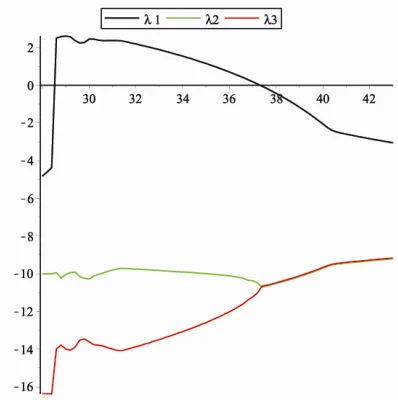
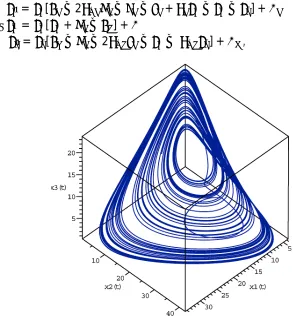
the some values of is a chaotic system, since one of its Lyapunov exponents, is positive. Also it is a dissipative system, because sum of its Lyapunov exponents is negative. Figure 3 shows the attractors diagrams of system (2.1). The attractors are bounded but not a fixed point or limit cycle. It is a property of chaotic systems [6].
Figure 1: Lyapunov exponents of (2.1), for = 16.5, = 10, = 0.5, = 0.5
and 28 < < 42, with initial conditions (0) = 5, (0) = 17 and (0) = 0.3.
3.
S
YNCHRONIZATIONV
IAS
LIDINGM
ODEC
ONTROLFor synchronization, assume the drive and response systems are defined as follow:
̇ = ( ), (3.1)
̇ = ( ) + , (3.2)
where = ( , , … , ) , = ( , , … , ) ℝ are the state vectors of the systems (3.1) and (3.2), and = ( , , … , ) is an -dimensional control signal. Let = − ,
is the error of synchronization. Then, the error dynamical system between drive and response systems is:
Figure 2. Bifurcation diagrams of (2.1), for = 16.5, = 10, = 0.5, = 0.5
and 28 < < 42, with initial conditions (0) = 5, (0) = 17 and (0) = 0.3.
The goal is to design an appropriate sliding mode controller such that for any initial condition and , we have:
lim
→ ‖ ‖= lim→ ‖ ( )− ( )‖= 0,
where ‖.‖ is the Euclidean norm.
For studying chaos synchronization of chemical reactor model for parameter values
= 30, = 16.5, = 10, = 0.5 and = 0.5 which generates chaotic
behavior. We use the idea of sliding mode control technique for synchronization of two identical chaotic systems and stability obtained by Barbalate's lemma [18, 24, 27].
̇ = − − − ̇ = −
̇ = − −
(3.4)
and
̇ = − − − +
̇ = − +
̇ = − − + ,
(3.5)
where , and are control functions. We discuss the synchronization via sliding
mode control. Let = − , = − and = − . Then the error dynamical
system of (3.4) and (3.5) is:
̇ = [ −2 − − + − − ] +
̇ = [ + − ] +
̇ = [ − −2 − − ] + ,
(3.6)
Figure 3. Attractor of (2.1), for = 30, = 16.5, = 10, = 0.5 and = 0.5
where
= − − +
=− +
= − + .
(3.7)
Sliding mode control [18, 27] is a robust control method. The first step is to select an appropriate sliding surface. The sliding surface can be designed as:
( ) = ( )
( ) = ( )
( ) = ( ),
(3.8)
where surface parameters are positive constants. The next step is to determine an input signal ( ) to guarantee that the error system trajectories reach to the sliding surface
( ) = 0. The sliding mode control law is proposed as:
=− ( )
= − ( )
= − ( ),
(3.9)
where , ( = 1,2,3) are the switching gain and positive. By note that the chaotic properties all states of (3.4) and (3.5) are bounded, then there exist , and such that:
−2 − − + − − <
+ − <
− −2 − − <
(3.11)
We note that , and are positive and bounded mole functions.
Theorem 3.1. Consider the error dynamics (3.6), this system is controlled by ( ) in (3.9), Such that = 2 | |, = 2 and = 2 | |. Then the error system trajectories will converge to the sliding surface ( ) = 0.
Proof. We define the Lyapunov function as follow
( ) =∑ (3.11)
̇ =∑ ̇ = ̇ + ̇ + ̇
= −2 − − + − − + [ + − ]
+ [ − −2 − − ] + + + ,
(3.12)
then
̇ < + + + + +
= + + − | |− − | |. (3.13)
If we let = 2 | |, = 2 and = 2 | | then we have
̇ <− + + = − | | = − ( )≤0 (3.14)
where | | = ( )≥ 0. Integrating equation (3.14) from zero to yields:
(0)− ( )≥0⟹ (0)≥ ( )
(0)− ( ) >∫ ( ) . (3.15)
Then lim → ∫ ( ) exists and is positive. Thus, according to the Barbalate's lemma [18], we have:
lim → ( ) = lim → | | = 0. (3.16)
Since is greater than zero, (3.16) implies = 0. This completes the proof. ▄
4.
N
UMERICALS
IMULATIONTo demonstrate and verify the validity of the proposed scheme, we discuss and illustrate the numerical simulations results for synchronization of two identical chaotic chemical reactor model.
For synchronization, systems (3.4) and (3.5) with controllers (3.7) are solved numerically by Maple 16 with Runge-Kutta method of order four.
By assuming = 30, = 16.5, = 10, = 0.5, = 0.5 and with initial
conditions (0) = 15, (0) = 17, (0) = 3, (0) = 1, (0) = 5, (0) = 5, the proposed system in section 2 is chaotic. Also, we assume the constant parameters in controllers rule are = 0.1, = 0.5, = 1 and ( = 1,2,3) which are arbitrary positive constant.
plotted in Figure 5. As expected from the above analytical considerations the synchronization errors , and converge to zero as →0.
Figure 4. Synchronization of (3.4) and (3.5) with different initial conditions.
5.
C
ONCLUSIONIn this paper, we studied the dynamics of a chaotic chemical reactor system. The basic properties of chemical reactor model such as Lyapunov exponents, chaotic attractors, equilibria and their stability was discussed. For synchronization, we used sliding mode controller scheme. Obtained controllers laws were satisfied in Barbalate's lemma. Numerical simulations were given to show the effectiveness of study method.
R
EFERENCES1. M. M. Al-sawalha and M. S. M. Noorani, On anti-synchronization of chaotic systems via nonlinear control, Chaos Solitons Fractals.42 (2009) 170–179.
2. R. Andrievskii and A. R. Fradkov, Control of Chaos: Methods and Applications, I. Methods Automation and Remote Control. 64 (2003) 3–45.
3. P. Arena, S. Baglio, L. Fortuna and G. Manganaro, Hyperchaos from cellular neural networks, Electron Lett.31 (1995) 250–251.
4. C. Barbara and C. Silvano, Hyperchaotic behavior of two bidirectional Chua’s circuits. Int. J. Circuit Theory Appl. 30 (2002) 625–637.
5. B. Blasius, A. Huppert and L. Stone. Complex dynamics and phase synchronization in spatially extended ecological system, Nature. 399 (1999) 354–359.
6. H. Broer and F. Takens, Dynamical systems and chaos. Springer. (2009).
7. L. O. Chua, M. Hasler, G. S. Moschytz and J. Neirynck, Autonomous cellular neural networks: A unified paradigm for pattern formation and active wave propagation. IEEE Trans. CAS. 42 (1995) 559–577.
8. D. Cox, J. Little, D.O SheaIdeals, Varieties, and Algorithms, Third Edition, Springer, New York USA, (2007).
9. E. M. Elabbasy and M. M. El-Dessoky, Adaptive anti-synchronization of different chaotic dynamical systems, Chaos Solitons Fractals. 42 (2009) 2174–2180.
10.M. M. El-Dessoky, Synchronization and anti-synchronization of a hyperchaotic Chen system, Chaos Solitons Fractals. 39 (2009) 1790–1797.
11.P. Geysermans and F. Baras, Particle simulation of chemical chaos, J. Chem. Phys. 105 (4) (1996) 1402–1408.
12.P. Geysermans and G. Nicolis, Thermodynamic fluctuations and chemical chaos in a well-stirred reactor: A master equation, analysis. J. Chem. Phys. 99 (11) (1993) 8964–8969.
14.S. K. Han, C. Kerrer and Y. Kuramoto, Dephasing and bursting in coupled neural oscillators, Phys. Rev. Lett.75 (1995) 3190–3193.
15.Y. Haung, Chaoticity of some chemical attractors: a computer assisted proof, J Math Chem. 38 (1) (2005) 107–117.
16.J. Y. Hsieh, C. C. Hwang, A. P. Li and W. J Li Controlling hyperchaos of the Rössler system, Int. J. Control.72 (1999) 882–886.
17.T. Kapitaniak, L. O Chua and G. Q. Zhong, Experimental hyperchaos in coupled Chua’s circuits, IEEE Trans. CAS. 41 (1994) 499–503.
18.H. K. Khalil, Nonlinear systems, secound edition, Michigan State University, Prentice Hall, (1950).
19.H. Kheiri, H. R. Moghaddam and V. Vafaei, Anti-synchronization of the T System with Uncertain Parameters Via Adaptive Control, Int. J. of Nonlinear Sci. 12 (4) (2011) 394–399.
20.E. N. Lorenz, Deterministic non-periodic flows, J. Atoms. Sci.20 (1963) 130–141. 21.G. M. Mahmoud, T. Bountis and E. E. Mahmoud, Active control and global
synchronization of complex Chen and Lüsystems, Int. J. Bifurc. Chaos. 17 (2007) 4295–4308.
22.T. Matsumoto, L. O. Chua and K. Kobayashi, Hyperchaos: laboratory experimental and numerical confirmation, IEEE Trans. CAS. 83 (1986) 1143–1147.
23.E. Ott, C. Grebogi and J. A. Yorke, Controlling chaos , Phys. Rev. Lett. 64 (1990) 1196–1199.
24.L. M. Pecora and T. L. Carroll, Synchronization in chaotic systems, Phys. Rev. Lett.64 (1990) 821–824.
25.J. H. Peng, E. J. Ding, M. Ging and W. Yang, Synchronizing hyperchaos with a scalar transmitted signal, Phys. Rev. Lett. 76 (1996) 904–907.
26.M. Pourmahmood, S. Khanmohammadi and G. Alizadeh, Synchronization of two different uncertain chaotic systems with unknown parameters using a robust adaptive sliding mode controller, Commun. Nonlinear. Sci. Numer. Simulat. 16
(2011) 2853–2868.
27.J. J. E. Slotine and W. P. Lin, Applied Nonlinear Control, New York, Prentice-Hall, (1991).
28.N. Vasegh and F. Khellat. Chaos Synchronization of Chemical Models,
International Journal of Applied Science and Technology. 1 (5) (2011) 233–243. 29.R. Vicente, J. Daudén and R. Toral, Analysis and characterization of the
hyperchaos generated by a semiconductor laser subject, IEEE J. Quantum Electron. 41 (2005) 541–548.
31.T. Yang and L. O. Chua, Secure communication via chaotic parameter modulation,
IEEE Trans. Circuits Syst. I. 43 (1996) 817–819.
32.S. M. Yu, J. H. Lü, H. Leung and G. R. Chen, N-scroll chaotic attractors from a general jerk circuit, Circuits Systems ISCAS.2 (2005) 1473–1476.