R E S E A R C H A R T I C L E
Open Access
Development and external validation of a new
PTA assessment scale
Bram Jacobs
1, Janneke van Ekert
1, Lotje PL Vernooy
1, Peter Dieperink
1, Teuntje MJC Andriessen
1,
Marc PH Hendriks
2,3, Arie B van Vugt
4, Marjolein AA Emons
4, George F Borm
5and Pieter E Vos
1*Abstract
Background:Post-traumatic amnesia (PTA) is a key symptom of traumatic brain injury (TBI). Accurate assessment of PTA is imperative in guiding clinical decision making. Our aim was to develop and externally validate a short, examiner independent and practical PTA scale, by selecting the most discriminative items from existing scales and using a three-word memory test.
Methods:Mild, moderate and severe TBI patients and control subjects were assessed in two separate cohorts, one for derivation and one for validation, using a questionnaire comprised of items from existing PTA scales. We tested which individual items best discriminated between TBI patients and controls, represented by sensitivity and specificity. We then created our PTA scale based on these results. This new scale was externally evaluated for its discriminative value using Receiver Operating Characteristic (ROC) analysis and compared to existing PTA scales. Results:The derivation cohort included 126 TBI patients and 31 control subjects; the validation cohort consisted of 132 patients and 30 controls. A set of seven items was eventually selected to comprise the new PTA scale: age, name of hospital, time, day of week, month, mode of transport and recall of three words. This scale demonstrated adequate discriminative values compared to existing PTA scales on three consecutive administrations in the validation cohort.
Conclusion:We introduce a valid, practical and examiner independent PTA scale, which is suitable for mild TBI patients at the emergency department and yet still valuable for the follow-up of more severely injured TBI patients.
Keywords:Traumatic brain injury (TBI), Head injury, Post-traumatic amnesia (PTA), PTA assessment scale
Background
Post-traumatic amnesia (PTA) is an essential aspect of traumatic brain injury (TBI), characterized by confu-sion, disorientation, retrograde and anterograde am-nesia [1-3]. PTA duration designates injury severity [4,5], and predicts cognitive recovery [6,7], functional outcome [8-11] and return to work [9-13]. Additionally, after mild TBI, the presence and duration of PTA are associated with the risk for intracranial traumatic lesions [5,14-16]. Evaluation of PTA is further used to monitor TBI recovery and to guide therapy and re-habilitation decisions. Despite the importance of accur-ate PTA assessment, no gold standard for PTA assessment exists, and controversy remains regarding
the preferred method to objectively measure the pres-ence and duration of PTA.
Existing PTA scales including the Galveston Orienta-tion and Amnesia Test (GOAT) [17], the (Modified) Oxford PTA Scale (MOPTAS) [18], the Westmead PTA Scale (WPTAS) [19] and the Revised-WPTAS (2004, Ponsford version) [20] use standardized assess-ment formats (Table 1). Limitations associated with these scales refer to imperfect accuracy, because not all answers to memory questions can be verified. Further-more, several test items are retrospective in nature [1], and pictures are used instead of words as memory items, which may be impractical, especially in emergency de-partment (ED) settings [21,22]. In addition, test items that require remembering the examiner’s name and face are unfeasible given the fact that longitudinal PTA as-sessment often requires multiple testing [20]. The item
name of examiner is often failed by a substantial * Correspondence:[email protected]
1
Department of Neurology, Radboud University Nijmegen Medical Centre, Nijmegen, the Netherlands
Full list of author information is available at the end of the article
proportion of control subjects as well [20]. A final area of concern is the level of task difficulty. Although widely accepted as a legitimate test item, the three-picture memory test has been shown to be less sensitive to test PTA than a three-word memory test [22-24].
To overcome the accuracy and practical shortcomings related to existing PTA scales the present study was undertaken. In the first part we constructed an examiner independent PTA scale composed of a set of individual items with the highest discriminative value taken from existing PTA scales. In part two this newly composed scale was subsequently validated in patients and con-trols, and the concurrent validity was assessed by com-paring it to the existing GOAT [17], MOPTAS [18] and (Revised-)WPTAS [19,20] scales.
Methods Subjects
This single center prospective cohort study was executed at the ED and neurological and surgical wards of the Radboud University Nijmegen Medical Centre, a level I trauma centre; the first part of the study (derivation) be-tween 2005 and 2006 and the second part (validation) in 2009.
All consecutive TBI patients, over 16 years of age and admitted to the ED, were eligible for inclusion. TBI was classified, based on the admission Glasgow Coma Scale (GCS) score at the ED, as mild (GCS: 13–15), moderate (GCS: 9–12) or severe (GCS≤8) [14]. GCS scores were obtained after initial (surgical) resuscitation preferably before sedation and intubation.
Two control groups for both the derivation and the validation study were recruited, one group of healthy controls and a second control group of patients with iso-lated traumatic orthopedic injuries who were admitted to the ED and the surgical ward. For the derivation study we recruited an extra control group of neurological patients admitted for a central nervous system disease. Including orthopedic trauma patients permitted control-ling for factors such as pain and traumatic stress. By in-cluding neurological control subjects we aimed to control for aspects of admittance at a hospital ward due to neurological disease.
Exclusion criteria for participants were the following: age below 16 (no upper age limit), previous history of moderate or severe TBI, a history of alcohol and/or drug abuse, previous diagnosis of dementia, and inability to communicate, for example due to aphasia, a tracheos-toma or a language barrier. Participants were not included during weekend- or night shifts. However, follow-up testing of included participants was carried out during weekends. Test administrations were also missed if the subject was unable to participate, for in-stance due to surgery.
The local ethics committee waived the need for review board approval and written informed consent.
PTA assessment
Assessment of PTA started immediately on presentation to the ED for the mild TBI and orthopedic patients and the day after admittance for the neurological controls. The moderate/severe TBI patients were assessed as soon as possible after regaining consciousness and when they were able to cooperate sufficiently. During derivation and validation a 23-item questionnaire composed of all the individual test items derived from the GOAT [17], MOPTAS [18] and (R-)WPTAS [19,20] scales (Table 1) was administered by the same examiner on a daily basis to the participants until the formal criteria of these tests were met or until discharge or transfer from our Table 1 The combined PTA questionnaire administered to
participants; a composite of items from existing PTA scales
Questionnaire GOAT WPTAS R-WPTAS MOPTAS Reference [17] [19] [20] [18]
01.Name √
02.Age √ √ √
03.Date of birth √ √ √ √
04.Residence √
05.Marital status √
06.Children √
07.Occupation √
08.Recognition face examiner √ √ √
09.Recall name examiner √ √
10.Kind of place √ √
11.Name of place √ √ √
12.City of hospital √
13.Date of admittance √
14.Mode of transport √
15.Last memory preceding injury √ √
16.First memory following injury √ √
17.Period of day √ √
18.Time of day √
19.Day of week √ √ √
20.Date √
21.Month of year √ √ √ √
22.Year √ √ √ √
23. 3-item memory test √ √ √
Maximum Score 100 12 10 15
Criterion–PTA present
(disease positive) ≤
75 ≤11 ≤9 ≤14
hospital. During PTA assessment patients were told the correct answer to a question if the answer was incorrect. In order to prospectively test anterograde memory and compare the use of pictures against words, patients and controls included in the derivation cohort were rando-mized using a sealed envelope method for a pictures group (PG) or a words group (WG). For both groups 35 sets, each comprising three memory items, pictures or words, were created as we previously described [23]. At the end of the combined PTA questionnaire the partici-pant was instructed to memorize three items (pictures or words). If free recall was not perfect during the fol-lowing test (preferably 24 hours after the initial adminis-tration and every subsequent 24 hours), the participant had to select the three target pictures or words out of nine distracters. Each time recognition was tested, new sets of distracters were used. In case of errors in recog-nition, the same three memory items were presented again, and the participant was asked to remember the items until the subsequent test day. The set of target items was changed only in case of flawless recognition. In the (R-)WPTAS, performance on the three-picture test is used to calculate a total test score. In our study, total (R-)WPTAS test scores are based on either the three-picture or the three-word memory test.
Test procedures in the validation study were similar to those described above with three exceptions. First, based on the results of the PTA scale derivation, only words were used as memory items. Second, one extra adminis-tration (next to the initial adminisadminis-tration and the
subsequent assessments each 24 hours) of the composite PTA questionnaire was introduced at one hour after the first administration. Finally, recall and recognition of three words were also tested at five minutes after pres-entation during the initial questionnaire administration.
Data analysis
Since no gold standard exists to define PTA, we com-pared patients and controls, recognizing that not all TBI patients suffered from PTA. The discriminative value of individual test items was determined separately for both the derivation and validation study by calculation of the sensitivity and specificity. The sensitivity of a test item was defined as the proportion of TBI patients giving an incorrect answer to that particular item whereas specifi-cityreferred to the proportion of controls answering the particular test item correctly.
To develop an examiner independent and objective PTA scale, the examiner related items (nameandface of examiner) and the items that cannot objectively be veri-fied for correctness (last memory preceding and first memory following injury), were excluded from further analysis. Performance of patients and controls was com-pared using Chi-squared and Fisher’s exact tests: For the orientation items the scores on day one (first administra-tion) and day two were used. We used the score on day two for the memory items. Pearson’s correlation analysis was performed for all items on test day one to determine inter-item correlation. To compose a new PTA scale,
items with the highest sensitivity and specificity, taking the inter-item correlation into account, were chosen.
The discriminative value (patients versus controls) of free recall versus recognition of the three-word memory test in the validation sample was determined by comput-ing Receiver Operatcomput-ing Characteristic (ROC) curves. Spearman correlation coefficients were calculated to examine the association between performance on our proposed PTA scale and performance on the GOAT, MOPTAS and (R-)WPTAS scales. Since we used a three-word memory test instead of a three-picture test in this validation cohort the total scores of the MOPTAS and (R-)WPTAS scales were calculated using the three-word recognition scores.
Finally, to compare the performance of our PTA scale with existing scales, we also carried out ROC analyses of the sum scores of all PTA scales to calculate the individ-ual discriminative values (patients versus controls). For all statistical analyses a p <0.05 (two-sided) was consid-ered statistically significant.
Results
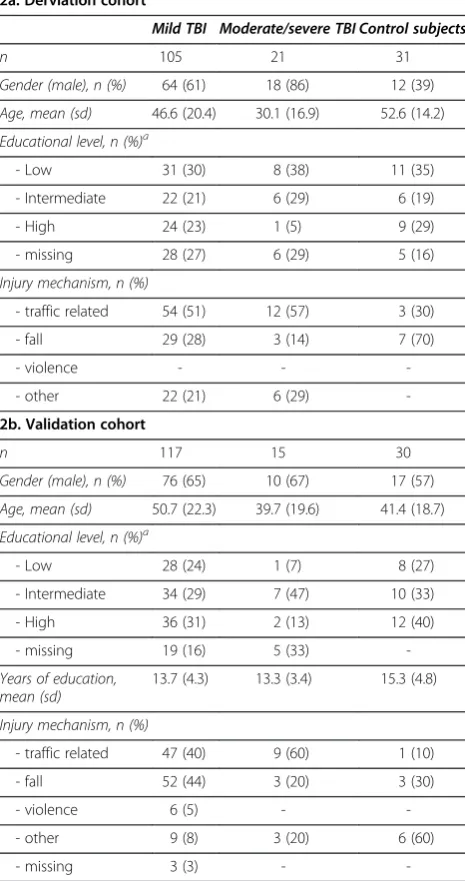
Figure 1 shows the inclusion procedure of the TBI patients for both cohorts. In the derivation study 10 healthy, 10 orthopedic (upper or lower leg fracture) and 11 neurological controls (10 patients suffering from a sensorimotor ischemic stroke without aphasia and 1 pa-tient with a benign cerebral tumor) were included. For the validation study we recruited 20 healthy individuals and 10 patients with traumatic orthopedic injuries. The different control groups were collapsed into one single control group per cohort. Table 2 demonstrates the demographic and clinical characteristics of TBI patients and control subjects. Within the derivation study, patients and controls differed considerably in gender and age (Table 2a). For the validation cohort differences were less apparent except for the age difference of nine years between mild TBI patients and controls (Table 2b). The first PTA assessment in the moderate/severe patients included in the derivation cohort was executed at a mean of 17,3 days (standard deviation [sd] 14,9) post-injury, for the validation cohort the mean was 8,6 (sd 10,1) days.
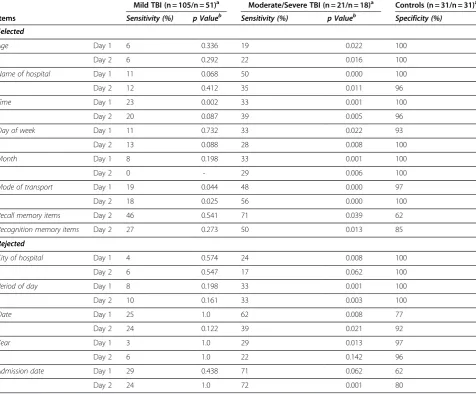
Table 3 shows the sensitivity and specificity of individ-ual items administered to the derivation cohort on test days one and two. Moderate/severe TBI patients per-formed poorer on all items compared to controls except for name, date of birth, residence, marital status, off-spring and occupation (not shown in Table 3). In mild TBI, only time of day (margin 30 minutes) on day one and mode of transport on days one and two showed a significant difference between patients and controls.
No significant differences in test performance on the memory items were found between the picture and word
groups (data not shown). Both item groups were com-bined for further analyses. The 24-hours free recall and recognition scores did not differ significantly between mild TBI patients and controls (Table 3), whereas mod-erate/severe TBI patients performed significantly poorer than controls. The 24-hours free recall of memory items proved to be more difficult than recognition for both patients and controls, as demonstrated by higher sensi-tivity and lower specificity values.
A correlation was found betweenname of hospitaland
city of hospital (r = 0.61; p <0.0001) and month, day of week,timeandperiod of day (0.50 <r <0.56; p <0.0001). Table 2 Participant characteristics
2a. Derviation cohort
Mild TBI Moderate/severe TBI Control subjects
n 105 21 31
Gender (male), n (%) 64 (61) 18 (86) 12 (39)
Age, mean (sd) 46.6 (20.4) 30.1 (16.9) 52.6 (14.2)
Educational level, n (%)a
- Low 31 (30) 8 (38) 11 (35)
- Intermediate 22 (21) 6 (29) 6 (19)
- High 24 (23) 1 (5) 9 (29)
- missing 28 (27) 6 (29) 5 (16)
Injury mechanism, n (%)
- traffic related 54 (51) 12 (57) 3 (30)
- fall 29 (28) 3 (14) 7 (70)
- violence - -
-- other 22 (21) 6 (29)
-2b. Validation cohort
n 117 15 30
Gender (male), n (%) 76 (65) 10 (67) 17 (57)
Age, mean (sd) 50.7 (22.3) 39.7 (19.6) 41.4 (18.7)
Educational level, n (%)a
- Low 28 (24) 1 (7) 8 (27)
- Intermediate 34 (29) 7 (47) 10 (33)
- High 36 (31) 2 (13) 12 (40)
- missing 19 (16) 5 (33)
-Years of education, mean (sd)
13.7 (4.3) 13.3 (3.4) 15.3 (4.8)
Injury mechanism, n (%)
- traffic related 47 (40) 9 (60) 1 (10)
- fall 52 (44) 3 (20) 3 (30)
- violence 6 (5) -
-- other 9 (8) 3 (20) 6 (60)
- missing 3 (3) -
-TBI, traumatic brain injury; n, number; sd, standard deviation;a
Not surprisingly, date and date of admission showed a correlation in the mild TBI patients (r = 0.67; p <0.0001). For our PTA scale (Table 4), to be validated in the sec-ond part of this study, we selected the items age, name of hospital, time, day of week, month, mode of transport
andrecall of three wordsafter 24 hours based on the fol-lowing arguments. For the use of a new scale at an ED, we chose items with discriminative value from at least day one in mild TBI patients: time and mode of trans-port. Both items showed high specificity (>95%). We selected age since it showed significant differences in sensitivity and specificity in moderate/severe TBI patients on at least two consecutive days.
The items name of hospital, day of week and month
were selected because of high specificity and significant differences in test performances between moderate/ severe TBI and controls. Year demonstrated discrimina-tive value only on day one, hence it was excluded. Items
dateand admission datewere not selected since specifi-city was low (≤80%).Period of day was not selected be-cause it correlated withtime. Finally,city of hospitalwas excluded as it correlated with name of hospital and proved significant only on day one in the moderate/se-vere TBI patients.
To test anterograde amnesia, we selected for our new PTA scale words instead of pictures as memory items, as they were not inferior to pictures and might be more practical, especially at ED settings. We pre-ferred recall rather than recognition based on its su-perior sensitivity.
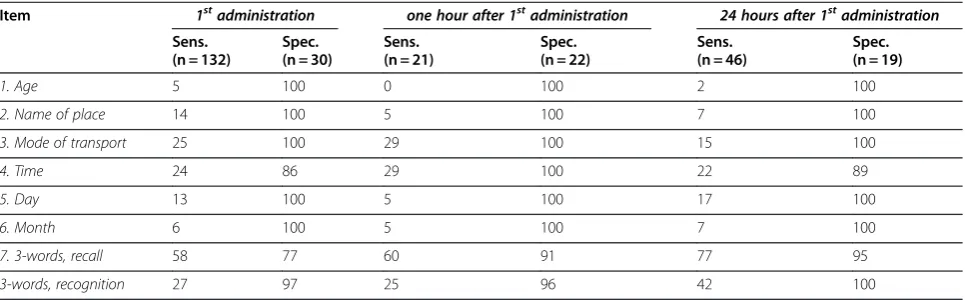
Table 5 demonstrates the sensitivity and specificity of each individual item of our proposed PTA scale as found in the validation cohort on the three primary administra-tions (TBI patients and control subjects grouped to-gether). Additionally, data on three-word recognition are given. In the validation cohort specificity of the item Table 3 Discriminative value: Sensitivity and specificity of individual test items on first two days of admission
Mild TBI (n = 105/n = 51)a Moderate/Severe TBI (n = 21/n = 18)a Controls (n = 31/n = 31)a
Items Sensitivity (%) p Valueb Sensitivity (%) p Valueb Specificity (%)
Selected
Age Day 1 6 0.336 19 0.022 100
Day 2 6 0.292 22 0.016 100
Name of hospital Day 1 11 0.068 50 0.000 100
Day 2 12 0.412 35 0.011 96
Time Day 1 23 0.002 33 0.001 100
Day 2 20 0.087 39 0.005 96
Day of week Day 1 11 0.732 33 0.022 93
Day 2 13 0.088 28 0.008 100
Month Day 1 8 0.198 33 0.001 100
Day 2 0 - 29 0.006 100
Mode of transport Day 1 19 0.044 48 0.000 97
Day 2 18 0.025 56 0.000 100
Recall memory items Day 2 46 0.541 71 0.039 62
Recognition memory items Day 2 27 0.273 50 0.013 85
Rejected
City of hospital Day 1 4 0.574 24 0.008 100
Day 2 6 0.547 17 0.062 100
Period of day Day 1 8 0.198 33 0.001 100
Day 2 10 0.161 33 0.003 100
Date Day 1 25 1.0 62 0.008 77
Day 2 24 0.122 39 0.021 92
Year Day 1 3 1.0 29 0.013 97
Day 2 6 1.0 22 0.142 96
Admission date Day 1 29 0.438 71 0.062 62
Day 2 24 1.0 72 0.001 80
a
Number of patients between parenthesis: first number on day 1, second number on day 2.b
time of daywas lower at the first (86% versus 96%) and 24-hours administration (89% versus 100%). The other items were never failed by the control subjects.
The Area Under the Curve (AUC) of free recall was larger than that of recognition. Consequently, free recall demonstrated better discriminative values: First adminis-tration: 0.71 (95% confidence interval [CI]: 0.62-0.79) versus 0.62 (95% CI: 0.52-0.72); second administration:
0.76 (95% CI: 0.61-0.92) versus 0.60 (95% CI: 0.42-0.77); third administration: 0.87 (95% CI: 0.79-0.96) versus 0.71 (95% CI: 0.58-0.84).
Performances on our proposed PTA scale and existing PTA scales showed strong and significant correlations, except for the modest, nevertheless significant, correla-tions between performances on our PTA scale and the GOAT (Table 6).
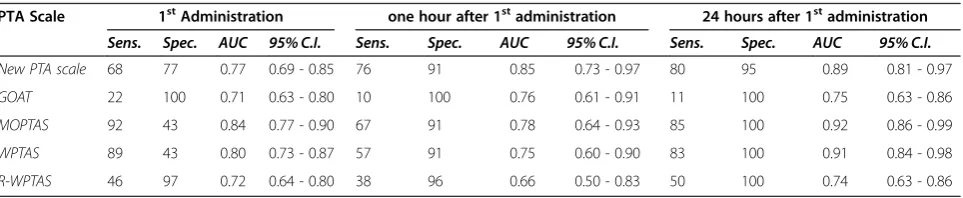
Table 7 compares the sensitivity and specificity of the proposed PTA scale with current PTA scales, based on the sum scores of each individual scale (Table 1). Our new PTA scale had largely comparable AUC’s to the existing PTA scales.
Discussion
We derived and externally validated a new PTA scale consisting of seven objective items including an antero-grade memory test of three words. In general, the new scale proved to have equal discriminative capacity com-pared to existing PTA scales, while being more practical, less time consuming and examiner independent.
An essential feature of ongoing PTA is the inability to store new information. Therefore, anterograde memory testing should be included in a PTA scale [25]. At present, several acknowledged PTA scales, i.e. MOPTAS and (R-)WPTAS, use pictures as memory items. How-ever, the use of words is probably more practical. More-over, in the derivation cohort the specificity of words as memory items was not inferior to pictures but had a higher sensitivity, confirming earlier findings [22-24]. On the other hand, pictures might still be useful in patients with dysphasia disorders or in case of a lan-guage barrier. In line with previous research [23], com-pared to recognition, free recall of memory items was overall more sensitive and equally specific in diagnosing patients with TBI. Moreover, in the validation cohort, free recall of words showed higher discriminative values (AUC’s: 0.71-0.87) than recognition (AUC’s: 0.60-0.71) on three consecutive administrations. One explanation Table 4 Proposed new PTA scale
1. What is your age?
□
. . ../12. Where are you now?(name hospital)
□
. . ../13. What time is it?(margin 30 minutes)
□
. . ../14. Which day of the week do you think it is?
□
. . ../15. Which month of the year do you think it is?
□
. . ../16. How did you get here?(mode of transport)
□
. . ../1On first administration end here and present three words as memory items (procedure see below); on the consecutive administrations (for instance one hour) continue:
7. Can you recall the three words you heard last
administration?
□
. . ../3- If less than 3 words are recalled: present the same three words that should have been
remembered for this day as memory items.
While presenting the new words:
Can you repeat the words I am presenting you? Immediately after presenting the three words:
Can you tell me the three words you just have heard?
If not: present the words once more and have the patient repeat them.
Score one point for every correct answer to the items 1–6
(maximum 6 points) and 1 point for every word correctly recalled.
Sum score
□
. . ../9PTA, post-traumatic amnesia.
Table 5 Sensitivity and specificity of each individual item of the proposed PTA scale
Item 1stadministration one hour after 1stadministration 24 hours after 1stadministration Sens.
(n = 132)
Spec. (n = 30)
Sens. (n = 21)
Spec. (n = 22)
Sens. (n = 46)
Spec. (n = 19)
1. Age 5 100 0 100 2 100
2. Name of place 14 100 5 100 7 100
3. Mode of transport 25 100 29 100 15 100
4. Time 24 86 29 100 22 89
5. Day 13 100 5 100 17 100
6. Month 6 100 5 100 7 100
7. 3-words, recall 58 77 60 91 77 95
3-words, recognition 27 97 25 96 42 100
for this finding may be that after having sustained a TBI recognition of memory items recovers more swiftly than free recall of memory items [22,24,26].
For the external validation of the Nijmegen PTA scale, we recruited a new cohort of participants. Using ROC analysis we studied the discriminative value of our scale across three consecutive administrations in relation to existing PTA scales. During all three test moments our PTA scale showed good discriminative values (AUC’s: 0.77, 0.85 and 0.89) and even the highest value of all scales at the second administration (one hour after initial administration). Although not entirely comparable, the performances of our PTA scale are in agreement with a recent study on the accuracy of the R-WPTAS in the first 24 hours after mild TBI [27]: The specificity of the R-WPTAS was 91%, compared to the 84% maximum specificity of our scale, whereas the sensitivity of the R-WPTAS scale proved 60% and 80% for our proposed PTA scale.
This study has some limitations. Because no gold standard for the assessment of PTA exists, we evaluated test performances of TBI patients against control sub-jects. The proportion of patients that failed a test item was interpreted as the sensitivity of that particular item. However, as not all TBI patients suffer from PTA [14], the sensitivity of test items appeared relatively low. Spe-cificity was evaluated by administrating the test to con-trol subjects without previous head injury, who
consequently did not suffer from PTA. Hence, we think that the specificity of the test items was determined satisfactorily. Furthermore, in the validation study we compared the Nijmegen PTA scale with currently acknowledged PTA scales, which served as surrogate gold standards. In general, we found correlations of more than 0.70 indicating that the level of performance on our PTA scale accurately estimates the cognitive state of the patient. However, no other measures of cognitive functioning were administrated.
In the derivation cohort, some differences in the demographic characteristics existed between patients and controls. The control group consisted of more males, and controls were older than the moderate/severe TBI patients. To our knowledge, no evidence exists that gender effects PTA test performance or PTA emergence. Furthermore, higher age is normally associated with poorer cognitive test performance. Despite their older age, controls were generally able to obtain maximum scores on all test items. In both study cohorts the mod-erate/severe TBI patients had received less formal educa-tion than the mild patients and the controls. This might have influenced the performance of the moderate/severe patients in a negative way, although we think that also most of the lower educated subjects have to be able to answer the questions of the different PTA scales correctly.
Some caution is needed when interpretating the results since the number of moderate/severe TBI patients was restricted possibly reducing the generalizability of our scale to this patient category. And, the number of mild TBI patients tested on consecutive trials decreased which may have increased the sensitivity at later administra-tions. It is possible that assessing PTA at later stages after injury might have lead to higher sensitivity because better performing patients were already discharged from the hospital. Furthermore, in half of the subjects participat-ing in the derivation study and in all participants of the validation study, words were administered as memory items. However, the MOPTAS and (R-)WPTAS scales normally use a set of pictures to assess a patient’s mem-ory. Substitution of picture recognition scores with word Table 6 Spearman correlation coefficients demonstrating
the relationship between our proposed PTA scale and existing PTA scales
Proposed PTA scalea
1stadministration 2ndadministration (one hour) 3
rd
administration (24 hours)
GOAT 0.66 0.67 0.59
MOPTAS 0.76 0.79 0.81
WPTAS 0.74 0.73 0.80
R-WPTAS 0.75 0.65 0.76
a
All correlations were significant atp<0.0001. PTA, post-traumatic amnesia; GOAT, Galveston orientation and amnesia test; MOPTAS, modified Oxford PTA scale; (R-)WPTAS, (Revised-)Westmead PTA scale.
Table 7 Sensitivity, specificity and AUC’s (ROC analysis) of our proposed PTA scale and existing PTA scales
PTA Scale 1stAdministration one hour after 1stadministration 24 hours after 1stadministration
Sens. Spec. AUC 95% C.I. Sens. Spec. AUC 95% C.I. Sens. Spec. AUC 95% C.I.
New PTA scale 68 77 0.77 0.69 - 0.85 76 91 0.85 0.73 - 0.97 80 95 0.89 0.81 - 0.97
GOAT 22 100 0.71 0.63 - 0.80 10 100 0.76 0.61 - 0.91 11 100 0.75 0.63 - 0.86
MOPTAS 92 43 0.84 0.77 - 0.90 67 91 0.78 0.64 - 0.93 85 100 0.92 0.86 - 0.99
WPTAS 89 43 0.80 0.73 - 0.87 57 91 0.75 0.60 - 0.90 83 100 0.91 0.84 - 0.98
R-WPTAS 46 97 0.72 0.64 - 0.80 38 96 0.66 0.50 - 0.83 50 100 0.74 0.63 - 0.86
recognition may have influenced the results. Previous studies have shown that picture recognition and recall are less sensitive but equally specific to word recognition and recall [22-24].
We have developed a PTA scale that proved to be ac-curate in discriminating TBI patients in PTA from con-trol subjects. However, we did not specifically focus our study on the criteria that are required to consider a pa-tient as emerged from PTA. Nevertheless, we consider it reasonable to state that two consecutive maximum test results preclude ongoing PTA.
In this study the inter-rater reliability of our new PTA scale has not been determined. Moreover, we did not study the association of PTA test scores with other TBI (severity) indices - e.g. GCS score, duration of loss of consciousness, and imaging characteristics - and out-come. These additional studies are valuable for further validation of our PTA scale. We also think that an exter-nal validation particularly in a larger cohort of moder-ate/severe TBI patients may be favorable.
PTA assessment may be further improved, especially in patients with MTBI at an ED. We suggest that the diagnostic accuracy of the three-word memory test deserves additional examination, particularly over a time period of 10 to 30 minutes after the first assessment. Moreover, a stricter criterion might be developed on the basis of which a patient can be considered as emerged from PTA. Also, research aimed at a more demanding memory task, for instance a four-item memory test [28], might contribute to the development of more sensitive PTA scales.
Conclusions
We have developed and externally validated a new examiner independent PTA scale consisting of seven ob-jective items: age, name of hospital, time, day of week,
month, mode of transport and recall of three words. The discriminative capacity of our scale proved comparable to that of several existing PTA scales. Nevertheless, it has the advantage of being more practical and less time consuming. And although more comprehensive valid-ation is recommended, we think that our PTA scale is suitable for TBI patients of all severities.
Competing interests
The authors declare that they have no competing interests
Authors’contributions
BJ: study design, participant inclusion, data acquisition, data analysis and interpretation, manuscript drafting, editing and revision, literature search. JvE: participant inclusion, data acquisition, data analysis and interpretation, manuscript revision, literature search. LV: participant inclusion, data acquisition, data analysis and interpretation, manuscript revision. PD: participant inclusion, data acquisition, data analysis and interpretation, manuscript revision. TA: data analysis and interpretation, manuscript revision. MH: data interpretation, manuscript revision. AvV: participant inclusion, manuscript revision. ME: participant inclusion, manuscript revision. GB: data
analysis and interpretation, manuscript revision. PV: study design, data analysis and interpretation, manuscript drafting, editing and revision, takes responsibility for the paper as a whole, guarantees integrity of entire study. All authors read and approved the final manuscript.
Acknowledgement
The authors wish to thank Haley Smith for her critical review of this manuscript.
Author details
1
Department of Neurology, Radboud University Nijmegen Medical Centre, Nijmegen, the Netherlands.2Donders Institute for Brain, Cognition and Behaviour, Radboud University Nijmegen, Nijmegen, the Netherlands. 3Department of Behavioural Sciences, Epilepsy Centre Kempenhaeghe, Heeze, the Netherlands.4Department of Emergency Medicine, Radboud University Nijmegen Medical Centre, Nijmegen, the Netherlands. 5
Department of Epidemiology, Biostatistics and HTA, Radboud University Nijmegen Medical Centre, Nijmegen, the Netherlands.
Received: 16 April 2012 Accepted: 28 June 2012 Published: 8 August 2012
References
1. Gronwall D, Wrightson P:Duration of Post-traumatic Amnesia after Mild Head Injury.J Clin Neuropsychol1980,2:51–60.
2. Wilson BA, Evans JJ, Emslie H, Balleny H, Watson PC, Baddeley AD: Measuring recovery from post traumatic amnesia.Brain Inj1999, 13:505–520.
3. Schacter DL, Crovitz HF:Memory function after closed head injury: a review of the quantitative research.Cortex1977,13:150–176. 4. Russell WR, Smith A:Post-traumatic amnesia in closed head injury.Arch
Neurol1961,5:4–17.
5. Haydel MJ, Preston CA, Mills TJ, Luber S, Blaudeau E, DeBlieux PM: Indications for computed tomography in patients with minor head injury.New Engl J Med2000,343:100–105.
6. Shores EA:Comparison of the Westmead PTA Scale and the Glasgow Coma Scale as predictors of neuropsychological outcome following extremely severe blunt head injury.J Neurol Neurosurg Psychiatry1989, 52:126–127.
7. De GE, Leblanc J, Feyz M, Lamoureux J:Prediction of the level of cognitive functional independence in acute care following traumatic brain injury.
Brain Inj2005,19:1087–1093.
8. Walker WC, Ketchum JM, Marwitz JH, Chen T, Hammond F, Sherer M, Meythaler J:A multicentre study on the clinical utility of post-traumatic amnesia duration in predicting global outcome after moderate-severe traumatic brain injury.J Neurol Neurosurg Psychiatry2010,81:87–89. 9. Cifu DX, Keyser-Marcus L, Lopez E, Wehman P, Kreutzer JS, Englander J,
High W:Acute predictors of successful return to work 1 year after traumatic brain injury: a multicenter analysis.Arch Phys Med Rehabil1997, 78:125–131.
10. Katz DI, Alexander MP:Traumatic brain injury. Predicting course of recovery and outcome for patients admitted to rehabilitation.Arch Neurol1994,51:661–670.
11. van der Naalt J, van Zomeren AH, Sluiter WJ, Minderhoud JM:One year outcome in mild to moderate head injury: the predictive value of acute injury characteristics related to complaints and return to work.J Neurol Neurosurg Psychiatry1999,66:207–213.
12. Brown AW, Malec JF, McClelland RL, Diehl NN, Englander J, Cifu DX:Clinical elements that predict outcome after traumatic brain injury: a
prospective multicenter recursive partitioning (decision-tree) analysis.
J Neurotrauma2005,22:1040–1051.
13. Nakase-Richardson R, Yablon SA, Sherer M:Prospective comparison of acute confusion severity with duration of post-traumatic amnesia in predicting employment outcome after traumatic brain injury.J Neurol Neurosurg Psychiatry2007,78:872–876.
14. Vos PE, Battistin L, Birbamer G, Gerstenbrand F, Potapov A, Prevec T, Stepan CA, Traubner P, Twijnstra A, Vecsei L, Wild KK:EFNS guideline on mild traumatic brain injury: report of an EFNS task force.Eur J Neurol2002, 9:207–219.
Predicting intracranial traumatic findings on computed tomography in patients with minor head injury: the CHIP prediction rule.Ann Intern Med
2007,146:397–405.
16. Schonberger M, Ponsford J, Reutens D, Beare R, O'Sullivan R:The Relationship between age, injury severity, and MRI findings after traumatic brain injury.J Neurotrauma2009,26:2157–2167.
17. Levin HS, O'Donnell VM, Grossman RG:The Galveston Orientation and Amnesia Test. A practical scale to assess cognition after head injury.
J Nerv Ment Dis1979,167:675–684.
18. Fortuny LA, Briggs M, Newcombe F, Ratcliff G, Thomas C:Measuring the duration of post traumatic amnesia.J Neurol Neurosurg Psychiatry1980, 43:377–379.
19. Shores EA, Marosszeky JE, Sandanam J, Batchelor J:Preliminary validation of a clinical scale for measuring the duration of post-traumatic amnesia.
Med J Aust1986,144:569–572.
20. Ponsford J, Willmott C, Rothwell A, Kelly AM, Nelms R, Ng KT:Use of the Westmead PTA scale to monitor recovery of memory after mild head injury.Brain Inj2004,18:603–614.
21. Jackson WT, Novack TA, Dowler RN:Effective serial measurement of cognitive orientation in rehabilitation: the Orientation Log.Arch Phys Med Rehabil1998,79:718–720.
22. Schwartz ML, Carruth F, Binns MA, Brandys C, Moulton R, Snow WG, Stuss DT:The course of post-traumatic amnesia: three little words.Can J Neurol Sci1998,25:108–116.
23. Andriessen TM, de Jong B, Jacobs B, van der Werf SP, Vos PE:Sensitivity and specificity of the 3-item memory test in the assessment of post traumatic amnesia.Brain Inj2009,23:345–352.
24. Stuss DT, Binns MA, Carruth FG, Levine B, Brandys CE, Moulton RJ, Snow WG, Schwartz ML:The acute period of recovery from traumatic brain injury: posttraumatic amnesia or posttraumatic confusional state?
J Neurosurg1999,90:635–643.
25. Tate RL, Pfaff A, Baguley IJ, Marosszeky JE, Gurka JA, Hodgkinson AE, King C, Lane-Brown AT, Hanna J:A multicentre, randomised trial examining the effect of test procedures measuring emergence from post-traumatic amnesia.J Neurol Neurosurg Psychiatry2006,77:841–849.
26. Tate RL, Pfaff A, Jurjevic L:Resolution of disorientation and amnesia during post-traumatic amnesia.J Neurol Neurosurg Psychiatry2000, 68:178–185.
27. Shores EA, Lammel A, Hullick C, Sheedy J, Flynn M, Levick W, Batchelor J: The diagnostic accuracy of the Revised Westmead PTA Scale as an adjunct to the Glasgow Coma Scale in the early identification of cognitive impairment in patients with mild traumatic brain injury.
J Neurol Neurosurg Psychiatry2008,79:1100–1106.
28. Cantu RC:Posttraumatic retrograde and anterograde amnesia: pathophysiology and implications in grading and safe return to play.
J Athl Train2001,36:244–248.
doi:10.1186/1471-2377-12-69
Cite this article as:Jacobset al.:Development and external validation of a new PTA assessment scale.BMC Neurology201212:69.
Submit your next manuscript to BioMed Central and take full advantage of:
• Convenient online submission
• Thorough peer review
• No space constraints or color figure charges
• Immediate publication on acceptance
• Inclusion in PubMed, CAS, Scopus and Google Scholar
• Research which is freely available for redistribution