R E S E A R C H
Open Access
Early features of autism spectrum disorder:
a cross-sectional study
Antonia Parmeggiani
1, Arianna Corinaldesi
2and Annio Posar
3,4*Abstract
Background:Autism spectrum disorder is characterized by impairment in social interaction and communication along with repetitive, restricted, and stereotyped behaviors, interests and activities. It is important to detect this condition as soon as possible and promptly begin targeted treatments. This study aimed to report on age at onset, early signs, and mode at onset in 105 Italian patients with autism spectrum disorder, searching for correlations with a series of clinical and instrumental variables.
Methods:This retrospective cross-sectional study considered the following five categories of symptoms at onset: language, social interaction and relationships, stereotyped behavior and activities, motor skills, and regulation. Three modes of presentation were considered: a delay, a stagnation, or a regression of development, which were defined modes of onset of autism spectrum disorder. The age at onset, the category of clinical features, and the mode at onset were considered in the entire sample and statistically analyzed for several clinical variables. Statistical analysis was performed utilizing Fisher Exact test and Chi Square test.
Results:The first symptoms between 7 and 12 months were evident in 41.9% of cases, and between 13 and 24 months in 27.6%; no significant differences for the age at onset related to diagnosis, etiopathogenesis, early onset epilepsy, and intelligence quotient level emerged. Social interaction and relationships (93.3%) and language (92.4%) were the categories of early signs more represented in our sample. Delay in spoken language (to be understood as both verbal production and verbal comprehension) was one of the most common (even though not specific) symptoms prompting initial medical consultation for a possible diagnosis of autism spectrum disorder. At onset, patients without intellectual disability manifested stagnation more often than delay or regression of development; patients with a severe/profound intellectual disability more frequently showed delay or regression of development. Language signs at onset were less frequent in cases with regression, whereas motor skill disorders prevailed in cases with delay at onset. Feeding problems were more numerous in cases with delay and stagnation of development.
Conclusions:These data contribute to identifying an early trend of autism spectrum disorder, useful also for pediatricians.
Keywords:Autism spectrum disorder, Children, Early diagnosis, Intellectual disability
© The Author(s). 2020Open AccessThis article is licensed under a Creative Commons Attribution 4.0 International License, which permits use, sharing, adaptation, distribution and reproduction in any medium or format, as long as you give appropriate credit to the original author(s) and the source, provide a link to the Creative Commons licence, and indicate if changes were made. The images or other third party material in this article are included in the article's Creative Commons licence, unless indicated otherwise in a credit line to the material. If material is not included in the article's Creative Commons licence and your intended use is not permitted by statutory regulation or exceeds the permitted use, you will need to obtain permission directly from the copyright holder. To view a copy of this licence, visithttp://creativecommons.org/licenses/by/4.0/. The Creative Commons Public Domain Dedication waiver (http://creativecommons.org/publicdomain/zero/1.0/) applies to the data made available in this article, unless otherwise stated in a credit line to the data.
* Correspondence:[email protected]
3
IRCCS Istituto delle Scienze Neurologiche di Bologna, UOC Neuropsichiatria Infantile, Bologna, Italia
4Dipartimento di Scienze Biomediche e Neuromotorie, Università di Bologna,
Background
Autism spectrum disorder (ASD) is characterized by im-pairment in social interaction and communication along with repetitive, restricted, and stereotyped behaviors, inter-ests and activities [1]. The etiopathogenesis is multifactor-ial, originating from a complex interplay between genetic and environmental factors. In the USA, one in 59 children aged 8 years are diagnosed with ASD [2]; in Italy in our Emilia-Romagna Region in 2016 3.9 cases in 1000 children and adolescents between 0 and 17 years were detected. The mean age of diagnosis is around 4–5 years [3,4].
It is important to detect an ASD as soon as possible and promptly begin targeted treatments.
Generally, parents worry about the impairment in lan-guage and social development that is usually evident dur-ing the first 3 years of life; sometimes symptoms are mild and they are recognized later in childhood [1].
In Italy, to promptly recognize ASD, pediatricians are ad-vised to identify early symptoms utilizing the CHAT (Check-list for Autism in Toddlers) [5] beginning at 18–24 months, then if the child’s presentation raises a clinical suspicion of ASD, he/she is evaluated using a specific test (e.g., CARS Childhood Autism Rating Scale and ADOS Autism Diagnos-tic Observation Schedule) by a childhood neuropsychiatrist, and at this time the definitive diagnosis can be made.
It is noteworthy and at present must be always consid-ered that epilepsy and intellectual disability (ID) or both, may be frequently associated in children with ASD [6–8]. This association may be not casual and it is not suffi-ciently clear if these three variables (ASD, epilepsy and ID) have a special relationship.
At present, both retrospective and prospective studies have investigated behaviors of ASD children during infancy, informed by parents’ descriptions, early home videos, screening tools and sibling studies [9]. The most common early signs involve joint attention, eye contact, orienting to verbal call, facial expression, social smile and deficit or poor quality of movements. Few studies have investigated autis-tic features in the neonatal period [10,11], although some authors have examined preterm infants prospectively [12].
Different data are reported about the age at onset of the early signs: for example, the first decline of social interac-tions may occur between 2 and 6 months [13]; more gen-eric alterations in sleep, feeding and temperament may occur during the first year in children at risk for ASD [14–17]. The onset mode is characterized sometimes by a regression concerning language and social interaction around 16–20 months [18], sometimes by a psychomotor delay or even by developmental stagnation [19,20].
At present, retrospective, prospective and review ana-lyses have reached various conclusions. Zwaigenbaum and collaborators underscore that it is important both to consider all the data reported so far and to promote fu-ture research [21].
Future research regarding early diagnosis cannot ig-nore medical comorbidities such as ID, early onset epi-lepsy and genetic/other medical conditions frequently associated with ASD. For example, it is important to comprehend if, above and beyond any contribution from ID, autism and epilepsy have a relationship.
Our retrospective cross-sectional study on a large popu-lation of Italian patients affected by idiopathic (patients without genetic or metabolic diseases or cerebral lesions) and non-idiopathic (patients affected by genetic or meta-bolic diseases, or with cerebral lesions) ASD aims to de-scribe autism early signs by considering five categories of symptoms at onset. These categories include: a) language, b) social interaction and relationships, c) stereotyped be-havior and activities, d) motor skills, and e) regulation.
Methods
This retrospective cross-sectional study used data from medical records (e.g., medical history, neurologic examin-ation and observexamin-ation, psychological tests, analysis during hospitalization of home videos recorded by parents). These data, concerning the patients hospitalized at the Autism Centre of the Neurological Clinic of the University of Bologna coming from all over Italy, were collected from February 2001 to July 2011. Parents gave informed con-sent to the processing of personal data at the time of the clinical evaluation. The study was approved by the Institu-tional Review Board of the University of Bologna. One hundred and five patients with ASD–82 males and 23 fe-males (male/female ratio of 3.6:1)–were included.
Forty-six (43.8%) patients out of 105 had a pervasive de-velopmental disorder not otherwise specified (PDDNOS), 4 out of 105 (3.8%) had Asperger disorder, and the remaining 55 cases (52.4%) presented an autistic disorder (AD) accord-ing to DSM-IV-TR, 2000 [22]. ASD diagnosis was made utilizing CARS and ADOS. To evaluate the intelligence quo-tient (IQ) or the development quoquo-tient (DQ), depending on the patient age, Wechsler Scales and Stanford-Binet Scale (IQ) or Brunet-Lezine Scale (DQ) were used.
and e) regulation (sleep disorders, feeding disorders: e.g., poor, selective feeding).
As concerns psychomotor development three modes of presentation were considered: a delay, a stagnation, or a regression of development, which were defined modes of onset of ASD.
The age at onset, the category of clinical features, and the mode at onset were considered in the entire sample and statistically analyzed for the following variables: 1) ASD type (PDDNOS and AD), excluding Asperger dis-order for a very small number of cases; 2) non-idiopathic (patients affected by genetic or metabolic diseases, or with cerebral lesions) and idiopathic cases (patients without genetic or metabolic diseases, and without cerebral le-sions); 3) presence of epilepsy with onset before 3 years of age, because sometimes early-onset epileptic encephalop-athy is considered as evidence of the relationship between autism and epilepsy; and 4) presence of an ID.
Statistical analysis was performed utilizing Fisher Exact test and Chi Square test.
We considered significant apvalue < 0.05.
Results Sample
The mean age at onset of ASD symptoms was 13.6 months (range 3–48 months, median 12 and standard deviation 9.1). In the sample, 57 cases were idiopathic (54.3%), while 48 were non-idiopathic (45.7%). The latter presented such conditions as heterogeneous cerebral abnormalities (dam-ages from hypoxic ischemic injury during the pre- and perinatal periods, enlargement of lateral ventricles, incom-plete maturation of cerebral white matter, enlargement of the sylvian fissure with moderate temporal-polar atrophy, thinning of corpus callosum, hypoplasia of the cerebellar vermis, polymicrogyria of the right precentral gyrus, Arnold-Chiari malformation type 1, mesial temporal scler-osis, or asymmetry of temporal and frontal horns). Genetic examinations disclosed abnormal high resolution karyotype in 7/105 cases (6.7%): trisomy 21 in two, ring chromosome 22 in one, interstitial deletion of chromosome 2 in one, bal-anced translocation t (6;10) associated with pericentric in-version of chromosome 9 in one, balanced translocation t (5;10) in one, and pericentric inversion of 7q21.2-7q31.2 in one. Moreover, one patient was diagnosed with Cowden syndrome [23]. Eleven patients (10.5%) had epilepsy with onset before 3 years of age. The awake and sleep electro-encephalogram (EEG) recording, performed in all patients, both in those with epilepsy and in those without epileptic seizures, during the follow-up but not at the onset of ASD, excluded in all cases a condition of electrical status epilep-ticus during slow-wave sleep (ESES). Normal/borderline IQ was present in 19 cases (18.1%), mild/moderate ID in 51 (48.6%), and severe/profound ID in 34 (32.4%). In one patient IQ was not available.
Age at onset of ASD in the whole sample
Twenty-three cases (21.9%) presented the first symptoms be-tween 0 and 6 months, 44 (41.9%) bebe-tween 7 and 12 months, 29 (27.6%) between 13 and 24 months, 7 (6.7%) between 25 and 36 months, and 2 (1.9%) between 37 and 51 months.
Early ASD signs and age at onset in the whole sample, according to the five categories of clinical features
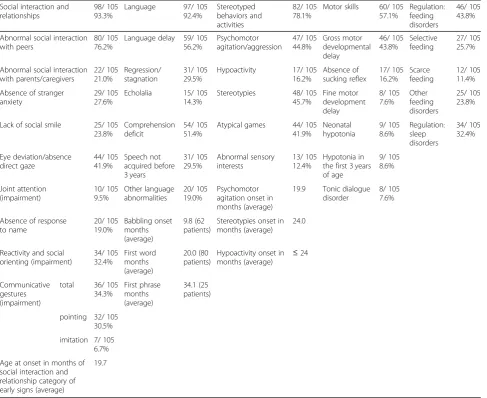
Most patients presented at onset a disorder in the social interaction and relationships (93.3%) and in language cat-egory (92.4%), while stereotyped behaviors and activities recurred in 78.1% of the cases, motor skills disorders in 57.1%, and disorders of regulation in 43.8% as feeding dis-orders and in 32.4% as sleep disdis-orders (Table1).
Early signs, age and mode at onset of ASD considering all variables
Considering the main 4 different intervals of age at onset (0–6, 7–12, 13–24, 25–36 months), with the exclusion of 37–51 months because only two cases belonged to this interval, we found no significant differences between AD and PDDNOS, idiopathic and non-idiopathic cases, cases with and without epilepsy starting before 3 years, and among IQ/DQ levels. Only the category of early signs with motor skill disorders was more represented in patients with age at onset between 0 and 6 and 7–12 months (73.9, 64.4% re-spectively), and the difference was significant (p= 0.040).
Table 2 shows all the variables considered, namely ASD type (AD, PDDNOS), non-idiopathic and idiopathic cases, presence of epilepsy before 3 years, ID levels, the 5 categories of early signs, and the age at onset. All these variables were statistically examined (Chi square test) by considering the onset mode (delay, stagnation or regres-sion of the development).
Forty-eight patients out of 105 (45.7%) presented a delay of development as onset mode, 30 (28.6%) stagna-tion, and 27 (25.7%) regression.
Regarding the five categories of early signs, patients with regression at onset manifested language signs less frequently (81.5%) (p= 0.046). Motor skill disorders as early signs prevailed in cases with a delay at onset (72.9%) (p= 0.0068791). Feeding problems were signifi-cantly more frequent (p= 0.031) in cases with delay and stagnation of development at onset (50.0 and 53.3%, respectively) than in cases with regression (22.2%). Age at onset between 0 and 6 months was significantly more frequent in the cases showing delay and stagnation of development at onset (p= 0.0054580). Age at onset between 13 and 24 months prevailed in the cases with regression of development at onset (44.4%) compared with cases with stagnation (26.7%) and delay (18.8%): this result was near to significance (p= 0.057). Age at onset between 25 and 36 months prevailed significantly (p= 0.040) in cases with stagnation and regression at
onset, while the two cases with age at onset between 37 and 51 months showed a development regression (p= 0.053).
Discussion
Our research considered a large population of Italian pa-tients to identify the ASD early signs and took into ac-count some correlations among variables, which have never been reported.
Sample and age at onset of symptoms
On account of the extreme etiological variability in ASD, we considered both idiopathic and non-idiopathic cases diagnosed according to DSM-IV-TR criteria [22]. With respect to age at onset of ASD, we found that 41.9% of the cases presented the first symptoms between 7 and 12 months and 27.6% between 13 and 24 months.
Table 1Five categories of early signs: number of cases and percentage
Social interaction and relationships
98/ 105 93.3%
Language 97/ 105
92.4% Stereotyped behaviors and activities 82/ 105 78.1%
Motor skills 60/ 105 57.1% Regulation: feeding disorders 46/ 105 43.8%
Abnormal social interaction with peers
80/ 105 76.2%
Language delay 59/ 105 56.2% Psychomotor agitation/aggression 47/ 105 44.8% Gross motor developmental delay 46/ 105 43.8% Selective feeding 27/ 105 25.7%
Abnormal social interaction with parents/caregivers 22/ 105 21.0% Regression/ stagnation 31/ 105 29.5%
Hypoactivity 17/ 105
16.2% Absence of sucking reflex 17/ 105 16.2% Scarce feeding 12/ 105 11.4%
Absence of stranger anxiety
29/ 105 27.6%
Echolalia 15/ 105
14.3%
Stereotypies 48/ 105
45.7% Fine motor development delay 8/ 105 7.6% Other feeding disorders 25/ 105 23.8%
Lack of social smile 25/ 105
23.8%
Comprehension deficit
54/ 105 51.4%
Atypical games 44/ 105
41.9% Neonatal hypotonia 9/ 105 8.6% Regulation: sleep disorders 34/ 105 32.4% Eye deviation/absence direct gaze 44/ 105 41.9% Speech not acquired before 3 years 31/ 105 29.5% Abnormal sensory interests 13/ 105 12.4% Hypotonia in the first 3 years of age 9/ 105 8.6% Joint attention (impairment) 10/ 105 9.5% Other language abnormalities 20/ 105 19.0% Psychomotor agitation onset in months (average)
19.9 Tonic dialogue disorder
8/ 105 7.6%
Absence of response to name 20/ 105 19.0% Babbling onset months (average) 9.8 (62 patients)
Stereotypies onset in months (average)
24.0
Reactivity and social orienting (impairment) 34/ 105 32.4% First word months (average) 20.0 (80 patients)
Hypoactivity onset in months (average)
≤24
Communicative gestures (impairment)
total 36/ 105
34.3% First phrase months (average) 34.1 (25 patients)
pointing 32/ 105 30.5%
imitation 7/ 105 6.7%
Age at onset in months of social interaction and relationship category of early signs (average)
Notably, there were no significant differences for this variable in relation to the diagnosis according to DSM-IV-TR (see the comparison between AD and PDDNOS), etiology (see the comparison between idiopathic and non-idiopathic cases), early onset epilepsy, and IQ/DQ level. These data confirm that regardless of the etiology or ASD type and the comorbidity with ID and early on-set epilepsy, the age at onon-set may shift more frequently between 7 and 24 months with a peak around 7 and 12
months, even though it is possible to recognize an earlier onset between 0 and 6 months in 21.9% of the cases. In the literature, the data on the age at onset of early signs is extremely variable. The similar age at onset regarding the different ASD types and the IQ/DQ levels were re-ported also in the review of Daniels and Mandell [24].
Prospective studies are consistent with retrospective studies in finding that for many ASD children, symptoms emerge gradually over the first 18 months or so of life.
Table 2PDD type, presence of epilepsy before 3 years of age, ID and IQ levels, the 4 categories of early signs, the age at onset
Variables Pvalue Delay Stagnation Regression
AD p=0.047 29/ 48
60.4%
10/ 30 33.3%
16/ 27 59.3%
PDDNOS p=0.093 19/ 48
39.6%
18/ 30 60.0%
9/ 27 33,3%
Non-idiopathic p=0.507 19/ 48
39.6%
15/ 30 50.0%
14/ 27 51.9%
Epilepsy before 3 yrs p=0.605 5/ 48
10.4%
2/ 30 6.7%
4/ 27 14.8%
IQ/DQ
Normal/borderline p=0.037 6/ 48
12.5%
10/ 30 33.3%
3/ 27 11.1%
Mild/moderate p=0.378 25/ 48
52.1%
16/ 30 53.3%
10/ 27 37.0%
Severe/profound p=0.016 17/ 48
35.4%
4/ 30 13.3%
13/ 27 48.1%
Categories Early signs
Language p=0.046 46/ 48
95.8%
29/ 30 96.7%
22/ 27 81,5%
Social interaction/relationship p=0.628 45/ 48
93.8%
27/ 30 90.0%
26/ 27 96.3%
Stereotyped behavior and activities p=0.966 38/ 48
79.2%
23/ 30 76.7%
21/ 27 77.8%
Motor skill disorders p=0.0068791 35/ 48
72.9%
15/ 30 50.0%
10/ 27 37.0%
Regulation
Sleep p=0.830 15/ 48
31.3%
9/ 30 30.0%
10/ 27 37.0%
Feeding p=0.031 24/ 48
50.0%
16/ 30 53.3%
6/ 27 22.2%
Age at onset (months)
0-6 p=0.0054580 15/ 48
31.3%
8/ 30 26.7%
/
7-12 p=0.292 24/ 48
50.0%
10/ 30 33.3%
10/ 27 37.0%
13-24 p=0.057 9/ 48
18.8%
8/ 30 26.7%
12/ 27 44.4%
25-36 p=0.040 / 4/ 30
13.3%
3/ 27 11.1%
37 -51 p=0.053 / / 2/ 27
7.4%
We did not consider variables such as higher socioeco-nomic level, greater parental concern, healthcare, and education, which may influence the age at earlier ASD diagnosis in our study but we wish to underscore the importance of promptly recognizing early signs.
The lack of significant differences for age at onset be-tween AD and PDDNOS indirectly confirms what DSM-5 now takes into account: ASD represents a disorder without the need to consider the subgroups previously reported in DSM-IV-TR.
Early ASD signs and age at onset in the whole sample according to the five categories of clinical features
Social interaction and relationships (93.3%) and language (92.4%) are the categories of early signs most repre-sented in our sample, which confirms the literature data [20].
Delay in spoken language (intended as both verbal production and verbal comprehension) represents one of the most common (even though not specific) symptoms prompting initial medical consultation for a possible ASD diagnosis.
Categories of stereotyped behavior and activities, motor skills and regulation (feeding/sleep disorders) curred less frequently (78.1% vs 57.1% vs 43.8/32.4%, re-spectively); nevertheless, they are equally important. Although repetitive behaviors and interests have been reported in ASD children, little data exist on how these symptoms manifest in early development. In our sample, the most represented subcategories of stereotyped be-haviors and activities were stereotypies (45.7%), psycho-motor agitation/aggression (44.8%), and atypical games (41.9%). The average age at onset of stereotypies and psychomotor agitation were 24 and 19.9 months, re-spectively. Hypoactivity recurred in 16.2% of the cases, in 70.6% of which it was evident during the first 24 months of life. Little information is available from retro-spective studies, but the literature reports that repetitive behaviors do not appear until after the first birthday [21].
Regarding motor skills, although the subgroup gross motor developmental delay recurred in 43.8% of the cases and it was the most present one, we want to underscore the importance of also finding such condi-tions as absence of sucking reflex, neonatal hypotonia, hypotonia in the first 3 years of life, fine motor develop-mental delay, and tonic dialogue disorder early on.
Finally, with regard to the regulation category, feeding problems and sleep disorders may represent a warning early sign suggesting an ASD as it has also been reported in the literature so far [14–17].
In conclusion, our study offers new data on account of the methods we have used (systematic search for corre-lations among early clinical features and later
clinical-instrumental findings) and the consistent sample size we have considered. It is not easy to compare our results with the literature data concerning retrospective studies for methods utilized and sample sizes considered [21,
25]. Larsen and collaborators reported six symptoms dif-ferentiating ASD children from typically developing chil-dren; this retrospective study examined children who attended day care centers at 12–24 months of age. Our data partly overlap with this study, excluding joint atten-tion impairment which is less frequent in our sample [26]. This discrepancy is perhaps due to the different data source, namely parents in our study, day care personnel in Larsen and collaborators.
Early signs, age and mode at onset of ASD considering all variables
Our results enrich the literature on the subject with new data; in fact, for the first time, many variables have been considered comparatively.
Regarding the onset age, as we have mentioned above, it is interesting to underscore that there were no signifi-cant differences between AD and PDDNOS, idiopathic versus non-idiopathic cases, among IQ/DQ levels, and when epilepsy started before 3 years of age. Once an early diagnosis of ASD is made, it is necessary to do some exams for the etiologic diagnosis for example to distinguish idiopathic and non-idiopathic cases. The identification of a specific condition underlying ASD, as already reported by our group, could be useful to pro-vide medical treatment and to advise family on the ASD recurrence risk [27].
In our sample, AD starts with a developmental delay or regression rather than stagnation (p= 0.047). Motor skill disorders were more frequent in patients with age at onset between 0 and 6 and 7–12 months. This finding confirms literature data regarding motor delays and motor impairments that are quite common in ASD [28].
In our study, 60.4% of the patients with delay and 59.3% of the cases with regression as onset modes pre-sented an AD, while only 33.3% of the subjects with stagnation had an AD, the difference was significant (p= 0.047). These data, not yet reported in literature, are not easy to explain even if we may suppose that a delay or regression represent something serious more evident in cases with AD rather than in PDDNOS.
not available at the onset of ASD. Only for IQ/DQ, it is relevant to point out that the cases without ID were af-fected by a stagnation of development at onset more fre-quently than a delay or a regression (p= 0.037). Patients with a severe/profound ID, instead, more frequently had, at onset, a delay or a regression of development (p= 0.016). These data are important and suggest that the cognitive level may affect the mode at onset.
With regard to the early signs and their categories, it is interesting to note that language signs were less fre-quent in cases with regression (81.5%) than in cases with other onset modes (p= 0.046); while motor skill disor-ders as early signs prevailed in cases with a delay at on-set (72.9%) (p= 0.0068791). Feeding problems were more frequent in cases with delay and stagnation of de-velopment at onset than in cases with regression (p= 0.031).
All these data, never reported in the literature so far, may contribute to recognizing and tracing an early trend of the pathology.
Age at onset and onset mode seemed to be somewhat correlated with each other: age at onset between 0 and 6 months was significantly more frequent in the cases showing delay and stagnation of development at onset (p= 0.0054580), whereas age at onset between 13 and 24 months prevailed in the cases with regression of de-velopment at onset (result near to significance: p= 0.057). Age at onset between 25 and 36 months prevailed significantly (p= 0.040) in cases with stagnation and re-gression at onset, while the two cases with age at onset between 37 and 51 months showed a regression of devel-opment (p= 0.053). These last two cases did not have a childhood disintegrative disorder according to DSM-IV-TR [22].
This study presents a few limitations, the most import-ant of which is its retrospective nature. In addition, it was carried out when DSM-IV-TR considered ASD as subdivided into different categories. The sample that we examined may represent a selected population, perhaps more clinically compromised coming to an Italian uni-versity centre for Autism. This study did not consider a control population. The sample was examined during a period of 10 years and 6 months, during which the lit-erature increasingly reported data concerning the diag-nosis, etiopathogenesis and evolution of autism, leading to significant progress in instrumental examinations: see, for example, the increasingly widespread use of array CGH - Comparative Genomic Hybridization, and sec-ondly of exome sequencing, in the diagnostic work-up of these patients, in view of the important genetic compo-nent in the etiology of ASD, also for the purpose of a genetic counseling for the family.
More importantly, this study has several significant strengths. It considers a large sample coming from Italy.
In this respect, we wish to underscore the importance of considering the location to improve knowledge of re-gional variations in age at diagnosis. It consists in an examination of data that were always collected in a con-sistent way, by the same group of child neuropsychia-trists at the Autism Centre of the University of Bologna, who used the same anamnesis checklist for all the vari-ables considered regarding the early signs. The varivari-ables analyzed are completely new. A similar systematic evalu-ation of data is not reported in the literature and our re-sults contribute to a better definition of the onset mode in relation to the categories of early symptoms, level of IQ/DQ, and presence of early onset epilepsy.
Autism, ID, and epilepsy are highly comorbid, which suggests shared etiologies [7,31]. In most cases ASD eti-ology is still a mystery. Recently, Casanova and collabo-rators studied ID with a known molecular origin by considering ID with high, modest or absent risk of aut-ism or epilepsy, and reported that ID with high rates of ASD comorbidity is present with a particularly homogenous genetic profile. They also reported that genes with high penetrance for syndromic and non-syndromic ASD are localized in the nucleus and are con-nected in transcription regulation [32]. A correlation among these results and early ASD symptoms is unknown.
Conclusions
In conclusion our results suggest that: a) early signs in ASD are various and sometimes heterogeneous; b) early symptoms may vary according to the onset mode and age; c) for an early diagnosis of autism, it is not import-ant that a case is idiopathic or non-idiopathic, or is af-fected by epilepsy early; d) the cognitive level may affect the onset mode.
Our study also suggests that more data regarding early clinical findings and biomarkers are necessary in order to build new strategies for an early ASD diagnosis and thus ensure early treatment and an improved clinical evolution.
Abbreviations
AD:Autistic disorder; ADOS: Autism diagnostic observation schedule; ASD: Autism spectrum disorder; CARS: Childhood autism rating scale; CGH: Comparative genomic hybridization; CHAT: CHecklist for autism in toddlers; DQ: Development quotient; DSM: Diagnostic and statistical manual of mental disorders; EEG: Electroencephalogram; ESES: Electrical status epilepticus during slow-wave sleep; ID: Intellectual disability; IQ: Intelligence quotient; PDD: Pervasive developmental disorder; PDDNOS: Pervasive developmental disorder not otherwise specified
Acknowledgements
The authors would like to thank Cecilia Baroncini for linguistic support.
Authors’contributions
Funding
This research received no specific grant from any funding agency in the public, commercial, or not-for-profit sectors.
Availability of data and materials
The datasets used and analyzed during the current study are available from the corresponding author on reasonable request.
Ethics approval and consent to participate
The study was approved by the Institutional Review Board of the University of Bologna and was performed in compliance with the Declaration of Helsinki and its later amendments. Parents gave informed consent to the processing of personal data at the time of the clinical evaluation.
Consent for publication
Not applicable.
Competing interests
The authors declare that they have no competing interests.
Author details
1UOC Neuropsichiatria Infantile, Azienda Ospedaliero Universitaria Policlinico
S. Orsola-Malpighi, Dipartimento di Scienze Mediche e Chirurgiche, Università di Bologna, Bologna, Italia.2Servizio Sanitario Nazionale, Bologna, Italia. 3
IRCCS Istituto delle Scienze Neurologiche di Bologna, UOC Neuropsichiatria Infantile, Bologna, Italia.4Dipartimento di Scienze Biomediche e
Neuromotorie, Università di Bologna, Ospedale Bellaria, Padiglione G, Via Altura, 3, Bologna, Italia.
Received: 1 May 2019 Accepted: 14 October 2019
References
1. American Psychiatric Association. Diagnostic and Statistical Manual of Mental Disorders. 5th ed. (DSM-5). Washington, DC: American Psychiatric Association; 2013.
2. Baio J, Wiggins L, Christensen DL, Maenner MJ, Daniels J, Warren Z, et al. Prevalence of autism spectrum disorder among children aged 8 years -Autism and Developmental Disabilities Monitoring Network, 11 sites, United States, 2014. MMWR Surveill Summ. 2018;67:1–23.
3. Mandell DS, Morales KH, Xie M, Lawer LJ, Stahmer AC, Marcus SC. Age of diagnosis among Medicaid-enrolled children with autism, 2001-2004. Psychiatr Serv. 2010;61:822–9.
4. Kurasawa S, Tateyama K, Iwanaga R, Ohtoshi T, Nakatani K, Yokoi K. The age at diagnosis of autism spectrum disorder in children in Japan. Int J Pediatr. 2018;2018:5374725.https://doi.org/10.1155/2018/5374725eCollection 2018. 5. Baron-Cohen S, Allen J, Gillberg C. Can autism be detected at 18 months?
The needle, the haystack, and the CHAT. Br J Psychiatry. 1992;161:839–43. 6. Amiet C, Gourfinkel-An I, Bouzamondo A, Tordjman S, Baulac M, Lechat P, et al. Epilepsy in autism is associated with intellectual disability and gender: evidence from a meta-analysis. Biol Psychiatry. 2008;64:577–82.
7. Parmeggiani A, Barcia G, Posar A, Raimondi E, Santucci M, Scaduto MC. Epilepsy and EEG paroxysmal abnormalities in autism spectrum disorders. Brain Dev. 2010;32:783–9.
8. Christensen DL, Baio J, Van Naarden Braun K, Bilder D, Charles J, Constantino JN, et al. Prevalence and characteristics of autism spectrum disorder among children aged 8 years--Autism and Developmental Disabilities Monitoring Network, 11 sites, United States, 2012. MMWR Surveill Summ. 2016;65:1–23.
9. Costanzo V, Chericoni N, Amendola FA, Casula L, Muratori F, Scattoni ML, et al. Early detection of autism spectrum disorders: from retrospective home video studies to prospective“high risk”sibling stiudies. Neurosci Biobehav Rev. 2015;55:627–35.
10. Karmel BZ, Gardner JM, Meade LS, Cohen IL, London E, Flory MJ, et al. Early medical and behavioral characteristics of NICU infants later classified with ASD. Pediatrics. 2010;126:457–67.
11. Pineda R, Melchior K, Oberle S, Inder T, Rogers C. Assessment of autism symptoms during the neonatal period: is there early evidence of autism risk? Am J Occup Ther. 2015;69:1–11.
12. Dudova I, Kasparova M, Markova D, Zemankova J, Beranova S, Urbanek T, et al. Screening for autism in preterm children with extremely low and very low birth weight. Neuropsychiatr Dis Treat. 2014;10:277–82.
13. Jones W, Klin A. Attention to eyes is present but in decline in 2–6 month-olds later diagnosed with autism. Nature. 2013;504:427–31.
14. Baranek GT. Autism during infancy: a retrospective video analysis of sensory-motor and social behaviors at 9-12 months of age. J Autism Dev Disord. 1999;29:213–24.
15. Garon L, Bryson SE, Zwaigenbaum L, Smith IM, Brian J, Roberts W, et al. Temperament and its relationship to autistic symptoms in a high-risk infant sib cohort. J Abnorm Child Psychol. 2009;37:59–78.
16. Richdale AL, Kimberly AS. Sleep problems in autism spectrum disorders: prevalence, nature, & possible biopsychosocial aetiologies. Sleep Med Rev. 2009;13:403–11.
17. Emond A, Emmett P, Steer C, Golding J. Feeding symptoms, dietary patterns, and growth in young children with autism spectrum disorders. Pediatrics. 2010;126:337–42.
18. Ozonoff S, Iosif AM, Baguio F, Cook IC, Moore Hill M, Hutman T, et al. A prospective study of the emergence of early behavioral signs of autism. J Am Acad Child Adolesc Psychiatry. 2010;49:256–66.
19. Siperstein S, Volkmar F. Brief report: parental reporting of regression in children with pervasive developmental disorders. J Autism Dev Disord. 2004;34:731–4.
20. Ozonoff S, Heung K, Byrd R, Hansen R, Hertz-Picciotto I. The onset of autism: patterns of symptom emergence in the first years of life. Autism Res. 2008;1: 320–8.
21. Zwaigenbaum L, Bauman ML, Stone WL, Yirmiya N, Estes A, Hansen RL, et al. Early identification of autism spectrum disorder: recommendations for practice and research. Pediatrics. 2015;136(Suppl 1):10–40.
22. American Psychiatric Association. Diagnostic and Statistical Manual of Mental Disorders. 4th ed., text revision (DSM-IV-TR). Washington, DC: American Psychiatric Association; 2000.
23. Conti S, Condò M, Posar A, Mari F, Resta N, Renieri A, et al. Phosphatase and tensin homolog (PTEN) gene mutations and autism: literature review and a case report of a patient with Cowden syndrome, autistic disorder, and epilepsy. J Child Neurol. 2012;27:392–7.
24. Daniels AM, Mandell DS. Explaining differences in age at autism spectrum disorder diagnosis: a critical review. Autism. 2014;18:583–97.
25. Guinchat V, Chamak B, Bonniau B, Bodeau N, Perisse D, Cohen D, et al. Very early signs of autism reported by parents include many concerns not specific to autism criteria. Res Autism Spectr Disord. 2012;6:589–601. 26. Larsen K, Aasland A, Diseth TH. Identification of symptoms of autism
Spectrum disorders in the second year of life at care Centres by day-care staff: step one in the development of a short observation list. J Autism Dev Disord. 2018;48:2267–77.
27. Duca M, Posar A, Parmeggiani A. A diagnostic protocol for autism: an Italian experience. J Pediatr Sci. 2011;3:e115.
28. Travers BG, Kana RK, Klinger LG, Klein CL, Klinger MR. Motor learning in individuals with autism spectrum disorder: activation in superior parietal lobule related to learning and repetitive behaviors. Autism Res. 2015;8:38–51. 29. Parisi P, Moavero R, Verrotti A, Curatolo P. Attention deficit hyperactivity
disorder in children with epilepsy. Brain Dev. 2010;32:10–6. 30. Parisi P, Bruni O, Villa MP, Verrotti A, Miano S, Luchetti A, et al. The
relationship between sleep and epilepsy: the effect on cognitive functioning in children. Dev Med Child Neurol. 2010;52:805–10. 31. McDermott S, Moran R, Platt T, Wood H, Isaac T, Dasari S. Prevalence of
epilepsy in adults with mental retardation and related disabilities in primary care. Am J Ment Retard. 2005;110:48–56.
32. Casanova EL, Sharp JL, Chakraborty H, Sumi NS, Casanova MF. Genes with high penetrance for syndromic and non-syndromic autism typically function within the nucleus and regulate gene expression. Mol Autism. 2016;7:18.https://doi.org/10.1186/s13229-016-0082-zeCollection 2016.
Publisher’s Note