R E V I E W
Open Access
Reproductive issues in patients undergoing
Hematopoietic Stem Cell Transplantation:
an update
Maurizio Guida
1†, Maria Antonietta Castaldi
2,3*†, Rosa Rosamilio
1, Valentina Giudice
1, Francesco Orio
4and Carmine Selleri
1Abstract
In 1963 George Mathé announced to the world that he had cured a patient of leukaemia by means of a bone-marrow transplant. Since than much progress has been made and nowadays Hematopoietic Stem Cell Transplantation (HSCT) is considered the most effective treatment of numerous severe haematological diseases. Gynaecological complications in HSCT women represent a serious concern for these patients, but often underestimated by clinicians in the view of Overall Survival. The main gynaecological complications of HSCT are represented by: premature ovarian failure (POF), thrombocytopenia-associated menorrhagia, genital symptoms or sexual problems in course of chronic GVHD (cGVHD), osteoporosis, secondary solid tumours due to immunosuppressive drugs to treat cGVHD and severity of cGVHD, and fertility and pregnancy issues. In particular fertility-related issues are always more relevant for patients, whose life expectation is constantly growing up after HSCT.
Thus, taking care of a patient undergoing HSCT should primarily include gynaecological evaluation, even before conditioning regimen or chemotherapy for the underlying malignancy, as, in our opinion, it is of great importance to ensure a complete diagnostic work-up and intervention options to guarantee maximum reproductive health and a better quality of life in HSCT women.
The present review aims at describing principal features of the aforementioned gynaecological complications of HSCT, and to define, on the basis of current international literature, a specific protocol for the prevention, diagnosis,
management and follow-up of gynaecological complications of both autologous and heterologous transplantation, before and after the procedure.
Background
In 1963 George Mathé announced to the world that he had cured a patient of leukaemia by means of a bone-marrow transplant [1].
Since than much progress has been made and nowadays Hematopoietic Stem Cell Transplantation (HSCT) is considered the most effective treatment of numerous severe haematological diseases [2]. The most common sources of multipotent hematopoietic stem cells are bone marrow, peripheral blood or umbilical cord
blood. Autologous transplantation–autograft or auto-HSCT– (hematopoietic cell transplantation in the same patient after appropriate treatment) differs from allogeneic transplantation (allograft or allo-HSCT), in which the marrow comes from a donor [2, 3].
Allo-HSCT is associated with a more severe derangement of the immune system than auto-HSCT. Main factors with important effects on post-transplantation period are: conditioning regimens administered to avoid graft rejection, cytokine storm triggered by transplantation, multiple immunosuppressive therapy to prevent graft-versus-host disease, and frequent development of acute/chronic multi-organ Graft Versus Host Disease (GVHD) [4].
Gynaecological issues before and after HSCT have been under investigation since the early 90s [5, 6]. * Correspondence:[email protected]
†Equal contributors
2
Ph. D. Program in Translational Medicine, Department of Experimental Medicine, Second University of Naples, Naples, Italy
3Department of Maternal and Child Health, Operative Unit of Obstetrics and
Gynaecology, A.O.R.N. S.G. Moscati, Contrada Amoretta, 83100 Avellino, Italy Full list of author information is available at the end of the article
Actually the main gynaecological complications of HSCT are represented by: premature ovarian failure (POF), thrombocytopenia-associated menorrhagia, genital symp-toms or sexual problems in course of chronic Graft Versus Host Disease (cGVHD), osteoporosis, secondary solid tumours due to immunosuppressive drugs to treat cGVHD and severity of cGVHD [7, 8], and fertility and pregnancy issues. Nonetheless, these last issues remain poorly investigated in the international literature with only some reports of successful pregnancies [9].
Therefore, fertility preservation in women undergoing HSCT should represent a major concern for the clin-ician taking care of these patients, who have a risk higher than 80 % of permanent amenorrhea after HSCT with cyclophosphamide/total body irradiation (TBI) or cyclophosphamide/busulfan [5, 10–12].
The first part of the present review aims at describing principal features of the aforementioned main gynaeco-logical complications of HSCT.
Otherwise, in the second part, which represents the aim of the present paper, we define, on the basis of current international literature, a specific protocol for the prevention, diagnosis, management and follow-up of gynaecological complications of both autologous and heterologous transplantation, before and after the procedure.
Methods
This review includes papers published in the English lan-guage on Hematopoietic Stem Cell Transplantation and Gynaecological complications since 1997 and identified through a MEDLINE and EMBASE search using combi-nations of the following subject heading terms: Hematopoietic Stem Cell Transplantation, gynaecological complications, cGVHD, fertility, fertility preservation, reproduction. Of the retrieved articles, 73 papers regard-ing gynaecological complications of HSCT were added, together with guidelines of different societies and inter-national recommendations from experts were added. Finally, our specific protocol for the prevention, diagnosis and treatment of gynaecological complications before and after HSCT women is described.
Gynaecological complications of HSCT POF
POF, also known as ovarian insufficiency, is characterized by loss of normal ovarian function before the age of 40 and usually occurs as secondary amenorrhea associated with hypergonadotropic hypogonadism, and reduced volumes of ovaries and uterus [4].
POF is characterized by symptoms of oestrogen defi-ciency, such as hot flushes, night sweats, mood disorders, sleep disorders, lack of concentration, arthralgia, impaired
sexual function and loss of reproductive potential, that have a negative impact on quality of life [4, 7].
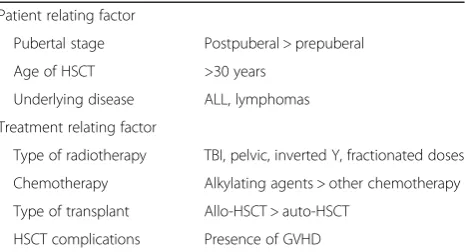
Lack of oestrogens at an early age prevents the develop-ment of secondary sex characteristics, increases the risk for osteoporosis, cognitive impairment and cardiovascular disease, frequently observed in women after HSCT [7, 13]. POF is the most frequent complication after stem cell transplantation for haematological malignancies, occur-ring in more than 90 % of women [14, 15]. Indeed, conditioning regimens consisting of high-dose antiblastic treatments associated or not with TBI, precede both auto- and allo-HSCT procedures, causing gonadal dam-age [4]. Moreover, allo-HSCT can be followed by acute or chronic GVHD and long-lasting steroid treatment, which can further increase ovarian damage [4]. Risk factors for gonadal damage in women undergoing HSCT are summarized in Table 1.
Thrombocytopenia-associated menorrhagia
Menorrhagia is defined as heavy regular menstrual cycles with more than 80 ml of blood loss/cycle or cycle duration longer than 7 days.
After different conditioning regimens, women in repro-ductive age may experience thrombocytopenia-associated menorrhagia, especially if they had experienced regular or irregular vaginal bleeding before HSCT [16]. This condi-tion is a serious complicacondi-tion in young female oncology patients who suffer from severe thrombocytopenia during myelosuppressive treatment, associated with significant morbidity. Consequently, effective management is neces-sary to prevent adverse outcomes [17].
Actually, in order to manage thrombocytopenia-associated menorrhagia, physicians can use the Menorrha-gia Impact Questionnaire (MIQ) [17], developed to iden-tify measurement domains, define meaningful, symptom relief, measure magnitude of response, assess a patient’s
Table 1Risk factors for gonadal damage in women undergoing HSCTa
Patient relating factor
Pubertal stage Postpuberal > prepuberal
Age of HSCT >30 years
Underlying disease ALL, lymphomas
Treatment relating factor
Type of radiotherapy TBI, pelvic, inverted Y, fractionated doses
Chemotherapy Alkylating agents > other chemotherapy
Type of transplant Allo-HSCT > auto-HSCT
HSCT complications Presence of GVHD
ALLacute lymphoblastic leukaemia,alloallogeneic transplantation,auto autologous transplatation,GVHDgraft-versus-host disease,HSCThematopoietic stem cell transplant,TBI“total body”irradiation
Symbol (>) means more than
a
ability to perform physical functions, work, and participate in social and leisure activities, as well as measures global change in menstrual blood loss.
Gonadotropin-releasing hormone analogues (e.g., leupro-lide) are promising therapies that have been shown to de-crease vaginal bleeding during periods of thrombocytopenia and to have minimal adverse effects other than those asso-ciated with gonadal inhibition [16, 17]. In patients who ex-perience menorrhagia despite preventive therapies, or in patients who have thrombocytopenia and menorrhagia at diagnosis, treatment is indicated. For these women, treat-ment options may include platelet transfusions, antifibrino-lytic therapy (e.g., tranexamic acid), continuous high-dose oral contraceptives, cyclic progestins, or other therapies for more refractory patients such as danazol, desmopressin, and recombinant factor VIIa. Hormonal therapies are often the mainstay of therapy in women with menorrhagia secondary to thrombocytopenia, but data for these agents, such as combined hormonal contraceptive pills, combined hormonal contraceptive patch, depot medroxyprogesterone, and oral norethindrone are sparse [16, 17]. The most robust data for the treatment of menorrhagia are for tranexamic acid [16, 17].
Genital symptoms of cGVHD
Chronic GVHD is a serious and common complica-tion of allogeneic hematopoietic cell transplantacomplica-tion (HCT), occurring in 30 % to 70 % of patients [18]. Chronic GVHD is a syndrome of variable clinical fea-tures resembling autoimmune and other immunologic disorders, with a pathophysiology involving inflamma-tion, cell-mediated immunity, humoral immunity, and fibrosis [19, 20].
Chronic GVHD of female genital tract was firstly de-scribed in 1982: five cases of severe vaginal scarring suc-cessfully treated with surgery (to remove scar tissue) and use of oestrogen and vaginal dilators were described [21].
Pain, burning, dysuria, a feeling of redness and swelling, perineal and perianal soreness, dryness and dyspareunia, are nonspecific symptoms of female genital cGVHD. Patients, who are sexually active, may recognize symptoms earlier [19, 20].
Female genital cGVHD can cause complete vaginal obstruction resulting in haematocolpos or hematometra, which can manifest as cyclic pain and amenorrhea in women taking HT or as difficulty in voiding in case of vulvar adhesions [7]. Actually, female genital cGVHD is well-recognized clinical condition, with a precise assess-ment and scoring form recently developed [19].
Treatment options include: topical steroids, topical im-munosuppressants (cyclosporine, tacrolimus), oestrogen therapy applied locally to vulva and vagina, and surgery if severe scarring is recognized [19].
Osteoporosis
Osteoporosis occurs when the creation of new bone does not keep up with the removal of old bone [22]. Significant effects on bone metabolism resulting from HSCT were observed [23, 24].
In particular, osteoporosis after HSCT is attributable to the influence of multiple factors including myeloablative conditioning regimens, huge cytokine re-lease at the time of transplant, altered kidney, liver and bowel function resulting in reduced intake and altered metabolism of calcium and vitamin D, in allogeneic HSCT setting, long-lasting high-dose steroids and cyclosporine-A [24]. There-fore, in women of reproductive age this is also associated with lack of oestrogens associated with secondary amenor-rhea and gonadal failure due to the underlying illness with its complications and treatments [23, 24].
Moreover, bone marrow transplantation recipients are at risk of osteoporosis secondary to bone loss associated with their illness and/or chemotherapy, particularly in female autograft recipients, and in allograft recipients secondary to GVHD and its treatment [25].
Few data are available so far on the treatment of bone loss in HSCT recipients. Early diagnosis of osteoporosis or early bone senescence in this particular population is a major aim to promptly start appropriate supportive measures, such as lifestyle modification, calcium and vit-amin D supplementation or bisphosphonates [24]. Treatment of osteoporosis in women undergone HSCT actually include hormonal therapy (HT), which has been demonstrated to increase bone mineral density of the hypogonadal patients [23].
Secondary solid tumours
One of the long-term complications associated with allo-geneic hematopoietic stem cell transplantation is the de-velopment of secondary malignancies [26–33]. Several factors contribute to the development of secondary neo-plasm: the radiation and chemotherapy used for condi-tioning and for treatment of the primary malignancy, and the profound immunosuppression that occurs post transplant [26].
Indeed, the risk of new solid cancers after bone marrow transplantation in different studies resulted to be higher than in general population, in particular after allo-HSCT [26–30]. In particular, two large co-hort studies published by the IBMTR and EBMT have confirmed the increased risk of secondary malignancy post transplant [27, 28].
solid tumours developed were: basal cancer cell skin [31], squamous cell cancer skin [32], squamous cell can-cer oral [33] and breast cancan-cer [32].
Moreover, prolonged use of immunosuppressive drugs to treat cGVHD and severity of cGVHD are risk factors for the development of human papillomavirus (HPV)-re-lated dysplasia and squamous cell carcinoma of the female genital tract [34–36]. Thus, on one side, regular surveil-lance by gynaecologic examination, including cervical cytological testing, in these patients allows for early diag-nosis and effective management of cervical abnormality and decreases the burden of this potentially fatal, but treatable, condition [35].
On the other side, the immunogenicity and efficacy of quadrivalent HPV vaccine has not been tested in long-term survivors after allo-HSCT [36].
Fertility and pregnancy issues
Fertility is clearly impaired after HSCT and the reported overall conception rate is <1 % [7]. Currently HSCT with cyclophosphamide/TBI or cyclophospha-mide/busulfan leads to >80 % risk of permanent amenorrhea in women [5, 7].
Nowadays, people with cancer are interested in dis-cussing fertility preservation. Health care providers, caring for adult and paediatric patients with cancer (including medical oncologists, radiation oncologists, gynaecologic oncologists, urologists, haematologists, paediatric oncologists, surgeons, and others), should address the possibility of infertility as early as possible before treatment starts [11].
In particular, patients undergoing HSCT, usually, have a restricted time-window to decide and under-take fertility preservation strategies. In this view, the classical oocytes/eggs freezing procedure could not represent the best option to be proposed to patients undergoing HSCT [5, 9]. Therefore, this procedure presents 2 main problems, as it includes at least a minimum of two-week-ovarian stimulation protocol. The first problem is the use of gonadotropins, which represent an open issue in cancer patients, and the second question is the two-weeks’ delay in the start of the conditioning regimen.
Actually, great effort is employing to improve both the communication between patients and physicians about fertility risks and preservation options, and the collabor-ation among haematologists and fertility specialists to give patients the opportunity to undergo well-timed and complete reproductive counselling [5].
Novel perspectives include strategies such as ovar-ian tissue freezing in young girls affected with various haematological diseases [5, 37]. This state-of-the-art procedure has been developed to preserve fertility in cancer patients.
However, not all the patients are considered eligible for cryopreservation strategies (i.e. due to need to start chemotherapy immediately [5]), so current clinical re-search is also focusing on agents which can prevent or attenuate the ovotoxic effects of treatment would pro-vide significant advantages over the existing fertility preservation techniques, and would allow patients to retain their natural fertility without the necessity for costly, invasive and risky procedures [38].
Ovarian tissue cryopreservation
Ovarian tissue cryopreservation is an investigational method of fertility preservation but has the advantage of requiring neither a sperm donor nor ovarian stimula-tion. Ovarian tissue is removed laparoscopically, a one hour outpatient procedure that requires general anaes-thesia, and frozen. At a later date, the ovarian tissue is thawed and reimplanted. Primordial follicles can be cryopreserved with great efficiency [10, 39, 40], but be-cause of the initial ischemia encountered after ovarian transplantation, a quarter or more of these follicles might be lost, as shown in xenografting studies [41]. To offset this relatively large loss, typically the cortex from an entire ovary could be cryopreserved in adults. The benefit of ovarian cryopreservation for women older than 40 years of age is very uncertain because there are too few primordial follicles remaining [42]. Ovarian tis-sue cryopreservation has been performed in humans for less than a decade, and the first ovarian transplant procedure was reported in 2000 [43], and the first preg-nancy after ovarian transplantation in 2004 [44]. Ovar-ian tissue can be transplanted orthotopically to pelvis [44, 45] or heterotopically to subcutaneous areas such as the forearm or lower abdomen [46, 47]. Following re-implantation of ovarian tissue, a successful recovery of ovarian function is expected in almost all cases within 3 to 6 months, with possible sustained longevity of function of the transplanted tissue [48, 49].
To date, a total of 40 live births have been reported in cancer patients after transplantation of frozen/thawed ovarian tissue [50]. It is almost impossible to calculate a precise pregnancy rate for transplantation of cryopre-served ovarian tissue until a large cohort of patients has had all their tissue transplanted [51].
Combining 80 cases from 4 fertility centres, the preg-nancy rate (i.e. ratio between the number of women who conceived and the number of transplanted women) with the use of this technique was 25 % [52–55]. Overall, the pregnancy rate with the use of cryopreservation of ovar-ian tissue seems to be increasing [5, 51].
low in the majority of cancers seen in young females, and there are no reports of cancer recurrence after ovarian transplantation [56, 57]. Thus, ovarian tissue screening to detect malignant cells is currently performed to minimize the risk of inadvertent transfer with the ovary [9].
Ovarian cryopreservation and transplantation procedures should only be performed in centres with the necessary expertise under IRB-approved protocols that include follow-up for recurrent cancer, as this procedure has been proven to be an effective, yet still experimental, technique to preserve fertility in patients undergoing gonadotoxic therapies [5, 10, 11].
GnRH analogues
Preserving patients’ natural fertility is the goal to which each reproductive health caregiver would lead. Recent data and reviews focus in particular on the use of GnRH analogues, also known as LHRH analogues, in fertility preservation of cancer patients undergoing cytotoxic treatments [38, 58–63].
LHRH analogues are used in various clinical situations, such as uterine fibroids, abnormal uterine bleeding, etc. LHRH analogues are widely used in oncology, and their mode of action is almost completely understood [58]. The mechanism of action of these analogues is mainly based on the inhibition of pituitary and gonadal function, but they also exert a direct function on the ovaries and uterus. Indeed, in germ cells, the cell cycle stage at the time of ex-posure will define the molecular response to cytotherapy [38, 57]. Between the primordial and antral follicle stages, the oocyte is in the dictyate (prolonged diplotene) stage of prophase I arrest [38]. Following the LH surge, the oocyte is triggered to enter into the first meiotic M-phase, M1 [64]. Thus, cytotoxic drug-induced apoptotic pathways have been well documented in growing follicles [65, 66]. On the other side, less is known on primordial follicles. A novel theory of chemotherapy-induced destruction of dormant follicles suggests that in vivo chemotherapy triggers follicle activation and growth, causing burnout and depletion of the ovarian reserve [67]. Histology demonstrated both an absence of apoptosis in primordial follicles together with an initiation of follicle growth immediately following chemotherapy exposure, occurring simultaneously with large follicle apoptosis [38].
Moreover, experimental data on mice show that intrao-varian transplantation of primordial follicles fails to rescue chemotherapy-injured ovaries [68].
In this view, recent literature suggests that GnRH ana-logues could be protective of the ovarian reserve and natural fertility in cancer patients [38, 69]. The majority of clinical data comes from breast cancer patients, and only two papers report data on women with lymphoma [59, 70]. In particular, Triptorelin was not associated with a significant decreased risk of POF in young
patients treated for lymphoma but may provide protection of the ovarian reserve [59]. Indeed, AMH levels were sig-nificantly higher in women who received cotreatment with GnRH analogue (1.4 compared with 0.56 ng/ml) [59].
However, despite this research effort, ovarian suppression with LHRH analogues during chemotherapy is still consid-ered an experimental strategy to preserve fertility by some international guidelines due to both the uncertainty regard-ing the efficacy of this strategy and the absence of data on pregnancies and long-term ovarian function [11, 69].
A clinic protocol for the management of gynaecological complications before and after HSCT
On the basis of the current literature and of our previous experience in the management of patients affected with dif-ferent haematological diseases and/or treated with HSCT we define a unified protocol for gynaecological manage-ment in patients undergoing HSCT before and after the procedure.
Diagnostic work-up before HSCT
Taking care of a patient undergoing HSCT should primarily include gynaecological evaluation, even before conditioning regimen or chemotherapy for the underlying malignancy.
Before HSCT a general gynaecological evaluation should include: anthropometric characteristics, together with data on haematological conditions, serum ferritin levels. Data on menarche, including age and spontaneity of menarche and menses, are essentials when evaluating these women. Additionally, data on oestro-progestin (EP) replacement therapy, previous pregnancies (spontaneous or obtained with ovarian stimulation) and pelvic infections should be included in the work-up. Then, a gynaecological pelvic examination together with a sonographic scan, evaluating uterine size, endometrial thickness and ovarian size should be performed in each patient. In women of reproductive age, ovarian reserve should be evaluated including Antral Follicular Count (AFC) in the pelvic scan. Moreover, an hormonal evaluation together, an HPG function analysis, including basal levels of luteinizing hormone (LH), follicular-stimulating hormone (FSH), estradiol (E2), pro-lactin (PRL), anti-Mullerian hormone (AMH) and a thy-roid profile (evaluation of blood levels of TSH, fT3, fT4, anti-TPO, anti-TBG) should be offered to all fertile women. This should be undertaken on day 2/3 of menses in women with a regular menstrual cycle, or on any ran-dom day in those with amenorrhea. Moreover, assessment of the partner, when possible, should be undertaken [5].
After that, an onco-fertility counselling should be offered to all patients undergoing HSCT. This counsel-ling analyses type and dose of the chemotherapy regi-men proposed, method of administration (oral versus intravenous), size and location of the radiation field and its dose, need of adjuvant therapy [10, 71]. Specifically, type of treatment and patients’age are the most import-ant factors to be taken into account when counselling the patients [72]. Onco-fertility counselling should be individualized, discussing both the absolute benefits of the proposed anticancer treatment (e.g. adjuvant chemo-therapy) and the risk of infertility for each individual, proposing to each one the best treatment options. Gynaecological diagnostic work-up in patients undergo-ing HSCT is summarized in Table 2.
Gynaecological follow-up after HSCT
Gynaecological Follow-Up After HSCT should in-clude a six-month complete evaluation including: collection of symptoms, pelvic scan and hormonal analysis of AMH, FSH, LH and estradiol. HPV-test should be repeated every six-month. Bone mineral density evaluation by MOC-DEXA of the vertebral district and of the right and left femur should be re-peated every twelve months. Women underwent allo-HSCT should be assessed at each control with the “Genital Tract Chronic Graft-versus-Host Assess-ment and Scoring Form” [11].
Limitations
Gynaecological evaluation should start even before patients become candidates for HSCT, but early when they become diagnosed with a haematological malignancy. Indeed, even if the conditioning regimens are at higher dosage respect to conventional dosages, traditional chemotherapy however results in gynaecological complications [38]. Furthermore, current recommendations are not to allow patients to undertake cryopreservation strategies between chemother-apy treatments and to wait at least 6 months post chemo-therapy before conception [32, 73].
Conclusion
Gynaecological complications in HSCT women repre-sent a serious concern for these patients, but often underestimated by clinicians in the view of Overall Sur-vival. In particular fertility-related issues are always more relevant for patients, whose life expectation is constantly growing up after HSCT. Thus, in our opinion, it is of great importance to ensure a complete diagnostic work-up and intervention options to guarantee maximum re-productive health and a better quality of life in HSCT women.
Funding Not applicable.
Availability of data and materials Yes.
Authors’contributions
CS and MG conceived edited and reviewed the manuscript; MAC conceived and wrote the manuscript, performed a comprehensive and systematic review of the literature, and designed the tables. FO reviewed the
manuscript and edited the tables. RR ad VG performed a comprehensive and systematic review of the literature. All authors have seen and approved the final version of the manuscript. All authors read and approved the final manuscript.
Authors’information
MG is Associate Professor in Obstetrics and Gynaecology, University of Salerno. MAC is M. D. consultant gynaecologist, Ph. D. Fellow in Translational Medicine, Second University of Naples. RR and VG are fellows in
Haematology, University of Salerno. FO is Associate Professor in
Endocrinology,“Parthenope”University of Naples. CS is Associate Professor in Haematology, University of Salerno.
Table 2Clinical and instrumental gynaecological first evaluation of women undergoing HSCT
Anthropometric Characteristics •
Age • Height • Weight • BMI Haematological
Data •
Kind of haematological malignancy • Kind, onset and duration of conditioning
regimen
• Serum Ferritin levels • Haemoglobin
Thrombotic Risk • Previous thrombotic disease • PT, PTT, ATIII, fibrinogen • Platelet Count
Bone Evaluation • MOC-DEXA of the vertebral district and of the right and left femur
Gynaecological
Features •
Age at menarche • Spontaneous Menarche • Menses Regularity
• Primary or Secondary Amenorrhea • Estro-progestins replacement therapy • Previous pregnancies
• History of pelvic infections/inflammations • Gynaecological Examination
• Pelvic ultrasound scan evaluating uterine size, endometrial thickness, ovarian size
• HPV-test Reproductive
Features
• FSH, LH, estradiol (E2), prolactin (PRL), anti-mullherian hormone (AMH), and thyroid profile (TSH, fT3, fT4, anti-TPO, anti-TBG)
• Antral Follicle Count (AFC)a • Onco-fertility counselling a
Competing interests
The authors declare that they have no competing interests.
Consent for publication Yes.
Ethics approval and consent to participate Not applicable.
Author details
1Department of Medicine and Surgery, University of Salerno, Salerno, Italy. 2Ph. D. Program in Translational Medicine, Department of Experimental
Medicine, Second University of Naples, Naples, Italy.3Department of Maternal
and Child Health, Operative Unit of Obstetrics and Gynaecology, A.O.R.N. S.G. Moscati, Contrada Amoretta, 83100 Avellino, Italy.4Department of Sports
Science and Wellness,“Parthenope”University of Naples, 80133 Naples, Italy.
Received: 12 August 2016 Accepted: 17 October 2016
References
1. Mathé G, Amiel JL, Schwarzenberg L, Cattan A, Schneider M.
Haematopoietic chimera in man after allogenic (homologous) bone marrow transplantation. Br Med J. 1963;2:1633–5.
2. Felfly H, Haddad GG. Hematopoietic stem cells: potential new applications for translational medicine. J Stem Cells. 2014;9(3):163-97. doi: jsc.2014.9.3.163. 3. Park B, Yoo KH, Kim C. Hematopoietic stem cell expansion and generation:
the ways to make a breakthrough. Blood Res. 2015;50(4):194–203. doi:10. 5045/br.2015.50.4.194.
4. Orio F, Muscogiuri G, Palomba S, Serio B, Sessa M, Giudice V, Ferrara I, Tauchmanovà L, Colao A, Selleri C. Endocrinopathies after allogeneic and autologous transplantation of hematopoietic stem cells.
ScientificWorldJournal. 2014;2014:282147. doi:10.1155/2014/282147. 5. Lambertini M, Del Mastro L, Pescio MC, Andersen CY, Azim Jr HA, Peccatori
FA, Costa M, Revelli A, Salvagno F, Gennari A, Ubaldi FM, La Sala GB, De Stefano C, Wallace WH, Partridge AH, Anserini P. Cancer and fertility preservation: international recommendations from an expert meeting. BMC Med. 2016;14:1. doi:10.1186/s12916-015-0545-7.
6. Kauppila M, Koskinen P, Irjala K, Remes K, Viikari J. Long-term effects of allogeneic bone marrow transplantation (BMT) on pituitary, gonad, thyroid and adrenal function in adults. Bone Marrow Transplant. 1998;22(4):331–7. 7. Frey Tirri B, Häusermann P, Bertz H, Greinix H, Lawitschka A, Schwarze CP, Wolff D, Halter JP, Dörfler D, Moffat R. Clinical guidelines for gynecologic care after hematopoietic SCT. Report from the international consensus project on clinical practice in chronic GVHD. Bone Marrow Transplant. 2015; 50(1):3–9. doi:10.1038/bmt.2014.242.
8. Park J, Kim TH, Lee HH, Chung SH, Lee D. Gynecologic complication of chronic graft-versus-host disease: Vaginal obstruction. Obstet Gynecol Sci. 2013;56(4):277–80. doi:10.5468/ogs.2013.56.4.277.
9. Silber S, Pineda J, Lenahan K, DeRosa M, Melnick J. Fresh and cryopreserved ovary transplantation and resting follicle recruitment. Reprod Biomed Online. 2015;30(6):643–50. doi:10.1016/j.rbmo.2015.02.010.
10. Lee SJ, Schover LR, Partridge AH, Patrizio P, Wallace WH, Hagerty K, et al. American Society of Clinical Oncology recommendations on fertility preservation in cancer patients. J Clin Oncol. 2006;24(18):2917–31. 11. Loren AW, Mangu PB, Beck LN, Brennan L, Magdalinski AJ, Partridge AH,
Quinn G, Wallace WH, Oktay K, American Society of Clinical Oncology. Fertility preservation for patients with cancer: American Society of Clinical Oncology clinical practice guideline update. J Clin Oncol. 2013; 31(19):2500–10. doi:10.1200/JCO.2013.49.2678.
12. Küçük M, Bolaman AZ, Yavaşoğlu I, Kadıköylü G. Fertility-preserving treatment options in patients with malignant hematological diseases. Turk J Haematol. 2012;29(3):207–16. doi:10.5505/tjh.2012.72681.
13. Tauchmanovà L, De Simone G, Musella T, Orio F, Ricci P, Nappi C, Lombardi G, Colao A, Rotoli B, Selleri C. Effects of various antireabsorptive treatments on bone mineral density in hypogonadal young women after allogeneic stem cell transplantation. Bone Marrow Transplant. 2006;37(1):81–8. 14. Tauchmanovà L, Selleri C, De Rosa G, Sammartino A, Di Carlo C, Musella T,
Martorelli C, Lombardi G, Rotoli B, Nappi C, Colao A. Estrogen-progestin therapy in women after stem cell transplant: our experience and literature review. Menopause. 2007;14(2):320–30.
15. Tauchmanovà L, Selleri C, De Rosa G, Esposito M, Orio Jr F, Palomba S, Bifulco G, Nappi C, Lombardi G, Rotoli B, Colao A. Gonadal status in reproductive age women after haematopoietic stem cell transplantation for haematological malignancies. Hum Reprod. 2003;18(7):1410–6. 16. Poorvu PD, Barton SE, Duncan CN, London WB, Laufer MR, Lehmann LE,
Marcus KJ. Use and effectiveness of gonadotropin-releasing hormone agonists for prophylactic menstrual suppression in postmenarchal women who undergo hematopoietic cell transplantation. J Pediatr Adolesc Gynecol. 2016;29(3):265–8. doi:10.1016/j.jpag.2015.10.013. 17. Bates JS, Buie LW, Woodis CB. Management of menorrhagia associated with
chemotherapy-induced thrombocytopenia in women with hematologic malignancy. Pharmacotherapy. 2011;31(11):1092–110. doi:10.1592/phco.31.11.1092. 18. Lee SJ, Flowers MED. Recognizing andmanaging chronic graft-versus-host
disease. In: Gewirtz AM, Muchmore EA, Burns LJ, editors. Hematology 2008: American Society of Hematology Education Program Book. Washington, DC: American Society of Hematology; 2008. p. 134–41.
19. Jagasia MH, Greinix HT, Arora M, Williams KM, Wolff D, Cowen EW, Palmer J, Weisdorf D, Treister NS, Cheng GS, Kerr H, Stratton P, Duarte RF, McDonald GB, Inamoto Y, Vigorito A, Arai S, Datiles MB, Jacobsohn D, Heller T, Kitko CL, Mitchell SA, Martin PJ, Shulman H, Wu RS, Cutler CS22, Vogelsang GB, Lee SJ, Pavletic SZ, Flowers ME. National Institutes of Health Consensus Development Project on criteria for clinical trials in chronic graft-versus-host disease: I. The 2014 diagnosis and staging working group report. Biol Blood Marrow Transplant. 2015;21(3):389–401. e1. doi:10.1016/j.bbmt.2014.12.001.
20. Filipovich AH, Weisdorf D, Pavletic S, Socie G, Wingard JR, Lee SJ, Martin P, Chien J, Przepiorka D, Couriel D, Cowen EW, Dinndorf P, Farrell A, Hartzman R, Henslee-Downey J, Jacobsohn D, McDonald G, Mittleman B, Rizzo JD, Robinson M, Schubert M, Schultz K, Shulman H, Turner M, Vogelsang G, Flowers ME. National Institutes of Health consensus development project on criteria for clinical trials in chronic graft-versus-host disease: I. Diagnosis and staging working group report. Biol Blood Marrow Transplant. 2005;11(12):945–56.
21. Corson SL, Sullivan K, Batzer F, August C, Storb R, Thomas ED. Gynecologic manifestations of chronic graft-versus-host disease. Obstet Gynecol. 1982; 60(4):488–92.
22. Mayo clinic. http://www.mayoclinic.org/diseases-conditions/osteoporosis/ home/ovc-20207808, Accessed 06 Aug 2016.
23. Kodama M, Komura H, Shimizu S, Hashimoto N, Mitsuda N, Kodama T, Inoue M, Ida S. Efficacy of hormone therapy for osteoporosis in adolescent girls after hematopoietic stem cell transplantation: a longitudinal study. Fertil Steril. 2011;95(2):731–5. doi:10.1016/j.fertnstert.2010.09.037.
24. Serio B, Pezzullo L, Fontana R, Annunziata S, Rosamilio R, Sessa M, Giudice V, Ferrara I, Rocco M, De Rosa G, Ricci P, Tauchmanovà L, Montuori N, Selleri C. Accelerated bone mass senescence after hematopoietic stem cell transplantation. Transl Med UniSa. 2013;5:7–13.
25. McClune BL, Polgreen LE, Burmeister LA, Blaes AH, Mulrooney DA, Burns LJ, Majhail NS. Screening, prevention and management of osteoporosis and bone loss in adult and pediatric hematopoietic cell transplant recipients. Bone Marrow Transplant. 2011;46(1):1–9. doi:10.1038/bmt.2010.198. 26. Curtis RE, Rowlings PA, Deeg HJ, Shriner DA, Socié G, Travis LB, Horowitz
MM, Witherspoon RP, Hoover RN, Sobocinski KA, Fraumeni Jr JF, Boice Jr JD, Schoch HG, Sale GE, Storb R, Travis WD, Kolb H-J, Gale RP, Passweg JR. Solid cancers after bone marrow transplantation. N Engl J Med. 1997;336: 897–904. doi:10.1056/NEJM199703273361301.
27. Kolb HJ, Socié G, Duell T, Van Lint MT, Tichelli A, Apperley JF, et al. Malignant neoplasms in long-term survivors of bone marrow transplantation. Late Effects Working Party of the European Cooperative Group for Blood and Marrow Transplantation and the European Late Effect Project Group. Ann Intern Med. 1999;131:738–44.
28. Curtis RE, Metayer C, Rizzo JD, Socié G, Sobocinski KA, Flowers ME, et al. Impact of chronic GVHD therapy on the development of squamous-cell cancers after hematopoietic stem-cell transplantation: an international case-control study. Blood. 2005;105:3802–11.
29. Bhatia S, Louie AD, Bhatia R, O'Donnell MR, Fung H, Kashyap A, Krishnan A, Molina A, Nademanee A, Niland JC, Parker PA, Snyder DS, Spielberger R, Stein A, Forman SJ. Solid cancers after bone marrow transplantation. J Clin Oncol. 2001;19(2):464–71.
31. Deeg HJ, Socie G, Schoch G, et al. Malignancies after marrow transplantation for aplastic anemia and fanconi anemia: a joint Seattle and Paris analysis of results in 700 patients. Blood. 1996;87:386–92. 32. Socie G, Curtis RE, Deeg HJ, et al. New malignant disease after allogeneic
marrow transplantation for childhood acute leukemia. J Clin Oncol. 2000; 18:348–57.
33. Witherspoon RP, Fisher LD, Schoch G, et al. Secondarymcancers after bone marrow transplantation for leukemia or aplastic anemia. N Engl J Med. 1989; 321:784–9.
34. Savani BN, Stratton P, Shenoy A, Kozanas E, Goodman S, Barrett AJ. Increased risk of cervical dysplasia in long-term survivors of allogeneic stem cell transplantation-implications for screening and HPV vaccination. Biol Blood Marrow Transplant. 2008;14:1072–5.
35. Wang Y, Brinch L, Jebsen P, Tanbo T, Kirschner R. A clinical study of cervical dysplasia in long-term survivors of allogeneic stem cell transplantation. Biol Blood Marrow Transplant. 2012;18(5):747–53. doi:10.1016/j.bbmt.2011.09.012. 36. Savani BN, Goodman S, Barrett AJ. Can routine posttransplant HPV
vaccination prevent commonly occurring epithelial cancers after allogeneic stem cell transplantation? Clin Cancer Res. 2009;15(7):2219–21. doi:10.1158/ 1078-0432.CCR-08-3099.
37. Castaldi MA, Cobellis L. Thalassemia and infertility. Hum Fertil (Camb). 2016; 19(2):90–6. doi:10.1080/14647273.2016.1190869.
38. Roness H, Kalich-Philosoph L, Meirow D. Prevention of chemotherapy-induced ovarian damage: possible roles for hormonal and non-hormonal attenuating agents. Hum Reprod Update. 2014;20(5):759–74. doi:10.1093/ humupd/dmu019.
39. Meirow D, Fasouliotis SJ, Nugent D, et al. A laparoscopic technique for obtaining ovarian cortical biopsy specimens for fertility conservation in patients with cancer. Fertil Steril. 1999;71:948–51.
40. Poirot C, Vacher-Lavenu MC, Helardot P, et al. Human ovarian tissue cryopreservation: Indications and feasibility. Hum Reprod. 2002;17:1447–52. 41. Newton H, Aubard Y, Rutherford A, et al. Low temperature storage and
grafting of human ovarian tissue. Hum Reprod. 1996;11:1487–91. 42. Oktay K. Evidence for limiting ovarian tissue harvesting for the purpose of
transplantation to women younger than 40 years of age. J Clin Endocrinol Metab. 2002;87:1907–8.
43. Oktay K, Karlikaya G. Ovarian function after transplantation of frozen, banked autologous ovarian tissue. N Engl J Med. 2000;342:1919.
44. Donnez J, Dolmans MM, Demylle D, Jadoul P, Pirard C, Squifflet J, Martinez-Madrid B, Van Langendonckt A. Livebirth after orthotopic transplantation of cryopreserved ovarian tissue. Lancet. 2004;364:1405–10.
45. Meirow D, Levron J, Eldar-Geva T, et al. Pregnancy after transplantation of cryopreserved ovarian tissue in a patient with ovarian failure after chemotherapy. N Engl J Med. 2005;353:318–21.
46. Oktay K, Buyuk E, Rosenwaks Z, et al. A technique for transplantation of ovarian cortical strips to the forearm. Fertil Steril. 2003;80:193–8. 47. Oktay K, Economos K, Kan M, et al. Endocrine function and oocyte retrieval
after autologous transplantation of ovarian cortical strips to the forearm. JAMA. 2001;286:1490–3.
48. Kim SS, Lee WS, Chung MK, Lee HC, Lee HH, Hill D. Long-term ovarian function and fertility after heterotopic autotransplantation of cryobanked human ovarian tissue: 8-year experience in cancer patients. Fertil Steril. 2009;91(6):2349–54.
49. Andersen CY, Silber SJ, Bergholdt SH, Berghold SH, Jorgensen JS, Ernst E. Long-term duration of function of ovarian tissue transplants: case reports. Reprod Biomed Online. 2012;25(2):128–32.
50. Donnez J, Dolmans M-M, Pellicer A, Diaz-Garcia C, Ernst E, Macklon KT, et al. Fertility preservation for age-related fertility decline. Lancet. 2015; 385(9967):506–7.
51. Andersen CY. Success and challenges in fertility preservation after ovarian tissue grafting. Lancet. 2015;385(9981):1947–8.
52. Donnez J, Dolmans M-M, Pellicer A, Diaz-Garcia C, Sanchez Serrano M, Schmidt KT, et al. Restoration of ovarian activity and pregnancy after transplantation of cryopreserved ovarian tissue: a review of 60 cases of reimplantation. Fertil Steril. 2013;99(6):1503–13.
53. Donnez J, Dolmans M-M. Transplantation of ovarian tissue. Best Pract Res Clin Obstet Gynaecol. 2014;28(8):1188–97.
54. Macklon KT, Jensen AK, Loft A, Ernst E, Andersen CY. Treatment history and outcome of 24 deliveries worldwide after autotransplantation of cryopreserved ovarian tissue, including two new Danish deliveries years after autotransplantation. J Assist Reprod Genet. 2014;31(11):1557–64.
55. Dittrich R, Hackl J, Lotz L, Hoffmann I, Beckmann MW. Pregnancies and live births after 20 transplantations of cryopreserved ovarian tissue in a single center. Fertil Steril. 2015;103(2):462–8.
56. Kim SS, Radford J, Harris M, et al. Ovarian tissue harvested from lymphoma patients to preserve fertility may be safe for autotransplantation. Hum Reprod. 2001;16:2056–60.
57. Sonmezer M, Oktay K. Fertility preservation in female patients. Hum Reprod Update. 2004;10:251–66.
58. Schally AV and Comaru-Schally AM. Mode of action of LHRH Analogs in Holland-Frei Cancer Medicine. 6th edition. Kufe DW, Pollock RE, Weichselbaum RR, et al., editors. Hamilton (ON): BC Decker; 2003. 59. Demeestere I, Brice P, Peccatori FA, Kentos A, Gaillard I, Zachee P, et al.
Gonadotropin-releasing hormone agonist for the prevention of chemotherapy-induced ovarian failure in patients with lymphoma: 1-year follow-up of a prospective randomized trial. J Clin Oncol. 2013;31(7):903–9. 60. Del Mastro L, Ceppi M, Poggio F, Bighin C, Peccatori F, Demeestere I,
Levaggi A, Giraudi S, Lambertini M, D’Alonzo A, et al. Gonadotropin-releasing hormone analogues for the prevention of chemotherapy-induced premature ovarian failure in cancer women: Systematic review and meta-analysis of randomized trials. Cancer Treat Rev. 2014;40:675–83.
61. Del Mastro L, Boni L, Michelotti A, Gamucci T, Olmeo N, Gori S, Giordano M, Garrone O, Pronzato P, Bighin C, et al. Effect of the gonadotropin-releasing hormone analogue triptorelin on the occurrence of chemotherapy-induced early menopause in premenopausal women with breast cancer: a randomized trial. JAMA. 2011;306:269–76.
62. Sverrisdottir A, Nystedt M, Johansson H, Fornander T. Adjuvant goserelin and ovarian preservation in chemotherapy treated patients with early breast cancer: results from a randomized trial. Breast Cancer Res Treat. 2009;117:561–7.
63. Badawy A, Elnashar A, El-Ashry M, Shahat M. Gonadotropin-releasing hormone agonists for prevention of chemotherapy-induced ovarian damage: prospective randomized study. Fertil Steril. 2009;91:694–7. 64. Carroll J, Marangos P. The DNA damage response in mammalian oocytes.
Front Genet. 2013;4:117. doi:10.3389/fgene.2013.00117.
65. Perez GI, Knudson CM, Leykin L, Korsmeyer SJ, Tilly JL. Apoptosis-associated signaling pathways are required for chemotherapy-mediated female germ cell destruction. Nat Med. 1997;3(11):1228–32.
66. Utsunomiya T, Tanaka T, Utsunomiya H, Umesaki N. A novel molecular mechanism for anticancer drug-induced ovarian failure: Irinotecan HCl, an anticancer topoisomerase I inhibitor, induces specific FasL expression in granulosa cells of large ovarian follicles to enhance follicular apoptosis. Int J Oncol. 2008;32(5):991–1000.
67. Kalich-Philosoph L, Roness H, Carmely A, Fishel-Bartal M, Ligumsky H, Paglin S, Wolf I, Kanety H, Sredni B, Meirow D. Cyclophosphamide triggers follicle activation and“burnout”; AS101 prevents follicle loss and preserves fertility. Sci Transl Med. 2013;5(185):185ra62. doi:10.1126/scitranslmed.3005402. 68. Park MR, Choi YJ, Kwon DN, Park C, Bui HT, Gurunathan S, Cho SG, Song H,
Seo HG, Min G, Kim JH. Intraovarian transplantation of primordial follicles fails to rescue chemotherapy injured ovaries. Sci Rep. 2013;3:1384. doi:10. 1038/srep01384.
69. Peccatori FA, Azim Jr HA, Orecchia R, Hoekstra HJ, Pavlidis N, Kesic V, et al. Cancer, pregnancy and fertility: ESMO Clinical Practice Guidelines for diagnosis, treatment and follow-up. Ann Oncol. 2013;24 Suppl 6:vi160–70. 70. Behringer K, Wildt L, Mueller H, Mattle V, Ganitis P, van den Hoonaard B, et al.
No protection of the ovarian follicle pool with the use of GnRH-analogues or oral contraceptives in young women treated with escalated BEACOPP for advanced-stage Hodgkin lymphoma. Final results of a phase II trial from the German Hodgkin Study Group. Ann Oncol. 2010;21(10):2052–60. 71. Wallace WHB, Anderson RA, Irvine DS. Fertility preservation for young
patients with cancer: who is at risk and what can be offered? Lancet Oncol. 2005;6(4):209–18.
72. Wallace WHB, Smith AG, Kelsey TW, Edgar AE, Anderson RA. Fertility preservation for girls and young women with cancer: population-based validation of criteria for ovarian tissue cryopreservation. Lancet Oncol. 2014; 15(10):1129–36.