Emerging Science Journal
Vol. 2, No. 2, April, 2018
Modeling and Implementing Nonlinear Equations in Solid-State
Lasers for Studying their Performance
Ali Roudehghat Shotorbani
a, Hassan Rasooli Saghai
b*a Department of Electrical Engineering, Faculty of Engineering, Islamic Azad University, Tabriz Branch, Tabriz, Iran b Associate Professor of Electrical Engineering, Islamic Azad University, Tabriz Branch, Tabriz, Iran
Abstract
In this paper, the effect of radius variation of beam light on output efficacy of SFD Yttrium aluminium borate laser doped with Neodymium ion, which is simultaneously a non-linear and active laser crystal, is investigated in a double-pass cavity. This is done with a concave lens that concentrates (Reduction of optical radius within nonlinear material) as much optical laser as possible, resulting in increasing the laser efficiency, second harmonic and the population inversion difference. In this study, we first developed five discrete differential equations describing the interactions of 807 nm pump beam, 1060nm laser beam and 530nm second harmonic beam. Output efficiencies of laser and second harmonic beams at pumping power of Pp =20W and beam radius of 5μm have been presented. Meanwhile, in this paper, the first experiment for creating second harmonic in solid state lasers was fully described with a figure and its procedure was investigated and then the equations (second harmonic and laser and population inversion) were studied. Radius variation of beam light aims at increasing laser output efficacy and improving second harmonic and population inversion. The analytic methods which have been solved the discrete differential equations via Matlab.
Keywords:
Yttrium Aluminum Borate Laser; Non-Linear and Active Laser Crystal; Pump;
Neodymium Ion; Beam Radius.
Article History:
Received: 17 November 2017
Accepted: 15 March 2018
1-
Introduction
Having used non-linear optical materials like harmonic producers and optical parameters oscillators, we can develop the frequency area in accessible lasers well. A laser spring with high power and non-linear materials can make the frequency of radiation laser as twice, three times or four times, non-linear crystals which are used for producing manifold frequencies compared to primary frequency provides the reproduction of frequency in a KP*D non-linear crystal via a proper laser having high energy photons like Nd:YAB laser [1].
Jaque in 2001 could produce three main colors of red, blue and green in NYAB crystal using some of non-linear phenomena such as the combination of self-accumulation frequency [5].
Jaque et.al in 2004 studied the effect of +Nd3 and +Yb3 on energy conversion output in YAB crystal and determined optimal value for laser usages [3].
Having published papers during 2009 to 2013, it was proved that thermal effects prevent power increasing alot therefore, pump power value were limited in this work [4, 5].
In this study, two discrete differential equations were considered for laser beam and two discrete differential equation for second harmonic and one equation for harmonic population inversion for radius per 5 μm.
Nonlinear optics studies the phenomena on the changes and modification in optical properties of materials in the presence of light. Typically, only the laser light exhibits sufficient intensity to modify the optical features of objects [6]
Frequency-doubler materials are very useful. These materials can double the frequency of the laser beam (i.e. they halve the wavelength). By this method, the output laser with 1.06μ wavelength can be converted to a radiation having 0.53μ wavelengths [7].
The laser consists of three components including active material, a pumping design and an intensifier [8].
2- Theoretical Bases
2-1- The first experiment to generate the second harmonic beam in lasers
In Figure 1, the frequency region of accessible lasers can be developed using nonlinear optical materials, such as harmonic generators and optical parameter oscillators.
The ruby laser beam at 𝜆 = 0.694 𝜇𝑚 wavelength is projected onto a quartz crystal and a ruby laser beam at
𝜆1= 0.347𝜇𝑚 wavelength is produced. Two beams (λ and λ1) are separated by a prism which are appeared on a
photographic plane.
Figure 1. Generation of the second harmonic beam by nonlinear materials [1].
3- Discrete Equations of Second Harmonic and Laser Beams and Inverse Population
Forward difference for the discretization of the equations corresponding progressive fields has been used as bellow:
ψs+(k + 1) = ψs+(k) + ∆z [−
∝s
2 ψs+(k) +
i L1ψl
+2(k)] (1)
Where, ψs+ and ψ𝑙+ are functions of the second harmonic wave and progressive lasers, respectively. ∝𝐬 and Ln are the
absorption coefficient of the second harmonic beam and interaction length, respectively. k is a variable and Δz is another variable depends on z (path length) and k. also 𝑖 = √−1.
ψl+(k + 1) = ψ l
+(k) + ∆z [− ∝l
2βl+ δΔNψl
+(k) + i L2ψl
+ ∗(k) ψ s +(k)]
(2)
In the above equation, ΔN is the inverse population and 𝛽𝑙is a variable depends on laser length.
A backward difference for discretization of the equations corresponding with retrograde fields has been used as bellow:
ψs−(k − 1) = ψs−(k) + ∆z [
∝s
2 ψs−(k) − i L1ψl
−2(k)]
(3)
ψl−(k + 1) = ψl−(k) + ∆z [−
∝l
2βl+ δΔNψl
−(k) + i
L2ψl − ∗(k) ψ
s
−(k)] (4)
Where: δ is cross section of laser emission of Nd3+ ions and ∝
𝐥 is absorption coefficient of the laser.
The discretization of the equation for laser level rhythm in stable status is as follows:
gg1 =4ηqTp Pp αp
hWprp2 (5)
gg2 = 2δPp
ΔN = (ΔN0
τ + βlψl− 2+ gg1 e−∝p∗z)/(gg2 ψl+ 2+
1
τ) (7)
Where, gg1 and gg2 are two dependent variables. Also, ∝s= 193 𝑚−1, ∝l= 4 𝑚−1 and ∝p = 340 𝑚−1 are absorption
coefficients of second harmonic beam, laser and pump, respectively [9].
δ = 4.5 × 10⁻¹⁹𝑐𝑚2 is the cross section of laser emission of Nd3+ ions [10].
τ = 56μs is the fluorescence lifetime [11].
ΔN0= −𝑁
𝑑isinverse population without pumping equaled to 𝑁𝑑= (7 ± 2) × 1020𝑐𝑚−3𝑁𝑑is the density of the doped
elements. deff = 1.4×10⁻¹² m/v is the nonlinear effective coefficient of the NYAB crystal [12].
Tp = 1-Rp= 0.74 and Pp are passed power using the left mirror for the pump beam, and the power of the pump beam,
respectively. ηq= 0.26 is quantum efficacy. Wp and Wl are the angular frequency of the pump and laser beams,
respectively. ϑp, ϑl and ϑs are the frequencies of the pump, the laser, the second harmonic beams. The reflection through
the mirrors leads to Rsb=0.03, Rlb =Rlf = Rsf =0.998. l and a are the crystal length and radius. I= 5mm and h is the
Hamiltonian constant [13].
ns = 1.7050, nl = 1.7553, are the failure coefficients of the second harmonic and the laser beams, respectively. rp = 5 ×
10 -6 is the beam radius [14].
Z is a counter or pump, K is a variable that belongs to ∆𝑧 ,∆𝑧 = 𝑧/𝑘, 1<K<11, Z=5mm.
Ψ𝑠+(𝑘): is forward second harmonic function.
Ψ𝑠−(𝑘): is backward second harmonic function.
Ψ𝑙+(𝑘): is forward laser wave function.
Ψ𝑙−(𝑘): is backward laser wave function.
∆N(k): is population reversion rhyme.
𝜂 = |Ψ|2: is output equal to wave function as duplicated.
∆N=1024: is population reversion.
C=3×10⁸: is light speed.
𝜀0= 8.854 × 10⁻¹²: is vacancy pass constant.
π =3.14
𝜆 :𝜗 = 𝐶/𝜆 is wavelength and c is light speed and ϑ is frequency.
W=2π𝜗 is angle frequency.
L1 is interaction length No. 1.
𝐿1= (𝐶3× 𝑛𝑠3× 𝜀0× 𝜋 × 𝑟𝑝2)/(𝑤𝐿2× 2 × 𝑑𝑒𝑓𝑓2 × 𝑃𝑝) (8)
L2: is interaction length of No. 2.
𝐿2= (𝐶3× 𝑛𝐿2× 𝑛𝑠× 𝜀0× 𝜋 × 𝑟𝑝2)/(𝑤𝐿2× 2 × 𝑑𝑒𝑓𝑓2 × 𝑃𝑝) (9)
4- Output Efficacy of Forward Second Harmonic Beam along Z-Direction for Beam Radius of
r
p= 5μm
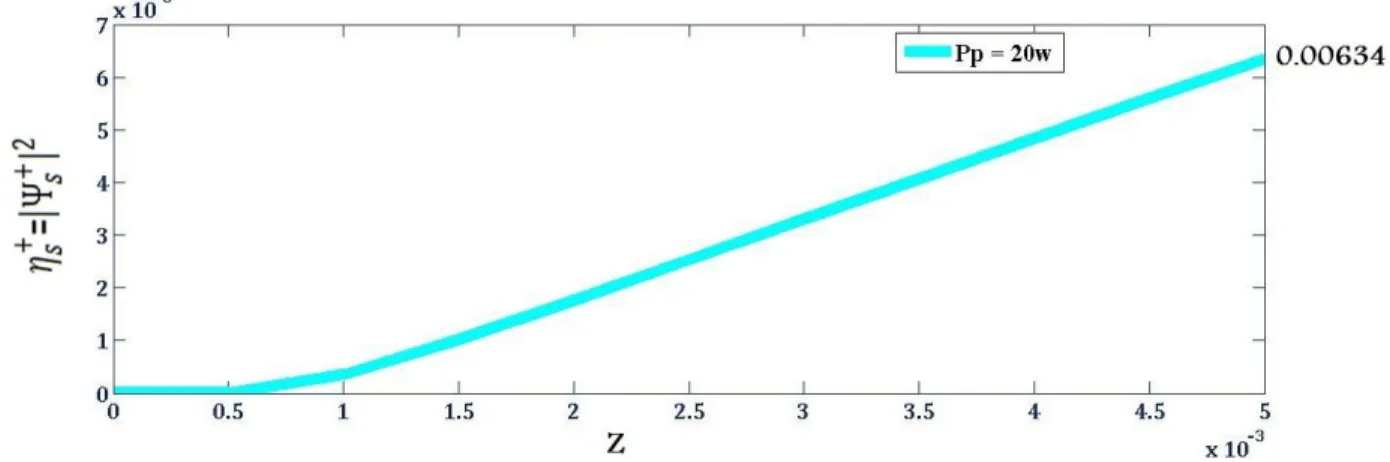
Figure 2 shows output of forward second harmonic beam in distance along crystal length for 20 w pump power. Output mirror (left side) has small reflection power and is a good crossing.
Output efficacy of forward second harmonic beam along Z=5 mm for pumping power of Pp=20W and beam radius
of rp=5mm is 0.634 %. Reflection is RSF = 0.988.
ψs+(k + 1) = ψs+(k) + ∆𝑧 [−
∝𝑠
2 𝜓𝑠+(𝑘) + 𝑖 𝐿1𝜓𝑙
+2(𝑘)]
Figure 2. Efficacy of forward second harmonic beam in z-direction (path length).
5- Output Efficacy of Backward Second Harmonic Beam along Z-Direction for Beam Radius
of r
p= 5 μm
Figure 3 shows that backward second harmonic beam loses some of its energy in backward (toward left side) via optical absorption in crystal (equation 7 manifests it). Backward second harmonic absorption assists in creating population reversion in laser. Increasing population backward leads to increasing infrared light 1060 nm which means increasing output of backward second harmonic beam.
Output efficacy of backward second harmonic beam along Z=5 mm for pumping power of Pp=20W and beam
radius of rp=5mm is 0.6327 %. Reflection is RSb = 0.03.
𝜓𝑠−(𝑘 − 1) = 𝜓𝑠−(𝑘) + ∆𝑧 [
∝𝑠
2 𝜓𝑠−(𝑘) −
𝑖 𝐿1𝜓𝑙
−2(𝑘)] (11)
Figure 3. Efficacy of backward second harmonic beam along z-direction (path length).
6- Output Efficacy of Forward Laser Beam along Z-Direction for Beam Radius of r
p= 5 μm
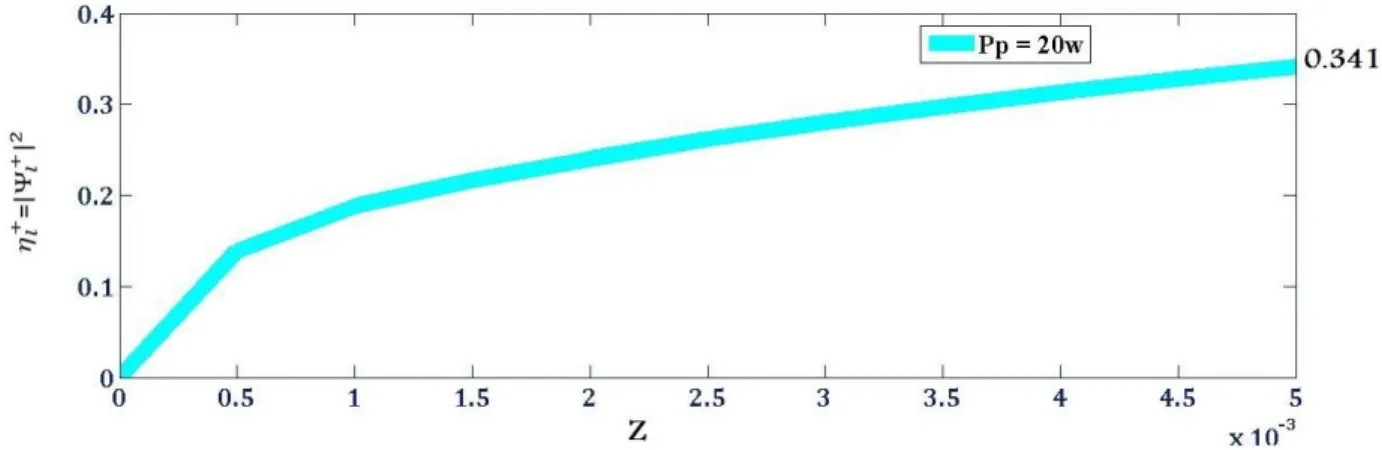
Figure 4 shows output of forward laser beam. According to this figure, 20% of pumping power is transferred to laser that is expected for solid-state lasers.
Output efficacy of forward laser beam along Z=5 mm for pumping power of Pp=20W and beam radius of rp=5mm is
34.1%. Reflection is RLF = 0.988.
𝜓𝑙+(𝑘 + 1) = 𝜓𝑙+(𝑘) + ∆𝑧 [−
∝𝑙
2𝛽𝑙+ 𝛿𝛥𝑁𝜓𝑙
+(𝑘) + 𝑖
𝐿2𝜓𝑙 + ∗(𝑘) 𝜓
Figure 4. Output efficacy of forward laser beam along z direction (path length).
7- Output efficacy of backward laser beam along z-direction for beam radius of r
p= 5 μm
Figure 5 shows output of backward laser beam as z for 20w power. This figure also shows than high value of pumping power is transferred to laser beam.
Output efficacy of backward laser beam along Z=5 mm for pumping power of Pp=20W and beam radius of rp=5mm
is 34.03 %. Reflection is RLB = 0.998.
ψl−(k + 1) = ψl−(k) + ∆z [−
∝l
2βl+ δΔNψl
−(k) + i
L2ψl − ∗(k) ψ
s
−(k)] (13)
Figure 5. Output efficacy of backward laser beam in z-direction (path length).
8- The Population Difference in Z-Direction for Beam Radius of r
p= 5μm
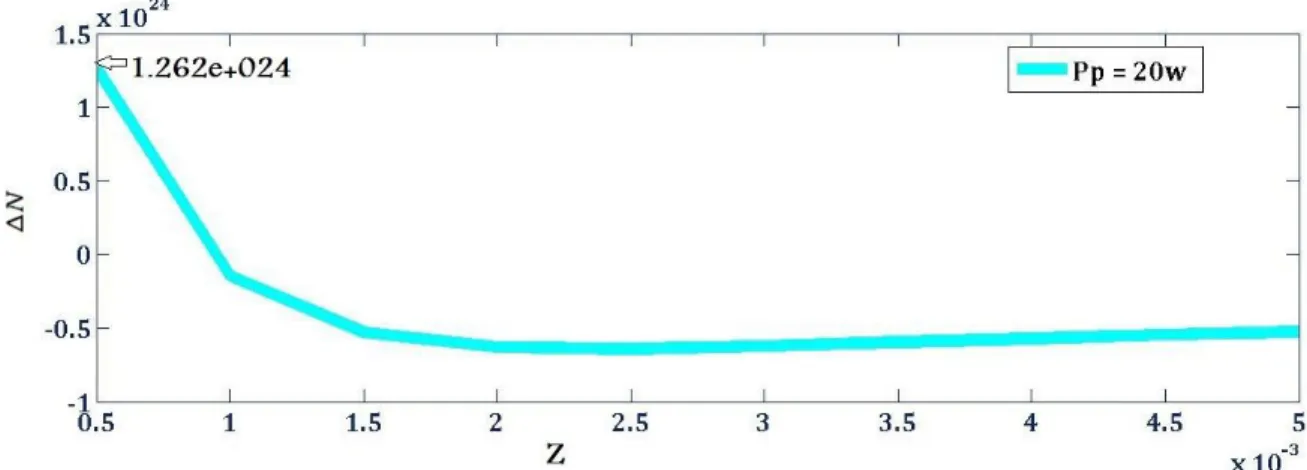
Figure 6 shows that population reverse depends on pumping power and has direct relationship with second harmonic beam efficacy.
The population difference along Z =5mm for pumping power of PP=20W and beam radius of rp = 5mm is 1.262 ×1024.
𝛥𝑁 = (𝛥𝑁
0
𝜏 + 𝛽𝑙𝜓𝑙− 2+ 𝑔𝑔1 ∗ 𝑒−∝𝑝∗𝑧)/(𝑔𝑔2 ∗ 𝜓𝑙+ 2+
1
Figure 6. Population Difference along Z direction (path length).
9- Experimental Method
Experimental efficacy of transferring 530 nm beam to 1060 nm in NYAB crystal by Jaque et.al is as follow [15, 16]:
𝜂1060→530=P530 / P1060 =4.6mW / 725mW ≈ 0.6 (15)
10- Conclusion
NYAB solid-state laser is an active non-linear crystal which has been studied in recent years due to its ability in producing green light laser. High effective non-linear coefficient and high damage threshold provides the possibility of being polluted with high value of ND ion, possibility of making pumped laser with diode in green area via self doubler (SFD) NYAB crystal has been the most efficient self doubler laser.
According to computations in MATLAB, thermal effects prevents the increasing opf pumping power.
In this study, five discrete differential equations describing the conversion of 807 nm pump beam to 1060 nm laser beam and then 530 nm second harmonic beam have been used in Yttrium aluminum borate crystal doped with neodymium ion (the most efficient self-doubler crystal). Calculations were done in MATLAB software. Finally, the efficacies of the second harmonic and the laser beams as well as the inverse population difference increased for beam radius of rp=5μm. This method is an interesting idea to achieve high efficacies in studied laser.
12- References
[1] H. Yousefi. Introduction on Solid -State Lasers and their Applications; Imam Hossein University; Vol. 1, (2002).
[2] D. Jaque, Self-frequency-sum mixing in Nd doped nonlinear crystals for laser generation in the three fundamental colours: The NYAB case, Journal of Alloys and Compounds 323-324 (2001) 204-209. https://doi.org/10.1016/s0925-8388(01)01111-2. [3] D. Jaque, M. de la O Ramirez, L. Bausa, A. Speghlini, M. Bettinelli, and E. Cavalli, Journal of the Optical Society of America B
21 (2004) 1203-1209. https://doi.org/10.1364/josab.21.001203.
[4] M. Sabaeian, H. Nadgaran, M. De Sario, L. Mescia and F. Prudenzano, Investigation of thermal effects in octagonal double-clad fiber lasers, Optical Materials 31 (2009) 1300-1305 https://doi.org/10.1016/j.optmat.2008.10.034.
[5] A. Sayahian Jahromi, M. Sabaeian, and H. Nadgaran, Heat coupled laser rate equations: a model for Er-doped fiber lasers, Optics Communications 311 (2013) 134-139. https://doi.org/10.1016/j.optcom.2013.08.058.
[6] Boyd, Robert W. Nonlinear optics. Academic press, 2003. https://doi.org/10.1016/b978-0-12-121682-5.x5000-7. [7] Wilson, John, and J. F. B. Hawkes. Lasers, principles and applications. Prentice Hall, 1987.
[8] Svelto, Orazio. “Principles of Lasers” (2010). doi:10.1007/978-1-4419-1302-9.
[9] Huang, Yidong, and Zundu Luo. “Relaxation Oscillation Theory for the Nd3+: YAB Self-Frequency-Doubling Laser.” Optics Communications 112, no. 1–2 (November 1994): 101–108. doi:10.1016/0030-4018(94)90086-8.
Nd:[YAl3(BO3)4] self-frequency-doubling laser, Journal of Applied Physics 87 (2000) 1042-1048. https://doi.org/10.1063/1.371977.
[12] H. Hemmati, Diode-pumped self-frequency-doubled neodymium yttrium aluminum borate (NYAB) laser, IEEE Journal of Quantum Electronics 28 (1992) 1169-1171. https://doi.org/10.1109/3.135243.
[13] T. Omutsu, Y. Kato, M. Shimosegawa, A. Hasegawa, I. Ogura, “Thermal effects in laser diode pumped self-frequancy-doubled NdxY1xAl3(Bo3)4 (NYAB) microchip laser” Optics Communications 118 (1995) 302-308. https://doi.org/10.1016/0030-4018(95)00208-p.
[14] L. Mousavi, M. Sabahian, H. Askari. Self-doubler Yttrium aluminum borate laser doped with Neodymium; Journal of Research on Many Body Systems; 4; 7; (2014): 45-54. https://doi.org/10.22055/JRMBS.2017.11591.1029.
[15] D. Jaque, et al. Continuous-wave laser properties of the self-frequency-doubling YAl3 (BO3)4: Nd crystal, Journal of the Optical Society of America B 15 (1998) 1656-1661. https://doi.org/10.1364/josab.15.001656.
![Figure 1. Generation of the second harmonic beam by nonlinear materials [1].](https://thumb-us.123doks.com/thumbv2/123dok_us/7935450.2109666/2.893.235.663.349.522/figure-generation-second-harmonic-beam-nonlinear-materials.webp)