Please cite this article as: K. Ramesh Kumar, R.S.D. Wahida Banu, A Novel Protection Guaranteed, Quality of Transmission Aware Routing and Wavelength Assignment Algorithm for All-optical Networks, International Journal of Engineering (IJE), TRANSACTIONS A: Basics Vol. 28, No. 7, (July 2015) 995-1001
International Journal of Engineering
J o u r n a l H o m e p a g e : w w w . i j e . i rA Novel Protection Guaranteed, Quality of Transmission Aware Routing and
Wavelength Assignment Algorithm for All-optical Networks
K.Ramesh Kumar*a, R.S.D.Wahida Banub
aBharat Sanchar Nigam Limited, Tamilnadu Circle, India bGovernment College of Engineering, Salem, Tamilnadu , India
P A P E R I N F O
Paper history: Received 11 April 2014
Received in revised form 20 January 2015 Accepted 11 June 2015
Keywords:
Optical Networks Protection QoT
Routing and Wavelength Assignment, Physical Layer Impairments Shortest Path
Blocking Probability WDM Networks Restoration Bit Error Rate
A B S T R A C T
Transparent All-Optical Networks carry huge traffic, and any link failure can cause the loss of gigabits of data; hence protection and its guarantee become necessary at the time of failure. Many protection schemes have been presented in the literature, but none speaks about protection guarantee. Also, in all optical networks, due to absence of regeneration capabilities, the physical layer impairments(PLI) accumulates along the lightpaths (LP) which causes sharp degradation of the Quality of Transmission (QoT), as measured by signal bit error rates (BER). The problem of protection with QoT issues has been rarely studied. In this work, a novel protection backup path ensured, QoT aware Routing and Wavelength Assignment (RWA) algorithm called “Virtual Lit –Exhaustive Highest Q factor” (V-Lit EHQ) is presented which exhibits desirable qualities for reliable network operation. The results of the proposed work are compared with the standard QoT aware versions of the Shortest Path (SP)-First Fit (FF) schemes as well as with literature for both lit and dark protection. The blocking probability (BP) and BER are taken as the performance metric and the proposed algorithm found to be outperforming as evidenced through simulations.
doi: 10.5829/idosi.ije.2015.28.07a.05
1. INTRODUCTION1
Transparent all-optical networks carry a very huge traffic and any interruption in the lightpath can cause huge data losses, hence survivability is important in optical networks. As regenerators are not available in transparent networks, the physical layer impairments (PLI) such as Polarization Mode Dispersion (PMD), Amplified Spontaneous Emission (ASE), Cross Talk(XT), Chromatic Dispersion (CD), Cross Phase Modulation (XPM), Four Wave Mixing (FWM) etc accumulate on lightpaths, and if not properly dealt with, the LPs may no longer be useful, as impairments will pull the QoT in terms of BER to below threshold [1, 2] which is not at all acceptable. Therefore, it is necessary to have both guaranteed lightpath protection
1*Corresponding Author’s Email:[email protected](K. Ramesh Kumar)
during failures and adequate QoT. In this work, a carefully designed routing and wavelength assignment algorithm is proposed to tackle both above issues.
Conventional studies on RWAs proposed many algorithms without considering PLIs. In recent days, the importance of PLI aware RWAs gained momentum and many papers discussed this issue [3-8]. Many of the papers considered only few PLI issues and neglect others [5-7]. Furthermore, except few, mostly all protection mechanisms available in the literature have an ideal physical layer and neglected the effect of PLIs[9].
is stopped when a QoT valid path is found. This will lower the BERs of LPs and keep them far away from the QoT threshold rather than close to it.
In the dedicated path protection scheme, every connection has two link-disjoint lightpaths, namely primary path and a backup path, to handle single-link failures. The backup path may be lit or dark. Employing the lit backup scheme will just double the live LPs, and path has a strong adverse effects on the QoT of other lightpaths and as well as on the whole network by enhancing the chances of FWM, XT , inter channel effects, and so on throughout the period of network operation, thus increasing the QoT blocking probability of lightpaths. This effect is more intensive in transmission-impaired all-optical networks [10]. The optical amplifier load will increases by two fold. Network monitoring load also increases. This will over use the network resources and consequently resource blocking will be more[11]. In dark backup case, when the backup path is lighted up, it worsens the impairments for other lightpaths due to added crosstalk, interference, and so on and leads to QoT blocking of LPs, and no longer is backup path usable, thus protection no longer guaranteed.
In this paper, a novel protection guaranteed QoT aware RWA is presented which uses virtual lit backup. In this scheme, the backup protection path is assumed as lit, as in the case of lit protection, but actually it is dark. Under such assumptions, the RWA is carried out and its QoT parameters are updated in the network accordingly. All future LP request(s) will be processed considering the virtually lit (dark, actually!) backup(s).During link failure, if any backup path is lighted up, that path will always be a QoT viable path as its impacts have already been addressed in the RWA process, thus yielding a guaranteed protection.
The paper is organized as follows. Related works is presented elaborately in Section II. PLI model and system description is given in Section III. In Section IV, the proposed Virtual –lit EHQ RWA algorithm is presented, while simulation and results appear in Section V. Finally, the paper is concluded in Section VI.
2. RELATED WORKS
Many papers in the literature have proposed PLI aware RWA algorithms and some of them have considered path protection. The RWA that consider the dynamic impairments for survivable optical networks were first presented in [12, 13]. The authors of [14] studied path and link protection, in physical layer impaired optical networks under single-link failures. In [15], it was pointed that Link protection got the lowest wavelength blocking probability(BP), but got the highest overall
BP since the backup paths were too long.(Higher QoT degradation due to longer paths).
A proposal in [16] considers FWM, XPM and ASE noise as the dominating PLIs, and ignores others. Link weights are the criteria for selecting primary paths to favor links with less impairment. The authors in [17] proposed a heuristic called RS RWA-Q by putting the protected LP requests before unprotected one. Authors claim that their enhanced RS-RWA-Q heuristic has low blocking rate compared to the RS-RWA proposed in literature. A comparison of dedicated path protection and shared path protection is presented in [18]. It was stated that, dedicated path protection has lower BP and providing complexity in comparison with shared path protection.
Azodolmolky et al. [19] introduces a novel RWA scheme named generalized dedicated protection with network coding (GDP-NC). Although authors claim that the proposed GDP-NC provided lower BP, its complexity is inevitable. A scheme called Coded Path Protection (CPP) was proposed in [20] making use of symmetric transmission over protection paths. The proposal also utilizes and link-disjointness among the connections in the same coding group; it is complex and mandates transmission in backup paths. A shorter path algorithm incorporating dedicated path protection was proposed in [21]. It is evident that this proposal is vulnerable to XT (resulting low QoT) as wavelengths are tightly packed to a maximum extent, even though resources are spare.
In [22], a multi cost approach to provide protection in impairment constrained optical networks is presented. This proposal may try hard for backup LP feasibility in terms of QoS, but higher BP for future requests are expected due to worst case assumptions. The authors in [23] proposed a novel QoS aware crosstalk reducing routing and wavelength assignment in all-optical networks with path protection implementations, in which the XT was the main criteria to tackle with. In [24], a QoS aware RWA comprising PLI effects named WpDp-MaMiQ was proposed. Though its BP performance is better, BER performance still can be improved. None of these works guarantee the path protection during failures. Most of these works aim at improving BP, but do not bother about BER performance. Many of these works failed to look on after failure scenario.
3. SYSTEM DESCRIPTION
compensation fiber (DCF) for the fiber CD. Links are linked by Optical cross connects (OXC). The receiver is modeled as an optical filter, followed by a photo detector per every channel. Wavelength conversion is assumed to be not available; hence, a call must use the same wavelength from source to destination. A centralized network management system is employed to perform entire call processing function. Typically, a low-speed control channel is reserved for the management of network operations.
The ASE noise originates from optical amplifiers, Polarization Mode Dispersion (PMD) originates due to asymmetries in the fibre core. Fabric crosstalk and adjacent-port crosstalk are the strongest linear cross talks considered. The filter concatenation (FC) effects arise due to optical filter pass band misalignments. Chromatic Dispersion or Group Velocity Dispersion (GVD) causes the broadening of the optical pulses as they propagate through the fiber, which in turn causes Inter-Symbol Interference (ISI).Nonlinear cross talk arises from FWM and XPM. The severity of the XT in both cases partly depends on the spectral spacing of the interfering signals [23]. All these PLIs have been considered in this work.
Most commonly, QoT for a signal is measured by its BER, and Q factor for a lightpath is related to the signal’s BER. For an On-Off modulated signal with Gaussian distributions for the ‘0’ and ‘1’ samples,the Q factor is given by [25]:
= (1)
where and are the means of the ‘0’ and ‘1’
samples, respectively, and and their standard
deviations. BER and the Q factor of a signal are related by:
= √ (2)
A BER of 10-9 corresponds to a Q factor of 6, and in
this work every established lightpath is expected to have a minimum Q value of 6. The ISI, ASE, and node crosstalk are accounted in Q factor through its noise
variances , and respectively. The non linear
effects XPM and FWM are accounted through the
noise variance term, . Incorporating these PLI
effects, Q factor of a lightpath can be written as:
= (3)
Noticing that ≪ and following [23], filter concatenation is modeled through a penalty on , yielding a new quantity ′ that accounts for the eye closure incurred by filter concatenation. The PMD effect is represented by a penalty on Q through a scaling factor η onPMD as in [26]. Therefore, Q is actually defined as:
= ′ (4)
As node XT, XPM and FWM are dynamic effects; they have to be computed on-line.
Call requests are assumed to arrive according to Poisson process with average arrival rate load. Call durations are assumed to follow an exponential distribution with unit mean, so that load is the total offered load to the network in Erlang units. The source and destination of the calls and link failures are assumed to be uniformly distributed over the network.
4. VIRTUAL LIT EXHAUSTIVE HIGHEST Q FACTOR RWA ALGORITHM (V-LIT EHQ)
The proposed algorithm is shown Figure 1. In the proposed RWA scheme, primary path is established first and then the backup path is computed in the following manner. As and when a new LP request arrives, the possible routes between the source and destination are computed and Route Set is formed. Every wavelength from the given Wavelength Set (λ=1,2…C) is taken one by one, and assigned to the routes in the Route Set, in an exhaustive manner. This is similar to FF technique except that all given wave lengths is attempted for LP establishment even after obtaining a QoT valid LP. During the wavelength assignment, wavelength continuity constraint is honored as the wavelength conversion is assumed to be not available. The above process results in a tentative LP set which is used to form Candidate LP Set. If no LP is found in Candidate LP set, then call is blocked. If LPs are available, then QoT is checked at this stage for the candidate LPs. All the LPs which are above the QoT threshold and do not bring the QoT of the already established LPs to below threshold level are listed in Usable LP Set. Here QoT threshold is fixed at BER=10-9, which corresponds to Q=6. The LP having
the highest Q is chosen from the Usable LP set as primary LP, and the network database is updated. If no LP is found in the Usable LP set, then call is dropped.
unavailability, or at QoT testing stage due to QoT constraints.
Figure 1. Flow Chart for V-Lit EHQ Routing and Wavelength Assignment Algorithm
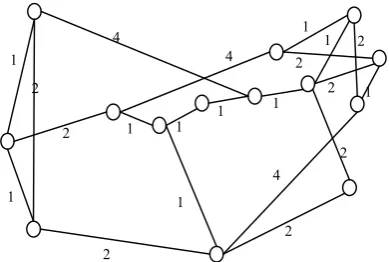
Figure 2.Topology used in the simulations. A downscaled 14 node NFS net topology is used. The link weights correspond to the number of fiber spans.
This backup LP is kept dark until link failure appears. For new call requests, this backup LP will also be taken into consideration for QoT calculations. For any future requests, this virtually lit backup path is considered as if it is lit and live working path, and new LPs are established accordingly. For QoT calculations of backup path, currently marked primary path is not considered as the primary LP is no more in live state, when backup LP come in to picture.
5. SIMULATIONS AND RESULTS
The proposed, QoT aware Protection Guaranteed, RWA algorithm is evaluated on the NSF topology shown in Figure 2 , with 8 wavelengths per link in each direction. For simplification purpose, it is assumed that all links were made up of one or several 70 km long spans.
The physical parameters are assumed as in [22]; these are reference parameters for a realistic regional area network. It is assumed that wavelength conversion is not feasible, and thus a call must use the same wavelength from source to destination. The call pattern is as described in section III.
QoT constraint (in terms of BER) is imposed in such a way that any given call at any given time should use a LP with a Q factor at least equal to 6, which equals to a BER of 10-9.The same constraints are used
for backup path as well. However, as the Lightpaths having highest exhaustive Q is selected for primary path, the BER of these LPs are far away from QoS threshold. This results in better performance in terms of BER.
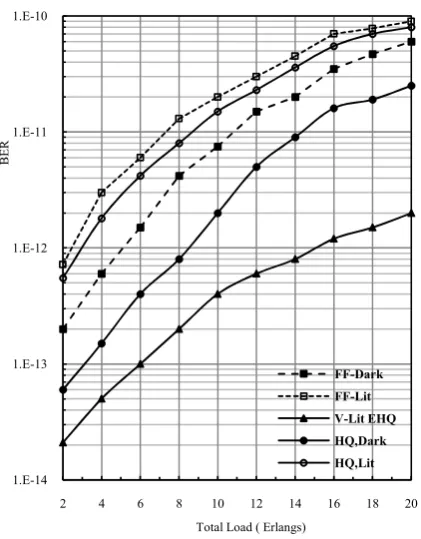
The blocking probability performance against load is given in Figure 3, wherein the BP performance of proposed scheme called “V-Lit EHQ” is compared against standard reference SP-FF dark protection scheme called “FF-Dark” and SP-FF lit protection scheme called “FF-Lit”. The BP performance of proposals in [15] namely “HQ, Dark” and “HQ, Lit” are also compared with V-Lit EHQ in Figure 3. It is seen that FF-Dark outperforms FF-Lit, HQ, Dark outperforms HQ, Lit, and the proposed V-Lit EHQ scheme outperforms all. This outperformance margin is more at lower loads. In both FF-Dark and HQ, Dark, paths are lit only when it is required, whereas in FF-Lit and HQ, Lit protection, the backup LPs are always lit, and therefore, the overall live LPs are almost double in both the lit protection methods causing increased interference by backup LPs which leads to QoT blocking of call requests. The proposals in [15] perform better than respective FF-Dark and FF-Lit schemes since they choose the LPs with better Q.
The blocking in V-Lit EHQ protection scheme is due to its primary paths only (as backup paths are QoT readily available), whereas in other methods, blocking
1
4
2
1
1 1
2
2
1 1
2
2 4
1 4
1 2 1
2 2
1
Update network database Call Block Passed?QoT
Disjoint Route Set
WA Using FF and QoT Checking
Select Backup LP (V-Lit)
()9 A
Yes New Request
Route Set
LP found? WA using each
λ=1, 2…C
Usable LP Set
Establish Primary LP and Virtual lit
Backup LP Select Primary LP
(E-HQ)
A
Yes
No No
No QoT
constraint s met?
depends on both primary and backup paths. As the QoT of backup path is not bothered during establishment of primary path in FF-Dark, FF-Lit, HQ, Dark and HQ, Lit protection schemes, the availability of backup path during failure is uncertain; this increases the blocking probability. In the proposed RWA, QoT blocking of backup path is nil as it’s QoT is well enforced during the establishment of primary paths itself. The proposed V-Lit EHQ RWA algorithm outperforms reference algorithms at big margin at lower loads and mid loads. At higher loads, the wavelength availability shrinks because of already established LPs; therefore, blocking performance is closer, but clearly better than other schemes presented.
In lit protection schemes, when connections affected by failures switch to backup paths, a fraction of these backup paths may not have adequate QoT, causing the corresponding connections not to be restored due to unavailable (Due to inadequate Q) backup paths. In dark protections, during failures if backup paths are lighted up, these backup paths themselves may not have sufficient QoT, or few of these lighted up backup paths may affect other ongoing connections, thus causing the backup paths to be unavailable. These drawbacks are completely nullified in the proposed V-Lit EHQ by the concept of Virtual Lit, wherein the backup paths are considered to be lit for all QoT verifications and calculations, though it is dark!
The BER performance of the proposed (V-Lit EHQ), reference (FF-Dark and FF-Lit) and existing(HQ, Dark and HQ, Lit [15]) RWA schemes are depicted and compared in Figure4. As said above, due to the increased live LPs and its corresponding interferences, the BER performance of lit backups are poorer than dark backups. The V-Lit EHQ show up the best BER performance followed by HQ, Dark, FF-Dark, HQ, Lit, and FF-Lit.
In the conventional FF-Dark and FF-Lit schemes, the primary path is established as soon as a Q valid path(Q=6) is found. However, chances are that, there may exist a better path if LP space is still searched by RWA, which is absent in the conventional protection enabled RWA schemes. Hence, their BER performance is inferier. In the HQ, Dark and the HQ, Lit RWA proposed in [15], the LPs are chosen in a non-exhaustive manner resulting in sub-optimal LPs.
In V-Lit EHQ protection scheme, as the LPs having highest Q is selected in an exhaustive manner, considering all wavelengths over the possible routes, its BER performance is the best at huge margin. Furthermore, as live LPs in V-Lit EHQ are only half (approximately) as that of the HQ, Lit and FF-Lit schemes, its BER is naturally lower. Even, if future new LP connections downgrade the QoT of already established paths, it is offset by the fact that the
established LPs are already faraway for the threshold due to Exhaustive-HQ selection mechanism.
Figure 3.Average Blocking Probability
Figure 4.Average BER 1.E-04
1.E-03 1.E-02 1.E-01 1.E+00
2 4 6 8 10 12 14 16 18 20
B
lo
ck
in
g
p
ro
ba
bi
lit
y
Total Load ( Erlangs)
FF-Dark FF-Lit V-Lit EHQ HQ,Dark HQ,Lit
1.E-14 1.E-13 1.E-12 1.E-11 1.E-10
2 4 6 8 10 12 14 16 18 20
B
ER
Total Load ( Erlangs)
6. CONCLUDING REMARKS
In this work, the problem of dedicated path protection has been addressed in a new perspective along with physical layer impairments consideration. A new, novel RWA algorithm called “V-Lit EHQ” for all-optical networks was presented and compared with the QoT aware versions of reference SP-FF RWA algorithms (FF-Dark, FF-Lit) and HQ, Dark and HQ,Lit RWAs proposed in [15]. The proposed V-Lit EHQ clearly outperforms all the four schemes in terms of blocking probability as well as BER at both lower and higher network loads. The proposed algorithm implies the guaranteed hundred percent availability of backup paths during failure, giving highly reliable network operations. The exhaustive highest Q selection mechanism employed for primary paths and V-Lit scheme employed for backup paths in the proposed work lowered the BER and BP considerably. The proposed algorithm involve intensive computations, but worth to afford it for the guaranteed recovery from failures and better BER performances.
7. REFERENCES
1. Markidis, G., Sygletos, S., Tzanakaki, A. and Tomkos, I., Impairment aware based routing and wavelength assignment in transparent long haul networks, in Optical network design and modeling, Springer, (2007), 48-57.
2. Rai, S., Su, C.-F. and Mukherjee ,B., "On provisioning in all-optical networks: An impairment-aware approach",
Networking, IEEE/ACM Transactions on, Vol. 17, No. 6, (2009), 1989-2001.
3. Pinart, C., Sambo, N., Rouzic, E.L., Cugini, F. and Castoldi, P., "Probe schemes for quality-of-transmission-aware wavelength provisioning", Journal of Optical Communications and Networking, Vol. 3, No. 1, (2011), 87-94.
4. Bakri, M., Koubaa, M., Menif, M. and Ouerda, I., "Static lightpath establishment with transmission impairments consideration in wdm all-optical networks", in Design of Reliable Communication Networks, DRCN 2009. 7th International Workshop on, IEEE, (2009), 251-258.
5. Deng, T., Subramaniam, S. and Xu, J., "Crosstalk-aware wavelength assignment in dynamic wavelength-routed optical networks", in Broadband Networks, BroadNets, Proceedings. First International Conference on, IEEE, (2004), 140-149. 6. Marsden, A., Maruta, A. and Kitayama, K.-i., "Routing and
wavelength assignment encompassing fwm in wdm lightpath networks", in Optical Network Design and Modeling, ONDM 2008, International Conference on, IEEE, (2008), 1-6. 7. Fonseca, I.E., Ribeiro, M.R., Almeida, R. and Waldman, H.,
"Preserving global optical qos in fwmimpaired dynamic networks",Electronics Letters, Vol. 40, No. 3, (2004), 191-192.
8. Staessens, D., Colle, D., Pickavet, M. and Demeester, P., "Path protection in wsxc switched networks", in Proc. European Conference on Optical Communications (ECOC), (2008). 9. Azodolmolky, S., Klinkowski, M., Marin, E., Careglio, D.,
Pareta, J.S. and Tomkos, I., "A survey on physical layer impairments aware routing and wavelength assignment
algorithms in optical networks",Computer Networks, Vol. 53, No. 7, (2009), 926-944.
10. Sole-Pareta, J., Subramaniam, S., Careglio, D. and Spadaro, S., "Cross-layer approaches for planning and operating impairment-aware optical networks", Proceedings of the IEEE, Vol. 100, No. 5, (2012), 1118-1129.
11. Saradhi, C.V. and Subramaniam, S., "Physical layer impairment aware routing (pliar) in wdm optical networks: Issues and challenges",Communications Surveys & Tutorials, IEEE, Vol. 11, No. 4, (2009), 109-130.
12. Zhai, Y., Pointurier, Y., Subramaniam, S. and Brandt-Pearce, M., "Performance of dedicated path protection in transmission-impaired dwdm networks", in Communications, ICC'07. IEEE International Conference on, IEEE, (2007), 2342-2347. 13. Askarian, A., Zhai, Y., Subramaniam, S., Pointurier, Y. and
Brandt-Pearce, M., "Protection and restoration from link failures in dwdm networks: A cross-layer study", in Communications, ICC'08. IEEE International Conference on, IEEE, (2008), 5448-5452.
14. Askarian, A., Subramaniam, S. and Brandt-Pearce, M., "Evaluation of link protection schemes in physically impaired optical networks", in Communications, ICC'09. IEEE International Conference on, IEEE, (2009), 1-5.
15. Askarian, A., Zhai ,Y., Subramaniam, S., Pointurier, Y. and Brandt-Pearce, M., "Cross-layer approach to survivable dwdm network design", Journal of Optical Communications and Networking, Vol. 2, No. 6, (2010), 319-331.
16. Georgakilas, K.N., Katrinis, K., Tzanakaki, A. andMadsen, O.B., "Performance evaluation of impairment-aware routing under single-and double-link failures", Journal of Optical Communications and Networking, Vol. 2, No. 8, (2010), 633-641.
17. Azodolmolky, S., Klinkowski, M., Pointurier, Y., Angelou, M . , Careglio, D., Sole-Pareta, J. and Tomkos, I., "A novel offline physical layer impairments aware rwa algorithm with dedicated path protection consideration", Journal of Lightwave Technology, Vol. 28, No. 20, (2010), 3029-3040.
18. Farabi, M., Idrus, S . , Fariza, S., Zulkifli, N. and Al-Shargabi, M., "A comparison of path protections with availability concern in wdm core network", International Journal of Computer Applications, Vol. 24, No. 4, (2011).
19. Babarczi, P., Tapolcai, J., Ho, P.-H. and Medard ,M., "Optimal dedicated protection approach to shared risk link group failures using network coding", in Communications (ICC), IEEE International Conference on, IEEE, (2012), 3051-3055. 20. Avci, S.N. and Ayanoglu, E., "Coded path protection: Efficient
conversion of sharing to coding", Communications, IEEE Transactions on, Vol. 61, No. 10, (2013), 4294-4309. 21. Stefanos T. Mylonakis "Full dedicated optical path protection
in the wdm mesh networks without wavelength conversion",
TheNinth International Conference on Networking and Services , March 2013 - Lisbon, Portugal.
22. Kokkinos, P., Manousakis, K. and Varvarigos, E.M., "Path protection in wdm networks with quality of transmission limitations", in Communications (ICC),IEEE International Conference on, IEEE, (2010), 1-5.
23. Kumar, K.R. and Banu, R., "A novel qos aware crosstalk reducing routing wavelength assignment in all optical networks with path protection consideration", in Communicationsand Signal Processing (ICCSP), International Conference on, IEEE, (2012), 47-51.
25. Agrawal, G.P., "Fiber-optic communication systems, John Wiley & Sons, Vol. 222, (2012).
26. Norimatsu, S. and Maruoka, M., "Accurate q-factor estimation of optically amplified systems in the presence ofwaveform
distortions",Lightwave Technology, Journal of, Vol. 20, No. 1, (2002), 19-27.
A Novel Protection Guaranteed, Quality of Transmission Aware Routing and
Wavelength Assignment Algorithm for All-optical Networks
K.Ramesh Kumara, R.S.D.Wahida Banub
aBharat Sanchar Nigam Limited, Tamilnadu Circle, India bGovernment College of Engineering,Salem,Tamilnadu, India
P A P E R I N F O
Paper history: Received 11April 2014
Received in revised form 20January 2015 Accepted 11 June 2015
Keywords:
Optical Networks Protection QoT
Routing and Wavelength Assignment, Physical Layer Impairments Shortest Path
Blocking Probability WDM Networks Restoration Bit Error Rate
هﺪﯿﮑﭼ ﺎﻫ ﻪﮑﺒﺷ ي رﻮﻧ مﺎﻤﺗ ي ﻓاﺮﺗ فﺎﻔﺷ ﮏﯿ ﻈﻋ ﯽﻤﯿ ﻞﻤﺣ ﯽﻣ ﺪﻨﻨﮐ ﻟ ﺖﺴﮑﺷ ﺮﻫ و ﮏﻨﯿ
ﻣ ﯽ ﺪﻧاﻮﺗ ﺐﺟﻮﻣ نداد ﺖﺳد زا ﻦﯾﺪﻨﭼ ﮔ ﺖﯿﺑﺎﮕﯿ دﻮﺷ هداد . ا زا ﻦﯾ ور ، ﻤﻀﺗ و ﺖﻇﺎﻔﺣ ﻦﯿ
ﻣ تروﺮﺿ ﺖﺴﮑﺷ نﺎﻣز رد نآ ﺪﺑﺎﯿﯿ . ﺎﻫ حﺮﻃ ي ﺴﺑ ﺖﻇﺎﻔﺣ يرﺎﯿ رد تﻻﺎﻘﻣ ﻫ ﺎﻣا ،ﺖﺳا هﺪﺷ ﻪﺋارا ﭻﯿ
ﻤﻀﺗ درﻮﻣ رد ماﺪﮐ ﻦﯿ ﺖﺒﺤﺻ ﺖﻇﺎﻔﺣ ﻧﻤ ﯿ ﺪﻨﮑ . ﻨﭽﻤﻫ ،ﻦﯿ ﺎﻫ ﻪﮑﺒﺷ مﺎﻤﺗ رد ي
رﻮﻧ ،ي ﺎﺑ
ﻠﺑﺎﻗ مﺪﻋ ﻪﺑ ﻪﺟﻮﺗ ﺖﯿ ﺎﻫ ي زﺎﺳزﺎﺑ ،ي ﻻ تﻻﻼﺘﺧا ﻪﯾ ﻓ ﯽﮑﯾﺰﯿ (PLI) رد داﺪﺘﻣا يﺎﻫﺮﯿﺴﻣ (LP) ﻣ ﻊﻤﺠﺗ ﺪﺑﺎﯿﯿ ﺚﻋﺎﺑ ﻪﮐ ﺶﻫﺎﮐ ﺪﺷ ﺪﯾ ﮐ ﺖﯿﻔﯿ ﺎﻘﺘﻧا ل (QoT) ﻪﮐ ﻪﺑ ترﻮﺻ ﺎﻄﺧ خﺮﻧ ي ﺑ ﯽﺘﯿ ﺳ لﺎﻨﮕﯿ ﮔ هزاﺪﻧا يﺮﯿ )
(BER
ﯽﻣ ﯽﻣ ،دﻮﺷ ددﺮﮔ . ﻞﮑﺸﻣ
ﻞﺋﺎﺴﻣ ﺎﺑ ﺖﻇﺎﻔﺣ
QoT
ﺪﻧ ﻪﺑ ﺖﺳا هﺪﺷ ﯽﺳرﺮﺒﺗر . رد ﺮﺿﺎﺣ ﻪﻟﺎﻄﻣ ، ﮏﯾ ﺴﻣ ﻦﯾﻮﻧﺮﯿ ﺘﺸﭘ ﯽﻧﺎﺒﯿ ﮔ ﻤﯾﺮﯿ ﻤﻄ ،ﻦﺌ QoT ﺴﻣ ﯽﺑﺎﯾﺮﯿ
ﺼﺨﺗ و هﺎﮔآ ﺺﯿ جﻮﻣ لﻮﻃ (RWA) رﻮﮕﻟا ﻢﺘﯾ مﺎﻧ ﻪﺑ " ﻨﺷور زﺎﺠﻤ ﺎﺑ ﯽﻠﯿﺼﻔﺗ ي ﺮﺗﻻﺎﺑ
ﻨﯾ ﻣﺎﻌ ﻞ
(V-Lit EHQ) Q
هﺪﺷ ﻪﺋارا ﺖﺳا ﮐ ﻪﮐ ﺖﯿﻔﯿ اﺮﺑ بﻮﻠﻄﻣ ي ﻠﻤﻋ ﮏﯿﺗﺎﯿ ﻋا ﻞﺑﺎﻗ ﻪﮑﺒﺷ ﯽﻣ ﺖﺳد ﻪﺑ ار دﺎﻤﺘ
ﺪﻫد . ﺎﺘﻧ ﺞﯾ ا زا ﻞﺻﺎﺣ ﻦﯾ ﭘ رﺎﮐ ﺎﺒﯾدﺎﻬﻨﺸﯿ ﻪﺨﺴﻧ هﺎﮔآ QoT
ﺮﺗ هﺎﺗﻮﮐ زا دراﺪﻧﺎﺘﺳا ﻦﯾ ﺴﻣ ﺮﯿ حﺮﻃ SP–First Fit(FF) ﻨﭽﻤﻫ و ﻦﯿ ﺎﺑ هداد تﻻﺎﻘﻣ رد دﻮﺟﻮﻣ يﺎﻫ اﺮﺑ
ي ود ﺮﻫ
ﺖﻟﺎﺣ ﺗ و ﻦﺷور ﺖﻇﺎﻔﺣ هﺮﯿ ﺎﻘﻣ ﻪﺴﯾ ﺖﺳا هﺪﺷ . دوﺪﺴﻣ لﺎﻤﺘﺣا ندﺮﮐ (BP) و BER ناﻮﻨﻋ ﻪﺑ ﺺﺧﺎﺷ يﺎﻫ دﺮﮑﻠﻤﻋ رﻮﮕﻟا ﻢﺘﯾ ﭘ يدﺎﻬﻨﺸﯿ ﺮﻃ زا ﻖﯾ ﺒﺷ ﻪﯿ زﺎﺳ ﻻﺎﺑ رﺎﯿﺴﺑ ،ي نﺎﺸﻧ
هداد ﺖﺳا هﺪﺷ
.