2008
Updated use case models and underlying vision
documents and pedagogical model definitions
Rob Koper
Open Universiteit Nederland
Judith Schoonenboom
University Of Amsterdam
Jocelyn Manderveld
Eric Kluijfhout
Open Universiteit Nederland
Miguel Arjona
See next page for additional authors
This Report is brought to you for free and open access by the Institute for Educational Cybernetics at UBIR: University of Bolton Institutional Repository. It has been accepted for inclusion in Educational Cybernetics: Reports by an authorized administrator of UBIR: University of Bolton Institutional Repository. For more information, please [email protected].
Digital Commons Citation
Koper, Rob; Schoonenboom, Judith; Manderveld, Jocelyn; Kluijfhout, Eric; Arjona, Miguel; Griffiths, David; Angehrn, Albert; and Van Rosmalen, Peter. "Updated use case models and underlying vision documents and pedagogical model definitions." (2008).
Educational Cybernetics: Reports.Paper 6.
Project no. 027087
TENCompetence
Building the European Network for Lifelong Competence Development
Project acronym: Integrated Project TENCompetence
Thematic Priority: 2.4.10
D2.2
Updated use case models and underlying vision documents and pedagogical model definitionsDue date of deliverable: 30-11-2007 Actual submission date: 08-01-2008
Start date of project: 01-12-2005 Duration: 4 years
ALTRAN SDB
Version 1.0
Project co-funded by the European Commission within the Sixth Framework Programme (2002-2006)
Dissemination Level
PU Public X
PP Restricted to other programme participants (including the Commission Services)
RE Restricted to a group specified by the consortium (including the Commission
CO Confidential, only for members of the consortium (including the Commission
Project Deliverable Report
D2.2 Updated use case models and underlying vision documents and pedagogical model definitions
Work package WP2 - Requirements & Analysis of the Integrated System
Task 2 and 3
Date of delivery Contractual: 30-11-2007 Actual: 08-01-2008
Code name D2.2 Version: 1.0 Draft Final
Type of deliverable Report
Security
(distribution level)
Public
Contributors ALTRAN SDB, University of Bolton, INSEAD, OUNL, SURF, UvA
Authors (Partner) Rob Koper (OUNL), Judith Schoonenboom (UvA), Jocelyn Manderveld (SURF), Eric Kluijfhout (OUNL), Naiara Sacristán (ALTRAN SDB), Miguel Arjona (ALTRAN SDB), David Griffiths (University of Bolton), Albert Angehrn (INSEAD), Peter van Rosmalen (OUNL)
Contact Person Miguel Arjona (ALTRAN SDB)
WP responsible Miguel Arjona (ALTRAN SDB)
EC Project Officer Martin Májek
Abstract
(for dissemination)
This deliverable contains the following 3 topics:
• An analysis of the current status of the project in relation to the lessons learned in the first two years of the project and the changes observed in the world outside of the project. In addition an approach is outlined what to achieve and how to achieve this in the remaining life-time of the project.
• The results of a study on pedagogical models for lifelong competence development. The study shows that in order for lifelong competence development to be optimally facilitated, four main aspects should be organised: organise the learning context; organise the different stages of lifelong competence development; put the learner into control of their own learning; provide resources and guidance from which learners can learn.
• A set of usage profile including use case models for the PCM describing the most important cases of use of the PCM.
Keywords List Pedagogical model definition; usage profile; scenario, use case; vision document
TENCompetence Project Coordination at: Open University of the Netherlands Valkenburgerweg 177, 6419 AT Heerlen, The Netherlands
TENCompetence – IST-2005-027087 Page 2 / 74
1 Executive summary ... 3
2 Overall analysis and approach... 5
2.1 Taking stock and facing challenges... 5
2.2 Addressing the challenges ... 7
2.3 Implications for planned project activities ... 10
2.3.1 Research, technology development and innovation activities... 10
2.3.2 Training activities ... 17
2.3.3 Demonstration activities ... 17
3 Pedagogical model definitions ... 19
3.1 Introduction ... 19
3.2 Method... 21
3.3 Results ... 24
3.4 Connecting the pedagogical model and the usage profiles... 31
3.5 Conclusion & future directions... 33
3.6 References ... 34
4 An elaboration of the first five usage profiles ... 37
4.1 Usage Profile "Follow Course" ... 38
4.1.1 Brief narrative scenarios... 38
4.1.2 Most important activities in this usage profile + related action ... 40
4.1.3 Importance of PCM elements in this usage profile ... 42
4.1.4 Use case diagram ... 43
4.2 Usage Profile "Create Course" ... 44
4.2.1 Authoring a UOL... 44
4.2.2 Publishing a UOL ... 45
4.2.3 Using a UOL at runtime ... 46
4.3 Usage profile "Personal Development plan" ... 46
4.3.1 Description ... 46
4.3.2 Most important activities in this usage profile + related actions... 47
4.3.3 Importance of PCM elements in this usage profile ... 48
4.3.4 Use case diagram ... 49
4.4 Usage Profile "Knowledge Management"... 50
4.4.1 Most important activities in this usage profile + related actions... 51
4.4.2 Importance of PCM elements in this usage profile ... 52
4.4.3 Use case diagram ... 53
4.5 Usage Profile "Overview" (exploring resources, persons and competence profiles)... 54
4.5.1 Use Case 1: Connecting with relevant peers in the network community54 4.5.2 Use Case 2: Connecting to competence networks through video-enhanced navigation and game dynamics ... 57
4.5.3 Importance of PCM elements in use case 1 AND use case 2... 59
4.5.4 Auxiliary Services ... 60
4.5.5 Use case diagram ... 60
Appendix I. Vision Group Meeting Minutes 5-10-2006 ... 61
Appendix II. Vision Group Meeting Minutes 20-06-2007... 64
Appendix III. Vision Group Meeting Minutes 16-10-2007 ... 66
TENCompetence – IST-2005-027087 Page 3 / 74
1 Executive
summary
During the first twelve months, a functional specification has been developed based on the domain model, its underlying theories, and the contributions from the different research groups in WP5-8. This work enabled us to define the first seven TENCompetence high level use cases and to expand them through activity diagrams, the building blocks for the development of the first version of the Personal Competence Manager (PCM 1.0). Obviously, since formulating the TENCompetence proposal but also since the specification of the first version of the PCM the world as the consortium saw it, has changed. The focus of this deliverable, therefore, is to establish and maintain the common vision of the project as a combination of an analysis of lesson learned, in and by the project, in relation to its changing environment. The deliverable contains 3 sections:
• An analysis of the current status of the project (chapter 2);
• The results of an study on pedagogical models for lifelong competence development (chapter 3);
• A set of usage profile for the PCM (chapter 4).
In Chapter 2, an analysis is given of the achievements of the project, mid-way, and the challenges the project has to face to achieve its objectives all in relation to the progress made so far and the changes observed in the world outside the project. The two most important observations made are (1) that there is a need to focus not merely on the integrated functionality of the PCM but also on distinct, limited usage profiles to meet specific desires of the users; (2) Web 2.0, its technology as well as the user expectations it has created, challenges the current approach taken in TENCompetence. An approach is outlined what to achieve and how to achieve this in the remaining life-time of the project. This approach has been developed, stepwise, in a special working group the ‘Vision group’ (WP2-task 2a), comprising visionary senior researchers from the consortium partners and has been discussed and elaborated upon in a meeting with all Work-package leaders. The background details of this meeting and of the meetings of the Vision group are available in appendix 1-4.
Chapter 3 describes the results of task 2b, the development of pedagogical models for lifelong competence development. The main research question explored, is: What aspects of learning have to be organised by those who offer lifelong competence development opportunities in order to optimally facilitate learning? The study showed that in order for lifelong competence development to be optimally facilitated, four main aspects should be organised: organise the learning context; organise the different stages of lifelong competence development; put the learner into control of their own learning; provide resources and guidance from which learners can learn.
TENCompetence – IST-2005-027087 Page 4 / 74
important cases of use of the PCM, for both the current and the next release. These usage profiles will be managed as change requests in the next cycle and incorporated to the functionality of the system in the following versions. The five usage profiles are the following:
• Follow Course: In this usage profile, the PCM is used in order to follow a course in three different scenarios: Corporate Training, Adult Education and seminar or tutorial group.
• Create Course: integrating visual editing and publishing into a single, integrated, and easy to set up and use system.
• Personal Development plan: In this usage profile, the PCM is used for working with their Personal Competence Development Plan, which means creating the plan, following it, and reflecting on the progress.
• Knowledge Management: This profile is directed at setting up communities to share knowledge about various topics. The resources and discussions about the resources are at the centre, organised per topic and in knowledge areas (better terms can be selected).
TENCompetence – IST-2005-027087 Page 5 / 74
2
Overall analysis and approach
In this chapter we provide an analysis of the project’s progress and identify the major challenges for the future; define four strategies to meet these challenges; and provide an update for the major activities of TENCompetence.
The analysis is the result of WP2, task 2a, i.e. to “provide a common vision for the project at large and for the work in WP3-8 specifically”. The two most important observations resulting from the analysis are:
(1) There is a need to focus not merely on the integrated functionality of the PCM but also on distinct, limited usage profiles to enable specific desires of the users;
(2) Web 2.0, its technology as well as the user expectations it has created, challenges the current approach taken in TENCompetence.
An approach is outlined what to achieve and how to achieve this in the remaining life-time of the project. This approach has been developed, stepwise, in a special working group the ‘Vision group’ (WP2-task 2a), comprising visionary senior researchers from the consortium partners and has been discussed and elaborated upon in a meeting with all Work-package leaders. The background details of this meeting and of the meetings of the Vision group are available in appendix 1-4.
2.1
Taking stock and facing challenges
During first twelve month, a functional specification has been developed based on the domain model, its underlying theories, and the contributions from the different research groups in WP5-8. This work enabled the consortium to define the first seven
TENCompetence’s high level use cases and to expand them through activity diagrams (c.f. D2.1), the building blocks for the development of the first version of the Personal Competence Manager (PCM 1.0). Obviously, since formulating the TENCompetence proposal but also since the specification of the first version of the PCM the world as the consortium saw it, has changed. In this chapter therefore an analysis is given of the achievements of the project, mid-way, and the challenges the project has to face to achieve its objectives all in relation to the progress made so far and the changes
observed in the world outside the project. The analysis revealed that we have to face the following five, major challenges:
1. Software development cycles
TENCompetence – IST-2005-027087 Page 6 / 74
pilots. Concluding, we can say that we have to be extremely careful with the
synchronizing of the development cycles. At this stage the development cycles were insufficiently synchronised, took too long, and software sometimes required
considerable revision before it could be released.
2. The world changes
Since formulating the TENCompetence proposal (late 2004, early 2005), but even since the specification of the first version of the PCM (end 2006), the world as the consortium saw it, has changed. Already during project year 1 of the project it turned out that the number of existing open source components for integration into the PCM (e.g. as developed by the e-learning framework1) was far more limited than expected.
In addition Web 2.0, its technology as well as the user expectations it has created, challenges the current approach taken in TENCompetence.
3. Collaboration within and between WPs
Within WPs the work is typically divided into tasks. The tendency is to distribute tasks along the lines of partners, and sometimes even to assign to individuals. The result is too much fragmentation and work carried out in isolation.
Although aspect WPs were deliberately defined in such a way that their
interdependency is minimal, in the final TENCompetence infrastructure they will all have to deliver components that operate on shared underlying services, and provide a common ‘look and feel’ towards the end-user. At present aspect WPs are insufficiently aware of the functionality and underlying services developed by WP3 onto which to integrate these future components.
4. Common ground
To be able to cooperate effectively and efficiently in a complicated project like
TENCompetence requires a shared vision and convergence on key concepts in the field of competence development. The TENCompetence RTD activities lead to new
knowledge; the external world keeps changing; and new staff joins the consortium continuously. Thus creating common ground and a shared vision is not a one-time activity at the start of the project (as we initially planned), but instead seems to require continuous pro-active efforts.
5. PCM usability
The present PCM release already incorporates most of the anticipated functionality, though part of it at a basic level and/or through placeholders. This integrated
functionality will especially appeal to professional users. The novice or average
end-1
TENCompetence – IST-2005-027087 Page 7 / 74
user, however, is presented with a) too much functionality for often limited needs, and b) an interaction design that is (too) complicated. The challenge is to make the PCM more scalable and user-friendly to attract not only corporate but also individual users.
2.2
Addressing the challenges
The five challenges identified on the basis of the analysis are closely interrelated. The following set of strategies will be applied to address these challenges. They will provide a common vision for the project at large. The implications for the work in WP3-8 in the second half of the project are covered in section 2.1.3 “Implications for planned project activities”.
Focus on core output
Although the overall output of TENCompetence over the first two years is quite impressive, we experienced problems with timely software delivery. At the same time the lack of suitable existing Open Source services - like for example QTI tools - requires additional - initially unplanned - development efforts. This dilemma can only be tackled by a re-orientation on the core tasks of TENCompetence.
In the last 2 years of the project therefore a distinction will be made between ‘core tasks’ which will be prioritised, with until they are finished about 80% of effort
dedicated to them, and ‘additional tasks’ to which WPs can direct their remaining time. Such core tasks focus on creating prioritised software components - core components. A core component qualifies as such when it covers a distinct usage profile (see the next paragraph or chapter 4 for a detailed description). A core component should therefore be used and tested in depth by/with end users. Some aspect WPs may have more than one core, which will be developed in order of priority.
In addition to focussing on core components, the PCM architecture will allow the integration of existing web tools that users require, but which are not core to the project (like chat, forum, etc.).
Increase usability: usage profiles and web clients
TENCompetence – IST-2005-027087 Page 8 / 74
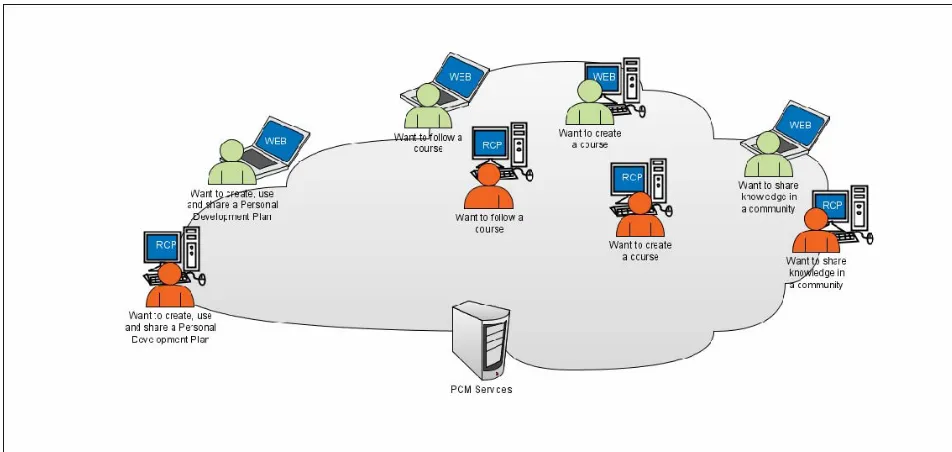
To lure new users used to web 2.0 tools we need attractive web clients2 in addition to the present rich client platform (RCP) of the PCM. Such web clients have to incorporate web2.0 principles to meet present day’s user expectations. Usability tests will be carried out on all components delivered.
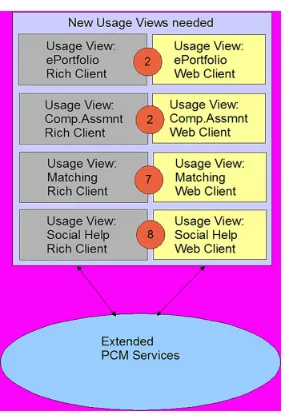
Figure 1. Examples of high priority usage profiles rendered through web-clients and the RCP.
Increase programming output
The analysis of the first two project years revealed a delay in software delivery, and at the same time it was concluded that more emphasis should be put on developing web clients to pull in new users in addition to the present rich client functionality that mainly appeals to ‘power users’.
As a result programming efforts will shift from rich client development to web client development, and at the same time overall development capacity needs to be increased. Recruiting additional staff proved difficult over the past year, and training junior staff is time-consuming and makes further demands on the already overburdened senior
programmers.
To facilitate a realistic development process, given these constraints, in the last two years of the project we will employ the following set of strategies:
2
TENCompetence – IST-2005-027087 Page 9 / 74
a) No further extension of present functionality of the integrated rich client PCM v1.0, but only: a) implement present placeholders; b) resolve CRUD3 discrepancies with the present prototype implementations of the aspect Work Packages; and c) improve its interaction design (most of the latter to be realise in the first part of year 3). b) Steer development efforts from developing a fully integrated rich client PCM (as in
the first 2 years) towards the implementation of distinct usage profiles.
c) Preferably implement the usage profiles as web clients, with the first batch of web clients on the basis of already existing PCM services.
d) Implement rich clients only when a) they have almost been completed already, or b) functionality is otherwise difficult to implement (as with an integrated LD authoring and deployment environment). The usage profiles that are completed as rich clients for ‘power users’ may next be developed as web clients for less demanding users. e) The present integrated rich client PCM will only be ‘maintained’ by integrating new
rich client usage profile implementations as they become available.
f) The web clients will be developed using tools a) with which the present developers are already familiar, and/or b) that have a relatively low entry threshold, thus make it easier for inexperienced programmers within and outside the partnership to contribute to their development.
g) The different architectural layers - services, rich clients and web clients - will be developed and maintained by distinct development teams recruited from various partners, and headed by senior programmers.
h) Special activities will be initiated to coordinate knowledge exchange and cooperation between these teams.
Creating common ground and a shared vision
Creating common ground and a shared vision in an integrated project proves a major challenge, even after two years, between as well as within WPs. The following measures are required to address this:
• Identify the basic issues where common ground is lacking (this is a technical as well as a vision issue).
• Create attractive training environments that make it very clear (by maximizing cognitive dissonance through questioning) where the discrepancies are.
• As aspect WPs till now had fragmented knowledge of what was going on in WP3
and the other aspect WPs, each team should keep updated with the latest version of the PCM rich client platform, its underlying services, and the usage profile
implementations in the other WPs.
• People within WPs should collaborate more. Teams should work on the same agenda collaboratively; people should be assigned to project tasks on the basis of their competences rather than on the basis of organizational affiliation, and fixed weekly online meetings should be scheduled in joint tasks and work is discussed. • WP9 will provide specific mechanisms to introduce new persons to the project, to
exchange knowledge between development teams, and to train staff where necessary.
3
TENCompetence – IST-2005-027087 Page 10 / 74
2.3
Implications for planned project activities
Based on the analysis provided above, we now describe the major implications for WP3-WP8, in addition given the continued need for training we also will indicate the consequences for WP9, including their planning. Finally, we describe the status and consequences for the demonstration activities in the last phase of the project.
2.3.1 Research, technology development and innovation activities
In the second project year the TENCompetence technical infrastructure developed and piloted comprised:
• The integrated Personal Competence Manager version 1.0 (PCM v1.0),
implementing a client-server architecture. The PCM v1.0 already incorporates most of the functionality that the final system is expected to contain, though with some placeholders. The PCM v1.0 was validated in two formal pilots.
• A number of ‘proof of concept’ software components, together with their application programming interfaces, for future integration into the PCM. These software components were user tested as part of their delivery procedure.
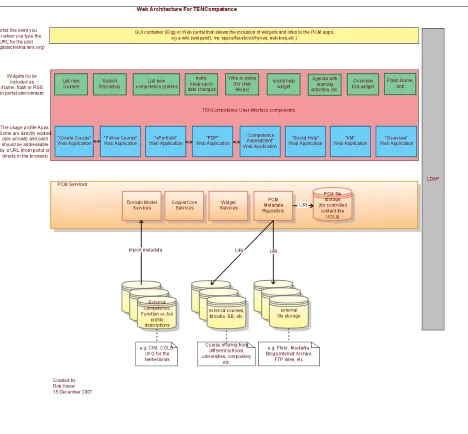
In the next two years, we plan to realise full PCM functionality, and extend the present client-server architecture to an architecture where the PCM server exposes services that will be consumed mainly by web clients and in some cases by rich clients. In addition to the PCM services the architecture also caters for inclusion of third-party web services and ‘dedicated’ services to be developed by individual aspect Work Packages. Widgets will allow the integration of the clients as Iframe, Flash or RSS in web portals or open source (web) platforms like ELGG4 (social networking) of Moodle (LMS).
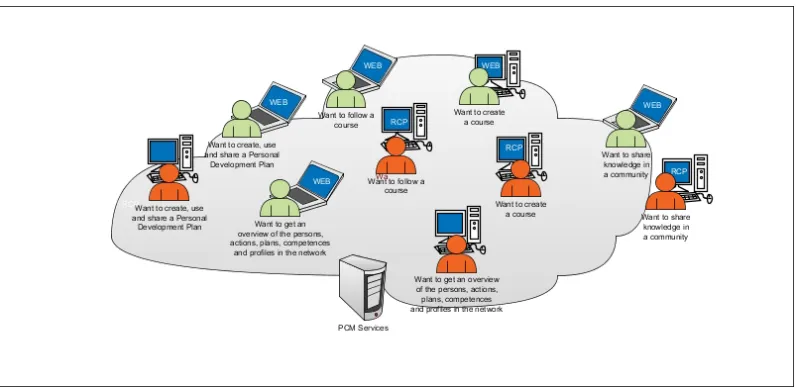
The web clients to be developed will provide a low threshold entry-point for new users, while the integrated rich client platform (RCP) will target ‘power users’. Both web client and rich client functionality will be described in terms of ‘usage profiles’.
Usage profile implementations are thus assembled on the basis of the services exposed by the PCM server, and will also consume web2.0 services provided by third parties (especially in the case of WP5).
This versatile architecture with dual client interfaces (web clients and rich client) will be realised through a phased approach to make it manageable:
4
TENCompetence – IST-2005-027087 Page 11 / 74
In the first six months of year 3 (till May 2008) work will concentrate on:
• Realising the first five high-priority usage profile implementations (see chapter 4 for details) as a mix of web-clients and integration components for the RCP (see figure 2). The clients developed in this period will only consume the services provided by the present PCM server v1.0.
• Designing additional usage profiles for implementation after May, five of which have already been identified (see below).
• Elaborating PCM services in preparation for additional usage profile implementations after May 2008.
• Creating the TENCompetence metadata repository, which integrates business objects exposed by the various services and links to various resources/learning activities/units of learning. Each usage profile implementation links to this tool.
In the following twelve months (June 2008 - May 2009) we will:
TENCompetence – IST-2005-027087 Page 12 / 74
Figure 2. TENCompetence web architecture
In order to realise this we will work with four programming teams:
• The WP3 PCM Services Team, responsible for exposing services from the PCM
server.
• The WP5-8 Web Client and Widget Teams, responsible for the implementation of
the web client usage profiles. These teams will in effect operate as one team, working on various web clients.
• The WP5-8 Rich Client Teams, responsible for the implementation of the different rich client usage profiles. These teams will in effect operate as one team, working on various rich clients.
TENCompetence – IST-2005-027087 Page 13 / 74
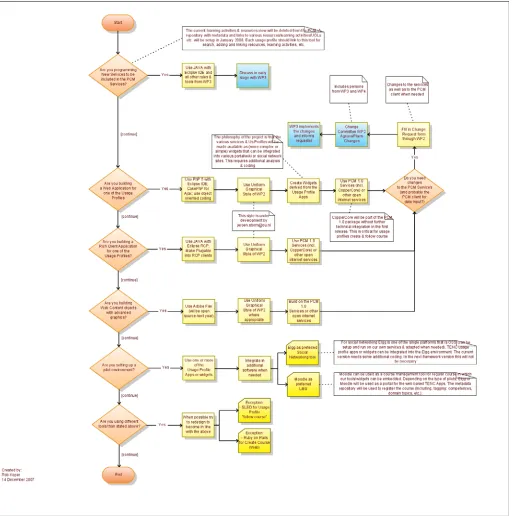
The selection of development tools in these different teams is based on: a) project principles (open source); b) a strong preference for a web2.0 approach, look and feel; c) the requirement that tools should preferably have a low entry threshold; and d) practical considerations like programmers familiarity with tools. Development coordination and tools selection is depicted below.
TENCompetence – IST-2005-027087 Page 14 / 74
Coordination and collaboration between the partners within the aspect Work Packages will be increased through weekly virtual meetings to stimulate participation, increase the tempo and synchronise efforts. Coordination between WP2, WP3 and the aspect WPs will be improved by regular face-to-face and on-line coordination sessions.
Taking into account the outcomes of the analysis, the Work Packages will work and cooperate on the basis of the following principles:
WP2 will be responsible for defining the usage profiles, which will be based on the high-level use cases and descriptions provided by the WP2 Vision Group. The actual development of the usage profiles will be the responsibility of ad-hoc working groups under WP2. These usage profiles so far are divided into the five high priority usage profile (see chapter 4) to be implemented before May 2008 by the aspect Work
Packages, and additional usage profiles to be implemented after May 2008 (see figure 4) by the aspect Work Packages.
The five high-priority usage profiles to be implemented till May 2008 are: • ‘Share knowledge in a community of practice’;
• ‘Create LD course’;
• ‘Follow LD course’;
• ‘Create and use personal development plans’;
• ‘Exploring resources, persons and competence profiles’.
The additional usage profiles that will be developed under WP2 before May, and to be implemented by the aspect Work Packages after May are:
• ‘e-Portfolio’;
• ‘Competence Assessment’;
• ‘Matching personal competences on job profiles to create personal development plans’;
• ‘Social help’.
WP2 will also be responsible for:
• Assessing and prioritising change requests for PCM services received from WP5-8, which will then be implemented by WP3 (see below).
• Defining the functional requirements for the integration of new rich client components into one integrated RCP, including its interaction design.
• Defining the functional requirements for the ‘TENCompetence portal’, integrating the various web clients.
TENCompetence – IST-2005-027087 Page 15 / 74
WP3 will concentrate on elaborating further services on the basis of the PCM server, and will build frequent releases of the integrated PCM based on the rich client components delivered by the aspect Work Packages (see next). The requirements for new/changed services will come from their aspect Work Packages, derived from
implementation requirements of the usage profiles. Such requirements will be evaluated and prioritised by WP2 (see above), after which WP3 will implement them.
In building PCM releases, WP3 will start with testing the technical quality of the delivered components. Functional quality of the components will be secured by the Aspect Work Packages themselves through user tests.
WP5-8 will each concentrate on implementing their ‘core’ usage profiles provided by
WP2 as a mix of web clients (preferably) and rich client components (only when a web client implementation will not be able to provide the required functionality). This includes technical design, programming, development of widgets, and usability testing of the web- and rich client implementations. Work on these cores will be prioritised, i.e. until completion they will take up the majority of capacity (around 80%) of the aspect Work Packages. Clients will be user- tested within the aspect Work Packages
themselves. Clients at the first stage will only use services (and related data stores) exposed by the PCM v1.0.
Before May 2008 the following usage profile implementations will be delivered: • WP5: ‘Share knowledge in a community of practice’, to be realised largely by
selecting, testing and integrating existing web2.0 services. Integration may be realised through a ‘Knowledge sharing home page’ using API’s to connect to underlying software services, but also by providing user guidance on how to use other web2.0 tools. Relating the TENCompetence identity management and
grouping strategies to those in underlying - existing web2.0 - services are the major challenges here.
• WP6: ‘Create LD course’, by integrating visual LD editing, QTI editing, course publishing, assigning users to runs, CopperCore, widget service, QTI service and SLED5 into a single, integrated, and easy to set up and use system/rich client component, together with a widget server for integration into the PCM RCP. Complementary to this WP6 will implement the ‘Follow LD course’ usage profile through a web client. Work on the competence assessment usage profile will start as part of the non-core (20%) activities in this period.
• WP7: ‘Create and use personal development plans’ by integrating the navigation and positioning tools prototyped under DIP-2. The rich client component will be developed first to replace the planning window in the present PCM RCP, and parallel to that the implementation of the web client.
• WP8: ‘Exploring resources, persons and competence profiles’ (the ‘Overview tool’) comprising rich competence descriptions; network visualisation and navigation; and network management) will be integrated as rich client components in the PCM first, and as web clients next.
5
TENCompetence – IST-2005-027087 Page 16 / 74
Figure 4. Usage profiles
After May 2008 the aspect Work Packages will concentrate on the following cores: • WP5: Further elaboration of ‘Share knowledge in a community of practice’ and
cooperate with WP8 on the ‘Social help’ usage profile.
• WP6: Further elaboration and integration with the other PCM services: integrate course bound assessment; extend authoring functionality with LD level b and c; and extend the widget server. Develop a web client for (simple) authoring and
deployment using web 2.0 principles.
• WP7: Further elaboration of the ‘Create and use personal development plans’ implementations, and technical design and implementation of the usage profile ‘Matching personal competences on job profiles to create personal development plans’.
• WP8: Include connection agents and game dynamics in the ‘Exploring resources, persons and competence profiles’ implementation, and implement the ‘Social help’ usage profile.
TENCompetence – IST-2005-027087 Page 17 / 74
only (e.g. CopperCore, Widget Service) may be implemented as a dedicated service. Final decisions, including those about implementation priorities, will be made by the WP2 Change Control Board.
2.3.2 Training activities
In principle as outlined in the Description of Work training activities would stepwise shift from an ‘internal’ orientation towards focusing on associate partners and other interested external audiences. However, given the identified challenges of ‘the changing world’ and ‘retaining common ground’, internal competence development and retaining common ground through training (WP9) and pro-active internal dissemination (WP10) remains necessary. Also the continuous turn-over of (junior) staff requires special efforts to bring new staff quickly up to date.
Therefore special coordination and training sessions will be organised by WP9 in close cooperation with WP2 and WP3 to secure a common understanding of the design and coordination of the software development activities by the various Work Packages.
2.3.3 Demonstration activities
In addition to version 1.0 of the technical infrastructure, TENCompetence has delivered the basis for the organizational infrastructure: the TENCompetence Foundation. Also a tender was put out at the end of year 2 to stimulate the active participation of SME’s. The technical infrastructure was validated through a first cycle of pilots. Starting in the third year and in particular in the fourth year demonstration activities will be designed and implemented through further pilots and by ‘activating’ the Foundation.
For the pilot activities managed by WP4 this implies running the cycle 2 pilots;
preparing the (Foundation) business model pilots (‘real-life demonstrators’) for the third cycle; developing tools that assist Associate Partners in participating as service
providers in cycle-3 pilots; and providing related training (through WP9) to these Associate Partners. Major points of attention for pilots are:
• Pilots should be large enough to demonstrate wide-impact use of the TENCompetence infrastructure
• Pilots should implement a combination of usage profiles (the separate usage profile implementations will be user-validated by the aspect WPs themselves),
demonstrating the flexible deployment of both the TENCompetence web-clients and the RCP.
• Pilots should start including associate partners in support roles in preparation for sustainability.
The TENCompetence Foundation has been established in such a way that it ‘copies’ the project aims, structure and planned activities. Starting in year 3 therefore, the
TENCompetence – IST-2005-027087 Page 18 / 74
TENCompetence – IST-2005-027087 Page 19 / 74
3
Pedagogical model definitions
3.1 Introduction
This section is the report of task WP2.2b: the development of pedagogical models for lifelong competence development. According to the DIP-2, our task was to:
“provide descriptions of new, promising innovative pedagogical approaches that meet the demands of lifelong competence development and new available learning technologies. The models integrate individual, collaborative and organisational learning, and knowledge management, and include technological artefacts as support for personal competence development. The models will be elaborated in successive specification documents - to be collected into an overall TENCompetence Pedagogical Models document (part of D2.2 and D2.3). The subtask feeds into subtask 2a, thus providing an overall vision, to be elaborated and specified towards WPs 3-8 in task 3.”
TENCompetence – IST-2005-027087 Page 20 / 74
Figure 5 shows an actor involved in lifelong competence development, who is situated in a specific ecological niche or context (e.g. a discipline or environment), both with their own characteristics. The grey box indicates the type of competence that this actor has to develop, and the green box indicates the infrastructure that TENCompetence offers for supporting learning. Learning takes place as the actor, either self-directed or triggered by an event, performs one or more learning activities, with one or more results.
The following list of what Koper (2005) mentions as ‘parts of competence development’, could be seen as a first approximation of an organisational model, of a list of those things that should be organised in an infrastructure for lifelong competence development:
1. Identification and naming of competences for specific groups of actors within specific ecological niches (e.g. disciplines).
2. Positioning actors relative to these competences: which proficiency levels have already been achieved, which proficiency levels does one want to achieve. 3. Identifying the right communities and the integration of persons into these
communities.
4. Identification and supply of adequate learning paths or curricula for the
development of competences.
5. Identification and supply of adequate learning activities (tasks, problems etcetera) as part of these learning paths.
6. Identification and supply of adequate learning resources as part of these learning activities.
7. Support with the performance of learning activities and with the search for adequate knowledge resources.
8. Supply of assessments in order to provide feedback on the results of learning
activities.
This report builds on an earlier TENCompetence deliverable, D6.1, in which the foundation was laid for what pedagogical models in TENCompetence should be.
In Deliverable D6.1 Pedagogical models for lifelong competence development were defined as a representation of a pedagogic activity using IMS Learning Design, which may or may not be a full Unit of Learning, and which can be used as the basis of authoring and delivering learning activities for the attainment of the desired competences using the TENCompetence infrastructure.
TENCompetence – IST-2005-027087 Page 21 / 74
Our main research question is:
What aspects of learning have to be organised by those who offer lifelong competence development opportunities in order to optimally facilitate learning?
This document contains the answers we found to this question. It is organised as follows. Section 3.2 explains the research method we used and the rationale behind it. In section 3.3 the organisational model resulting from our research is presented, followed by a detailed explanation of how it was derived from the literature we studied. Finally, section 3.4 contains our conclusions.
3.2 Method
Based on the preceding information, our task can be described as follows: to develop an overview of pedagogical elements that are needed in supporting life-long competence development, and to show their connections and functioning in context. Ultimately, this should lead to a description in the form of a specification. In operationalising this task, we use the concept of life-long competence development, as defined by Cheetham and Chivers (2005). They make a distinction between different classes of competences:
• cognitive competence (knowledge)
• functional competence (skills or competencies) • personal competence (e.g. intelligence, flexibility) • ethical competence (attitudes)
• trans-/meta-competences (e.g. communication skills)
In this sense competences can be seen as combinations of knowledge, skills, attitudes and the reflection on these components.
TENCompetence – IST-2005-027087 Page 22 / 74
The disciplines and the key publications are listed below.
(Lifelong) competence development
(Cheetham & Chivers, 2005; Eraut, 1994)
The literature on (lifelong) competence development is a very important source of information. It is most directly relevant to the topic. Important issues include (1) the aim of learning, which is competences, rather than courses or subjects in traditional education; (2) assessment, which is a continuous process of measuring life-long progress, rather than a one-shot exam and (3) the context, which is often related to professional work.
Competence-based education
(Eraut, 2004; Hyland, 1993)
With lifelong competence development, competence-based education shares having competences as the basic organising principle of learning. From this tradition, much focus has been on curriculum innovation and on the changing role of the teacher. In competence-based education, teacher and assessor are different roles and ideally different persons. The teacher role itself undergoes a change from instructor to a more coaching role.
Distributed cognition
(Pea, 1993; Perkins, 1993; Salomon, 1993)
Distributed cognition focuses on individuals in their daily surroundings, e.g. their workplace, and how they interact with the available tools. The main question is what and how people in such situations will have to learn. This will be completely different from learning in schools, in which individuals are asked to reproduce by heart factual knowledge, which is not connected to practice.
Experiential learning
(Hyland, 1994)
Experiential learning states that in their everyday practice, people will encounter situations from which they can learn by reflecting on these situations. Learning on the workplace in the widest sense of the word is central. As in competence
development, learning is seen as a continuous, repeating cycle of experience and reflection.
Development of expertise
(Bransford, Brown, & Donovan, 2000)
TENCompetence – IST-2005-027087 Page 23 / 74
Communities of practice
(Lave & Wenger, 1991)
People learn in communities of practice, groups of people who together work towards the game goal, e.g. at the workplace. Communities of practices have been studied from the
perspective how both individuals and groups develop, and how this development, thus including competence development, can best be supported.
Organisational learning
(Argyris, 1999)
From the organisational perspectives, analyses have been made how organisational learning can best be supported. Strategies are described for stimulating ‘double loop learning’ in which individuals not only correct mistakes and mistaken knowledge, but also learn how to solve problems effectively. Problem solving thus contributes to competence development.
Validation of prior learning
(Duvekot, 2005)
In lifelong competence development, individuals often have moments in which they wish or have to acquire some formal qualification. Validation of prior learning is about the matching of the competences that an individual, formally or informally, has already acquired, to the requirements of qualification programmes. A good fit between the two contributes to efficient competence development.
Adult learning
(Knowles, Holton, & Swanson, 2005)
The majority of people engaged in lifelong competence development, are adults. From the perspective of adult
learning, much study has been done on how to best support this age group. One very important point is how to deal with the enormous diversity among adult learners.
Navigational learning
(Peterson & Levene, 2003)
TENCompetence – IST-2005-027087 Page 24 / 74
3.3 Results
This chapter starts with a summary of the organisational model that was derived from the literature listed presented above. After that, for each aspect of the model, it is explained how it was derived from the literature.
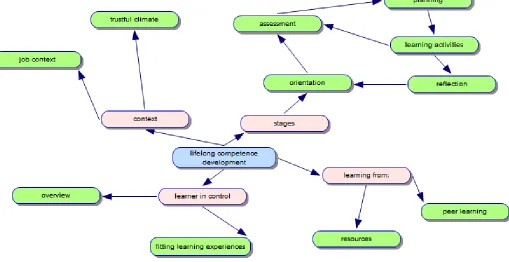
Figure 6. Model of aspects to be organised by those who offer lifelong competence development opportunities
Figure 6 visualises the model resulting from our literature analyses. It shows that from our analysis, four main aspects should be organised for an optimal support of lifelong competence development. Each aspect is composed of several underlying actions. These are comprised of:
• Organise the learning context
o Integrate the lifelong competence development opportunities with learning on the job and learning in daily life
o Create a trustful and warm learning climate
• Organise the different stages of lifelong competence development, which are:
o Orientation
o Assessment
o Planning
o Learning activities
TENCompetence – IST-2005-027087 Page 25 / 74 • Put the learner into control of their own learning:
o Fit the competence development opportunities to their learning experiences
o Enable peer learning and peer guidance
• Provide resources and guidance of which learners can learn from, which include:
o Material resources
o Human resources
Below we explain in more detail how these four aspects and their underlying actions were derived from the literature study.
Organise the learning context
The fist component of the organisational model for lifelong competence development is organising the learning context. Important here is the integration of learning into the job context and the creation of a trustful learning climate for learners.
There are several views on why learning in daily life should have a central position in lifelong competence development.
According to Knowles et al. (2005), experience is the richest source for learning, thus the core methodology of adult learning is the analysis of experience. A slightly different view on the relation between learning and experience comes from Kolb (1984). Kolb views learning as a continuous process grounded in experience, a process of adaptation through the resolution of conflicts and opposing viewpoints. For Lave and Wenger (1991) it is participation in a cultural practice which created opportunities for learning, and guaranteeing participatory access to these practices is an important task for those who organise learning.
Professional work of any complexity requires the concurrent use of several different kinds of knowledge in an integrated, purposeful manner. Yet this is difficult to achieve without significant interaction between formal teaching and professional practice (Eraut, 1994). Enough time should be devoted to learning how to apply theoretical knowledge to daily practice (Engeström, 1994; Eraut, 1994; Knowles et al., 2005).
Problems in their real-life situation make adults ready to learn. This applies especially to the transition between one developmental job stage to another. Adult learning should make use of this readiness to learn (Knowles et al., 2005).
TENCompetence – IST-2005-027087 Page 26 / 74 Learning climate
Create a trustful learning climate in which the learners can share feelings and thoughts, respect the feelings and thoughts of others and in which they can seek collaboration is an essential in organising the learning context of lifelong learners. Such a climate is characterised by physical comfort, mutual trust and respect, mutual helpfulness, freedom of expression, and acceptance of differences. Each student should be accepted as a person of worth and respects his feelings and ideas. Teachers should seek to build relationships of mutual trust and helpfulness among the students by encouraging cooperative activities and refraining from inducing competitiveness and judgementalness. Teachers should expose their own feelings and contribute their resources as a co-learner in the spirit of mutual inquiry (Knowles et al., 2005).
Organise the different stages of learning
Organising different stages of learning is the second component of the organisational model for lifelong competence development. This component compromises of:
• Orientation
• Assessment
• Planning
• Learning activities
• Overview/monitoring/reflection
Orientation
Lifelong competence development starts with the learner’s awareness. Awareness involves two things. First, the learner has to become aware of his/here learning needs, why do they need to learn (Knowles et al., 2005). Second, the learner has to become aware of the competences s/he possesses and the values these competences have for others in certain contexts at certain moments (Duvekot, 2005).
TENCompetence – IST-2005-027087 Page 27 / 74 Assessment
Students should have the opportunity to regularly test their proficiency level with respect to the competence as a whole, independent from learning resources, in an assessment that captures the complexity of the competence in real life, and in which they have to collect evidence from their whole experience in both formal and informal learning.
A series of assessments over appropriate intervals of time would indicate progress and provide evidence for formative feedback, while their combined reliability would be considerably greater than the current system of occasional high stakes assessments (Eraut, 2004). Assessment, according to Duvekot (2005), should make visible and value the full range of qualifications and competences held by an individual. In an assessment the required competences should all be integrated together in larger, more complex chunks of behaviour, rather that treating them as separate bundles of knowledge and skills (Eraut, 2004). The assessment occurs irrespective of where the competences have been acquired, and through each learning path, formal or informal.
Planning
Learners should be enabled to make a planning for their learning, in close consultation with their organisations and tutors. Learners and tutors have a shared responsibility for planning, and mechanisms should be put in place that enable mutual planning (Knowles et al., 2005). Duvekot (2005) mentions the interplay between the individuals who need to be able to take control of their own learning and organisations who should facilitate the learners’ individual learning paths. An implication of this stance, not mentioned explicitly, is that setting up an action plan must be a mutual undertaking.
Learning activities
The learning activities presented to the learner that make up the competence development opportunities should be based upon learners’ experience, on real-life situations, on reflection on their own learning experiences, and on applying acquired knowledge to daily practice. Learning activities should:
• help learners recognise meaningful patterns of information
• make use of instructional procedures that speed pattern recognition • help students learn about conditions of applicability
• provide models of how experts solve problems (Bransford et al., 2000)
TENCompetence – IST-2005-027087 Page 28 / 74
These learning activities should facilitate lifelong competence development. From a development point of view, this entails the development from being a novice to becoming an expert. From research on expertise, it is known that experts differ from novices on several dimensions. Four of them are directly relevant to education:
1. Experts notice features and meaningful patterns of information that are not noticed by novices. One dimension of acquiring greater competence appears to be the increased ability to segment the perceptual field (learning how to see). Research on expertise suggests the importance of providing students with learning experiences that specifically enhance their abilities to recognise meaningful patterns of information (e.g., Bransford, Franks, Vye, & Sherwood, 1989 ; Simon, 1980).
2. Experts' knowledge cannot be reduced to sets of isolated facts or propositions but, instead, reflects contexts of applicability: that is, the knowledge is "conditionalised" on a set of circumstances. One way to help students learn about conditions of applicability is to assign word problems that require students to use appropriate concepts and formulas (Lesgold et al., 1988; Simon, 1980). The concept of conditionalised knowledge also has important implications for assessment practices that provide feedback about learning. Many types of tests fail to help teachers and students assess the degree to which the students' knowledge is conditionalised. 3. Experts have acquired a great deal of content knowledge that is organised in ways
that reflect a deep understanding of their subject matter (Bransford et al., 2000). Research on expertise suggests that a superficial coverage of many topics in the domain may be a poor way to help students develop the competencies that will prepare them for future learning and work. The idea of helping students organise their knowledge also suggests that novices might benefit from models of how experts approach problem solving--especially if they then receive coaching in using similar strategies (e.g., Brown, Collins, & Duguid, 1989).
4. Experts are able to flexibly retrieve important aspects of their knowledge with little attentional effort. The use of instructional procedures that speed pattern recognition are promising in this regard (e.g., Simon, 1980).
From the perspective of organisational learning, it is very important that double-loop learning is supported. Whenever an error is detected and corrected without questioning or altering the underlying values of the system (be it individual, group, intergroup, organisational or inter-organisational), the learning is single-loop. Single-loop learning occurs when matches are created, or when mismatches are corrected by changing actions. Double-loop learning occurs when mismatches are corrected by first examining and altering the governing variables and then the actions (Argyris, 1999).
TENCompetence – IST-2005-027087 Page 29 / 74
1. The emphasis in adult education should be on experiential techniques - techniques that tap into the experience of the learners, such as group discussions, simulation exercises, problem solving activities, case methods, and laboratory methods instead of transmittal techniques.
2. For adults, their experience is who they are. Thus, in any situation in which the participants' experiences are ignored or devalued, adults will perceive this as rejecting not only their experience, but rejecting themselves as persons.
3. Adults’ orientation to learning is focused on their experience. Adults are motivated to learn to the extent that they perceive that learning will help them perform tasks or deal with problems that they confront in their life situations. Furthermore, they learn new knowledge, understandings, skills, and attitudes most effectively when they are presented in the context of application to real-life situations.
On the negative side, as adults accumulate experience, they tend to develop mental habits, biases, and presuppositions that tend to cause them to close their minds to new ideas, fresh perceptions, and alternative ways of thinking. Adult educators should try to discover ways to help adults examine their habits and biases and open their minds to new approaches. Sensitivity training, values clarification, meditation, and dogmatism scales are among the techniques that are used to tackle this problem (Knowles et al., 2005).
Overview / monitoring / reflection
The self-directing adult learner (Duvekot, 2005; Knowles et al., 2005) chooses his/her own learning trajectory. To be able to do so, some support is needed. At any point in their learning trajectory, learners should be enabled to monitor their progress, to reflect upon their results and their experiences. This monitoring and reflection can serve several goals, among them:
1. that learners get a sense of progress toward their goals (Knowles et al., 2005) and 2. that they can choose those learning activities that match their current progress
(Peterson & Levene, 2003).
Monitoring and reflection can be performed by several means. Self-assessment (Knowles et al., 2005) and peer-assessment (Eraut, 2004) play an important role in professional life. The criteria for self-assessment should be developed in a joint effort by learner and teacher (Knowles et al., 2005). Progress is best indicated by a series of assessments (self-assessments or other types of assessment) over time, rather than having occasional high stakes assessments (Eraut, 2004).
TENCompetence – IST-2005-027087 Page 30 / 74 Put the learner in control
Putting the learner in control by enabling them to find those learning resources that match to their readiness to learn, their prior experience, their needs, interests and proficiency levels is the third component of the organisational model for lifelong competence development. Learners should be in control to create useful competence development programmes which fit with their experiences. In lifelong competence development there should be a greater emphasis on individualisation of teaching and learning strategies (Knowles et al., 2005).
Prior experience exists of both resources and mental models. That the learning resources should match the learner’s prior experience follows from the fact that their experience is itself the richest resource for adults’ learning, it is what they are. Adults become ready to learn those things they need to know and be able to do in order to cope effectively with their real-life situations. The motivation of adult learners lies in satisfying their needs and interests. An especially rich source of "readiness to learn" is the developmental tasks associated with moving from one developmental stage to the next, e.g. in job promotion (Knowles et al., 2005).
Provide resources and guidance of which learners can learn from
The last component of the organisational model of lifelong competence development is formed by the provision of the widest possible range and well organised resources to the learners (Rogers, 1969). Resources are meant here as both materials and people. For learners there is support needed to find their way in the abundance of learning opportunities. Therefore it would be good if learners could have an overview of all the resources, and what there is to be learned (Lave & Wenger, 1991). Personalisation on resources, based upon the learner’s preferences and comparisons between the learner’s profile and the properties of resources, provide the learner the optimal support to make their choice in all the resources available (Peterson & Levene, 2003).
TENCompetence – IST-2005-027087 Page 31 / 74
3.4
Connecting the pedagogical model and the usage
profiles
The activities described in the usage profiles (c.f. chapter 4) can be categorized under the headings of the pedagogical model. Some activities belong to more than one category. Note that the activities are not equally divided among the categories.
Organise the learning context
• Integrate the lifelong competence development opportunities with learning on the job and learning in daily life
Discuss progress with tutor or employer • Create a trustful and warm learning climate
Register
Engaging (adding peers to one’s network)
Organise the different stages of lifelong competence development, which are:
• Orientation
Search for a course
Search for an activity
Browsing knowledge networks
Search topic areas or topics
• Assessment
Carry out assessment activities
• Planning
Create and adapt a PDP
Publish plan
Collaborate on plan
View plan
• Learning activities
Follow a PDP
Navigate and use activities and resources
• Overview/monitoring/reflection
Reflection on progress within pdp
Mark courses as completed
Mark activities as complete and reveal the next
TENCompetence – IST-2005-027087 Page 32 / 74 Put the learner into control of their own learning:
– Fit the competence development opportunities to their learning experiences
– Enable peer learning and peer guidance
Participate in forums and chats
Exchange and share the things they make in the course
Discuss topics
Publish topic area
Collaborate topic area (viewers / collaborators)
Provide resources and guidance of which learners can learn from, which include:
– Material resources
Search for a course
Search for an activity
Browsing knowledge networks
Search topic areas or topics
Rating
Rate resources
Create a topic area
Fill the topic area with resources
Create topics under the topic area
Regroup the resources to different topics
Add new resources and activity descriptions
Manipulating the repository
– Human resources
Describing oneself
Engaging (adding peers to one’s network)
TENCompetence – IST-2005-027087 Page 33 / 74
3.5
Conclusion & future directions
In this document we have investigated the question what aspects of learning have to be organised by those who offer lifelong competence development opportunities in order to optimally facilitate learning. We based our analysis on the literature study of fourteen key publications in areas relevant to lifelong competence development, namely (lifelong) competence development, competence-based education, distributed cognition, experiential learning, development of expertise, communities of practice, organisational learning, the validation of prior learning, adult learning, and navigational learning.
The outcome was that in order for lifelong competence development to be optimally facilitated, four main aspects should be organised: organise the learning context; organise the different stages of lifelong competence development; put the learner into control of their own learning; provide resources and guidance from which learners can learn.
If we now compare these four aspects to the early Domain model of Koper (2005), presented in the introduction, we see that each of them relates to specific aspects of the Domain model:
• Organise the learning context can be translated as ‘connect the learning to the
existing ecological niche’
• Organise the different stages of lifelong competence development is visible with respect to two stages, namely: assessment, and the performance of learning activities • Put the learner into control of their own learning can be translated as ‘take into
account the actor characteristics’
• Provide resources and guidance from which learners can learn is visible in the green box, which includes both human resources (namely learning networks) and material resources (called ‘knowledge resources’)
Also, Koper’s (2005) list of eight aspects that should be organised in an infrastructure for lifelong competence development, can now be categorised under our four main aspects as follows:
Provide resources and guidance from which learners can learn:
3. Identifying the right communities and the integration of persons into these communities.
6. Identification and supply of adequate learning resources as part of these learning activities.
Organise the different stages of lifelong competence development: orientation
TENCompetence – IST-2005-027087 Page 34 / 74
2. Positioning actors relative to these competences: which proficiency levels have already been achieved, which proficiency levels does one want to achieve.
Organise the different stages of lifelong competence development: planning
4. Identification and supply of adequate learning paths or curricula for the development of competences.
Organise the different stages of lifelong competence development: learning activities
5. Identification and supply of adequate learning activities (tasks, problems etcetera) as part of these learning paths.
7. Support with the performance of learning activities and with the search for adequate knowledge resources.
Organise the different stages of lifelong competence development: assessment
8. Supply of assessments in order to provide feedback on the results of learning activities.
Finally, we have made a first attempt to categorize the activities described in the usage profiles under the headings of the pedagogical model.
Our resulting model is a very first draft of an organisational model for lifelong competence development. Thus, further research should include validation and elaboration of the model. Our model is very different to traditional models of organising learning in formal education, or models for curriculum development. According to these models, providers of education should determine the rationale, aims and objectives, goals, content, learning activities, teacher role, materials and resources, grouping, location, time and assessment of learning. One question for further research could be to what extent our model would be relevant to traditional education, especially given the trend towards more open curricula, in which learner have more possibilities for creating their own learning pathways.
3.6 References
Argyris, C. (1999). On organizational learning.
Bransford, J. D., Brown, A. L., & Donovan, M. S. (2000). How people learn : brain, mind, experience, and school, National Research Council. Commission on Behavioral and Social Sciences and Education (Expanded ed., pp. X, 374). Washington, DC: National Academy Press.
Bransford, J. D., Franks, J. J., Vye, N. J., & Sherwood, R. D. (1989 ). New approaches to instruction: Because wisdom can't be told. In S. V. a. A. Ortony (Ed.),
TENCompetence – IST-2005-027087 Page 35 / 74
Brown, J. S., Collins, A., & Duguid, P. (1989). Situated cognition and the culture of learning. Educational Researcher, 18, 32-41.
Cheetham, G., & Chivers, G. E. (2005). Professions, competence and informal learning. Cheltenham: Edward Elgar.
Duvekot, R. (2005). VPL in 10 steps. In R. Duvekot, K. Schuur & J. Paulusse (Eds.),
The unfinished story of VPL. Validation and valuation of prior learning in Europe's learning cultures. (pp. 11-27). The Netherlands, Utrecht: Foundation EC-VPL & Kenniscentrum EVC.
Engeström, Y. (1994). Training for Change: New Approach to Instruction and Learning in Working Life. Geneva: International Labour Office.
Eraut, M. (1994). Developing professional knowledge and competence. London: Falmer Press.
Eraut, M. (2004). A wider perspective on assessment. Medical education, 38(8), 803-804.
Hyland, T. (1993). Professional Development and Competence-based Education.
Educational studies, 19(1), 123-132.
Hyland, T. (1994). Experiential Learning, Competence and Critical Practice in Higher Education. Studies in higher education, 19(3), 327-340.
Knowles, M. S., Holton, E. F., III, & Swanson, R. A. (2005). The adult learner: the definitive classic in adult education and human resource development (6th ed.). Amsterdam: Elsevier.
Kolb, D. A. (1984). Experiential learning: experience as the source of learning and development. Englewood Cliffs, N.J.: Prentice-Hall.
Koper, R. (2005). Het Stimuleren van Levenslange Competentieontwikkeling Met Nieuwe Leertechnologie [Stimulating lifelong competence development using new learning technology]. Keynote EduExchange December 7, 2005.
Lave, J. & Wenger, E. C. (1991). Situated learning: legitimate peripheral participation. Cambridge: Cambridge University Press.
Lesgold, A. M., Rubison, H., Feltovich, P., Glaser, R., Klopfer, D., & Wang, Y. (1988). Expertise in a complex skill: Diagnosing x-ray pictures. In M. T. H. Chi, R. Glaser & M. Farr (Eds.), The Nature of Expertise (pp. 311-342). Hillsdale, NJ: Erlbaum.
Lindeman, E. C. (1926). The meaning of adult education.
Pea, R. D. (1993). Practices of distributed intelligence and designs for education. In G. Salomon (Ed.), Distributed cognitions: psychological and educational
considerations (pp. 47-87). Cambridge: Cambridge University Press.
TENCompetence – IST-2005-027087 Page 36 / 74
Peterson, D. & Levene, M. (2003). Trail records and navigational learning. London review of education, 1(3), 207-216.
Rogers, C. R. (1969). Freedom to learn. Columbus: Merrill.
Salomon, G. (1993). No distribution without individuals' cognitions: a dynamic interactional view. In G. Salomon (Ed.), Distributed cognitions: psychological and educational considerations (pp. 111-138). Cambridge: Cambridge
University Press.
Simon, H. A. (1980). Problem solving and education. In D. T. Tuma & R. Reif (Eds.),