VOLUME NO.6(2016),ISSUE NO.04(APRIL) ISSN 2231-5756
A Monthly Double-Blind Peer Reviewed (Refereed/Juried) Open Access International e-Journal - Included in the International Serial Directories
Indexed & Listed at:
VOLUME NO.6(2016),ISSUE NO.04(APRIL) ISSN 2231-5756
CONTENTS
Sr.
No.
TITLE & NAME OF THE AUTHOR (S)
Page
No.
1
.
FINANCIAL
APPRAISAL
OF
VARIOUS
FINANCIAL
SERVICES
OF
COOPERATIVE
CREDIT
SOCIETIES/PATANSTHAS IN AHMEDNAGAR DISTRICT
V. M. TIDAKE & DR. SANJAY V. PATANKAR
1
2
.
A REVIEW OF ETHICAL LEADERSHIP: GOING BEYOND THE CONVENTIONAL UNDERSTANDING
SHAJI JOSEPH & DR. ASHA NAGENDRA
8
3
.
mHealth: THE CLINICIANS PERSPECTIVE IN INDIA
S N SHUKLA & J. K. SHARMA
12
4
.
FINANCIAL INCLUSION AND ROLE OF PAYMENT AND SMALL FINANCIAL BANKS
DR. GITA SANATH SHETTY
18
5
.
THE IMPACT OF SUPPLY CHAIN MANAGEMENT ON AUTOMOBILE SERVICE CENTERS (PASSENGER
CARS) IN INDIA AND FUTURE IMPLICATIONS
DR. ASHA NAGENDRA, VINOD GYPSA & VINCENT SUNNY
25
6
.
SOCIAL MEDIA FOR RECRUITMENT
DR. SURUCHI PANDEY, GUNJAN AGARWAL & SWAPNIL CHARDE
30
7
.
EFFECT OF THE MAGGI FIASCO ON THE BRAND IMAGE OF NESTLE AND ITS IMPACT ON OVERALL
PACKAGED FOOD CATEGORY
PRANNAV SOOD, PRADEEP RAWAT, NAVNEET PRIYA & DR. KOMAL CHOPRA
35
8
.
IRREVOCABLE LETTERS OF CREDIT AND THE RESPONSIBILITY OF THE BANKS
DR. OSAMA MUSTAFA MUDAWI & DR. ELFADIL TIMAN
40
9
.
GOVERNANCE, ETHICS AND SUSTAINABILITY: A REVISIT IN THE LIGHTS OF LESSON’S FROM
KAUTILYA’S ‘ARTHASASTHRA’
DR. VINEETH KM & DR. GEETHA. M.
45
10
.
A CONCEPTUAL STUDY ON DISTANCE EDUCATION: PROBLEMS AND SOLUTIONS
ASHA RANI.K
48
11
.
WOMEN ENTREPRENEURSHIP IN INDIA
A. SESHACHALAM
53
12
.
IMPACT OF FII FLOWS ON INDIAN MARKET VOLATILITY
CH R S CH MURTHY
56
13
.
A STUDY ON OPTIMIZATION TECHNIQUES OF TRAVELLING SALESMAN PROBLEM USING GENETIC
ALGORITHM
DR. T. LOGESWARI
62
14
.
INDIAN IT SECTOR: AN OCEAN OF OPPORTUNITIES
PARAMJEET KAUR
67
15
.
RURAL ENTREPRENEURSHIP: A STUDY OF DISTRICT ALMORA, UTTRAKHAND
ABHA RANI
73
16
.
THE EFFECT OF ORGANIZATIONAL CLIMATE ON WORK LIFE BALANCE
OZAN BUYUKYILMAZ & SERTAC ERCAN
76
17
.
A DESCRIPTIVE STUDY ON THE IMPACT OF EMPLOYEE MOTIVATION TOWARDS THEIR CAREER
GROWTH AND DEVELOPMENT
MEHALA DEVI.R & AARTHI.S.P
81
18
.
A STUDY ON PROBLEMS FACED BY THE CUSTOMERS WITH REFERENCE TO BANKING SERVICES IN
PRIVATE SECTOR BANKS
NANDINI.N
83
19
.
E-RECRUITMENT: CHALLENGES AND EFFECTIVENESS
SWAGATIKA NANDA
93
20
.
A STUDY ON TRAITS AND ATTITUDES OF RURAL WOMEN ENTREPRENEURSHIP
SR. MANIKYAM
96
VOLUME NO.6(2016),ISSUE NO.04(APRIL) ISSN 2231-5756
CHIEF PATRON
PROF. K. K. AGGARWAL
Chairman, Malaviya National Institute of Technology, Jaipur
(An institute of National Importance & fully funded by Ministry of Human Resource Development, Government of India)
Chancellor, K. R. Mangalam University, Gurgaon
Chancellor, Lingaya’s University, Faridabad
Founder Vice-Chancellor (1998-2008), Guru Gobind Singh Indraprastha University, Delhi
Ex. Pro Vice-Chancellor, Guru Jambheshwar University, Hisar
FOUNDER PATRON
LATE SH. RAM BHAJAN AGGARWAL
Former State Minister for Home & Tourism, Government of Haryana
Former Vice-President, Dadri Education Society, Charkhi Dadri
Former President, Chinar Syntex Ltd. (Textile Mills), Bhiwani
FORMER CO-ORDINATOR
DR. S. GARG
Faculty, Shree Ram Institute of Business & Management, Urjani
ADVISORS
PROF. M. S. SENAM RAJU
Director A. C. D., School of Management Studies, I.G.N.O.U., New Delhi
PROF. M. N. SHARMA
Chairman, M.B.A., Haryana College of Technology & Management, Kaithal
PROF. S. L. MAHANDRU
Principal (Retd.), Maharaja Agrasen College, Jagadhri
EDITOR
PROF. R. K. SHARMA
Professor, Bharti Vidyapeeth University Institute of Management & Research, New Delhi
CO-EDITOR
DR. BHAVET
Faculty, Shree Ram Institute of Engineering & Technology, Urjani
EDITORIAL ADVISORY BOARD
DR. RAJESH MODI
Faculty, Yanbu Industrial College, Kingdom of Saudi Arabia
PROF. SANJIV MITTAL
University School of Management Studies, Guru Gobind Singh I. P. University, Delhi
PROF. ANIL K. SAINI
Chairperson (CRC), Guru Gobind Singh I. P. University, Delhi
DR. SAMBHAVNA
VOLUME NO.6(2016),ISSUE NO.04(APRIL) ISSN 2231-5756
DR. MOHENDER KUMAR GUPTA
Associate Professor, P. J. L. N. Government College, Faridabad
DR. SHIVAKUMAR DEENE
Asst. Professor, Dept. of Commerce, School of Business Studies, Central University of Karnataka, Gulbarga
ASSOCIATE EDITORS
PROF. NAWAB ALI KHAN
Department of Commerce, Aligarh Muslim University, Aligarh, U.P.
PROF. ABHAY BANSAL
Head, Department of I.T., Amity School of Engineering & Technology, Amity University, Noida
PROF. A. SURYANARAYANA
Department of Business Management, Osmania University, Hyderabad
PROF. V. SELVAM
SSL, VIT University, Vellore
DR. PARDEEP AHLAWAT
Associate Professor, Institute of Management Studies & Research, Maharshi Dayanand University, Rohtak
DR. S. TABASSUM SULTANA
Associate Professor, Department of Business Management, Matrusri Institute of P.G. Studies, Hyderabad
SURJEET SINGH
Asst. Professor, Department of Computer Science, G. M. N. (P.G.) College, Ambala Cantt.
FORMER TECHNICAL ADVISOR
AMITA
Faculty, Government M. S., Mohali
FINANCIAL ADVISORS
DICKIN GOYAL
Advocate & Tax Adviser, Panchkula
NEENA
Investment Consultant, Chambaghat, Solan, Himachal Pradesh
LEGAL ADVISORS
JITENDER S. CHAHAL
Advocate, Punjab & Haryana High Court, Chandigarh U.T.
CHANDER BHUSHAN SHARMA
Advocate & Consultant, District Courts, Yamunanagar at Jagadhri
SUPERINTENDENT
VOLUME NO.6(2016),ISSUE NO.04(APRIL) ISSN 2231-5756
CALL FOR MANUSCRIPTS
We invite unpublished novel, original, empirical and high quality research work pertaining to recent developments & practices in the areas of Computer Science & Applications; Commerce; Business; Finance; Marketing; Human Resource Management; General Management; Banking; Economics; Tourism Administration & Management; Education; Law; Library & Information Science; Defence & Strategic Studies; Electronic Science; Corporate Governance; Industrial Relations; and emerging paradigms in allied subjects like Accounting; Accounting Information Systems; Accounting Theory & Practice; Auditing; Behavioral Accounting; Behavioral Economics; Corporate Finance; Cost Accounting; Econometrics; Economic Development; Economic History; Financial Institutions & Markets; Financial Services; Fiscal Policy; Government & Non Profit Accounting; Industrial Organization; International Economics & Trade; International Finance; Macro Economics; Micro Economics; Rural Economics; Co-operation; Demography: Development Planning; Development Studies; Applied Economics; Development Economics; Business Economics; Monetary Policy; Public Policy Economics; Real Estate; Regional Economics; Political Science; Continuing Education; Labour Welfare; Philosophy; Psychology; Sociology; Tax Accounting; Advertising & Promotion Management; Management Information Systems (MIS); Business Law; Public Responsibility & Ethics; Communication; Direct Marketing; E-Commerce; Global Business; Health Care Administration; Labour Relations & Human Resource Management; Marketing Research; Marketing Theory & Applications; Non-Profit Organizations; Office Administration/Management; Operations Research/Statistics; Organizational Behavior & Theory; Organizational Development; Production/Oper-ations; International RelProduction/Oper-ations; Human Rights & Duties; Public Administration; Population Studies; Purchasing/Materials Management; Retailing; Sales/Selling; Services; Small Business Entrepreneurship; Strategic Management Policy; Technology/Innovation; Tourism & Hospitality; Transportation Distribution; Algorithms; Artificial Intelligence; Compilers & Translation; Computer Aided Design (CAD); Computer Aided Manufacturing; Computer Graphics; Computer Organization & Architecture; Database Structures & Systems; Discrete Structures; Internet; Management Information Systems; Mod-eling & Simulation; Neural Systems/Neural Networks; Numerical Analysis/Scientific Computing; Object Oriented Programming; Operating Systems; Pro-gramming Languages; Robotics; Symbolic & Formal Logic; Web Design and emerging paradigms in allied subjects.
Anybody can submit the soft copy of unpublished novel; original; empirical and high quality research work/manuscriptanytime in M.S. Word format after preparing the same as per our GUIDELINES FOR SUBMISSION; at our email address i.e. [email protected] or online by clicking the link online
submission as given on our website (FOR ONLINE SUBMISSION, CLICK HERE).
GUIDELINES FOR SUBMISSION OF MANUSCRIPT
1. COVERING LETTER FOR SUBMISSION:
DATED: _____________
THE EDITOR
IJRCM
Subject: SUBMISSION OF MANUSCRIPT IN THE AREA OF .
(e.g. Finance/Mkt./HRM/General Mgt./Engineering/Economics/Computer/IT/ Education/Psychology/Law/Math/other, please specify)
DEAR SIR/MADAM
Please find my submission of manuscript entitled ‘___________________________________________’ for possible publication in one of your journals.
I hereby affirm that the contents of this manuscript are original. Furthermore, it has neither been published elsewhere in any language fully or partly, nor is it under review for publication elsewhere.
I affirm that all the co-authors of this manuscript have seen the submitted version of the manuscript and have agreed to their inclusion of names as co-authors.
Also, if my/our manuscript is accepted, I agree to comply with the formalities as given on the website of the journal. The Journal has discretion to publish our contribution in any of its journals.
VOLUME NO.6(2016),ISSUE NO.04(APRIL) ISSN 2231-5756
NOTES:
a) The whole manuscript has to be in ONE MS WORD FILE only, which will start from the covering letter, inside the manuscript. pdf.
version is liable to be rejected without any consideration.
b) The sender is required to mention the following in the SUBJECT COLUMN of the mail:
New Manuscript for Review in the area of (e.g. Finance/Marketing/HRM/General Mgt./Engineering/Economics/Computer/IT/ Education/Psychology/Law/Math/other, please specify)
c) There is no need to give any text in the body of mail, except the cases where the author wishes to give any specific message w.r.t. to the manuscript.
d) The total size of the file containing the manuscript is expected to be below 1000 KB.
e) Abstract alone will not be considered for review and the author is required to submit the complete manuscript in the first instance.
f) The journal gives acknowledgement w.r.t. the receipt of every email within twenty four hours and in case of non-receipt of
acknowledgment from the journal, w.r.t. the submission of manuscript, within two days of submission, the corresponding author is required to demand for the same by sending a separate mail to the journal.
g) The author (s) name or details should not appear anywhere on the body of the manuscript, except the covering letter and the cover page of the manuscript, in the manner as mentioned in the guidelines.
2. MANUSCRIPT TITLE: The title of the paper should be bold typed, centeredand fully capitalised.
3. AUTHOR NAME (S) & AFFILIATIONS: Author (s) name, designation, affiliation (s), address, mobile/landline number (s), and email/alter-nate email address should be given underneath the title.
4. ACKNOWLEDGMENTS: Acknowledgements can be given to reviewers, guides, funding institutions, etc., if any.
5. ABSTRACT: Abstract should be in fully italicized text, ranging between 150 to 300 words. The abstract must be informative and explain the background, aims, methods, results & conclusion in a SINGLE PARA. Abbreviations must be mentioned in full.
6. KEYWORDS: Abstract must be followed by a list of keywords, subject to the maximum of five. These should be arranged in alphabetic order separated by commas and full stop at the end. All words of the keywords, including the first one should be in small letters, except special words e.g. name of the Countries, abbreviations.
7. JEL CODE: Provide the appropriate Journal of Economic Literature Classification System code (s). JEL codes are available at www.aea-web.org/econlit/jelCodes.php, however, mentioning JEL Code is not mandatory.
8. MANUSCRIPT: Manuscript must be in BRITISH ENGLISH prepared on a standard A4 size PORTRAIT SETTING PAPER. It should be free from any errors i.e. grammatical, spelling or punctuation. It must be thoroughly edited at your end.
9. HEADINGS: All the headings must be bold-faced, aligned left and fully capitalised. Leave a blank line before each heading. 10. SUB-HEADINGS: All the sub-headings must be bold-faced, aligned left and fully capitalised.
11. MAIN TEXT:
THE MAIN TEXT SHOULD FOLLOW THE FOLLOWING SEQUENCE:
INTRODUCTION REVIEW OF LITERATURE
NEED/IMPORTANCE OF THE STUDY STATEMENT OF THE PROBLEM OBJECTIVES
HYPOTHESIS (ES)
RESEARCH METHODOLOGY RESULTS & DISCUSSION FINDINGS
RECOMMENDATIONS/SUGGESTIONS CONCLUSIONS
LIMITATIONS
SCOPE FOR FURTHER RESEARCH REFERENCES
APPENDIX/ANNEXURE
VOLUME NO.6(2016),ISSUE NO.04(APRIL) ISSN 2231-5756
12. FIGURES & TABLES: These should be simple, crystal CLEAR, centered, separately numbered & self explained, and titles must be above the table/figure. Sources of data should be mentioned below the table/figure. It should be ensured that the tables/figures are referred to from the main text.
13. EQUATIONS/FORMULAE: These should be consecutively numbered in parenthesis, horizontally centered with equation/formulae number placed at the right. The equation editor provided with standard versions of Microsoft Word should be utilised. If any other equation editor is utilised, author must confirm that these equations may be viewed and edited in versions of Microsoft Office that does not have the editor. 14. ACRONYMS: These should not be used in the abstract. The use of acronyms is elsewhere is acceptable. Acronyms should be defined on its
first use in each section: Reserve Bank of India (RBI). Acronyms should be redefined on first use in subsequent sections.
15. REFERENCES: The list of all references should be alphabetically arranged. The author (s) should mention only the actually utilised
refer-ences in the preparation of manuscript and they are supposed to follow Harvard Style of Referencing. Also check to make sure that
eve-rything that you are including in the reference section is duly cited in the paper. The author (s) are supposed to follow the references as per the following:
• All works cited in the text (including sources for tables and figures) should be listed alphabetically.
• Use (ed.) for one editor, and (ed.s) for multiple editors.
• When listing two or more works by one author, use --- (20xx), such as after Kohl (1997), use --- (2001), etc, in chronologically ascending order.
• Indicate (opening and closing) page numbers for articles in journals and for chapters in books.
• The title of books and journals should be in italics. Double quotation marks are used for titles of journal articles, book chapters, dissertations, reports, working papers, unpublished material, etc.
• For titles in a language other than English, provide an English translation in parenthesis.
• Headers, footers, endnotes and footnotes should not be used in the document. However, you can mention short notes to elucidate some
specific point, which may be placed in number orders after the references.
PLEASE USE THE FOLLOWING FOR STYLE AND PUNCTUATION IN REFERENCES: BOOKS
• Bowersox, Donald J., Closs, David J., (1996), "Logistical Management." Tata McGraw, Hill, New Delhi.
• Hunker, H.L. and A.J. Wright (1963), "Factors of Industrial Location in Ohio" Ohio State University, Nigeria. CONTRIBUTIONS TO BOOKS
• Sharma T., Kwatra, G. (2008) Effectiveness of Social Advertising: A Study of Selected Campaigns, Corporate Social Responsibility, Edited by David Crowther & Nicholas Capaldi, Ashgate Research Companion to Corporate Social Responsibility, Chapter 15, pp 287-303.
JOURNAL AND OTHER ARTICLES
• Schemenner, R.W., Huber, J.C. and Cook, R.L. (1987), "Geographic Differences and the Location of New Manufacturing Facilities," Journal of Urban Economics, Vol. 21, No. 1, pp. 83-104.
CONFERENCE PAPERS
• Garg, Sambhav (2011): "Business Ethics" Paper presented at the Annual International Conference for the All India Management Association, New Delhi, India, 19–23
UNPUBLISHED DISSERTATIONS
• Kumar S. (2011): "Customer Value: A Comparative Study of Rural and Urban Customers," Thesis, Kurukshetra University, Kurukshetra. ONLINE RESOURCES
• Always indicate the date that the source was accessed, as online resources are frequently updated or removed. WEBSITES
VOLUME NO.6(2016),ISSUE NO.04(APRIL) ISSN 2231-5756
A STUDY ON OPTIMIZATION TECHNIQUES OF TRAVELLING SALESMAN PROBLEM USING GENETIC
ALGORITHM
DR. T. LOGESWARI
ASST. PROFESSOR
NEW HORIZON COLLEGE
BANGLORE
ABSTRACT
One way to approach theTravelling salesman problem (TSP) is to use an Evolutionary algorithm. Genetic algorithm is a randomized search technique and derivative
free optimization. Genetic Algorithm has several uses such as problem solver, basis for competent machine learning. Travelling salesman problem has two con-straints which can be one city at a time and each city visited once and only once to find its optimization. But with the increase in the number of cities, the complexity of the problem goes on increasing. In this paper, we have solved Travelling Salesman Problem using Genetic algorithm approach. System starts from a matrix of the calculated Euclidean distances between the cities to be visited by the travelling salesman and randomly chosen city order as the initial population. Then new generations are created repeatedly until the proper path is reached upon reaching a stopping criterion.
KEYWORDS
TSP, GA, fitness value, selection, 2-point crossover, interchange mutation.
I. INTRODUCTION
he travelling salesman problem (TSP) is the most well-known optimization problem. TSP is used to find a routing of a salesman who starts from a home location, visits a prescribed set of cities and returns to the original location in such a way that the total distance travelled is minimized and each city is visited exactly once [1]. TSP is solved very easily when there is less number of cities, but as the number of cities increases it is very hard to solve, as large amount of computation time is required. The numbers of fields where TSP can be used very effectively are military and traffic. Another approach is to use genetic algorithm to solve TSP because of its robustness and flexibility [2]. Some typical applications of TSP include vehicle routing, computer wiring, cutting wallpaper and job sequencing.
II. TRAVELLING SALESMAN PROBLEM
The Travelling salesman problem is defined as a permutation problem with the objective of finding the path of the shortest length (or the minimum cost). TSP can be modeled as an undirected weighted graph, such that cities are the graph’s vertices, paths are the graph’s edges, and a path’s distance is the edge’s length. It is a minimization problem starting and finishing at a specified vertex after having visited each other vertex only once. Often, the model is a complete graph. If no path exists between two cities, adding an arbitrarily long edge will complete the graph without affecting the optimal tour. Mathematically, it can be defined as given a set of n cities, named {p1, p2,…pn}, and permutations, σ1,..., σn!, the objective is to choose σi such that the sum of all Euclidean distances between each node and its successor is minimized. The successor of the last node in the permutation is the first one. The Euclidean distance d, between any two cities with coordinate (x1, y1) and (x2, y2) is calculated by equation 1 [3].
d=√(│X1-X2│)²+(│Y1-Y2│﴿² (1)
The most popular practical application of TSP are regular distribution of goods or resources, finding of the shortest of costumer servicing route, planning bus lines etc., but also in the areas that have nothing to do with travel routes[4].
III. VARIOUS APPROACHES USED FOR SOLVING TSP
In 1997, Rong Yangintroduce several knowledge-augmented genetic operators which guide the genetic algorithm more directly towards better quality of the population but are not trapped in local optima prematurely. The algorithm applies a greedy crossover and two advanced mutation operations based on the 2-opt and 3-opt heuristics [5].In 2001, Chiung Moon introduces the concept of topological sort (TS), which is defined as an ordering of vertices in a directed graph.Also, a new crossover operation is developed for the proposed GA [6].In 2004, new knowledge based multiple inversion operators and a neighbourhood swapping operator is proposed by Shubhra Sankar Ray [7].In 2005, Lawrence V. Snyder presents a heuristic to solve the generalized traveling salesman problem.
The procedure incorporates a local tour improvement heuristic into a random-key genetic algorithm. The algorithm performed quite well when tested on a set of 41 standard problems with known optimal objective values [8]. In 2005, Milena Karova introduces the solution, which includes a genetic algorithm implementation in order to give a maximal approximation of the problem, modifyinga generated solution with genetic operators [9].In 2006, PlamenkaBorovska investigates the efficiency of the parallel computation of the travelling salesman problem using the genetic approach on a slack multicomputer cluster [10].In 2007, A two-level genetic algorithm (TLGA) was developed for the problem, which favours neither intra-cluster paths nor inter-cluster paths, thus realized integrated evolutionary optimization for both levels of the CTSP [11].In 2007, A novel particle swarm optimization (PSO)-based algorithm for the travelling salesman problem (TSP) is presented, and is compared with the existing algorithms for solving TSP using swarm intelligence [12].In 2008, A software system is proposed to determine the optimum route for a Travelling Salesman Problem using Genetic Algorithm technique [3].In 2009, S.N. Sivanandam presents two approaches i.e Genetic Algorithms and Particles warm optimisation to find solution to a given objective function employing different procedures and computational techniques; as a result their performance can be evaluated and compared [13].
In 2010, a novel hybrid discrete PSO algorithm has been presented by add heuristic factor, crossover operator and adaptive disturbance factor into the approach. Numerical results show that the proposed algorithms are effective [14].In 2011, Ivan Brezina Jr. discusses the Ant Colony Optimization (ACO), which belongs to the group of evolutionary techniques and presents the approach used in the application of ACO to the TSP [4].In 2011, a comparative performance of roulette wheel, Elitism and tournament selection method is presented to solve the Travelling Salesman problem [16].In 2012, different authors present a critical survey to solve TSP problem using genetic algorithm methods[15].
IV. PROPOSED GENETIC ALGORITHM
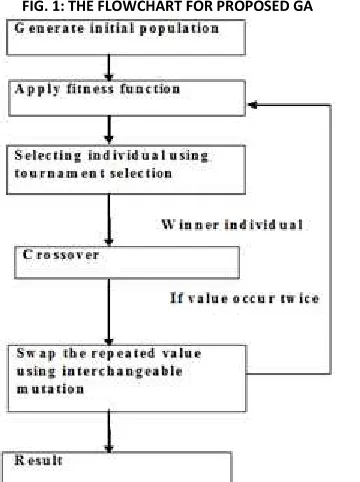
John Holland proposed Genetic Algorithm in 1975. In the field of artificial intelligence genetic algorithm is a search heuristic that mimics the process of natural evolution. Genetic Algorithm belongs to class of evolutionary algorithm. GA begin with various problem solution which are encoded into population, a fitness function is applied for evaluating the fitness of each individual, after that a new generation is created through the process of selection, crossover and mutation. After the termination of genetic algorithm, an optimal solution is obtained. If the termination condition is not satisfied, then algorithm continues with new popu-lation [2].
VOLUME NO.6(2016),ISSUE NO.04(APRIL) ISSN 2231-5756
FIG. 1: THE FLOWCHART FOR PROPOSED GA
The distance matrix of the problem is given in table 1. We have assumed the distance-matrix to be symmetric; therefore, the part above the main diagonal contains all necessary information. The first row and column denotes the city.
TABLE I - DISTANCE MATRIX OF 6 CITIES PROBLEM
Delhi = 1 Mumbai = 2 Calcutta = 3 Pune = 4 Bangalore = 5 Chennai = 6
A. Initial Population
Initial population of chromosomes is created randomly by using unique random number generator function in Matlab. The initial population created is shown in following section. The population consists of four chromosomes, where each chromosome denotes the sequence in which cities have to be traversed and each gene represent the number assigned to a city.
Pop 1: Pop 2: Pop3: Pop4:
B.Fitness Value
The Purpose of the fitness function is to decide if a chromosome is good then how good it is? In the travelling salesman problem, the criteria for good chromosome is its length. Calculation takes place during the creation of the chromosomes as given in equation 2. Each chromosome is created and then its fitness function is calculated. The length of the chromosome is measured in pixels by the scheme of the tour [11].
VOLUME NO.6(2016),ISSUE NO.04(APRIL) ISSN 2231-5756
C. Selection
Selection is used to select the chromosome whose fitness value is small. We have used the tournament selection by using Sorting method. Here P1 and P3 winning unit.
D. Crossover
2-point crossover is applied to the pair of chromosomes so that new chromosomes will be generated which might have better fitness value. In 2-point crossover, randomly two positions in the chromosomes are chosen and then replace the gene with each other in both
E. Mutation
VOLUME NO.6(2016),ISSUE NO.04(APRIL) ISSN 2231-5756
F. Termination and Result
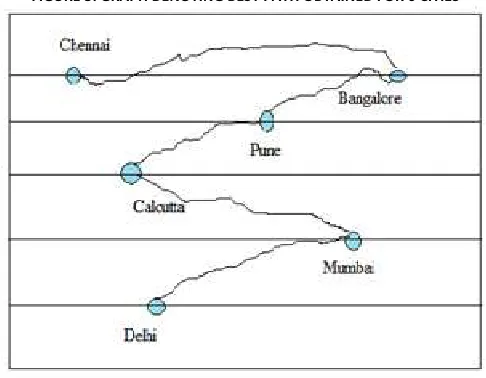
After completing the number of iterations the best tour will be obtained and the process will be terminated. The tour obtained with minimum distance is as shown in figure 3 for the problem of 6 cities.
FIGURE 3: GRAPH DENOTING BEST PATH OBTAINED FOR 6 CITIES
V. RESULT AND ANALYSIS
We have solved a total of 4 populations. The best and worst results obtained in table II. The same table denotes the best results of the problems presents in literature. Looking at results in the optimization technique
VI. CONCLUSION AND FUTURE SCOPE
Combining the information from heuristic methods and genetic algorithms is a promise approach for solving the TSP. Genetic algorithms appear to find good solutions for the travelling salesman problem, however it depends very much on the way the problem is encoded and which crossover and mutation methods are used. A number of genetic algorithm techniques have been analysed and surveyed for solving TSP. The research work can be extended for different hybrid selec-tion, crossover and mutation operators. The proposed approach can be applied for various advanced network models like logistic network, task scheduling models, vehicle navigation routing models etc. The same approach can also be used for allocation of frequencies in cells of cellular network.
REFERENCES
1. Chetan Chudasama, S. M. Shah and Mahesh Panchal, “Comparison of Parents Selection Methods of Genetic Algorithm for TSP”, International Conference on Computer Communication and Networks (CSI- COMNET), 2011.
2. Naveen kumar, Karambir and Rajiv Kumar, “A Genetic Algorithm Approach to Study Travelling Salesman Problem”, Journal of Global Research in Computer Science, 2012, Vol. 3, No. (3).
3. Adewole Philip, AkinwaleAdioTaofiki and OtunbanowoKehinde, “A Genetic Algorithm for Solving Travelling Salesman Problem”, International Journal of Ad-vanced Computer Science and Applications, 2011, Vol. (2), No. (1).
VOLUME NO.6(2016),ISSUE NO.04(APRIL) ISSN 2231-5756 5. ButhainahFahran, Al-Dulaimi, and Hamza A. Ali, “Enhanced Traveling Salesman Problem Solving by Genetic Algorithm Technique (TSPGA)”, World Academy
of Science, Engineering and Technology, 2008, Vol. (14).
6. Rong Yang, “Solving Large Travelling Salesman Problems with Small Populations”. IEEE 1997.
7. Chiung Moon, Jongsoo Kim, Gyunghyun Choi,Yoonho Seo,” An efficient genetic algorithm for the traveling salesman problem with precedence constraints”, European Journal of Operational Research 140 (2002) 606–617, accepted 28 February 2001.
8. ShubhraSankar Ray, SanghamitraBandyopadhyay and Sankar K. Pal,” New Operators of Genetic Algorithms for Traveling Salesman Problem”, 2004 IEEE. 9. Lawrence V. Snyder a,*, Mark S. Daskin,” A random-key genetic algorithm for the generalized traveling salesman problem”, European Journal of Operational
Research 174 (2006) 38–53, 2005.
10. Milena Karova, Vassil Smarkov, StoyanPenev, ”Genetic operators crossover and mutation in solving the TSP problem”, International Conference on Computer Systems and Technologies - CompSysTech’ 2005.
11. Plamenka Borovska,” Solving the Travelling Salesman Problem in Parallel by Genetic Algorithm on Multicomputer Cluster”, International Conference on Computer Systems and Technologies - CompSysTech’06
12. DING Chao, CHENG Ye, HE Miao,” Two-Level Genetic Algorithm for Clustered Traveling Salesman Problem with Application in Large-Scale TSPs”, TSINGHUA SCIENCE AND TECHNOLOGY ISSN 1007-0214 15/20 pp 459-465 Volume 12, Number 4, August 2007.
13. X.H. Shi, Y.C. Liang, H.P. Lee, C. Lu, Q.X. Wang,” Particle swarm optimization-based algorithms for TSP and generalized TSP”, Information Processing Letters 103 (2007) 169–176,2007.
14. S.N. Sivanandam, S. N.Deepa,”A Comparative Study Using Genetic Algorithm and Particle Swarm Optimization for Lower Order System Modelling,” Interna-tional Journal of the Computer, the Internet and Management Vol. 17. No. 3 (September - December, 2009) pp 1 -10.
15. Huilian FAN,” Discrete Particle Swarm Optimization for TSP based on Neighborhood”, Journal of Computational Information Systems 6:10 (2010) 3407-3414. 16. Alka Singh Bhagel and Ritesh Rastogi, “Effective Approaches for Solving Large Travelling Salesman Problems with Small Populations”, International Journal of
VOLUME NO.6(2016),ISSUE NO.04(APRIL) ISSN 2231-5756
REQUEST FOR FEEDBACK
Dear Readers
At the very outset, International Journal of Research in Commerce, IT & Management (IJRCM) acknowledges
& appreciates your efforts in showing interest in our present issue under your kind perusal.
I would like to request you to supply your critical comments and suggestions about the material published
in this issue, as well as on the journal as a whole, on our e-mail
for further
improve-ments in the interest of research.
If you have any queries, please feel free to contact us on our e-mail
.
I am sure that your feedback and deliberations would make future issues better – a result of our joint effort.
Looking forward to an appropriate consideration.
With sincere regards
Thanking you profoundly
Academically yours
Sd/-
Co-ordinator
DISCLAIMER