UBIR: University of Bolton Institutional Repository
Educational Cybernetics: Reports
Institute for Educational Cybernetics
2004
A framework for the pedagogical evaluation of
eLearning Environments.
Sandy Britain
University of Wales, Bangor
Oleg Liber
University of Bolton, [email protected]
This Report is brought to you for free and open access by the Institute for Educational Cybernetics at UBIR: University of Bolton Institutional Repository. It has been accepted for inclusion in Educational Cybernetics: Reports by an authorized administrator of UBIR: University of Bolton Institutional Repository. For more information, please [email protected].
Digital Commons Citation
Britain, Sandy and Liber, Oleg. "A framework for the pedagogical evaluation of eLearning Environments.." (2004).Educational Cybernetics: Reports.Paper 2.
A Framework for the Pedagogical Evaluation of Virtual
Learning Environments
Sandy Britain
Introduction
This report updates an earlier JISC report by the same authors entitled ‘A Framework for the Pedagogical Evaluation of Virtual Learning Environments’ (1999). That report can be found online at: [http://www.jisc.ac.uk/uploaded_documents/jtap-041.doc].
The structure of this report is as follows:
Chapter one provides an overview of the current context of e-learning
Chapter two presents the revised framework which elaborates and extends the model
Chapter three presents a review of a selection of current systems against the framework
Acknowledgements
1:The Changing Landscape of Elearning
Introduction
In 1999 we proposed a pedagogical framework for the evaluation of VLEs that was grounded in both educational and organisational theory, (Britain and Liber, 1999). That report was driven by the lack of work in the field at the time examining how VLEs could enhance teaching and learning. In 1999 many institutions were evaluating VLEs with a view to making their first step into using Internet-based ICT in their teaching and so the report was written to help educators understand how the design of systems could facilitate or constrain their pedagogical use in different contexts.
Now in 2003, elearning has matured considerably. ICT developments to support teaching and learning are no longer predominantly confined to isolated projects within academic
departments and learning technology support units, but instead form a core part of
institutional strategy and policy (Conole et al., 2002) Widespread uptake of VLEs within HEIs has been supplemented by work to join up institutional administrative systems with VLEs to form Managed Learning Environments (MLEs). At a national level, e-learning has become the subject of a variety of government sponsored strategic initiatives in support of the programme of widening participation in HE and FE and promoting e-learning as an approach to improving the quality of education provision and empowering learners. The government’s vision for the future of e-learning is encapsulated in the DfES e-learning strategy consultation document ‘Towards a unified e-learning strategy’ (online).
However, a recent JISC survey suggests that despite the current investment in e-learning through development of MLEs, this work has yet to make a significant impact on the quality of teaching and learning and pedagogical innovation; even though these are most commonly cited as key drivers.
‘Enhancing the quality of teaching and learning’ is the key driver, identified by almost every institution, for MLE development. However, the reality appears to be that the student experience is being enhanced through improved delivery of teaching materials and course announcements, improved access to learning resources and better communication. Pedagogical issues are not (yet) a part of this, and, indeed, appear to have been of secondary concern until now.
Managed Learning Environment Activity in Further and Higher Education in the UK. JISC / UCISA report (2003) 1
Since the 1999 report was published, the landscape of Elearning in HE and FE in the UK has changed considerably. Many of these changes are reviewed in the Landscape report from which the above quotation was taken. The quotation serves to highlight the tension that exists between three of the core themes of e-learning developments today: The trend towards institutional level management of e-learning initiatives, the desire to enhance the quality and creativity of teaching and learning using e-learning and the desire to provide an empowering and student-centred learning experience
A key premise guiding the development of the framework presented in our earlier report was that the electronic environment provides the potential for alternative forms of organisation that free education from some of the constraints of the traditional face to face environment. It is our view that the organisational structures and processes that constitute the educational environment have a major impact on how teaching and learning is conducted in that
environment. Consequently, it we suggest that HOW a particular VLE or MLE is designed and constructed for the purposes of management can have a profound impact on how likely it is to constrain or facilitate the use of a variety of pedagogical approaches. Other authors have commented on this relationship (e.g. Conole, 2004).
1
In the first part of this chapter we examine e-learning developments over the last four years, since our previous report was published in relation to the core themes identified above. In the second part we explore ways in which recent technology developments and
educational initiatives may help to address the need for pedagogical flexibility and innovation in the design of elearning tools, environments and architectures.
VLE use within institutions
Recent evidence shows that there has been a dramatic increase in the uptake of VLEs by institutions in the last four years. A survey by UCISA in 2001 of VLE use in HE institutions found that 40% of the 89 HEIs included in the survey reported using a VLE (as opposed to an estimate of 7% four years previously). The greatest growth had taken place in the year prior to 2001.
By contrast, the MLE landscape report survey in 2003, which received returns from 358 institutions across both HE and FE, reports a very high prevalence of VLE usage in all types of institutions surveyed. 85% of FE colleges, 84% of pre-1992 universities and 97% of post-1992 universities report using one or more VLEs in their institution.
Given this high level of VLE uptake by institutions, how are VLEs being used within
institutions to support teaching and learning functions? The MLE Landscape report provides some information.
Firstly the majority of institutions report using VLEs with less than 500 students. Only a small minority of institutions are using VLEs with very large numbers of students (more than 2000). This suggests that many institutions are still at a stage of tentative exploration of the use of elearning rather than mainstream adoption.
Secondly, the survey shows that in many cases VLE use is optional. Whilst it is not desirable that VLE use should be a mandatory requirement, it remains the case that unless teachers perceive the VLE as adding value to their teaching then they are unlikely to invest the time to use it voluntarily. Also experience to date has shown that students will not engage with online learning opportunities unless they are integrated into their programme of study, including its assessment criteria and learning outcomes.
Thirdly, for VLEs to begin to have greater impact on teaching and learning activities, we suggest that staff are in need of a higher level of professional development than they are currently receiving if they are to use the new VLEs for anything beyond routine administration: course announcements, lecture notes online and a list of Internet links. Even where lecturers are setting up discussion threads but with little understanding of how to engage students, how to structure their online interactions, or how to integrate these aspects of the course with other learning activities, their efforts have limited impact on students’ learning experience. Part of the problem (in HE) is that lecturers often do not view themselves as teachers or their role in educating students as teaching. Where this is the case it is as much an issue of identity as engagement or professional development.
Our final point and the one to which we give the greatest emphasis here is the possibility that one major reason why the predominant pattern of use VLEs is for the basic course
management tasks mentioned above and consequently why there has been little pedagogical innovation using these tools to date is that the first generation VLEs do not obviously support more radical or diverse learning activities. If the design of the software environment
encourages a pattern of use that mimics traditional lecturer-student roles there is little incentive for lecturers to adopt new approaches.
In the next section we review the changes in the types of VLE used in UK HE and FE to see how this situation has changed in the last four years.
VLEs in use in institutions
In 1999 when elearning in HE and FE was in its infancy, there were a relatively small number of web-based applications that might be termed VLEs. Mostly these had come from the US and from either a business training or purely distance learning background. Examples included TopClass, Lotus LearningSpace etc. Two notable exceptions were WebCT and Blackboard. Although still originating in the US, these came from developers with a Higher Education background who subsequently formed companies to market their products commercially. These two systems soon began to dominate the market both in the US and in the UK.
The chart in figure 1 below shows a comparison of the percentage of different types of VLEs being used in institutions in 2001 and 2003. The 2001 data comes from the UCISA VLE survey of that year and the 2003 data from the MLE landscape report already cited.2
VLE use in institutions - a comparison between 2001 and 2003
0% 5% 10% 15% 20% 25% 30% 35% 40% intra net i
n ho use Blac kboa rd Web CT Gra nada Lea rnw ise Oth er V
LE - in h
ouseothe r Tekn iCal Firs tCla ss Fret wel
l Dow ning Com mer cial intra net Bodi ngto n Lotu s D
omin o Cos e Top Cla ss Mer lin Lotu s Le
arni ng S
pace Col loqu ia % o f in s ti tu ti o n s u s in g V L E t y p e 2001 2003
It can be seen that Blackboard and WebCT are the most commonly used commercial systems. The UCISA survey of 2001 shows WebCT as the most popular system, followed by Blackboard and FirstClass. The 2003 data shows that of the commercial VLEs Blackboard and WebCT remain the most popular, being used in 32% and 20% of institutions across both sectors, followed by Granada Learnwise (17%), Teknical Virtual-CAM (10%), FirstClass (7%) and Fretwell Downing (5%). As the first wave of elearning development has matured in the UK over the last four years these commercial systems have come to dominate the
marketplace.
2 The following differences in the data sets should be borne in mind when making a comparison:
The 2001 survey only included HE institutions, but the 2003 survey results were obtained across HE and FE institutions. Thus, for example, First Class still has a higher level of use in HE institutions than in FE, but the combined data from both types of institution would indicate a drop in use. Learnwise is much more commonly used in the FE sector and so the apparent rise in the level of use of this system is skewed by inclusion of FE institution data only in 2003.
One of the criticisms levelled at these first-generation commercial VLEs in our earlier report was that they lacked the flexibility to be adapted to the variety of different teaching and learning situations found in HE. Adopting a single VLE across the institution may often not be appropriate as different departments and / or modules may have radically different demands from their elearning tools. Many institutions surveyed in 2003 reported having two or more VLEs in use in their institution and the high level of in-house developments strongly suggests that commercial systems were not always appropriate to learning and teaching needs. It may also indicate that the expense of commercial license fees was prohibitive where sufficient technical expertise existed to do in-house development.
Integration: Joining-up Institutional systems for eLearning
Following the Further Education Funding Councils joining the JISC in 1999, the JISC established a steering committee for Managed Learning Environments in FE, and in the process invented the concept of a Managed Learning Environment (MLE). The committee's aim was to help FE colleges to integrate VLEs with their existing management information systems, which were crucial in providing student returns to the government on which funding was claimed. This gave rise to some considerable activity (including some funded pilot studies) in examining how VLEs could become an integrated part of any institution's
administrative and support systems, such as the student records, finance and library systems, instead of existing as an isolated system. It was quickly realised that student and course information already held in administrative systems was involved in implementing many of the functions of a VLE. Problems associated with replication of this information - not to mention time-consuming data-entry tasks - mean that some level of integration with student records systems is highly desirable if not essential. The need for data transfer between MIS systems and VLEs is one driver behind MLE development, but not the only one. In addition there was a more general demand by both students and staff for web access to institutional information and services coupled with a desire to join-up administrative systems (e.g. finance and student records).
Inevitably different institutions and even different groups within the same institution have different views about what the aim of MLE development is.3 A report for the JISC ‘Building MLEs in HE’ programme (Boys, 2002) suggested that MLE developments can be broadly viewed in either of two ways. The first is primarily as an exercise in integrating an institution’s technology systems, which involves the additive combining of existing institutional services and processes. The second is a comprehensive approach that involves the thinking and re-design of existing processes and relationships and then producing technology integration to support the organisational changes. These are two very different ways of thinking about the process of building an MLE.
Most MLE developments to date have taken what Boys characterises as an additive approach. One popular solution is to develop a web portal for the integration of institutional systems and services via a web applications layer with a browser interface. Recent
technology development such as Web Services and portal toolkits such as uPortal make this an increasingly attractive and tractable approach. Vendors of MIS systems and VLEs provide other solutions either through the formation of strategic corporate alliances that allow
integration between selected products or through provision of an entire enterprise solution.
But Boys argues that approaches to MLE development such as these fail to address many of the important functions of an MLE for elearning, in particular they can easily bypass issues of organisational change that may crucially affect the benefits of MLE development for
enhancing teaching and learning. Other commentators have echoed this criticism. It has been suggested that a major problem with existing practice is that it ignores or postpones many of the benefits envisaged at the outset of VLEs, which require far richer student profiles than exist in current MIS systems.4 For example, Diana Laurillard’s vision of interactive learning systems has each learner arriving online with a personal profile that includes detailed records of what they have already learned (at the level of learning object, rather than module or programme), with a profile of their learning preferences, and with a developmental portfolio of
3
The JISC programme ‘Building MLEs in HE’ funded a variety of MLE implementations. This was one of the common findings amongst projects.
4
transferable skills. A learning portfolio might also include a history of their interactions with their tutors, peers, and other significant learning conversations they may have had. Whilst some might view such ideas as idealistic, it is useful to return to this vision to see how far short current developments have fallen.
Although, for most institutions taking a piecemeal or additive approach to MLE development through a focus on improving existing systems is the most pragmatic approach, it is unlikely to ultimately yield the hoped-for benefits in enhancing teaching and learning. This is more likely to be achieved by taking a comprehensive approach that involves reviewing and changing existing practices within the institution, including teaching and learning practices. Furthermore any development must take an approach centred on the student not on administration. However, such an approach at present appears to be difficult to justify or implement for many institutions.
Boys (2002) concludes with the following recommendations for implementing a comprehensive approach to MLE development:
A ‘problem seeking’ rather than just a solution driven approach
An explicit model for the management of change, relevant to tertiary education
Explicit organisational and educational goals, preferably including some kind of institution-wide business process review
Development methodologies which centre on structure and quality of content and processes rather than on technical compatibilities
Involvement of students from the outset
Alternative ‘visualisations’ of what a MLE should be like
For institutions to begin to engage in the process outlined by Boys above they need greater confidence in the technical frameworks and architectures that will support the accompanying changes. Recent developments in this area are discussed towards the end of this chapter.
At the beginning of this chapter we quoted the recent MLE Landscape study in saying that MLE developments thus far had improved the student experience whilst pedagogical
concerns have received comparatively little attention. The evidence we have reviewed above provides some indication of why this has been the case. Much activity has been on MLE or portal development, which has often been more concerned with administrative aspects and improving student experience in a general sense than with teaching and learning. Instead of focusing on process review and organisational change to support elearning, developing staff skills in the use of VLEs for innovation in teaching, developing local tools, applications and learning activities to meet specific learning needs – institutions have focused on ease of use, centralisation and integration with existing systems. Secondly, despite high VLE uptake by institutions, uptake by learning and teaching staff remains relatively localised, and use by students is often ad-hoc and optional.
Current trends and Future directions for e-Learning
What we might conclude from the above is that there has been an insufficient level of attention given to the nature of teaching and learning practice in elearning developments to date. This is understandable since there have been major barriers to overcome in the form of implementing the technical infrastructure, professional training and getting staff and students on board with the idea of elearning. In the second part of this chapter we discuss ways in which current developments may help to establish a greater focus on teaching and learning in the future. In particular we focus on the following:
Learning Design and activity-centred approaches
Open Interoperability Standards
Frameworks and Architectures
Learning Activities and Learning Design
Significant steps have already begun to be taken in this direction in the development world. The first major contribution was the development of EML (educational modelling language) by Rob Koper and his colleagues at the OUNL in the Netherlands. The work involved in the development of EML has more recently fed into the construction of the IMS Learning Design Specification. Both of these developments are discussed below.
The development of EML which began 1998 was spurred by a dissatisfaction with several features of what we have thus far characterised here as the prevailing model of elearning to date; that is a heavy focus on content or learning objects and an inclination towards
information transmission as the overriding yet implicit pedagogical model.
The OUNL team, by contrast wanted to provide a language to explicitly model the interactions involved in a given teaching and learning situation so that this could be incorporated into the design of a learning activity. EML was developed as the notational system for modelling ‘units of study’, which is their abstraction of a learning activity (e.g. a course, a module, a lesson etc).
This is a departure from the prevailing learning objects model of elearning design, which is centred on units of content and metadata rather than units of activity. The major problem with the learning objects model, argue the EML designers, is that it fails to provide a coherent framework that can express semantic relationships between the learning objects in an educational context. EML is designed to provide a way to type objects according to their pedagogical use, derived from a pedagogical meta-model. The rationale behind the construction of the pedagogical meta-model is described in Koper (2001).
The main contribution of EML to the elearning community at large is that it has played a core role in the development of the IMS learning design specification. The primary aim of the learning design specification is to allow teachers or designers to describe a learning design in a standardised way that means it could be ‘run’ in a variety of learning-design aware players or environments.
Unfortunately there are currently no environments that can take an existing learning design and run it, also there is a paucity of tools available to assist in creating a learning design. However, there are two recent developments that are worthy of mention here.
The first of these is LAMS (Learning Activity Management System) LAMS is a learning design inspired system for the creation and running of learning designs in the form of sequences of learning activities and is reviewed as part of this report
The second development in the space is the RELOAD project – www.reload.ac.uk . This project funded under the JISC X4L Program is engaged in producing tools for the creation, editing and running of both learning objects and learning activities that implement the
appropriate IMS / SCORM specifications. The project is implementing IMS content packaging, simple sequencing and learning design specifications in a suite of open-source tools including a package editor based on the existing PackageIt, a SCORM player for running SCORM 1.3 content and the Colloquia VLE.
These two tools currently still in development point a new direction away from the primacy of content management in VLEs towards systems that make activity-centred learning design using interoperability standards a reality. There are still a variety of difficult technical issues to overcome in creating learning designs in one system and running them in another. However, the fact that this work is underway and is feeding into the further development of the
interoperability specifications is a positive step.
Frameworks, Open-standards and Services
Various initiatives are exploring the core common services of an elearning architecture. These initiatives are working towards a common understanding of the technical framework required to underpin flexible, student-centred elearning. Using a combination of (possibly open-source) components that communicate with each other by means of standardised interfaces (such as those provided by Web services) these developments could open up the field to a much wider range of pedagogical tools, which can be flexibly allocated to different contexts within an institution than is currently possible.
Here we discuss two related developments in particular: advances in interoperability specifications and initiatives to develop open-frameworks for elearning.
Further Development of Interoperability Specifications and Standards
Since 1999 there has been the vast amount of work globally that has gone into developing an infrastructure for interoperability through the production and refinement of learning technology standards specifications, notably by the IMS Global Learning Consortium, although a number of other bodies are also involved. This work is seen by many in the field as essential to the future of elearning by aiming to ensure that software systems can work with each other, that learning content and student information can be transported and reused and repositories can be searched using standard metadata.
According to Bill Olivier of CETIS, there are two main motivations for the development of interoperability standards. The first is portability of content and data exchange. If we buy or develop a piece of content we want it to run on a variety of different platforms The second is to lower the cost of systems integration by allowing existing systems to work with new e-learning systems. Without standards we are dependent on bespoke integration which is time consuming and expensive or lock-in to proprietary systems.
It may seem that we have started to peel off on a technology tangent here and that we have forgotten that the point of this article is about enhancing the quality of teaching and learning but we haven’t done either of these. Let us re-iterate a point that is central to this report: technology should adapt to fit teaching not the other way round. So by implementing interoperability standards, it may be possible to put together different elearning tools for different contexts within the same institution, the same department or even the same module. This would allow different subject departments, for example, to choose different eLearning tools that suit the particular teaching approach, instead of having to use the institution's chosen VLE. The aim is to put control of how teaching happens back into the hands of the educator not the software designer.
Importantly, work in defining agreed technical standards for data interchange means that small to medium content providers and software developers can compete effectively with the big players and lock–in to proprietary systems can be avoided, where once one major system has been adopted, it becomes impossible to migrate to another without major costs being incurred to transfer (or re-enter) data that has been saved in a proprietary format.
Interoperability allows systems from different vendors to work together (interoperate), and as a consequence, has paved the way for the development of open frameworks for elearning. The idea of these is that instead of having to buy into a single monolithic VLE application institutions will be able to put together a variety of lower-level components which will provide more flexibility and better suit their elearning needs. These new developments are discussed in the next section.
Open frameworks and eLearning Architectures
This latest set of developments has been inspired by the shortcomings of the one-size-fits-all model of current VLEs we have outlined already. Educational technologists feel that there needs to be an alternative that can reduce costs by permitting a saving on the license fees charged by software vendors for their systems and at the same time provide more flexibility control over teaching and learning processes.
reconfigure. These will give institutions greater flexibility, confidence and control over their own elearning management.
Scott Wilson of CETIS draws a picture in which the situation today is characterised by the existence of giant components: A VLE / LMS component, one or more MIS components, a library component etc. The aim of recent MLE integration attempts has been to get these large-scale components exchanging data and working together. As Scott explains, this is inefficient because many common services are replicated. An example is the number of times users have to sign on to institutional systems – the library system, the VLE and student information systems often all require the user to log on separately, since each system has its own authentication system. If we break these down into smaller components (e.g. have a separate authentication component that is linked to all the other systems) and provide a coherent architecture and standards-based data exchange then the common services can be separated out to create a more efficient modular system. IMS have described an abstract framework for elearning architectures. It is a layered architecture with a ‘sea’ of available components at the bottom layer. The middleware of the architecture consists of layers 2 and 3, which implement the common, services and application services. At the top level are E-learning applications, which use objects and services defined at lower-levels of the architecture.
One of the main contributors to this work is the Open Knowledge Initiative (OKI). Founded at MIT in 2001, the OKI is a collaborative project to produce an open and extensible architecture in which e-learning components can be embedded and communicate with each other and external enterprise software. Phase 1 of the project is due to complete in July 2003 with delivery of a set of Open Service Interface Definitions (OSIDs) to specify interactions between services both within and across institutions, a reference implementation of each service with open-source code and two open-source learning management systems – Stellar and Coursework.
Inherent in the idea of an open architecture is a foundation on the open standards specifications discussed above and the development of open-source components that conform to the standards. In order to assist these two streams of development moving forwards together there is a strong relationship between IMS and OKI made concrete in a memorandum of understanding between the two projects.
This is an exciting strand of development as it lays the foundations for the design of pedagogically effective systems suited to specific demands of individual institutions and courses. It both obviates the need to purchase a single VLE for an entire institution and opens the door to portable content and student data.
The optimism surrounding open-standards and the development of common frameworks for elearning has to be tempered by the understanding that there remain difficult technical and organisational problems with both the transport and reuse of learning activities at the elearning level and the top-down approach involving the specification of educational
interoperability standards that meet needs across the industry .The identification of common architectures for core services is one thing, but producing an open framework that can accommodate the interactions and fine granularity components at the level of educational applications has not yet been addressed. While this approach offers considerable hope for the future there is a long journey still ahead.
A complementary approach is the work of developer and practitioner communities working with the growing number of open-source products producing add-on tools and custom integrations to fit a wide variety of contexts where standards have not yet been specified or are in the process of evolving. This work in turn has much to contribute to the continued development and refinement of standards and to further understanding about what is educationally useful in elearning. What is important is that the educational community
2: The revised pedagogical framework
The principle aim of this chapter is to review and extend the framework for pedagogical evaluation of e-learning tools that was presented in 1999. In the sections below we review the contribution of each of these models to the framework and the discuss issues that emerged when they were applied to VLEs.
In this chapter we:
• Describe the theoretical models
• Show how they can be applied to evaluate eLearning tools • Construct a series of questions that emerge from the framework
Overview of the Pedagogical Framework
Our aim in providing this framework is to help readers to analyse eLearning tools without being distracted by the details of user interface objects and components. While these are of some importance in the user experience, it is the workflows that are facilitated by these that need to be focused on. The framework provides a means by which reflection on aspects of pedagogical process can be structured, and then how elearning systems encourage or discourage these can be evaluated.
We would stress, however, that the framework does not seek to provide a “true” evaluation of elearning tools and systems; there inevitably remains an interpretive aspect. The framework does, however, provide a means by which discussion about specific process aspects of tools and systems can take place in a structured way, and hopefully result in better choices and design decisions.
Education providers using VLEs and other ICT tools for e-learning have two primary aims:
• To enhance the quality of teaching and learning by allowing teachers to use pedagogies that are not possible with large numbers in a face to face environment
• To manage the delivery and administration of programmes of learning through an electronic (on-line) medium. This includes management of groups of students.
The first of these is a more difficult problem, but (perhaps as a consequence of this) much more effort so far has been put into the second. It is not surprising then that the MLE Landscape study reached the conclusions quoted in the first chapter of this report.
We suggest as a result of the work conducted in developing the pedagogical framework in 1999 that these two aims are intrinsically linked and that HOW a particular VLE or e-learning platform or course management system is designed and constructed for the purposes of management can have a profound impact on how likely it is to constrain or facilitate the use of alternative pedagogies.
The framework as formulated in the 1999 report was constructed out of two different
theoretical models: The conversational framework (Laurillard, 1993) which is a well-known model of effective teaching practice for academic learning and the Viable System Model (VSM) (e.g. Beer 1981) which is a model for the design and diagnosis of effective
organisational structures drawn from management cybernetics. These two models are complementary, with the first providing a model for incorporating effective teaching and learning practice into an e-learning environment and the second providing a number of criteria from an organizational perspective which influence whether the system will facilitate or inhibit the ease with which a pedagogic model such as the conversational model can be used within that system.
conversational model). Alternatively if all the students in one group are treated as belonging a single ‘class’ object to which learning activities are assigned in the VLE, then there is no possibility for creating individual learning activities.
In these examples design decisions in the creation of the VLE that have been made on the basis of a particular model of the management flow in the teaching and learning process directly affect the pedagogical flexibility of the environment.
Many first-time users of VLEs seek to adapt the way that they work to the way that the software needs things to be done. It is an ongoing abrasive feature of HCI that we should attempt to adapt to the software’s preferred modus operandi rather than the other way around.
Happily most of the VLE vendors are much more aware of these sorts of criticisms than they were in 1999 and the systems that are around now are much more sophisticated than their earlier counterparts. Consequently, since it remains just as important that systems are critically appraised and that design features are evaluated to reveal their limitations and inconsistencies, the methods of evaluation need to become more sophisticated to match.
The Viable System Model
The VSM was described in a simplified way in the report of 1999. The aim was to elucidate enough of the model to show how and why it provides an extremely relevant and useful basis for the evaluation of VLEs, without overwhelming the reader with details of the theory on which it is based.
The key premise on which the VSM is based is that it is VARIETY5 that threatens to
overwhelm organisations and it is this variety that needs to be managed by any organisation. This is particularly relevant to precisely those issues that education is facing today and that e-learning, it is hoped, will help alleviate. That is to say: how can the quality of educational provision be maintained in the face of increasing student numbers and increasing diversity. The cybernetic answer to this problem is that the variety of educational provision must be increased to match the increased variety presented by the environment. The VSM proposes a number of communication channels by which the variety of the controller might be increased. These channels were elaborated in the 1999 report to yield criteria for the evaluation of VLEs in the effective management of large numbers of students so that resource intensive
pedagogic models such as the conversational model could be used in an e-learning context. These criteria are:
• Resource negotiation • Adaptation
• Self organisation • Monitoring • Individualisation
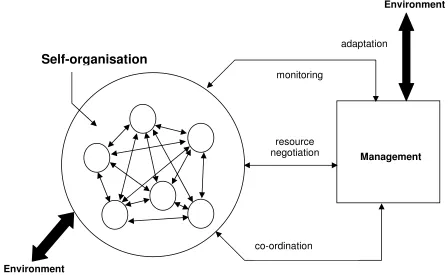
We reproduce below in fig X the diagram that was used in the 1999 report to illustrate the relationship between a management system and a controlled system using these channels
5
Figure 1: The simplified VSM
In order to deepen our understanding of how the VSM can contribute to our depth of insight into how the design of e-learning management tools can affect pedagogical effectiveness; we need to elaborate this model in a few ways. Specifically we need to refer to two aspects of the VSM left out of the previous description for the sake of simplicity:
1. RECURSIVE SYSTEMS (viable systems contain and are contained by other viable systems)
2. MANAGEMENT SUB-SYSTEMS (a viable system is comprised of a number of sub-systems with specific roles)
Recursive Properties of the VSM
Course management can be viewed from a number of perspectives or levels: • Programme level
• Module level • Individual level
It is important to be specific about the level of teaching and learning activity we are talking about. One of the criticisms of the first generation of VLEs is that almost without exception they are centred on the activities at the module level. To be more precise they are designed around the interactions between teacher and learner and the administrative activities that occur at this level of granularity. They do not scale well to programme level activities at a more macro–level or, at a finer grained level of analysis, the activities of a single student.
As a tool of analysis the VSM is ideally equipped to accommodate changes in level of focus, as it is a basic mathematical feature of the model that the same general entities and
relationships remain valid at any level of analysis. Whether it is a single organism or a global corporation or an entire national economy, the same general principles of viability are the same – i.e. that the variety of the controller must match the variety of the system to be controlled. And at any level of analysis (so the model states) the same sub-systems and channels of control and coordination are involved in the process of managing variety. The model is inherently recursive.
Management monitoring
resource negotiation
Self-organisation
adaptation
Environment
Environment
The structure and functions of management
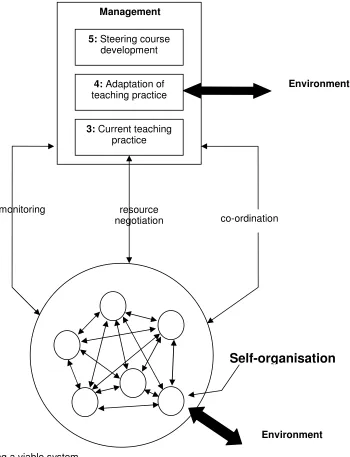
The more detailed diagram below (a 90 degree rotation of the simplified model in figure x) expands the management ‘box’ to illustrate the structure and different functions involved in
managing a viable system.
Figure 2: The Elaborated VSM, Module level
In the VSM each of the sub-systems has a specific cybernetic function, and the reader is encouraged to study these for a deeper understanding. For the example of a module as interpreted by the authors, their function is as follows
System 1: all the activities undertaken by learners in directly developing their learning – the PRIMARY activities of the module
System 2: a framework to coordinate the learners’ activities so that their demands for
teaching and support do not conflict, and to allow them to benefit from each other’s activities; this will include course schedules and assessment frameworks.
System 3: this system is responsible for directly managing the learners’ activities – typically this is where the teacher is located.
System 3*: this is responsible for checking on the ongoing “health” of the course. Formative assessment plays a role in this, but other techniques can be used to pursue its purpose in making sure that learning is taking place successfully across the learner group as expected
Management
monitoring resource
negotiation
Self-organisation
Environment
Environment co-ordination
3: Current teaching practice 4: Adaptation of teaching practice 5: Steering course
System 4: this is where responsibility for developing the course resides – finding new resources and developing new teaching ideas based on the needs of the learners. In many cases this is the responsibility of the teacher, but on other cases may involve a course design team.
System 5: the needs of system 3 (managing the delivery of a module), and system 4
(adapting and improving the module), need to be balanced to avoid the extreme examples of a module that never changes and one that is never stable; this balancing is the role of system 5, which steers the module as it unfolds. Typically this is the role of a module management team or academic board.
These systems need to be well interconnected, and the VSM identifies the key channels that maintain good communication between sub-systems, elaborated below. These channels connect systems, which generate different levels of complexity (variety), and so they need to be designed to make sure that variety is disposed of in planned ways; this is the role of pedagogic design.
Variety management using e-learning systems at the module level
Resource Bargain channel
Resource bargaining is the process by which system 3 (the teaching staff) makes an agreement with the parts of system 1 (the students) on what they need to provide for each other. One aspect of this is the establishment of rules – safety rules, employment rules and conditions, wage rates, management procedures and so on. It also enables establishment of mutual responsibilities – what the parts of system 1 need from system 3 to do the job
properly, and what system 3 needs from the parts of system 1 for the requirements of the larger system to be met.
What might this mean in education? In f2f learning many rules are established at the
institutional level – how many hours of teaching students can expect, and typically what they need to do to successfully complete the course, and so this part of the agreement is tacit – but not always. In less formal courses, and those less oriented on certification, this agreement needs continuous negotiation. It should also be noted that in the VSM, this agreement needs to take place with each individual student – it is about balancing the resources the teacher has available between the students to achieve equitable learning. And as a homeostatic loop, variety needs to be managed by some means.
So what typically happens? In strictly formal situations, there is a one shot resource bargain at the start of the course, and each student gets the same deal – they get so many hours of lectures, and in return have to do the work necessary to pass the assessment, which is irremedial. But teachers usually agree to make themselves available for individual questions, at the end of or after lessons, and sometimes offer limited times when they can be visited by students, singly or in groups; sometimes they may use teaching assistants or graduate students. Some students can, in this way, get extra support if they need it – more explanation, additional reading - but it usually represents a small part of the total hours on offer.
In a more resource-based situation, the negotiation is somewhat different. The teacher agrees to provide learning resources appropriate to the individual students’ needs, and to provide individual assistance around these resources. Agreeing the limits of the teacher’s inputs becomes more difficult to establish – what can each student expect in this situation? The student’s responsibility is to read or engage with the resources, and manage their demands on the teacher’s time. Resource bargaining here becomes more difficult and needs to be a continually open channel, as individual needs are able to be better expressed, and time management – the precious resource in education – is crucial and problematic.
appropriately – PDP in particular seems to be used at a more global level, after or between modules, and not within them. The biggest issue online is time management for teachers – demands for responses from students are expected to be met quickly (free of time and space) in a way that could not be expected in a campus based situation. Some means of establishing the limits of the teacher’s responsibility need to be created. Many VLEs do not provide any tools to help with this.
Coordination Channel
In the VSM, coordination is concerned with damping oscillation, thus making it impossible for competing demands of the system 1 components to destabilise the system. This can be interpreted in a human situation in preventing conflict through good system design. An example is a timetable, which ensures that people meet in allocated rooms at a particular time, avoiding competition for these resources. Another example is a schedule, which ensures that work is structured to allow available resources to be used effectively without competition. So coordination is about system design, and does not usually involve real time action. The timetable is not invented in real time, but at the start of the year, and then runs for the whole year.
In a course or module, coordination should prevent conflict arising between students through competition for resources. Scheduling access to resources, including the teacher and each other, providing common ways and tools by which this access can be structured, and establishing protocols are all part of this.
In a sense, the organisation of a classroom is a powerful coordination device. Seats in rows tell the learners what they are supposed to do – face the front and listen. The classroom gives subtle yet powerful messages on how to behave, and the formal education inculcates an expectation in students about what a lesson should be like, which coordinates their behaviour.
In online environments things are less clear. In a sense, the whole VLE is all about
coordination – it constrains what and how things can be done. By being asynchronous, the limits of timetabling are lifted, and by making all resources available online removes the need for resource scheduling. The problem that remains concerns human resources – the students and the teacher. What structure is needed to allow students equitable access to the teacher’s time, and what will ensure that they can help each other without constraining all students to march in time together? This is where pedagogic design is important. The design of the course – the sequencing and structuring of learning activities and resources (including assessments) – is how a teacher can provide a co-ordinatory framework. Like classrooms, many VLEs provide limited opportunity for flexibility here. Just as a 1 hour lesson in a lecture theatre encourages coordination by sitting still and being quiet so that the class can all learn together, many VLEs encourage a method that can be caricatured as “read this material, check the forum and do the test”. It takes some effort on the part of the teacher to overcome these, but they do – and are supported to some extent by the design of the system. If you can move the chairs, you have more choice in a classroom; if you can adapt the workflow of a VLE, you can provide more flexibility in your learning opportunities.
Monitoring Channel
Beer argues that monitoring is concerned with soaking up the variety left in the system that system 3 and 2 have not managed to do. It is concerned with checking that the system is operating successfully, with monitoring the health of the system. It involves management checking the operations of the subsystems of system1 (not the managements). He suggests that monitoring should be spasmodic and occasional.
needs to be able to occasionally engage in a deep way with a randomly selected individual to find out if understanding is developing as expected; and during a course, each student may need to be visited, depending on the teacher’s sense of how the course is going. This can be onerous, and this is why tracking is so popular. It provided the illusion that student progress is monitored. Actually it is the resource bargain that is being monitored, that the student should at least access the material, or enter the discussion space. It does NOT monitor
understanding. MCQs give no more than a glimmer of deep understanding. In our view, only learning conversations between teacher and student can hope to achieve this depth of monitoring successfully. The system needs to facilitate this, and help the teacher to manage a large number of these conversations successfully.
Self-organization channel
In any human system, variety management depends on the cooperation of the high variety system. Beer’s example is the police; if every citizen decided to act as a criminal, then we’d need a policeman for each individual. It is because people generally obey the law that allows police to only deal with the residual variety created by the lawless. In other words, people manage their own variety. Education is no exception. Students learn by themselves, they help each other, they find other materials to help with things they don’t understand, and they set up study groups. Some are better at this than others; some have better facilities than others. Traditional universities provided opportunities for self-organization – cafes, bars, common rooms, libraries. Newer institutions do this less well, space being more expensive than when older universities were established. VLEs rarely provide for self-organizing activities hardly at all. What opportunities are there for students to organize themselves outside the formal learning sessions/areas? The fear of system abuse has led to there being no private space in most VLEs. No doubt students use other electronic means – email and chatrooms – but a powerful message is given to learners by the lack of self-organizing opportunities in VLEs, that the institution does not value their independence, does not value their privacy, and feels that learners should be monitored at all times. The implication is that personal exploration of ideas is not valued nor encouraged. From an ethical standpoint this is of some concern; but from an educational standpoint it raises major questions, and needs to be addressed. If we don’t encourage self-organization of learning, learning will tend to be more “surface”. A learning organization, especially one where higher learning takes place, has to be one where people are enabled to engage freely in debate, argument and thereby increase
understanding. Education is not a commodity that can be transferred by some mechanistic process. It requires self-transformation, and often involves deep personal struggle if it is to be meaningful. It needs to be nurtured and appropriate supporting facilities need to be provided.
Adaptation
Founded on a rich model of the organization, system 4 is responsible for ensuring that the whole system is aware of external threats and opportunities. For a course, these involve the teacher or others responsible for the course design staying involved in the subject matter and pedagogy debates outside the immediate course – there needs to be a rich connection to the knowledge environment in which the course is engaged. Opportunities available in this environment may include new learning resources and new ways of teaching the subject in question; these may come from colleagues locally or wider a field, or may be available on subject networks. Threats may be the outdating of current materials and ideas. It would be beneficial if it were possible for the teacher to vary the way the course or module is provided to incorporate new materials and processes, but many VLEs have to be pre-packaged and don’t support that flexibility. It may be that materials and pedagogies are not suited to the particular cohort or part of it – it should be possible to change them based on new opportunities.
Balancing the needs of the present and the future
adapt in the light of learner experience, and on the other avoid a constant chopping and changing as new, “better” resources and methods become available. It is thus crucial that the systems responsible course delivery and
course development (systems 3 and 4 in the VSM) have a rich connection, and are able to negotiate the balance appropriately, allowing the course to develop in a way that meets learning needs as they become evident.
Managing the needs of delivery and adaptation
If a course is well designed and managed, then these needs can be properly balanced with little intervention from higher level management. However, to avoid conflict arising, and to provide a channel for learners to make their concerns known, there needs to be a mechanism by which the overall development of a module can be steered. Since the curriculum of most modules in institutions tends to be strictly defined, this is often only triggered at validation and review time. But in a more dynamic course, where the content may be defined in real time (some research degrees) there needs to be the possibility for a higher level involvement on a more frequent basis, to regulate adaptation and provide an emergency channel for learners should a crisis arise.
The programme level
The preceding section discussed the application of the VSM to a teaching and learning situation – a course or a module. These typically tend to be the unit of learning in UK HE (and FE to some extent). But a module is almost always part of a larger programme (or
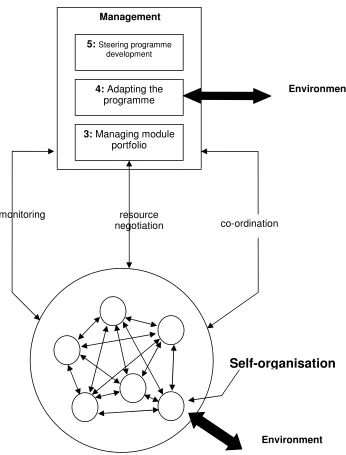
Figure 3: The VSM at the programme level
Resource bargaining channel
The management unit for a programme (usually at department level) needs to negotiate the resources available to the modules it is constructed from. Typically this is done at the start of a programme; but it could be that resources are varied depending on the progress and needs of courses as they unfold. This would require that course leaders are able to report on their needs and progress in order to negotiate resource provision, and that mechanisms to facilitate this have been put in place.
Coordination
Typically modules are designed to operate completely independently of each other, having first defined which other modules are pre-requisites or co-requisites. However it may be that opportunities are lost for inter-module activities. For example, it may be that there are times when two modules could be merged for some aspect of their content. However in a strictly timetabled situation, such interoperation is incredibly difficult to manage. This could be a place where eLearning tools could offer new opportunities, by offering new frameworks to allow coordination between multiple modules’ activities; however most leading VLEs do little to support learning at the programme level.
Management
monitoring resource
negotiation
Self-organisation
Environment
Environment co-ordination
3: Managing module portfolio 4: Adapting the
programme
5: Steering programme
Monitoring
To be able to assess the health of any module, programme management needs to be able to have access to individual learners’ progress information. Once again, VLEs could provide tools to facilitate this, but usually fail to do so, since they tend to work only at the module level.
Self-organization
In many institutions teachers talk continuously about their teaching, and learn from each other’s experience as it takes place – they can help each other by teaching sessions, or through peer-observation, or by sharing resources. A VLE could make powerful tools to support this sort of self-organization between courses or modules, but again rarely does so, leaving this to be provided by other institutional systems, (which may be part of the MLE).
Adaptation and balancing the needs of the present and the future
Any programme of learning needs to be constantly examining its set of modules, and considering whether and when new modules may be needed, based on changes in the knowledge domain, the needs of society, and new resource capabilities (e.g. funding sources). Once again, technology can and does play a large part in this, but usually not integrated with the VLE, where the needs for adaptation are expressed.
Managing the needs of delivery and adaptation
The programme board is usually charged with the task of ensuring appropriate development of a programme of study. To do so well it needs good information from programme
management based on the actual experience of course delivery, as well as an excellent understanding of development opportunities. Technology can play an important role in providing this information in a manageable way, and VLEs could play an important part of they were able to provide flexible reporting.
In summary, since many VLEs operate purely at the modular level, they rarely provide any integrative support for programmes; rather, they make it more difficult for the assessment of student learning at a level appropriate for programme development. This is a huge
opportunity missed.
The student level
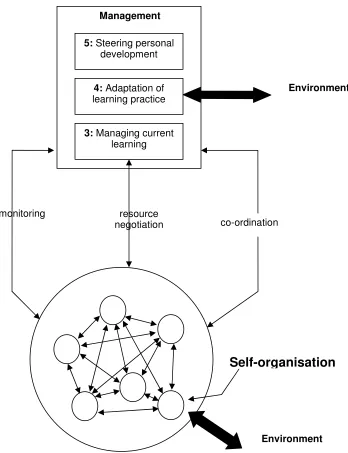
Figure 5: The Viable System Model, learner level
Resource Bargaining
The learner needs to assess the requirements of the modules they are following, and plan the time and effort they devote to each, depending on the demands of any module at any
particular time.
Coordination
They need to develop a plan or framework that help them avoid any conflict between the demands of different modules – this could be a timetable or a time management tool.
Monitoring
Learners need to reflect on their learning in a deep way in order to be able to identify where problems may be arising. Self-assessment and reflective practice tools can help here.
Self-organization
Management
monitoring resource
negotiation
Self-organisation
Environment
Environment co-ordination
3: Managing current learning 4: Adaptation of learning practice 5: Steering personal
Groups of learners can be incredibly mutually supportive, both within the formal course structure and informally. Learners often use email and chat tools outside the VLE structure to establish these self-help networks; it would be useful to have these provided as part of a course or programme structure.
Adaptation
Learners need to be able to plan their future learning based on their current and past learning. They need tools to know what is available, how the demands of society and employment are changing, and what resources may be available to them.
Managing overall progress
Learners need to be able to reflect on their current learning activities and their future learning needs and wishes; tools that bring together information on both of these, and enable
reflection and planning – personal development tools – need to be incorporated into the total eLearning experience.
Using the VSM
In this section we have elaborated the application of the VSM to three levels of learning management – the course or module level, the programme level, and the learner level. These three recursive levels of our elaboration of the VSM correspond to the themes we identified in chapter one namely:
Supporting pedagogical innovation using elearning (module level)
Supporting institutional management of programmes (programme level)
Supporting students management of their own learning (learner level)
We have identified the issues this brings into focus, and how they might be addressed within a VLE. Technology brings new opportunities for managing complexity, where there were previously none. The choices we make affect both the pedagogy and the flexibility available to learners.
In our 1999 report we used Laurillard’s Conversational Framework to amplify the framework created using the VSM described above because it captures in detail the workflow of teaching and learning interactions that are capable of supporting a wide variety of pedagogical models and approaches. The conversational model helps to exemplify the difference between a student-centred workflow and the so-called ‘transmission’ model that pervades education at a variety of levels in face-to-face environments and has been replicated to a certain extent in 1st generation VLEs. In the section below we briefly describe the main features of the
The Conversational Framework
There are a number of key characteristics of the conversational model as applied to academic learning, drawn from Laurillard, (1993, pp.94-95). This model elaborates on Pask and Scott’s Conversation Theory (refs) to emphasise the importance of dialogue in effective academic learning. Laurillard argues that the nature of much academic learning is largely defined by the acquisition of complex concepts and the creation of conceptual distinctions. This cannot be achieved by a pedagogy based around the one-way presentation of content; there needs to be a two-way dialogue between teacher and student at the level of conceptions. According to the conversational model this dialogue is central to academic learning. The process of learning is supported by the creation of interactive ‘micro-worlds’ (learning activities) in which the student can actively engage in practice that enhances and reinforces the ideas that have been formulated through discussion. The model emphasises that these activities should be created and adapted on the basis of the conceptual dialogue, rather than pre-set in advance. The final key aspect of the model is that opportunity for reflection is provided as part of the teaching and learning process.
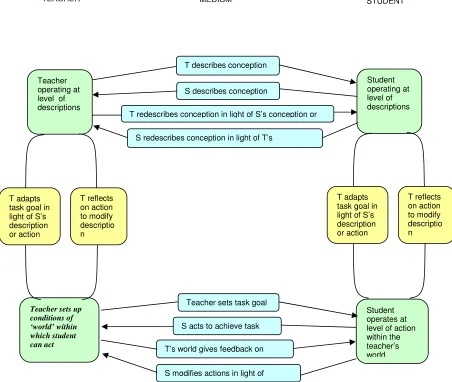
Figure 6: The Conversational Framework (adapted from Laurillard, 1993)
The primary workflow actions that take place through the interactive medium are as follows: Teacher
operating at level of descriptions
Student operating at level of descriptions T describes conception
S describes conception
S redescribes conception in light of T’s redescription
T redescribes conception in light of S’s conception or
TEACHER MEDIUM STUDENT
Student operates at level of action within the teacher’s world Teacher sets up
conditions of ‘world’ within which student can act
S modifies actions in light of T’s world gives feedback on action
S acts to achieve task Teacher sets task goal T adapts
1. Teacher presents / redescribes conception 2. Student presents / redescribes conception 3. Teacher sets up micro-world activities 4. Student interacts with micro-world activities 5. The system provides feedback on the action 6. Student modifies actions in light of feedback
The conversational model as shown in the diagram of figure X depicts the workflow between tutor and student during learning. Certain activities (centre in blue boxes) are interactive and take place through some medium. Other activities (right and left in yellow boxes) are internal to either the student or the teacher. If we suppose that the medium involved is a VLE, then this model provides a clear set of requirements for evaluating the system’s suitability for supporting the processes that form the basis of interactive learning.
The conversational model and VLEs
This relatively simple framework offers much potential as a methodology for evaluating virtual learning environments. A similar proposal was put forward by Crawley, 1999.6 In order to make this scheme work, all interactions must be assumed to take place via the medium of the VLE. It is then possible to make judgements about how well the VLE handles each of the individual interactions labelled in the model. The sort of questions one might ask are: How does the learning environment allow a teacher to present a conception? What does it mean for a teacher to set up a micro-world within a VLE? How can the student interact with the micro-world?
The model raises further questions about the mechanisms that support conversations. How easy is it to track conversations relating to a particular issue? Can conversations be
enhanced by presentation of additional resources? Yet other questions relate to the overall flexibility of the system. How adaptable are micro-world structures once they are in use? How easy is to tailor them to individual students needs?
We might also want to ask whether the learning environment provides any extra tools to support reflection by the student on the relationship between the conversation at the level of descriptions and the activities they have completed or whether it provides structuring to assist the student in modifying their actions.
The interactions illustrated in the model do not necessarily occur in the linear order given above and the model involves recurrence at several levels. In particular the conversation may shift freely between the conceptual level and the level of actions. Any software environment supporting learning should allow this to occur naturally.
Evaluation criteria for VLEs from the Conversational Model
In order to evaluate a virtual learning environment using the conversational framework we need to establish what tools are provided within the software to allow dialogue and action to mutually influence each other to allow modification of both conceptions and actions on the part of the student as described above.
Additionally we need to be able to say what level of structuring is provided for each interaction. For example if e-mail is used as the tool for communication between tutor and student in a given VLE we need to know how the use of e-mail is embedded within the context of the dialogue about a specific topic or set of learning goals. Thus we might consider whether it is:
a) simply a link to the users own e-mail client and existing mailbox
b) a built-in e-mail client that allows messages to be stored and viewed from within the software
6
c) a fully integrated client that automatically builds a conversation thread that is easily located from material relating to the specific topic of discourse.
Clearly b) and c) would be more sophisticated tools from the pedagogical perspective of the conversational framework than a).
Another issue that quickly becomes apparent is that the notion of a ‘micro-world’ takes on a different meaning in the case of VLEs than more traditional forms of courseware. In essence, the VLE provides the tools for a teacher to build a micro-world by allowing the teacher to construct learning activities enriched by multimedia resources and simulation programmes.
The crucial point from the perspective of the conversational framework is that the teacher should be able to construct the learning activity following a conversation with the student at the level of conceptions and the identification of a learning goal for the topic in question. Thus for any given learning environment we should consider how well the tools provide for both structuring conversations and actions and also how well they allow for integrating dialogue with actions.
Discursive Tools
All of the VLEs described in appendix A contain tools for conducting conversations. Naturally these rely to a great extent on e-mail and asynchronous discussion groups. It is important to consider how well the VLE leverages e-mail technology to support the conversation as an integral part of learning. For example, is the conversation accessible directly from the learning topic within the course structure or does the user have to move out of the course work in order to continue the conversation? Does the e-mail or conferencing tool allow attachments to be included with messages? And if so, can the attachment be extracted and embedded into the users course work structure? Does the tool allow learning goals to be specified and recorded on the basis of the conversation? Ideally the agreed learning goal should be in a prominent location with respect to the topic of learning.
Adaptability
How easy is it to adapt the activities associated with a learning topic according to the needs of an individual student or student sub-group as revealed by the conversation? This raises the question of whether students in the same group can be easily differentiated within the VLE once a course or learning activity is in progress.
Interactivity
A basic pre-requisite for a VLE is that it should be interactive. It is not enough for material to be presented to a student and then be tested on it. A VLE should allow the students to restructure the presented material, add resources of their own, annotate material, launch and run simulations etc. In other words the student should not merely be a passive observer of the ‘micro-world’ constructed by the teacher, but should be pro-active in shaping the ‘world’.
Reflection
How does the VLE allow the teacher to help the student link detailed feedback on their actions to the topic goal? A concept-mapping tool might be a helpful feature in this respect. Alternatively, contextualised discourse for every level of the topic structure should be possible.
When we used the Conversational Framework to look at some of the available VLEs in 1999, we found that many of them did not measure up well.
Whilst the conversational framework is a useful tool for evaluating some of the important aspects of online pedagogy, its main limitation is that it is based around communications between one teacher and student and is not suited for evaluating the management side of e-learning tools function.
In the evaluation framework we developed in the 1999 report we separately presented a set of questions based on the VSM and a set based on the Conversational Framework. Whilst this was appropriate when we were only effectively considering the module level we decided that it was too cumbersome a framework to be practically used across all three levels. Thus the revised framework presented in the next section merges the two models into a single set of key questions at each of three levels.
The Revised Pedagogical Framework
In this section we have taken the two models, the VSM and the Conversational Framework, and teased out a number of key questions that these suggest need to be answered when evaluating eLearning tools or VLEs. These combine insights from both models, and address the three structural or recursive levels identified earlier.
Part 1: The Module
1. What tools does the system provide for teachers to present/express their ideas to students?
2. What tools does the system provide for students to articulate their ideas to teachers and other students?
3. Can teachers and learners extend/change their presentations during the module’s time period?
4. A VLE is not a single tool; it is a structuring and coordination system containing a variety of tools. These questions are about the model of teaching and learning interactions that forms the basis of the system.
- Can a module be structured sequentially and / or hierarchically over time? - What facilities are there to organise learners in a variety of ways in the module (whole group, small groups, individuals)?
- What types of learning activity are supported by the system?
- What underlying pedagogical model(s) or approach(es) does the system encourage?
5. How are the ‘rul