© Fabrizio Macagno & Giovanni Damele. Informal Logic, Vol. 33, No. 3 (2013). Pp. 361-389.
Presumptions in Enthymemes
F
ABRIZIOM
ACAGNO&
G
IOVANNID
AMELEInstituto de Filosofia da Linguagem (IFL) Faculdade de Ciências Sociais e Humanas Universidade Nova de Lisboa
Avenida de Berna, 26-C P 1069-061 Lisboa – Portugal
[email protected] [email protected]
Abstract: The implicit dimension of enthymemes is investigated from a pragmatic perspective to show why a premise can be left unexpressed, and how it can be used strategically. The relationship between the implicit act of taking for granted and the pattern of presumptive reasoning is shown to be the cornerstone of kairos and the fallacy of straw man. By taking a proposition for granted, the speaker shifts the burden of proving its un-acceptability onto the hearer. The resemblance (likeliness) of the tacit premise with what is commonly ac-ceptable or has been actually stated can be used as a rhetorical strategy.
Résumé: La dimension implicite des enthymèmes est étudiée dans une perspective pragmatique afin de montrer pourquoi une prémisse peut être laissée inexprimée, et comment elle peut être utilisée de façon stra-tégique. La relation entre l'acte im-plicite de prendre pour acquis et le modèle de raisonnement présomptif se révèle être la pierre angulaire du kairos et du sophisme de l'homme de paille. En prenant une proposition pour acquis, l'orateur transfère le fardeau de prouver son caractère inacceptable à l'auditeur. La ressem-blance de la prémisse tacite avec ce qui est généralement acceptable ou avec ce qui a été réellement dit peut être utilisée comme une stratégie rhétorique.
Keywords: burden of proof, commitment, implicit premise, interpretation, kairos, pragmatics, presumption, presupposition, rhetorical strategies, straw man
1. Introduction
© Fabrizio Macagno & Giovanni Damele. Informal Logic, Vol. 33, No. 3 (2013). Pp. 361-389.
(a piece of reasoning or an argument) “in which, certain things being laid down, something other than these necessarily comes about through them” (Topics 100a 25-26). For Aristotle, rhetori-cal syllogisms are syllogisms having fewer premises than the ordinary ones (Rhetoric 1357a 16-17); they are characterized by an implicit dimension, by a premise that is left unexpressed (Sorensen 1988; Gough & Tindale 1985). From an epistemic perspective, enthymemes are grounded on premises that are not absolutely true, but only commonly accepted (Walker 1994: 47; Walton 2001: 106). Unlike dialectical topoi, rhetorical topics do not represent abstract relations between concepts (such as “what is said of the species is said of the genus as well”), but refer spe-cifically to connections between specific states of affairs (for instance, the relationship between the existence of a specific an-imal and the existence of anan-imals belonging to the genus there-of). For this reason, they proceed from what usually happens, from “the province of opinion” (De Quincey 1893: 146; McBur-ney 1994: 184).
These two characteristics of enthymemes are strictly con-nected to each other. As Braet (1999: 107) pointed out, the im-plicit dimension is not described by Aristotle as essential, but rather as a property that enthymemes often have because of their epistemic nature (Hamilton 1874: 389). On this view, the major premise of an enthymeme can be taken for granted because it is commonly considered as likely, which makes these instruments context-relevant and audience oriented (Tindale 1999: 112). However, this characteristic raises some crucial problems. What is the relationship between likeliness and the possibility of tak-ing a proposition for granted? Why does a speaker decide to leave a premise unexpressed? In order to address these ques-tions, we will move from an epistemic perspective to a pragmat-ic one. Enthymemes will be considered as moves in a dialogue, i.e. speech acts aimed at a pursuing a specific communicative goal, which in case of rhetorical syllogisms corresponds to per-suading the interlocutors or the audience.
© Fabrizio Macagno & Giovanni Damele. Informal Logic, Vol. 33, No. 3 (2013). Pp. 361-389.
2. The implicit dimension of enthymemes: missing premises and presuppositions
From a pragmatic perspective, enthymemes can be considered as dialogical moves aimed at supporting a given conclusion, in which a premise is left unexpressed. Aristotle underscored this implicit dimension when he stated that the speaker does not need to mention any of the propositions making up a rhetorical argument if it is a familiar fact. In this case, he claims, the hear-er will add it himself (Rhetoric 1357a 17-18; Burke 1985). In this account we can distinguish two different aspects of the same phenomenon. On the one hand, the speaker decides to leave some propositions unexpressed; on the other hand, the hearer reconstructs what is taken for granted and retrieves the meaning of the argument. The first issue to tackle is the analysis of the relation between the speaker and his tacit premises, and between the linguistic and the epistemic dimension of the propositions left unexpressed. Why and how is it possible to leave a compo-nent of a speech act implicit? Moreover, the possibility of leav-ing a proposition unexpressed leads to the problem of establish-ing the limits of this act, or rather non-act. Why is it not possible to take a false or an unacceptable premise for granted? When does the implicit premise of an enthymeme become fallacious and how is it possible to pinpoint and describe its fallacious na-ture?
Possible answers to these questions can be found by taking into account a particular type of enthymeme, the rhetorical syl-logism in which the major premise is tacit, and analyzing it from a linguistic and pragmatic perspective.
2.1 Implicit premises as presuppositions
From a linguistic perspective, the relationship between premises and conclusion in an enthymeme can be represented by a so-called high-level predicate (Rigotti 1993; Rigotti 2005; Rigotti & Rocci 2001), which can we express with the connector ‘there-fore.’ Karttunen (1973: 176) described the structure of such higher-level predicates, called connectives, whose linguistic ar-guments are discourse sequences.
© Fabrizio Macagno & Giovanni Damele. Informal Logic, Vol. 33, No. 3 (2013). Pp. 361-389.
assertion (“John is tall, and he is no good at basketball”) and a presupposition (“If someone is tall, then one would expect him to be good at basketball”). The effect of the connector is a con-tradiction (or rather a denial of expectation, see Ducrot 1978) between what is stated and what is presupposed. Similarly, the connective ‘and’ presupposes a common relevance or topic (Lakoff 1971: 128; Kempson 1975: 58), which can be a tem-poral sequence (it would be awkward to say “The Ranger rode off into the sunset and mounted his horse”) or a causal relation (it would make little sense to claim “Pope John is dying and the cat is in the bath”). Subordinate connectives, such as ‘therefore’, specify explicitly the type of relationship between the sequences that needs to be reconstructed in coordination (Hobbs 1985). For instance, the predicate ‘therefore’ presupposes that the first se-quence is a reason supporting the second one (see also Grice 1975: 44). In both cases of coordination and subordination, the high-level predicate imposes a set of specific coherence condi-tions, or pragmatic presuppositions (Vanderveken 2002: 47; Bach 2003: 163), on the text sequences (Grimes 1975: 162).
There can be several high-level relations: explanation, nar-ration, contrast, etc. (see Hobbs 1985; Lascarides & Asher 1993). Enthymemes are characterized by a specific type of rela-tion, called “motivation or support.” For instance, consider the following reasoning based on a definitional major premise, tak-en from a rectak-ent discussion betwetak-en Presidtak-ent Obama and the U.S. Congress concerning the classification of air strikes as ‘hostilities’ (Obama Administration letter to Congress justifying Libya engagement, June 15th, 2011, p. 25):
Case 1
(A) Our operations do not involve the presence of U.S. ground troops. (B) (therefore) Our operations are not ‘hos-tilities.’
© Fabrizio Macagno & Giovanni Damele. Informal Logic, Vol. 33, No. 3 (2013). Pp. 361-389.
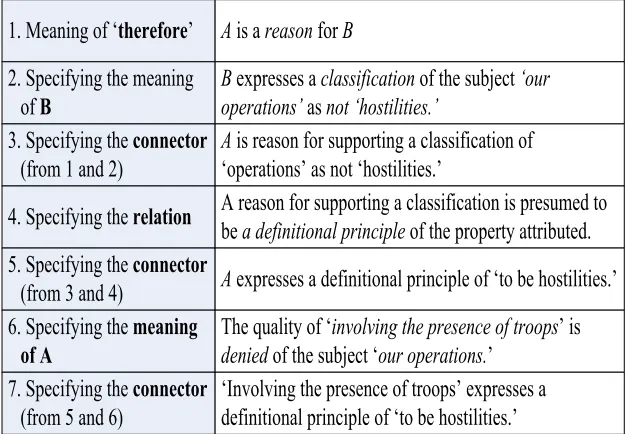
subject of the previous sequence (A). The attribution of a predi-cate on the basis of its qualities can be usually presumed to be a classification, which requires that the quality mentioned in the first sentence represents a definitional principle for the attribu-tion of the quality in the second sentence (Kempson 1975: 109-110). Therefore, the characteristic of U.S. operations, i.e. “not involving the presence of ground troops,” shall be taken to be a definitional principle, of ‘to be hostilities.’ The presupposition of ‘therefore’ in this specific case can be reconstructed by speci-fying the abstract relation of the high-level predicate. This pro-cess can be summarized as follows:
1. Meaning of ‘therefore’ A is a reason for B 2. Specifying the meaning
of B
B expresses a classification of the subject ‘our operations’ as not ‘hostilities.’
3. Specifying the connector (from 1 and 2)
A is reason for supporting a classification of ‘operations’ as not ‘hostilities.’
4. Specifying the relation A reason for supporting a classification is presumed to be a definitional principle of the property attributed. 5. Specifying the connector
(from 3 and 4) A expresses a definitional principle of ‘to be hostilities.’ 6. Specifying the meaning
of A
The quality of ‘involving the presence of troops’ is denied of the subject ‘our operations.’
7. Specifying the connector (from 5 and 6)
‘Involving the presence of troops’ expresses a definitional principle of ‘to be hostilities.’
Figure 1: Reconstructing the missing premise
© Fabrizio Macagno & Giovanni Damele. Informal Logic, Vol. 33, No. 3 (2013). Pp. 361-389.
will analyze this choice in section 5, when we will consider the cases in which the reconstruction of the tacit premise becomes a strategic and potentially fallacious instrument.
Considering the relationship between the speaker and the presupposed content, the presuppositional nature of the implicit premise raises the problem of defining its characteristics and its boundaries. In order to address this issue, we need to investigate the pragmatic dimension of presupposition.
2.2 The speech act of taking for granted
Stalnaker defined the concept of presupposing a proposition as “to take its truth for granted, and to assume that others involved in the context do the same” (Stalnaker 1970: 279). He under-scored how the act of taking a proposition for granted shall be considered as a propositional attitude, which can be interpreted as an action of a kind (Stalnaker 2002: 701). On his view, pre-suppositions are made by the speakers (Stalnaker 1970: 279), in the sense that presupposing a proposition amounts to a form of decision made by the speaker to treat some information as com-mon ground among the participants, or rather as belonging to the Universe of Discourse (Kempson 1975: 17). However, enthy-memes can be based on major premises that are known to be false or not accepted or considered acceptable by the hearer. How can a speaker believe or assume that a proposition is shared by the addressee, especially when it is known to be unac-ceptable or unaccepted?
© Fabrizio Macagno & Giovanni Damele. Informal Logic, Vol. 33, No. 3 (2013). Pp. 361-389.
refuse the possibilities opened up by the move of his opponent, and thereby continue or terminate the game (Ducrot 1968: 87).
This account of presuppositions as a kind of speech act can explain how and why the speaker can treat a proposition as part of the common ground even if it is not. Such an act does not depend on what the interlocutors actually share, or on what the speaker believes (Burton-Roberts 1989: 26). A proposition that is known or believed not to be shared can be still presupposed, in the sense that it can be advanced as a condition or ground for the continuation of the dialogue. However, the structure of the dialogue move should be distinguished from its possibility, i.e. from the limits that separate an acceptable act of presupposition from a mischievous or fallacious one.
2.3 The limits of presupposing
According to Ducrot, presuppositions need to be accepted in or-der for the dialogue to be possible. However, at the same time presuppositions need to be part of the common ground of the interlocutor. How is it then possible to presuppose information not shared, or not known to be shared? On Lewis' perspective (Von Fintel 2008), in this case the hearer “accommodates” (or reconstructs) the presupposed and not shared propositions in or-der to avoid communicative failure, within certain limits (Lewis 1979: 340). The problem is to identify the “certain limits” that restrict the possibility of reconstructing a presupposition.
According to Stalnaker (1998: 8), the relationship between speaker’s and hearer’s knowledge in the process of accommoda-tion can be considered as a presumpaccommoda-tion of the speaker that the presupposed information is available to his or her audience. For instance, we modified the argument in Case 1 above so that we can analyze the acceptability and reasonableness of the follow-ing variants:
A. Our intervention cannot be considered as hostilities. We have not used weapons or the military.
B. Our intervention is not a çatışma1. We have not
inter-vened.
C. Our intervention cannot be considered as hostilities. It is fast and well done.
D. Our intervention cannot be considered as hostilities. It does not involve the cooking of potatoes.
© Fabrizio Macagno & Giovanni Damele. Informal Logic, Vol. 33, No. 3 (2013). Pp. 361-389.
E. Our intervention cannot be considered as hostilities. Ground troops have not intervened.
The first crucial issue that these examples point out is the possibility of accommodating a presupposition. In (A) the inter-locutor can accommodate the missing premise and accept it. In (B), the tacit premise cannot be evaluated as the hearer cannot accommodate some pieces of information. In (A), the speaker grounds the presupposition of his major premise on the fact that people (and congressmen) usually know that “use of weapons and the military is a definition of hostilities.” Case (B) is radi-cally different. The hearer (in an ordinary context, where people cannot speak Turkish) cannot reconstruct and accept the presup-position. As an essential requirement, it fails clearly for two rea-sons. The speaker cannot presume that the interlocutor knows the meaning of a Turkish word (‘çatışma’) and, therefore, that he can retrieve the tacit premise (“çatışma means intervention”) from his background information. The speaker can reconstruct the tacit premise, but he cannot understand its meaning and can-not evaluate it. The purpose of the enthymeme, transferring the acceptability of the premises onto the conclusion, fails com-pletely, as an unknown proposition cannot be evaluated.
Another crucial dimension is the acceptability of a presup-position, namely the case in which the interlocutor can recon-struct and evaluate the presupposed premise, but he does not or cannot accept it. In (C) and (D) the hearer can understand the nature of the proposition taken for granted (a definitional state-ment) and connect it with his or her background knowledge. However, in (C) the hearer cannot accept that the property of “being nice and well done” is a definition of an action (hostili-ties). In (D), the presupposition can be reconstructed and its na-ture as a definitional statement accepted. However, no English speaker can accept that ‘cooking of potatoes’ is a definition of ‘hostilities.’ The possibility of presupposing (corresponding to the possibility of our speaker’s evaluating it) needs to be distin-guished from the acceptability (or rather the evaluation) of a proposition taken for granted.
(in-© Fabrizio Macagno & Giovanni Damele. Informal Logic, Vol. 33, No. 3 (2013). Pp. 361-389.
tervention of ground troops) is treated as a necessary one. We distinguish between four different cases of presupposition of implicit premises:
(i) The premise can be reconstructed, evaluated and ac-cepted as a background assumption (case A);
(ii) The presupposition cannot be evaluated, as it cannot be related with the common ground (case B);
(iii) The presupposition can be evaluated but its function (the relation between antecedent and consequent) cannot be accepted (case C);
(iv) The presupposition can be evaluated but its content cannot be accepted (case D and E).
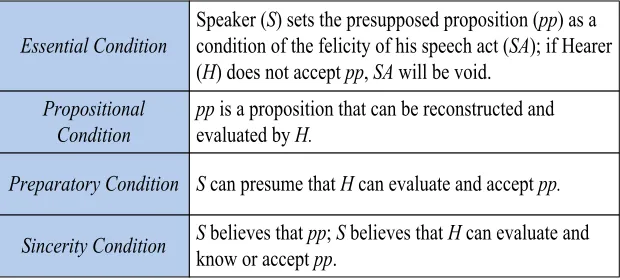
These possibilities allow us to outline the possible felicity condi-tions of the implicit speech act of presupposing, building on Austin’s and Searle and Vanderveken’s accounts of speech act conditions (Austin 1962: 14-15; Searle & Vanderveken 1985: 13-19; Holdgraves 2008: 13):
Essential Condition
Speaker (S) sets the presupposed proposition (pp) as a condition of the felicity of his speech act (SA); if Hearer (H) does not accept pp, SA will be void.
Propositional Condition
pp is a proposition that can be reconstructed and evaluated by H.
Preparatory Condition S can presume that H can evaluate and accept pp.
Sincerity Condition S believes that pp; S believes that H can evaluate and
know or accept pp.
Figure 2: Conditions of the act of presupposing
© Fabrizio Macagno & Giovanni Damele. Informal Logic, Vol. 33, No. 3 (2013). Pp. 361-389.
the speaker’s and hearer’s mind from an epistemic and argumen-tative perspective.
3. Tacit premises and presumptive reasoning
The crucial characteristic of the act of presupposing mentioned above is the possibility of presuming that the hearer shares the proposition to be taken for granted (see for this notion Strawson 1971: 58-59; Kempson 1975: 166-167). This condition repre-sents the grounds of the reasonableness of this move. By inves-tigating the structure of presumptive reasoning it is possible to understand the relationship between a presumed proposition and its epistemic status, and the dialogical effects of leaving a prem-ise unexpressed.
3.1 Implicit premises and presumption
Implicit premises can be conceived as the conclusion of pre-sumptive reasoning. The speaker cannot know the other’s mind, what the interlocutor knows. He can only advance a tentative and defeasible conclusion based on a form of reasoning in lack of evidence. The speaker draws specific conclusions on what the interlocutor may know based on general principles concerning common knowledge, such as “Speakers belonging to a specific speech community usually know the meaning of the most im-portant words of the language used therein.” According to Rescher, presumptions are forms of reasoning in lack of evi-dence (Rescher 1977: 1). They cannot prove a conclusion, and are used when it is not possible to demonstrate a conclusion. This type of reasoning is rebuttable and defeasible, as it supports a conclusion until contrary evidence is produced. However, its inherent defeasibility has a fundamental effect on the dialogical setting: it has the effect of shifting the burden of producing evi-dence, or supporting a standpoint, onto the other party.
© Fabrizio Macagno & Giovanni Damele. Informal Logic, Vol. 33, No. 3 (2013). Pp. 361-389.
Premise 1:
P (the proposition representing the presumption) obtains whenever the condition C obtains unless and until the standard default proviso D (to the effect that
countervailing evidence is at hand) obtains.
Premise 2: Condition C obtains (Fact).
Premise 3: Proviso D does not obtain (Exception).
Conclusion: P obtains.
Figure 3: Presumptive reasoning
The Rule of presumption links the acceptability of a prop-osition P (for instance, a man is dead) to a condition C (the man has not been heard from in five years) until a specific default proviso D obtains (for instance, he is found to be alive). If a man has not been heard from in five years and no evidence of his be-ing alive has been advanced, he is to be considered as dead.
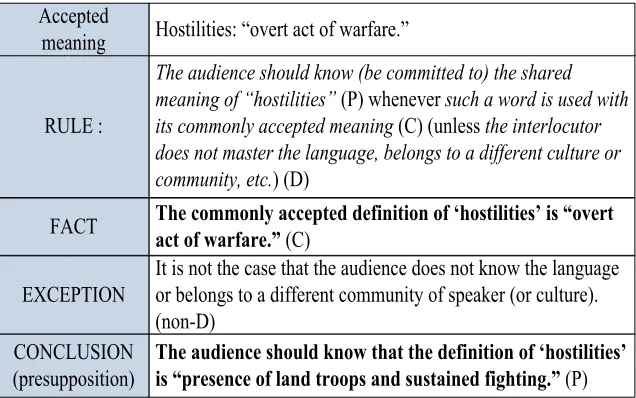
This type of reasoning can be applied to the analysis of the implicit premise in enthymemes. Presumptive reasoning can be used to highlight the conditions in which the speaker can rea-sonably take a premise for granted and the possible contradic-tion resulting from presupposing an unshared or unaccepted proposition. For instance, we analyze Case 1 above and assess the reasonableness of its implicit premise reconstructing the pre-sumptive reasoning on which it is based (see Figure 4, below).
RULE :
The audience should know (be committed to) the shared meaning of “hostilities” (P) whenever such a word is used with its commonly accepted meaning (C) (unless the interlocutor does not master the language, belongs to a different culture or community, etc.) (D)
FACT The commonly accepted definition of ‘hostilities’ is “overt
act of warfare.” (C)
EXCEPTION
It is not the case that the audience does not know the language or belongs to a different community of speaker (or culture). (non-D)
CONCLUSION (presupposition)
The audience should know that the definition of ‘hostilities’ is “presence of land troops and sustained fighting.”(P) Accepted
meaning Hostilities: “overt act of warfare.”
© Fabrizio Macagno & Giovanni Damele. Informal Logic, Vol. 33, No. 3 (2013). Pp. 361-389.
In this case, the presupposed proposition is in conflict with the premise on which it is drawn (the Fact), and therefore cannot follow from it. The reconstruction of the presumptive meaning shows a clear contradiction, which makes the whole act of pre-supposing unreasonable (Macagno 2011).
However, as mentioned above, the possibility and the rea-sonableness of presupposing need to be distinguished from its effectiveness. In this case, Obama took for granted a definition similar to the commonly accepted one. Moreover, he used it be-fore the Congress, relying on the lack of an official definition of this word. As a matter of fact, ‘hostilities’ was not defined in the relevant act, in this case the War Powers Resolution Act. As a consequence, the effect was extremely powerful. Obama chose to take the major premise of his reasoning for granted, as he could not prove that “hostilities means presence of land troops and sustained fighting.” However, he also knew that, in lack of an explicit definition, the contrary could be hardly proved. The Congress could not accept the implicit premise, but at the same time they could not prove the contrary. The force of Obama’s rhetorical syllogism did not lie in its probative weight (the major premise was unacceptable), but in its implicit dimension (the major premise was presupposed). The force of his argument rested in the dialogical effect of burden-shifting of the tacit premise. The presumptive reasoning underlying his move shift-ed the burden of proof.
3.2 The effects of presuming
© Fabrizio Macagno & Giovanni Damele. Informal Logic, Vol. 33, No. 3 (2013). Pp. 361-389.
negative judgment is often associated with presumptions of knowledge or interest. By underscoring that a premise is shared by everybody, or the “true” or the “good” citizen, it is possible to enhance the burden of rejection. Ideally, the interlocutor would need to show not only that the premise is wrong, but that actually it is not shared, facing an implicit threat of being classi-fied as an ignorant, or an “untrue” citizen (Macagno 2012).
Politicians often use this appeal to the common ground by emphasizing the concept of ‘we-ness,’ which underscores the fact that they are voicing an opinion commonly shared in the country. For instance, consider the following excerpt from Clin-ton’s speech in favor of the Bosnia intervention in 20082 (em-phasis added):
Case 2
And all around the world, more people than ever before live in freedom, more people than ever before are treated with dignity, more people than ever before can hope to build a better life. That is what America's leadership is all about. We know that these are the blessings of freedom, and America has always been freedom's greatest champi-on.
Clinton stresses how the relationship between the improving conditions of people on earth and the American wars is known by his fellow countrymen. Potentially controversial premises (the actual role of U.S. wars on the freedom and dignity of the population of the world; the relationship between wars and free-dom, etc.) are presented as shared, and to be shared. Another clear example of this strategy is the following quotation from Mitt Romney’s Wisconsin speech3 (emphasis added):
Case 3
You know, we all know that President Obama cannot run on his record. We know that he can’t run on his broken promises. [..] We need someone who appeals to our dreams and our aspirations, not to our fears and our anxi-eties. We as Americans deserve to choose what kind of country we want and what kind of people we want to be.
2http://edition.cnn.com/US/9511/bosnia_speech/speech.html (Accessed on 7 February 2013).
© Fabrizio Macagno & Giovanni Damele. Informal Logic, Vol. 33, No. 3 (2013). Pp. 361-389.
And the good news is, it’s not too late to get America back on track. It’s not too late to put our country back on-to a path of prosperity. Guess what? We have a leader who can do that. We have a leader who will give Ameri-cans that choice. We have a leader who will put our country back on the right track. Tonight, Wisconsinites have spoken. Republicans are unifying.
Romney presents Obama’s unreliability (broken promises), ap-peals to fear, and poor ability to run the country as a fact that everybody knows. He increases the burden of disproving this premise, which becomes the reason not to vote Obama and therefore choose the alternative, specifically the speaker, Mitt Romney.
Presuppositions, and in particular tacit enthymematic premises, are acceptable and reasonable when they can be pre-sumed to be shared or accepted.4 However, they are effective also when they only resemble the commonly accepted ones. This characteristic of presupposition can explain one of the most important dimensions of enthymemes, their context-dependency.
4. Enthymemes and Kairos: Tacit premises and their
con-text-dependency
The presumptions on which an enthymeme is based are not all at the same level (Giuliani 1961: 66-67). Their credibility (or ra-ther acceptability) varies according to their nature, and, more importantly, according to the values of the interlocutors. Ac-cording to Quintilian, there are different levels of credibility of a premise (Institutio Oratoria V, 10, 16):
With regard to credibility there are three degrees. First, the highest, based on what usually happens, as for in-stance the assumption that children are loved by their parents. Secondly, there is the highly probable, as for in-stance the assumption that a man in the enjoyment of good health will probably live till tomorrow. The third degree is found where there is nothing absolutely against
© Fabrizio Macagno & Giovanni Damele. Informal Logic, Vol. 33, No. 3 (2013). Pp. 361-389.
an assumption, such as that a theft committed in a house was the work of one of the household.
On this view, some presumptions shall be, or usually are, pre-ferred over others, and who challenges them carries the burden of proof (Giuliani 1961: 67). The hierarchy of presumptions de-pends on the hierarchy of values and opinions shared by a given community. For instance, ethical norms such as “If she is his mother, she loves her son” or “If he is an avaricious man, he ne-glects his oath” (Ciceronis De Inventione I, 29-30) represent the strongest presumptions. They carry not only a burden of proof, but also a burden of criticism (Kauffeld 1998: 264), as the party who rejects one of them risks being criticized for challenging shared values. For this reason, depending on the hierarchies of values of the audience (Perelman & Olbrechts-Tyteca 1951), some premises will be more effective because they are more shared, more acceptable, and more difficult to rebut in a given community.
This relationship between presumptions, enthymemes, values, and audience brings to light the “situational” or rather contextual dimension of rhetoric (Bitzer 1968), which is essen-tially related to the notion of kairos, i.e. opportunity. Even though according to Vatz “rhetoric controls the situational re-sponse” (Vatz 1968), and therefore it “is a cause not an effect of meaning,” kairos plays a crucial role in rhetorical discourse. Rhetorical discourse can be seen as the result of an activity of strategic invention, and not as the outcome of a process of dis-covery from reality. Therefore, rhetorical discourse can be con-sidered as grounded on a sort of epistemological relativism, whose keystone is the concept of kairos (Untersteiner 1954). The contextual and individual dimension of the rhetorical dis-course is also a crucial element of the Aristotelian approach to rhetoric, and in particular to its role in political and legal discus-sions (Rhetoric 1354b 3-8). The concept of kairos, which is complex and hard to define, is basically related to the specific opportunity at a given time (Kinneavy 2002: 67). It is strictly bound to the ability of finding or reconstructing a premise that is strategically necessary to achieve a specific outcome in a given context. It is the situational, contextual dimension of rhetoric, in the spatial and temporal meaning of the term.
© Fabrizio Macagno & Giovanni Damele. Informal Logic, Vol. 33, No. 3 (2013). Pp. 361-389.
Aristotle when he analyzes the use and the choice of the maxims (Rhetoric 1394a 25-26): “In regard to the use of maxims, it will most readily be evident on what subjects, and on what occa-sions, and by whom it is appropriate that maxims should be em-ployed in speeches.” Kairos does not simply describe a tactic; it concerns the whole rhetorical strategy, as it refers to the selec-tion of the persuasive premises. On the one hand, the rhetorical syllogism cannot be simply described as a syllogism grounded on common knowledge, or rather endoxa (propositions belong-ing to the common ground, i.e. accepted by the majority or the wise), otherwise there would be no difference between the dia-lectical and the rhetorical syllogism. On the other hand, the presence of an audience that characterizes rhetorical discourse does not only result in the emotional components of rhetoric. The crucial role that the audience plays in rhetoric is related to the very structure of the rhetorical syllogism and its persuasive power (pithanòn). According to Aristotle, the grounds of en-thymemes are probabilities [ex eikònta] and signs. In particular, eikòs refers to what “is accustomed generally to take place, or which depends upon the opinion of men, or which contains some resemblance to these properties, whether it be false or true.” (Ciceronis De Inventione I, 46). Enthymemes are ground-ed on what is presumed to usually occur, on what is likely to be true for a specific audience, and not on statistical probability (Viano 1955: 280-86).
In this rhetorical view, truth is regarded not as the end of the discourse, but as an instrument of persuasion. The perspec-tive from which the elements of the discourse are analyzed changes radically with respect to dialectics. The discourse is not aimed at what is true or what is accepted, like in dialectics, but at what is persuasive. For this reason, truth is rhetorically im-portant because of its persuasive force, as “things that are true and things that are just have a natural tendency to prevail over their opposites” (Rhetoric 1355a 21-22). An enthymeme can be also apparently true, as long as it is likely, i.e. persuasive. The rhetorical syllogism is bound to the audience, as the speaker needs to choose the premises that are likely to be true for the specific interlocutors in a given situation.
© Fabrizio Macagno & Giovanni Damele. Informal Logic, Vol. 33, No. 3 (2013). Pp. 361-389.
Simpson trial, and in particular in the arguments in the defense attorney’s closing statement (Bayor 2004: 928):
Case 4
We owe a debt of gratitude to this lady that ultimately and finally came forward. And she tells us that this man over the time of these interviews uses the "N" word 42 times is what she says. And so-called Fuhrman tapes. And you of course had an opportunity to listen to this man and espouse this evil, this personification of evil. […] Talking about women. Doesn't like them any better than he likes African Americans. They don't go out and initiate contact with some six foot five inch Nigger who has been in prison pumping weights. This is how he sees this world. That is this man's cynical view of the world. This is this man who is out there protecting and serving. That is Mark Fuhrman.
pre-© Fabrizio Macagno & Giovanni Damele. Informal Logic, Vol. 33, No. 3 (2013). Pp. 361-389.
sented in the civil trial before a mostly white jury. In this other context, characterized by an audience having different shared values, the strength of the presumptions used was different. The same tacit major premises were no longer opportune, and the argument lost most of its effectiveness.
Implicit premises are grounded on a presumptive mecha-nism that results in a powerful dialogical effect. By presuppos-ing a premise, the speaker presumes that is shared, shiftpresuppos-ing the burden of proof onto the interlocutor, who needs to prove that the proposition left unexpressed is not acceptable or is false. This presumptive aspect of enthymemes can be used strategical-ly, taking for granted not what is actually shared, but what only appears to be so. On this perspective, the likeliness of a premise plays a crucial role. The speaker can understand what his partic-ular audience holds to be likely, and presuppose premises that are only apparently shared.
5. Manipulating the tacit premises: Strategies of presuming
In section 2, and in particular in subsection 2.1, we have men-tioned that the phenomenon of presupposition has two dimen-sions, depending on its relation with the dialogical “actors.” On the one hand, the speaker performs the act of presupposing, within the limits mentioned in 2.3, which results in the presump-tive effects mentioned in section 3.2 above. On the other hand, however, this implicit proposition needs to be reconstructed by the hearer. The way he can retrieve this presupposed content can be the ground of a specific strategy, the likely distortion of im-plicit commitments, which is a particular type of the fallacy of straw man.
© Fabrizio Macagno & Giovanni Damele. Informal Logic, Vol. 33, No. 3 (2013). Pp. 361-389.
From a pragmatic perspective, the straw man encompasses three different tactics that are based on the different pragmatic nature of the speaker’s move and the hearer’s commitments: (1) the explicit distortion of the interlocutor’s explicit position; (2) the implicit manipulation of the addressee’s explicit commit-ments; and (3) the implicit or explicit distortion of the interlocu-tor’s implicit commitments. In the first case, as mentioned above the speaker exposes himself to the risk of being counter-attacked. In the second case, the effect of the argument amounts to shifting the burden of interrupting the dialogue and rejecting the implicit premise onto the interlocutor. The most powerful and dangerous tactic is the third one, which is closely related with the concepts of premise reconstruction and likeliness of the tacit propositions.
The speaker can attack or take for granted the misrepre-sentation (and therefore misinterpretation) of interlocutor’s commitments that can be reconstructed from his arguments or claims. This move can be extremely effective, as it consists in an implicit distorted, but at the same time likely, interpretation (or rather an uncharitable reconstruction) of a tacit position, and for this reason it is more difficult to detect and reconstruct. The hearer cannot rebut the tacit straw man by simply appealing to a statement that can be “on record,” as the distorted position has never been explicitly put forward. In order to reject the move, the hearer needs to reconstruct his implicit position, and provide arguments to support his interpretation of his own view. He needs to show that the speaker’s interpretation is not correct, or not acceptable, or in any case less likely than the one that the addressee is advocating. For this reason, the distortion of implic-it commimplic-itments is characterized not only by the burden-shifting effect, but more importantly by the increase of the burden of re-jecting the altered commitment. This strategy is extremely pow-erful and is greatly effective both in law and politics.
© Fabrizio Macagno & Giovanni Damele. Informal Logic, Vol. 33, No. 3 (2013). Pp. 361-389.
Brazil, Mr. Eros Grau and Mr. Cezar Peluso, concerns the ap-peal issued by the Italian Government against the Minister of Justice, who offered protection to Battisti as a refugee. The sub-ject matter of the controversy is the reason put forward by the Minister of Justice (in this case representing the Public Admin-istration) on the right of asylum to Battisti. Mr. Grau holds that the Minister has the right to appear before the Court to explain his reasons and clarify his position. On the contrary, Mr. Peluso aims at avoiding any appearance of the Minister and grounding the decision on the brief of the Minister’s lawyer5:
Case 5
Grau: When there is a discussion before the court con-cerning the validity of a decision of the Public Admin-istration […], the AdminAdmin-istration shall be considered as a party.
Peluso: [...] Why do you insist on claiming that the Min-ister of Justice has not expressed his reasons, or that his claims are not valid?
Grau: Because what I have read is not enough for me. Peluso: Then, you should have told to the lawyer of the
Minister of Justice to be clearer in writing his state-ment of defence.
Grau: This claim of yours is a serious one.
Peluso: Your excellence, you have said that you are not happy with the reasons put forward by the Minister of Justice!
Grau: I have already said what I think. I will just vote.
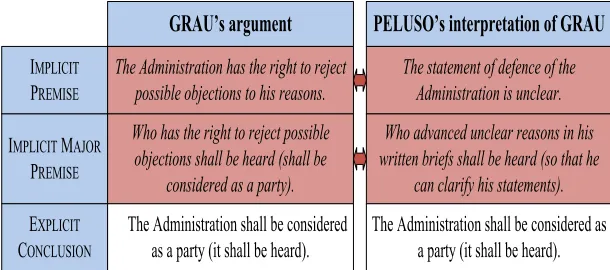
Here Mr. Peluso reconstructs the implicit reasons underly-ing Mr. Grau’s claim that the Minister has the right to be heard. According to Mr. Peluso, Mr. Grau wants the Minister heard because the reasons advanced in his brief are not clear enough. However, as shown in the opinion supporting his vote (Supremo Tribunal Federal, Ext 1085, Voto Eros Grau, at 5-8), Mr. Grau requested the hearing of the Minister because the Minister had the right of appearance, which in this case amounts to the right to reject possible objections to his reasons. Peluso, by recon-structing and distorting the reasoning supporting Grau’s conclu-sion, can attack the reasonableness of his request. His move is grounded on the strategy of taking for granted potentially
© Fabrizio Macagno & Giovanni Damele. Informal Logic, Vol. 33, No. 3 (2013). Pp. 361-389.
troversial enthymematic premises, which we represent as fol-lows:
GRAU’s argument PELUSO’s interpretation of GRAU
IMPLICIT PREMISE
The Administration has the right to reject possible objections to his reasons.
The statement of defence of the Administration is unclear.
IMPLICIT MAJOR PREMISE
Who has the right to reject possible objections shall be heard (shall be
considered as a party).
Who advanced unclear reasons in his written briefs shall be heard (so that he
can clarify his statements). EXPLICIT
CONCLUSION
The Administration shall be considered as a party (it shall be heard).
The Administration shall be considered as a party (it shall be heard).
Figure 5: Distorting the implicit grounds of a claim
In this figure, it is clear how Peluso distorts Grau’s implic-it premise supporting his conclusion. Moreover, he increases the burden of attacking his straw man by taking for granted that his reconstruction is the accepted one (“why do you insist on claim-ing…”).
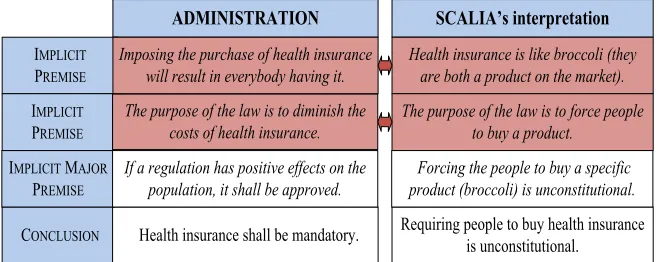
The second example is taken from a statement delivered by Judge Scalia during the discussion on the constitutionality of the American health law (Affordable Care Act), requiring every citizen to purchase a mandate, or rather health insurance. In or-der to attack the health insurance mandate, Scalia used the fol-lowing analogy6:
Case 6
“Could you define the market—everybody has to buy food sooner or later, so you define the market as food, therefore, everybody is in the market; therefore, you can make people buy broccoli,” Scalia said.
The argument can be paraphrased as follows7:
6 http://washington.cbslocal.com/2012/03/27/you-can-make-people-buy-broccoli-scalia-goes-after-health-care-law/ (Accessed on 9 July 2012). 7 For the interepretation, see
© Fabrizio Macagno & Giovanni Damele. Informal Logic, Vol. 33, No. 3 (2013). Pp. 361-389.
ADMINISTRATION SCALIA’s interpretation IMPLICIT
PREMISE
Imposing the purchase of health insurance will result in everybody having it.
Health insurance is like broccoli (they are both a product on the market).
IMPLICIT
PREMISE
The purpose of the law is to force people to buy a product.
CONCLUSION Health insurance shall be mandatory. Requiring people to buy health insurance
is unconstitutional. IMPLICIT MAJOR
PREMISE
If a regulation has positive effects on the population, it shall be approved.
Forcing the people to buy a specific product (broccoli) is unconstitutional. The purpose of the law is to diminish the
costs of health insurance.
Figure 6: Distorting the purpose of a proposal
Scalia used an analogy whose implicit premises misrepresent the interlocutor’s position. Scalia presented the supporters of the Affordable Care Act as imposing the purchase of a product, not taking into consideration the essential differences between a commercial item and an essential need whose lack can affect the rights of others. Scalia implicitly distorts the purpose of the law, which was actually to extend health insurance to everybody, es-pecially to the poor, reducing its costs.
The two aforementioned examples show the strategic im-portance of implicit premises and kairos in enthymemes. The implicit dimension of enthymemes can be used strategically to take for granted a misrepresentation of another’s position. The two examples point out the crucial strategic role of implicitness in distorting the interlocutor’s position. The speaker can recon-struct the tacit premise of the interlocutor’s enthymeme to serve a specific goal, and take his (mis)reconstruction for granted to avoid the burden of proof. In both cases the speaker is extremely successful. In the first example the interlocutor does not even reply; in the second one, the rebuttal is extremely weak and inef-fective.8 These two examples underscore the crucial role of kairos. The speakers were successful because they could select premises that were likely to be the ones that grounded the inter-locutor’s argument. They provided implicit reconstructions that were plausible, or rather likely.
The effectiveness of the implicit straw man crucially de-pends on the likeliness of the distorted position. The speaker needs to choose the implicit premise in an opportune fashion: his misrepresentation needs to be credible, likely and, most
© Fabrizio Macagno & Giovanni Damele. Informal Logic, Vol. 33, No. 3 (2013). Pp. 361-389.
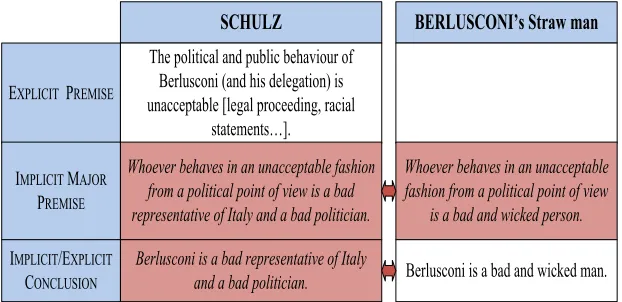
portantly, acceptable by the audience. The relationship between effectiveness and opportunity becomes clear when things go wrong, namely when the strategy of implicit reconstruction and misrepresentation is unsuccessful. An extremely famous exam-ple is the notorious Berlusconi’s reply to Martin Schulz before the European Parliament. In the discussion of 2 July 2003, the German delegate attacked the former Italian Prime Minister on several grounds: he criticized the racist statements of his politi-cal partner and member of the Italian delegation, Mr. Bossi, and the intelligence and the political abilities of Berlusconi’s minis-ters. He pointed out the problem of conflict of interests in Italian politics and reminded the audience of Berlusconi’s trials. Final-ly, he asked the Italian politician to apply the European direc-tives in matter of criminal law. Schulz attacked Berlusconi from a purely political perspective, as his target was the clear incapac-ity and inadequacy of a public and political figure. Berlusconi replied as follows9:
Case 7
Mister Schulz, I know that a producer in Italy is currently preparing a film on the Nazi concentration camps: I would propose you for the role of a kapo; you would be perfect!
The interpretation of the reasoning underlying this coun-ter-attack was provided by Berlusconi himself, who later claimed to the press that Schulz attacked him personally and wickedly, and, therefore, the reply was on the same personal level.10 Berlusconi interpreted an attack to his political and pub-lic dimension as a personal attack. He reinterpreted the imppub-licit premises and the implicit conclusion of Schulz’ criticism and used them as a justification for his offensive reply. We can rep-resent the reasoning as follows:
9http://ec.europa.eu/avservices/video/shotlist.cfm?ref=81521 (Accessed on 9 July 2012).
10
© Fabrizio Macagno & Giovanni Damele. Informal Logic, Vol. 33, No. 3 (2013). Pp. 361-389.
SCHULZ BERLUSCONI’s Straw man
EXPLICIT PREMISE
The political and public behaviour of Berlusconi (and his delegation) is unacceptable [legal proceeding, racial
statements…].
IMPLICIT MAJOR
PREMISE
Whoever behaves in an unacceptable fashion from a political point of view is a bad representative of Italy and a bad politician.
Whoever behaves in an unacceptable fashion from a political point of view
is a bad and wicked person.
IMPLICIT/EXPLICIT
CONCLUSION
Berlusconiis a bad representative of Italy
and a bad politician. Berlusconi is a bad and wicked man.
Figure 7: Manipulating the subject matter and the purpose of a move
Berlusconi reconstructed the purpose of Schulz’s state-ments and misrepresented them as aimed at attacking him sonally instead criticizing him from a public and political per-spective. He distorted the very purpose of Schulz’s attack, and consequently he manipulated the implicit conclusion and the ex-plicit premise of his enthymeme. Berlusconi took for granted this misrepresentation in replying to him: he insulted him per-sonally, putting the criticism of the German representative on the same level of his vulgar joke. However, his reconstruction of the implicit dimension of Schulz’s move was completely unrea-sonable and unlikely, and could not be anyhow accepted by the audience.
This example is useful to show the crucial importance of kairos and its relationship with ethics pointed out in the ancient tradition. Berlusconi chose the implicit premises that “Schulz resembles a Nazi,” and that “Nazis (and those who are similar to them) are bad.” Both premises are totally inopportune in an in-ternational and diplomatic context, especially from an ethical perspective. For this reason, this move resulted in an interna-tional scandal.11
11 Straw man can be combined with other strategies, such as auto-victimization, which are based on more ethically opportune premises, and lead to extremely successful outcomes. One of the clearest examples is Rom-ney’s straw man of Gingrich’s attack: Romney distorts Gingrich’s claim that “Romney is the most anti-immigrant representative among us [the candi-dates]” playing the part of the victim, stating that he cannot be racist and anti-immigrant, considering that his father was born in Mexico.
© Fabrizio Macagno & Giovanni Damele. Informal Logic, Vol. 33, No. 3 (2013). Pp. 361-389.
6. Conclusion
Enthymemes have been described by Aristotle as rhetorical in-struments, aimed at the persuasion of the audience. Why and how can the structure of the rhetorical syllogism be aimed at persuasion? A possible answer can be found in their pragmatic dimension, in reason why a premise can be “missing”, or rather left unexpressed. By investigating the linguistic structure of an enthymeme, we have shown how tacit premises can be consid-ered as presuppositions of a higher level predicate, or rather “coherence relation” between the explicit premise and the con-clusion. Presuppositions are forms of implicit speech acts, char-acterized by specific conditions governing their possibility and reasonableness. In particular, the reasonableness of this act de-pends on the possibility of presuming the interlocutor’s ac-ceptance (or knowledge) of the proposition that is left unex-pressed. On this view, presuppositions are linguistic phenomena that are crucially grounded on a pattern of presumptive reason-ing. The speaker presumes that a proposition is accepted by the interlocutor, and for this reason treats it as uncontroversial. This analysis of implicit premises accounts for two fundamental rhe-torical dimensions of enthymemes: their dialogical effects and their strategic uses.
From a dialogical perspective, the implicit move shifts the burden of proof onto the hearer, who needs to reject the move and provide evidence that the presupposed proposition is in fact not acceptable or shared. The presumptive dimension of enthy-memes is the cornerstone of kairos, which is the strategic aspect of rhetoric. The speaker can take a proposition for granted be-cause he presumes that it will be accepted by his interlocutors. Presumptions are different in strength, and depending on the community some propositions are considered more or less like-ly, more or less acceptable. For this reason, the effectiveness of an enthymeme is determined by the opportunity of its implicit premise, i.e., its appropriateness in a given context.
© Fabrizio Macagno & Giovanni Damele. Informal Logic, Vol. 33, No. 3 (2013). Pp. 361-389.
with the actual proposition, or with what is usually the case. In this sense, the representation of the interlocutor’s (or third par-ty’s) words does not need to be true, but simply likely, similar to what usually happens or should be the case. In this sense enthy-memes can be considered as strategies of presuming.
References
Aristotle. (1969). Topica. In W. Ross (ed.), The works of Aristotle. Oxford: Oxford University Press.
Aristotle. (1991). On Rhetoric (translated by G. A. Kennedy). New York: Oxford University Press.
Austin, J. (1962). How to do things with words. Oxford: Claren-don.
Bach, K. (2003). Speech acts and pragmatics. In M. Devitt and R. Hanley (eds.), Blackwell. Guide to the philosophy of lan-guage (pp. 147-167). Oxford: Blackwell.
Bayor, R. (2004). The Columbia documentary history of race and ethnicity in America. New York: Columbia University Press.
Bitzer, L. (1968). The rhetorical situation, Philosophy and Rhet-oric 1: 1-14.
Braet, A.C. (1999). The enthymeme in Aristotle's Rhetoric: From argumentation theory to logic. Informal Logic 19: 110-117.
Burke, M. (1985). Unstated Premises. Informal logic 7: 107-118.
Burton-Roberts, N. (1989). The limits to debate: A revised theo-ry of semantic presupposition. Cambridge: Cambridge Uni-versity Press.
Cicero, M.T. (1988). De Inventione. In The orations of Marcus Tullius Cicero (translated by C. D. Yonge). London: George Bell & Sons.
De Quincey, T. (1893). Essays on style, rhetoric, and language. Boston: Scott.
Ducrot, O. (1966). "Le roi de France est sage". Implication logique et présupposition linguistique. Etudes de linguistique appliquée 4: 39-47.
Ducrot, O. (1968). Le structuralisme en linguistique. In O. Du-crot et al. (eds.), Qu'est-ce que le structuralisme? (pp. 13-96). Paris: Seuil.
© Fabrizio Macagno & Giovanni Damele. Informal Logic, Vol. 33, No. 3 (2013). Pp. 361-389.
Ducrot, O. (1978). Deux mais. Cahier de linguistique 8: 109-120.
Dung, P.M., & Thang, P.M. (2010). Towards (Probabilistic) Ar-gumentation for Jury-based Dispute Resolution. In P. Baroni et al. (eds.), Proceedings of the 2010 conference on Compu-tational Models of Argument: Proceedings of COMMA 2010 (pp. 171-182). Amsterdam: IOS Press.
Giuliani, A. (1961). Il concetto di prova. Milano: Giuffré. Gough. J., & Tindale, C. (1985). Hidden or missing premises.
Informal Logic 7: 99-106.
Grice, P. (1975). Logic and conversation. In P. Cole and J. Mor-gan (eds.), Syntax and semantics 3: Speech acts (pp. 41-58). New York: Academic Press.
Grimes, J. (1975). The thread of discourse. The Hague: Mouton. Hamblin, C. (1970). Fallacies. Newport News: Vale Press. Hamilton, W. (1874). Lectures on logic. Edinburgh: William
Blackwood & Sons.
Hickey, L. (1993). Presupposition under cross-examination. In-ternational journal for the semiotics of law 6 (16): 89-109. Hobbs, J. (1985). On the coherence and structure of discourse.
Report No. CSLI-85-37, Center for the Study of Language and Information, Stanford University.
Holdgraves, T. (2008). Language as social action. Mahwah: Lawrence Erlbaum.
Hopper, R. (1981) How to do things without words: The taken for granted as speech action. Communication Quarterly 29 (3): 228-236.
Karttunen, L. (1973). Presuppositions of compound sentences. Linguistic inquiry 4 (2): 169-193.
Kauffeld, F. (1998). Presumptions and the distribution of argu-mentative burdens in acts of proposing and accusing. Argu-mentation 12: 245–266.
Kempson, R. (1975). Presupposition and the delimitations of semantics. Cambridge: Cambridge University Press.
Kinneavy, J.L. (2002). Kairos in classical and modern rhetori-cal theory. In P. Sipiora and J.S. Baumlin (eds.), Rhetoric and kairos (pp. 58-76). Albany: State University of New York Press.
Lakoff, R. (1971). If’s, and’s, and but’s about conjunction. In C. Fillmore and D. Langendoen (eds.), Studies in linguistic se-mantics (pp. 115-150). New York: Holt.
© Fabrizio Macagno & Giovanni Damele. Informal Logic, Vol. 33, No. 3 (2013). Pp. 361-389.
Lewis, D. (1979). Scorekeeping in a language game. Journal of philosophical logic 8: 339–359.
Macagno, F. (2011). The presumptions of meaning. Hamblin and equivocation. Informal logic 31 (4): 367-393.
Macagno, F. (2012). Presumptive reasoning in interpretation. Implicatures and conflicts of presumptions. Argumentation 26 (2): 233-265.
McBurney, J. (1994). The place of enthymeme in rhetorical the-ory. In E. Schiappa (ed.), Landmark essays on classical Greek rhetoric (pp. 169-190). Davis: Hermagoras Press. Perelman, C., & Olbrechts-Tyteca, L. (1951). Act and person in
argument. Ethics 61 (4): 251-269.
Quintilian, M.F. (1996). Institutio Oratoria (translated by H.E. Butler). Cambridge, Mass.: Harvard University Press.
Rescher, N. (1977). Dialectics: a controversy-oriented approach to the theory of knowledge. Albany: State University of New York Press.
Rescher, N. (2006). Presumption and the practices of tentative cognition. Cambridge: Cambridge University Press.
Rigotti E., & Rocci A. (2001). Sens - non-sens – contresens. Studies in Communication Sciences 2: 45-80.
Rigotti, E., & Rocci, A. (2006). Denotation vs. Connotation. In Encyclopedia of language and linguistics. Second edition (pp. 1-9). Oxford: Elsevier.
Rigotti, E. (1993). La sequenza testuale: definizione e procedi-menti di analisi con esemplificazioni in lingue diverse. L'ana-lisi linguistica e letteraria 1 (1): 43-148.
Rigotti, E. (2005). Towards a typology of manipulative proces-ses. In L. de Saussure and P. Schulz (eds.), Manipulation and ideologies in the twentieth century: discourse, language, mind (pp. 61- 83). Amsterdam: John Benjamins.
Schiller, L., & Willwerth, J. (1997). American tragedy: The un-censored story of the Simpson defense. New York: Avon Books.
Searle, J.R., & Vanderveken, D. (1985). Foundations of Illocu-tionary Logic. Cambridge: Cambridge University Press. Sorensen, R. (1988). Are Enthymemes Arguments? Notre Dame
Journal of Formal Logic 29(1): 155-159.
Stalnaker, R.C. (1970). Pragmatics. Synthese 22 (1-2): 272-289. Stalnaker, R.C. (1998). On the representation of context.
Jour-nal of logic, language, and information 7 (1): 3-19.
© Fabrizio Macagno & Giovanni Damele. Informal Logic, Vol. 33, No. 3 (2013). Pp. 361-389.
Strawson, P. (1971). Identifying reference and truth-values. In logico-linguistic papers (pp. 75-95). London: Methuen. Thagard, P. (2003). Why wasn't O. J. convicted? Emotional
co-herence in legal inference. Cognition and emotion 17 (3): 361-383.
Tindale, C. (1999). Acts of arguing: a rhetorical model of argu-ment. Albany: State University of New York Press.
Untersteiner, M. (1954). The sophists. Oxford: Basil Blackwell. Vanderveken, D. (2002). Universal grammar and speech act
theory. In D. Vanderveken and S. Kubo (eds.), Essays in speech act theory (pp. 25-62). Amsterdam: John Benjamins. Vatz, R.E. (1968). The myth of the rhetorical situation.
Philoso-phy & rhetoric 6 (3): 154-161.
Viano, C.A. (1955). La logica di Aristotele. Taylor, Torino. Von Fintel, K. (2008). What is presupposition accommodation,
again? Philosophical perspectives 22: 137–170.
Walker, J. (1994). The Body of Persuasion: A Theory of the En-thymeme. College English, 56, 1: 46-65.
Walton, D. (1999). Profiles of dialogue for evaluating arguments from ignorance. Argumentation 13: 53-71.