1
Graded observations of trainee teaching
practice: Analysis of grades by ethnicity
_____________________________________
Initial Teacher Training Programmes
Full-time study 2010-11
2 Acknowledgements
My sincere thanks are due to Anita Moore for regularly providing me with the data upon which this analysis is based.
3 Contents
______________________________________________________________
Acknowledgements 2
Executive summary 4
Background 5
Objectives 5
Ethnicity and achievement: an overview of findings from
research undertaken in 2008 6
Methodology and actions undertaken 6
Analysis of data from the grading pilot by ethnicity 7
Discussion 10
Recommendations 12
References 13
Appendix 1: University based full-time generic cohort – grading by ethnicity
Appendix 2: University based full-time Skills for Life cohort (Literacy, Numeracy and ESOL)– grading by ethnicity
Appendix 3: Partnership full-time cohort– grading by ethnicity
Addendum: Factors influencing differential achievement 17
Objectives 18
Methodology and actions undertaken 18
Analysis of interview data 18
Discussion 19
Recommendations 21
References 21
Appendix 4: Analysis of grades by ethnicity: Tutor/assessor explanations relating to individual full-time BME trainee grades (2010-11)
4 Executive summary
The University of Bolton has a clear commitment to improving the success
and attainment of black and minority ethnic (BME) students. Research
undertaken for the teacher training team at the University in 2008 had drawn attention to differential achievement of BME trainees in relation to their white colleagues. Although recruitment of BME trainees to University teacher training provision remains high, the teacher training team continues to interrogate its own practice in relation to BME achievement, and to work to identify strategies for improvement.
The introduction of the teaching observation grading pilot during 2010-11 has made possible a detailed analysis of an aspect of trainee progression and achievement. Specifically, it has enabled a more precise monitoring of progression and achievement in relation to ethnicity and other diversity characteristics. This report presents findings from an analysis of grading results by ethnicity for all full-time trainee teacher cohorts – generic, Skills for Life (SfL) and partnership.
Analysis of the graded observation results for all cohorts demonstrates overall trainee progression from observation 5 to observation 8 for both BME and white trainees. However differential achievement has been identified, and for each of the three cohorts, BME trainees have generally been assessed as achieving less well than white trainees. These differences are most evident in relation to generic and partnership cohorts. It should be noted that very few trainees, either BME or white, fail to achieve in terms of their assessed
teaching observations (less than 2% of the total). What the analysis of grading
overwhelmingly draws attention to is the extent to which BME and white
trainees have achieved; it reveals very little failure to achieve at all.
Quantitative methods only were employed in the analysis and therefore any attempt to explain differential achievement is at this stage tentative. However, one of the key factors would appear to relate to skills in written English. Further research, involving qualitative methods, is recommended.
Other recommendations focus upon:
More formalised use of SfL trainees in providing support
Discussion around differing cultural conceptions of teaching and
learning
Focused use of recorded/filmed observations of trainee teaching
practice
Maintenance of a bank of subject specific recordings/films of trainee
teaching practice
Use of the software package SPSS in support of the future analysis of
5 1. Background
1.1 In relation to diversity, the University of Bolton aims to:
‘Identify trends or barriers and recommend strategies in specific areas
e.g. improving the success and attainment of black and minority ethnic (BME) students
Achieve student outcomes that are comparable across all students
irrespective of their racial/ethnic backgrounds’ (see:
http://www.bolton.ac.uk/POD/DiversityMatters/Uni-Diversity.aspx)
Recruitment of BME trainees to University teacher training provision remains high, with 18% of all trainees and 27% of full-time trainees coming from a minority ethnic background (data analysis 2010-11)¹. In part fulfillment of the aims noted above, the teacher training team at Bolton continues to interrogate its own practice in relation to BME achievement, and to work to identify
strategies for improvement.
1.2 A small-scale examination of second attempt module results of white and BME trainees on the [then] full-time PGCE/Cert Ed at the University of Bolton for the year 2006-07 had drawn attention to differential achievement. Because a similar pattern was indicated yet again in the year 2007-08, a detailed analysis was undertaken in order to examine data for that year in terms of the
achievement rates of white and BME trainees, to explore the reasons for any differences found, to identify good practice in working with diverse ITT trainee cohorts, and to recommend practical strategies which would support the development and achievement of all trainees (Noel, 2008) (see Appendix 5). The recommendations which were made were accepted. In subsequent years, and following the introduction of new teaching qualifications, the monitoring of achievement by ethnicity has continued.
1.3 The introduction of the grading pilot during 2010-11 has made possible a more robust analysis of trainee progression generally and, specifically, has enabled a more precise monitoring of progression and achievement in relation to ethnicity. Before the grading pilot, the teacher training scheme did not involve a numerical grading of the eight teaching observations, and a grade of
‘successful’ or ‘unsuccessful’ was recorded following each assessed
observation. The grading of teaching observations now means that trainees receive a grade for the last four of their assessed teaching observations. Grades are based upon the criteria identified by Ofsted (2009).
2. Objectives
2.1 To analyse results from the grading of teaching observation pilot by ethnicity
2.2 To identify key issues emerging and to begin to explore the reasons for any differences found
6 2.3 To identify additional strategies in support of the progression and
achievement of all trainees
3. Ethnicity and achievement: an overview of findings from the research undertaken in 2008
3.1 A pattern of differential achievement was found at Bolton on the University-based full-time generic pathway (2007-08). Analysis of the pass rates of BME and white trainees for first module submissions revealed that white trainees were more likely to succeed first time:
The overall pass rate on first submission for white trainees was higher
than for BME trainees.
The discrepancy in achievement between white and BME trainees was
the most marked where assessment involved submission of a written assignment or a portfolio.
There was no significant discrepancy in achievement where assessment
concerned practical teaching (WBE), where first attempts for BME trainees were slightly better than for white trainees.
The most significant gap in achievement was in relation to the first
assignment.
Discrepancy in proportionate achievement between the two groups
remained through to course completion.
3.2 The evidence suggested the following:
The standard of written English required by the course may have been a
contributory factor in the relative underachievement of some BME trainees.
It is easier to detect plagiarism in the work of any student who requires
support with written English – international, BME or white; however, greater use of plagiarism within the BME group was not detected.
Some BME trainees were found to be reluctant to seek out support for
themselves.
Some BME women lacked support from their families.
BME trainees are not a homogenous group, including those from the
same communities and sharing the same religion.
3.3 Key recommendations focused upon initial assessment, action planning, enlisting support from SfL trainees, enhanced staff diversity awareness and the ongoing monitoring and evaluation of ethnicity and achievement. Each of these areas of focus has been subject to review, with practice and procedures
strengthenedas necessary.
4. Methodology and actions undertaken
7 4.2 An analysis by ethnicity of graded teaching observation results for the
University of Bolton PGDE/PDE SfL full-time cohort (2010-2011), University based
4.3 An analysis by ethnicity of graded teaching observation results for the University of Bolton PGDE/PDE partnership full-time cohort (2010-2011) Note: Summary sheets record trainees’ four graded observation results and their final overall grades for each separate group within the three cohorts – generic, SfL and partnership. Summary sheets were made available following the June exam board when a few trainees had yet to complete, therefore data used in the analysis, although largely, is not fully comprehensive.
5. Analysis of data from the grading pilot by ethnicity
5.1 Generic full-time cohort, University based
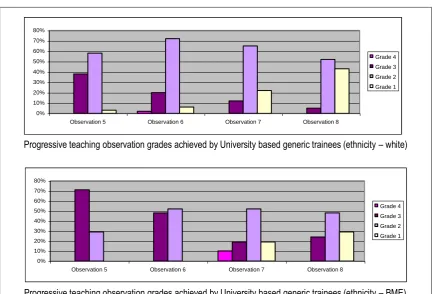
5.1.1 Analysis of the graded observation results for the generic cohort as a whole demonstrates trainee progression from observation 5 to observation 8` for both BME and white trainees (Figure 1).
0% 10% 20% 30% 40% 50% 60% 70% 80%
Observation 5 Observation 6 Observation 7 Observation 8
Grade 4 Grade 3 Grade 2 Grade 1
Progressive teaching observation grades achieved by University based generic trainees (ethnicity – white)
0% 10% 20% 30% 40% 50% 60% 70% 80%
Observation 5 Observation 6 Observation 7 Observation 8
Grade 4 Grade 3 Grade 2 Grade 1
Progressive teaching observation grades achieved by University based generic trainees (ethnicity – BME)
Figure 1. Progressive teaching observation grades achieved by University based generic trainees by ethnicity
8 observations graded 1. This is quite marked by observation 8 (Figure 2). For a detailed breakdown of grading by ethnicity, from observation 5 – 8 for the generic cohort, see Appendix 1.
Observation 8 Grade 1 Grade 2 Grade 3 Grade 4
BME trainees 29% 48% 24%
White trainees 43% 52% 5%
Totals for generic cohort 40% 51% 9%
Percentages rounded to nearest whole
Figure 2. Final observation grades achieved by University based generic trainees by ethnicity
5.1.3 A Grade 4 was recorded for one white trainee and for two BME trainees; however for each of them this was in relation to a sole observation. Progress was made by each of these trainees following this.
5.1.4 A total of 55% of white trainees from the generic cohort achieved a Grade 1 for at least one graded observation; this contrasts with the 29% of BME trainees who achieved at least one Grade 1.
5.2 Skills for Life full-time cohort, University based
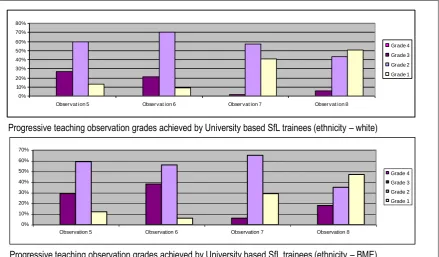
5.2.1 Analysis of the graded observation results for the SfL cohort as a whole demonstrates trainee progression from observation 5 to observation 8 for both BME and white trainees (Figure 3).
0% 10% 20% 30% 40% 50% 60% 70% 80%
Obser vat ion 5 Obser vat ion 6 Obser vat ion 7 Obser vat ion 8
Gr ade 4 Gr ade 3 Gr ade 2 Gr ade 1
Progressive teaching observation grades achieved by University based SfL trainees (ethnicity – white)
0% 10% 20% 30% 40% 50% 60% 70%
Observation 5 Observation 6 Observation 7 Observation 8
Grade 4 Grade 3 Grade 2 Grade 1
Progressive teaching observation grades achieved by University based SfL trainees (ethnicity – BME)
Figure 3. Progressive teaching observation grades achieved by University based SfL trainees by ethnicity
5.2.2 The pattern of progression noted above is to a large extent in direction
9 direction; however, for both BME and white trainees at observation 2 the
number of trainees graded 1 has decreased slightly from observation 1, and for observation 8, the number of trainees assessed at Grade 3 has increased slightly from observation 7 (Figure 4). The results do reveal differences between ethnic groups, but not as great as in those of generic trainees. From the first to the final graded observation white trainees achieve a greater proportion of observations graded 1. For a detailed breakdown of grading by ethnicity, from observation 5 – 8 for the SfL cohort, see Appendix 2.
Observation 8 Grade 1 Grade 2 Grade 3 Grade 4
BME trainees 47% 35% 18%
White trainees 51% 43% 6%
Totals for SfL cohort 50% 41% 9%
Percentages rounded to nearest whole
Figure 4. Final observation grades achieved by University based SfL trainees by ethnicity
5.2.3 None of the SfL trainees received a Grade 4.
5.2.4 A total of 54% of white trainees from SfL achieved a Grade 1 for at least one graded observation; this compares with the 65% of BME SfL trainees who achieved at least one Grade 1. However, for a higher proportion of the BME trainees this was on a single occasion only.
5.3 Partnership full-time cohorts
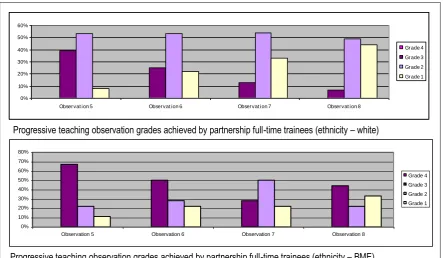
5.3.1 Analysis of the graded observation results for the partnership cohort as a whole demonstrates trainee progression overall from observation 5 to
observation 8 for both BME and white trainees (Figure 5).
0% 10% 20% 30% 40% 50% 60%
Obser vat ion 5 Obser vat ion 6 Obser vat ion 7 Obser vat ion 8
Gr ade 4 Gr ade 3 Gr ade 2 Gr ade 1
Progressive teaching observation grades achieved by partnership full-time trainees (ethnicity – white)
0% 10% 20% 30% 40% 50% 60% 70% 80%
Observation 5 Observation 6 Observation 7 Observation 8
Grade 4 Grade 3 Grade 2 Grade 1
Progressive teaching observation grades achieved by partnership full-time trainees (ethnicity – BME)
10
5.3.2 The pattern of progression noted above is to a large extent in direction
similar for each ethnic group i.e. each group progresses in the main in a positive direction; however, for BME trainees progression is less marked and at
observation 8 the number assessed at Grade 3 has increased from observation 7 (Figure 6). Again, the results do reveal differences in achievement between ethnic groups and by observation 8 these differences are greater than those found in either the generic or the SfL cohort. However, although by the third and final graded observations white trainees achieve a greater proportion of
observations graded 1, at the first graded observation a higher proportion of BME trainees than white are graded 1 and at graded observation 2 the proportions are the same. For a detailed breakdown of grading by ethnicity, from observation 5 – 8 for the partnership cohort, see Appendix 3. It should be noted that numbers of BME trainees in the partnership cohort were small (n=9) and statistics must be viewed accordingly.
Observation 8 Grade 1 Grade 2 Grade 3 Grade 4
BME trainees 33% 22% 44%
White trainees 44% 49% 7%
Totals for SfL cohort 42% 43% 14%
Percentages rounded to nearest whole
Figure 6. Final observation grades achieved by partnership trainees by ethnicity
5.3.3 None of the partnership trainees received a Grade 4.
5.3.4 A total of 47% of white trainees across the partnership achieved a Grade 1 for at least one graded observation; this compares with the 33% of BME trainees who achieved at least one Grade 1.
6. Discussion
6.1 The report into grading by ethnicity presented here is based upon a quantitative analysis only and any attempt to account for differential achievement must at this stage remain tentative and unsubstantiated. Qualitative research allowing for interviews with a representative sample of teaching observation assessors – teacher educators, mentors and other assessors – from across each cohort should enable a better understanding of the factors leading to the differences identified.
6.2 The percent of full-time trainees across all University teacher training provision who attained the qualification in the year 2010-11 was 81%; for BME
trainees this was 70%, mirroring the direction of difference revealed through the
11 teaching practice as their white colleagues. It is important that the teacher
training team are able to understand the reasons for this and that they continue to work to implement strategies to improve BME teaching practice results.
6.3 It has been noted that earlier research undertaken at the University into ethnicity and achievement found no significant discrepancy in achievement where assessment concerned practical teaching (WBE), where first attempts for BME trainees were slightly better than for white trainees. However, as it has been pointed out, before 2010-11 teaching observation assessments were judged either successful or not, and this system did not allow for precision in determining the extent to which trainees were achieving.
6.4 A key factor to emerge from the earlier research into ethnicity and
achievement was the significance of written English skills. In comparison with white trainees, some trainees from BME backgrounds were found to perform less well with written assessments. Teaching practice clearly also involves the use of written English – for example, with regard to planning documentation, the production of learning resource material and the recording of self-evaluation. It would be useful to ascertain whether this has been a factor in differential
grading results (see also: Bowl, 2001; Ofsted, 2005; Universities Scotland, 2006; Broeke and Nicholls, 2007).
6.5 Differences in achievement are less evident within the SfL cohort. Entry requirements for the ESOL and Literacy courses include possession of at least a Level 3 qualification in English (or equivalent). Applicants who do not possess this must work through a pre-course booklet where skill at this level is checked. This provides support to the notion that English language skill may be a factor in under achievement.
6.6 As recommended, following the earlier research the course team have promoted use of SfL trainees to provide support in written English skills for trainees on the generic pathway, where appropriate. There have been notable successes whereby SfL trainees have given effective support (and they have been able count this towards their WBE hours). However, there have also been instances where a trainee has not taken up the offer of support; previous
research indicated that some BME trainees may not always seek out support for themselves. A more formal ‘twinning’ would strengthen this process, where need has been identified following PTLLS assessments (in relation to either the micro-teach and/or the written component), and progress subsequently
monitored and recorded in the trainee’s ILP.
12 6.8 Where appropriate, trainees are encouraged to arrange for one of their assessed observations to be filmed; this provides the opportunity for assessor and trainee to watch the recording together and enables very focused feedback and discussion. This strategy would be particularly beneficial where a trainee is not making the progress that might be expected in their teaching practice.
Where permission has been obtained from all relevant parties, a bank of subject specific recordings might provide a useful resource for all trainees to draw upon.
6.9 Use of the software package SPSS would be a useful tool in the ongoing analysis of grading data.
7. Recommendations
In the light of this analysis into grading and ethnicity, it is recommended that management of ITE at the University of Bolton:
7.1 Commission qualitative research allowing for interviews with a
representative sample of teaching observation assessors in order to enhance understanding of the factors influencing differential achievement
7.2 Ensure that the teacher training team are able to understand the reasons for differential achievement, and work to implement strategies to improve teaching practice results for all trainees
7.3 Establish a formal ‘twinning’ arrangement whereby SfL trainees provide support with written English and/or ESOL support for trainees who require this
7.4 Ensure curriculum tutors identify trainees needing support immediately following the marking of PTLLS assessments, and that they pass on names to the appropriate SfL tutor (see 7.3)
7.5 Ensure that curriculum tutors require trainees receiving support to monitor and record progress within their ILP (see 7.3)
7.6 Encourage curriculum tutors to seek opportunities to include discussion of the ways in which teaching and learning may be conceptualised differently in other cultures
7.7 Encourage WBE assessors to seek opportunities to make use of recordings of assessed teaching observations as a vehicle to encourage discussion and to provide focused feedback upon practice
7.8 With permission from all relevant parties, work to build a bank of subject specific recordings of successful teaching practice
13 8. References
Bowl, M. (2001) Experiencing the barriers: non-traditional students entering
higher education, Research Papers in Education, 16 (2), 141-160
Broeke, S. and Nicholls, T. (2007) Ethnicity and degree attainment, London:
DfES
LLUK. (2011) Further Education College Workforce Data for England An
Analysis of the Staff Individualised Record Data 2009-2010, London: LLUK [online] Available at:
https://sirdatacollection.lsis.org.uk/consultation/sites/default/files/SIR_Report_20 0910_FINAL.pdf
Office for Standards in Education. (Ofsted) (2005) Raising the achievement of
bilingual learners, London: Ofsted
Office for Standards in Education. (Ofsted) (2009) Grade criteria for the
inspection of initial teacher education 2008-11 London: Ofsted.
Office for National Statistics. (ONS) (2009) Key Figures for People and Society:
Population and Migration [online] Available at:
http://www.neighbourhood.statistics.gov.uk/dissemination/LeadKeyFigures.do?a =7&b=276776&c=Bolton&d=13&e=13&g=349663&i=1001x1003x1004&m=0&r= 1&s=1317729264578&enc=1
Noel, P. (2008). Ethnicity and achievement: An analysis of module results
(Generic Initial Teacher Training Programme Full-time study (University-based) 2006-08. Bolton:University of Bolton
Noel, P. (2011) Graded observations of trainee teaching practice: Analysis of
data from the pilot. Bolton: University of Bolton
Traher, S. (2007) Teaching and learning: the international higher education
landscape HEA/ESCalate [online] Available at: http://escalate.ac.uk/3559
University of Bolton.Uni-Diversity Bolton: University of Bolton[online] Available
at: http://www.bolton.ac.uk/POD/DiversityMatters/Uni-Diversity.aspx
Universities Scotland. (2006) Race Equality Toolkit: Learning and Teaching
[online] Available at:
` Appendix 1 University of Bolton PGDE/PDE: Graded observations pilot (2010-11)
University based full-time generic cohort – grading by ethnicity
Grade 1 Grade 2 Grade 3 Grade 4
Observation 5
BME trainees 29% 71%
White trainees 3% 58% 38%
Totals for generic cohort 2% 51% 47%
Observation 6
BME trainees 52% 48%
White trainees 6% 72% 20% 2%
Totals for generic cohort 5% 67% 27% 1%
Observation 7
BME trainees 19% 52% 19% 10%
White trainees 22% 65% 12%
Totals for generic cohort 22% 62% 14% 2%
Observation 8
BME trainees 29% 48% 24%
White trainees 43% 52% 5%
Totals for generic cohort 40% 51% 9%
Final grade
BME trainees 5% 57% 38%
White trainees 18% 68% 13%
Generic trainees’ overall grade 15% 66% 19%
Percentages rounded to nearest whole
Progression 0% 10% 20% 30% 40% 50% 60% 70% 80%
Observation 5 Observation 6 Observation 7 Observation 8
Grade 4 Grade 3 Grade 2 Grade 1
Progressive teaching observation grades achieved by University based generic trainees (ethnicity – white)
0% 10% 20% 30% 40% 50% 60% 70% 80%
Observation 5 Observation 6 Observation 7 Observation 8
Grade 4 Grade 3 Grade 2 Grade 1
Appendix 2 University of Bolton PGDE/PDE: Graded observations pilot (2010-11)
University based full-time Skills for Life cohort (Literacy, Numeracy and ESOL) – grading by ethnicity
Grade 1 Grade 2 Grade 3 Grade 4
Observation 5
BME trainees 12% 59% 29%
White trainees 13% 60% 27%
Totals for SfL cohort 12% 60% 28%
Observation 6
BME trainees 6% 56% 38%
White trainees 9% 70% 21%
Totals for SfL cohort 8% 67% 25%
Observation 7
BME trainees 29% 65% 6%
White trainees 41% 57% 2%
Totals for SfL cohort 38% 59% 3%
Observation 8
BME trainees 47% 35% 18%
White trainees 51% 43% 6%
Totals for SfL cohort 50% 41% 9%
Overall grade
BME trainees 24% 41% 35%
White trainees 28% 70% 2%
All SfL trainees’ final grade 27% 62% 11%
Percentages rounded to nearest whole
Progression
0% 10% 20% 30% 40% 50% 60% 70% 80%
Observation 5 Observation 6 Observation 7 Observation 8
Grade 4 Grade 3 Grade 2 Grade 1
Progressive teaching observation grades achieved by University based SfL trainees (ethnicity – white)
0% 10% 20% 30% 40% 50% 60% 70%
Observation 5 Observation 6 Observation 7 Observation 8
Grade 4 Grade 3 Grade 2 Grade 1
16
Appendix 3
University of Bolton PGDE/PDE: Graded observations pilot (2010-11)
Partnership full-time cohorts – grading by ethnicity
Grade 1 Grade 2 Grade 3 Grade 4
Observation 5
BME trainees 11% 22% 67%
White trainees 8% 53% 39%
Totals for partnership cohort 9% 47% 44%
Observation 6
BME trainees 22% 28% 50%
White trainees 22% 53% 25%
Totals for partnership cohort 22% 48% 30%
Observation 7
BME trainees 22% 50% 28%
White trainees 33% 54% 13%
Totals for partnership cohort 31% 53% 16%
Observation 8
BME trainees 33% 22% 44%
White trainees 44% 49% 7%
Totals for partnership cohort 42% 43% 14%
Overall grade
BME trainees 33% 33% 33%
White trainees 36% 47% 17%
Partnership trainees’ overall
grade 36% 44% 20%
Percentages rounded to nearest whole
Progression 0% 10% 20% 30% 40% 50% 60%
Observation 5 Observation 6 Observation 7 Observation 8
Grade 4 Grade 3 Grade 2 Grade 1
Progressive teaching observation grades achieved by partnership full-time trainees (ethnicity – white)
0% 10% 20% 30% 40% 50% 60% 70% 80%
Observation 5 Observation 6 Observation 7 Observation 8
Grade 4 Grade 3 Grade 2 Grade 1
Addendum
______________________________________________________________
Graded observations of trainee teaching practice: Analysis of grades by ethnicity
Factors influencing differential achievement
In the light of the analysis into grading and ethnicity, it was recommended that management of ITE at the University of Bolton commission qualitative research allowing for interviews with a representative sample of teaching observation assessors in order to enhance understanding of the factors influencing differential achievement.
This addendum details the subsequent small-scale research undertaken.
18 1. Objectives
1.1 To identify and explore the factors which may account for differential achievement of BME and white trainees in relation to graded teaching observations
1.2 To identify and recommend additional strategies in support of the progression and achievement of all trainees
2. Methodology and actions undertaken
2.1 With four graded teaching observations and the addition of the overall grade awarded, trainees receive a total of five grades. There were seventeen BME trainees who received a majority of grades at 3 and/or (rarely) 4. They are the focus of this small-scale research.
2.2 The teaching observation assessors of the BME trainees noted above were identified for interview. Interviews, which were in the main unstructured, were completed with the assessors of fifteen of the seventeen trainees. This involved seven assessors. Assessors taught on the generic and SfL pathways at the University, and on partnership programmes. A number of interviews were conducted by telephone.
2.3 Each interviewee was told about the purpose of the research and then asked to outline the reasons for a named BME trainee, one whom they had assessed for a teaching observation, receiving grades at the lower end of the scale. Open discussion followed.
2.4 Research was conducted in line with ethical guidelines for educational research
(BERA, 2011) and identifying information concerning trainees and assessors is withheld.
3. Analysis of interview data
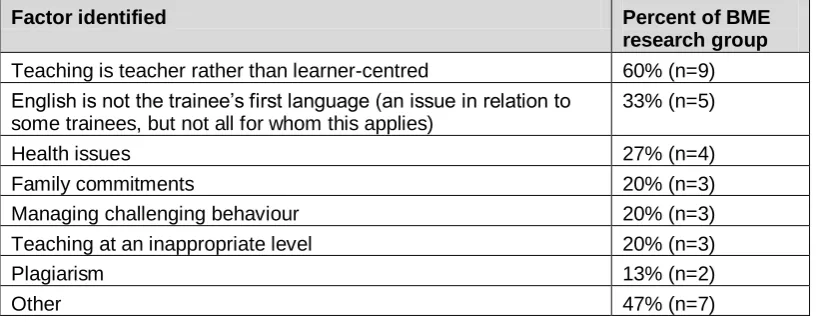
3.1 Tutors/assessors identified a number of factors to account for the lower grades of the BME research trainees. These are outlined below (Figure 1) and discussed in section 4. (For more detail, see Appendix 1)
Factor identified Percent of BME
research group
Teaching is teacher rather than learner-centred 60% (n=9) English is not the trainee’s first language (an issue in relation to
some trainees, but not all for whom this applies)
33% (n=5) Health issues 27% (n=4) Family commitments 20% (n=3) Managing challenging behaviour 20% (n=3) Teaching at an inappropriate level 20% (n=3)
Plagiarism 13% (n=2)
Other 47% (n=7)
19 4. Discussion
4.1 Teaching is teacher rather than learner-centred
Attention has already been drawn to the work of Trahar (2007) in relation to working with international students in higher education in the UK. At this point in time in the UK participative learning is emphasised and teacher training
encourages a learner-centred approach. This has not always been the case – and will not necessarily remain the favoured way of teaching. As noted,
teaching and learning are conceptualised differently in other cultures, and the teaching practice of a trainee is likely to be influenced by the ways in which he or she has been taught. The following quote from a teacher of English as a foreign language illustrates the potential for misunderstanding:
… at the beginning of my teaching career in Taiwan, I found it very easy to teach English, but very difficult to get the students to interact with me while I was teaching. Teaching was very easy because the students were well behaved and very attentive. The difficulties surfaced when trying to get the students to interact with me, their teacher. At the time, I did not realize that in Taiwan, it was culturally unacceptable for students to interact with their teacher … (http://www.tefl.net/)
The findings from the present research, whilst admittedly small-scale, indicate that for some BME trainees there may be a certain challenge in moving towards a learner-centred approach. An interviewee described how for one of her BME trainees, this was ‘a long journey’. The fact that people from different cultures may have been taught in very different ways – and may have learned very effectively, is something worth discussing with trainees at an early stage in the programme. Tutors might then clarify course expectations about the learner-centred approach to be adopted.
4.2 English is not the trainee’s first language
Earlier research undertaken for the University into ethnicity and achievement drew attention to the standard of written English required by the course as a contributory factor in the relative underachievement of some minority ethnic trainees (Noel, 2008). Ofsted (2005) has pointed out that:
Although English remains the most common first language for more than a third of bilingual young people nationally, it is not consistently the language spoken at home. While a significant proportion … are fluent in English and another
language, many – even those who have been in the British education system for a considerable length of time – require ongoing support to develop their academic writing and comprehension skills …
Seven of the BME research group were identified as using English as a second language; for two of them this was not judged to be a problem. However, in relation to teaching practice, interviewees felt that for five of the trainees, language was causing some difficulty, for example:
… didn’t always appear to understand nuances in language/non-verbal
communication
20
… spoken English quite accented
… trainee’s accent could be difficult to understand
… trainee needed support with written English
Trainees had been directed to support and some had taken advantage of this. An interviewee explained how one of her trainees, through working on her English with an ESOL trainee, had improved – not only in terms of her English, but also in relation to a growth in confidence. However, earlier research had revealed that some BME trainees might be reluctant to seek out support. A recommendation was made in the initial report that a formal ‘twinning’ arrangement be established following the marking of PTLLS assessments, whereby SfL trainees would provide support with written English and/or ESOL for trainees identified as needing it. This has now been implemented.
4.3 Health issues
Rather less than a third of the BME research group had experienced health issues. There is no evidence to suggest that this is a factor of specific relevance in relation to BME differential achievement. Statistics relating to instances of ill health across the total trainee population are unavailable.
4.4 Family commitments
Again, as in the earlier research, a small number of BME women were found to lack support from their families. One interviewee commented on the dual role of one of her trainees, both as a student and as the person responsible for a young family. As noted in the previous research:
There are likely to be women from every background who are unsupported in their pursuit of higher education. As tutors we are well placed to provide
encouragement, and where possible, to demonstrate flexibility – for example, in our response to trainees’ childcare arrangements (Noel, 2008, p.16)
4.5 Managing challenging behaviour
Three trainees found the challenging behaviour of their students difficult to manage – and their assessors identified this as one of the reasons for their lower grades. Experience tells us that this is also likely to be an issue for some of our white trainees. Interestingly, two of the interviewees identified a possible contributory factor relating to the BME difficulty with classroom management noted. One tutor felt that it was the apparent difficulty in understanding nuances in language and non-verbal communication that had made managing
challenging behaviour an issue for her trainee. Another tutor explained that because in some cultures to give eye-contact to someone in authority would be found disrespectful, certain BME trainees may misread the non-verbal signals
of their students as a sign of challenge to their authority. Who on Earth are we?
21 trainees.
http://www.bbc.co.uk/worldservice/learningenglish/webcast/tae_whoonearth_ar chive.shtml
4.6 Teaching at an inappropriate level
Three trainees had difficulty in assessing the appropriate level at which to pitch their teaching. There is no evidence to suggest that this is a factor of specific relevance in relation to BME differential achievement.
4.7 Plagiarism
A couple of interviewees described an initial misunderstanding about how to reference on the part of two BME trainees. Both tutors felt that this could have suggested that the trainee was plagiarising. However, this was quickly
addressed. It is easier to detect plagiarism in the work of someone who uses English as a second language; however there is no evidence to suggest that plagiarism is a factor of specific relevance in relation to BME differential achievement. It is important that all trainees are provided with precise advice about correct referencing from the outset, backed by examples of what would constitute plagiarism.
4.8 Other
Inevitably, interviewees identified very specific reasons for the lower grades of individual trainees. There is no evidence to suggest that any of these are factors of specific relevance in relation to BME differential achievement.
5. Recommendations
In the light of research findings it is additionally recommended that within the Education Department:
5.1 Course tutors across the partnership provide trainees with the opportunity for discussion about different academic traditions, and clarify course
expectations about the learner-centred approach to be adopted
5.2 The formal ‘twinning’ arrangement following the marking of PTLLS assessments is embedded and subject to monitoring, review and evaluation
5.3 Course tutors explore differences in non-verbal communication across cultures with their trainees
5.4 From the outset, all trainees should be enabled to develop (or recall, as appropriate) an unambiguous understanding of plagiarism.
References
BBC. (2009) Who on Earth are we?Part 5 Culture and non-verbal
22
http://www.bbc.co.uk/worldservice/learningenglish/webcast/tae_whoonearth_arc hive.shtml
BERA (2011) Ethical guidelines for educational research. London: British
Educational Research Association [online] Available at:
http://www.bera.ac.uk/files/2011/08/BERA-Ethical-Guidelines-2011.pdf
Leveridge, A. N. (2008) Relationship between language & culture and the
implications for language teaching. Cambridge: TEFL.net [online] Available at:
http://edition.tefl.net/articles/teacher-technique/language-culture/
Noel, P. (2008) Ethnicity and achievement: An analysis of module results
Generic Initial Teacher Training Programme Full-time study (University-based) 2006-08. Bolton: University of Bolton
Ofsted. (2005) Raising the achievement of bilingual learners, London: Ofsted
Traher, S. (2007) Teaching and learning: the international higher education
landscape. Bristol: HEA/ESCalate [online] Available at:
Appendix 4
23 Analysis of grades by ethnicity: Tutor/assessor explanations relating to individual full-time BME trainee grades (2010-11)
Trainee Ethnic origin (as declared on the application form)
No. of observations graded 3 (or below)
(including overall grade)
Explanations provided by the tutor/assessor for three or more grades of 3 and/or 4
A Asian or Asian British -
Pakistani 5
Significant health issues meant that the course wasn’t the trainee’s priority; insufficient time given to development
Was neither dynamic nor creative
B Other ethnic background 5 Initially, didn’t understand referencing (it could appear that the trainee was plagiarising); this was subsequently addressed
Only addressed most recent targets set following an observation, not those from earlier observations
C Black or Black British -
African 3
Initially, didn’t understand referencing (it could appear that the trainee was plagiarising); this was subsequently addressed
Teaching was teacher-centred
Taught challenging students and classroom management was an issue; didn’t always appear to understand nuances in language/non-verbal communication
English was not the trainee’s first language - however, used throughout the trainee’s life
D Black or Black British -
African 3
Teaching was teacher-centred; there was little interaction with no opportunity to explore concepts
English was probably not the trainee’s first language - however, used throughout the trainee’s life; spoken English quite accented, although fluent; written English weak
E Chinese 4 English was not the trainee’s first language; initially there was some difficulty with pronunciation and with written English, although the trainee had support with English from an ESOL trainee and improved; levels of confidence also improved
Teaching was very teacher-centred; however the trainee did make progress and tried to use different methods – to get students to explore ideas for themselves, but this was a long journey for the trainee
F Asian or Asian British - Pakistani
4 Teaching was teacher-centred
Although sufficient to teach, English was not the trainee’s first language
The trainee had a young family; there was an expectation that this was the trainee’s responsibility, with no allowances made for course commitments
G Asian or Asian British -
Pakistani 3
Teaching was teacher-centred
Although sufficient to teach, English was not the trainee’s first language
Appendix 4
24 lead to insufficient preparation
H Mixed – White and Black
African 3
Qualified to PhD level – the trainee struggled with teaching at an appropriate level for students
Teaching was very teacher-centred, with over-use of PowerPoint; this was noted by two WBE assessors and the trainee’s mentor
I Other mixed background 4 Lack of motivation; questioned whether teaching was the right choice
Found classroom management more difficult than anticipated
J Asian or Asian British -
Indian 4
Showed great promise initially, however decided to pursue a different career in a family business and subsequently merely wanted to pass
An un-graded teaching observation was described by an assessor as ‘formulaic’
K Black or Black British -
African 5
Teaching was very teacher-centred
English was probably not the trainee’s first language, and although this was not a key issue; trainee’s accent could be difficult to understand
L Black or Black British -
African 4
The trainee misjudged the level at which the students were working, teaching at a higher level than required
Teaching tended to be teacher-centred, with insufficient participation; this was addressed by trainee’s tutor
There were significant health issues, and family commitments meant that timing was a cause for concern;
M Black or Black British -
African 5
English was not the trainee’s first language; there was some difficulty for students with the trainee’s speed of delivery; the trainee needed support with written English and was directed to support
There were health issues; the trainee’s tutor was impressed by the determination demonstrated by the trainee
N Asian or Asian British -
Pakistani 4
Teacher-centred approach, though confident
Was required to use placement planning documentation, but didn’t put ‘own spin’ on this
Ongoing health issues
O Black or Black British -
African 5
Challenging students at a lower level than the trainee had expected
Appendix 5
Ethnicity and achievement:
An analysis of module results
____________________________
Generic Initial Teacher Training Programme
Full-time study (University-based) 2006-08
Appendix 4
University of Bolton: Ethnicity and achievement, 2008 Acknowledgements
My thanks are due to Phil Matear and members of the Initial Teacher Training team, to Ruth Coward and the University Student Experience Officer team, to Karen Senior – Head of the Library at the University, and to David Price, all of whom gave me their time during the course of the research.
Appendix 4
University of Bolton: Ethnicity and achievement, 2008 Contents
Acknowledgement 2
Executive summary 4
Background 5 4
Objectives 7 7
Ethnicity and achievement in HE 7 7
Methodology 9
Actions undertaken 9 9 Actions undertaken 9
Analysis of module results 2007-08 10 10
Focus group discussion with the initial teacher training team 12
Interview with the Head of the Library at the University 13
Focus group discussion with the University Student Experience Officer team 13
Discussion 14 14
Recommendations 17 17
References 19 19
Appendices
Appendix: University of Bolton Post-Graduate Certificate in 21
Appendix 4
University of Bolton: Ethnicity and achievement, 2008
Executive summary
An initial small-scale examination of the module results of White and minority ethnic trainees on the full-time PGCE/Cert Ed at the University of Bolton for the year 2006-07 revealed significant differences in achievement. The research reported here builds on that earlier work and provides a more detailed analysis for the following year (2007-08). The research also sought to identify strategies to support the achievement of diverse ITT trainees. Research methods involved a literature review, an analysis of first attempt results, focus group discussions with the teacher education and student experience officer teams and an unstructured interview with the Head of Library at the University.
Minority ethnic people from every group are more likely than White people to enter higher education and have been found to place a higher value on higher education qualifications. However, despite their greater representation, no minority ethnic group achieves as well as their White counterparts in terms of degree classifications. The likelihood of an Asian student gaining a good degree is half that of a White student, and for a Black student the likelihood is a third of that of a White student. A pattern of differential achievement has been found at Bolton on the University-based full-time generic pathway (2007-08). Analysis of the pass rates of minority ethnic and White trainees for first module submissions revealed that White trainees are far more likely to succeed first time. Findings from the analysis:
The overall pass rate on first submission for White trainees was 79%; for minority ethnic trainees the equivalent pass rate was 69%
The discrepancy in achievement between White and minority ethnic trainees was the most marked where assessment involved submission of a written assignment or a portfolio
There was no significant discrepancy in achievement where assessment concerned practical teaching (WBE), where first attempts for minority ethnic trainees were slightly better than for White trainees
The most significant gap in achievement was in relation to the first assignment
Discrepancy in proportionate achievement between the two groups remained through to course completion
The evidence suggests:
The standard of written English required by the course may be a contributory factor in the relative underachievement of some minority ethnic trainees. It is easier to detect plagiarism in the work of any student who requires
support with written English – international, minority ethnic or White; however it was not possible to detect greater use of plagiarism within the minority ethnic group.
Some minority ethnic trainees were found to be reluctant to seek out support and there may be a perception of shame in doing so. Trainees were referred for support by their tutors.
Some minority ethnic women lacked support from their families,
Minority ethnic trainees are not a homogenous group, including those from the same communities and sharing the same religion.
Appendix 4
University of Bolton: Ethnicity and achievement, 2008 1. Background
1.1 The University of Bolton has been commended by researchers for the Higher Education Academy (HEA) for its “description of activity to be taken in relation to students’ achievements and progress” (Willott and Stevenson, 2008, p 8). Commitment to this activity is outlined in the Race Equality Policy of the University, which draws attention to the following:
The town of Bolton and the North West of England is the home of significant minority ethnic communities. Such communities have a valuable and increasingly significant role in the social, political, cultural and economic life of the sub-region which the University serves. It is part of the widening participation mission of the University and also of our leadership role as a major local institution to celebrate the influence and successes of minority ethnic communities. It is also our duty to set an example in ensuring that there are no intentional or unintentional impediments to the aspirations of individual members of such communities to learn and work.
The University welcomes students and staff from overseas to study, teach and conduct research. It is our duty of care to such people, as well as to indigenous staff and students, that our own institutional practices are not discriminatory and demonstrate respect for everyone irrespective of obligations acquired as a result of the recent legislation (p.1)
The policy specifies an undertaking to collect and analyse relevant monitoring data about student admissions, achievements and progress. In their survey of Higher Education Institution (HEI) policies concerning ethnicity, gender and attainment, the HEA researchers found Bolton’s to be the most thorough example of good practice.
1.2 In relation to admissions, the University is achieving its widening
participation mission and Bolton has one of the most socially inclusive student populations. Many students from minority ethnic communities have chosen the University as the HEI where they will study and the student population is amongst the country's most ethnically diverse. Minority ethnic trainees on the full-time initial teacher training programme at the University are particularly well represented (Table 1).
Resident population from a non-white background (North-West)
Resident population from a non-white background - Bolton (Local Authority)
Minority ethnic (home) students at Bolton University (All)
Minority ethnic¹ students on Bolton F/T ITT generic programme (University based)
5.57% 11% 13% 26%
2001 Census ONS
2001 Census ONS Bolton University
Key Facts, 2008 ITT programme data analysis, 2008
Appendix 4
University of Bolton: Ethnicity and achievement, 2008
1.3 A healthy representation of minority ethnic trainees intending to teach in the Lifelong Learning sector is to be welcomed in light of the findings of the Commission for Black Staff in Further Education (2002). The Commission drew attention to the proportion of further education (FE) teaching staff from minority ethnic groups – seven percent of the total, with the majority of FE colleges employing less than five percent. This is not representative of the population in England where over nine per cent are from a non-white background. Black and minority ethnic students entering (school) teacher training have also been found to be under-represented (Carrington and Tomlin, 2000). Young people from different minority ethnic communities continue to underachieve compared with young White learners and they are more likely to remain unemployed (DfES, 2006). The report of the
Commission for Black Staff in FE highlights “tackling the under-representation of Black staff in further education which is key to raising achievement for all learners” (p. 50)
1.4 In relation to achievements and progress, the Race Equality Policy of the University specifies the collection of the following data:
Student assessment (including the results of different assessment methods) including tests, examinations, course projects, dissertations, continuous assessment and presentations (p.3)
1.5 In 2007, the Module Board for the Post-Graduate Certificate in Education/Certificate in Education (full-time study 2006-07) held at the University towards the end of the academic year, examined referred module
results (2nd attempts). An examination of the names of the trainees with
referred results on the generic pathway indicated that a disproportionate number were members of minority ethnic communities, although the majority subsequently went on to achieve the award. A pattern of disproportionate minority ethnic referral obtained in relation to each of the six modules that made up the (then) generic course. The smaller number of referrals overall on Skills for Life provision did not support a robust analysis; however a pattern of minority ethnic underachievement was not indicated. The analysis undertaken took place near the end of the academic year and had not been planned for, arising only in response to what appeared to be a pattern of
underachievement. There were difficulties in achieving an accurate analysis. Names had to be used as an indication of ethnicity and clearly this strategy would not capture the total number of trainees from a minority ethnic
background. Additionally, the module results as printed and distributed at the Module Board were unavoidably incomplete. Where possible, this was
subsequently corrected. However, the analysis that was undertaken cannot be viewed as fully reliable.
Appendix 4
University of Bolton: Ethnicity and achievement, 2008
recourse to more detailed research findings, it was difficult to determine what might have been done to address the situation as identified.
1.7 Although the number of referrals involved in each of the modules was small, what was clearly indicated was a worrying general pattern meriting further investigation. (For a detailed breakdown of the 2006-07 referrals, see Appendix 1). What was required was a more in-depth analysis in subsequent years.
2. Objectives
The initial small-scale examination of the module results of White and minority ethnic trainees on the full-time PGCE/Cert Ed at the University of Bolton for the year 2006-07 had revealed differences in achievement. The overall aim of the subsequent research project was to identify strategies to support the achievement of diverse trainees. The project had the following objectives:
2.4 To analyse School data for the year 2007-08 in terms of the achievement rates of White and minority ethnic trainees on the full-time PGCE/Cert Ed at the University of Bolton
2.5 To explore the reasons for any differences found
2.6 To identify good practice in working with diverse ITT trainee cohorts
2.7 To recommend practical strategies as appropriate which support the development and achievement of all trainees
3. Ethnicity and achievement in HE
3.1 Minority ethnic people are more likely than White people to enter higher education. In an examination of ethnicity and higher education, Connor et al, (2004) found that although participation rates are not the same for each minority ethnic group, with the exception of female Bangladeshis, all minority ethnic groups have a higher participation rate than the White group. People from minority ethnic groups were found to place a higher value on the benefits to be derived from higher education qualifications, with parents and family exerting more influence than is the case for White students. However, despite their greater representation, no minority ethnic group achieves as well as their White counterparts in terms of degree classifications. Richardson (2008) reported “the odds of an Asian student being awarded a good degree were half those of a White student … whereas the odds of a Black student being awarded a good degree were a third of those of a White student” (p.10).
Appendix 4
University of Bolton: Ethnicity and achievement, 2008
… there is still an unexplained difference between students from minority ethnic communities and students from White (UK and Irish) when we
look at a subset of qualifiers who entered with level 3 qualifications (p. 19)
The following variables were not examined in their analysis – term-time working, parental income and education, English as an Additional Language and prior institution attended.
3.3 Research commissioned by the Higher Education Academy and the Equality Exchange Unit (Jacobs et al, 2007) sought views from within HE concerning differences in achievement between minority ethnic and White groups. For many respondents the differences were seen to relate to
“disadvantages students faced through financial need or other factors relating to socio-economic positioning” (p.3). Family background was also highlighted. Jacobs et al discuss the use of a “deficit model” by some of their respondents in the search for an explanation of difference, where the focus becomes “some type of cultural lack by a student or groups of students” rather than “educational or institutional processes and practices” (p.38). A broad spectrum of opinion was revealed – with one respondent accounting for differential achievement in terms of the mental capacities of Black students, through to explanations drawing attention to everyday racism.
3.4 Exploring the experience of minority ethnic students, Connor et al, (2004) sought to identify the occurrence of racism and discrimination through their student survey and follow-up interviews. They wanted to know whether minority ethnic students found themselves subject to stereotyping, whether they suffered from “particular assumptions and behaviour by staff (e.g. ‘not very bright’, ‘hardworking’, etc)” (p.69). They found the incidence of racial discrimination relatively low, with seven per cent of their sample reporting discrimination. However, they caution that numbers were too small to support generalisations, and that under-reporting may mask the real extent of racism experienced. Trahar (2007) draws attention to the inherent difficulty within HE of raising the issue of discrimination:
Most academics would baulk at the suggestion that their attitude or behaviour might, in any way, be discriminatory. Such a suggestion is not only provocative but also it does not fit with the liberal values traditionally embraced by higher education. Unfortunately though this can mean that it is difficult to initiate reasoned debate (Back, 2004) about the complexities of the multicultural higher education environment and the opportunities for increased understanding can, therefore,
remain subordinated discourses (Koehne, 2006) (p.4)
Certainly, it has been found that people are not always aware of their own implicit attitudes towards, and stereotyping of, different social groups (see Nosek, Banaji, & Greenwald , 2002; Crombie, 2003).
Appendix 4
University of Bolton: Ethnicity and achievement, 2008
‘assessment and marking arrangements have been fair’ only 64% of Asian students and 66% of Black students agreed with the statement. The authors suggest that “what students think is happening can have a bearing on their study behaviour” (p.16)
3.6 Interventions to address differential achievement, identified through the HEA/ECU survey (Jacobs et al, 2007) were primarily those concerned with data collection and the provision of various forms of student support. Attention was also drawn to the need to monitor the take-up of student support activities (HEA, 2008). The final report of the HEA (2008) suggests that HEIs consider two key recommendations; closing the loop “between data collection, data analysis and action planning”, and implementing “systems that can evaluate, review and design teaching, learning and assessment activities in light of data on degree attainment variations” (p.4).
4. Methodology
4.1 The research project made use of both qualitative and quantitative methods and involved the following:
A literature review
The analysis and interpretation of Education Department data
A focus group discussion with the Initial Teacher Training team
An unstructured interview with Karen Senior, Head of the Library
A focus group discussion with the University Experience Officer team
5. Actions undertaken
5.1 A literature review with a focus upon:
Minority ethnic achievement in HE
Teaching, learning and cultural diversity
Race equality and assessment issues
5.2 A detailed analysis of relevant Departmental data for the academic year, 2007 – 08. The information analysed concerned full time trainees based at the University and provided a breakdown of their achievement in terms of module referrals and final awards. Information relating to trainees seeking mitigating circumstances (names only) was also examined.
5.3 Towards the end of the academic year, a focus group discussion was held with the initial teacher training team. Fourteen members of staff were present (all White). Attention was drawn to statistics indicating differences in patterns of achievement between minority ethnic and white trainees, and staff were invited to contribute ideas. Discussion was informal and shaped largely by individual staff members.
Appendix 4
University of Bolton: Ethnicity and achievement, 2008
Whilst the focus of her work was library services, she was interviewed in order to ascertain whether any of her findings might inform the research described in this report.
5.5 The University Student Experience Officers (SEOs) offer a generic and school specific support service, with the aim of improving the retention, achievement and satisfaction of students. The University Experience Officer team took part in a focus group discussion following an end of year evaluation of their service.
6. Analysis of full-time generic pathway module results 2007-08
6.1 The analysis that follows relates only to trainees on the University-based full-time generic pathway. In other cohorts the smaller number of both
referrals and minority ethnic trainees were insufficient from which to draw reliable conclusions.
6.2 Although names may be used to provide an indication of ethnicity, this approach is unlikely to be either comprehensive, or accurate in every case. In order to ensure accuracy, curriculum tutors were asked to identify the names of minority ethnic trainees from group lists.
6.3 The pass rate for each module has been calculated as a percentage of
the number of trainees who submitted assignments (1st attempts). Trainees
who did not submit, or deferred submission have been omitted from the calculations. Analysis involved use of data prepared for the Final Awards Board, 2008.
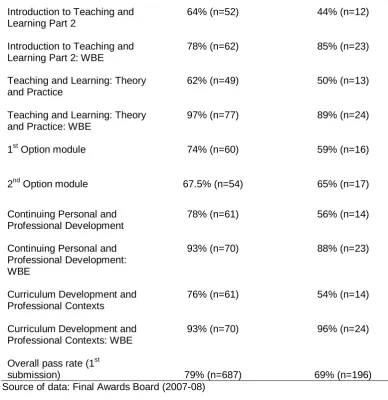
6.4 As in the previous year, data analysis revealed significant differences in the achievement rates of White and minority ethnic trainees. The overall pass rate on first submission for White trainees was 79%; for minority ethnic
trainees the equivalent pass rate was 69% (2007-08). The specific pass rates for each module are shown in Table 2.
6.5 Overall, the discrepancy in achievement between White and minority ethnic trainees was the most marked where assessment involved the submission of an assignment or a portfolio. There was no significant difference in achievement for elements of the course that involved the assessment of practical teaching (WBE), where the overall percentage pass rate (1st attempt) for minority ethnic trainees was slightly better than that of White trainees. The most significant gap in achievement was found in the
pass rates (1st submission) for the first assignment – Preparing to Teach in
the Lifelong Learning Sector (PTLLS).
Module % White trainees: 1st submission = pass
% Minority Ethnic trainees: 1st submission = pass Introduction to Teaching and
Learning Part 1 (PTLLS)
Appendix 4
University of Bolton: Ethnicity and achievement, 2008
Introduction to Teaching and Learning Part 2
64% (n=52) 44% (n=12)
Introduction to Teaching and Learning Part 2: WBE
78% (n=62) 85% (n=23)
Teaching and Learning: Theory and Practice
62% (n=49) 50% (n=13)
Teaching and Learning: Theory and Practice: WBE
97% (n=77) 89% (n=24)
1st Option module 74% (n=60) 59% (n=16)
2nd Option module 67.5% (n=54) 65% (n=17)
Continuing Personal and Professional Development
78% (n=61) 56% (n=14)
Continuing Personal and Professional Development: WBE
93% (n=70) 88% (n=23)
Curriculum Development and Professional Contexts
76% (n=61) 54% (n=14)
Curriculum Development and Professional Contexts: WBE
93% (n=70) 96% (n=24)
Overall pass rate (1st
submission) 79% (n=687) 69% (n=196) Source of data: Final Awards Board (2007-08)
Table 2. A comparison of the achievement of white and minority ethnic trainees: 1st submission results (2007-08)
6.6 The analysis above concerns first submissions and attempts only. The majority of both White and minority ethnic trainees went on to achieve the qualification for which they had enrolled. However, although the numbers are very small, the discrepancy in proportionate achievement between the two groups remains through to course completion. Although White trainees outnumbered minority ethic trainees by a ratio of 74% to 26%, this was not reflected in the proportion of trainees who finished the year with a result of PTLLS only, Defer, Refer, or Fail, as shown in Table 3.
PTLLS only Defer Refer Fail % without the full
qualification (end of year) White trainees 2 5 2 0 11%
Minority ethnic trainees
3 2 2 1 29% Source of data: Final Awards Board (2007-08)
Appendix 4
University of Bolton: Ethnicity and achievement, 2008
7. Focus group discussion with the initial teacher training team
The focus group discussion was relatively brief, taking place at the end of a full team meeting. Key issues discussed are summarised below, with no commentary. Illustrative quotations are included in italics. Where a sole respondent holds a view this has been indicated.
7.1 Much of the discussion around differences in achievement between White and minority ethnic trainees focused upon standards of written English; clarity
was evidently perceived to be a key issue. There was felt to be some lack of
Standard English and problems with the use of academic language were noted. Attention was drawn to the fact that although most minority ethnic trainees are completely fluent in English, many will use another language in
the home. Someone pointed out that in the past, everyone did English. A view
was expressed that possession of a degree does not necessarily indicate that
a person is ready to do a teacher training course.
7.2 Linked to the concern expressed about written English, but addressing additional issues, team members considered aspects of student support. Initial assessment followed by additional and focused support was seen as very important. A member of the Skills for Life team described how a trainee on the ESOL pathway had provided support to a minority ethnic trainee. She noted that this arrangement had worked very well. One suggestion concerned the use of Skills for Life trainees to provide additional [English] workshops. Someone expressed the view that minority ethnic students do not necessarily always accept support.
7.3 There was some discussion suggesting examination of any possible link
between curriculum subject and achievement. A team member asked Have
you looked at curriculum area – science and maths?
7.4 Other points arising:
There is the possibility of racism
An examination of cultural issues would be useful (tacit knowledge)
The issue of plagiarism needs to be addressed
Work issues may have a role to play
8. Interview with the Head of the Library at the University
8.1 The Head of the Library had been the convener of a group of staff from four HEIs who produced guidelines for library services for international students on behalf of the Access Group of the Society of College, National and University Libraries (SCONUL). The teacher-training cohort had included a few international trainees, included as minority ethnic in the analysis that forms the focus of this research. An informal and unstructured interview took place where discussion moved from the SCONUL guidelines to focus