EMAL-2015-002.R3 The role of academic managers in workload and performance management of academic
staff: a case study.
Abstract
This small-scale case study focused on academic managers to explore the ways in which they control the workload of academic staff and the extent to which they use the workload model in performance management of academic staff. The linkages that exist between the workload and performance management were explored to confirm or refute the conceptual dichotomy, identified from the literature, exist in practice. A conceptualisation derived from neoliberal ideology is described which uses new public management (NPM) as the anchor for the study. Semi-structured interviews were conducted with the three academic managers in each of the faculties and the transcripts analysed. The analysis of the responses confirmed that workload and performance management are not linked at the operational level, confirming the dichotomy in practice. Further research is suggested that would focus on the perceptions of academic staff directly affected by the workload and performance management processes.
Keyword
New Public Management, workload, performance, managerialism, neoliberalism
Introduction
Managers’ supervision of staff performance and utilization of the workload model are analysed in this article. This small-scale case study was conducted with the three academic managers responsible for implementing the workload model and performance management processes across the three faculties at a post-92 university (these being ex-polytechnics and colleges of higher education that acquired university title following the Further and Higher Education Act 1992) in the North of England; anonymised as the University of Eagleton. A critical analysis of the data illuminates the way in which the academic managers use
workload management models and how these are used to manage staff performance. This study has been guided by one research question:
How and why is academic staff workload being managed within faculties by academic managers and to what extent do these managers link workload to performance of staff within each Faculty in a small post-92 HE institution?
Literatures and conceptualisation
It has been argued that the processes themselves and those who control them (in this case the academic managers) are a consequence of the rise of a managerialist approach to academic endeavour. This raises the question; what are the ideological roots that underpin this managerialism and can it provide a conceptual framework for this case study?
According to Miles and Huberman (1994) a conceptual framework ‘explains the main things to be studied…. and the presumed relationships’ (p18) and provides the umbrella for the overarching paradigm that locates the study. Neoliberalism, originally a macro-economic idea, provides such an ideological umbrella because it is the foundation of the current managerialist ideas. Neoliberalism has its roots in the inaugural meeting of the Mont Pelerin Society in April 1947 led by the economist Friedrich A. von Hayek. The society and its founder were reacting against the spread of communist ideologies. Hayek (1947) perceived this as a challenge to freedom;
‘Over large stretches of the Earth’s surface the essential conditions of human dignity and freedom have already disappeared. In others they are under constant menace from the development of current tendencies of policy.’
Hayek (1947) argued that the result of the policy trends at the time were to reduce the influence of the competitive market and through this diminish ‘private property’ which he asserted was essential for freedom. Harvey (2005) wrote that contemporary neoliberals felt freedom was ‘threatened… by all forms of state intervention…’ (p.5). Freedom itself was linked to earlier classical liberal concepts where ‘all men [sic] were free and equal with inalienable rights independent of the laws of any government…’ (Steger and Roy, 2010: p.5). Interestingly, two of the six aims in Hayek’s ‘Statement of Aims’ were;
‘The redefinition of the functions of the state so as to distinguish more clearly between the totalitarian and the liberal order.’ and;
‘The possibility of establishing minimum standards by means not inimical to initiative and functioning of the market.’
(https://www.montpelerin.org/montpelerin/mpsGoals.html)
It was during the later 1970s and 1980s that these aims were revisited as part of the political doctrines that came to the fore; notably ‘Reaganomics’ (after President Ronald Reagan of the USA) and ‘Thatcherism’ (after the British PM Margaret Thatcher). Harvey (2005) stated that it was during this period that neoliberalism was ‘transformed… into the central guiding principle of economic thought and management.’ (p.2). Thus the 1970s and 1980s witnessed political interventions consonant with the aims of neoliberalism; privatisation of state
industries, sales of government assets and withdrawal from state welfare systems.
conceptualisation in which to locate the research and the attributes of NPM provide a useful coding structure for analysing the data.
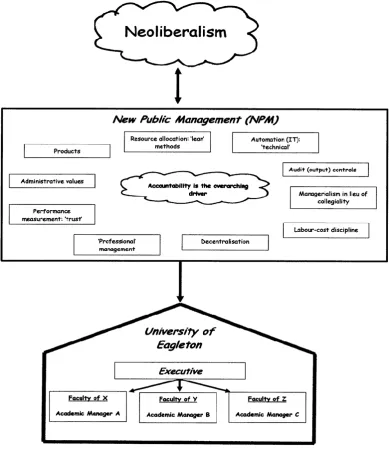
Figure 1 shows the relationship between the ideology of neoliberalism, the concept of NPM and their particular relationship to the case in question; the University of Eagleton. The concept of NPM could only be helpful in the design of the study and the subsequent data analysis if there were specific areas identified within the concept that enabled it to be taken from the abstract to the concrete. Interestingly, as NPM develops through the processes of political change then this influences how neoliberalism is discussed; hence the bidirectional arrow in Figure 1. The University of Eagleton is subservient to the macro-political
environment due to its size and has little chance of influencing the development of NPM itself; hence the unidirectional arrow at the bottom of Figure 1. Thus the focus of the research was the academic managers as they are effectively the agents of change at the micro-level within Eagleton.
Conceptual ‘bin’ Description
Decentralisation One of the tenets of NPM is that central control is almost anathema to the operation of any type of market. Thus centralised units are broken up, even within monolithic bodies to create an internal market. From hierarchy to participation (Steger & Roy 2010, p13)
Professional management
Active managers, highly visible, with clearly defined roles and the authority to carry out their designated function. Usually by a cadre who want to ‘manage’ rather than happening upon this in the course of a career.
Performance measurement
The overarching accountability requires quantitative measures (whether real or pseudo). It could be argued that performance management of staff with its quasi-performance indicators is part of this.
Administrative values
A common understanding of what makes for ‘good’ administration at the micro-level recognising that administration isn’t a pejorative term.(Hood 1991, p10) Products Another way of considering this is to use the word ‘results’ but this is too narrow.
The focus on the product is linked to resource-allocation methods and includes all of the things that higher education does.
Resource allocation One of the claimed outcomes from NPM is that productivity should increase and that this requires careful management of all resources. Clearly within higher education the costliest resource is staffing and so there is another link with workload management.
Automation The use of information technology has been seen as a key driver for lower costs, but only if used appropriately. However, if used badly then it can lead to greater inflexibility (Hood and Peters, 2004). This is used here to allude to the IT systems being developed to automate workload and performance management processes. Audit Once firmly of the financial sector this is now used in all aspects of higher
education. Within this paper it refers to the cross-checking of workload allocations or that performance targets for staff are met; almost internal audit (Shore and Wright, 1999).
Managerialism This refers to the debate within HE internationally regarding the displacement of traditional collegial approaches by those management practices found in the private sector (Deem 1998; Bryson 2004).
Labour-cost discipline
The seven ‘doctrines’ identified by Hood (1991) could be grafted onto the research agenda since the central theme (as in Figure 1) is that of accountability; ‘intensive specification of outputs, encapsulated in performance…indicators’ (Hood and Peters 2004, p.270). The other attributes distilled from the ‘doctrines’ support the accountability agenda and are influenced by the work of Deem (1998) and (Chandler et al., 2002). The notion of ‘intellectual bins’ (Miles and Huberman, 1994) to group the attributes conveniently was then used as it helped to shape the coding structure for the analysis of the data. Table 1 shows the definitions of these ‘bins’.
Table 1: Conceptual 'bins'
Research methodology
An exploratory case study approach (Yin, 2004) was adopted for the study since it allowed the linkages between workload and performance to be examined and it fitted well with the narrative enquiry method (Baumeister and Leary, 1997; Green et al., 2006). There is a lack of literature surrounding the interactions between workload and academic performance management, resulting in a need to investigate whether these linkages exist in practice
(Graham, 2014). Thus the twin threads of exploring the subject and giving voice to the issues can be joined in this exploratory case study. Yin (1994) referred to the statement of the case as the ‘unit of analysis’ and a unit of analysis was developed that focused on the role of the academic managers in operationalizing these processes;
To explore the ways in which academic managers in faculties manage the workload of academic staff and to establish the extent to which these managers use the models in the performance management of their staff.
Narratives are provided as an outcome of the study that would help to illuminate the current situation within a post-92 higher education institution offering the potential to inform further areas of research.
Semi-structured interviews with the three academic managers offered the potential to link the two dichotomous threads. Interviews provide a natural social context for data gathering (Blaxter et al., 2003) and generate narratives once the record of the interview has been analysed. A research question was devised to guide the formulation of the interview;
How and why is academic staff workload being managed within faculties by academic managers and to what extent do these managers link workload to performance of staff within each Faculty in a small post-92 higher education institution?
The interviews were conducted at the University of Eagleton which is a post-92 institution in the north of England structured into three academic faculties (X, Y and Z in this paper) with faculties X and Y being of similar sizes in terms of staff complement and Faculty Z is the smallest. Within each of these faculties there exists a management team comprised of a Dean, Faculty Manager (non-academic) and four academic managers with each one having a
timetables and staff deployment. Thus it was these three academic managers who were interviewed. A brief biography of the three academic managers follows.
Academic Manager Ais female located in faculty X and has undertaken the current role for 1
year but was a principal lecturer for 2 years previously, with14 years’ experience in the subject area for which she remains operationally responsible. She has responsibility for; workload, part-time staffing and student retention.
Academic Manager Bis male located in faculty Y with management responsibility for a
subject team. Has held the role of operations manager, which includes workload, for 7 years. He has a total of 22 years’ service with the University. He has an executive role within the branch of the University & College Union.
Academic Manager C is male located in faculty Z that he joined in October 2011 but has been with the University for 8 years. Until October 2011 he held a commercial role rather than an academic role. He has responsibility for academic operational management including workload management and part-time staffing.
The question was derived from the conceptual ‘bins’ discussed in the previous section as this provided a logical way of developing a framework for the interviews. The relationship between the conceptual ‘bins’ and the questions is shown in Table 2;
Conceptual Bin Linked to interview question prompts;
Resource allocation
What do you perceive to be the purposes of workload and performance management of academic staff?
How do you perceive the linkages between workload and performance management? Automation What method(s) of a) workload management and b) performance management are
being used within your Faculty?
Audit What are the goals of workload management?
What performance management tools/processes are available to you?
Managerialism Where do feel that academic managers ‘sit’ within the overall management structure of the Faculty?
Are you a senior manager, middle manager or other categorisation?
How do you undertake workload and performance management of staff? Labour cost How is the workload model/process used?
What is your understanding of the University policy drivers for workload and performance management? (micro level issues)
Decentralisation What is your role in relation to workload management; scale and scope, responsibility? Professional
management
What is your understanding of both workload management and performance management?
Performance measurement
What does workload management encompass in your role?
What is ‘good’ and ‘poor’ performance in an academic context? Administrative
values
What is your remit in performance and workload management of academic staff?
Table 2: Conceptual bins linked to interview questions
A series of questions were designed to be open ended as they allowed flexibility to follow-up on issues raised and would enable a more natural social exchange to occur.
Ethical Considerations
The main ethical issues centred on Eagleton being a small university and that the researcher was employed in the organisation. Care was needed when anonymising the transcripts in order that identities could not be gleaned from inadvertent use of faculty descriptions. Ethical clearance was sought from the appropriate committee at Eagleton and an agent was appointed to make the initial approach to the academic managers thereby avoiding any suggestion of coercion to participate. Once the participants had consented then contact was made directly in order to setup an interview lasting no longer than 90 minutes.
Hitchcock and Hughes (1995) suggested that there may be an issue of reciprocity with interviewees who are peers, sometimes tending to give the answers that they think the interviewer wants to hear. The interviewer needs to be aware of this and Hitchcock and Hughes recommended using open ended questions to probe responses in order to check the validity of the answer given. Platt (1981) said that whilst this can be helpful, there are social obligations that may present difficulties; mainly anonymity. Platt also suggested that a semi-structured interview is probably best when interviewing peers because a more social
interaction is likely to ensue, allowing the interviewee to feel equally valued; equality implying reciprocity. Interviewing colleagues can take advantage of rapport between interviewer and respondent to gather information that might otherwise be unavailable; ‘…using rapport to elicit information which might not be provided under purely impersonal conditions’ (Platt, 1981, p.84), and this certainly proved to be the case with the three
colleagues interviewed. Ethical considerations in these situations cannot be absolute but must be considered on a risk-benefit basis; risk mainly to the interviewee versus benefit to the researcher from a free dialogue.
Findings and analysis
The interviews were digitally recorded so that the files could be exported to a computer that facilitated the use of Transana (Woods and Fassnacht, 2012) software to aid transcription, after which a suitable coding structure for analysing the responses was devised. The act of coding a transcript is a form of analysis in itself because the codes build a ‘conceptual web’ (Miles and Huberman, 1994) that can be matched to the conceptualisation developed for the study; namely NPM. The codes become a way of allocating a meaning to each response that allows inferences to be drawn from the transcripts. The guidance presented by Miles and Huberman (1994) on the designing of a coding scheme proved useful in allowing the data gathered through the interviews to be matched to the conceptualisation shown in Figure 1. The conceptual ‘bins’ were used as a guide to developing these codes in order to ensure that the data was tested against the conceptualisation. In some cases the ‘bin’ was the overarching
Products What does performance management mean for you?
thematic code which was divided into detailed codes, whilst in other case the ‘bin’ itself provided the detailed code. This is a ‘mid-range accounting scheme’ and it provides a logical framework in which to code the transcripts (Miles and Huberman, 1994). Table 3 shows the relationships between the themes used to group the codes for presentation in the analysis and the conceptual ‘bins’ (the latter are underlined in the first column);
Conceptual ‘bins’ & key themes
Code Description
Biography
Role scale Decentralisation
RS A holistic view of the job role, covering all aspects of the role. Responsibility
Decentralisation
R Specific responsibilities related to workload & performance management. Background personal B General biographical background of the manager.
Perception role Decentralisation
PR How does the manager view their role within the university structure?
Resource Allocation
Workload definition Labour-cost discipline
WD The managers understanding of the way workload is defined for academic staff in a post-92 institution.
Workload model Labour-cost discipline
WM Identifying and explaining the workload model that they are using within their role.
Staff cost
Labour-cost discipline
SC The managers understanding of the labour costs of academic staff and the linkages between this and workload management.
Managerialism
Performance model ‘trust’
PM Identifying and explaining the performance management model that they are using within their role.
Performance definition ‘trust’
PD The managers understanding of the way performance is defined for academic staff in a post-92 institution.
Implementation (both) ‘trust’
I Focusing on the way in which each model is implemented within the faculties.
Understanding (both) Administrative values
U To what extent do the managers understand the need for the two models within post-92 higher education?
Values
Administrative values
V The personal ‘values’ of the manager to try to understand any tensions that may exist when applying the models to colleagues that they manage. Performance
Linkages between models ‘lean’ methods
LM How do the managers perceive that workload and performance are linked?
Accountability
Audits Audit control
A The managers have the responsibility for implementing the models but how is their implementation checked?
Function of models ‘Professional’ management
F To what extent do the managers understand the need for such models to be used and what do the models actually contribute to the sustainability of the University.
Workload Audit control
W What is the line management structure within the organisation that the managers follow to escalate problems or report progress on workload? Performance
Audit control
Systems used Automation (IT)
S Identifying any IT systems that are used to help with the implementation of the models or for recording the output.
Influences
Micro politics (internal) Products
MI Are the managers aware of the way in which external factors are generating local opportunities for the University to pursue its own internal strategic agendas?
Macro-political (policy) Products
MA The extent to which the manager understands the external political picture affecting the University, especially government policy/agencies.
Leadership Managerialism
L To what extent do the managers view what they do with workload and performance as contributing to effective leadership of academic staff? Management
Managerialism
M How do the managers perceive their position within the university management structure?
Table 3: Coding structure
Roles of the academic managers
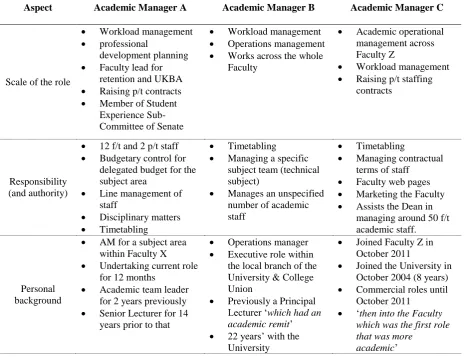
The most immediate observation across all three academic managers was that whilst workload and performance management featured prominently in their roles, each of these managers had other responsibilities unrelated to these. For comparative purposes Table 4 is useful in summarising the key aspects of their roles as outlined during the interviews;
Aspect Academic Manager A Academic Manager B Academic Manager C
Scale of the role
Workload management
professional
development planning
Faculty lead for retention and UKBA
Raising p/t contracts
Member of Student Experience Sub-Committee of Senate
Workload management
Operations management
Works across the whole Faculty
Academic operational management across Faculty Z
Workload management
Raising p/t staffing contracts
Responsibility (and authority)
12 f/t and 2 p/t staff
Budgetary control for delegated budget for the subject area
Line management of staff
Disciplinary matters
Timetabling
Timetabling
Managing a specific subject team (technical subject)
Manages an unspecified number of academic staff
Timetabling
Managing contractual terms of staff
Faculty web pages
Marketing the Faculty
Assists the Dean in managing around 50 f/t academic staff.
Personal background
AM for a subject area within Faculty X
Undertaking current role for 12 months
Academic team leader for 2 years previously
Senior Lecturer for 14 years prior to that
Operations manager
Executive role within the local branch of the University & College Union
Previously a Principal Lecturer ‘which had an academic remit’ 22 years’ with the
University
Joined Faculty Z in October 2011
Joined the University in October 2004 (8 years)
Commercial roles until October 2011
‘then into the Faculty which was the first role that was more
Table 4: Roles
Two made interesting observations on their roles that are worthy of note;
Academic Manager B:
‘So you're there to enable things although it might appear you've got some authority and control and so on, actually you're assisting it all to happen properly working in a collaborative way with colleagues.’
Academic Manager C:
‘the Dean is very good because he empowers… enables us to carry out that function with his full support.’
Whilst responsible for workload and performance management of the staff within their faculty, the academic managers recognise that they operate only with delegated authority from the Dean. The personal background of the three managers is very different; the longest serving is B who had been with the University for 22 years had originally joined in an industrial liaison role, before becoming a Principal Lecturer and volunteered an emphatic view of academic management;
‘So I've come into teaching via a rather strange circuitous route and I've never been comfortable with the academic management systems because with an industrial background they just seem crazy and out of date, and that's always been my view’
This background comment was indicative of the tone for the rest of the interview. This can be contrasted with a view from C, who had been with the University for 8 years and yet also has a commercial background;
‘where academic managers sit, within the Faculty that I work I think they sit in a very relevant and appropriate role because they are able to help shape and form because of the autonomy they're given by the Dean.’
This is a less cynical view of the role based on the fact that C had only relatively recently assumed an academic role and may well still have their enthusiasm intact!
Originally joined to develop industry links and consultancy
‘I still see myself as somebody from industry, I don’t really see myself as an academic’
Perception of the role
Operational
responsibility for the subject area
‘Yes it’s huge’
‘this is probably the worst job in the University’
‘Servant management’;
driving the operations of the Faculty from the rear
Academic managers are ‘valued but they’re impotent’
An important role that has not been clearly defined
Resource allocation
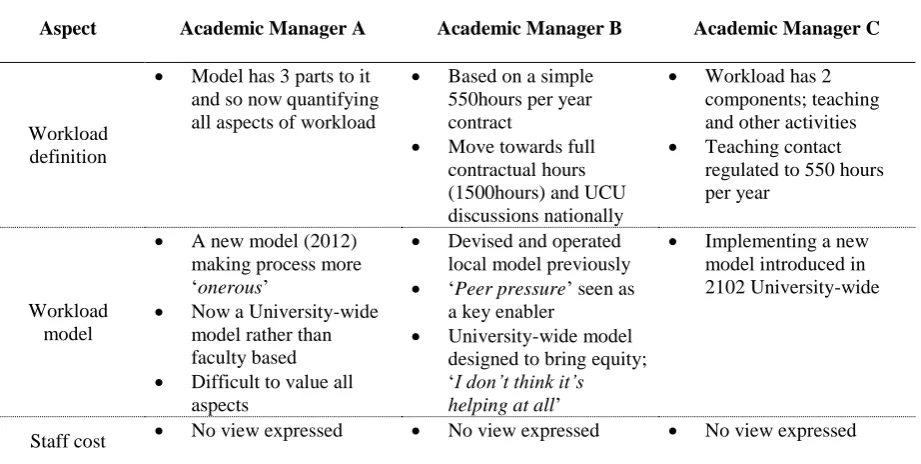
Within this section the responses given in relation to resource allocation are examined by focussing on workload definitions and models. Within the context of Eagleton as a post-92 institution, workload of academic staff is a key concern since it is seen as the key to managing the financial stability of the institution. This is not unusual in the post-92 sector since staffing costs account for around 58per cent of income and thus maximising the use of the workload allocated to each member of staff ultimately reduces the number of staff needed. Clearly this is a legacy of the ‘audit explosion’ that Power (1994) was referring to when examining the way in which business models had been brought into the public sector during the 1980s and 1990s. It is useful at this stage to explain the workload model that is used within post-92 higher education institutions within the UK. The academic contract defines the working year as being 1650 hours and within this total 550 hours should be devoted to student-facing activities; often referred to as ‘contact’ time. The balance of the 1100 hours is supposed to be used for a variety of activities including scholarly activity (a nebulous term), research, lecture preparation and so forth. The ‘contact’ time is fairly easy to define since most staff and managers can relate that directly to the teaching role but there has always been difficulty in agreeing the duties that fall into the 1100 hours. This ambiguity has often formed the basis for the flexibility in establishing workloads for staff by the academic managers at a local level. The 550 hours for ‘contact’ was traditionally used at Eagleton as a proxy for managing the whole annual workload. A common factor throughout is the
Table 5: Resource allocations
None of the academic managers made any links at all with the raison d'être for workload models espoused by the senior management, viz controlling staffing costs. Given the commercial and business orientation of Academic Managers B and C, this is startling. All three had a good understanding of the definition of workload in an academic context and equally they had all implemented workload models locally, within faculties, prior to the introduction of a University-wide model. These interviews were conducted at a time when the senior management team at Eagleton had decided to move away from local faculty workload models to a University-wide workload model. The argument was made that there was a lack of uniformity under the faculty model but this was a result of senior managers not
understanding that faculty Deans used to meet regularly to discuss their models with a view to ensuring some equity across the faculties. Thus the University workload model became a ‘one size fits all’ approach and that provides a useful context for understanding the way that the academic managers responded. The argument is made that the nature and pattern of work in, say, health subject areas is different from that in engineering; each requiring a different approach to the workload of the staff while managing the contracted workload. The ‘new’ University workload model does not take account of these differences and caused significant problems for the faculties in trying to match the requirements of the workload model to the different ways of working across faculties.
Academic Manager B’s political agenda came through strongly in disparaging comments about the new system but Academic Manager A did recognise the problems of quantifying the workload that isn’t directly teaching;
‘I think when you're looking at valuing the work someone just going out and meeting employers, that's very difficult to quantify.’
The teaching workload was an item that all three managers understood in the most depth and had clarity on what they were doing, as exemplified by this comment from B;
Aspect Academic Manager A Academic Manager B Academic Manager C
Workload definition
Model has 3 parts to it and so now quantifying all aspects of workload
Based on a simple 550hours per year contract
Move towards full contractual hours (1500hours) and UCU discussions nationally
Workload has 2 components; teaching and other activities
Teaching contact regulated to 550 hours per year
Workload model
A new model (2012) making process more ‘onerous’
Now a University-wide model rather than faculty based
Difficult to value all aspects
Devised and operated local model previously
‘Peer pressure’ seen as a key enabler
University-wide model designed to bring equity; ‘I don’t think it’s helping at all’
Implementing a new model introduced in 2102 University-wide
‘The workload management is in one sense clear cut because you have a contract… and there are some very, very clear items in that contract such as the 550 hours maximum teaching in a year, the 18 hours maximum class contact per week; that's about the end of it actually!’
The managers understood what the components of the workload were for the 550 hours of teaching commitment inter alia class contact, personal tutoring and dissertation supervision but the components of the workload that comprised the remaining 1100 hours did not have such clarity. Concern was expressed that the University model now excluded any recognition in workload for roles such as programme leadership or PhD supervision. It was clear from the interviews that the three managers had been used to managing the contractual 550 hours of classroom contact workload and then using this as a proxy for managing the 1100 hours of other duties. Academic Manager B held the view this model had been brought in too late in the day, suggesting that it wouldn’t work in the long term.
The impact of managerialism on Eagleton
Managerialism meant that universities, certainly post-92 ones, evolved from autonomous seats of academe into business-oriented enterprises more in line with the political doctrines of NPM. This provides a clue as to the alternative to managerialism; a collegiate institution with professional autonomy (Hull, 2006). Unfortunately the increasing accountability
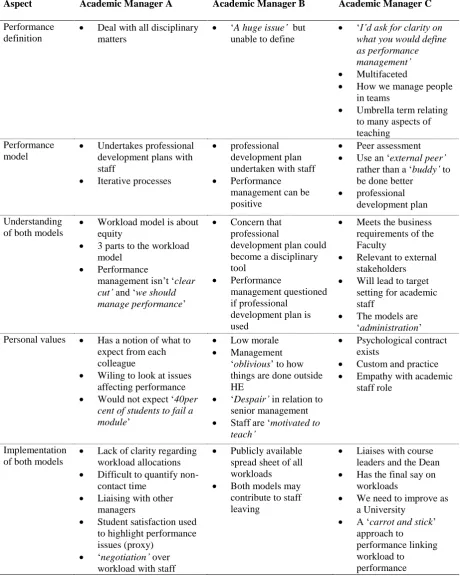
mechanisms mean that it is unlikely that higher education management will return to one based on professional autonomy and trust. Certainly within the analysis of the question responses in this section of the interview it is clear that it is the ‘managerial’ traits that are to the fore with the academic managers as none of them gave responses that hinted at a more collegial approach to managing their staff.
Table 6: Managerialism
The paucity of the views on the definition of performance in an academic context was
surprising given that all three of the managers did have a role in managing academic staff and was a theme that the three managers seemed to be troubled with during the interview. They
Aspect Academic Manager A Academic Manager B Academic Manager C
Performance definition
Deal with all disciplinary matters
‘A huge issue’ but unable to define
‘I’d ask for clarity on what you would define as performance management’ Multifaceted
How we manage people in teams
Umbrella term relating to many aspects of teaching
Performance model
Undertakes professional development plans with staff
Iterative processes
professional development plan undertaken with staff
Performance management can be positive
Peer assessment
Use an ‘external peer’ rather than a ‘buddy’ to be done better
professional development plan Understanding
of both models
Workload model is about equity
3 parts to the workload model
Performance
management isn’t ‘clear cut’ and ‘we should
manage performance’
Concern that professional
development plan could become a disciplinary tool
Performance
management questioned if professional
development plan is used
Meets the business requirements of the Faculty
Relevant to external stakeholders
Will lead to target setting for academic staff
The models are ‘administration’ Personal values Has a notion of what to
expect from each colleague
Wiling to look at issues affecting performance
Would not expect ‘40per cent of students to fail a module’
Low morale
Management ‘oblivious’ to how things are done outside HE
‘Despair’ in relation to senior management
Staff are ‘motivated to teach’
Psychological contract exists
Custom and practice
Empathy with academic staff role
Implementation of both models
Lack of clarity regarding workload allocations
Difficult to quantify non-contact time
Liaising with other managers
Student satisfaction used to highlight performance issues (proxy)
‘negotiation’ over workload with staff
Publicly available spread sheet of all workloads
Both models may contribute to staff leaving
Liaises with course leaders and the Dean
Has the final say on workloads
We need to improve as a University
A ‘carrot and stick’ approach to
clearly had notions of what performance meant but were unable to convey this during the interviews. Academic Manager C tried to answer the questions surrounding performance from the commercial background and yet was unable to provide a definition whilst Academic Manager A expressed that;
‘it is a lot more onerous now trying to quantify the roles that people undertake’
This indicates that in order to manage performance a prerequisite is to know actually what people undertake in their work role and went on to say;
‘I will look at a module that a tutor's taught and if 60per cent of students have passed then for me there’s maybe a performance issue there’
In some respects such an answer is troubling because it seems as though performance is being reduced to simple metrics which, whilst fitting in with the concept of NPM and the audit culture (Power, 1994), does seem to trivialise a complex issue. Clear responses were not forthcoming on what performance model(s), if any, were being used and yet all managers referred to the professional development planning process and peer review that should be undertaken with each staff member. These processes are meant to form part of an overall performance management model that should include appraisal, but again as A said;
‘we don't link actually, professional development planning with appraisal and performance management as much as we could do. I try to in professional development plans but I think that's something we could do better.’
It is encouraging to see that the academic managers are reflecting on the practices but as the key change agents in the University it is disconcerting that they all have a very passive view of their role. Academic Manager C, who came from a recent commercial background, summed up the situation;
‘I think it is something that we need to get a better handle on university wide and not just faculty wide’
Unfortunately whilst this is a truism it will be very difficult for C to effect meaningful change because of the lack of a clear voice in the University management.
Academic staff performance
Questions related to performance were asked in order to discover the way in which the performance and workload models were linked. It was reassuring to hear that ‘they must be linked’ (Academic Manager B) although within the University ‘we haven't really addressed performance management in the past year’ (Academic Manager B). On this theme, Academic Manager C could not understand why the question was asked because ‘Why would you want to segregate the two?’ A good question indeed given that (Graham, 2014) found that there was a dichotomy in the literature. Academic Manager A indicated that;
Academic Manager B made a surprising link between the two models and an issue that is critical to the University of Eagleton; retention;
‘We haven't attempted to link those together and yet we should be doing because that's one of the reasons why retention can be poor’
Further probing of Academic Manager B elicited that the manner in which staff conduct themselves with students can cause students to leave a programme and that this issue should be factored into any performance management model. Finally, Academic Manager C felt that both models should form part of the overall management data set for a faculty that ‘…ties back into a local operating plan for the Faculty’; a logical response given C’s commercial background.
Accounting for workload hours
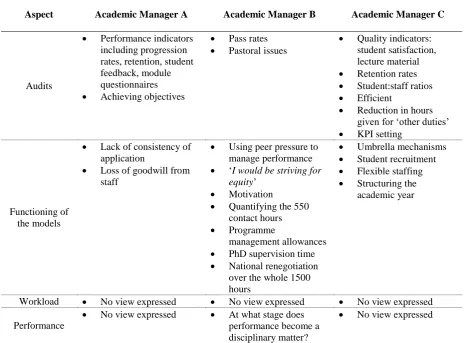
Table 7 groups the data from the coding scheme against accountability (the overarching aspect of NPM).
Table 7: Accountability
Within the realm of NPM there is increasing ‘specification of practice’ (Ranson, 2003) tying into one of the tenets of NPM; audit. It is argued that audit provides ‘an account of
quantifiable performance’ (Ranson, 2003: p.470) so much valued by those who seek to employ evidence-based management. All three academic managers showed an appreciation of the ‘audit’ function of the models being implemented. The workload allocated a member
Aspect Academic Manager A Academic Manager B Academic Manager C
Audits
Performance indicators including progression rates, retention, student feedback, module questionnaires
Achieving objectives
Pass rates
Pastoral issues
Quality indicators: student satisfaction, lecture material
Retention rates
Student:staff ratios
Efficient
Reduction in hours given for ‘other duties’
KPI setting
Functioning of the models
Lack of consistency of application
Loss of goodwill from staff
Using peer pressure to manage performance
‘I would be striving for equity’
Motivation
Quantifying the 550 contact hours
Programme
management allowances
PhD supervision time
National renegotiation over the whole 1500 hours
Umbrella mechanisms
Student recruitment
Flexible staffing
Structuring the academic year
Workload No view expressed No view expressed No view expressed Performance
No view expressed At what stage does performance become a disciplinary matter?
of staff (this workload model is described in the section on ‘resource allocation’) had to be entered into a complex internet-based system that allowed senior managers to interrogate individual workloads; effectively becoming an audit process. They did collectively highlight the significance of such things as performance indicators and were acutely aware of the necessity of monitoring these. It was surprising to find that only one of them (Academic Manager C) mentioned efficiency as a key driver. Once again, it could be the case that the commercial background meant that C was more focused on this aspect. Once again the commercial side of Academic Manager C came through when summing up the situation;
‘the university needs to become more efficient in … the way that it … manages both work related … elements and performance management’
None of them discussed the ways in which the workload or performance models were checked by their line managers as part of an internal audit process.
Automation through information technology
Given that the University had introduced a new workload model in September 2012 that utilised a web based system for capturing workloads it was surprising that information technology systems were only mentioned by Academic Managers B and C. Automation through information technology is one of the ‘administrative megatrends’ cited by (Hood, 1991) and hence the significance in this study. The new system allowed all managers to view an individual workload and so provided a management information system for workload that could facilitate auditing of the process. Academic Manager B only touched on systems in relation to an earlier computer spread sheet system that had been used previously whilst C referred to the new model. Academic Manager C acknowledged the fact that this system would allow greater transparency of workloads that could lead to greater consistency across the University.
Influences on the management of Eagleton
The questions were designed to elicit responses around several attributes that link to the conceptual ‘bins’ surrounding managerialism and what are termed ‘product’ or results expected from HE in general. Managerialism is often linked with NPM since within the public sector it has been used to displace the notion that ‘professionals know best’ (Clarke et al., 2001: p9). Thus there is a feeling that the term ‘managerialism’ has certain attributes that can be defined but it really is a term for a more general ideological view of management; often quoted in terms such as ‘behaving in a business-like way’ (Clarke et al., 2001: p.9). There is almost a hierarchy of terms from the concept of ‘managerialism’ to the operational branches of ‘management’ and ‘leadership’ but in reality they are all nebulous. The
questioning in this section was designed to tease out what each academic manager felt about their own role with regard to management and leadership. Indeed Handy (1993) discusses the role of managers and leaders at some length and comes to the view that leadership is a
…management refers to an orientation towards results and goals, organising tasks and systems, while leadership alludes to an orientation towards human relations and organising people. (p.6)
The attributes outlined in this quotation relating to management certainly come through in the answers to the interview questions. All of the academic managers talked about factors such as functionality, administration, coordination and so forth, only focusing on leadership when pressed during the interviews. Academic Manager B was very clear about the role as being a manager and this was largely supported by the other two as the following analysis will show.
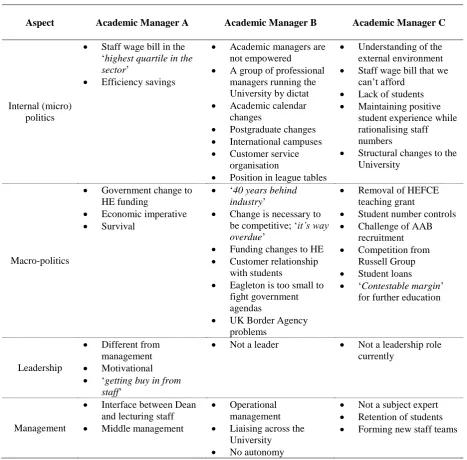
Table 8 summarises the analysis of the responses to these questions;
Table 8: Influences
The three managers had a very good awareness of the external factors affecting higher
education in the United Kingdom and they had translated this into meaningful thoughts on the effect it had internally on Eagleton. The data suggests that academic managers A and C were the two most focused on the issues affecting the University and the rational for internal
Aspect Academic Manager A Academic Manager B Academic Manager C
Internal (micro) politics
Staff wage bill in the ‘highest quartile in the sector’
Efficiency savings
Academic managers are not empowered
A group of professional managers running the University by dictat
Academic calendar changes
Postgraduate changes
International campuses
Customer service organisation
Position in league tables
Understanding of the external environment
Staff wage bill that we can’t afford
Lack of students
Maintaining positive student experience while rationalising staff numbers
Structural changes to the University
Macro-politics
Government change to HE funding
Economic imperative
Survival
‘40 years behind
industry’
Change is necessary to be competitive; ‘it’s way overdue’
Funding changes to HE
Customer relationship with students
Eagleton is too small to fight government agendas
UK Border Agency problems
Removal of HEFCE teaching grant
Student number controls
Challenge of AAB recruitment
Competition from Russell Group
Student loans
‘Contestable margin’
for further education
Leadership
Different from management
Motivational
‘getting buy in from
staff’
Not a leader Not a leadership role currently
Management
Interface between Dean and lecturing staff
Middle management
Operational management
Liaising across the University
No autonomy
Not a subject expert
Retention of students
changes with students at the centre. Academic Manager B was critical of the University and felt the need to make an opening statement at the start of the interview;
‘I'd just like to explain that my understanding is that I'm here as an employee of the university in my capacity as the operations manager for the Faculty… I'm in no sense representing UCU [sic] or the local branch of UCU [sic] at this meeting and I do need to make that clear’
This helps to explain most of B’s responses throughout the interview because whilst making the statement the actuality was different in the interview.
It is clear from the data that what Hoyle (1982) calls the ‘maintenance paradigm’ is in play. Hoyle (1982) posits that the changing macro-political environment focussing on resources, structure and legal frameworks will be professionalised within an organisation rather than politicised through micro-politics. Indeed this is what the responses to the questions
demonstrate. Academic Manager A says that the role is one of an interface between the Dean and other staff which resonates well with Hoyle's (1982) description of ‘exchange theory’ whereby the social operation of an organisation is founded on ‘implicit and explicit bargains struck between groups’; a very apt summary of the description of not just the academic manager role but also the way in which workload in particular is managed.
Questions were asked as to how these managers perceived themselves in their roles; was it just a management role or was there an element of leadership? In terms of position within the University one view was ‘I suppose it's middle management really’ (Academic Manager A) whilst Academic Manager C gave a more circumspect answer, but broadly in alignment with A;
‘…as part of the academic function and what they do within the faculty they can probably be seen as senior managers, but in the functionality of the university it's between junior and senior.’
This is interesting because Eagleton is a post-92 university and has its roots in the local authority in much the same was as further education colleges. The role definition certainly resonates with that espoused by Gleeson and Shain (1999) when referring to middle
managers in further education ‘who assume managerial responsibility for the co-ordination of courses, people management, budgets and income generation…’ This definition of the role of middle managers is supported by Briggs (2004) when she defined five aspects of the middle manager role in further education; ’corporate agent, implementer, staff manager, liaison and leader’. Writers on higher education such as Bryman and Lilley (2009) and Floyd (2012) use the term ‘middle manager’ to refer to Dean of Faculty or equivalent level roles which clearly does not map onto the academic manager role at Eagleton.
Consistent with a generally negative view of the University throughout the interview Academic Manager B felt that;
‘I'm very much a manager not a leader … I do things right; I don't necessarily do the right things and that is the difference between a leader and a manager I think’
rounded view of their role and could see aspects of leadership within their overtly
‘management’ role. As Academic Manager C said ‘…the leadership aspect of that is almost around reconnaissance, invigoration, empowerment, freeing up of time via workload allocation [for academic staff] to enable them to do those [other] aspects’. Academic Manager A put the leadership versus manager debate into context;
‘I think you can be a leader without being a manager so you can be a leader I think if you command the respect of the people that you lead. They will look to you and follow your lead, and you can do that without having a title of manager but yet you can be a manager and not lead particularly well; it might be in your job title that you manage and you lead this area but you might be very good at the admin and the operational bits but if you can't motivate a team to follow you then you're not leading them… I see my job to be a good manager and you should be able to be a good leader as well, I think there's differences but I see hopefully, my role as both’
It is clear from the analysis that the three academic managers view themselves as fulfilling a middle management role; whether at faculty or university level was not clear for them. Their answers did emphasise their roles as key change agents within the University by virtue of their responsibilities to staff in implementing University policy.
It was surprising to discover that none of the managers understood the reason for managing workload - that of controlling staffing costs - itself a key tenet of NPM. In terms of another key aspect of NPM, performance management, the managers showed a lack of clarity on what ‘performance’ means in the academic context and held views on ‘performance
management’ that demonstrated a surface level approach. Audit is a key conceptual ‘bin’ for NPM and the three managers again showed a good awareness of this through mention of such things as KPIs and yet they were unclear about University processes in relation to the internal audit of workloads. They all showed a good awareness of the macro agenda impacting on universities and were able to translate this to a local level. Probably the single most important finding from the study was that the three managers displayed a lack of clarity surrounding the linkages between workload and performance management actually in an operational setting resonating strongly the dichotomy identified by Graham (2014).
Conclusion
At the beginning of this paper the research question was posed;
‘How and why is academic staff workload being managed within faculties by academic managers and to what extent do these managers link workload to performance of staff within each faculty in a small post-92 higher education institution?’
The questions asked during the interviews probed the managers’ experiences of workload and performance management. The analysis of the responses confirmed that the academic
significant finding supports the dichotomy established by Graham (2014) and highlights that in actuality this lack of a linkage exists at the operational level.
These academic managers saw themselves in a role that fitted into a ‘middle’ structure but they couldn’t agree on a common position; in some cases they saw the role as a middle manager within their faculty but more junior in terms of the wider University. Although the interviews did not test the way they felt valued in the organisation there was sufficient data to support the view that they felt undervalued generally. This is troubling given that the
academic managers are the key agents of change at the micro-level within the University. Their roles as leaders or managers were explored and they predominantly saw their role as a manager, explaining that leadership and management were different in their eyes. What was encouraging to see in the data was the level of macro-political awareness that was helping to frame their job role and, whilst they were able to make some linkages with the internal micro-political agenda, it was clear that they were not fully attuned to the internal politics of the University. Judging from the transcripts and subsequent coding, the concepts of NPM have permeated the organisation that helps to support the conceptualisation developed earlier in this paper.
However, what is clear to from this small scale study is that there are opportunities for further research examining the linkages between workload and performance management and how they affect staff and the University. It could be argued that this study has been a ‘top-down’ approach to examining workload and performance management by looking at the roles of the ‘implementers’ (the academic managers) and a follow-up study taking a ‘bottom-up’
approach with those directly affected - academic staff – would be illuminating. ‘Higher education fails to scrutinise and rigorously research its own affairs…’ (Gill, 2013) is finding its voice in the sector at the time of writing this paper and so it would seem to be an
opportune time to be examining the issues of workload and performance at the core of this study.
References
Baumeister RF and Leary MR (1997) Writing narrative literature reviews for peer-reviewed journals: secrets of the trade. Review of General Psychology, 1(3), 311–320, Available from:
http://www.pubmedcentral.nih.gov/articlerender.fcgi?artid=2647067&tool=pmcentrez& rendertype=abstract.
Bennis WG (1989) Why leaders can’t lead. 1st. ed. San Francisco: Jossey-Bass.
Blaxter L, Hughes C and Tight M (2003) How to research. 2nd. Ed.i. Maidenhead: OU Press/McGraw Hill Education.
Briggs ARJ (2004) Middle managers in further education colleges: The ‘New Professionals’.
Journal of Educational Administration, 42(5), 586–600, Available from:
Bryman A and Lilley S (2009) Leadership Researchers on Leadership in Higher Education.
Leadership, 5(3), 331–346, Available from:
http://lea.sagepub.com/cgi/doi/10.1177/1742715009337764 (accessed 14 March 2012).
Bryson C (2004) What about the workers? The expansion of higher education and the
transformation of academic work. Industrial Relations Journal, 35(1), 38–57, Available from: http://doi.wiley.com/10.1111/j.1468-2338.2004.00299.x.
Burgess TF (1996) Planning the academic ’ s workload : different approaches to allocating work to university academics The UK higher education context. Higher Education, 32, 63–75.
Chandler J, Barry J and Clark H (2002) Stressing Academe: The Wear and Tear of the New Public Management. Human Relations, 55(9), 1051–1069, Available from:
http://hum.sagepub.com/cgi/doi/10.1177/0018726702055009019 (accessed 19 October 2011).
Clarke J, Gewirtz S and McLaughlin E (eds) (2001) New Managerialism, New Welfare? 2nd. ed. London: SAGE Publications Ltd.
Deem R (1998) ’ New managerialism ’ and higher education : The management of
performances and cultures in universities in the United Kingdom. International Studies in Sociology of Education, 8(1), 47–70.
Floyd A (2012) ‘Turning Points’: The Personal and Professional Circumstances That Lead Academics to Become Middle Managers. Educational Management Administration & Leadership, 40(2), 272–284, Available from:
http://ema.sagepub.com/cgi/doi/10.1177/1741143211427980 (accessed 5 June 2012).
Gill J (2013) Leader : Look sharp , the ground is shifting. THES, London, (31 Jan - 6 Feb), 5, Available from:
http://www.timeshighereducation.co.uk/story.asp?sectioncode=26&storycode=422527& c=1.
Gleeson D and Shain F (1999) Managing ambiguity : between markets and managerialism – a case study of ‘ middle ’ managers in further education. The Sociological Review, 47(3), 461–490.
Graham AT (2014) Academic staff performance and workload in higher education in the United Kingdom: the conceptual dichotomy. Journal of Further and Higher Education, Abingdon: Taylor Francis Ltd., 1–15, Available from:
http://dx.doi.org/10.1080/0309877X.2014.971110.
Green BN, Johnson CD and Adams A (2006) Writing narrative literature reviews for peer-reviewed journals: secrets of the trade. Journal of chiropractic medicine, 5(3), 101–17, Available from:
http://www.pubmedcentral.nih.gov/articlerender.fcgi?artid=2647067&tool=pmcentrez& rendertype=abstract.
Harvey D (2005) A Brief History of Neoliberalism. Oxford: Oxford University Press.
Hayek FA von (1947) Statement of Aims. The Mont Pelerin Society, Available from: https://www.montpelerin.org/montpelerin/mpsGoals.html.
Hitchcock G and Hughes D (1995) Research and the Teacher. 2nd. ed. London: Routledge.
Hood C (1991) A Public Management For All Seasons? Public Administration, 69(1), 3–19.
Hood C and Peters G (2004) The Middle Aging of New Public Management: Into the Age of Paradox? Journal of Public Administration Research and Theory, 14(3), 267–282, Available from: http://jpart.oupjournals.org/cgi/doi/10.1093/jopart/muh019 (accessed 29 October 2012).
Houston D, Meyer LH and Paewai S (2006) Academic Staff Workloads and Job Satisfaction: Expectations and values in academe. Journal of Higher Education Policy and
Management, 28(1), 17–30, Available from:
http://www.tandfonline.com/doi/abs/10.1080/13600800500283734 (accessed 19 August 2011).
Hoyle E (1982) Micropolitics of Educational Organisations. Educational Management and Administration, 10, 87–98.
Hull R (2006) Workload allocation models and ‘collegiality’ in academic departments.
Journal of Organizational Change Management, 19(1), 38–53, Available from:
http://www.emeraldinsight.com/10.1108/09534810610643677 (accessed 10 November 2011).
Miles MB and Huberman AM (1994) Qualitative Data Analysis. 2nd. ed. Thousand Oaks: Sage Publications Inc.
Platt J (1981) On interviewing one ’ s peers. British Journal of Sociology, 32(1), 75–91.
Power M (1994) The Audit Explosion. Demos, London: DEMOS, Available from: http://www.demos.co.uk/files/theauditexplosion.pdf?1240939425.
Ranson S (2003) Public accountability in the age of neo-liberal governance. Journal of Education Policy, 18(5), 459–480, Available from:
http://www.informaworld.com/openurl?genre=article&doi=10.1080/0268093032000124 848&magic=crossref||D404A21C5BB053405B1A640AFFD44AE3 (accessed 9 August 2011).
Steger MB and Roy RK (2010) Neoliberalism: A very short introduction. Oxford: Oxford University Press.
Tripp D (1992) Critical theory and educational research. Issues in Educational Research, 2(1), 13–23, Available from: http://www.iier.org.au/iier2/tripp.html.
Yielder J and Codling A (2004) Management and Leadership in the Contemporary University. Journal of Higher Education Policy and Management, 26(3), 315–328, Available from: http://www.tandfonline.com/doi/abs/10.1080/1360080042000290177 (accessed 18 April 2012).
Yin RK (1994) Case Study Research: Design and Methods. 2nd. Ed. Thousand Oaks: Sage Publications Inc.
Yin RK (2004) Case Study Methods. Complementary Methods in Research in Education.
Andrew T. Graham
Manchester Institute of Education, University of Manchester, United Kingdom
Email: [email protected]
Andrew has worked in the post-92 university sector in the UK for 24 years having started as a lecturer in technical and vocational education. Since 2001 he has held senior management positions that range from Head of Department and Dean of Faculty through to his current role as an Executive Dean. His interest in the dislocation of workload management and