EFFECTS OF VISCOUS DISSIPATION AND VARIABLE
PROPERTIES ON NANOFLUIDS FLOW IN TWO
DIMENSIONAL MICROCHANNELS
A. Ramiar and A.A. Ranjbar*
Department of Mechanical Engineering, Babol Noshirvani University of Technology P.O. Box 484, Babol, Iran
[email protected] - [email protected]
*Corresponding Author
(Received: March 22, 2011 – Accepted in Revised Form: June 21, 2011)
Abstract Laminar two dimensional forced convective heat transfer of Al2O3 –water nanofluid in a
horizontal microchannel has been studied numerically, considering axial conduction, viscous dissipation and variable properties effects. The existing criteria in the literature for considering viscous dissipation in energy equation are compared for different cases and the most proper one is applied for the rest of the paper. The results showed that nanoparticles enhance heat transfer characteristics of the channel and on contrast, viscous dissipation causes the Nusselt number and friction factor to decrease. The viscous dissipation effect may be emphasized by increasing Reynolds number and decreased by raising the exerted heat flux. Also, it was found that there is a critical Reynolds number below which the average Nusselt number of the nanofluid changes unusually with Reynolds number as a result of variable properties effect.
Keywords Nanofluids, Heat Transfer Enhancement, Nusselt Number, Critical Reynolds Number
هﺪﯿﮑﭼ
بآلﺎﯿﺳﻮﻧﺎﻧيﺪﻌﺑودتراﺮﺣلﺎﻘﺘﻧاونﺎﯾﺮﺟﻪﻟﺎﻘﻣﻦﯾارد
-ﺮﻈﻧردﺎﺑلﺎﻧﺎﮐوﺮﮑﯿﻣردﻢﯿﻨﯿﻣﻮﻟآﺪﯿﺴﮐا
ﺖﺳاﻪﺘﻓﺮﮔراﺮﻗﯽﺳرﺮﺑدرﻮﻣﺪﻣﺎﺟﻪﯿﺣﺎﻧردﯽﺗراﺮﺣﺖﯾاﺪﻫﻦﺘﻓﺮﮔ .
ﺟﺰﻟفﻼﺗاﻪﻠﻤﺟﺮﺛا ﯽ
ﺮﺑيژﺮﻧاﻪﻟدﺎﻌﻣرد
ﺘﻣ تﺎﯿﺻﻮﺼﺧﻦﺘﻓﺮﮔ ﺮﻈﻧ رد ﺎﺑ،لﺎﻧﺎﮐوﺮﮑﯿﻣ ردنﺎﯾﺮﺟﻂﯾاﺮﺷ هﺪﺷ ﻪﺋاراﺞﯾﺎﺘﻧ وهﺪﺷ ﯽﺳرﺮﺑﺎﻣد ﺎﺑﺮﯿﻐ
ﺪﻧا . ﺎﺑ
ﯿﻐﺗﻦﺘﻓﺮﮔ ﺮﻈﻧردﺎﺑ،ﺮﺘﮑﭼﻮﮐدﺎﻌﺑا ردﻪﮐﺪﺷﺺﺨﺸﻣ،ﺖﺑﺎﺛزﺪﻟﻮﻨﯾردﺪﻋﮏﯾردلﺎﻧﺎﮐوﺮﮑﯿﻣدﺎﻌﺑاردﺮﯿﯿﻐﺗ ﯿ
ﺮ
ﺟﺰﻟ فﻼﺗا ﻪﻠﻤﺟ ﺮﺛا ،ﺎﻣدﺎﺑ تﺎﯿﺻﻮﺼﺧ ﯽ
فﺮﺻﻞﺑﺎﻗ ﻪﻈﺣﻼﻣ ﻞﺑﺎﻗ ﺮﯿﯿﻐﺗ ﺚﻋﺎﺑ وهدﻮﺒﻧﺮﻈﻧ
يا
تﺎﺼﺨﺸﻣ رد
ﯽﻣ لﺎﻧﺎﮐﯽﺗراﺮﺣ دﻮﺷ
. ﺟﺰﻟ فﻼﺗاﻪﻠﻤﺟ ﺮﯿﺛﺄﺗ راﺪﻘﻣﻦﯿﻨﭽﻤﻫ ﯽ
ﻪﻠﻤﺟ ﻦﯾازا ناﻮﺘﻧ نآرد ﻪﮐيﺮﻄﻗ ﻞﻗاﺪﺣﺎﯾ
ﺰﯿﻧ ﺮﺘﮔرﺰﺑ يﺎﻫﺮﻄﻗردﻪﻠﻤﺟ ﻦﯾا ،ﺮﺘﮔرﺰﺑ ﻞﺘﻧاﺮﭘدﺪﻋ ﺎﺑﯽﻟﺎﯿﺳ ياﺮﺑ و هدﻮﺑ لﺎﯿﺳعﻮﻧ زا ﯽﻌﺑﺎﺗ،دﺮﮐ ﺮﻈﻨﻓﺮﺻ ﺪﺷ ﺪﻫاﻮﺧ ﺖﯿﻤﻫاﺰﺋﺎﺣ .
ﻨﭽﻤﻫ ﯿ ﺎﺘﻧ ﻦ ﯾ نﺎﺸﻧﺞ دﻮﺟوهﺪﻨﻫد ﯾ
ردﺪﻋ ﮏ
ﯾ ﻧاﺮﺤﺑزﺪﻟﻮﻨ ﯽ
ﺖﺳا ازا ﻪﺑ ﻪﮐ ي دﺎﻘﻣ ﯾ ﺮ
رﯾ ازاﺮﺘﻤﮐزﺪﻟﻮﻨ ﯾ
اﺰﻓاﺎﺑ،راﺪﻘﻣﻦ ﯾ
ردﺪﻋﺶ
ﯾ ﻣﺶﻫﺎﮐلﺎﻧﺎﮐردﻂﺳﻮﺘﻣﺖﻠﺳﺎﻧدﺪﻋزﺪﻟﻮﻨ ﯽ
ﯾ ﺪﺑﺎ .
1. INTRODUCTION
With the advances in computing technology over the past few decades, electronic devices have become faster, smaller and more powerful, and the vital issue is an ever-increasing heat generation rate from these devices. In most cases, the chips are cooled using forced air flow. However, when dealing with a component that contains billions of transistors working at high frequencies, the temperature can reach a critical level where standard cooling methods are not adequate. In addition to high-performance electronic chips, high heat flux removal is also required in devices such
as laser diode arrays and high-energy mirrors. In the last two decades, many cooling technologies have been pursued to meet the high heat dissipation rate requirements and maintain a low junction temperature. Among these efforts, the microchannel heat sink (MCHS) has received much attention because of its ability to produce high heat transfer coefficient, small size and volume per heat load, and small coolant requirements [1]. Recent progress in MCHS development was reported by Kandlikar, et al [2].
laminar conditions in silicon microchannels. Subsequently, features of liquids flow in microchannel were examined by many researchers experimentally and numerically [4-8]. From viscous dissipation point of view, Tso, et al [9-11] studied the role of the Brinkman number (Br) in microchannel flows and explained the unusual behavior of convective heat transfer in microchannels. They found that the effect of Br on convective heat transfer is more in the laminar regime, than in the transition regime.
Judy, et al [12] experimentally observed liquid flow temperature rises and related this to viscous dissipation. They suggested that the viscosity change due to temperature changes should be taken into account to estimate the friction factor.
Koo, et al [13,14] investigated the effects of viscous dissipation on the temperature field and friction factor and showed that ignoring viscous dissipation could affect accurate flow simulations and measurements in microconduits. They neglected the conjugate heat transfer effects. Giudice, et al [15] studied numerically the effect of viscous dissipation and temperature dependent viscosity in the flow of liquids in straight microchannels using finite element procedure considering the viscosity of the fluid to vary linearly with temperature and neglected the variation of thermal conductivity. They concluded that, in the laminar forced convection in straight microchannels, both temperature dependence of viscosity and viscous dissipation effect cannot be neglected.
Nanofluids have been proposed as a mean to enhance the performance of heat transfer liquids currently available. In the past decade, much attention has been paid to nanofluids because of their enhanced properties and their applications in heat transfer and biomechanical applications. Fluid flow and heat transfer of nanofluid in different geometries have been studied by several authors [16] but there are little works related to the nanofluid flow in microchannel.
Masuda, et al [17] reported on enhanced thermal conductivity of dispersed ultra-fine (nanosize) particles in liquids. Soon thereafter, Choi [18] was the first to coin the term “nanofluids” for this new class of fluids with superior thermal properties. Many researchers have worked and are working in the field of convective
heat transfer of nanofluids but there are limited works considering nanofluids in microchannels. Considering the research in the field of microchannel, Koo, et al [19] studied the effect of nanoparticles concentrations on different parameters of microchannel heat sinks. They considered two combinations of copper oxide nanoparticles in water or ethylene glycol and used their own models for the effective thermal conductivity and dynamic viscosity for nanofluids. Their results proved the ability of nanofluids to enhance the performance of heat sinks. They considered the effect of the viscous dissipation but in the considered geometry only for the ethylene glycol the viscous dissipation term became important and for water it was negligible. They didn’t consider the difference between variable properties and constant properties.
Jang, et al [20] used their thermal conductivity model [21] to predict thermal performance of microchannel heat sinks using nanofluids. They neglected the viscous dissipation term and their results showed an enhancement of 10% for water-based nanofluids containing diamond (1 Vol. %, 2 nm) at the fixed pumping power. Bhattacharya, et al [22] analyzed numerically laminar forced convective conjugate heat transfer characteristics of Al2O3/H2O nanofluid flowing in a silicon
microchannel heat sink. They also ignored the effect of viscous dissipation term. They found that the improvement of microchannel heat sink performance due to use of nanofluid becomes more pronounced with increase in nanoparticle concentration. They also showed that fully developed heat transfer coefficient for nanofluid flow in microchannel heat sink increases with Reynolds number even in laminar flow regime rather than a constant.
Ho, et al [23] experimentally investigated enhancement of forced convective heat transfer in a copper microchannel heat sink with Al2O3-water
found that the thermal performance of a microchannel is overrated when viscous dissipation is excluded in the analysis. It was also found that for a particular value of nanoparticles volume fraction, the viscous dissipation effect is more significant in the cooling process compared to that in the heating process.
Lelea, et al [25] numerical studied of the conjugate heat transfer and fluid flow of Al2O3/water nanofluid through the micro-tube in the
laminar flow regime. They considered the effect of viscous dissipation in a constant diameter and didn’t consider the effect of channel size on the significance of this term.
Cole, et al [26] analytically solved the conjugate heat transfer of a constant property liquid in a parallel-plate microchannel considering axial conduction. They ignored viscous dissipation term and variable properties. They found that the effect of the axial conduction in the channel wall will become important when the microchannel has a small length-over-height ratio; the peclet number of the fluid is small or when the wall has high thermal conductivity.
Although there are many works related to microchannel and also nanofluid, in most of the papers, the viscous dissipation term is neglected and from the knowledge of the authors there is not any work highlighting the simultaneous effect of variable properties and viscous dissipation on the behavior of nanofluid. In this paper, the flow and heat transfer 36 nm Al2O3 nanoparticles in water
with various volume fractions ranging from 1 to 5% will be investigated. The effect of viscous dissipation besides variable properties in the presence of nanoparticles will be studied for various volume concentrations and in microchannels with different width. Specially, the different behavior of the nanofluid in lower and higher Reynolds number is explored. The criteria for considering the viscous dissipation term are compared with the numerical results. A new critical Reynolds number is introduced for the effect of variable properties on the average Nusselt number.
2. PROBLEM DESCRIPTION
Different channels with the height varying from
H = 200 μm to H = 50 μm has been investigated the length of channel in all cases is L= 10 cm to assure fully developed condition at the channel exit. The flow condition is laminar, and a wide range of Reynolds numbers from 100 to 1250 has been considered. The lower solid region is made of copper (kSL=400 W/m K) with a height of HSL=
400 μm and the upper solid part is a cover plate, made of plastic with a thermal conductivity of 0.2 W/m K and height of HSU= 200 μm.
A computer code has been developed which uses collocated grid arrangement and the finite volume method to solve governing equations. A SIMPLE based method is applied for pressure-velocity coupling and in order to achieve more precise results a third order QUICK [27] method is utilized to descritize the governing equations in the fluid region.
Considering the nanofluid as a single fluid with modified properties [28], for a 2-D incompressible steady flow of a dilute uniform suspension of nanofluids, the governing equations are:
Continuity equation:
0 . =
∇Vv (1)
Momentum equation:
( )
. 1 1 .( nf V)nf p nf V
Vv ∇ v=− ∇ + ∇ µ ∇r ρ
ρ (2)
Energy equation for fluid:
( )
∇ = ∇ ∇ + Φnf p c
nf T
nf k nf p c T V
) ( ) .( ) (
1 .
ρ µ ρ
r
(3)
Where
Φ
is the viscose dissipation term:j x
i V
i x
j V
j x
i V
∂ ∂
∂ ∂ + ∂ ∂ =
Φ (4)
For the upper and lower solid regions the energy equation is respectively:
0
2 =
∇ Ts (5)
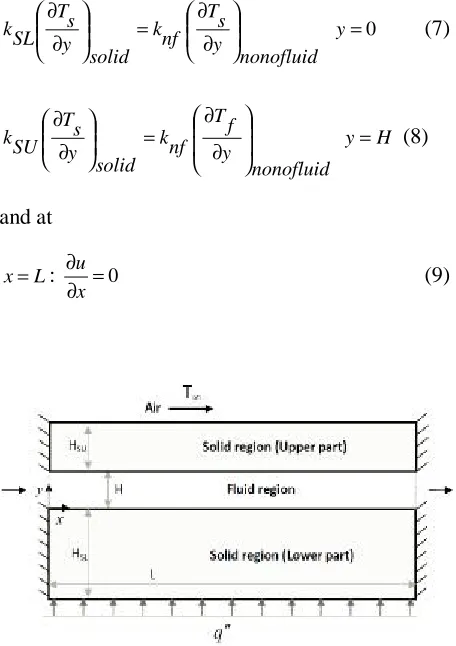
In Figure 1, the nanofluid enters the channel in a constant temperature of 293 K and uniform velocity and the walls are assumed to obey the no-slip condition. At the exit, the zero normal stress for velocity and outlet flow for temperature is supposed. For the solid regions, the upper region in exposed to the ambient air, a uniform heat flux is exerted from below to the lower one and all side walls are considered adiabatic:
SL H y at q y s T SL
k = ′′ =
∂ ∂ −
SU
s T at y H
T h y s T SU
k = − =
∂ ∂
− ( ∞) (6)
L x and x at x Ts = = = ∂ ∂ 0 0
Finally the conjugate heat transfer boundary condition for the interfaces between the solid regions and the fluid is:
0 = ∂ ∂ = ∂ ∂ y nonofluid y s T nf k solid y s T SL k (7) H y nonofluid y f T nf k solid y s T SU
k =
∂ ∂ = ∂ ∂ (8) and at L
x= : =0 ∂ ∂
x u
(9)
For the case of the problem considered in the paper the inlet velocity is considered equal to 0.267 m/s which is identical to a Reynolds number of 100 and particle volume fraction varying from 1 to 5%.
3. NANOFLUID PROPERTY MODELS
Considering the nanofluid as a single phase fluid, we need to determine properties of the mixture (nanofluid) as a function of the concentration of nanoparticles.
Density of the nanofluid is simply determined from:
( )
ρ nf =(1−φ)ρf +φρp (10)where φ is the particle volume fraction of the suspension. The heat capacitance of the nanofluid is obtained by:
p p c f p c nf p
c (1 φ)(ρ ) φ(ρ )
ρ = − +
(11)
Hereafter, subscripts f, nf and p stand for base fluid, nanofluid and nanoparticles, respectively. There are different relations for calculating the dynamic viscosity of nanofluid. Here we use the relation developed by Corcione [29] based on existing experimental data in the literature:
03 . 1 3 . 0 87 . 34 1 1 ϕ µ µ − − = f d p d f nf (12)
df is the equivalent diameter of a base fluid
molecule, given by:
3 / 1 0 6 1 . 0 = f N M f d ρ π (13)
where M is the molecular weight of the base fluid, N is the Avogadro number ( ≈ 6.023×10²³), and ρf0
is the density of the base fluid calculated at temperature T0 = 293 K.
For the thermal conductivity of the nanofluid, Chon, et al [30] model is chosen which has been used and suggested for CuO and Al2O3-water
2321 . 1 Re 9955 . 0 Pr
7476 . 0 369 . 0 746 . 0 7 . 64 1
×
+
=
f k
p k
p d
f d
f k
nf k
ϕ
(14)
f
d and dp are diameter of the molecule of the base fluid and nanoparticles, respectively.
f f f ρ α µ /
Pr= and Re=ρfkbT/3πµ2flf are specific Prandtle number and Reynolds number, respectively. where αf is the thermal diffusivity,
b
k
is the Boltzmann constant and fl is the mean free path of the base fluid which has been considered equal to 0.17 nm for water.
Considering the effect of thermal dispersion, we can use:
d k nf k efff
k = + (15)
where kd is the thermal conductivity due to
thermal dispersion and is obtained from:
p d u
nf p c C d
k = (ρ ) 2+ν2+ϕ (16)
where C is an empirical constant obtained from experimental results [32]. Value of
d k are
negligible comparing with the value of nf
k for the case of this paper and we will not be considered here.
Using above mentioned relations, properties of the nanofluid can be calculated and be applied to the governing equations.
4. VALIDATION OF THE CODE
The generated grid is highly concentrated close to inlet in order to ensure the accuracy of the numerical simulations and for saving both the grid size and computational time. The convergence criterion required that the maximum sum of the error for each of the conserved variables be smaller than 1×10⁻⁵. The grid independence study has been conducted for the microchannel (L = 0.1 m, H = 100 μm), at Ref = 1000. The entire computational
domain is discretized using different grid
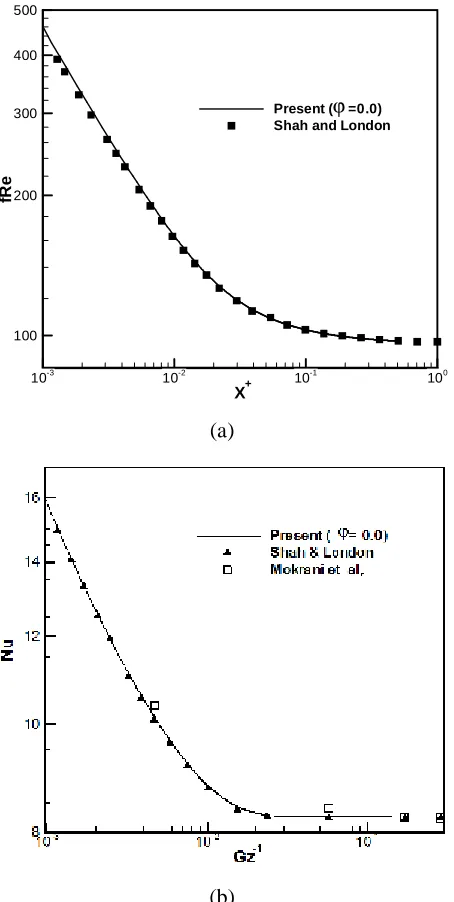
arrangements of 500×10, 1000×20, 1500×30, 2000×40. Simulations with different grids showed a satisfactory grid-independence for the results obtained by a 1500×30 mesh for the fluid region. For validation of the developed code, the Nusselt number and friction factor distribution of pure water along a microchannel with a height of H = 100 µm and without solid regions is compared with the correlation proposed by shah, et al [33] and experimental results of Mokrani, et al [34] as shown in Figures 2a and 2b. The non-dimensional horizontal distance in Figure 2b is X+ =x/ReDh
and the Graetz number in Figure 2a is defined as
x h D
Gz=RePr . Pr is the Prandtl number and Re is the Reynolds number of the fluid.
5. RESULTS AND DISSCUSSION
Since the main purpose of this paper is to carry out some research on the role of viscous dissipation term on the flow behavior, we first should know when this term cannot be eliminated from the energy equation. Morini [35] presented a criterion to represent the limit of significance for viscous dissipation effects in microchannel flows:
1 4 Re * Re
4EcL f 〉 (17)
where
ref p c in u
Ec= 2 /2 ∆θ is the Eckert number, L* is the nondimensional length (=L/ Dh), uin is the
uniform velocity in the entrance of the channel and fRe is the product of Darcy friction factor (f) for the
fully developed flow and Reynolds number which in the laminar regime is only a function of aspect ratio of the channel. In this paper the value of fRe=24 is used for the flow through parallel plates.
The term ∆θref in the above equation is the
reference temperature rise which usually a value of 1K is suggested for water.
Xu, et al [36] individually introduced another criterion for this purpose:
056 . 0 1 . 0
2 〉
−
∆ ref Dh Pr p
c L in u
θ ρ
µ
Figure 3 compares the two criteria for a parallel plate channel with L = 0.1m and the fluid of pure water and alumina-water nanofluid. The lines with symbol X have been calculated by Xu, et al [36] criterion and others obtained using Morini [35] criterion. The properties of the fluid for most of the cases are obtained at T = 293 K. Since the temperature and consequently the properties of the fluid change along the channel, the mean
temperature of T = 310 K has also been considered for the case of φ = 0.5. The parameters in horizontal and vertical axes are the hydraulic diameter of the channel and the Reynolds number. This figure for a certain hydraulic diameter gives a minimum Reynolds number beyond which the viscous dissipation cannot be neglected or for a given Reynolds number offers a minimum diameter below which viscous dissipation should be considered.
As seen in the figure, for example in a channel with H=50 µm (Dh=100 µm) the Morini [35]
criterion will yield to Re=864.67, 340.41 and 717.667 for pure water at T=293K, Al2O3-water
nanofluid (φ = 0.05) at 293K and 310K respectively. The corresponding values obtained using Xu, et al [36] criterion are Re= 2823.81, 1141.23 and 2297.76. In other words, employing the Morini [35] criterion for pure water, it was found that for Reynolds numbers greater than 864.67 the viscous dissipation should not be ignored but on the other hand the Xu, et al [36] gives a value of 2823.81 for this critical Reynolds number. The two criteria give far different Reynolds numbers and will be compared by numerical results in this paper.
The effect of adding nanoparticles can be observed by comparing the corresponding curves for pure water and nanofluid with φ = 0.05. At
X
fR
e
10-3
10-2
10-1
100
100 200 300 400 500
Present ( =0.0) Shah and London
+
ϕ
(a)
(b)
Figure 2. Validation of the developed code.
X
X
X
X
X
X
X
X
X
D
R
e
2.5E-050 5E-05 7.5E-05 0.0001 0.000125 1000
2000 3000 4000 5000
=0.0 =0.0 =0.05 =0.05 =0.05 =0.05 X
X
X
h
ϕ ϕ ϕ ϕ ϕ
ϕ T=310 K T=293 K
Re=1000, for instance, the Morini [35] criterion gives approximate values of Dh = 105 and 143 µm
for pure water and 5 % volume fraction alumina-water nanofluid, both at 293 K. In other words, although for pure water at Re=1000 the viscous dissipation effect is considerable only in channels with hydraulic diameters smaller than 105 µm, adding nanoparticles, causes it to affect in a larger hydraulic diameters (143 µm). So adding nanoparticles will intensify the viscous dissipation effect.
Figure 4 depicts the effect of channel height on the significance of viscous dissipation term in Re=1000. Four different channel heights of 50, 100, 150 and 200 µm are considered and in most of the cases, the fluid is Al2O3-water nanofluid with φ
= 0.03 except the case of H=50 µm, in which the pure water is also considered to study the effect of adding nanoparticles on the Nusselt number distribution. Symbols are for the case when the viscous dissipation term is neglected. It is obvious from the figure that adding nanoparticles will improve the Nusselt number and enhances the heat transfer process. Comparing the curves obtained considering viscous dissipation with the ones ignoring it, reveals that the viscous heating effect can approximately be disregarded for the microchannels with H>100 µm. However, the effect is more pronounced for the Al2O3-water
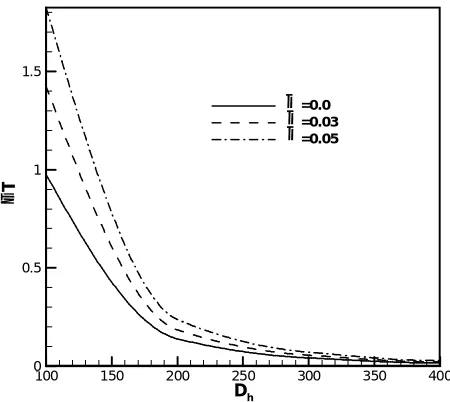
nanofluid than the pure water for H = 50 µm. The two criteria discussed before, use a temperature rise of 1˚C as the measure of the significance of viscous dissipation term. Using the same flow conditions of Figures 4 and 5 shows the variation of the difference of outlet temperature when viscous dissipation is considered and the one when it is neglected (ΔT = Tout–Tout(viscous dissipation ignored)) versus hydraulic diameter of the channel. In other words, the figure shows the temperature rise due to viscous dissipation for different channel heights at Re=1000. The temperature difference diminishes when the hydraulic diameter increases and for Dh>300 µm it tends to zero for all nanofluid
concentrations. Using 1˚C as the measure, only for hydraulic diameters less than 138 µm (channel height of 69 µm) for Al2O3-water nanofluid with φ = 0.05, 124 µm for φ = 0.03 and approximately 100 µm for pure water the viscous heating is considerable. These results confirm that the Morini [35] criterion gives more reasonable values and can
be used as a measure for viscous dissipation ignorance. It should be noted that both of the criteria have not been achieved for parallel plate geometry and we cannot completely deny any of them.
x (m)
N
u
0 0.04 0.08
6 8 10 12 14
H=50 m H=50 m H=75 m H=100 m H=150 m H=50 m H=50 m H=75 m H=100 m H=150 m
Viscous dissipation ignored µ
µ µ µ µ µ µ
µµ
µ
=0.0
ϕ
Figure 4. Effect of viscous dissipation on Nusselt number distribution for different channel heights at Re=1000 utilizing pure water and Al2O3-water nanofluid with φ = 0.03 as
working fluid.
Dh
T
100 150 200 250 300 350 400 0
0.5 1 1.5
=0.0 =0.03 =0.05
∆
ϕ ϕ ϕ
Since the effect of viscous dissipation term on various parameters of the nanofluid is to be considered, for the rest of this section the height of the channel will be considered H = 50µm, assuring that this term has considerable effect.
Figures 6 and 7 demonstrate the temperature contours distribution in the geometry. Figure 6 has obtained for Al2O3-water nanofluid with φ = 0.05
and Re=1250. Figure 7 compares the temperature contours of 4% volume fraction Al2O3-water
nanofluid for the cases of considering viscous dissipation (solid line) and ignoring it (dashed line) both at Re = 750. Viscous dissipation causes the fluid temperature to increase more rapidly through the channel.
The mean Darcy friction factor f can be deduced from the pressure drop of the fluid flowing through the microchannels:
x in u
h D P in P f
2 ) (
2
ρ
−
= (19)
Where Pin and P are the mean pressure at inlet
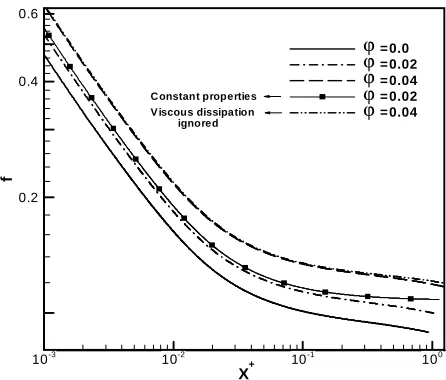
and each cross section at distance x from inlet. As a result of the presence of viscous dissipation term, some of the fluid kinetic energy converts to the thermal energy and the friction factor will reduce slightly. Figure 8 depicts the effect of various parameters on the friction factor distribution along the channel for pure water and Al2O3-water
nanofluid at Re = 750. Adding nanoparticles raises the friction factor to some extent and it means a little more power is needed to pump the nanofluid through the channel rather than the pure fluid. On the other hand, considering variable properties will cause the friction factor to decrease specially at the end of the channel. This is because of the reduction of the viscosity of the fluid with temperature, leading to a less viscous fluid at the end of the channel which has a smaller pressure drop.
Comparing curves in the figure reveals that in all the curves except the case of constant properties the friction factor at the end of the channel decreases gradually as a result of reducing the viscosity of the fluid. From the viscous dissipation point of view, adding this term will increase the temperature of the fluid slightly and accordingly the viscosity of the fluid declines, causing rather smaller pressure drop and friction factor.
2
9
3
.2
2
9
4
2
9
5
295
2
9
5
2
9
6
296 29
6
2
97
297
2
9
7
2
9
8
298
2
9
8
29
9
299
3
0
0
300
3
0
1
3
02
x (m)
y
(m
)
0 0.02 0.04 0.06 0.08 0.1
0 0.0002 0.0004 0.0006
Figure 6. Temperature contours of fluid and solid regions for nanofluid with φ = 0.05 and Re=1250.
293.5
294
295
294
295 296
297
297
298 298
293. 5
294
295 296
297 298
299
x (m)
y
(m
)
0 0.02 0.04 0.06 0.08 0.1 0
5E-05
Figure 7. Temperature contours of pure water (____) and nanofluid with φ = 0.04 (_ _ _) at Re=750.
X
f
10-3 10-2 10-1 100 0.2
0.4 0.6
= 0.0 = 0.02 = 0.04 = 0.02 = 0.04
+ C onstant properties V iscous dissipation
ignored ϕ
ϕ ϕ ϕ ϕ
The cooling performance of a microchannel heat sink can be evaluated in terms of the thermal resistance:
q in T w T
th ′′
−
=( )
θ (20)
where Tw and Tin are the local wall and inlet
temperature and q′′ is the exerted heat flux at the bottom wall. For better demonstration of the results, W/cm2 is used as the unit of heat flux in the equation. The lesser the value of thermal resistance of the channel, the more the heat transfer performance of it.
Figure 9 illustrates the effect of various parameters on thermal resistance of the microchannel for Re=500 and q′′=250000 W/m2. Adding nanoparticles decreases the thermal resistance of the channel and consequently enhances the thermal performance of the channel. Although in the case of ignoring viscous dissipation the improvement is more evident but viscous dissipation weakens the enhancement. Adding nanoparticles raise the viscosity of the nanofluid and hence emphasizes the viscous dissipation effect. It is obvious that viscous dissipation increases the temperature of the fluid, yielding to lower temperature difference between wall and the fluid which can be a reason to increase thermal resistance of the nanofluid. The reduction of temperature of the fluid by adding nanoparticles will be partly recovered by increasing the temperature due to viscous dissipation.
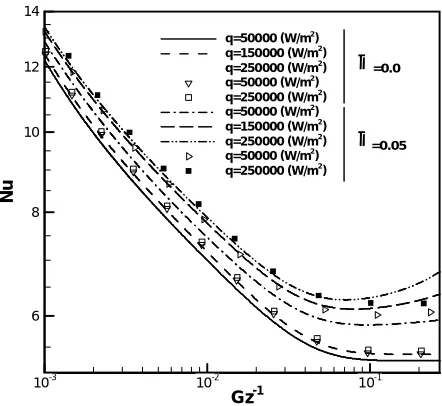
Figure 10 depicts the axial distribution of Nusselt number in the channel for pure water and 5% volume fraction Al2O3-water nanofluid at Re=500
and different applied heat fluxes from 50000 to 250000 W/m2. Filled symbol shows constant properties condition and hollow ones are for the case of ignoring viscous dissipation. Increasing the concentration of the nanofluid will intensify the local Nusselt number and the rate of intensification grows with increasing heat flux. Increasing the exerted heat flux raises the fluid temperature and consequently augments the Nusselt number. Considering variable properties, the temperature rise boosts the thermal conductivity and cause another improvement in Nusselt number.
The effect of variable properties is more pronounced at the end part of the channel, where
temperature rise changes the properties of the fluid. Especially for the nanofluid with 5% volume fraction, it caused steep changes in Nusselt number at the end part. As it is seen in the figure, in the case of constant properties for the 5% volume fraction Al2O3 nanofluid with q′′=250000 W/m
2 x (m)
θ
0 0.02 0.04 0.06 0.08 0.4
0.8 1.2
=0.0 =0.02 =0.04 =0.02 =0.0 =0.04 Constant properties
Viscous dissipation
ignored ϕ
ϕ ϕ ϕ ϕ
th
(c
m
2
oC
/W
)
Figure 9. Effect of viscous dissipation and variable properties on thermal resistance.
Gz
N
u
10-3 10-2 10-1 6
8 10 12 14
q=50000 (W/m2
)
q=150000 (W/m2
)
q=250000 (W/m2
)
q=50000 (W/m2
)
q=250000 (W/m2
)
q=50000 (W/m2
)
q=150000 (W/m2
)
q=250000 (W/m2
)
q=50000 (W/m2
)
q=250000 (W/m2
)
-1
=0.05 =0.0
ϕ ϕ
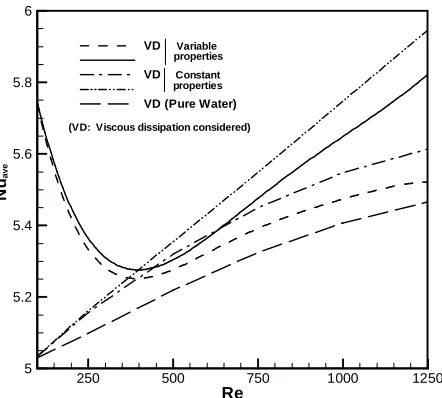
(shown with ■ symbol) the sharp changes at the end part is eliminated. The effect of viscous dissipation is shown in the figure as a reduction in Nusselt number. In the case of q′′=50000 W/m2 for both pure water and the nanofluid, the effect is noticeable but for higher heat fluxes diminishes. Finally, Figure 11 compares the average Nusselt number of the fluid, defined as:
L dx x Nu
Nuave = ∫ ( ) (21)
in the vicinity of the lower wall for different conditions.
The effect of viscous dissipation and variable properties is investigated for pure water and 2% volume fraction Al2O3-water nanofluid. Using
constant properties, as it is expected the average Nusselt number increases with Reynolds number. But taking variable properties effect into consideration there is an irregularity in average Nusselt treatment. In low Reynolds numbers, the fluid moves slower and the fluid region temperature can be more affected by solid regions, this event lead to a higher temperature to the end part of the channel. The thermal conductivity of the nanofluid is more sensitive to temperature than the pure fluid and increases steeper at the end part
of the channel as a result of temperature rise. So there are two factors affecting the average Nusselt number in different manners, the first one is raising the average Nusselt number by increasing the temperature at the end of the channel, and the other, is increasing the average Nusselt number by thinning the boundary layer. The first factor is intensified at lower Reynolds numbers and is weakened at higher Reynolds numbers, while the second one is weak at lower Reynolds numbers and will strengthen at higher Reynolds numbers.
In consequence of the above discussion, in lower Reynolds number the first factor is dominated and the Nusselt number increases because of higher thermal conductivity at the end section of the channel. As the Reynolds number increases, this effect is weakened because of the smaller temperature rise along the channel, so the average Nusselt number decreases. But there is a definite Reynolds number (450 for the case in the figure) beyond which the second factor is dominated and the average Nusselt number increases with increasing the Reynolds number. The moderate changes of thermal conductivity of the pure water with temperature prevent the above mentioned anomalous phenomenon to occur and a regular treatment is seen in the figure.
However, it seems that for nanofluids there is a critical Reynolds number that should be considered for design and optimization purposes and is a function of the channel geometry and nanofluid characteristics. It should be mentioned that the results are severely related to the thermal conductivity and viscosity calculation models used (Equation 12 and 14) and altering them may cause substantial changes to the outcomes of the paper, so more experimental results are needed in this field to capture the real treatment of the nanofluids.
6. CONCLUDING REMARKS
The two dimensional laminar flow and heat transfer of Al2O3-water nanofluid in a
microchannel is solved considering axial conduction in the fluid and solid regions. It was shown that adding nanoparticles will intensify heat transfer characteristics of the fluid but on the other hand will slightly increase shear stress on the
Re
N
u
250 500 750 1000 1250 5
5.2 5.4 5.6 5.8 6
VD
VD
VD (Pure Water)
a
v
e
Variable properties
Constant properties
(VD: Viscous dissipation considered)
Figure 11. Variable properties and viscous dissipation effects on the behavior of average Nusselt number of nanofluid with
walls. The two criteria of Morini [35] and Xu, et al [36] for viscous dissipation considerations have been inspected for the parallel plate flow and it was found that the former give more reasonable results. The numerical results of investigating viscous dissipation and variable properties effect revealed that taking into consideration of this term causes a reduction in Nusselt number and friction factor. For the nanofluid the effect will be intensified and Based on the thermal conductivity and viscosity model used for nanofluids, it was found that there may be a critical Reynolds number below which the average Nusselt number behaves abnormally and could be important for design considerations. Nanofluids flow in microchannel may be a good choice for future cooling devices but the results of the paper shows that more experimental investigation is needed to study the limitations induced by viscous dissipation on the heat transfer enhancement of the nanofluids.
7. NOMENCLATURE
cp specific heat (kJ/kg K)
d diameter (m)
Dh hydraulic diameter (m)
Ec Eckert number
f friction factor
H height
k thermal conductivity (W/m K) M molecular weight (kg/kmole)
p pressure
Pr Prandtl number
Re Reynolds number
T temperature (K)
V velocity vector (m/s)
Greek
φ particle volume fraction
µ dynamic viscosity (Pa.s)
ρ density (kg/m3)
τ shear stress (N/m2)
ψ sphericity
Subscripts
ave average
b bulk
d dispersion
f base fluid
in inlet
nf nanofluid
out outlet
p nanoparticles
ref reference
s solid region
SL lower solid region SU upper solid region
8. REFERENCES
1. Chein, R. and Chen, J., “Numerical Study of the Inlet/outlet Arrangement Effect on Microchannel Heat Sink Performance”, International Journal of Thermal Sciences, Vol. 48, (2009), 1627–1638.
2. Kandlikar, S.G. and Grande, W.J., “Evolution of Microchannel Flow Passages–Thermohydraulic Performance and Fabrication Technology”, Heat
Transfer Engineering, Vol. 24, (2003), 3–17.
3. Tuckerman, D.B. and Pease, R.F.W., “High Performance Heat Sink for VLSI”, IEEE Electron Device Letters, Vol. 2, (1981), 126–129.
4. Hetsroni, G., Mosyak, A., Pogrebnyak, E. and Yarin, L. P., “Heat Transfer in Micro-Channels: Comparison of Experiments with Theory and Numerical Results”,
International Journal of Heat and Mass Transfer, Vol. 48, (2005), 5580–5601.
5. Lee, P.S. and Garimella, S.V., “Thermally Developing Flow and Heat Transfer in Rectangular Microchannels of Different Aspect Ratios”, International Journal of Heat and Mass Transfer, Vol. 49, (2006), 3060-3067. 6. Li, Z., He, Y.L., Tang, G.H. and Tao, W.Q.,
“Experimental and Numerical Studies of Liquid Flow and Heat Transfer in Microtubes”, International Journal of Heat and Mass Transfer, Vol. 50, (2007), 3447–3460.
7. Gamrat, G., Favre-Marinet, M. and Le Person, S., “Modelling of Roughness Effects on Heat Transfer in Thermally Fully-Developed Laminar Flows Through Microchannels”, International Journal of Thermal Sciences, Vol. 48, (2009), 2203-2214.
8. He, W. and Tao, Q., “Numerical Study of Laminar Heat Transfer and Pressure Drop Characteristics in a Water-Cooled Minichannel Heat Sink”, Applied Thermal Engineering, Vol. 29, (2009), 64–74.
9. Tso, C.P. and Mahulikar, S.P., “Use of the Brinkman Number for Single Phase Forced Convective Heat Transfer in Microchannels”, International Journal of Heat and Mass Transfer, Vol. 41, (1998), 1759–1769. 10. Tso, C.P. and Mahulikar, S.P., “The Role of the
11. Tso, C.P. and Mahulikar, S.P., “Experimental Verification of the Role of Brinkman Number in Microchannels using Local Parameters”, International Journal of Heat and Mass Transfer, Vol. 43, (2000), 1837-1849.
12. Judy, J., Maynes, D. and Webb, B.W., “Characterization of Frictional Pressure Drop for Liquid Flows Through Microchannels”, International Journal of Heat and Mass Transfer, Vol. 45, (2002), 3477-3489.
13. Koo, J. and Kleinstreuer, C., “Liquid Flow in Microchannels: Experimental Observations and Computational Analysis of Microfluidics Effect”,
Journal of Micromechanics and Microengineering, Vol. 13, (2003), 568-579.
14. Koo, J. and Kleinstreuer, C., “Viscous Dissipation Effects in Microtubes and Microchannels”,
International Journal of Heat and Mass Transfer, Vol. 47, (2004), 3159–3169.
15. Del Giudice, S., Nonino, C. and Savino, S., “Effects of Viscous Dissipation and Temperature Dependent Viscosity in Thermally and Simultaneously Developing Laminar Flows in Microchannels”, International Journal of Heat and Fluid Flow, Vol. 28, (2007), 15– 27.
16. Keblinski, P., Eastman, J.A. and Cahil, D.G., “Nanofluids for Thermal Transport”, Materials Today, Vol. 8, No. 6, (2005), 36-44.
17. Masuda, H., Ebata, A., Teramae, K. and Hishinuma, N., “Alteration of Thermal Conductivity and Viscosity of Liquid by Dispersing Ultra-Fine Particles”, Netsu Bussei, Vol. 7, No. 4, (1993), 227–233.
18. Choi, S.U.S., “Enhancing Thermal Conductivity of Fluids with Nanoparticles, in: Developments and Application of Non-Newtonian Flows”, ASME: FED, Vol. 231/MD- 66, (1995), 99–105.
19. Koo, J. and Kleinstreuer, C., “Laminar Nanofluid Flow in Microheat-Sinks”, International Journal of Heat and Mass Transfer, Vol. 48, (2005), 2652–2661. 20. Jang, S.P. and Choi, S.U.S., “Cooling Performance of a
Microchannel Heat Sink with Nanofluids”, Applied Thermal Engineering, Vol. 26, (2006), 2457–2463. 21. Jang, S.P. and Choi, S.U.S., “Role of Brownian Motion
in the Enhanced Thermal Conductivity of Nanofluids”,
Applied Physics Letters, Vol. 84, (2004), 4316–4318. 22. Bhattacharya, P., Samanta, A.N. and Chakraborty, S.,
“Numerical Study of Conjugate Heat Transfer in Rectangular Microchannel Heat Sink with Al2O3/H2O
Nanofluid”, Heat and Mass Transfer, Vol. 45, (2009), 1323–1333.
23. Ho, C.J., Wei, L.C. and Li, Z.W., “An Experimental InvestigationofForced Convective Cooling Performance of a Microchannel Heat Sink with Al2O3/Water
Nanofluid”, Applied Thermal Engineering, Vol. 30, (2010), 96-103.
24. Hung, Y.M., “Analytical Study on Forced Convection of Nanofluids with Viscous Dissipation in Microchannels”, Heat Transfer Engineering, Vol. 31, No. 14, (2010), 1184–1192.
25. Cole, K.D. and Cetin, B., “The Effect of Axial Conduction on Heat Transfer in a Liquid Microchannel Flow”, International Journal of Heat and Mass Transfer, Vol. 54, (2011), 2542–2549.
26. Lelea, D. and Nisulescu, C., ‘The Micro-Tube Heat Transfer and Fluid Flow of Water Based Al2O3
Nanofluid with Viscous Dissipation”, International Communications in Heat and Mass Transfer, Vol. 38: 6 (2011), 704-710. Doi: 10.1016/ j.icheatmasstransfer. 2011.04.002.
27. Pollard, A. and Siu, A.L.W., “The Calculation of Some Laminar Flows using Various Discretization Schemes”,
Computer Methods in Applied Mechanics and Engineering, Vol. 35, (1982), 293-313.
28. Xuan, Y. and Roetzel, W., “Conceptions for Heat Transfer Correlation of Nanofluids”, International Journal of Heat and Mass Transfer, Vol. 43, (2000), 3701–3707.
29. Corcione, M., “Rayleigh-Bénard Convection Heat Transfer in Nanoparticle Suspensions”, International Journal of Heat and Fluid Flow, (2010), Doi:10.1016/ j.ijheatfluidflow.2010.08.004
30. Chon, C.H., Kihm, K.D., Lee, S.P. and Choi, S.U.S., “Empirical Correlation Finding the Role of Temperature and Particle Size for Nanofluid (Al2O3) Thermal
Conductivity Enhancement”, Applied Physics Letters, Vol. 87, No. 15, (2005), 153107–153110.
31. Mintsa, H.A., Roy, G., Nguyen, C.T. and Doucet, D., “New Temperature Dependent Thermal Conductivity Data for Water-Based Nanofluids”, International Journal of Thermal Sciences, Vol. 48, (2009), 363– 371.
32. Wakao, N. and Kaguei, S., “Heat and Mass Transfer in Packed Beds”, Gordon and Breach Science Publishers, New York, U.S.A., (1982), 175–205.
33. Shah, R.K. and London, A.L., “Laminar Flow Forced Convection in Ducts”, Academic Press, New York, (1978).
34. Mokrani, O., Bourouga, B., Castelain, C. and Peerhossaini, H, “Fluid Flow and Convective Heat Transfer in Flat Microchannels”, International Journal of Heat and Mass Transfer, Vol. 52, (2009), 1337– 1352.
35. Morini, G.L., “Viscous Heating in Liquid Flows in Micro- Channels”, International Journal of Heat and Mass Transfer, Vol. 48, (2005), 3637–3647.