Vol.8 (2018) No. 5
ISSN: 2088-5334
Implementing a Secure Key Exchange Protocol for OpenSSL
Janaka Alawatugoda
#1, Seralathan Vivekaanathan
#, Nishen Peiris
#, Chamitha Wickramasinghe
#,
Chuah Chai Wen
* #Department of Computer Engineering, Faculty of Engineering, University of Peradeniya, Sri Lanka E-mail: [email protected]
*
Information Security Interest Group, Faculty Computer Science and Information Technology University Tun Hussein Onn Malaysia, Malaysia
E-mail: [email protected]
Abstract— Security models have been developed over time to examine the security of two-party authenticated key exchange protocols. In 2007, a reasonably strong security model for key exchange protocols has been proposed, namely extended Canetti-Krawczyk model (eCK model), addressing wide range of real-world attack scenarios. They constructed a protocol called NAXOS, that is proven secure in the eCK model. In order to satisfy the eCK security, NAXOS protocol uses a hash function to combine the ephemeral key with the long-term secret key, which is often called as “NAXOS trick”. However, for the NAXOS trick based protocols, the way of leakage modelled in the eCK model leads to an unnatural assumption of leak-free computation of the hash function. In 2015, Alawatugoda, Stebila and Boyd presented a secure and NAXOS trick key exchange protocol, namely protocol P1. In this work, we implement the protocol P1 to be used with the widely-used OpenSSL cryptographic library. OpenSSL implementations are widely used with the real-world security protocol suites, particularly Security Socket Layer and Transport Layer Security. According to our knowledge, this is the first implementation of an eCK-secure protocol for the OpenSSL library. Thus, we open up the direction to use the recent advancements of cryptography for real-world Internet communication.
Keywords— authenticated key exchange; eCK mode; OpenSSL; secure key; security models.
I. INTRODUCTION
In symmetric key cryptography (SKC), a single key is used for encryption and decryption, which is often called as the secret key. Therefore, prior to message communication, both the sender and the receiver need to share the secret key, in such a way that no eavesdropper can learn the secret key. Hence, a trusted channel is needed to share the secret key. Historically, this trusted channel was accomplished by means of trusted couriers, diplomatic bags etc. This mechanism is undesirable, because of the necessity of a third party, and the entire confidentiality relies on the trustworthiness of this third party. With the ground breaking work of Diffie and Hellman [1] on public-key cryptography (PKC) and key distribution, cryptographers realized a more sophisticated solution for securely exchanging the secret key. Thus, the idea of public-key cryptography eliminates the need of a trusted third party to create a secure channel.
A. Diffie-Hellman Protocol
A key exchange protocol defines a method of securely exchanging secret session keys over a public channel. Diffie
and Hellman, researchers at Stanford University, presented about public-key cryptography and key distribution in their ground breaking paper, “New Directions in Cryptography” [1]. The key exchange primitive presented in their paper is widely known as the Diffie-Hellman (DH) key exchange primitive and is considered to be the earliest practical authenticated key exchange protocol.
We simply explain the Diffie-Hellman protocol as follows: Users A and B negotiate on a group G of prime order q and a generator g. The values G, g, q are released as public values. In the protocol execution, A chooses a random
element a ∈ G, computes A ← ga and sends it to B. Upon
receiving A, B chooses a random element b ∈ G, computes B
← gb and sends it to A. Finally, A computes K ← Ba = (gb)a,
and B computes K ← Ab = (ga)b. Thus, both A and B
compute the same value K ∈ G.
An eavesdropping attacker observes the communication
above may see A and B values. Given A = ga, B = gb
computing K = gab is “computational Diffie-Hellman
problem (CDH)”. There is no known efficient algorithm,
which is capable of computing K = gab given that A = ga, B = gb.
Several key exchange protocols are designed on top of the Diffie-Hellman protocol [2]–[7]. The Diffie-Hellman protocol is applied to many security protocol suits including Security Sockets Layer (SSL), Transport Layer Security (TLS), Secure Shell (SSH), and IP Sec.
B. NAXOS Trick and eCK-secure Key Exchange
Generally, a security model is a scheme that is designed to enforce security policies. Extended Canetti-Krawczyk (eCK) security model [8] is considered as a widely used security model for key exchange protocols, as it addresses wide range of real-world attack scenarios. We discuss about the security models in detail in Section II.
The motivation of constructing the eCK model was to make the adversary obtain both the ephemeral and long-term secret keys of a party to compute the session key of that particular communication. In the NAXOS protocol [8], the session key is computed using the so-called NAXOS trick. In this trick, the “psuedo” ephemeral key psk is calculated as a hash value of the ephemeral key esk and the long-term secret key lsk, such that psk = H(esk, lsk). This psuedo ephemeral key is not stored. Hence, the adversary have to get both the lsk and esk to calculate the psuedo ephemeral key psk. Following the NAXOS protocol, few NAXOS trick based authenticated key exchange protocols are presented [4]. However, in NAXOS trick based protocols, the leakage of ephemeral key modelled in the eCK model seems not natural, as the eCK model leaks esk, while psk remains safe. In a work of Alawatugoda et al. [9], a NAXOS trick free eCK-secure AKE protocol is presented, namely the protocol P1.
C. OpenSSL Cryptographic Library
OpenSSL is an open source project which provides a commercial grade toolkit for the TLS and SSL protocol suits. It is a general purpose cryptographic library. This cryptographic library is implemented in C programing language, but it has wrappers in Java and some other languages as well. There are three variants of
Diffie-Hellman primitive used in the OpenSSL cryptographic
library.
• Anonymous DH: Diffie-Hellman primitive is used
without authentication.
• Fixed DH: Embeds the server's public parameter in the
certificate.
• Ephemeral DH: Uses one-time public keys. The
authenticity is verified using signatures. Since the public keys are one-time values, compromising the long-term signing keys does not reveal the old session keys. Therefore, this protocol provides perfect forward secrecy.
According to statistics from various cryptography related sources, a considerable large number of websites (more than
4,545,900) rely on the security measures of the OpenSSL
cryptographic library. Apparently, OpenSSL cryptographic
library has a steady usage as well. One important factor to highlight here is that the highest number of websites among them, fall under the vertical of business related websites.
Therefore, it is obvious that the OpenSSL cryptographic
library has a significant place in today's Internet.
D. Our Contribution
In this work we implement the eCK-secure protocol P1 of Alawatugoda et al. [9] to be used with the widely using
cryptographic library, the OpenSSL library. The OpenSSL
implementations are widely used for the real-world security protocol suites, particularly Security Socket Layer protocol and Transport Layer Security protocol. As per our knowledge, this is the first implementation of an eCK-securet key exchange protocol to be used for real-world communications. Thus, we open up the direction to use the recent advancements of cryptography for real-world Internet communications.
II. MATERIAL AND METHOD
In this section, key exchange security models and extended canetti-krawczyk models are presented.
A. Key Exchange Security Models
Researchers keep on constructing authenticated key exchange protocols, strengthening them against various attacks and vulnerabilities. The continuous growth of key exchange protocols created a necessity of a formal methodology to analyze their security. Therefore, in order to fulfill this necessity, computer scientists have introduced key exchange security models.
Security models are designed in a way that they reflect present real-world attacks, and of course potential attacks that can exist in future.
Components of a security model:
• Definition: abstraction of the algorithm.
• Powers of the Adversary: Queries which the
adversary is capable of performing to reveal information of protocol instances.
• Security game (challenge): Order that the adversary
uses the queries.
• Security definition: Condition to the adversary to
win the challenge.
There is a set of queries which an adversary is allowed to use (powers of the adversary). The queries leak various secret values to the adversary. A protocol to be secure within the security model, the adversary's advantage of identifying the real session key of the target session from a random value (from the same distribution) has to be negligible.
Researchers aim to construct security models which are capable of modeling maximum of possible known attacks mentioned below:
• Implicit Key Authentication: assures that nobody
other than the protocol participants calculates the session key. Such protocols are known as authenticated key exchange protocols.
• Key Confirmation: assures that all the other protocol
participants compute the session key.
• Unknown Key Share (UKS) Security: no party P
shares a session key with a party Q, believing that it is shared with some other party R.
• Key Compromise Impersonation (KCI) Security:
having the long-term secret key of a party P does not
make the adversary capable of impersonating other parties to P.
• Forward Secrecy: an adversary who knows the
long-term secret keys of two parties cannot compute the past session keys between those two parties.
Bellare-Rogaway (BR) [10], [11], Canetti-Krawczyk (CK) [12] and extended Canetti-Krawczyk (eCK) [8] are few of the widely used key exchange security models. Table I shows a comparison between the above three security models with respect to security features addressed by the security models.
TABLE I[9]
SECURITY FEATURES SUPPORTED BY BR, CK AND ECK SECURITY MODELS
Security Features BR CK eCK
Implicit key authentication yes Yes yes
Key confirmation yes Yes yes
UKS yes Yes yes
KCI no No yes
Forward secrecy (FS) no Yes Weak-FS
B. eCK Model
We now look at the eCK model of LaMacchia et al. [8]. Wcall principal to a party which involves in the protocol run. Each party has a pair of long-term public/secret keys, which are generated before the protocol run. Each instance of the protocol between any two principals is defined as a session.
We model a session belongs to the principal as an oracle.
∏sU,V is an oracle which represents the sth protocol instance
between owner principal U and a partner principal V. When
∏sU,V computes a session key it come to the accepted state.
Any time a session can terminate without computing a session key. The information of whether acceptance or not publicly available.
1) Partnering: Legitimate protocol execution between principals V and U makes two partner sessions owned by V and U respectively. In order to define the partnership, we have used the notation of a session identifier (SID). The SID is the concatenation of messages exchanged between two
intended principals with their identities. The SID of ∏sU,V is
denoted by SIDsU,V = (comm1 || … || commn). Two oracles
∏sU,V and ∏s’V,U are partners if:
•∏sU,V and ∏s’V,U compute session keys (both oracles
come to accepted state) SIDsU,V = SIDs’V,U (here s = s’).
•∏sU,V and ∏s’V,U agree on the initiator of the protocol.
2) Powers of the Adversary: The adversary
A
is an efficient algorithm that adaptively asks below queries.• Send (U,V,s,m): This query sends a message m to
the oracle ∏sU,V as sending from the oracle ∏sV,U.
∏sU,V will send to
A
the next message according tothe protocol conversation. This query is also used to initiate a new protocol instance.
• Session-Key reveal (U,V,s): If an oracle ∏sU,V hold
a session key,
A
gets to know it.• Ephemeral-Key reveal (U,V,s): Reveals the
ephemeral keys of the oracle ∏sU,V to
A
.• Corrupt (U):
A
get all the long-term secrets of U.This query captures the UKS attacks, KCI attacks and forward secrecy.
• Test (U,s): When
A
asks this query, the oracle ∏sU,Vchooses a random bit b ∈ {0,1} and if b = 1, the real
session key is revealed to
A
, otherwise returns arandom string.
3) Freshness: An oracle is fresh iff:
• The particular oracle or its partner (if exists), it has
not been asked to reveal the session key.
• If partner exists, none of the following have been
asked:
a. Ephemeral-Key reveal (U,V,s) and Corrupt (U).
b. Ephemeral-Key reveal (V,U,s’) and Corrupt (V).
• If partner does not exist, none of the following have
been asked:
a. Corrupt (V).
b. Ephemeral-Key reveal (U,V,s) and Corrupt (U).
4) Challenge
• Stage 1:
A
is capable of asking any of Session-Keyreveal, Send, Corrupt and Ephemeral-Key reveal queries at will.
• Stage 2:
A
asks a Test query to any oracle.• Stage 3:
A
continues asking queries again withoutviolating the test session’s freshness.
• Stage 4:
A
outputs its guess on the value b (lets nameit as b`).
A
wins if the value b` = b.5) Security Statement
SuccA be the instance that the
A
wins the eCK challenge.A protocol (let’s say π) is secure in eCK model if there is no efficient A which is capable of winning the eCK challenge with non-negligible advantage.
C. eCK-secure and NAXOS Trick Free AKE Protocol The protocol P1 of Alawatugoda et al. [9] is proven-secure in the eCK model.
Let G be a group of prime order q and generator g. After exchanging the public values both principals compute shared
secrets (Z1, Z2, Z3 and Z4). Then the session key is computed
as a random oracle combination of Z1, Z2, Z3 and Z4, which
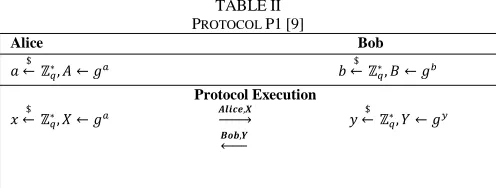
can be replaced by a hash function in the implementation. Table II shows the protocol diagram of protocol P1.
In the protocol execution, for each party, the PI protocol
needs 5 exponentiations and one random oracle
computation, whereas the NAXOS protocol needs 4 exponentiations and 3 random oracle computations.
TABLEII PROTOCOL P1[9]
Alice Bob
$
← ℤ∗, ← ← ℤ$ ∗, ←
Protocol Execution
$
← ℤ∗, ← ⎯⎯⎯, ← ℤ$ ∗, ←
"⎯⎯# ,!
$%← , $&← ' $%(← , $&(←
$)← , $*← ' $)(← , $*(←
+ ← ,- $%, $&, $), $*, ./01, , 2 , 3 +
← ,- $%(, $&(, $)(, $*(, ./01, , 2 , 3 K is the session key
1) Technical Preliminaries for security Proof:
Definition 1 (Decision Diffie-Hellman (DDH) Problem)
Given (ga, gb, gc) for a, b ← ℤ$ , the DDH problem is to
distinguish whether c = ab or not.
Definition 2 (Gap Diffie-Hellman (GDH) Problem)
Given (ga, gb) for a, b ←$ ℤ , the GDH problem is to find
gab accessing an oracle that solves the DDH problem.
2) Security of the Protocol P1:
If H is a random oracle function and the gap Diffie--Hellman problem is hard in the group G, then protocol P1 is secure in the eCK model.
III. RESULT AND DISCUSSION
A. Implementation of Protocol P1
The implementation of the Diffie-Hellman protocol is
found under the directory crypto in the OpenSSL
cryptographic library. While implementing the protocol P1, we have kept the original Diffie-Hellman key exchange protocol implementation intact. Our new implementation has been done as a separate key exchange protocol for the
OpenSSL cryptographic library. We have provided our
implementations in check.c, gen.c, key.c, and p1.h files.
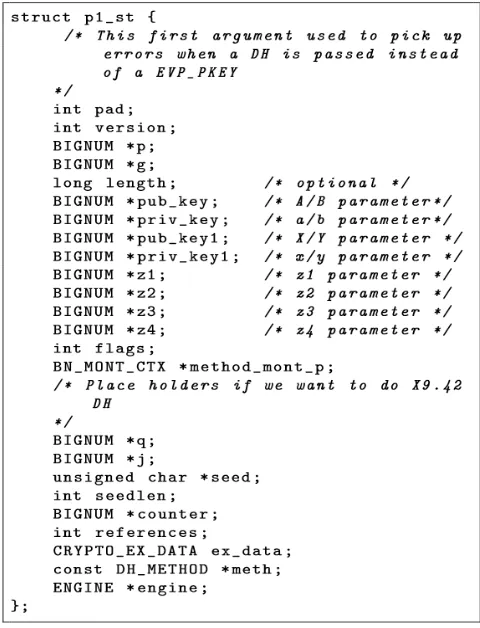
Fig. 1 P1.h: Structure used in the execution of protocol P1.
The file p1.h defines the structure which is used to store all the inputs and outputs of computation during the protocol execution (Fig. 1)
Fig. 2 check.c.
check.c (Fig. 2) contains two functions that check all the parameters calculated during the protocol execution including p, q and confirm that they are likely enough to be valid. If any of the parameters are invalid, a flag is set indicating the reason for being invalid. The error code values are updated if any problem is found.
Fig. 3 gen.c.
gen.c (Fig. 3) contains a function that generates
parameters p and q. The function
DH_generate_parameters_ex generates Diffie-Hellman
parameters, and stores them in the structure defined in p1.h.
The pseudo-random number generator must be seeded prior to calling the function DH_generate_parameters_ex.
Fig. 4 key.c.
key.c (Fig. 4) computes the shared secret keys (Z1, Z2, Z3,
Z4), from the long-term or ephemeral private key (a/b or x/y
respectively) in *dh and the other party's long-term or ephemeral public value (A/B or X/Y respectively) in
*pub_key, then stores it in *key. Finally, SHA-256 is used
to calculate the session key using the above-computed Z1, Z2,
Z3, Z4 values.
B. Deploying the Protocol P1 in a client/ server environment
We establish an OpenSSL client connection with the
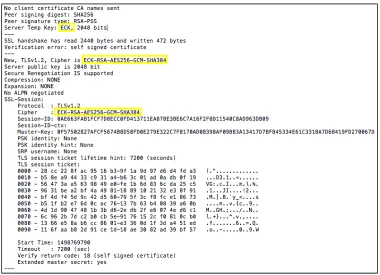
server running on localhost port 44330, using the ECK cipher suite, which is created by us. The ECK cipher suite uses the protocol P1 implementation for key exchange. Fig. 5 shows the server certificate (the cipher suite ECK is highlighted).
Fig. 5 Server certificate (the cipher suite ECK is highlighted)
Following command is used to run the client:
$openssl s_client -connect localhost:44330 -cipher ECK
Fig. 6 Client/ Server connection
Then the following command is used to run the server:
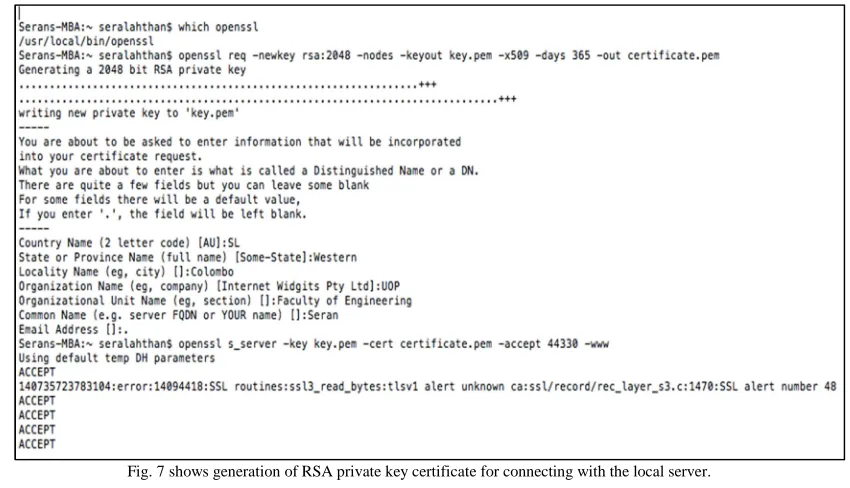
$openssl s_server -key key.pem -cert certificate.pem -accept 44330 -www
Fig. 7 shows generation of RSA private key certificate for connecting with the local server.
IV.CONCLUSIONS
In this work we implement the protocol P1 (eCK-secure and NAXOS trick free authenticated key exchange protocol)
to be used with the widely-used OpenSSL cryptographic
library. OpenSSL implementations are widely used with the
real-world security protocol suites, such as Security Socket Layer and Transport Layer Security. According to our
understanding, this is the first OpenSSL implementation of
an eCK-secure key exchange protocol. Thus, our work opens up the direction to use the recent advancements of cryptography for betterment of the real-world Internet communication.
As a future work, we aim to implement a leakage-resilient
AKE protocols [9], [13]-[15] for OpenSSL, which is
resilient to wide range of side-channel attacks, in addition to eCK security.
ACKNOWLEDGMENT
This research is supported by Faculty Computer Science, UTHM, Malaysia and Information Technology (FSKTM), Research Management Centre (RMC), H082 Tier 1/2018 and Gates IT Solution Sdn. Bhd. under its publication scheme.
REFERENCES
[1] W. Diffie and M. Hellman, New Directions in Cryptography, IEEE Transactions on Information Theory 20(6), pp 644-654, 1976.
[2] V. Boyko, P. MacKenzie, and S. Patel, Provably Secure Password-authenticated Key Exchange using Diffie-Hellman, EUROCRYPT 2000, pp 156 – 171, Springer, 2000.
[3] W. Diffie, P. C. Van Oorschot, and M. J. Wiener, Authentication and Authenticated Key Exchanges, Des. Codes Cryptography 2(2), pp107 – 125, 1992.
[4] A. Fujioka, K. Suzuki, and B. Ustaoglu, Utilizing Postponed Ephemeral and Pseudo-Static Keys in Tripartite and Identity-based Key Agreement Protocols, IACR Cryptology ePrint Archive, 2009:423, 2009.
[5] D. P. Jablon, Strong Password-only Authenticated Key Exchange, SIGCOMM Computer Communication Revise 25(5), pp 5 – 26, 1996. [6] H. Krawczyk, HMQV: A High-performance Secure Diffie-Hellman
Protocol, CRYPTO 2005, pp 546 – 566, Springer, 2005.
[7] L. Law, A. Menezes, M. Qu, J. Solinas, and S. Vanstone, An Efficient Protocol for Authenticated Key Agreement, Des. Codes and Cryptography 28(2), pp 119—134, Springer, 1998.
[8] B. A. LaMacchia, K. E. Lauter, and A. Mityagin, Stronger Security of Authenticated Key Exchange, Provsec 2007, pp 1 – 16, Springer, 2007.
[9] J. Alawatugoda, D. Stebila, and C. Boyd, Continuous After-the-fact Leakage-resilient eCK-secure Key Exchange, IMA Cryptography and Coding 2015, pp. 277 – 294, Springer, 2015.
[10] M. Bellare and P. Rogaway, Entity Authentication and Key Distribution, CRYPTO 1993, pp 232 – 249, Springer, 1993. [11] M. Bellare and P. Rogaway, Provably Secure Session Key
Distribution – The Three Party Case, STOC 1995, pp 57 – 66, 1995. [12] R. Canetti and H. Krawczyk, Analysis of Key-exchange Protocols
and Their Use for Building Secure Channels, EUROCRYPT 2001, pp 453 – 474, Springer, 2001.
[13] J. Alawatugoda, Generic construction of an eCK-secure key exchange protocol in the standard model, International Journal of Information Security 16(5), pp 541 – 557, Springer, 2017
[14] J. Alawatugoda, On the leakage-resilient key exchange, Journal of Mathematical Cryptology 11(4), pp 541 – 557, Springer, 2017 [15] S. Chakraborty, J. Alawatugoda and C. Pandu Rangan,
Leakage-resilient non-interactive key exchange in the continuous-memory leakage setting, Provsec 2017, pp167—187, Springer, 2017