*Corresponding author e-mail: [email protected] DOI: 10.21608/EJSS.2019.15281.1291
Received 26/7/2019; Accepted 23/9/2019
Introduction Peanut (Arachis hypogaea L.) is one of the most important summer oil seed and protein crop, where it’s known as king of oil seed crops (Hammons, 1982). Peanut is considered as the 13th food crop,
4th oil seed crop and the 3rd vegetable protein crop
(Taru et al., 2008). Economic importance of peanut is mainly due to its short stay duration in soil, which makes better economic returns compared to other crops. Peanuts are as popular as they are healthy. It is an excellent plant-based source of oil, protein, vitamins, minerals and plant compounds. Peanut seeds have a high nutritional value,contain a high percentage of oil ranging from 40-50%, 25-30% protein, 20% carbohydrates and 5% ash according
to cultivar variety and agricultural treatments. Sothat it is used in human nutrition, and its leaves are used as feed for animals (Fageria et al.,1997). Therefore, this crop has been given great attention from Government as well as from the scientific institutes, particularly due to its suitability for grown in the new reclaimed sandy areas.
Beside genetic factors, yield potential of peanut depends on some other limiting factors such as soil, climatic conditions, pests and disease control nutrient availability and fertilization. Sandy soils are widespread in Egypt covering about 90 % of Egyptian soils. They are characterized by low fertility and poor physical condition. Its content of available nutrient and organic carbon are very
T
HERE are many factors playing major role in use efficiency of phosphatic fertilizers, which varies from soil to another. Therefore, this study aims mainly to evaluate the effect of some trails, i.e. compost additives and P application times in different methods in sandy soil as well as its effect on growth, productivity and quality of peanut (Arachis hypogaea L.). This study was carried out as field experiment in sandy soil at South Al-Tahrir Sector, Al-Behaira Governorate, Egypt during two successive growing summer seasons. The experiment was laid out in a split plot design with three replicates. Four rates of compost i.e. (C1) 0, (C2) 4.76 (C3) 9.52 and (C4) 14.28 ton ha-1 were arranged in the main plots, while the four treatments of phosphorus were randomly distributed in the sub plots.With all the studied treatments of compost and P, the studied growth parameters, i.e. plant height (cm), number of branches per plant, and dry matter weights of straw and leaves were higher in the second growth season than those of first one. Data obtained from our experiments showed that growth parameters increased significantly with the increasing rates of compost application as well as with P applications in three doses (P4). Foliar application of P at 70-80 days of planting (P3) resulted in more increases in the determined growth parameters than those found with other treatments. Similar effect was found with peanut yields of pods and seeds and seeds contents of N, P and K as well as its content of protein and oil.Keywords: Compost, Phosphorus, Sandy soil, Peanut
Effect of Compost Additives and Application Time of Phosphorus
in Different Methods on Growth, Productivity and Quality of
Peanutin Sandy Soils
I. A. Hammouda1, A. M. Elbaalawy2* and M. A. El-Feishy1
1Soils, Water and Environment Research Institute, Agriculture Research Center, Giza,
Egypt
2Department of Soil Science, Faculty of Agriculture, Menoufia University, Egypt
Egyptian Journal of Soil Science
low. Organic manure serves as a major source for improving various fractions of soil organic matter and subsequently soil fertility (AbouHussien et al., 2017 and 2019).
Phosphorus is the second major plant fertilizer and non-renewable source for higher crop yield (El-Meselawe, 2014).Phosphorus element is an essential nutrient for crop growth and high yield with good quality. In this respect, Nasr-Alla et al. (1998) found that increasing rate of P and K addition as single or mixed fertilizer resulted in an increase of the number of branches per plant, number of pods perplant and pod yield. In addition, El-Far and Ramadan, (2000) indicated that application of 46.6 kg P2O5/fed. and36 kg K2O/fed. presented the highest effect on yield. Similarly, Ali and Mowafy (2003) reported that phosphorus fertilizer addition significantly increased seed yield and all its attributes. Also, El-Habbasha et al. (2005) found that increasing rate of phosphorus application increased leaves and stem weight per plant, number of pods and seeds per plant, weight of pods and seeds per plant, weight of 100 seed, seed yield, oil percentage, seed contents of N, P and K, protein content and yield.
The soil of the south Al-Tahrir sector like the sandy texture soils are characterize by very low organic matter, low water holding capacity, high nutrient leaching losses and occurrence of phosphorus deficiency in semiarid regions (El-Shouny, 2011). Phosphorus deficiency is a common feature in many climatic regions,
particularly in sandy soil and it causes severe decreases in yield and quality of peanut.
The primary objective of the present study was to study the effect of organic manure (compost) application individually and in combination with phosphorus application in soil and foliar spraying at different growth periods on vegetative growth, yield and yield attributes of peanut plant grown in sandy soil of Egypt.
Material and Methods Two field experiments were carried out in sandy soil at South Al-Tahrir Sector, Al-Behaira Governorate, Egypt (30° 39′ 37″ N, 30° 37′ 01″ E) during the two summer seasons of 2017 and 2018 to evaluate the response of peanut plants (Arachis
hypogaea L.) variety Giza 6 to P fertilizer applied in
soil and foliar spraying at different growth timesin sandy soil prepared with compost as well as their effect on plant growth, seed quality and yield.
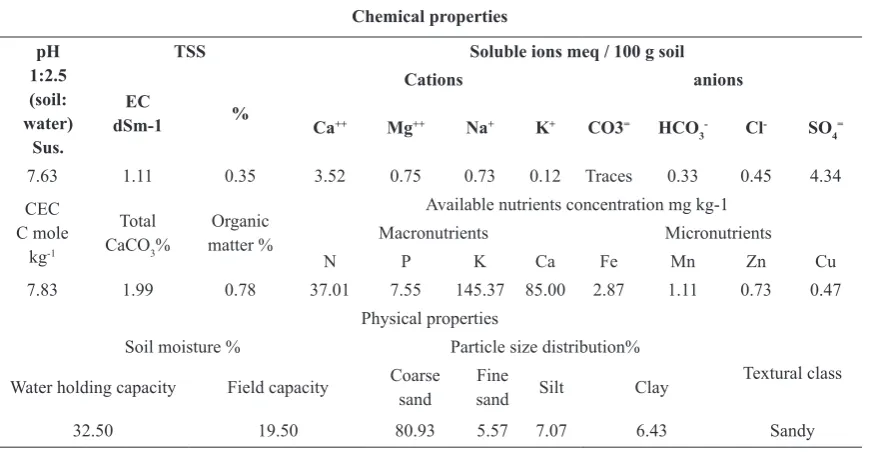
Surface soil sample (0-30 cm) of the experimental soil was taken before planting and analyzed for some physical and chemical properties and its content of available N, P and K according to the methods described by Klute (1986) and Cottenie et al. (1982). The obtained data are listed in Table 1.
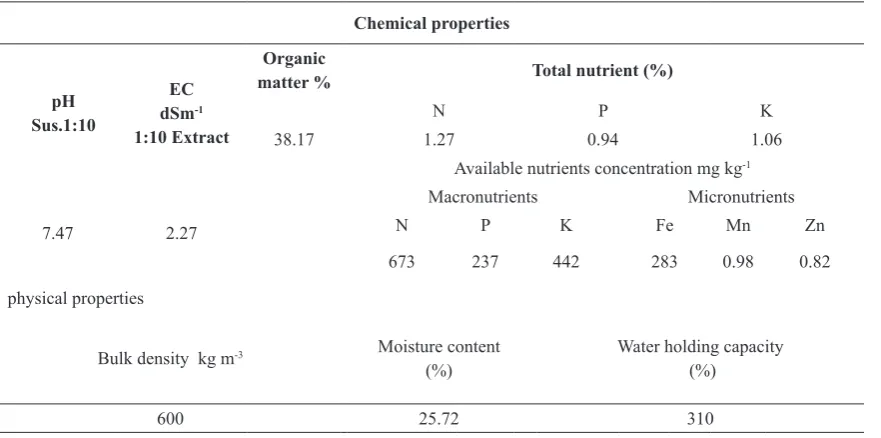
The used compost was analyzed for some physical and chemical properties and its content of some essential plant nutrients according to the methods described by Page et al. (1982) and the obtained data are recorded in Table 2.
TABLE 1. Some physical and chemical properties of the studied soil Chemical properties pH
1:2.5 (soil: water)
Sus.
TSS Soluble ions meq / 100 g soil
EC
dSm-1 %
Cations anions
Ca++ Mg++ Na+ K+ CO3= HCO
3- Cl- SO4=
7.63 1.11 0.35 3.52 0.75 0.73 0.12 Traces 0.33 0.45 4.34
CEC C mole
kg-1
Total CaCO3%
Organic matter %
Available nutrients concentration mg kg-1
Macronutrients Micronutrients
N P K Ca Fe Mn Zn Cu
7.83 1.99 0.78 37.01 7.55 145.37 85.00 2.87 1.11 0.73 0.47
Physical properties
Soil moisture % Particle size distribution%
Textural class Water holding capacity Field capacity Coarse
sand
Fine
sand Silt Clay
Before planting, peanut seeds were inoculated with the specific rhizobium (Rhizobium radiobactersp strain) using gum media. The inoculant was prepared by the Soil Microbilology Dept., Soil, Water and Environoment Res. Inst., Agricultural Research Center (ARC), Egypt. Seeds of peanut were sown in the first week of May in the two growing seasons. Also, before sowing the soil was preparedusing agricultural gypsum (CaSO4.2H2O) at a rate of 1190 kg/ha. Potassium sulphate (41.5% K) at a rate of 119 kg/ha was applied in two equal portions. The first half was added at sowing and the second one was added after 30 days. Nitrogen fertilizer was added at a rate of 142.8 kg N/ha, as ammonium sulfate (20.6%N) in six equal doses. The first dose was added at sowing and other five doses were added after 15, 22, 30, 40, 50 and 60 days of sowing, respectively. A mixture of some essential micronutrient in EDTA from containing 12% Fe, 12% Mn, 13% Zn and 13% Cu /liter was added as foliar application at a rate of 20.5l /ha in two equal doses after 30 and 50 days of sowing. The normal farming practices for peanut were applied as recommended by Egyptian Ministry of Agriculture and Land Reclamation for this district. Sprinkler irrigation was applied, where the irrigation was carried out according to plant requirements and climatic conditions.
The experiment was laid out in a split plot design with three replicates and the plot (experimental unit) area was 10.5 m2 consisting of six furrows
(3.5 m length and 50 cm between furrows). Four rates of compost were arranged in the main plots,
while the four treatments of phosphorus were randomly distributed in the sub plots.
To prepare P solutions, 12 Kg of superphosphate (6.8 % P) for P2 and P3 and 8 kg for P4 were soaked in 120 and 80 liter of water, respectively for 24 hrs and stirred mechanically for 3 hrs and filtered. According to Cottenie et al. (1982) the content (mg l-1) of P in the diluted P solution was
determined which was 6.55 mg P l-1 for P2 and P3
and 4.37 mg P l-1 for P4.
This experiment included 48 experimental units. These units were divided into four main groups (12 unit/ main group) representing compost applications, i.e. 0, 4.76, 9.52 and14.28 ton ha-1. All compost applications were carried out
before planting with tillage and soil preparation. The plots of each main group were divided into four subgroups representing P treatments (superphosphate 6.8% P) applications ate rate of 62.4 Kg P ha-1 which may be listed as follows:
P1): P was added as soil application at rate of 62.4 kg P ha1 before sowing with soil preparation.
(P2): P application was divided into two equal doses, where the first was added as soil application (31.2 kg P h-1) before sowing and the second was
added as foliar spraying of prepared P solution (P2). The filtrate was divided into five equal doses and added every two days at rate of 1liter per plot, which is equal to 952 L ha-1, during period of
flowering (30-40 days of sowing).
Chemical properties
pH Sus.1:10
EC dSm-1
1:10 Extract
Organic
matter % Total nutrient (%)
38.17
N P K
1.27 0.94 1.06
Available nutrients concentration mg kg-1
7.47 2.27
Macronutrients Micronutrients
N P K Fe Mn Zn
673 237 442 283 0.98 0.82
physical properties
Bulk density kg m-3 Moisture content (%)
Water holding capacity (%)
600 25.72 310
(P3): P application was divided into two equal doses as in P2 but the foliar application was carried out during period of pod development (70-80 days of sowing) at the same rate (952 L ha-1) as
foliar spraying, with the same addition procedure. (P4): P application was divided into three equal doses. The first dose was added before sowing as soil application while the second and third were carried out as in P2 and P3 during periods of flowering and pod development, respectively.
After 90 days of sowing five plants of each plot were taken randomly from each plot to estimate some vegetative growth parameters, i.e. plant height (cm) and number of branches per plant. Then, the leaves of each plant sample were separated from the stems. The leaves and stems of each plant sample were air dried, oven dried at 70 °C for 48 hr and weighed separately to determine dry weights.
At harvest (at September 10th and 14th in the
first and second season, respectively), five plants of each plot were taken randomly to determine the yield component, i.e. number of pods/plant, weight of 100-pods/(g), seeds weight (%), peels weight (%), empty pods (%), shilling rate (%), yield of pods (ton ha-1)and seed yield (ton ha-1).
Seed samples of each replicate were taken and weighed then, oven-dried at 70 °C for 48 hr and weighed to determine the dry matter yield, ground and kept for chemical determination.
A 0.2 g of oven-dried plant (seeds) samples was digested using 5ml of 3:1 H2SO4 + HClO4 mixture according to the method described by Chapman and Pratt (1961). The digest was diluted up to 100 ml using distilled water. Seeds content of N, P and K was determined in their digests using the methods described by Cottenie et al. (1982). Oil and protein contents of peanut seeds were determined according to methods reported by AOAC (1980). Oil content was obtained by the soxhlet extraction method using diethyl ether. Protein was calculated by multiplying and N content determined by the Kjeldahl method by 6.25.
All data were statistically analyzed according to Snedecor and Cochran (1982) using coStat software.
Results and Discussions Peanut vegetation growth parameters
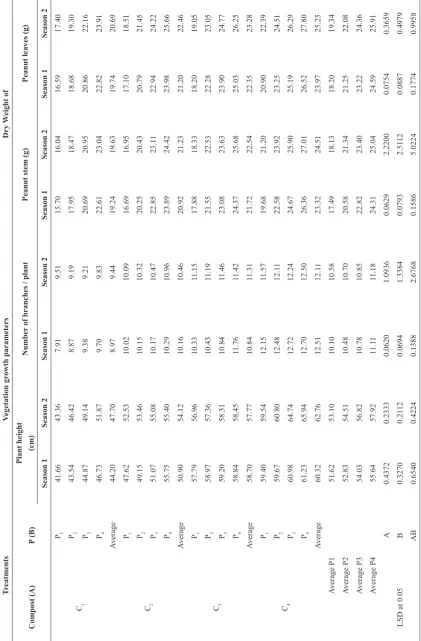
Data in Table 3 show the effect of P application method at different periods on peanut vegetation growth parameters in sandy soil prepared with compost in two successive growing seasons. Results
showed that, with all studied treatments of compost and P, the studied vegetation growth parameters, i.e. plant height (cm) number of branches per plant and dry weights of peanut stems and leavesafter 90 days of planting were higher in the second season than those found in the first season. These findings may be attributed to residual effect of both compost and P fertilizers application on the experimental soil fertility and plant growth.
Peanut vegetation growth parameters gradually increased with different applications of compost to sandy soil (Table 3), where the highest values were resulted from the high application rate of compost (14.28 ton ha-1). Plant height (cm) increased from
44.20 to 60.32 cm in first season and from 44.70 to 62.76 cm in the second season as a result of increased application of compost from C1 to C4. Also, number of branches per plant was significantly increased with increasing rate of added compost, where, it was increased with increases rate of the added compost from 0 to 14.28 ton ha-1, from 8.97
to 12.51 and from 9.44 to 12.11 for first and second season, respectively. Data also revealed that dry weights of peanut stems and leaves significantly increased as a result of compost application. On average, increasing rate of added compost from 0 (C1) to 14.28 ton ha-1 (C4) increased dry weights of
peanut stems and leaves from 19.4 to 23.9 and from 20.2 to 24.6 (g plant-1), respectively. Abou Hussein
et al. (2019) concluded that compost application to soil improves soil properties, nutrient availability and root development, which improved plant growth and dry matter yield. Radwan and Awad (2002) found that application of organic composts to newly reclaimed sandy soil of Egypt, resulted in an increase in dry matter yields of peanut different organs.
In addition, data in Table 3 show that the vegetation growth parameters of peanut plants grown in sandy soil received four application rates of compost, i.e. 0, 4.76, 9.52 and14.28 ton ha-1 in
relation with both manner and application time of P fertilizer. These data revealed that P applications individually (without compost) in two methods as soil and foliar application (P2 and P3) resulted in a significant increase of plant height (cm), number of branches per plant and dry weights of both stems and leaves (g plant-1) of peanut plant
Tr eatments Vegetation gr owth parameters Dry W eight of Compost (A) P (B) Plant height (cm) Number
of branches / plant
Peanut stem (g)
Peanut leaves (g)
Season 1 Season 2 Season 1 Season 2 Season 1 Season 2 Season 1 Season 2 C1 P1 41.66 43.36 7.91 9.51 15.70 16.04 16.59 17.40 P2 43.54 46.42 8.87 9.19 17.95 18.47 18.68 19.30 P3 44.87 49.14 9.38 9.21 20.69 20.95 20.86 22.16 P4 46.73 51.87 9.70 9.83 22.61 23.04 22.82 23.91 A verage 44.20 47.70 8.97 9.44 19.24 19.63 19.74 20.69 C2 P1 47.62 52.53 10.02 10.09 16.69 16.95 17.10 18.51 P2 49.15 53.46 10.15 10.32 20.25 20.43 20.79 21.45 P3 51.07 55.08 10.17 10.47 22.85 23.1 1 22.94 24.22 P4 55.75 55.40 10.29 10.96 23.89 24.42 23.98 25.66 A verage 50.90 54.12 10.16 10.46 20.92 21.23 21.20 22.46 C3 P1 57.79 56.96 10.33 11.15 17.88 18.33 18.20 19.05 P2 58.97 57.36 10.43 11.19 21.55 22.53 22.28 23.05 P3 59.20 58.31 10.84 11.46 23.08 23.63 23.90 24.77 P4 58.84 58.45 11.76 11.42 24.37 25.68 25.03 26.25 A verage 58.70 57.77 10.84 11.31 21.72 22.54 22.35 23.28 C4 P1 59.40 59.54 12.15 11.57 19.68 21.20 20.90 22.39 P2 59.67 60.80 12.48 12.1 1 22.58 23.92 23.25 24.51 P3 60.98 64.74 12.72 12.24 24.67 25.90 25.19 26.29 P4 61.23 65.94 12.70 12.50 26.36 27.01 26.52 27.80 A verage 60.32 62.76 12.51 12.1 1 23.32 24.51 23.97 25.25 A verage P1 51.62 53.10 10.10 10.58 17.49 18.13 18.20 19.34 A verage P2 52.83 54.51 10.48 10.70 20.58 21.34 21.25 22.08 A verage P3 54.03 56.82 10.78 10.85 22.82 23.40 23.22 24.36 A verage P4 55.64 57.92 11 .11 11.18 24.31 25.04 24.59 25.91
LSD at 0.05
A 0.4372 0.2333 0.0620 1.0936 0.0629 2.2200 0.0754 0.3659 B 0.3270 0.21 12 0.0694 1.3384 0.0793 2.51 12 0.0887 0.4979 AB 0.6540 0.4224 0.1388 2.6768 0.1586 5.0224 0.1774 0.9958 TABLE
3. Effect of compost addition and phosphorus application (time and method) on peanut vegetation gr
owth parameters in sandy soils at gr
With the same application methods (soil and foliar) of P (P2 and P3), applying time of foliar application resulted in wide differences in the values of the estimated vegetation growth parameters of peanut plants at the same rate of added compost (Table 3), where the P3 treatment resulted in a high plant height, number of branches per plant and dry weights (g plant-1) of both stems
and leaves of peanut plants compared to those resulted from P2 treatment. For example, with C0 treatment, plant height and dry weights of stems in the first growth season were (43.45 and 44.87 cm) and (17.95 and 20.69 g) with the treatments of P2 and P3, respectively. The highest response of peanut vegetation growth parameters to P3 compared to those observed with the treatment of P2 may be resulted from the greater biomass and herbs of both straw and leaves at growth period (70-80 days) compared with that at earlier growth period (30-40 days) which resulted in high uptake of P as mentioned before by Hammad (2019).
More increases in plant height (cm), number of branches per plant and dry weights (g plant-1)
of both stems and leaves of peanut plants were found when P was applied in three doses (one as soil and two as foliar applications at 30-40 and 70-80 days) represented in P4 treatment, where this treatment reduced the added dose of P as soil application compared with those in the other P treatments (P1, P2 and P3) (Table 3). In this respect, Hammad (2019) pointed out that P applications efficiency in four doses was higher than that found when it was applied on one, two or three doses on vegetation growth parameters of common bean plants. These findings mean that, to increase the efficiency of P fertilization, foliar applications should be performed on many doses at different growth periods.
Regarding the combined effect of compost and P applications on vegetation growth parameters of peanut plants, data in Table 3 show the significant increases in the estimated growth parameters of peanut in two growing seasons compared with their individual applications. These increases are due to improve of soil properties and its content of available macro and micro nutrients as a result of compost application (Abou Hussien et al., 2017 and Mahmoud 2017). Also, Emam (2018) and Tanatwy et al. (2019) pointed out that efficiency of P fertilizer was increased when P was added in combination with farmyard manure. Other studies added that, organic manures applications of different sources increased soil P availability
and efficiency of P fertilizer (El-Meselawe, 2014 and Hammad, 2019).
Peanut yield
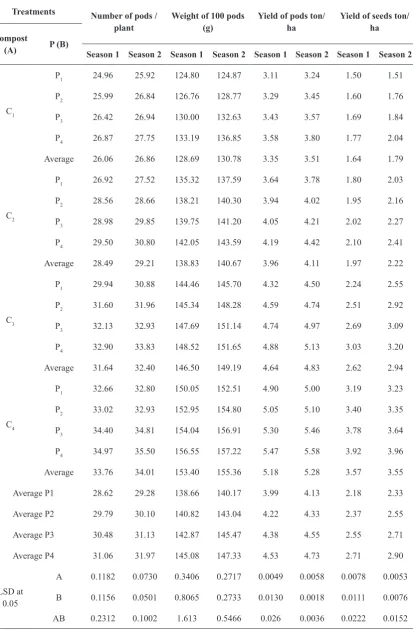
Data of peanut yield and its components as affected by compost and P application time and method under sandy soil conditions are presented in Table 4. Data showed that, peanut yield and its components, i.e. number of pods per plant, weight of 100 pods (g) and yields of pods and seeds (ton ha-1), significantly increased by individual
application of compost. For example, increasing rate of added compost from 0 (C0) to 14.28 (C4) ton ha-1 resulted in increasing of number of pods
per plant from 26.06 to 33.76with relative change of 22.8 % in the first growing season and from 26.86 to 34.01 with relative change of 21.0 % in the second growing season. Also, weight of 100 pods (g) was significantly affected by application of compost, where the highest weight of 100 pods was resulted from the high application rate of compost (C4). This trend may be cleared from the average weights of 100 pods of peanut plant of second growing season, where these values were 130.78, 140.67, 149.19 and 155.39 g for treatments of C1, C2, C3 and C4, respectively.
Yields of peanut pods and seeds as ton ha-1
also, significantly responded to the increase rate of added compost. For example, yield of pods increased from 3.35 ton ha-1 in treatment of C0 to
3.96 ton ha-1 in treatments of C1 and achieved the
highest yield (5.18 ton ha-1) in treatment of C4 in
the first growing season. Data of second growing season are in accordance with those found in the first one. Enhancement of peanut yield and its components are resultedfrom improve effect of compost on soil quality (Junedi et al., 2013,Wardah et al., 2014 and Mahmoud, 2017). Compost application to soil improves soil quality by improving soil properties such as pH, EC and nutrient availability (Adriano et al., 2012), biological properties (Argaw, 2017) and soil content of plant hormones, that act as stimulant for plant growth (Hernandez et al., 2009).
Treatments Number of pods /
plant Weight of 100 pods (g) Yield of pods ton/ha Yield of seeds ton/ha Compost
(A) P (B) Season 1 Season 2 Season 1 Season 2 Season 1 Season 2 Season 1 Season 2
C1
P1 24.96 25.92 124.80 124.87 3.11 3.24 1.50 1.51
P2 25.99 26.84 126.76 128.77 3.29 3.45 1.60 1.76
P3 26.42 26.94 130.00 132.63 3.43 3.57 1.69 1.84
P4 26.87 27.75 133.19 136.85 3.58 3.80 1.77 2.04
Average 26.06 26.86 128.69 130.78 3.35 3.51 1.64 1.79
C2
P1 26.92 27.52 135.32 137.59 3.64 3.78 1.80 2.03
P2 28.56 28.66 138.21 140.30 3.94 4.02 1.95 2.16
P3 28.98 29.85 139.75 141.20 4.05 4.21 2.02 2.27
P4 29.50 30.80 142.05 143.59 4.19 4.42 2.10 2.41
Average 28.49 29.21 138.83 140.67 3.96 4.11 1.97 2.22
C3
P1 29.94 30.88 144.46 145.70 4.32 4.50 2.24 2.55
P2 31.60 31.96 145.34 148.28 4.59 4.74 2.51 2.92
P3 32.13 32.93 147.69 151.14 4.74 4.97 2.69 3.09
P4 32.90 33.83 148.52 151.65 4.88 5.13 3.03 3.20
Average 31.64 32.40 146.50 149.19 4.64 4.83 2.62 2.94
C4
P1 32.66 32.80 150.05 152.51 4.90 5.00 3.19 3.23
P2 33.02 32.93 152.95 154.80 5.05 5.10 3.40 3.35
P3 34.40 34.81 154.04 156.91 5.30 5.46 3.78 3.64
P4 34.97 35.50 156.55 157.22 5.47 5.58 3.92 3.96
Average 33.76 34.01 153.40 155.36 5.18 5.28 3.57 3.55
Average P1 28.62 29.28 138.66 140.17 3.99 4.13 2.18 2.33
Average P2 29.79 30.10 140.82 143.04 4.22 4.33 2.37 2.55
Average P3 30.48 31.13 142.87 145.47 4.38 4.55 2.55 2.71
Average P4 31.06 31.97 145.08 147.33 4.53 4.73 2.71 2.90
LSD at 0.05
A 0.1182 0.0730 0.3406 0.2717 0.0049 0.0058 0.0078 0.0053
B 0.1156 0.0501 0.8065 0.2733 0.0130 0.0018 0.0111 0.0076
AB 0.2312 0.1002 1.613 0.5466 0.026 0.0036 0.0222 0.0152
second growing season, where these values were 2.33, 2.55, 2.71 and 2.91 ton ha-1 for treatments
of P1, P2, P3 and P4, respectively. Therefore, the relative changes (RC %) of the average yields of peanut seeds with the treatments of P2, P3 and P4 compared with the data at P1 were 9.44, 16.31 and 24.46 %, respectively. This trend was found with foliar application of P at all compost applications. Regarding the effect of time of foliar application, data in Table 4 show that application period of P as foliar application significantly increased peanut yield and its components, where the highest yield was achieved in the treatment P4 where P was applied in three doses (first dose was as soil application and second and third were as foliar applications at periods of 30-40 and 70-80 days, respectively) followed by treatment P3 where foliar application was performed at period of 70-80 days. Treatment P2 where foliar application was performed at period of 30-40 days achieved lowest yield of peanut among foliar application treatment, however it was significantly higher than that of P1 where all P dose was added as soil application. These results suggest that foliar application of P in combination with soil application increased peanut yield. These results may be due to lower P solubility in soil application treatment (Al Harbi et al., 2013).
Results in Table 4 also, showed that combinedapplication of compost and P had a significant increase effect on seeds yield of peanut and its components. These increases compared to those found with the single treatments of P and compost are mainly due to improve effect of compost on soil properties, nutrient availability and plant growth (Elgezery, 2016, Mahmoud, 2017 and Emam, 2018).
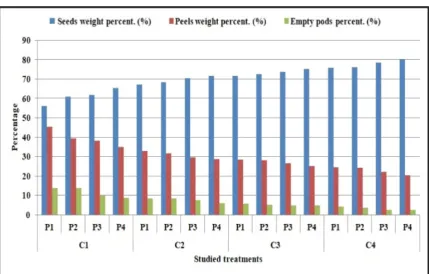
Figure 1 showed that components of peanut yield as percentage, i.e. seeds weight, peels weight and empty pods were affected by the studied treatments of compost and P. For example, seedsweight percentage of total yield increased with increasing rate of added compost. Increasing rate of added compost from 0 (C1) to 14.28 (C4) ton ha-1 resulted in increasing seed
weight percentage from 61.06 to 77.69 % on average of both growing seasons. Opposite trend was found with both peels weight and empty pods percentages. Empty pods percentage decreased from 11.60 to 3.20 %with increasing rate of added compost from 0 to 14.28 ton ha-1. These findings
mean that, organic manure application increase
nutrient availability, soil fertility and improve soil physical conditions of root zone which finally increase peanut yield and quality (Xiaobing et al., 2017).
Time and method of P fertilizer application alsoaffected percentage components of peanut yield (Fig. 1). At the same application rates of compost, different methods of P application showed wide variation in their effect on percentage of peanut yield components. Foliar application of P plus soil application increased seed weight percentage (%) compared to that found in soil application alone. Also, time of foliar application affected seed weight, peels weight and empty pods percentages. The maximum seed weight percentage was found when P appliedin three doses (P4) followed by application at 70-80 days (P3) while treatment P2 recorded the lowest values of seed weight percentage among foliar application treatments. Phosphorus application in foliar spraying method increase P use efficiency and its uptake by plants, which enhance using of nutrients and assimilates and increase number of filled pods and seed yield (Karma, 2010). Zoz et al. (2018) and Mekdad (2019) reported that P played an important role in increasing pod and seed yield of peanut.
Seed content of N, P and K
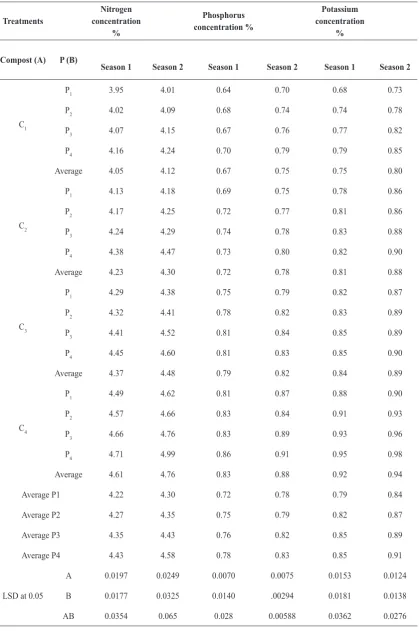
Result of effect of compost application in relation with both time and application method of P on peanut seed’s content of N, P and K are shown in Table 5. Data reveled that application of compost to sandy soil significantly increased seed contents (%) of N, P and K. Maximum concentration of N,P and K was obtained in treatment C4 (14.28 ton compost ha-1)while the
lowest was observed in treatment C0 (without compost application). Nitrogen concentration followed by K concentration in peanut seeds was higher than P. AbouHussien et al. (2019) reported that compost application to soil increased soil content of available macro and micro nutrients as well as nutrients uptake by growing plants. Increased uptake of nutrients upon application of compost is mainly due to effect of compost on soil physical, chemical and biological properties which increase nutrients availability and finally their uptake by plants (Wardah et al., 2014 and Emam, 2018).
observed that, under all compost treatments, foliar application of P plus soil application resulted in a significant increase of nutrients concentrations. For example, average concentrations of N with all compost rates in the first growing season were 4.22, 4.27, 4.35 and 4.43 % for treatments of P1, P2, P3 and P4, respectively, where the relative changes of their concentrations were 1.78, 3.79 and 4.90 % for the treatments of P2, P3 and P4 compared with the date of P1. Similar trend was observed for P and K concentrations in both growing seasons. These results suggest that foliar application of P was more efficient than soil application especially when it was dividedinto three doses (P4). Foliar application of P assure more solubility to plant compared to soil application where P is subjected to precipitation by reacting with soil components (Shete et al., 2018). Enhanced P sutability by foliar application resulted in better peanut growth and better use of assimilation which finally resulted in more uptake of nutrients (Karma, 2010).
Oil and protein content
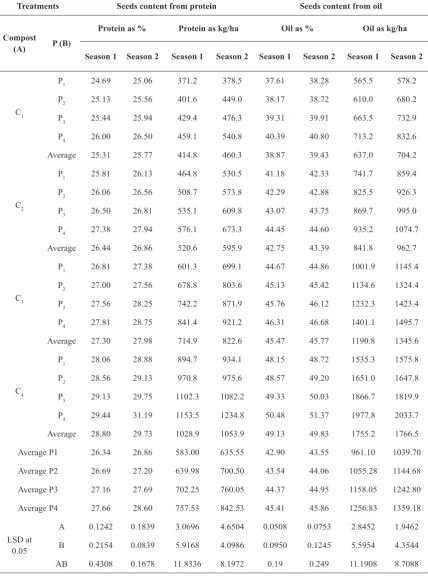
Data of seed’s content of oil and protein are shown in Table 6. Both oil and protein contents and yield were significantly increased by the studied treatments of compost and P application. Increasing rate of added compost from 0 (C1) to 14.28 ton ha-1 (C4) increased protein and oil
yield from 414.8 and 637.0 to 1028.9 and 1755.2 kg ha-1, respectively. Radwan and Awad (2002)
reported that organic amendments application to sandy soil increased peanut yield and its content of protein and yield.
Data in Table 6 also revealed that P treatments (method and time of application) significantly increased peanut content of oil and protein, where maximum yield of oil and protein was observed in treatment of P4, while the lowest value was observed in treatment of P1. Split application of foliar P fertilization enhanced its use efficiency by plants (Hammad, 2019), which finally resulted in an increase of peanut yield and content of oil and protein (Karma et. al., 2017).
TABLE 5. Effect of compost addition and phosphorus application (time and method) on N, P and K concentrations in peanut seeds in sandy soils
Treatments concentration Nitrogen %
Phosphorus concentration %
Potassium concentration
%
Compost (A) P (B)
Season 1 Season 2 Season 1 Season 2 Season 1 Season 2
C1
P1 3.95 4.01 0.64 0.70 0.68 0.73
P2 4.02 4.09 0.68 0.74 0.74 0.78
P3 4.07 4.15 0.67 0.76 0.77 0.82
P4 4.16 4.24 0.70 0.79 0.79 0.85
Average 4.05 4.12 0.67 0.75 0.75 0.80
C2
P1 4.13 4.18 0.69 0.75 0.78 0.86
P2 4.17 4.25 0.72 0.77 0.81 0.86
P3 4.24 4.29 0.74 0.78 0.83 0.88
P4 4.38 4.47 0.73 0.80 0.82 0.90
Average 4.23 4.30 0.72 0.78 0.81 0.88
C3
P1 4.29 4.38 0.75 0.79 0.82 0.87
P2 4.32 4.41 0.78 0.82 0.83 0.89
P3 4.41 4.52 0.81 0.84 0.85 0.89
P4 4.45 4.60 0.81 0.83 0.85 0.90
Average 4.37 4.48 0.79 0.82 0.84 0.89
C4
P1 4.49 4.62 0.81 0.87 0.88 0.90
P2 4.57 4.66 0.83 0.84 0.91 0.93
P3 4.66 4.76 0.83 0.89 0.93 0.96
P4 4.71 4.99 0.86 0.91 0.95 0.98
Average 4.61 4.76 0.83 0.88 0.92 0.94
Average P1 4.22 4.30 0.72 0.78 0.79 0.84
Average P2 4.27 4.35 0.75 0.79 0.82 0.87
Average P3 4.35 4.43 0.76 0.82 0.85 0.89
Average P4 4.43 4.58 0.78 0.83 0.85 0.91
LSD at 0.05
A 0.0197 0.0249 0.0070 0.0075 0.0153 0.0124
B 0.0177 0.0325 0.0140 .00294 0.0181 0.0138
TABLE 6. Effect of compost addition and phosphorus application(time and method) on peanut seeds content from protein and oil (as % and kg/ha) in sandy soils
Treatments Seeds content from protein Seeds content from oil
Compost
(A) P (B)
Protein as % Protein as kg/ha Oil as % Oil as kg/ha
Season 1 Season 2 Season 1 Season 2 Season 1 Season 2 Season 1 Season 2
C1
P1 24.69 25.06 371.2 378.5 37.61 38.28 565.5 578.2 P2 25.13 25.56 401.6 449.0 38.17 38.72 610.0 680.2 P3 25.44 25.94 429.4 476.3 39.31 39.91 663.5 732.9
P4 26.00 26.50 459.1 540.8 40.39 40.80 713.2 832.6 Average 25.31 25.77 414.8 460.3 38.87 39.43 637.0 704.2
C2
P1 25.81 26.13 464.8 530.5 41.18 42.33 741.7 859.4 P2 26.06 26.56 508.7 573.8 42.29 42.88 825.5 926.3 P3 26.50 26.81 535.1 609.8 43.07 43.75 869.7 995.0 P4 27.38 27.94 576.1 673.3 44.45 44.60 935.2 1074.7 Average 26.44 26.86 520.6 595.9 42.75 43.39 841.8 962.7
C3
P1 26.81 27.38 601.3 699.1 44.67 44.86 1001.9 1145.4 P2 27.00 27.56 678.8 803.6 45.13 45.42 1134.6 1324.4 P3 27.56 28.25 742.2 871.9 45.76 46.12 1232.3 1423.4 P4 27.81 28.75 841.4 921.2 46.31 46.68 1401.1 1495.7 Average 27.30 27.98 714.9 822.6 45.47 45.77 1190.8 1345.6
C4
P1 28.06 28.88 894.7 934.1 48.15 48.72 1535.3 1575.8
P2 28.56 29.13 970.8 975.6 48.57 49.20 1651.0 1647.8 P3 29.13 29.75 1102.3 1082.2 49.33 50.03 1866.7 1819.9 P4 29.44 31.19 1153.5 1234.8 50.48 51.37 1977.8 2033.7 Average 28.80 29.73 1028.9 1053.9 49.13 49.83 1755.2 1766.5 Average P1 26.34 26.86 583.00 635.55 42.90 43.55 961.10 1039.70 Average P2 26.69 27.20 639.98 700.50 43.54 44.06 1055.28 1144.68 Average P3 27.16 27.69 702.25 760.05 44.37 44.95 1158.05 1242.80 Average P4 27.66 28.60 757.53 842.53 45.41 45.86 1256.83 1359.18
LSD at 0.05
References
A.O.A.C. (1990) Association of Official Methods of Analysis Chemists, Official Methods of Analysis. 5th ed. Washington , D. C. , USA.
AbouHussien,E. A., A. M. Elbaalawyand M. M.Hamad (2019) Chemical properties of compost in relation to calcareous soil properties and its productivity of wheat. Egypt. J. Soil. Sci.59, 85-97.
AbouHussien, E. A., W. M. Nada and M. Kh. Elgezery (2017) Evaluation efficiency of sulphur fertilizer in calcareous soil amended by compost. Menoufia J. Soil Sci.,2, 59-72.
Adriano, M. D. L., F. Gutierrez, L. Dendooven, and M. S. Figueroal (2012) Influence of compost and liquid bioferment on the chemical and biological characteristics of soil cultivated with banana (Musa spp. L). J. Soil Sci. Plant Nutr.12, 33-43.
Al Harbi, S.F., A.M. Ghoneim, A.S. Modaihsh and M.O. Mahjoub, (2013) Effect of foliar and soil application of phosphorus on phosphorus uptake, use efficiency and wheat grain yield in calcareous soil. J. Appl. Sci.13, 188-192.
Ali, A. A. G and S. A. E. Mowafy (2003) Effect of different levels of potassium and phosphorus fertilizers with the foliar application of zink and boron on peanut in sandy soils. Zagazig J. Agric. Res.,30, 335-358.
Argaw, A. (2017) Organic and inorganic fertilizer application enhances the effect of Bradyrhizobium on nodulation and yield of peanut (Arachis hypogea L.) in nutrient depleted and sandy soils of Ethiopia. Int. J. Recy. Org. Waste Agric. 6, 219-231.
Chapman, H.D. and P. F. Pratt (1961) Methods of Analysis for Soils, Plants and Waters. Division of Agric. Sci., Univ. California, Riverside. USA. Cottenie, A.,M. Verloo, L. Kiekens, G. Velgh and R.
Camerlynck (1982) Chemical Analysis of Plants and Soils. State Univ. Ghent Belgium.
EL-Far, I.A and B. r. Ramadan (2000) Response of yield, yield components and quality of peanut (Arachis hypogaea, L.) to plant density and p and k fertilization in sandy calcareous soil. Proc. 9 Conf. Argon., Moinufiya Univ., 1-2 Sept: 453-466. Elgezery, M.Kh. (2016) Effect of Organic Additives on
Efficiency of Sulphur Fertilization. M. Sc. Thesis, Fac. of Agric., Menoufia Univ., Egypt.
El-Habbasha, S. F., A. A. Kandil, N. S. Abu-hagaza,
A. K. Abd El-Haleem, M. A. Khalfallah and T. Gh. Behairy (2005) Effect of phosphorus levels and some biofertilizers on dry matter, yield and yield attributes of groundnut. Bull. Fac. Agric. Cairo Univ., 56, 237-252.
El-Meselawe, A. E. S. (2014) Effect of bio-organic additives on phosphate solubilization in soils. M. Sc. Thesis, Evaluation of Natural Resources and Planning for their Development Department, Environmental Studies and Research Institute, Sadat City Univ., Egypt.
El-Shouny, M. M. (2011) Response of wheat plants grown on newly reclaimed sandy soil to bio, organic and mineral fertilization. Menoufia J. of Agric. Res.,
36, 452-480.
Emam, A. A. E. (2018) Effect of Some Organic and Inorganic Fertilizers on Plant Irrigated by Saline Water. Ph.D. Thesis, Fac. of Agric., Menoufia University, Egypt.
Fageria N.K., V.C. Baligar and C. Jones (1997) Growth and Mineral Nutrition of Field Crops. 2nd ed. Marcel Dekker, Inc, New York, N Y.
Hammad, M. A. B. (2019) Combined Effect of Organic and Mineral Fertilization on Nodulation and Yield of Common Beans Phaseolus vulgaris L. under sandy soil conditions. M.Sc.Thesis, Fac. of Agric., Menoufia University, Egypt.
Hammad, M. M. H. (2009) Effect of Saline Irrigation Water on Calcareous Soil and Productivity. Ph.D. Thesis, Fac. of Agric., Menoufia University, Egypt. Hammons, RO. (1982) Origin and Early History of
the Peanut. In: Pattee, H.E. and C.E. Young (Ed.) Peanut Science and Technology. American Peanut Research and Education Society. Yoakum, pp. 1-20. Hernandez, L.R., A.C.G. Francol, S.O. Guy and W. C. Chun (2009) Liquid compost factor: a biologically derived seed treatment for increased grain chickpea production. Inter. J. Exp. Botany, 78, 129-134.
Junedi, H., Zurhalena and I. A. Mahbub (2013) Short-term effect of china violet compost on soil properties of Ultisol and peanut yield. Inter. J. Adv. Sci. Eng. Inf. Tech., 3, 50-53.
Kamara, E. G., N. S. Olympio , J. Y. Asibuo, M. K. Kabbia , K. M. Yila and A. Conteh (2017) Effect of calcium and phosphorus fertilizer on seed yield and nutritional quality of groundnut (Arachis hypogaea L.) IntlJ. Agric. Forest. 6, 129-133.
Klute, A. (1986) Method of Soil Analysis. Part 1, Physical and Mineralogical Methods, 2nd ed., Amer. Soc. of Agron., Madison, Wisconsin, USA. Mahmoud, H. M. A. (2017) Organic Amendments and
Their Effect on Status of Some Nutrients in Soil and Plant. Ph.D. Thesis, Fac. of Agric., Menoufia University, Egypt.
Mekdad, A.A.A.(2019) Response of Arachishypogaea L. to different levels of phosphorus and boron in dry environment. Egypt. J. Agron., 41, 21-28. Nasr- Alla, A. E, F. A. A. Osman and K. G. Soliman
(1998) Effect of increased phosphorus, potassium and sulfur application in their different combinations on yield, yield components and chemical composition of peanut in a newly reclaimed sand soil. Zagazig. J. Agric. Res.,25, 557-579.
Page, A. I., R. A. Millerand D. R. Keene (1982) Methods of Soil Analysis. Part 2: Chemical and Microbiological Properties. 2nd ed., Amer. Soc. of Agron., Madison, Wisconsin, USA.
Radwan, S.M.A. and N. M. Awad (2002) Effect of soil amendment with various organic wastes with multi-biofertilizer on yield of peanut plants in sandy soil. J. Agri. Sci. Mansoura Univ., 27, 3129-3138. Shete, S.A., A.V. Bulbule, D.S. Patil and R.B. Pawar
(2018) Effect of foliar nutrition on growth and
uptake of macro and micronutrients of kharif groundnut (Arachis hypogaea L.). Int. J. Curr. Microbiol. App. Sci., 7, 1193-1200.
Snedecor, G.W. and W. G. Cochran (1980) Statistical Methods. 7th ed. The Iowa State University Press, Ames, Iowa.
Tantawy, M. F., M. A. Ahmed, B. Y. El-Koumey, E. A. AbouHussien and A. A. E. Emam (2019) Effect of farmyard manure on barley plants response to foliar applications of micronutrients and silicon in sandy soil irrigated by saline water. Menoufia J. Soil Sci.
4, 1-14.
Taru, V.B., I. Z. Khagya, S. I. Mshelia and E. F. Adebayo (2008) Economic efficiency of resource use in groundnut production in Adamawa State of Nigeria.World J. Agric. Sci. 4, 896-900.
Wardah, L., S. Prijono and Z. Kusuma (2014) Soil health improvement by addition the manure and compost for peanut plant (Arachis hypogaea l) in Leranwetan, Palang, Tuban. IOSR J. Agri. Vet. Sci.7, 64-71.
Xiaobing, W., L. Wuxing, L. Zhen’gao, T. Ying, C. Peter and L.Yongming (2017) Effects of long-term fertilizer applications on peanut yield and quality and on plant and soil heavy metal accumulation. Pedosphere, DOI: 10.1016/S1002-0160, 17, 60457-0.
ةدوجو ةيجاتنإو ومنلا ىلع روفسوفلا ةفاضإ ةقيرط و تيقوتو تسوبمكلا تافاضإ ريثأت
ةيلمرلا ةبرتلا يف ينادوسلا لوفلا لوصحم
1ىشيفلا ىفطصمو 2ىولاعبلا دمحم دمحأ ،1ةدومح ميهاربإرصم - ةزيلجا - ةيعارزلا ثوحبلا زكرم - ةئيبلاو هايلماو ىضارلأا ثوحب مسق1
رصم - ةيفونلما ةعماج - ةعارزلا ةيلك - ىضارلأا مولع مسق2
ةيتافسوفلا ةدمسلأا مادختسإ ةءافك ىلع ريثأتلا ىف اريبك ارود بعلت ىتلا لماوعلا نم ديدعلا دجوي ةيوضعلا تافاضلإا) تلاماعلما ضعب ريثأت مييقتل ةساردلا هذه تيرجأ اذهلو .ىرخلأ ضرأ نم فلتخت ىتلاو
ىلع كلذ ريثأتو ةيلمرلا يضارلأا فورظ تتح (ةفلتخم ةفاضإ قرطب روفسفلا ةفاضإ تاتيقوتو ”تسوبمكلا“
لامش ةقطنبم ةيلمرلا ضرلأا ىلع ةيلقح ةبرجتك ةساردلا هذه تيرجأو .ينادوسلا لوفلا ةدوجو ةيجاتنإ و ونم
عطق ميمصت ىف ةساردلا تلاماعم عيزوت تم .ينيلاتتم فيص يمسوم للاخرصم -ةريحبلا ةظفاحم -ريرحتلا
ىف (راتكه/ نط 14.28 و9.52 و4.76 و0) تسوبمكلل تلادعم عبرلأا ةفاضإ تم ثيح تارركم ثلاث ىف ةقشنم
تتح ةيبيرجتلا عطقلا ىف ةساردلا تتح عبرلأا روفسوفلا تلاماعم عيزوت تم امنيب ةيسيئرلا ةيبيرجتلا عطقلا ومنلا سيياقم نإف روفسوفلاو تسوبمكلا نم لكل ةساردلا تتح تلاماعلما عيمج عم نأ دجو دقو.ةيسيئرلا
مسوم ىف ىلعأ (قارولأاو ناقيسلا نم لكل فالجا نزولاو تابن لكل عرفلأا ددعو ”مس“ تابنلا عافترإ ) ةردقلما
تسوبمكلا نم فاضلما ةدايز عم ةيونعم ةدايز ومنلا سيياقم تدادزإ امك . لولأا ومنلا مسوم نع ىناثلا ومنلا
ةبحاصلما ةردقلما ومنلا سيياقم ىف ةدايزلا تناكو .ةيواستم تاعرج ثلاث ىلع روفسفلا ةفاضإ عم كلذكو
نم موي40-30 رمع دنع ةيقرولا ةفاضلإل ةبحاصلما كلت نم ىلعأ ةعارزلا نم موي80-70 رمع دنع ةيقرولا ةفاضلإل