DOI: 10.22192/iajmr.2020.6.1.2
Indo – Asian Journal of Multidisciplinary Research (IAJMR)
ISSN: 2454-1370
METHODOLOGICAL APPROACHES TO THE FORMATION AND
DEVELOPMENT OF AGROCLUSTERS
Khodjamuratova Gulbahar Yuldashevna*and Aripov Ulugbek Tashkent State University of Economics, Tashkent City, Republic of Uzbekistan
Abstract
This article discusses methods for analyzing the formation of clusters in the agricultural sector as applied to the macro, meso and micro levels: building target ratings, the method of cluster statistical analysis, and the expert method. The author defines the role and tasks of economic analysis in creating agro-industrial clusters and monitoring their development. At the end of the article, suggestions are made for the further development of the agrocluster.
Key words: Methodology, Clusters, Region, Technologies, Competitiveness and Agriculture.
1. Introduction
A modern agricultural cluster for the production and processing of cotton and other agricultural products will be built in the Bukhara region. This is determined by Cabinet Decree dated June 14, 2019 No. 500. The cluster will be created on the basis of Bukhoro Pakhtasano at Hoody Birlashmasi JSC to attract direct investment, introduce effective methods for growing raw cotton, producing, processing and preparing seed, organizing the production of others types of agricultural products based on deep processing. The main tasks of the agrocluster are:
Introduction of advanced scientific achievements, modern and effective methods of growing raw cotton and other types of crops.
Introduction of effective and highly profitable methods of primary processing of raw cotton, as well as advanced processing technologies.
*Corresponding author: Khodjamuratova Gulbahar Yuldashevna
E.mail: [email protected]
Received: 22.09.2019; Revised: 18.10.2019;
Accepted: 25.11.2019.
Production, preparation and sale of sowing seeds of cotton and other crops in accordance with the requirements of state and international standards.
Introduction of advanced agrotechnical and water-saving technologies.
Organization of deep processing of raw materials and the production of competitive, export-oriented products by attracting direct investment, including foreign, as well as loans from international financial institutions.
Widespread adoption of modern ICT in the processes of accounting and control over the quality and quantity of cotton and other agricultural products.
Carrying out research in the field of selection and seed production together with scientific and educational institutions, creating new varieties and hybrids of crops, as well as technologies for the primary processing of raw cotton.
equal annual payments). For the period of formation and launch of the spinning and knitting production capacities, the agricultural cluster is allowed to sell cotton fiber for export under direct or futures contracts in the amount of up to 30 thousand tons.
Mutual settlements with farms for raw cotton are carried out through ginneries that are part of the agrocluster. Final settlements for the raw cotton of the 2019 harvest will be made by the agrocluster at the expense of own funds and funds included in its composition of organizations, as well as loans from commercial banks. Monitoring and control of the process of growing raw cotton and other agricultural products for agricultural enterprises will be carried out using drones.
The sale of cotton, lint and technical cotton seeds to consumers is carried out by the agrocluster through the conclusion of commission agreements with ginneries in compliance with the established procedure for the sale of this type of product through exchange trading, as well as direct and tolling contracts. The difference between the realized price and the price according to the price list approved by the Ministry of Finance remains at the disposal of the agrocluster and is not subject to taxation (in the event of a negative difference, expenses are covered from the own funds of the agrocluster) (Feldman and Audretsch, 1999).
The agrocluster and its constituent organizations are exempted from customs duties (with the exception of customs duties) until June 1, 2022 when importing equipment, special vehicles and machinery, components, raw materials, building materials, greenhouse complexes, animals, seeds and plants, veterinary preparations not produced in the republic, as well as mineral fertilizers, fuels and lubricants for their own production needs according to the lists formed in the prescribed manner.
2. Methodology
Methodologically, it is necessary to determine the institutional element that will act as the main object in the further reform of the economy of Uzbekistan. Scientific studies of the theory, methodology and practice of developing
high-tech production systems in Uzbekistan and abroad show that one of the most effective forms of managing economic development is a policy based on the creation of a system for ensuring national development priorities, based on large innovative projects implemented on the basis of state private partnership; identifying and stimulating the development of emerging clusters, within the framework of which stable relations are formed between the participants of the innovation system (Bogdanova, 2018).
The founder of cluster theory is M. Porter. Following his definition, “a cluster is a group of geographically neighboring interconnected companies and related organizations operating in a certain area, characterized by common activities and complementing each other” (Glotko, 2008). A cluster approach to the study of economic processes of competitiveness formation is also used in a number of other theories. Modern theories of the development of competitiveness on the basis of clusters were developed by V. Feldman. Their advantages are that they are based on extensive empirical studies of diversification forms in various countries (Kleiner, 2007).
Clustering capabilities in Uzbekistan were studied by several scientists as well as Ortikmirzaevich (2017); Tursunov (2017) and Tursunov (2018). Innovative ways of development of Uzbekistan agroindustrial complex were researched by Russian and Uzbek scientists as well as Nuritdin Yuldashev et al. (2019).
3. Analysis and Results
Domestic scientists so far disagree in the definition of the term “cluster”, while recognizing that the cluster belongs to a variety of network structures and is distinguished by the presence of an innovative component that allows it to adapt to changes in the competitive sphere.
rarely suitable for industry classification, it is mobile and is distinguished by the tightness of economic ties and industry complementarity , the degree of technology used, marketing policy, information space, innovative development.
A cluster in an agro-industrial complex is understood to mean a geographically separate, innovatively directed quasi-integrated structure that implements the common economic interests of participants associated in this structure with a specific interaction culture. The agro-industrial cluster performs the functions of the main tool for program-oriented planning and management within the framework of the regional agro-industrial policy with the aim of the integrated use of the economic and social component of the region (Porter, 2006).
In the light of world experience in creating cluster structures in the agro-industrial complex, the desire of enterprises to work in a cluster is caused by the need and real opportunity to solve the problems of transaction costs, “double marginalization”, get a synergistic effect and realize the economies of scale.
For the domestic agro-industrial economy, the problem of cluster formation has not been sufficiently studied. There is no assessment of the development of clusters, their role in the economic stabilization of regional agribusiness, the advantages of the cluster approach for participants in agro-industrial clusters are not substantiated. There is no theory of cluster development adapted to the domestic economy in the agro-industrial complex, methodological aspects and methodological approaches to their formation have not been developed. Let us dwell on the latter in the article.
Creation of an agrocluster involves passing through five stages: preparatory, analytical, strategic, implementation and planning of future development:
Stage 1 includes the following activities: assessment of the production direction of the participants; coordination of interests; development of a pilot project to familiarize cluster members with the terms of joint work; cluster design development, principles of its
functioning; creation of a regulatory framework for the functioning of the agrocluster.
Stage 2 involves the following analytical procedures: monitoring to identify problems in the development of innovation in the cluster; setting goals and objectives; development of events (projects) to achieve goals; linking projects to resources and over time; program adjustment. Analysis of the internal and external environment of the cluster.
Stage 3 includes the following: determining the extent of joint activities of participants; development of the concept of innovative development of agricultural cluster participants; creation of an innovation development program; development of the cluster personnel policy framework.
Stage 4 - Implementation of the developed agricultural cluster project.
Stage 5 boils down to monitoring the effectiveness of cluster ties, developing a scenario for the long-term development of the agrocluster.
Given the dynamism of the processes of the functioning of the agro-industrial complex, the uncertainty in the structure of the interconnections of its internal elements, which at present is not adequately reflected in the statistical data, it seems promising to use an integrated comparative-analytical approach to the analysis of development characteristics. The purpose of this methodological approach is to conduct an expert-analytical procedure that allows us to evaluate the development of the agro-industrial sphere both in various regions and in the administrative regions of individual regions, that is, to analyze the formation of macro-, meso- and microclusters.
principles for the formation of a development strategy.
Based on the official statistics of the Federal State Statistics Service, we have constructed target ratings for agricultural development, depending on their share in the gross output of the industry in the Russian Federation and the growth rate of the region’s products compared to the growth rate of the industry as a whole, using the following groupings for comparison:
Leading regions (share - over 3 %; lead index > 1.8)
Regions with a high level of development (share -3-2.1 %; lead index> 1.5)
Regions with a level of development above average (share - 2.1 - 1.2 %; lead index> 1.2).
Regions with an average level of development (share - 1.2 - 0.65 %; lead index = 1);
Regions with a level of development below average (share - 0.65 - 0.16 %; lead index 0.10.5)
Regions with a low level of development (share - less than 0.16 %; lead index 0.5 - 1).
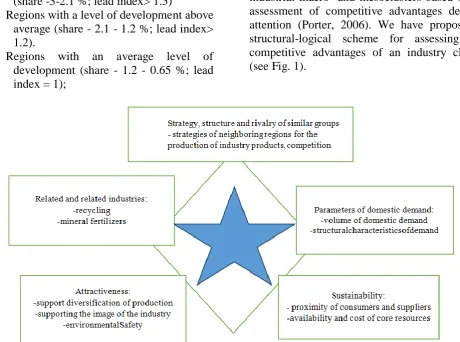
Thus, the results of the ranking carried out for regional agribusinesses according to certain criteria provide a good basis for both an expert analysis of macroclusters emerging in this sector of the economy and for the development of current control actions and strategic decisions for their development. Methods of a comparative analysis of the development of sectoral agro-industrial macro- and mesoclusters based on an assessment of competitive advantages deserve attention (Porter, 2006). We have proposed a structural-logical scheme for assessing the competitive advantages of an industry cluster (see Fig. 1).
Figure – 1: Determinants of the competitive advantage of an industry cluster
The set of private assessments of the competitive advantages of the sectoral agrocluster allows us to assess the conformity of its cluster structure to the necessary economic profile (mesoscale), consistency with the economic strategy for the development of territories, the efficiency of using the resource potential and development trends.
Agro-industrial zones are organized in areas with developed agriculture and infrastructure enterprises or with the potential for their future development. Due to the small size of the territories of administrative regions, the organization of agricultural zones is advisable on an inter-district basis.
Thus, the creation of clusters can be initiated on a geographical basis, i.e. where there is a high concentration of similar enterprises both in terms of manufactured products and the principles of organization. Following the geographical principle of creating clusters allows you to enhance the synergistic effect of the presence of similar enterprises not only participating in the main technological chain, but also serving the main enterprises. Due to this, a certain local quasi-self-sufficient innovative agricultural economy is created, aimed at the production of a limited number of guaranteed sales products outside the cluster.
The methodology for the formation of local agroclusters at the regional level includes sectoral and territorial components and, according to the algorithm, is similar to the agricultural zoning method. As a primary tool for implementing this method are multidimensional statistics tools that sort objects into relatively homogeneous classes based on pairwise comparison according to predefined criteria, the merit of which is to reduce the subjective effect on the results.
Hierarchical Cluster Analysis, implemented in the statistical package SPSS for Windows 13, is widely used in the group of methods of multidimensional statistics. The cluster analysis procedure uses the Ward's method. This method is based on the principle of minimizing dispersion within clusters, which corresponds to the problem of obtaining groups of factor and resultant attributes that are homogeneous in degree of deviation from the explained values (trend and cyclical). The distance metric for obtaining homogeneous groups of objects is set as the usual Euclidean distance (Euclidean distance), which corresponds to the case when the signs are equally important for classification.
The obtained research results confirm the possibility of using hierarchical agglomerative cluster analysis as a typological tool for typifying the municipal regions of the region according to the criteria of production activity. Zoning obtained through clustering reflects the economic situation in the regional agribusiness. Adequacy of the obtained solutions and ease of use allows us to consider this tool as a valuable addition to the analysis tools necessary in the transition to indicative planning.
Municipal (transmunicipal) clusters are the primary link in the organizational structure of the agro-industrial complex of the region, in which the "growth points" are located - Leaders. The establishment of a municipal (transmunicipal) cluster involves the development of a methodology for organizing production based on the principles of a cluster approach and, therefore, combining in a comprehensive study the solution of heterogeneous subtasks:
Increase the economic competitiveness of producers
Ensuring a sustainable development path for the Participants and the Leader based on their commercial and social potential Achievements of technological
breakthrough
Definition of guidelines for potential investors.
Thus, the data obtained using hierarchical agglomerative cluster analysis allow us to determine the territories where it makes sense to create regional and interregional agro-industrial clusters that are promising for investment and innovation; assess the impact of specific changes in the external and internal business environment; to predict the dynamics of conjugation of target interests and timely conduct organizational and economic transformations that realize the benefits of balanced management of their development.
agro-industrial complex. The creation and prospects for the development of clusters in the region should be considered from the angle of the following principles: general, which are inherent for all types and types of clusters, regardless of their industry orientation, and special, which take into account the industry orientation of a real or emerging cluster.
The general principles of cluster formation include accounting:
Geographical location of the region
Administrative and territorial structure of the region
Features of the nature and natural resource base of the region, their impact on the living conditions of the population
Composition of the population, demographic and ethnocultural characteristics;
Features of the region’s economy (i.e., the main factors in the development of industries, problems of the region and ways to solve them) (Ortikmirzaevich, 2018).
Special principles take into account the industry orientation of a real or emerging cluster.
Monitoring the process of formation of agroclusters requires improving the organizational and informational and methodological base of agribusiness management in such a way that accounting information and statistical reporting of business entities not only formally meet international standards and provide control and informational tasks of state bodies, but also serve the purposes of effective management for their intended purpose business and state property in the agro-industrial complex. In this regard, the creation of a system of balanced indicators, implying the formation of a consolidated list of indicators from the maximum number of data sources, should be the most important step towards the formation of a modern effective system of public administration in the agricultural sector in Uzbekistan.
Summarizing the foregoing, we note the high importance of conducting analytical procedures both in studies of the formation of
agro-industrial clusters and in the justification of their establishment and monitoring of development.
4. References
1) Bogdanova E.A. (2018). Strategy for the formation of an agro-industrial cluster in the region.
2) Feldman, V. P and Audretsch, D. B. (1999). Innovation in Cities: Science based Diversity, Specialization and Localized Competition. European Economic Review, 43: 31 - 39.
3) Glotko, A. V. (2008). Innovation and cluster development of agribusiness in the region. A.V. Glotko. Materials interregion. scientific-practical conf. from the international participation "Problems and prospects of state legal, economic and social development of the constituent entities of the Russian Federation", 3-4 October. 2008 Gorno - Altaisk: RIO GAGU, 104-111.
4) Kleiner, G. B., Kachalov, P. M and Breast, N. B. (2007). Formation of the functioning strategy of innovative industrial clusters. Tsemiran, 61.
5) Nuritdin Yuldashev, Vladimir Nabokov, Konstantin Nekrasov and Bobir Tursunov. (2019). Innovative development of Uzbekistan agroindustrial complex. Proceedings of the International Scientific and Practical Conference “Digital agriculture - development strategy” (ISPC 2019). 6) Ortikmirzaevich, T. (2018). Distinctive
features of organization of production at light industry enterprises. Zbornikradova Departmanazageografiju, turizam i hotelijerstvo, (47-1): 88 - 93.
7) Ortikmirzaevich, T. B. (2017). Improving logistics as main factor in textile capacity usage. Zbornikradova
Departmanazageografiju, turizam i hotelijerstvo, (46-2): 44 - 52.
9) Porter, M. E. (2006). Competition: TRANS. from English M. Williams, 608 p.
10) Tursunov, B. (2017). Role of Managing Industrial Stocks in Increasing of Textile Enterprises Capacity. Journal of Applied Management and Investments, 6(4): 260 - 266.
11) Tursunov, B. O. (2018). Modern methods of production capacity usage
management in textile
enterprises. Economics and Innovative Technologies, 3: 32.
Access this Article in Online Quick Response Code
Website www.jpsscientificpublications.com
DOI Number DOI: 10.22192/iajmr.2020.6.1.2
Thomson Reuters Researcher ID K-4194-2016
ISI Impact Factor 3.652
How to Cite this Article:
Khodjamuratova Gulbahar Yuldashevna and Aripov Ulugbek. 2019. Methodological
approaches to the formation and development of Agroclusters. Indo - Asian Journal of
Multidisciplinary Research, 5(6): 1967 – 1973.
DOI: 10.22192/iajmr.2020.6.1.2