TRANS Asian Research Journals
http://www.tarj.in 14
DEVELOPING A MANAGEMENT TEACHER COMPETENCY SCALE
FOR INDIAN CONTEXT
Rajkumar Guntuku*; Appalayya Meesala**
*Associate Professor,
Guru Nanak Institute of PG Studies, Ibrahimpatnam, Hyderabad, India.
**Professor & Director,
Dr. B. R. Ambedkar Institute of Management and Technology, Baghlingampally, Hyderabad, India.
ABSTRACT
PURPOSE: The aim of this research paper is to develop and publish a research scale for measuring the competency of management teacher, particularly in India.
DESIGN /METHODOLOGY: After generating items through two focus group interviews with 20 teaching veterans and later deleting the duplicates, a pilot survey on 99 management teachers was done. Item analysis and principal component analysis were made to establish validity and reliability of the scale.
ORIGINAL CONTRIBUTION: A research scale for measuring management teacher’s competency was constructed.
FINDINGS: There are now 36 items in the constructed scale. The Cronbach’s alpha for the entire instrument is 0.929 which is far higher than the desirable statistic 0.7. The total variance explained by the factors is 66.847. Further, the Content Validity Index which was worked out based on 8 experts’ responses is 0.8.
ORIGINALITY/ VALUE: This scale is useful for any further research on management teachers, for example, the relation between competency and student satisfaction levels, competency and career success of students, teacher’s background and their competency and so on.
PRACTICAL IMPLICATION: Such a scale was not developed till now for Indian context to further research on management teachers. Even outside India too, there was no research scale developed for measuring management teacher’s competency.
KEYWORDS: Management Teacher, Competency, Effectiveness, Scale, Measure, Instrument, Construct, Reliability, and Validity.
TRANS Asian Research Journals
http://www.tarj.in 15
INTRODUCTION
This research sets out to identify qualities and behaviors of a competent management teacher and develop a research scale to measure his competency. A research scale for management teacher‟s competency is needed since there is no such scale available, particularly for the Indian context where b-schools have mushroomed and teachers recruited are haphazardly and from the bottom of the barrel, while top rung b-schools who keep impeccable standards experience the shortage of faculty strength. This era here witnesses management graduates being rolled out in unusually large numbers but only to find that the graduates are either rejected by the recruiters or employed for non-managerial, and low-paying jobs. This context calls for a slew of devoted research initiatives particularly with regard to the teachers‟ competency. Absence of a standard scale comes in the way of doing research on management teachers. Identification and enumeration of all the dimensions of a management teacher‟s competency is a prerequisite to the construction of a measurement scale. This research first identified the dimensions of competency by review of literature and holding focus group interviews with the veterans. It was followed by deletion of duplicates and holding of a pilot survey on the dimensions identified. What follows is a detailed discussion of our efforts and outcome of them on identification of competency dimensions, and construction of a scale, followed by working out of statistics to establish reliability and validity of the scale.
WHAT IS COMPETENCY?
Competency is seen as a series of integrated capabilities consisting of clusters of knowledge, skills and attitudes necessarily conditional for task performance and problem solving and for being able to function effectively in a certain profession, organization, job, role and situation. (Mulder, Gulikers, Biemans, & Wesselink, 2009). This research has in its scope the teachers‟ habitual behaviors as well as competencies.
NEED FOR AWARENESS OF EFFECTIVE MANAGEMENT TEACHING METHODS
Teaching quality is the most significant factor in students‟ learning (Goldhaber & Anthony, 2004; Rivkin, Hanushek, & Kane, 2005). An achievement gap in students‟
performance suggests a performance gap in teachers‟ practice (Berg, 2010). Several successive years of low quality teaching will leave students at a significant disadvantage (Sanders & Rivers, 1996). There are initiatives to stop deterioration of teaching quality. In UK, for instance, annual appraisal has been a statutory requirement for government primary and secondary school teachers since 1992 (Ironside, Seifert, & Sinclair, 1997).
TRANS Asian Research Journals
http://www.tarj.in 16
ROLE OF TEACHERS
Oldfield & Baron ( 2000) have classified higher education as a “pure” service and underlined the importance of the quality of „personal contacts‟. „Personal contacts‟ make an important dimension of teacher competency. That apart, for students, the qualities and behaviors of professors have a significant impact on their perceptions of service quality (Voss, Gruber, & Reppel, 2010).
Perceived positive service quality might result in student satisfaction, and as a consequence, the satisfied students might help attract new students through engaging in positive word-of-mouth (WOM) communication, and might come back to the university to take further courses (Guolla, 1999; Wiers-Jenssen et al., 2002).
ATTRIBUTES OF AN EFFECTIVE BUSINESS SCHOOL TEACHER
There were scads of widely diverse researches on measurement of teaching efficiency as can be seen from the review of researches made by A.S. Bars right in 1948, but those on management teachers‟ efficiency are scant. Brar (1948, p. 206) opined that the unique features of specific learning and teaching situations (like teaching the management students) doubtlessly need far more attention than they have had to date.
In the monograph of Barr (1948) that summarizes investigations made till 1948, the author notes that certain aspects of teaching were given more attention than others. Overall, some sixty-seven different aspects of teaching have been investigated. “Over nine hundred different mentions were made of these aspects of teaching in the studies summarized. Of all,
(a) the personal prerequisites to teaching efficiency, (b) knowledge of subject matter, and (c) professional preparation have received a very large amount of attention”.
TRANS Asian Research Journals
http://www.tarj.in 17
HOW EFFECTIVE EFFECTIVE ARE BUSINESS DOCTORAL GRADUATES IN TEACHING?
Hersey, Gargeya, & Eatman( 1996) in their study to assess to what extent the business doctoral graduates are prepared to teach, have collected the perceptions of faculty members who have less than four years‟ service about the doctoral graduates on 26 teaching dimensions. Those dimensions are: (1) appropriate content coverage, (2) designing instruction for different levels of learning, (3) aligning courses, style and expectations with school environment, (4) setting learning objectives and priorities, (5) determining evaluation criteria, (6) preparing tests and other evaluation material, (7) selecting instructional material, (8) preparing instructional material and aids,(9) organizing class sessions and pacing instruction, (10) designing a new course, (11) selecting appropriate teaching methods, (12) using group, case and discussion methods, (13) developing teachin-presentation skills, (14) using questioning, critical thinking, and discovery learning techniques, (15) adjusting instruction to class size, (16) adjusting instruction to class level, (17) adjusting instruction for student level, (18) selecting projects, home work and student assignments, (19) assessing student achievement, (20) motivating students, (21) assessing instructional effectiveness and student reactions, (22) managing classroom environment, (23) teaching nontraditional students (excutives), and (24) advising, counseling and mentoring. This list gives an idea about the competency dimensions. In the report on their study, there was a reference to the questionnaire‟s reliability and validity. But most of the items on course designing etc. are not relevant to Indian unversity environment where there is no freedom to design courses independently of the university to which the subject college is affiliated.
In a study on qualifications and competencies of workplace trainers who are akin to management teachers,(Gould & Miller, 2004), the authors enumerated the competencies of a workplace trainer; they are: (1) setting goals and objectives of the course, (2) developing lesson plans, (3) keeping current and up to date, (4) conducting needs assessment, (5) counseling students, (6) providing positive reinforcement, (7) blending different training techniques, (8) use of questioning technique to involve participants, (9) facilitating group learning activities, (10) attending to individual differences, (11) evaluation of impact of training, (12) analysis of course material, (13) preparation of instructional site, (14) maintaining instructior credibility, (15) managing the learning environment, (16) possessing content knowledge and skills sets, (17) demonstrating effective communication skills, (18) demonstration of effective presentation skills, (19) response to learner‟s feedback, (20) use of media effectively, (21) evaluation of learner‟s performance, (22) evaluation of delivery of instructions, (23) reporting of evaluation information, (24) understanding program development, (25) understanding training and development, (26) applying researching skills, and (27) building relationships. But these competencies, although similar to those of management teachers and useful to scale development, were not converted into a research scale with validity and reliability duly established. Similar to the foregoing study, Charters and Waples (1929) found some eighty three terms to describe teacher efficiency traits which were, with the help of experts, condensed to twenty five but these traits were not a research scale.
THE INFLUENCE OF PROFESSOR QUALITIES ON STUDENT ACHIEVEMENT
TRANS Asian Research Journals
http://www.tarj.in 18
Oreopoulos (2009) found in their study that overall college instructor influence on student achievement is smaller; differences in commonly observed instructor traits, such as rank, faculty status, and salary, have virtually no effect on student outcomes; further, the researching tendency of a faculty member does not influence teaching effectiveness. The instructor variables which this research studied included (a) providing of helpful comments and feedback, (2) accessibility, (3) clear and effective answering of questions, (4) enthusiastic communication, (5) lucid explanation of concepts, (6) organized presentation of material, and (7) fair evaluation of student learning. This study did not identify the entire gamut of traits of an effective teacher.
Albee & Piverol ( 2003), who in 2000 tried to identify dispositions of effective teachers, made efforts to consturct an instrument to measure and monitor the dispositions of effective pre-service teachers. The working definition of disposition that they have arrived at after intense search is “habitual tendencies or inclinations of effective teachers”. This definition is akin to that of Katz (1993) which reads: „ the pattern of behaviors exhibited frequently and in the absence of coercion, and constitutes a habit of mind under some conscious and voluntary control, and that is intentional and oriented to broad goals. The researchers have identified the following 10 dispositions after screeining and collapsing 62 dispositions in three stages. The following is the list of those dispositions. (1) The teacher commits to high expectations for all students and also values the ability/capacity for each student to learn. (2) He values students‟ ability to apply concepts learned to performance-related activities. (3) He commits to the development of critical thinking skills ( i.e., problem solving, analysis, etc.) (4) He commits to seeking out, developing, and continually refining teaching practices that generate more learning for more students. (5) He commits to the development of lessons that are interestingg and engaging through a variety of instructional strategies to accommodate all learners, including those from diverse backgrounds, experiences, and cultures. (6) He commits to appropriate adaptations and accommodations for students with diverse needs. (7) He appreciates and promotes acceptance of self-discipline, responsibility, and discipline. (8) He commits to a positive and enthusiastic attitude for teaching and learning to inspire self and others. (9) He believes students and colleagues should be treated with civility and should treat each other with kindness, fairness, patience, dignity, and respect. (10) He commits to collaboration with families in educational decisions; and collaborates with colleagues and community patrons to enrich classroom experiences.
Several studies (Mccombs & Whisler, 1997; Pintrich, Brown, & Weinstien, 1994)) spanning over seven decades identified the following common dispositions of effective teachers similar to those in the foregoing. They are: (a) interest and enthusiasm in their subject and students, (b) respect for all students, (c) concern about student learning, and (d) fairness and sympathy towards students.
LEARNING OUTCOMES OF A B-SCHOOL CURRICULUM
Teaching effectiveness is rooted in the learning outcomes. Moskal, Ellis and Keon (2008) have listed the common learning outcomes of a business school education. They are as follows.
TRANS Asian Research Journals
http://www.tarj.in 19
Content specific knowledge (e.g., financial theories, analysis, reporting, and markets) Critical thinking skills
Ethical understanding Global awareness
Group and individual dynamics in organizations Motivational and leadership skills
Multicultural and diversity understanding Organizational skills
Use and management of information technology
COMPETENCIES OF A WORKPLACE TRAINER
Darryl & Miller(2004) have identified 27 competencies of a workplace trainer, (an equivalent of a b-school teacher to some extent ) and from among them, 20 competencies are listed in following in the order of their frequency of mention in a survey. They are: (1) setting goals, (2) reflecting upon work, (3) evaluating effects and impact of training, (4) providing positive reinforcement, (5) facilitating group learing activities, (6) being fair in assessment, (7) listening actively, (8) conducting needs assessment, (9) couseling students, (10) questioning to involve participants, (11) demonstrating vision, (12) writing effectively, (13) building relationships, (14) attending to individual differences in trainees, (15) knowing the organization‟s needs, (16) keeping current and uptodate, (17) having researching skills, (18) developing lesson plans, (19) blending different training techniques, (20) excellent knowledge of the subject. Competencies listed in the following are almost similar to a b-school teacher but slightly differ on issues like (1) conduct of needs assessment, (2) reflection upon work, and (3) knowing of the organization‟s needs. The other 7 competencies are: (1) analysing course material and learner information, (2) ensuring preparation of instructional site, (3) establishing/maintaining instructor credibility, (4) managing the learning environment, (5) possessing content knowledge taught, (6) demonstration of effective communication skills, (6) use media effectively, and (7) Evaluation of delivery of instruction.
Voss, Gruber, & Reppel (2010) in their study done with critical incident technique (CIT) identified 10 teacher qualities that make the students happy or unhappy. They are: (1) approachability, (2) empathy, (3) enthusiasm , (4) expertise, (5) fairness, (6) friendliness, (7) helpfulness/attentiveness,(8) openness, (9)reliability, and (10) teaching skills.
They also found that two attributes of professors were only mentioned in negative incidents: expertise and reliability. In other words, two negative critical incidents are low expertise and low reliability.
BROAD CATEGORIES OF TEACHER COMPETENCIES
TRANS Asian Research Journals
http://www.tarj.in 20
person; 2) desired competencies, performances, ability to do; and 3) behavior controls: knowledge, generalized skills, attitudes, interests and ideals. This view suggests that teacher competencies fall into three categories: personality, competency for performance and general skills.
This research attempted to improve categorization by either increasing or decreasing the number of categories for the sake of focus and ease of understanding critical skills. PROCESS OF INSTRUMENT DEVELOPMENT
Focus group interviews were held twice with 20 management teaching veterans to brainstorm on and make a list of the various competencies, attributes and behaviors (all three terms, albeit slightly different, are interchangeably used) of an ideal teacher. In all we have got 75 items. Later, on reflection we have pruned the list to 37. Later, after checking with reliability coefficient, the items were further reduced to 36. The Cronbach‟s alpha for the whole instrument was worked out to be 0.929. The items in the scale are as follows. They are followed by the other details of scale development.
I. TEACHING CAREER DEVELOPMENT (CRONBACH’S ALPHA: 0.708)
1. I read a lot. 2. I research a lot .
3. I upgrade my researching skills. 4. I upgrade my teaching skills.
5. I am always engaged in acquiring domain knowledge.
II. STUDENTS’ CAREER /DOMAIN ( CRONBACH’S ALPHA: 0. 637)
1. I encourage students to read a lot. 2. I encourage students to organize events. 3. I expose students to the realities of the field.
4. I often confront students with tests and assignments. 5. I supply the students with lots of information. 6. I compel students to write research papers. 7. I build analytical skills in students.
III. STUDENTS’ PERSONALITY DEVELOPMENT ( CRONBACH’S ALPHA: 0.831)
TRANS Asian Research Journals
http://www.tarj.in 21
3. I build in students the confidence about their future.
4. I encourage students to believe in hard work and perseverance. 5. I encourage students to believe in future possibilities.
6. I build leadership qualities in a student. 7. I encourage students to be open-minded. 8. I encourage students to take risks.
IV. TEACHERS’ DELIVERY (CRONBACH’S ALPHA:0.858)
1. I give practical/real-life examples.
2. I often give a broad overview of topic and subject. 3. I give cases for analysis.
4. I make the session interactive.
5. I check the students‟ understanding of each learning point. 6. I prepare well for the session.
7. I often innovate my teaching methods.
V. TEACHER PERSONALITY (CRONBACH’S ALPHA: 0.806)
1. I assert my authority. 2. I am transparent. 3. I am self-disciplined. 4. I am well dressed.
5. I appreciate students‟ real problems. 6. I am creative.
7. I treat students with civility. 8. I am proactive.
9. I make myself a role model for the students‟ future managerial career.
TRANS Asian Research Journals
http://www.tarj.in 22
A.P., Karnataka, Tamil Nadu, and Maharashtra, although there are a few from Madhya Pradesh, Kerala, U.P. and New Delhi.
PURIFICATION OF THE SCALE ITEMS & ITEM ANALYSIS
We attempted to purify the scale (Nunnally, 1978) by identifying those items which are poorly correlated with the average of all correlations ( item-to-total correlation). After working these correlations out, t-values of such correlations were worked to find out which correlation value is not significant. It was found that all correlation coefficients are significant.
Item analysis was made to find out if the responses of group of highest responses discriminate well with the responses of group of lowest response (Cooper & Schindler, 2006). The item analysis is done by first arranging the responses in ascending order, later calculating the means of the lowest 25% of the responses and also the highest 25% of the responses, and calculating t-value of the these means. The t-values of such comparisons are found to be more than 1.99 and p-values are naturally less than 0.05. Hence all items passed the test of variability through item analysis.
RELIABILITY
Reliability measure for all the 36 items were worked out. Reliability statistic, Cronbach‟s alpha, which is an average of the all the inter-correlations between one and the other of all items, is worked out to be 0.929 ( See Table 1) which is far higher than the desirable measure, 0.7 (Nunnally, 1978). Besides, Cronbach‟s alpha statistics for all the five sub-constructs were also worked out. They are: (1) 0.708 for teacher career domain development, (2) 0.637 for students‟ domain capability development (3) 0.831 for students‟ personality development, (4) 0.858 for teacher delivery, and (5) 0.806 for teacher personality. The Cronbach‟s alpha for students‟ domain capability, i.e. 0.637, which is slightly lower than the acceptable level can be ignored since the overall statistic is excellent.
TABLE NO. 1
RELIABILITY STATISTICS
Cronbach's Alpha N of Items
.929 36
Since the Cronbach‟s alpha works out to be 0.929 which is far higher than the acceptable 0.70, the scale is reliable.
VALIDITY
TRANS Asian Research Journals
http://www.tarj.in 23
between the construct and its outcome. The results of the efforts are explained in the following.
CONTENT VALIDITY
Content Validity Index (CVI) was calculated (Waltz & Basell, 1983) by taking responses from eight experts on four parameters: Relevance, Clarity of Expression, Comprehensiveness and Simplicity. The combined average score of 8 experts on a 5-1 Likert Scale on the four variables was worked out to be 0.80, which is more than the acceptable value of 0.7.
CONSTRUCT VALIDITY
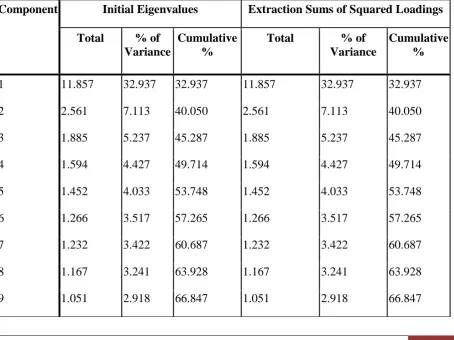
Construct validity gives an idea of the extent of coverage of dimensions of a construct. This is understood from Total Variance Explained (See Table 2) and range of factor loadings on the first factor.
TOTAL VARIANCE EXPLAINED
For this to be worked out, principal components analysis with varimax rotation ( with a cut-off eigenvalue of 1) was conducted with SPSS V.16. The total variance explained is worked out to be 66.847% ( See Table 2) which is more than the required 0.500. That apart, the loadings on the first factor ranged between 0.405 and 0.774. Thus, the construct validity of the scale is established.
TABLE NO. 2 TOTAL VARIANCE EXPLAINED
Component Initial Eigenvalues Extraction Sums of Squared Loadings
Total % of Variance
Cumulative %
Total % of
Variance
Cumulative %
1 11.857 32.937 32.937 11.857 32.937 32.937
2 2.561 7.113 40.050 2.561 7.113 40.050
3 1.885 5.237 45.287 1.885 5.237 45.287
4 1.594 4.427 49.714 1.594 4.427 49.714
5 1.452 4.033 53.748 1.452 4.033 53.748
6 1.266 3.517 57.265 1.266 3.517 57.265
7 1.232 3.422 60.687 1.232 3.422 60.687
8 1.167 3.241 63.928 1.167 3.241 63.928
TRANS Asian Research Journals
http://www.tarj.in 24
CRITERION VALIDITY
Criterion validity was found out by working out correlation coefficient between the total score of scale responses and the score on the competency outcome construct , a two- item scale for each respondent. The items in the said outcome scale are: (1) I am happy with what I am getting from my career; (2) I am happy with what I give to my stakeholders. The correlation coefficient is worked out to be 0.194 and its t-statistic is 1.34 which is not significant. This part of the research is not heartening. The main reasons might be that (1) the responses on outcome construct were taken form 30 respondents only but not on all respondents and (2) the respondents sample of 30 teacher may not adequately represent their population. It is quite paradoxical that the relationship between teaching competency and its outcome is weak! This finding leaves scope for further research on why outcome of competency is independent of competency.
LIMITATIONS
The sample respondents are from certain states of India and so their perceptions relate to local conditions and might not be applicable universally, particularly, for advanced countries like USA and those in Europe. Criterion validity statistic worked out in this research is contrary to the widely accepted theory that competency/effectiveness leads to best outcome. There might be some flaw in the sample of respondents surveyed for outcome.
SCOPE FOR FURTHER RESEARCH
This scale suits Indian context. Disconnection of academics from industry and fewer quality-focused institutions characterize Indian context. For other contexts, different scales may be developed. Definitely, the average management teacher in India is a far cry from his counterpart in advanced countries.
CONCLUSION
A research scale for measuring the competency of a management teacher is now developed. The scale consists of 36 items with 5 subscales. The subscales are teacher career development, student domain capability development, teacher personality development, student personality development and teacher‟s delivery. The subscales too have the desired reliability as reflected in the Cronbach‟s alphas which are all higher than 0.70 except one. The reliability statistic, Cronbach‟s alpha, for all the 36 items of the instrument is worked out to be 0. 929 and content validity index of it is 0.80. The total variance explained by all the items is 66.847% and factor loadings on the first factor ranged from 0.405 to 0.774. This scale can be used for any further research concerning the competency of management teachers, particularly in India.
REFERENCES
TRANS Asian Research Journals
http://www.tarj.in 25
Berg, J. H . (2010),"Constructing a Clear Path to Complished Teaching", Theory into Practice, vol 49, pp. 193-202.
Charters, W. W. & Waples, D. ( 1929), "The Commonwealth Teacher-Training Study", Chicago University Press, Chicago.
Cooper, D. R. & Schindler, M. P. S. ( 2006), Business Research Methods, ninth ed. edn, Tata McGraw-Hill, New Delhi.
Darryl, G. & Miller, P. ( 2004), "The qualifications and competencies held by effective workplace trainers" Journal of European Industirial Training, vol 28, no. 1, pp. 8-22.
Frost, P. J. & Fukami, C. V. ( 1997), "Teaching effectiveness in the organizational sciences:
Recognising and enhancing scholarship of teaching", Academy of Management Journal, vol 40, no. 6, pp. 1271-81.
Goldhaber, D. & Anthony, E. ( 2004), Can teacher quality be assessed?, Evans School of Public Affairs, University of Washington, Washington, D.C.
Gould, D. & Miller, P. ( 2004), "Qualifications and competencies held by effective workplace trainers" Journal of European Industrial Training, vol 28, no. 1, pp. 8-22.
Guollo, M. 1999, "Assessing the teaching quality to student satisfaction relationship: applied customer satisfaction research in the classroom", Journal of Marketing Theory and Practice, vol 7, pp. 87-97.
Hersey, G.L., Gargeya, V.B. & Eatman, J. ( 1996), "Are Business Doctoral Graduates Prepared to Teach?", Selections, vol 13, no. 1, pp. 17-26.
Hoffmann, F. & Oreopoulos, P.( 2009), "Professor Qualities and Student Achievement", The Review of Economics and Statistics, vol 91, no. 1, pp. 83-93.
Ironside, M, Seifert, R. & Sinclair, J. (1997), "Teacher Union Responses to Education Reforms: Job Regulation and the Enforced Growth of Informality", Industrial Relations Journal, vol 28, no. 2, pp. 120-35.
Katz, L.G. (1993), "Dispositions: Definitions and Implicaitons for Early Childhood Practices", ERIC Report, 4, ERIC Clearing House of Elementary and Early Childhood Education, Urbana, IL.
Mccombs, B.L. & Whisler, J. S. ( 1997), The Learner-Centerd Classroom and School, Jossey-Bass, Sanfransico, CA.
Moskal, P, Ellis, T. & Keon, T. ( 2008), "Summary of Assessment in Higher Education and the Management of Student Learning Data", Academy of Management Learning and Education, vol 7, no. 2, pp. 269-279.
TRANS Asian Research Journals
http://www.tarj.in 26
Nunnally, J.C. 1978, Psychometric Theory, 2nd edn, McGraw-Hill, New York, NY.
Oldfield, B.M. & Baron, S. ( 2000), "Student perceptions of service quality in a UK University business and management faculty", Quality Assurance in Education, vol 8, no. 2, pp. 85-95.
Pintrich, P.R., Brown, D.R. & Weinstien, C.E. ( 1994), Student Motivation, Cognition, and Lessions; Essays in honor of Wilbert J Mckeachie, Erlbaum, Hillsdale, NJ.
Rikvin, S.G., Hanushek, E. A. & Kane, M. ( 2005), "Teachers, School and Academic Achievement", Econometrica, vol 73, pp. 417-458.
Rowan, B. ( 1994), "Comparing teachers' work with work with other occupations: Notes on the professional status of teaching", Educational Researcher, vol 23, no. 67, pp. 4-21.
Sanders, W. L. & Rivers, J. C. (1996), "Cumulative and residual effects of teachers on future student academic achievement (research progress report)", University of Tennessee Value-Added Research and Assessment Center, Knoxville.
Simendinger, E., Galperin, B., Leclair, D.R. & Malliaris, A.G. ( 2009), "Attributes of Effective Business Teachers", Academy of Educational Leadership Journal, vol 13, no. 3, pp. 107-131.
Voss, R., Gruber, T. & Reppel, A. ( 2010), "Which classroom encounters make students happy or unhappy? Insights from an online CIT study", International Journal of Educational Management, vol 24, no. 7, pp. 615-636.
Waltz, C.F. & Basell, R.B. ( 1983), Design, Statistics & Computer Analysis, 2nd edn, FA Davis Company, Philadelphia.