Photo:
It is the rapidly gr
owing global demand for natural r
esour
ces that lies at the heart of encr
Introduction
The greatest threats to the conservation of great apes and gibbons are forest loss and poaching. These impacts are manifested in a number of ways that include habitat loss, fragmentation and degradation by logging, expanding agriculture and food production for commercial and subsistence purposes, expanding infrastructures, forest fires, expanding mining, and changed land use. Other factors such as expanding human set-tlements in, or in the vicinity of, ape habitats, growing tourism, increased hunting for bushmeat, the live pet trade, and increased spread of human diseases also contribute to the loss of great ape and gibbon populations. It is the rapidly growing global demand for natural resources including land, water,
CHAPTER 1
minerals, energy, food, and forest products that lies at the heart of encroachment into ape habitats and there are a number of different drivers underlying these trends. This chap-ter focuses on the drivers that influence the expansion of extractive industries into ape habitats, highlighting various megatrends.
By focusing on megatrends, which are major societal and transformative forces, this chapter initially presents detail on the follow-ing global drivers: economic development, demographics, globalization, and infrastruc-ture. The impacts of these drivers on miner-als and mining, biodiversity, and industrial logging are further explored as these three factors are considered most relevant to pre-senting the linkages between global proc-esses, extractive industries, and the status and welfare of apes.
The final section of this chapter inter-rogates three elements of the megatrends – trade, law, and finance – and presents examples of how these factors are being utilized to influence ape conservation. In particular, this section examines the role of EU Forest Law Enforcement Governance and Trade (FLEGT), contract law, and the International Finance Corporations (IFC) Performance Standard 6 (PS6) that prescribes biodiversity conservation to its clients.
Key findings from this chapter include:
Substantial economic growth within ape range countries and beyond over the next several decades will exert intense pressure on natural resources and ape habitats.
Substantial increases in the size of the middle classes in emerging economies will have a dramatic impact on ape hab-itats due to their consumption patterns. Impacts of globalization are likely to be
a factor in armed conflicts, especially in sub-Saharan Africa, with subsequent direct and indirect impacts to great apes and their habitats.
The impacts of global trends in produc-tion, consumpproduc-tion, and demography are interconnected. New approaches to risk strategies and management, that move beyond focusing on individual issues but rather concentrate on systems and patterns, promote alternatives to manag-ing the myriad of interconnected trends and impacts.
Industry behavior can be influenced through civil society action, particularly when targeting international financial institutions.
Recent trade agreements seek to incorpo-rate conditionalities that mitigate habitat destruction and degradation but cover-age is still limited.
Global drivers of
megatrends
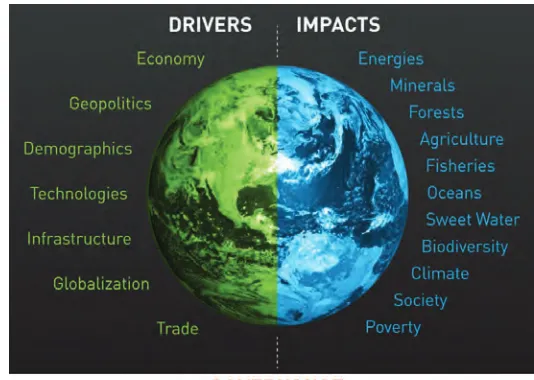
This section presents detail on a selection of global drivers of the megatrends. By high-lighting the role of economy, demographics, and infrastructure on natural resources and the environment especially in the tropical forest belt, it demonstrates the linkages between global processes, extractive indus-tries, and ape conservation and welfare. An illustration of some of these drivers and their impacts is presented in Figure 1.1. A detailed treatment of all the drivers (highlighted in Figure 1.1) is beyond the scope of this pub-lication but the three drivers elaborated on in this section are considered most relevant for their impact on extractive industries and ape habitats.
Economy
crisis at the onset of the twenty-first century developed into a recession, which in turn developed into political economic crisis and on to a global crisis of confidence. The Bank for International Settlements (often referred to as the Bank of Central Banks) concluded that the greatest risks for the economies are the developed economies, but also those emerging economies whose rapid growth was through exports. The Bank also concluded that a sustainable growth path can only be achieved by restructuring the banking and financial industry. These con-ditions create huge uncertainties in making any assessment about the long-term devel-opment of the global economy.
However, a number of predictions indi-cate that the global economy will grow by 2–4 times between 2010 and 2050 (Ward, 2011; OECD, 2012; Randers, 2012; Rubin, 2012; Ward, 2012). The variation in growth is shown to depend on the direction of policy development and implementation by both the international and national communities. Various scenarios that include business-as-usual models and other scenarios that con-sider using investments to solve problems related to resource depletion and environ-mental destruction have been articulated. Furthermore, rapid growth in the middle class will have dramatic impacts on ape habi-tats due to their consumption patterns. The growth of the middle class (defined as
house-holds with daily expenditures of US $10–100 per person in purchasing parity terms (PPP) is expected to change from 1.8 billion in 2009 to 4.9 billion in 2030. This represents an increase in purchasing power from US$21 trillion in 2009 to US$56 trillion in 2030. If current consumption patterns are maintained, it is highly likely that global resources will be unable to accommodate such levels in 20–30 years (Wilson and Dragusanu, 2008). The shifts of the middle classes during the next 40 years will be dominated by the emerging economies (Kharas, 2010).
FIGURE 1.1
Examples of drivers and impacts of megatrends
TAblE 1.1
Total GDP (gross domestic product) growth per year in the developed world, Asia and sub-Saharan Africa per decade from 2010–50
Time period Developed world Asia Sub-Saharan Africa
2010–20 1.8 5.8 4.6
2020–30 1.8 5.1 5.1
2030–40 1.9 4.7 5.2
2040–50 2.1 4.3 5.3
Ward, 2012
Consensus that there will be substantial economic growth in the emerging econo-mies is rarely disputed (see Table 1.1) and the resultant accelerating shift of global eco-nomic power alongside the newly emerged economic balance will be the driving force for global and international policy setting. With great apes and gibbons found in many of the countries that will have substantial economic growth over the next few decades, the resulting pressure on natural resources and their habitats will therefore increase sub-stantially. Extractive industries will increas-ingly expand their operations into pristine habitats that include ape ranges in order to meet the demands of the growing economy.
Strongly linked to innovations and technological development is the creation of a ubiquitous Green Economy. A Green Economy is based on principles of sustain-able development of natural resources. In comparison to a conventional economy, a Green Economy is based on resource effi-ciency and renewable raw materials, gener-ating little waste and pollution. This in turn means that there would be a substantial increase in the use of renewable energy, green buildings, clean transportation, sustainable waste management, and sustainable man-agement of water and land, to mention but a few characteristics. With predictions that the global population is using 50% more natural resources than the Earth can sustainably provide, an alternative to current economic models is being increasingly considered and debated. The potential positive impact on the habitats of great apes is enhanced in Green Economy models with more value ascribed to protecting critical ecosystems and bio-diversity in comparison to business-as-usual models.
Demographics
The global human population is likely to increase from 7 billion (2010) to 9.3 billion by
bOX 1.1
Forever Sabah
Forever Sabah (http://www.forever-sabah.com/) is a new initiative that aims to transition the Malaysian state of Sabah toward a diversified, equitable and ecologically sustainable “green” economy. Sabah’s 74 000 km2 (7.4 million hectares) on the island of Borneo harbor some
of the world’s most biologically diverse and ecologically significant habitats, including critical lowland forest habitat for the endangered Bornean orangutan and gibbon (Wikramanayake et al., 2002). Over the last 40 years, intense natural resource extraction (logging and subse-quent conversion of land to large-scale agriculture) has helped fuel expo-nential growth in Malaysia’s GDP at the cost of lowland forests. This growth is expected to continue, with the federal government proposing a new economic program intended to achieve a high-income economy by 2020 (Prime Minister’s Department of Malaysia, 2010).
Amidst relentless pressure, the state remains committed to protection of forests and biodiversity, setting aside vast protected areas and imple-menting sustainable forest management strategies. However, these initiatives lack support amongst an increasingly urban society and the business community, and have contributed to marginalization of indig-enous communities – placing additional pressure on remaining forests. Forever Sabah offers an integrated approach to reverse current trends by engaging a diverse group of stakeholders – government, communi-ties, industry, civil society, scientists, and conservation groups – to jointly develop a concept for a common sustainable future. With a national policy framework geared to stimulate business development and economic wealth, a business “model” approach was chosen as the most viable mechanism to attract investment, gain political trac-tion, and ensure the establishment of legal and policy frameworks to incentivize, sustain, and enforce a transition to sustainability. The aim is to catalyze fundamental changes in the way natural resource conservation and economic development interface. For businesses, this means instilling a focus on a “triple bottom line” – measuring ben-efits to economy, equality, and ecology. For natural resource managers, this entails engaging in sustainable enterprise approaches to fund management and restoration of ecosystems. Research and technology transfer, as well as impact accounting, will be emphasized to ensure verifiable net ecological gains.
2050 and to 10.1 billion by 2100. The pop-ulation in sub-Saharan Africa is estimated to increase by nearly 1.2 billion between 2010 and 2050 (an increase of 130%) and in Southeast Asia by nearly 200 million people (Population Reference Bureau, 2011). With population growth expected to be much more dramatic in Africa than Asia, it is likely that there will be an accelerated rate of impact on the natural environment in Africa while the rate of impact on the natural environment in Asia will be slower.
Impacts on the natural environment are further compounded when predictions are disaggregated to show the increases in rural populations. In the least developed countries the rural population will increase by 268 million, or 45%, between 2010 and 2050. The total rural population in sub-Saharan Africa is expected to increase by 300 million people, or 57%, over the same period. In comparison, in Southeast Asia the rural population is expected to decrease by 73 million people, or 22%. Rural popula-tion increases in sub-Saharan Africa and especially in Western Africa will probably cause an increased pressure on the natural resources, especially as poverty is an over-riding issue, and significant impacts on ape habitats in these countries are therefore likely to occur.
Finally, an additional component of future demographic patterns is the increase in life expectancies, which are expected to converge substantially across all the world’s regions by 2050. Currently approximately 0.5 billion people are 65 or older and this number is predicted to increase to 1.5 billion in 2050 and 2.2 billion in 2100. Impacts on the economies of governments will manifest themselves in the pensions, health, and care that are currently in the range of 10–20% of GDP but will rise to 30–40% in 2050 (Franklin and Andrews, 2012).
Globalization
One definition of globalization is “the widen-ing, deepenwiden-ing, and speeding up of world-wide interconnectedness.” However, no clear definition has emerged (see Box 1.2) and while globalization impacts the global society in many dimensions (such as demographics, politics, social and cultural changes, edu-cation, etc.), this section will explore the impact of globalization on severe conflicts in
bOX 1.2
The many faces of globalization
In 2007, the United Nations Environment Programme (UNEP) themed its February issue of Our Planet magazine on globali-zation and the environment. For some of the eminent contribu-tors, globalization provides opportunities for growth and more efficient allocation of resources. For the remainder, globalization is the main vector of environmental degradation chiefly by virtue of encouraging increased consumption. The journal issue is worthy of mention because the dissonance among its authors reflects the diversity of meanings inherent in globalization. Consequently, it is exceedingly difficult to define: no single author in the issue attempted it explicitly. Yet for those seeking a greater understanding of the connections between globaliza-tion and environmental change – and a decline in biodiversity in particular – the absence of a definition is frustrating and com-pounded by the traditional separation of the two discourses. This section explores what is generally meant by globalization.
Space and its politics
Globalization has obvious spatial connotations but economic connotations are dominant. Advocates of economic globaliza-tion – globalists – presuppose and champion a geographical spread of free markets that those skeptical of globalization – globoskeptics – dismiss as limited to the developed world. Implicitly then, globalists see globalization as more inclusive than globoskeptics. Conservationists have tended to be cog-nizant of global trends but more keenly aware of their differ-entiated impact across local spaces.
Decline of the state
For such reasons, many prefer the term ‘internationalization’ as this highlights the role of nation states in the processes linked to globalization. Globalization is an engineered process for globoskeptics while being a “natural” process for globalists that is best left unfettered by government regulation. The two camps differ in their assessment of the benefit of deregulation. Historically, the conservation movement has advocated for greater regulation, which is most notable in the expansion of international treaties since the 1970s.
Political agendas
Globalists are often associated with the neoliberal economic thinking of the political right, whereas globoskeptics tend to belong to the left of the political spectrum. However, there are exceptions to this rough guide. Some members of the left accept that globalization has changed the role of the nation state but have judged this to be a cause for lament rather than celebration. They see the responsibility for negative externali-ties that markets generate left to governments to solve with costs that burden citizens more than business. From this per-spective, global markets frequently fail rather than flourish with calamitous effects on the environment.
Movement
Globalization is frequently taken to mean movement of goods, people, capital and ideas that is more intensive or more exten-sive than any seen historically. Many perceive levels of immigra-tion, the influx of transnational companies into local markets, the penetration of foreign cultural products, and so on, as more marked than before (Smith, 1990). Of course, much move-ment is subject to control in the form of state regulation or deregulation. Clearly other forms – such as the movement of
greenhouse gases or the spread of introduced species – prove difficult, if not impossible, to control.
Beyond interdependence
The recent global financial crisis has underlined the financial and economic connections between different parts of the globe, but more importantly the degree to which collective action is required by governments to solve problems that spill over state boundaries. However, the various strands of globalization theory look beyond governmental interdependence to other dimensions of globalization, such as the growth of civil society (Martell, 2007).
Interconnectivity
New types of interconnection among and between populations rather than governments and markets are closely and power-fully associated with globalization. These understandings are not merely the result of movements of people but of tech-nological advances in the field of telecommunications. The increased speed and volume of information transfer since the onset of the Internet appears to negate the importance of physical distance. It has become possible to envision social relations as stretched across vast expanses of space.
Global consciousness
Developments in television broadcasting allow for news and events to be viewed virtually simultaneously through satellite links in disparate places across the world, thus amplifying the perceptions of global interconnection. Not only do advances in telecommunications help to broaden audience horizons, they help to engender a global consciousness. Transnational move-ments, including environmentalist and anti-globalization vari-ants, can also arouse precisely this type of consciousness.
Inequality and culture
Increases in movement and interconnection across space impact cultures to varying degrees. With magnified expo-sure to foreign ideas, products, and people, cultural conver-gence is perceived by many but cultural hybridity by others. Anxieties arise over both the loss of cultural uniqueness and the domination of Western and especially American cultures over others. Remarkably similar worries plague conserva-tionists keen to protect ecosystems from invading species. Ironically for local populations, the inundation of international environmental organizations tasked with environmental pro-tection may itself be seen as an invasion.
Neo-imperialist understandings of globalization gain potency in certain quarters, among them anti-globalization movements. Such groups point to the unevenness in the distribution of the costs and benefits of globalization. Elsewhere, concerns mount for the overall socioeconomic consequences of globalization. Globalists interpret the trends as an aggregate improvement in population wealth but detractors point to growing relative poverty in the same figures (Hirst and Thompson, 2000).
Global governance
Asia and Africa and the subsequent impact on apes and their habitats. An additional treatment of globalization and the environ-ment is explored in Box 1.2.
Globalization has the potential to increase both armed and non-armed conflict over natural resources. Over the last 20 years there have been severe armed conflicts in Africa and Asia that have impacted the habitats and conditions of great apes and gibbons living in these regions. Since 1946 all great ape range states, except for Tanzania, have experienced some form of civil con-flict. Post the cold war, civil wars occurred in 40% of the great ape states (Benz and Benz-Schwarzburg, 2010). In the last 50 years there has been an increase in the propor-tion of global internal armed conflicts in sub-Saharan Africa and this upward trend is likely to continue. With warring parties utilizing tropical forests for protection, and also to harvest and trade forest resources that in turn finance conflict, the impact on great ape populations in these regions is a reality. Examples include dramatic declines in eastern lowland gorilla populations in Kahuzi Biega National Park in Eastern DRC (Democratic Republic of Congo) and mas-sacring of mountain gorillas in the same region (Yamagiwa, 2003; Jenkins, 2008). Linkages to the extraction of valuable min-erals from areas that include ape habitats have been cited as a driver of the conflict in the region.
Factors that exacerbate and potentially initiate conflict are linked to both the scarcity and abundance of certain natural resources (Cater, 2003). Other factors such as poverty, poor education, ethnicity, inequality, cor-ruption, and external aggression also con-tribute to the onset and perpetuation of armed conflicts. Additionally, weak govern-ment effectiveness, a lack of rule of law, and low control of corruption increase the likeli-hood of a country descending into civil war by 30–45% (World Bank, 2011a). The use of
increased wealth and growth to implement necessary reforms that reduce poverty and improve education and security has been cited as a critical factor to prevent future con-flict. A significant proportion of the 1.5 billion people currently living in countries affected by or recovering from organized crime and political violence depend on access to and use of natural resources for their survival. This in turn has further impacts on natural resources as compromised communities unsustainably utilize resources to ensure their survival during periods of conflict and post conflict (McNeely, 2007). This section high-lights the necessity of monitoring future conflicts especially in great ape range states in sub-Saharan Africa in order to better pro-tect the habitats and populations of great apes in the region.
Infrastructure
Physical infrastructure is considered critical to enable economic growth and develop-ment. Infrastructure is not only an issue of economy and physical assets through the opening and connecting of markets, con-necting jobs and improving competitive-ness, it also improves the overall quality of life in the form of increased mobility, better housing, safer lives, and reductions in pov-erty. Infrastructure development is thus per-ceived as contributing to better economies and society; however, some investments have negative impacts on land use and the environment. For example, investments in transport infrastructure increase emissions and pollution, and lead to increased and often times uncontrolled exploitation of natural resources (Wright, 2010).
focus of planning, as well as the needs for the next 50–100 years rather than just working to meet current demands.
Countries in tropical Africa and South-east Asia are expected to capitalize on the global demand for their commodities driven by economic growth and demographic developments. However, current transpor-tation networks constitute a constraint on these ambitions; for example, Indonesia has the lowest road density in all of Southeast Asia, and the government is not surprisingly prioritizing the development of infrastruc-ture to unlock the economic potential of its natural resource base (Moser, 2011). With future investments by the World Bank and African Development Bank aimed at pro-viding assistance that will target connecting rural African populations (some 75% of the total population) with markets, similar to the planning in Southeast Asia, the impact on great apes and gibbons is likely to be signifi-cant. Their habitats will become more frag-mented as a result of increased road networks, which will in turn increase the exploitation of natural resources as previously inacces-sible areas open up. The resulting increases in forest degradation and fragmentation, hunting, and poaching of animal species are explored in Chapter 7.
Impacts of megatrends
Although this section focuses on explor-ing some of the impacts of the drivers and their subsequent role in the status of great apes and gibbons, there is no absolute divi-sion between the two. When impacts reach a tipping point they in turn become drivers of developments, predominantly in unfavo-rable directions, and often no clear bound-aries exist to distinguish between cause and effect. Maintaining the focus on the interface of extractive industries and ape conservation means that this section only explores the following impacts of
mega-trends: minerals and mining, biodiversity, and industrial logging.
Minerals and mining
Minerals and metals underpin the global economy with sectors such as transport, energy, housing, health, and agriculture heavily dependent on the raw materials that are extracted around the world. Due to growth in economies and the human popu-lation, there has been a tremendous increase in the consumption of minerals over the last 100 years. Over the period 1900–2005, the extraction of construction materials grew by a factor of 34 and ores and industrial min-ing extraction by a factor of 27 (UNEP, 2011a). A number of scenarios for future demand for minerals for 2050 have been analyzed. If business-as-usual models prevail, total resource use by 2050 will be some 140 billion tons per year. This means that from an extrac-tion rate of 8–9 tons/capita/year in 2005 it will increase to 16 tons/capita/year in 2050. Extraction at such levels is considered to be unsustainable, and if investments in sustainable-oriented innovations are made then predicted substantial structural changes in industry consumption and production could generate far more per unit of resources than the current rates (UNEP, 2011a).
also the strong political support of develop-ments in this direction (African Union, 2009). An additional dimension of minerals and mining to the environment is the increase in the use of lower grades of minerals and its impact on waste and energy. This is illus-trated by the decline in average global lead grade from about 0.75% in 1998 to 0.5% in 2009 (ICMM, 2012). The extraction of lower grade ores and minerals requires more energy and results in increased waste pro-duction. In the 1940s, the production of 1 ton of copper generated 25–50 tons of waste, whereas current production results in 250 tons of waste per ton of copper. Increasing energy requirements to extract relevant ores are likely to be prohibitive, especially for elements such as aluminum, iron, silicon, magnesium, and titanium. Furthermore, many of the new environmental technologies such as wind turbines, energy efficient light bulbs, and electric car batteries are dependent on the use of a range of rare earth metals (REM),
which constitute a limited resource, pre-dominantly extracted from China. This will have repercussions on international ten-sions for resources and there will continue to be a scramble for resources, especially in Africa (Bloodworth and Gunn, 2012).
A number of ape range states are key producers of minerals, such as Guinea for bauxite and the DRC for cobalt. The establish-ment of mining concessions in ape habitats has known impacts on habitat fragmenta-tion and loss. Furthermore, mineral wealth in poorer countries is often linked to pov-erty and instability, which is considered to be a driver for informal artisanal and small-scale mining (ASM) on which millions of people are economically dependent. The direct and indirect environmental impacts in ape habitats of both industrial-scale mining and ASM are explored in greater depth in Chapters 5 and 6, and the increas-ing extent of exploration and exploitation will further expand into ape ranges.
Biodiversity loss and
deforestation
Understanding and knowledge of biodiver-sity is incomplete; current estimates put the total number of species on earth at between 2 and 100 million, of which some 45 000 have been assessed. Of the assessed species, 2% are already extinct, 7% are critically endan-gered, and 11% are classified as endangered (Convention on Biological Diversity (CBD) Secretariat, 2010). The importance of bio-diversity for human welfare is not fully understood and species such as cockroaches could, for example, provide the key to con-trolling bacterial infections and outbreaks. Cockroaches have nine molecules that are toxic to bacteria and, with increasing levels of resistance to antibiotics (Bouamama et al., 2010), the opportunities to exploit solu-tions from nature (and in this case from cockroaches!) are likely to be increasingly critical.
However, significant declines in biodi-versity are expected over the next decades. Terrestrial biodiversity, measured as mean species abundance, is projected to decrease by an additional 10% by 2050 with mature forests in particular decreasing by 13% over that period (OECD, 2012). The driving forces for this decline will be as a result of expansion of agriculture and commercial forestry, infra-structure development, human encroach-ment, fragmentation of habitats, climate change, and pollution. The greatest losses in biodiversity will be in Africa, Latin America, the Caribbean, and Asia. International trade has been associated with declines in bio-diversity stocks as consumers in developed countries increase demand for commodi-ties produced in developing countries which have high levels of biodiversity.
Deforestation is expected to have a par-ticularly significant impact on tropical bio-diversity. Under business-as-usual scenarios, severe impacts on extinction of species by
deforestation were detected for Latin America, sub-Saharan Africa, and Southeast Asia. Depending on the methodology employed, out of 4500 forest-dependent species, defor-estation will cause the extinction of mammal and amphibian species to the range of 9–27% by 2100 (Strassburg et al., 2012). In fact, gross yearly deforestation in Africa is 32 000 km2/ year (3.2 million ha/year) and in Asia it is assessed to be 24 000 km2/year (2.4 million ha/year), although there is no net loss for the region due to the large plantations being developed in China. Gross forest loss is occurring primarily in the tropical regions with forest gains in other climatic domains (FAO and JRC, 2011).
As great apes and gibbons primarily inhabit tropical forest in Asia and Africa, the impact on their survival is likely to be significant (see Chapter 3). There is, however, no clear consensus on the causes of deforesta-tion, although these include subsistence farming (Sanz, 2007; Kissinger et al., 2012), commercial large-scale farming including increased demand for biomass for biofuels and edible oils, and shifting cultivation (FAO, 2010a, 2010b). Extractive industries often require substantial infrastructure not only to access viable deposits of minerals and metals or remove valuable timber but also to transport the commodity to markets. In this way, extractive industries contrib-ute to increasing fragmentation of tropical forests and loss of biodiversity. This was highlighted in the development of the Chad– Cameroon oil pipeline that not only cut through ape habitat but also impacted the indigenous Bagyéli community whose sacred sites were threatened and many of whom had to move their camps (Nelson, 2007).
that zero deforestation will be achievable in the foreseeable future, especially considering increased demand for food and biofuels, and the subsequent increase in conversion to croplands to meet these demands.
Industrial round wood
Globally, over 2 million people are estimated to be employed by the forestry industry in the tropical timber sector, over half of these in Southeast Asia (FAO, 2011a). In this region forestry contributes almost US$20 billion to the region’s economy annually, whereas for the Congo basin, the figure is US$1.8 billion which, although smaller than that for South-east Asia, represents a similar proportion of GDP (FAO, 2011b).
Demand for industrial round wood, which includes industrial wood in the rough (i.e. saw logs and veneer logs, pulpwood, and other industrial round wood) is likely to increase from 1.5 billion cubic meters to 2.3 billion cubic meters by 2020 (FIM, 2012) and 3.9 billion cubic meters by 2030 (Indufor, 2012). Key drivers in the increased demand for industrial round wood include population growth, with much of the expansion expected to occur in emerging markets such as India, China, Latin America, and the Caribbean, as well as Africa. Demand from emerging economies will constitute the larger share of increased demand for round wood despite a lower per capita consumption of wood products compared to mature markets. Other drivers include economic growth, where round wood consumption follows the increasing growth in GDP as a result of higher standards of living. However, when GDP reaches a certain level, consumption of forest products and wood starts to decrease as people switch from traditional paper-based products to electronic products.
In 2012, wood from plantations was supplying approximately 33% of the total
global industrial round wood demand. This is expected to be in the region of 24–35% by 2050. With the remainder of the wood obtained from tropical and boreal natural and semi-natural forests, an increase in pressure on these resources is expected and, with access to boreal forests limited, pres-sure will mount in areas that are easier to access (Indufor, 2012). As of 2010, approxi-mately 116 million hectares of the equatorial forests in Africa were allocated for the pro-duction of wood and non-wood products. Forest coverage has continued to decline since 1990 in Central, West and East Africa where Gorilla and Pan spp. are found (FAO, 2011b). In Indonesia, a similar scenario emerges with over half of the remaining for-ests earmarked for production (FAO, 2010a, 2010b) of which half again are primary for-est, the majority in Papua and Kalimantan, the latter a stronghold for the endangered Bornean orangutan (Pongo pygmaeus). As increased supply for the demand for indus-trial round wood is predicted to come from natural sources, the overlap with ape habitats is already a reality and will increase. This interface is further explored in Chapter 4.
Interconnections,
complexity, and a new
paradigm?
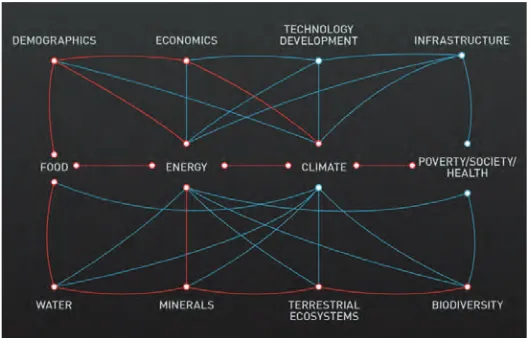
Current scientific knowledge of the impacts of megatrends and options for substantial mitigation are known and understood (FAO, 2009; Lambin and Meyfroidt, 2011; WWF, 2011; Franklin and Andrews, 2012), however little in the way of meaningful implementation that can lead to the funda-mental changes required is occurring. This is further compounded when one acknowl-edges that the impacts of one factor create a chain reaction on to other factors. The driv-ers and impacts of megatrends explored in the previous section are explicitly linked to impacting apes and their habitats, but these also further influence, to mention just a few, climate change, poverty, and food consump-tion. These interconnections are complex and a simple illustration of the change in demo-graphics is used as an example to demonstrate these interactions (Figure 1.2).
Figure 1.2 presents, through the con-nections illustrated by the red line, how the demographic megatrend contributes to eco-nomic growth as a result of increasing demand and size of workforce. The growing economy will in turn generate more consumption and increased emissions contributing to climate change. The increased human pop-ulation will also result in increased food demand, which together will influence the upward trajectory of energy demand. This will also contribute to changes in the global climate as increased energy consumption increases emissions of greenhouse gases. Further impacts of increased food consump-tion will be manifested in increased con-sumption of fresh water and the knock-on effects of increased energy consumption will lead to increases in the use of minerals and biomass energy, further impacting terres-trial ecosystems and biodiversity.
FIGURE 1.2
Example of megatrend interconnections
While the simple interconnections can be identified, there is limited knowledge of the extent of these impacts and exactly where the tipping points into drivers occur is poorly understood. Furthermore, defining interconnections in situations with several megatrends occurring in parallel is more complex and current knowledge is limited.
A systems and paradigm shift is con-sidered necessary with new approaches to risk strategies and management moving beyond focusing on individual trends but instead concentrating on systems and pat-terns. Information is predominantly dealt with in silos but the paradigm shift would require knowledge to be nested and net-worked thereby promoting alternative premises to managing the myriad of inter-connected trends and impacts.
Trade agreements,
finance, and contract law
reconciling extractives
and conservation
The previous discussion highlighted the impact of global drivers of increasing glo-balization, human populations, economies, and infrastructure on mining and minerals, biodiversity and industrial round wood. Considering the necessity for governments to exploit opportunities for economic devel-opment, creating opportunities to influence policy- and decision-makers to consider conservation of apes and their habitats is challenging. This is further compounded when impacts are the result of interactions among a number of factors and contexts are continually evolving.
With global demand and extraction of minerals, mining, and logging expected to increase significantly, this section presents a number of existing and theoretical frame-works that encompass trade, finance, and contract law. It showcases examples of how
sustainably sourced timber from tropical forests is increasingly considered in trade, highlights opportunities for conserving apes through contract law that interfaces with extractive industries, and concludes by pre-senting the challenge for multilateral finance institutions to reconcile environmental con-servation and economic development.
European Union Forest Law
Enforcement Governance and
Trade (FLEGT) Action Plan
Considering the impact of consumers on tropical forests, there has only recently been the recognition that policies within tropical timber consumer countries could be a potent tool for driving change in environmental and social standards within the tropical timber sector, in particular with regard to addressing the myriad of issues associated with illegal logging. It is estimated that, between 1990 and 2005, Africa lost over 570 000 km2 (57 million hectares) of forests, representing 1.5% of the world’s total for-ests. Deforestation and forest fires are recog-nized as significant factors, but the inability of forest agencies to manage these resources in a sustainable manner due to financial limitations is also considered to be part of the problem (Powers and Wong, 2011).
Policies that seek to ensure that timber is produced in accordance with producer country laws, including wildlife, forestry, and indigenous people’s rights, are being promoted as avenues that could make a sig-nificant contribution to addressing one of the major threats to wildlife in tropical forests.
system with capacity-building measures for verification and enforcement in producer countries. Other global initiatives by the World Bank are Africa Forest Law Enforce-ment and Governance (AFLEG) and Europe and North Asia Forest Law Enforcement and Governance (ENAFLEG). One funda-mental difference between these initiatives and FLEGT is the incorporation of the trade component. The World Bank supported initiatives do not provide binding power to require countries to take action or face sanc-tion. Despite showing initial promise there has been little progress on these initiatives since their inception, just over and just under 10 years ago respectively (Powers and Wong, 2011).
Within developed nations the state is a major purchaser of goods and services, accounting for an estimated 10% of GDP (Brack, 2008). Many states have sought to use this purchasing power to ensure that the public sector purchases only legal and sustainable timber. These include Belgium, Denmark, France, Germany, Japan, the Netherlands, New Zealand, Norway, and the UK. Within the UK, certified timber now accounts for 80% of the timber prod-uct market (Moore, 2012), a substantial portion of which is thought to be driven by public procurement policies which can act as major drivers for suppliers (Simula, 2006). Procurement policies have the advantage of being more easily legislated for and imple-mented than the other methods described above.
The FLEGT process is realized through Voluntary Partnership Agreements (VPAs) negotiated on a country-by-country basis with Ghana one of the earliest to sign up, in 2009. Since then Cameroon, Liberia, Repub-lic of Congo, and Indonesia are amongst those who have signed VPAs. Each agree-ment is country specific, defines concepts of legality and standards of production and verification with producer countries
com-mitting to legislation changes as required, and are sovereign, legally binding trade agreements. Once VPAs have been signed, exporter countries receive financing from the EU to develop appropriate systems to regulate the forestry sector including trac-ing products and licenstrac-ing their export to the EU. These systems have to be in place after an allocated period, from which point only licensed timber is permitted to enter the EU. Benefits to the exporting countries are improved access to EU markets, EU political and financial reinforcement of forest governance, increased revenue from taxes and duties, increased development assistance from the EU, additional enforce-ment tools to combat illegal activities, and improved reputation by demonstrating a commitment to good governance (Powers and Wong, 2011).
Currently a small portion of timber traded internationally is licensed and/or verified as being legally harvested – approx-imately 8% of forests globally (FAO, 2010a, 2010b); a fact recognized in measures taken by the EU and United States to try to ensure only legal timber enters their markets. In the United States this takes the form of the Lacey Act, which extends the concept of
illegality of goods imported or exported in the United States to include definitions of illegality in their country of origin, making it unlawful to: “import, export, transport, sell, receive, acquire or purchase in interstate or foreign commerce . . . any plant taken, possessed, transported or sold . . . in viola-tion of any foreign law” with the onus on importers to verify that their goods are
legitimately sourced. Within the EU this comes under the Timber Regulation. It requires due diligence, which places the responsibility for verifying legality on to the supplier that initially places the prod-uct on the EU market. Timber produced under a VPA is automatically approved. This system only came online in 2013, so how it functions remains to be seen. However, areas of concern relate to possible corrup-tion and the ability of companies to have timber verified as legal despite not meet-ing the relevant criteria and standards (BBC, 2013).
Ultimately, all measures driven by con-sumer countries (in common with certifica-tion schemes) are dependent on the quality and implementation of the standards and criteria they use. They are also vulnerable to weak enforcement, fraud, and leakage to other consumer nations that are not part of FLEGT. Properly implemented, however, they have the potential to be a potent driver promoting legal and sustainable produc-tion of tropical timber as well as improving forest governance in producer countries. The use of such initiatives can also be extended to mining; however, consumer-orientated initiatives are less likely to be effective where the supply chain between consumer and mine is longer and more convoluted, and determining the chain of custody becomes impossible.
Conserving apes through
contract law
A number of major international laws gov-ern the lives and treatment of apes, of which the most important is the Convention on International Trade in Endangered Species of Wild Fauna and Flora (CITES). In rela-tion to regulating the timber industry, it is increasingly being used by states to ensure that trade in listed timber species is legal,
sustainable, and traceable. Around 350 tree species are listed under CITES Appendices, and trade in their products is therefore sub-ject to regulation to avoid utilization that is incompatible with their survival. CITES also partners with the International Tropical Timber Organization (ITTO) to promote sustainable forest management and to build the capacity of developing states to effectively implement the Convention as it relates to listed tree species. However, enforcement is uneven; even within certain states of the United States differences exist. In the United States, implementation demands federal, state, and local coordination and monitor-ing US practice is itself complex. The reality is that much of ape conservation is governed by contracts and informal agreements and this is most developed in the extractive indus-try sector.
There is acknowledgment that extractive industries are moving away from traditional strategies and toward partnership working through engagement with public and pri-vate institutions. Examples are highlighted throughout this publication, demonstrating various successes that have shifted industry behavior as a result of the concerted effort of visionary individuals and networks of nongovernmental organizations (NGOs). This section focuses on how NGOs establish effective “laws” by leveraging the contract approach. Although lessons must be learned from engaging in legal proceedings, the real-ity is that a majorreal-ity of issues arising, tied to great apes and gibbons, occur outside of a courtroom through contracts, legislative, or executive action. However, laws that gov-ern the conservation of apes and practice of extractive projects emerge from a com-bination of public and private law, as well as domestic, foreign, and international law. They therefore share a common group of legal documents and sources including pri-vate and public contracts, loan agreements, regulations, executive documents such as
“
There isacknowledgment that extractive industries are moving away from traditional strategies and toward partnership working through engagement with public and private institutions.
Presidential Directives and white papers. It is at the interface of the laws that govern apes and the extractive sector where the conservation and welfare of many apes is determined and typically the details of apes in the extractive sector are woven into con-tract clauses.
Even though contracts play a central role, in how the tendering of projects is shaped by government regulations, often procurement laws are also relevant. With mediation occur-ring in the rules governing tendeoccur-ring to construction and operation of projects, the question of rights and their realization is included in this process and interacts with extractives’ sites in many ways. The process of procurement is not the realm of private law and private players only, with govern-ments and international organizations both involved throughout. Furthermore, the laws of international organizations also play a key role. For instance, the World Bank’s Multilateral Investment Guarantee Agency (MIGA) might be more important than governments and certain private players. MIGA issues insurance for private parties to a contract (MIGA, 2013b).The Agency is part of the World Bank Group and presents a promising area for promoting the conser-vation of apes because they insure private corporate behavior (MIGA, 2013a). However, the political risk insurance (PRI) provided by MIGA excludes regulations enacted by governments that are non-discriminatory and may result in regulations that are con-sidered expropriation from the investor’s perspective (Comeaux and Kinsella, 1994). This likely affects the number of mining companies that use the MIGA PRI. This, however, does not diminish the potential that a condition tied to conservation could readily cohere and it may be effective to tar-get the Agency to secure ape conservation and welfare.
The current law of contracts is part of a wider effort to assert anti-neoimperialism
and NGOs are often the site of attack and defense. They provide a communication function by letting others know what is going on. Box 1.3 showcases the ability to bring NGOs to a single but broad issue resulting in an increased focus on contract and financial expertise. Having said that, as a great deal is known of the legal facets of the extractive sector, it can serve as a model from which a number of lessons can be drawn for the protection of apes. These include:
1. Leverage: By mapping all of the
domes-tic and foreign as well as public and private players involved in a project, one can determine who and how to target participating institutions so as to advance public values.
2. Responsibility: Despite the large
num-bers of players in a project, one can target the specific one(s) with primary responsi-bility over a project. For instance, although 50 international banks finance the bulk of projects, realistically only 10 or so take the lead.
3. Repeat player: Related, a movement away
from targeting states has happened over time. For globally oriented NGOs, it is more efficient to target private actors and international organizations. Both are often involved in projects in far reaching parts of the globe.
4. Choose your issue: Because different
organizations of a major project have dis-tinct roles and responsibilities, it is impor-tant to choose a Bank Group, which is a more likely ally when it comes to apes than are governments.
5. Litigate sparingly: Litigation takes
enormous time and other resources. Oftentimes the payout in a successful case is not worth much. The most effec-tive international legal forum is the International Centre for the Settlement of Invest Disputes (ICSID), which is part
“
NGOsestab lish effective “laws” by leverag-ing the contract approach.
bOX 1.3
Extractive Industries Transparency Initiative (EITI): a model for great ape conservation?
The Extractive Industries Transparency Initiative (EITI) offers a model for the reporting of public-interest information, with the active participation of civil society groups in many developing countries. This initiative has been put into practice by more than 30 governments, shortly to be joined by the United States. Although the long-term effects of the EITI have yet to be determined, the initiative has been successful in attracting the endorsement not only of governments but also of civil society groups and multinational extractive companies (EITI Secretariat, 2012b). Could this initiative have relevance for the conservation of apes and ape habitat?
The theory behind the EITI, which has inspired legislation in the United States (Securities and Exchange Commission, 2012) and regulatory proposals in the European Union (European Commission, 2011), is that accurate and timely information will enable citizens to better hold their governments and extrac-tive companies to account. The core activity of the EITI is the production and distribution of reports in each country, under the auspices of a “multi-stakeholder group” (MSG), which pro-vides detailed information on revenue payments by compa-nies and receipts by the relevant states (EITI Secretariat, 2012a). The EITI is now in the middle of a debate about its future. The issues at the center of the debate include questions about other kinds of information that should be included in EITI reports, how countries should be incentivized to broaden and deepen the initiative beyond the minimum requirements of the rules, and how to better connect its work in each country to broader discussions about governance and public policy.
Is EITI relevant to conservation issues?
EITI is designed to address the specific problem of managing natural resource revenues: it does not include conservation issues within its ambit and is unlikely to in the near future, at least at the international level. It does not currently cover logging or other industries apart from oil and mining, which involve the conversion of natural forest. One country (Liberia) has chosen to report on logging revenues (LEITI Secretariat, 2010), but it is not assessed by the EITI Board on its reporting in this area because it lies outside the international require-ments of the initiative.
That said, countries can choose to report on any area under the EITI and there is nothing to stop a country extending EITI reporting to conservation issues if it chooses. Due, in part, to the initiatives of some countries to move beyond the minimum rules, the focus of EITI is starting to broaden. The EITI Board is considering new systems of evaluation, which would give governments a reputational incentive to extend the scope of EITI reporting within their countries. It cannot be ruled out that at some point in the future, some countries could opt to include the impact of extractive activities on the conservation of natural resources in their EITI reports and have this form of reporting evaluated by the Board. The form this reporting should take will likely be hotly debated by EITI’s supporters: a conservation NGO in a central African country, for example,
might take a wholly different view of what such reporting should involve, and what the consequences of failing to meet estab-lished standards should be, from that of a mining company hoping to explore for minerals in a forested area of that country.
The centrality of civil society participation to EITI
There are safeguards to ensure the participation of local civil society groups in the country concerned, although their effec-tiveness depends on the attitude of the government and the ability of civil society activists to make their voices heard. Almost all civil society groups value the ability to engage within the umbrella of protection created by EITI, in which they can engage with government and company officials, but many are frustrated by its limited effect, so far, on underlying problems of poor governance. The rules on data quality in EITI are quite loose, reports from some countries in West and Central Africa have often been late, and there have been par-ticular problems with the quality of some government data (Ravat and Ufer, 2010).
Is EITI relevant to great ape conservation?
A weakness of the EITI in some countries is that it has little connection with the communities in areas of natural resource extraction. A conservation initiative that involved local com-munities in forest areas, not just in monitoring activities but also in the decision-making structures of the initiative, might gain some useful legitimacy from being part of an international reporting system like the EITI. Weighed against this advantage, however, are the very long and complex negotiations that would be necessary to create such an international system: the EITI was first mooted in 2002 and can only be said to have reached a critical mass of country reporting around 2011–12.
Conclusion: what does the EITI offer for ape conservation?
of the World Bank Group and hears disputes mainly over projects. NGOs have no standing to sue; oftentimes they have not even been able to participate in a hearing.
6. International public organizations:
Groups such as the World Bank or export credit agencies like the Export– Import Bank have been a fertile area for rule-making and implementation.
The approach employed in the extrac-tives sector is generally to make little men-tion of internamen-tional agreements. Instead, the target for change is usually a repeat player with sway over how a project happens. Therefore the integration of extractive indus-try and ape conservation NGO networks presents a case that is potentially beneficial to both groups.
NGOs in the extractive industry sector focus on the myriad of public international law institutions to achieve change; these include the International Finance Corpora-tion (IFC), the African Development Bank (AfDB), the Asian Development Bank (ADB), the European Bank for Reconstruction and Development (EBRD), the European Invest-ment Bank (EIB), and the Inter-American Development Bank (IDB). Their strategies focus on either internal or external reforms to the international institution. Internal reforms target governance-incorporating issues that include transparency, account-ability, and democracy/participation; while external ones address the impact of the international institution on a broader polit-ical and environmental landscape. These may target a policy or project of which three common areas are the specific projects (e.g. extractive industries, power, dams, and transportation), debt relief, and struc-tural adjustment. The mechanism for imple-menting meaningful change often happens in partnership with government institutions. Important NGO success stories include the
establishment of the World Commission on Dams (WCD) (WCD, 2000) and the World Bank Inspection Panel (World Bank Group, 2011).
NGOs utilize a number of tools to effect change and these include networking between local, national and international civil society actors, protest, lobbying, use of media, public–political mobilization, build-ing local capacity, and engagbuild-ing in legal action. Other tools incorporate “naming and shaming” strategies, independent research, and also diplomacy to educate the general public and government representatives on the impacts of international financial insti-tutions and ultimately influence contract detail. Going forward, the fields of apes and extractives might find themselves allies. Each brings with it capital, moral or strategic advantage, and extractives can utilize the experiences from NGO networks that are making the law bottom-up to resolve frus-trations over the implementation of basic agreements or having to use the courts. From a resource perspective it is best to approach NGOs, integrate strands, and create enforce-able contracts.
International Finance
Corporation and
Performance Standard 6
vation and Sustainable Natural Resources Management – it was stated that “in areas of critical habitat, the client will not implement any project activities unless the following requirements are met: there are no measure-able adverse impacts on the ability of the critical habitat to support the established population of species . . . or the functions of the habitat [and] there is no reduction in the population of any recognized critically endan-gered or endanendan-gered species” (IFC, 2006).
Given the nature of large-scale mining, which involves the removal of all vegetation and top soil, the construction of wide roads and almost continual use of heavy machin-ery, it would be virtually impossible to guar-antee the protection of chimpanzees and other apes, or almost any critically endan-gered (CR) or endanendan-gered (EN) species, with-out placing large areas of a number of mining concessions off limits.
action and conserving biodiversity continues to present conflicting realities. Alternative responses that still enable extraction to occur in areas of environmental value are emerg-ing and beemerg-ing integrated into lendemerg-ing struc-tures. This section focuses on the experience of the IFC, a member of the World Bank Group and the largest source of multi lateral private sector funding. The IFC “further[s] economic development by encouraging the growth of productive private enterprise in member countries, particularly in the less developed areas, thus supplementing the activities of the International Bank for Recon-struction and Development” (IFC, 2012a).
Through eight performance standards (PSs), the IFC manages its reduction in lend-ing exposure to environmental and social risk. In 2009, the Board of Executive Directors of IFC requested a review of all the PSs. At the time of the review PS6 – Biodiversity
The IFC approved revised PSs in January 2012 and two standards in particular affect biodiversity and great apes – PS11 and PS6.2 PS1 generally requires the IFC clients to conduct social and environmental impact assessments and to develop management systems and action plans to respond to environmental impacts. PS1 also requires that clients follow a “mitigation hierarchy” in addressing environmental impacts. The mitigation hierarchy states that the first objective is to “avoid” risks and impacts, but that “where avoidance is not possible” the client must “reduce, restore, or compensate/ offset for risks and impacts.” Thus, PS1 estab-lishes offsetting as a key environmental response measure for IFC projects. PS6 pro-vides the framework for responding to the risks and impacts to biodiversity identified by the assessments required under PS1. As with the 2006 version, the 2012 version of PS6 is organized around a classification system of three habitat types: Modified Habitat (MH), Natural Habitat (NH), and Critical Habitat (CH), where the latter can be a subset of either modified or natural habitat. Annex I summarizes how each of these habitat types is defined by the IFC. Biodiversity and endangered species concerns are addressed in the context of these habitat types, which are redefined in the 2012 version.
In addition to laying out the habitats framework, PS6 also restates the mitigation hierarchy described in PS1. With respect to biodiversity offsets, PS6 notes that offsets should achieve conservation outcomes that can “reasonably be expected” to achieve no net loss (NNL) of biodiversity, though in the case of CH, offsets must not only achieve NNL, but must achieve a net gain. The revised PS1 and PS6 therefore resolve the problem for projects that will impact EN and CR species by creating an offset option.
A report (Kormos and Kormos, 2011a) submitted to the IFC noted that the revised performance standards limited the definition
of CH via the concept of discrete manage-ment units, which would have the effect of excluding wide-ranging species such as great apes. The IFC attempted to address this issue by including a footnote to the Guidance Note for PS6, which states:
In terms of the definition of Tier 13 habitat, special consideration might be given to some wide-ranging, large EN and CR mammals that would rarely trigger Tier 1 thresholds given the application of the discrete management unit concept. For example, special consider-ation should be given to great apes (i.e., family Hominidae) given their anthropological and evolutionary significance in addition to ethical considerations. Where populations of CR and EN great apes exist, a Tier 1 habitat designation is probable, regardless of the discrete manage-ment unit concept. (IFC, 2012b, p. 24)
Offsets Program (BBOP) has developed guide-lines about biodiversity offsets, published several case studies, and continues to imple-ment additional research (see Chapter 5).
Furthermore, the performance standards, in most cases, apply to relatively advanced projects – towards the end of feasibility studies – when significant environmental damage may have already been caused. The inclusion of legal requirements for compa-nies to comply with IFC PS6 from the onset, regardless of when they apply for funding from IFC, could impact industry action at the pre-feasibility stage. Currently any enforce-ment of reducing social and environenforce-mental impacts at the pre-feasibility stage is depend-ent on individual company policies or if there is IFC investment at the exploration stage, which is not common.
The importance of major lending insti-tutions attaching conditions that seek to mitigate environmental and social impacts is proving to be a key avenue to ensure that extractive industries integrate these con-siderations. The recent review of PS6 and subsequent changes highlights the complex-ity of resolving species conservation of CR and EN species with extractive industries, which is further compounded if funding is not sought from IFC early in the project cycle. Consultation with civil society and the pri-vate sector continue to inform this process. Furthermore, banks that fall outside of multilateral oversight have less incentive to implement standards that may affect their profit margins and do not oblige environ-mental and social considerations to be part of the lending conditions.
Conclusion
Global drivers of deforestation and hunting that impact ape populations and their hab-itats, particularly the impacts of demography, economies, and globalization, require a
sub-stantial response if the gloomy trends are to be reduced, halted, or reversed. While there is a good understanding of the link-ages between individual megatrends, less is known about the extent to which the various impacts interact.
Although policy responses to the impact of changes in rates of extraction of minerals and timber on ape populations and their habitats are emerging, including processes that address consumer behavior and demand, these are still unproven and require strin-gent oversight by consumer nations to ensure their effectiveness.
This chapter acknowledges the pragmatic approach of action at the interface of con-tract law and in so doing highlights the cur-rent weak enforcement of existing laws and conventions that are explicitly linked to ape conservation. It presents detail on how contract law can be shaped to influence ape conservation through action of civil society and potentially in partnership with indus-try partners.
Further reform of conditionality around lending works to modify industry behavior within critical ape habitats, and influences national policy development, showcasing some of the complexity of reconciling aspects of ape conservation with industry practice and, in so doing, options that have not been proven in ape ranges are gaining traction. Further reform of lending condi-tionality is required if lack of clarity and risks associated with unproven approaches are to be resolved.
However, responses are still siloed and considering the interrelated and poorly understood nature of the drivers, a call for shifts in approaches that acknowledge the interconnected nature of global processes and their ultimate impact on ape conservation appears necessary but requires a paradigm shift away from current modes of practice. Future research at this interface is critical if meaningful responses are to be developed.
“
Lendinginsti-tutions attaching conditions that seek to mitigate environmental and social impacts is a key avenue to ensure that extrac-tive industries integrate these considerations.
Acknowledgments
Principal author: Helga Rainer
Contributors: Eric Arnhem, Laure Cugnière, Oliver
Fankem, Global Witness, Cyril Kormos, Rebecca Kormos, LEAP, Michael Likosky, Lorraine MacMillan, Sten Nilsson, Paul De Ornellas, Chris Ransom, and ZSL
Endnotes
1 PS1 Assessment and Management of Environ-mental and Social Risks and Impacts: http:// www1.ifc.org/wps/wcm/connect/3be1a68049a78 dc8b7e4f7a8c6a8312a/PS1_English_2012.pdf? MOD=AJPERES
2 PS6 Biodiversity Conservation and Sustainable Management of Living Natural Resources: http:// www1.ifc.org/wps/wcm/connect/bff0a28049a 790d6b835faa8c6a8312a/PS6_English_2012.pdf? MOD=AJPERES
3 “Habitat required to sustain ≥ 10 percent of an IUCN Red-listed CR or EN species where there are known regular occurrences of the species and where that habitat could be considered a discrete management unit for that species”; or
“Habitat with known regular occurrences of IUCN Red-listed CR or EN where that habitat is one of 10 or fewer discrete management sites globally for that species.”
Guidance Note 6 defines a discrete management unit as: