ISSN 2185-3762
Language Counseling Trends: Implications for Beginning Language Learner Strategy
Instruction
Erin O’Reilly, Defense Language Institute Foreign Language Center, USA
Corresponding author: [email protected]
Publication date: December, 2012.
To cite this article
O’Reilly, E. (2012). Language counseling trends: Implications for beginning language learner strategy instruction. Studies in Self-Access Learning Journal, 3(4), 438-451.
To link to this article
http://sisaljournal.org/archives/dec12/oreilly
This article may be used for research, teaching and private study purposes. Please contact the author for permission to re-print elsewhere.
Language Counseling Trends: Implications for Beginning Language Learner
Strategy Instruction
Erin O’Reilly, Defense Language Institute Foreign Language Center, USA
Abstract
This paper summarizes a qualitative, exploratory research project using archival data from language counseling reports written for adult, Arabic foreign language learners (N = 19) enrolled in weeks 1 – 10 of an intensive, academic Arabic language program at a West Coast school in the United States who attended a language counseling session at a self-access center. The goal was to analyze reports for possible trends in students’ needs using Oxford’s (2011) Strategic Self-Regulation (S2R) model as a framework to better inform targeted strategy instruction for this population. The study used a two-cycle coding method. Descriptive codes were developed using a constant-comparison approach for first cycle coding. An axial coding approach was used for the second cycle, where the descriptive codes were collapsed into four major themes
analyzed using frequency counts. Results indicated that students struggled with vocabulary, aural input discrimination, study management, and stress. Discussion includes practical applications for language counselors. Limitations and suggestions for future research related to trend analysis and the S2R model in language counseling are discussed.
Keywords: language advising, language counseling, metacognition, self-management, strategic self-regulation
Framing Learning Strategies
One such framework is Oxford’s (2011) Strategic Self-Regulation model (S2R). In brief,
the S2
R model is divided into two parts: metastrategies and strategies. Metastrategies refer to the learner’s executive functions, his or her ability to adjust behaviors depending on the task or context and choose appropriate strategies; strategies refer to the learner’s direct behaviors. The model further defines metastrategies and strategies in a tripartite classification system:
metacognitive and cognitive strategies, affective and affective strategies, and meta-sociocultural-interactive (SI) and SI strategies.
Learners have six distinct types of metaknowledge available to them which are similar to, and expand on, Winne and Perry’s (2000) metacognitive knowledge dimension. The difference between the two is that in the S2
R model, metaknowledge is not limited to metacognition, but can be applied to the categories of meta-affect and meta-SI (Oxford, 2011). These are: person knowledge (e.g., individual goals), group/culture knowledge (e.g., cultural expectations), task knowledge, whole-process knowledge (e.g., long-term learning goals), strategy knowledge, and conditional knowledge (i.e., knowledge of when to use a strategy and why).
The S2R model gives strategy researchers the ability to label and discuss learning strategies as they fall into the possible categories of metastrategies and strategies. For example, learners’ use of flashcards or mobile devices for vocabulary review falls under cognitive strategies, while time management and study planning would be considered metacognitive strategies. A meta-affective strategy includes positive learner self-talk about learning progress; an affective strategy is the use of positive imagery of learner or task outcomes. A learner who seeks out opportunities to speak the second language (L2) is using a meta-SI strategy. By using gestures to overcome gaps in understanding, the learner employs an SI strategy. Together, meta-strategies and meta-strategies offer two broad classification systems to describe learner behaviors, a necessary first step to be able to systematically analyze areas of learner difficulty and then identify strategies and an approach to strategy instruction which can help learners self-regulate.
Counseling for Language Learning
class, offering targeted, attention-raising training for particular language learning strategies (e.g., non-participatory listening) (Cohen, 2003; Oxford, 1990). Another approach is strategy-based instruction (SBI), an integrated method to strategy instruction; the teacher describes and models a strategy; the learner practices the strategy; and the class reflects on use (Cohen, 2003; Rubin, 2005; Rubin, Chamot, Harris & Anderson, 2007).
The final method, language counseling, uses a more tailored approach than those outlined above by basing strategy instruction on the individual learner’s needs. A language counselor works with a language learner to raise awareness of strengths and needs along with appropriate strategies which will better work to meet the learner’s goals (Karlsson, Kjisik, & Norlund, 2007; Mozzon-McPherson, 2007; Reinders, 2007). Self-access centers use counselors as facilitators in the learning process, coaching language learners facing challenges (Mozzon-McPherson, 2000). The counselor and student can collaboratively outline a plan with metastrategies and strategies to help the student develop strategic self-regulation and become more self-aware of learning
processes (Mozzon-McPherson, 2007; Reinders, 2007).
One of the complexities of effective language counseling is that it requires counselors to familiarize themselves with challenges learners commonly experience, with the language learning process, and with both metastrategies and strategies. Faced with a variety of learners at different levels, the range of ongoing language and learning problems can make relevant
advising difficult (Reinders, 2007). For example, a beginning Mandarin learner working with pinyin and characters has different learning needs than an advanced Spanish student working with pragmatics.
The purpose of the present study was to systematically analyze the historical data
Methodology
Context and materials
The current research project focused on a language counseling program in a self-access center developed to support adult foreign language learners in an intensive, academic foreign language program in a West Coast school in the United States. Students were enrolled in a foreign language program consisting of six hours of academic language instruction daily followed by two hours of evening homework. Students either voluntarily enrolled to receive language counseling services or were sent by their language teachers for help. The counseling program was developed to support students at various developmental stages of language learning by offering tailored strategy instruction in individual sessions with a language counselor. Each session was conducted face-to-face over one hour.
Counselors received a general training guide and strategy elicitation resources, such as the Strategy Inventory for Language Learning (SILL) (Oxford, 1990), but were not normed in the guidance provided to learners. Language counselors did not necessarily speak the target language the student was studying. Following are the guidelines counselors used for completing counseling reports:
In one or two paragraphs describe how you understand the academic struggles of the student. Your view of the root cause(s) of the student’s difficulties may or may not be the same as the student’s view. Briefly describe your student’s vocational and/or academic background prior to starting the course and his/her learning goals.
And:
List strategies that address the student’s language learning struggles. Include a brief rationale for your recommendations.
self-assessment from the learner consisting of perceived strengths, weaknesses, current strategies, and study habits. The second section consisted of the counselor’s qualitative assessment of the
learner’s progress and challenges. The final section outlined tailored strategies, learning resources, and recommendations which the counselor and student had discussed during the session. For example, after reviewing class materials, and discussing current study habits, one counseling report included the following strategies for a student struggling with vocabulary memorization:
Write translations in the margins of the textbook, not above the word. This forces you to try and remember the vocabulary word instead of automatically having it there in front of you when you review for homework.
And:
Do spaced review of the vocabulary and presentations in the units over a period of two to three weeks. We discussed how the mind moves short term memory vocabulary into long term memory. Review during breaks, at lunch and in the evening before bed. Say the vocabulary out loud and focus on the illustrations, page layouts, titles, and notes written in the margin. Remember the funny stories, jokes, or comments your fellow classmates made during the hour. This way your memory uses not only the words, but the visual cues on the page and the auditory cues from class to help recall classroom discussions that were meaningful.
Coding methodology
Using a systematic, two-cycle coding approach, descriptive coding was used during the first cycle of open coding to extract a categorized inventory of the data using lean codes (labels rephrased in the researcher’s own words). Codes were developed using a constant-comparison approach, allowing the coded data from one report to be compared to that of another for either similarity or difference (Glaser & Strauss, 1967; Strauss & Corbin, 1988). The descriptive codes were developed using investigator triangulation, with two readers coding the reports separately and then triangulating the results for validity. Disagreement was resolved through reanalysis until 100% agreement was achieved.
The second cycle of coding consisted of axial coding to analyze the data for invariant structures in the descriptive codes and collapsed into four major themes which were analyzed using frequency counts (Creswell, 2009; Saldaña, 2009). All of the open codes were charted which allowed codes to be rearranged into related categories.
Results
Open coding
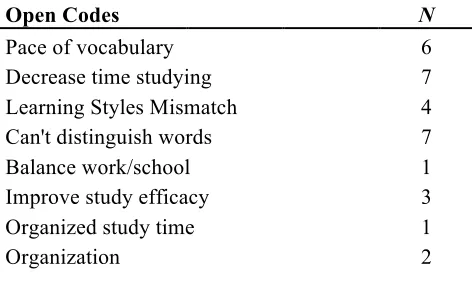
The initial coding process resulted in 13 separate open codes. Table 1 illustrates codes developed during the first cycle of open coding, and shows a high incidence of issues related to vocabulary memorization. Indeed, the primary reason for every learners’ language counseling session was trouble related to vocabulary, with one counseling report including the statement, “the pace is hard to maintain, with vocabulary retention the biggest challenge.” This led to the lean code pace of vocabulary. The lean code vocabulary was used for students struggling with vocabulary memorization.
Table 1. Open coding codes and frequencies
Open Codes N
Pace of vocabulary 6
Decrease time studying 7
Learning Styles Mismatch 4
Can't distinguish words 7
Balance work/school 1
Improve study efficacy 3
Organized study time 1
Study planning 1
Stress 6
Relaxation 3
Vocabulary 18
Trouble listening 3
Issues related to study and time management also occurred with high levels of frequency. For example, during the first cycle of coding, the lean code for improve study efficacy came from the report data “[student] was looking for how to improve his time spent studying”. The lean code decrease time studying was used in reference to learners’ reporting long hours spent on homework. Organized study time referred to a report focused on helping a learner to prioritize learning tasks. Study planning referred to a student who needed to develop a detailed learning plan. The lean code organization was used for references to learners’ who needed help with general organization skills (e.g., using a day planner). The code balancing work/school came from a report where the learner expressed anxiety over competing job and school demands. The code learning styles mismatch referred to materials design or teaching styles which were
mismatched with the student’s preferred learning style.
The third problem area for students was listening. As a discrete skill, listening was divided into two separate categories: the inability to hear words (coded as can’t distinguish words), and general, non-descript problems with listening (coded as trouble listening).
The final problem area for students was stress. The initial descriptive lean codes for stress were stress and relaxation. For example, the lean code stress was used for ‘[the course] has produced a tremendous amount of stress in [the student’s] daily life.’ Another report included, ‘[the student] is experiencing real difficulties in dealing with stress.’ Conversely, ‘…eat well and get enough sleep. If [the student] is not taking care of himself physically and emotionally, he will not finish’ was coded as relaxation.
Axial coding
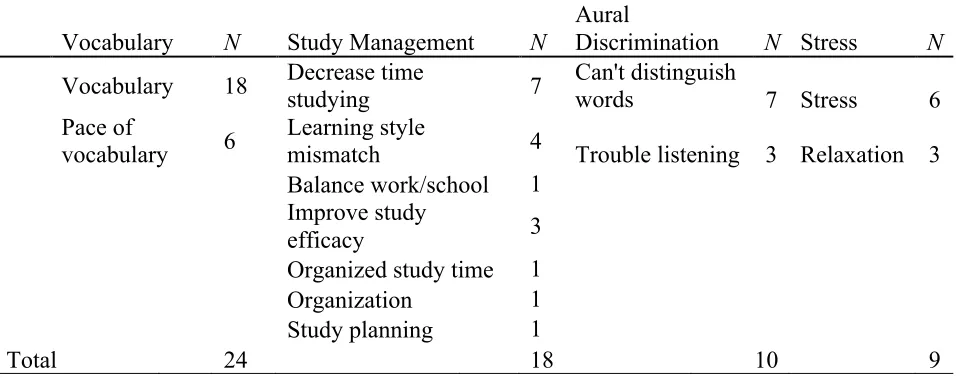
Four major themes emerged from the axial coding: vocabulary, aural discrimination, stress, and study management. Vocabulary encompassed any references to challenges relating to
learner has trouble hearing words and individual sounds.’). Descriptive data directing the student to relax (e.g., ‘Relax! If you are stressed out and tired, it makes remembering information much more difficult.’), as well as the lean codes for stress were combined into the stress theme during axial coding. Here, one of the initial lean codes generated in the first cycle became a main category in the final axial coding. The final category, study management, included any reference to study habits, balancing learning styles, or time management (e.g., ‘The learner is spending long hours on fruitless self-study.’). Table 2 shows the final axial codes, corresponding open codes, and frequencies.
Table 2. Axial Codes and Corresponding Open Codes Vocabulary N Study Management N
Aural
Discrimination N Stress N
Vocabulary 18 Decrease time studying 7 Can't distinguish words 7 Stress 6 Pace of
vocabulary 6 Learning style mismatch 4 Trouble listening 3 Relaxation 3 Balance work/school 1
Improve study
efficacy 3
Organized study time 1
Organization 1
Study planning 1
Total 24 18 10 9
Discussion
This study was designed as exploratory research using a qualitative lens examining the challenges beginning Arabic learners commonly experience. The data analysis produced four main themes for this population: vocabulary, study management, aural discrimination, and stress. These themes highlight the multidimensional reality of language learning and the need for distinctive forms of self-regulation.
learning. Study management skills apply to any student, regardless of discipline. Under affect, stress emerged as a major theme, underscoring the need for further investigation on its role in this context. At a minimum, counselors interacting with similar student populations should be aware of these trends and their implications for targeted strategy instruction discussed below. Implications for language learning self-regulation
Vocabulary memorization and aural discrimination both emerged as challenging areas for learners. There is evidence of a connection between the two themes in the literature. Bundgaard-Nielsen, Best and Tyler (2011) examined the trajectory of phonetic and phonological perception in adult L2 learners in an intensive environment and found that significant changes in the
student’s ability to accurately discriminate between phonemes can occur in an intensive program within the first 12 weeks. The current study’s findings seem to support their research. The researchers also found that the larger a second language learner’s vocabulary, the more consistently the learner could accurately discriminate vowel contrasts in the L2. Interestingly, length of target language exposure did not result in an automatic, increased ability to
discriminate between phonemes. The inference here is that directing the learner to strategies which broaden vocabulary rather than to additional listening resources should improve the individual’s listening skills.
When it comes to learning vocabulary, however, the ability to retain quality phonological sequences of L2 input for short periods of time is a necessary pre-requisite to transferring
vocabulary into long-term memory (Kempe & Brooks, 2011). Students who are better at the short-term phonological retention (e.g., ability to remember how the language sounds) are better at learning vocabulary (Kempe & Brooks, 2011). Phoneme discrimination is an essential
requisite to successful vocabulary acquisition which in turn augments listening skills.
Segmentation is a low-level skill which develops during the initial stages of the language acquisition process, which may be why it appears as a major theme in the current study. Field (2003) described the early stages of the listening process as learners develop the strategy of scanning aural input for familiar sounds and matching them to known words in their lexicons, creating elaborate stories so that the sounds they hear will make sense. Once a student has come up with an incorrectly segmented word, the student ignores what follows to logically support the previous lexical item (Field, 2003). Awareness-raising activities, for example dictation exercises, alert learners’ to the dangers of faulty segmentation.
While simple dictation alone is not an effective strategy to improve listening comprehension (Jafarpur & Yamani, 1993), targeted dictation can help students develop
phonemic awareness. Field (2003) suggested students practice phrase dictation using ambiguous word boundaries to raise learners’ awareness of segmentation. Counselors must keep in mind that language learners have set expectations and preconceived ideas of how language should sound influenced by the written language (Field, 2003). Guiding learners to authentic, self-study listening resources where they must use syntax to distinguish the weak forms, reductions, and contractions can be useful in helping to develop segmentation skills. Learners can be told explicitly the rationale behind dictation is to practice segmentation, and encouraged to play difficult audio passages repeatedly to puzzle out word boundaries. The goal of dictation is not to arrive at the correct answer for a content question, but rather to develop phonemic awareness.
Implications for metacognitive self-regulation
Self-regulation in language learning refers to the processes a learner uses to exercise control over learning, and the term is often used synonymously with autonomy, self-directed behavior, self-control, and self-management (Cohen, 2007; Dörnyei, 2005). Many issues related to metacognitive self-regulation, coded as self-management, emerged from the data analysis. The ability to self-manage is a metacognitive strategy all students employ. During the counseling sessions, learners received guidance on study planning, time management, balancing learning styles, organization, and balancing work/school demands, all of which fall under metacognitive strategies. Intensive foreign language programs require students to cope with strenuous
learners. The findings suggest value in future research investigating the need for this area of skill development for these language learners. At a minimum, counselors should be aware that
learners may be struggling to cope with course demands and require general metacognitive strategy support not specifically related to language learning.
Implications for affective self-regulation
Stress management reoccurred frequently as a major theme, either explicitly or implicitly, in the counseling reports, highlighting the role of affect and the need for meta-affective and affective strategies. For language learners, affective variables are at least as important as aptitude when predicting language learning achievement (Gardner, 1985; Scovel, 2000). There are many possible factors which could be contributors to student stress. For example, students may have felt pressured and distressed with their inability to meet program demands early on in an intensive course. While this study did not look at the correlation between the need for affective and metacognitive self-regulation strategies, the findings suggest the value of examining this correlation in future research. Counselors should be mindful of stress as an area for targeted affective strategy instruction with a potential cross-over in the need for metacognitive strategy coaching.
Conclusions
The current research project served as an initial look at problems facing beginning language learners in an intensive foreign language program. The study was intentionally limited in scope because of its exploratory nature. As such, findings are limited to the current population, which consisted of beginning Arabic learners in an intensive language program experiencing learning difficulties. While trends suggested that learners experienced similar obstacles, future research should be expanded to include different languages and proficiency levels.
Future researchers should explore if and how the four major themes of vocabulary, aural discrimination, stress, and self-management are interconnected. To advance practical
applications of theory, future research should include how researchers can employ the S2
This study used the basic elements of the S2R model as a framework to understand
learner difficulties. While the goal of language counseling remains to offer individual students tailored strategy instruction, initial findings suggest that trends exist. Awareness of trends could inform the pre- and in-service training which language counselors receive. At a minimum, counselors should be cognizant of the common problem areas learners experience in a particular program and be prepared with appropriate metastrategies, strategies, and resources.
Notes on the contributor
Erin O’Reilly is an Associate Professor at the Defense Language Institute Foreign Language Center. Her research interests include language learning counseling, affective variables and strategy use, and learner autonomy. Contents of this paper are not necessarily the official views of, or endorsed by, the U.S. Government, DoD, Department of the Army, or DLIFLC.
References
Bundgaard-Nielsen, R., Best, K., & Tyler, M. (2011). Vocabulary size is associated with second-language vowel perception performance in adult learners. Studies in Second Language Acquisition,33, 433-461. doi:10.1017/S0272263111000040
Cohen, A. D. (2003, August). Strategy training for second language learners. Minneapolis: Center for Advanced Research on Language Acquisition, University of Minnesota. (ERIC Document Reproduction Services No. EDO-FL-03-02)
Cohen, A. D. (2007). Language learner strategies. A. Cohen and E. Macaro (Eds.). Oxford, UK: Oxford University Press.
Creswell, J. (2009). Research design: Quantitative, qualitative, and mixed methods approach. Thousand Oaks, CA: Sage Publications.
Dörnyei , Z. (2005). The psychology of the language learner: Individual differences in second language acquisition. Mahwah, NJ: Erlbaum.
Field, J. (2003). Promoting perception: Lexical segmentation in L2 listening. ELT Journal, 54(7), 325-334. doi:10.1093/elt/57.4.325
Gardner, R. (1985). Social psychology and second language learning: The role of attitudes and motivation. London, UK: Arnold.
Jafarpur, A., & Yamani, M. (1993). Does practice with dictation improve language skills? System,21(3), 359-369. doi:10.1016/0346-251X(93)90026-D
Karlsson, L., Kjisik, F., & Norlund, J. (2007). Language counseling: A critical and integral component in promoting an autonomous community of learning. System, 35(1), 46-65. doi:10.1016/j.system.2006.10.006
Kempe, V., & Brooks, P. (2011). Individual differences in adult second language learning: A cognitive perspective. Scottish Language Review, 25, 15-22.
Mozzon-McPherson, M. (2000). Promoting and supporting independent learning out of the classroom: An analysis of the skills of advising and their implications on the emerging role of language learning advisors. Links & Letters, 7, 111-126.
Mozzon-McPherson, M. (2007). Introduction to special issue: Language counseling. System, 37, 66-92.
Oxford, R. (1990). Language learning strategies: What every teacher should know. New York, NY: Newbury House.
Oxford, R. (2011). Teaching and researching language learning strategies. Harlow, UK: Pearson.
Reinders, H. (2007). Big brother is helping you: Supporting self-access language learning with a student monitoring system. System, 35(1), 93-111. doi:10.1016/j.system.2006.10.009 Rubin, J. (2005). The expert language learner: A review of good language learner studies and
learner strategies. In K. Johnson (Ed.), Expertise in second language learning and teaching (pp. 37-63). Basingstoke, UK: Palgrave Macmillan.
Rubin, J., Chamot, A. U., Harris, V., & Anderson, N. (2007). Intervening in the use of strategies. In A. D. Cohen & E. Macaro (Eds.), Language learner strategies: 30 years of research and practice (pp. 29-45). Oxford, UK: Oxford University Press.
Saldaña, J. (2009). The coding manual for qualitative researchers. Thousand Oaks, CA: Sage Publications.
Scovel, T. (2000). Learning new languages: A guide to second language acquisition. Boston, MA: Heinle & Heinle.
Strauss, A., & Corbin, J. (1988). Grounded theory methodology: An overview. In N. K. Denzin & Y. Lincoln (Eds.), Strategies of qualitative inquiry (pp. 158-183). Newbury Park, CA: Sage.