
Fixed Firefighting System Selection: Towards Improved Decision Making
Author‟s Details: Simon Bird1, Kirti Ruikar2,Lee Bosher3 Jim Glockling4
1
Dr, Centre for Innovative and Collaborative Construction, Loughborough University, UK
[email protected] Dr, Centre for Innovative and Collaborative Construction, Loughborough University,
UK City, State, Country [email protected] Dr, Centre for Innovative and Collaborative Construction, Loughborough University, UK City, State, Country [email protected], The Fire Protection
Association, Moreton-in-Marsh, UK [email protected]
Abstract
A fixed firefighting system is a fire suppression, control or extinguishing system for use as a fixed installation in a building to protect the whole or part of a building and/or the objects within. Examples of such systems include; automatic fire sprinkler systems and other systems such as deluge and water mist systems. Fixed firefighting systems are an essential fire safety tool. The fire remains a destructive force leading to loss of life and irreversible loss of property. Its effects are long term leading to disruption to communities and economies. Fixed firefighting systems play a critical role in mitigating a fire hazard. In the United Kingdom and in Europe, over recent decades, regulatory changes have created a favourable environment for innovation to take place. This has led to an increase in the numbers of fixed firefighting system types that are now available. These systems offer levels of performance (and therefore safety) with considerable variance. A critical part of ensuring safety, isn‘t simply the availability of a variety of fire hazard mitigating systems, but also the selection of the most appropriate system that is ‗fit for purpose‘. This relies on the knowledge and expertise of disparate experts and is often situated within regulatory procedures and heuristics or ‗rules of thumb‘. Selection is now more complex. There is thus a need for a tool that enables optimal selection of fixed firefighting systems. In response, a Fixed Firefighting System Selection Tool has been developed. The tool incorporates knowledge, logic, rules and fire safety educational resources to aid the system selection process. Evaluation of the tool has been undertaken using qualitative inputs from a range of key experts. The evaluation findings indicate that the tool: is an innovative approach to promoting good fire safety designs, efficiently provides useful fire safety education to users and the supporting resources which consider firefighting system benefit is helpful.
Keywords: Decision support; knowledge management; fixed firefighting system; selection; fire; suppression.
1. Introduction
In the aftermath of the Grenfell Tower fire in the UK, an independent review of Building Regulations and Fire Safety, led by Dame Judith Hackitt, was conducted. The Hackitt Review [53], suggested radical changes to existing practices in the building industry. It specifically referred to adversarial practices witnessed through the lifecycle in the building design and delivery phases which collectively impact the operational safety objectives.
The RIBA [68] set up an Expert Advisory Group on Fire Safety following the tragedy at Grenfell Tower and
urged an immediate consideration of various recommendations requiring, among other things, the installation of sprinklers/automatic fire suppression systems in all new and converted residential buildings, as currently required under Regulations 37A and 37B of the Building Regulations for Wales [73].
The underpinning expert knowledge, which forms the backbone of the decision support tool discussed in this paper, ensures that the users are equipped with expert knowledge and so any decisions (i.e. system choices) made as a result are expert informed.
1.1. Scale of risk and the need for fixed firefighting systems
In the built environment, like the density, complexity and scale of populations and activity within a building increase, then the potential sources of causes of fire will also increase dramatically. So too might the potential scale and consequence of fire [6]. Fixed firefighting systems tend to be specified as additional fire protection and resilience measures when various perceived risk and consequence thresholds are breached. The work of
BRE Global [9], CEBR [35] and Optimal Economics [66] confirm that fixed firefighting systems are a
beneficial fire protection feature when the risk posed by fire is sufficiently great. They also confirm that the use of such systems is under exploited. Prompted by the Grenfell tragedy the Institution of Civil Engineers has undertaken a substantial piece of work [56], which seeks to evaluate risk to economic infrastructure. The report highlights the importance of the inclusion of performance data in BIM and digital construction information management techniques, in support of improving resilience and mitigating risk.
Fixed Firefighting Systems (FFS) are an essential hazard mitigation tool, particularly in potentially high financial and/or risk consequence scenarios. Previous research [5-7] has explored and reported the background to the FFS selection problem; historically, the choice of fixed firefighting system type has been somewhat limited by prescriptive regulatory requirements, or in non-regulatory circumstances (such as risk management initiatives or obtaining favourable insurance terms) practice that had to some extent perhaps become de facto. For instance, cases of sprinkler systems being a widely adopted solution, with several other solutions (for example: gaseous, powder, wet chemical and water mist) being available for circumstances where sprinkler systems were considered unsuitable. However, in the United Kingdom (UK) and Europe over recent decades regulatory changes have been successful in opening markets and in a number of areas creating an environment in which more innovation can take place. It appears that consequently an increased number of types of fixed firefighting systems are now available to the user, also with increasingly overlapping ambitions in terms of scope of application. Not all systems now offered are equally mature in terms of; cost, supporting knowledge, experience and overall performance. Case studies [7] have demonstrated that understanding of performance and limitations (suitability, cost, benefit and in-service reliability) may not be widely appreciated. Experts are observing increasing numbers of what they consider to be poor fixed firefighting system choices and/or fire outcomes when such systems are called upon to fight the fire, which is a cause of concern [5,7].
In order to provide better guidance upon the selection of FFS a Tool has been developed (Fixed Firefighting System Selection Tool or FFSST), which makes system recommendations to users and gives them access to various information resources intended to be of potential interest to their specific circumstances. This paper summarises the tool‟s development and presents the key findings and implications from the evaluation of the Fixed Firefighting System Selection Tool by fire risk management experts.
1.2. Background to fixed firefighting system design
Systems” [14] and “Fire Suppression System” [71] are also often encountered and sometimes used interchangeably, although arguably having different meanings (different firefighting objectives). It could be said they are subsets of the term “fixed firefighting system”. This term is therefore used as a generic descriptor for many types of fixed (installed and non-portable) firefighting (with suppression or extinguishing objective) systems that generally comprise a firefighting media (such as water, gas, powder or other chemical), a motive source (such as a pump, stored pressure or stored chemical energy), actuation device(s) and a delivery means (such as pipes and nozzles). Field experience supported by BRE Global‟s guide [10] confirms that fixed firefighting systems are installed mostly; to meet legislative requirements, or to reduce risk(s) for business resilience purposes. The focus of this research is to investigate whether current fixed firefighting systems selection practices could be considered optimal and if not, to develop a means by which improvements in selection practice could be affected.
In the field of fixed firefighting system design, it is generally considered that good quality standards are desirable supporting resources. “Conformity assessment and accreditation, along with standards are important parts of the nation‟s quality infrastructure” [8]. British Standards Institution (BSI) define a Standard as a “document, established by consensus and approved by a recognized body, that provides, for common and repeated use, rules, guidelines or characteristics for activities or their results, aimed at the achievement of the optimum degree of order in a given context” [11]. The Loss Prevention Council (LPC) Design Guide states that all fire protection products shall be certified by an accredited body [47].
There are many factors to consider when seeking to design and install a fixed firefighting system; these are systems that might have the capability to activate and discharge significant quantities of firefighting media autonomously. Often these media, which may be water, gas or other chemicals, could in themselves be damaging or harmful, although less harmful than the effects of a fire. Therefore, it is critical that the suppression systems actuate only in „very‟ specific circumstances. Typically, there would be a considerable time lag after the original design and installation task has been performed. Maintenance is usually recommended, but there is widespread anecdotal knowledge in the industry that maintenance is often poorly undertaken or not undertaken at all. These are some examples of factors that contribute to a situation where good quality guidance can be very helpful in addressing these issues. Standards (and guides) aim to fulfil the function of capturing and documenting experience and knowledge to improve and uphold outcomes. One of the important objectives of this research has therefore, been to improve the guidance available to the user such that it is comprehensive, free from bias towards one system compared to another and in a form that is easy to access. In order to provide better guidance for the selection of Fixed Firefighting Systems (FFS), the Fixed Firefighting System Selection Tool was based upon the three problem areas identified after discussions with a range of experts throughout the project. These include; 1) Suitability; 2) Cost-Benefit; and 3) Reliability.
1.3. Fixed firefighting system suitability
There are a variety of sources of knowledge that include guidance on system specifications and the basic suitability of a system for a variety of applications. These include regulations, guidance and standards many of which are reported in previous work [5-7]. However, such guidance tends to be quite limited. Most of the documents either deal with broad regulatory matters (encompassing many aspects of a building; not just fire safety) or with one specific FFS technology only.
From these types of documents, the most useful type of information is typically found in the „Scope‟ section of documents, where the intended application of a technology (i.e. FFS) is given. Other limitations upon the use of the technology can be found peppered throughout some of the documents. Some of this information can be used to derive underpinning logic and rules for use in the Fixed Firefighting System Selection Tool. None of these sources deal in any detail with the issue of selecting FFS where a choice of types is available.
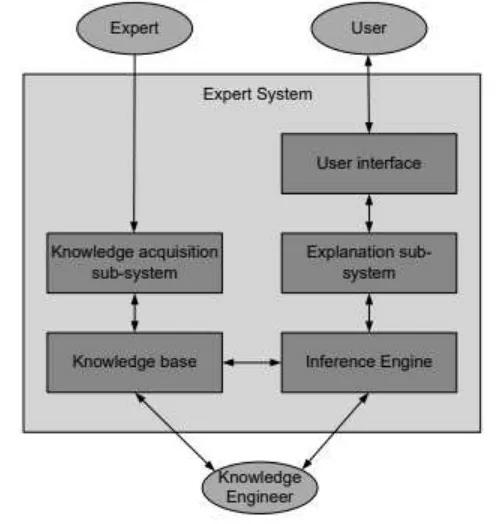
Figure 1: Main elements and interaction with a typical expert system (adapted from Nilsson (1998) and Giarratano (1998)
The knowledge is contained within several documents (see examples in Table 1) that contain and record much of the subject area knowledge amassed to date. As such there are many standards, guides and documents intended to fulfil this role and assist users in designing FFSs. These documents tend to be rich sources of knowledge about FFSs. However, they are of varying age, relevance, scope, quality and thus, suitability. Some are written for national or international standards bodies by committees and independent bodies, whilst others are written by trade associations, certification bodies or commercial organisations such as user groups or system suppliers. Often, each document is written to support a specific technology type and not with a view to perform or support an overarching selection function, such as the purpose of this research. Thus, for this research, a systematic process was adopted to identify and review sources of heuristic knowledge (to derive underpinning rules and logic of the FFSST) contained within a dotted landscape of subject-specific literature.
Table 1 Summary of sources of „knowledge‟ General
classification Standard System type description
Firefighting
Media Reference
Sprinkler system
BS 9251 Sprinkler systems for residential and domestic occupancies - Code of practice
Water [15]
Sprinkler system
BAFSA TGN1
Technical Guidance Note No 1 - The Design and Installation of Residential and Domestic Sprinkler Systems
Water [3]
system 12845 sprinkler systems - Design, installation and maintenance
Sprinkler system
LPC Rules LPC Rules for Automatic Sprinkler Installations 2009 Incorporating BS EN 12845
Water [48]
Sprinkler system
DD CEN/TS 14816
Water spray systems - Design, installation and maintenance
Water [31]
Water mist DD 8458-1 Residential and domestic watermist systems – Part 1: Code of practice for design and installation
Water [25]
Water mist DD 8489-1 Industrial and commercial watermist systems – Part 1: Code of practice for design and installation
Water [26]
Water mist DD 8489-4 Tests and requirements for watermist systems for local applications involving flammable liquid fires
Water [27]
Water mist DD 8489-5 Tests and requirements for watermist systems for the protection of combustion turbines and machinery spaces with volumes up to and including 80 m3
Water [28]
Water mist DD 8489-6 Tests and requirements for watermist systems for the protection of industrial oil cookers
Water [29]
Water mist DD 8489-7 Tests and requirements for watermist systems for the protection of low hazard occupancies
Water [30]
CO2 BS 5306-4 Fire extinguishing installations and equipment on premises - Part 4: Specification for carbon dioxide
systems
Gas [12]
Inert Gas BS EN 15004-1
Fixed firefighting systems - Gas extinguishing systems - Part 1: Design, installation and maintenance
Gas [22]
Halocarbon Gas
BS EN 15004-1
Fixed firefighting systems - Gas extinguishing systems - Part 1: Design, installation and maintenance
Gas [22]
Powder BS EN 12416-2
Fixed firefighting systems - Powder systems - Part 2: Design, construction and maintenance
Chemical [18]
Foam BS EN 13565-2
Fixed Firefighting systems - Foam systems - Part 2: Design, construction and maintenance
Chemical [21]
Aerosol PD CEN/TR 15276-1
Fixed firefighting systems. Condensed aerosol extinguishing systems - Requirements and test methods for components
Chemical [33]
Kitchen protection
LPS 1223 LPS 1223 - Fixed Fire Extinguishing Systems for Catering Equipment
Water or Chemical
[60]
Permanent O2
displacement
PAS 95 Hypoxic air fire prevention systems – Specification
O2
displacement by Nitrogen
[32]
1.4. Cost and benefit
and perhaps opportunity cost (what else could have been purchased instead [61], for example other fire prevention or safety measures). The benefits might be described as „firefighting performance‟ or „the consequence of damage arising from fire without a fixed firefighting system compared to the same fire with a firefighting system‟. However different systems have different ambitions; for example to „suppress‟ fires, to „control‟ fires [48], to „extinguish‟ [22] fires or to „prevent‟ [32] fires. The reliability (discussed further in Section 1.4) of a fixed firefighting system is also expected to have an impact upon the overall benefits. Depending upon what is being protected, it is expected that these factors would have a material effect on the „benefit‟ (and potentially the „cost‟) of an FFS. Detailed CBA study of fixed firefighting system performance appears to be in its infancy (examples of such work have been published by Building Research Establishment (BRE) [9] and Centre for Economics and Business Research (CEBR) [35]). Such work confirms the complexity of properly investigating CBA in this area even with very confined parameters.
1.5. Performance and reliability
FFS reliability, or the quality of being reliable “able to be trusted, predictable or dependable” [37] has emerged as an important aspect (because of its link to „benefit‟ discussed in the preceding section) to be considered in the selection of an FFS. BSI‟s “Guide to reliability and maintainability” [13] and US Department of Defence‟s “Guide for Achieving Reliability, Availability, and Maintainability” [72] states that reliability may be achieved by: Good initial system design, certification (component level, system design level and system installation level), on-going surveillance of system performance, preventative and reactive maintenance, and iterative improvement feedback cycles (or pedigree). A recent report [56] by the Institution of Civil Engineers highlights the importance of the inclusion of performance (i.e. in this context, reliability data) data in BIM and digital construction information management techniques.
Fixed firefighting systems, like any system are not 100% reliable, so in some instances will fail to deliver some or all of the potential benefits. It would be reasonable to expect different FFS with very different sets of components and design philosophies to have different levels of reliability. It may also be reasonable to expect different FFS to have different levels of reliability when they are used to protect different scenarios.
Literature review [34,40,50,54,55,66,72,76,77] has yielded only a very limited amount of reliability (or performance) data. There are notable gaps in the newer FFS technologies. The data which has been found has been useful in forming an appreciation of what constitutes and contributes to „reliability‟ in the context of this selection problem. In turn this has been useful in the development of supporting informative resources (examples are given in section 2.4 “supporting media” of this paper).
2. Methodology and research design
In order to undertake this research, a review of the suitability to the task of various research methods was undertaken. Correct selection and use of methods are important in ensuring the identification of relevant variables, their mechanisms and impact [42]. The research was conducted to an adapted action research [70] model and using rapid application development [2] techniques. It employed the following techniques: literature review, quantitative, qualitative, case studies and field experience.
Previous work from this research [5-7] reports in greater depth how the research was designed and includes information about the selection of case studies, the learning from which informed the development of the tool. It provides an in-depth analysis of the operation of the tool and the process of developing the underlying heuristic knowledge.
· Task 7: derive development environment · Task 8: develop tool · Task 9: maintenance
and upkeep
· Task 8: develop tool · Task 9: maintenance
and upkeep · Task 10: evaluation
Task 1: evidence of the problem and background
Time Task 2: determine scope
Task 3: identify target FFS technologies Task 4: identify and address gaps in knowledge
Objective 1: background
and knowledge Objective 2:
current
practice Task 5: identify target users and needs
Task 6: optimum FFS selection · Task 7: derive
development environment
Development cycle 2
Development cycle 1 Development cycle 3
Objective 3: develop tool
Objective 4: summarise progress and future recommen dations
Figure 2 - Derived approach to the research and tool development, incorporating an adaptation of “Action Research interacting spiral” [70]
Initially, an in-depth review was undertaken to identify potentially suitable development environments or techniques. Also, consideration was given to identifying potentially suitable commercially available software development environments or techniques, which could be used to develop the fixed firefighting system selection tool. However, this investigation highlighted that no suitable (readily commercially available) solutions could be identified by merely reviewing existing tools and the research or industrial literature. The decision was therefore taken by the project team to seek external expertise on the software development side of the project. In order to consult with software experts, a specification was developed. Frappier, et al. [51, p.
preface ] suggests that “A specification method is a sequence of activities leading to the development of produce
called a specification”. They then go on to state that typically several system characteristics may be specified; functional requirements (input-output behaviours), efficiency requirements (addressing execution time considerations) and implementation requirements (programming language to use, targeted hardware and software platforms). Alagar and Periyasamy [1] refers to the concept of a Software Requirements Document (SRD) as an essential tool in taking an abstract idea for a piece of software through to development; the route through stages of software development are shown in Figure 3.
Figure 3 - A simple life-cycle model with specification phases [1]
some of the general principles were observed (such as developing a BS and partial development of a DS) in order to obtain some of the benefits (suitability of end product, efficient use of resource) of utilising a specification approach.
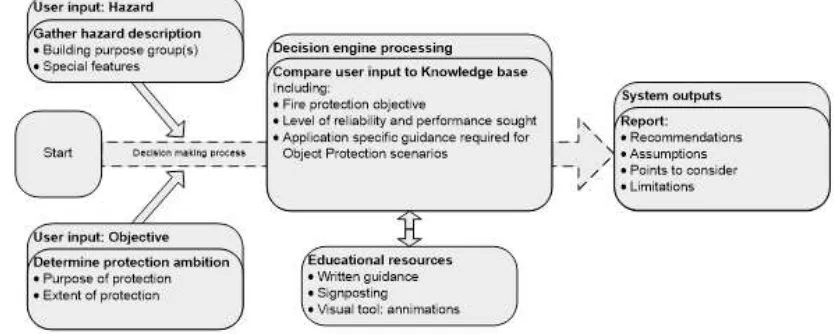
The Fixed Firefighting System Selection Tool (FFSST) requires the user (e.g. designer) to answer a series of questions (in Table 2) to elicit the required knowledge to make recommendations and signpost users to tailored relevant material that may be useful to them in making their FFS selection. Recommendations are in the form of „Green‟ meaning this selected technology (FFS) type is likely to be a good choice to meet the firefighting objectives, „Amber‟ meaning it might be suitable, but some limitations may exist and „Red‟ meaning it is unlikely to be suitable. The process concludes with a report being produced, recording the recommendation to the user in relation to each system type. Each recommendation will be accompanied by relevant application notes and links to other appropriate resources. These resources may be in various media formats (i.e. documents, animations, videos, pictures). Figure 4 depicts an overview of the FFSST architecture, presented graphically in style inspired by the work of Ruikar, et al. [69] in developing an e-readiness assessment application architecture and Giarratano [52] and Nilsson [65] in their efforts to describe the main elements of earlier expert systems.
Figure 4 - Overview of derived FFSST architecture.
To decide on the most suitable environment for software development a requirements specification was prepared, and an expert consultation followed. This sought to identify which environment would be best suited to develop the decision support application (FFSST). Having considered the recommendations received from experts, it was decided to select “Knowledge Builder” software, by XpertRule Software Ltd. This software can automate business decisions and deliver intelligent user interfaces [75]. The software is highly customisable and the first step in developing a decision support application is usually to tailor the package to suit the specifics of the problem.
2.1Logic and rules forming the tool
their conclusions [58], and therefore make it easier for the user (in this instance the designer) to decide whether to accept their conclusions (provided by FFSST). As such the derived (and customised) development environment is both, the software FFSST compiler and the record of the identified knowledge. An explanation of the method of development follows.
2.2 Tool development method
A framework of rules is established as Attributes in the software development environment. An attribute is essentially a question with two or more answers. Attributes (or questions) may be relevant to one or more FFS technologies.
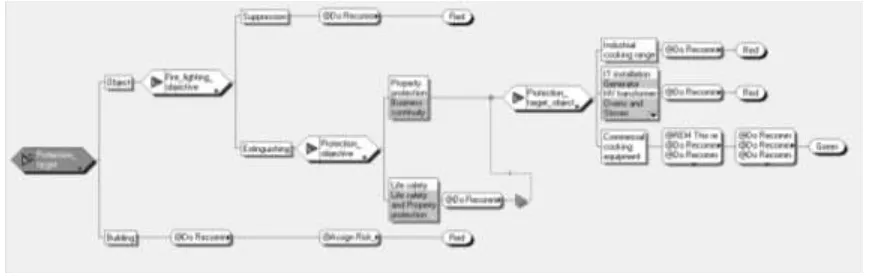
A Tree is created for each FFS technology. FFS technologies are grouped by the most relevant design and installation standard applicable in the UK. This was found to be a convenient (and most fully formed pre-existing) way to demark one technology from another. Horizontal „Trees‟ are used to structure together „Attributes‟ and serve to structure the knowledge elicitation process in relation to the suitability of each FFS technology in the user‟s circumstances. It was found that an efficient way to develop each tree was to consider it to be an elimination process, for example by adopting the stance of asking “when is this technology not suitable?” (and what do I need to ask to find that out early in the process?). Figure 5 is an example of a decision tree in the development environment.
Figure 5 - Example decision tree – for “LPS 1223 - Fixed Fire Extinguishing Systems for Catering Equipment”
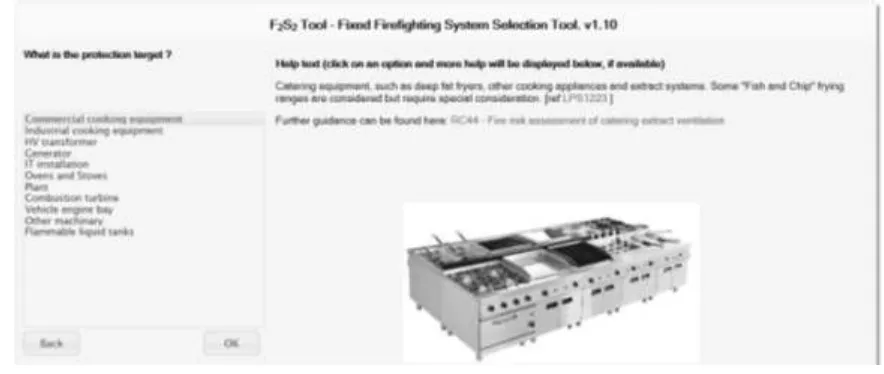
Depending upon how the user responds to questions, each tree will be traversed, and the software will record a recommendation (red, amber or green) in relation to that tree (which is the recommendation in relation to a particular technology type). As the user progresses through the tree (via a Graphical User Interface (GUI) having an altogether different appearance; see Figure 6 for an example) additional information may be provided to them intended to help make the meaning of questions clear or illustrate various points. This method of development was found to offer the following advantages:
· Where attributes (or questions) are shared between trees, for efficiency, the user will only be asked that question once.
· In structuring trees from attributes, it is possible to minimise the number of questions put to the user by asking the most impactful (usually the most used) questions first. Thus, irrelevant branches of trees may be closed off (and those questions not asked).
assembled rules and knowledge to document the elements that come together to form one tree. An example of such an exercise is presented in Table 2.
Table 2 – Rules and Knowledge tree in Loss Prevention Standard (LPS) 1223 [60]
Attribute Question Possible answers
Significance Related information to be given to the user
Protection target
What is the type of protection?
Object Within scope: proceed to the next question
State FFSST limitation: only one object can be considered at a time
Expand on what is meant by „object‟. Give examples.
Signpost to: BS EN 13478 “Safety of machinery - Fire prevention and protection” [20] and BS EN ISO 12100 “Safety of machinery - General principles for design - Risk assessment and risk reduction” [24] Building Recommendation:
RED
Record note: ‗This technology is not
suitable for the protection of whole buildings‘
Firefighting objective
What is the firefighting objective?
Suppression Acceptable variation to scope: proceed to next question. Note variation.
Record note: „This is an extinguishing technology, so it should exceed your requirement to suppress a fire‟
Extinguishing Within scope: proceed to the next question
None
Protection objective
What is the protection objective?
Property protection
Within scope: proceed to the next question.
None
Business continuity
Life safety Acceptable variation to scope: proceed to the next question. Note variation.
Record note: 'This method of protection is primarily intended to protect an object (cooking equipment) but in doing so may bring life safety benefit'
Life safety & property protection Protection
target object
What is the protection target? Commercial cooking equipment Last question. Recommendation: GREEN
Expanded definition of „commercial cooking equipment‟. The illustrative figure of such cooking equipment.
Signpost to: RC44 “Risk Control - Recommendations for Fire Risk Assessment of Catering Extract Ventilation” [49] and LPS 1223 [60] Make (and record) assumptions: as we know this is a cooking range it is reasonable to expect there to be water and personnel present and that there will not be a sufficiently gas-tight enclosure to render gaseous systems as likely to be feasible. Record notes: various recommendations are made based upon field experience of the use of this type of system.
Video: A video animation of an example of this system type in operation is provided Industrial
cooking
equipment Recommendation: RED
Expanded definition of „Industrial cooking equipment‟. The illustrative figure of such cooking equipment.
Record note: ‗This approach is for
All others Expand on what is meant by this object type. Give examples.
Record note: This FFS technology is not suitable for this scenario
2.3 Signposting
As the user advances through the process of answering questions, more becomes known about their circumstances. The derived GUI (see Figure 6 for an example) is capable of responding in a number of ways; question text and selectable answer options change each time a new question must be posed. Help text is dynamic and may include hyperlinks (useful to signpost towards related documents for reading outside the tool, explanatory videos or animations) and images.
Figure 6 - Example of Graphical User Interface – displaying „object‟ protection scenarios and help text and graphic for „Commercial cooking equipment‟
The signposting is „dynamic‟ in that it adapts to the circumstances the user describes and thus seeks to avoid overloading the user with irrelevant material and only refer them to material that is likely to be applicable. If the tool can be confident that the scenario involves commercial cooking equipment, it will make available related further reading to the user. For example (as in Figure 5) the Loss Prevention Certification Board (LPCB) LPS 1223 “Requirements and testing procedures for the LPCB certification and listing of fixed fire extinguishing systems for catering equipment” [60] and the Fire Protection Association (FPA) Risk Control (RC) guidance “RC44 - Fire risk assessment of catering extract ventilation” [49]. This dynamic signposting is believed to be a facet of the work of considerable value in that it efficiently directs the user towards focused and related material.
2.4Supporting media
[43]. Fleming suggests that people respond differently to different presentations of information. He defines the main modes of presentation as visual (V), aural (A), printed words (R), and kinesthetics (K) using all senses including touch, hearing, smell, taste and sight. Each of the modes is assigned a letter as denoted in brackets and the letters form the acronym „VARK‟ which is now in common use in the field [43]. The area appears to be not without controversy; Bennett [4] cites the work of Coffield, et al. [36] as suggesting that many of identified styles (and he specifically refers to Fleming‟s „VARK‟ model) were not backed up by credible evidence.
However, there does appear to be a general agreement that different people respond differently to different styles of learning stimuli. The opportunity that this presents should be exploited [36]. As the FFSST is intended to benefit a broad range of users perhaps from quite different backgrounds, the intention is to introduce as many learning styles as can reasonable be achieved. The project team has identified opportunities to use the following techniques: An interactive software tool, on-screen descriptive text, graphical information (explanatory pictures, sketches and animations) and system feedback. Supporting media incorporated in the FFSST now includes help text and pictures within the Tool, links to applicable standards and guidance, animations to illustrate key concepts and video footage to explain the operation of some system types. Some of this material was pre-existing. Some of it has been created specifically to enrich the tool and address perceived problem areas. Examples of informative material developed as part of this research intended to help users understand and contemplate issues such as cost, benefit and reliability (and for incorporation in to the FFSST) include Insurer Questionnaires “IQ1: Water Mist Questionnaire: Building Protection” [45] and “IQ2: Water Mist Questionnaire: Object Protection” [46], intended to ask searching questions about the technical integrity of proposed fixed firefighting systems.
3. Findings: evaluation of the Fixed Firefighting System Selection Tool 1
3.1Evaluation method
Evaluation of research is an important step to demonstrate the validity and reliability or “the confidence which someone may have in the findings” [p. 263, 42]. Wong [74] lists some of the problems that can occur as a result of defective software including: undesirable outcomes, reduced customer (or user in this case) satisfaction, increased maintenance costs and/or decreased productivity (or usefulness in this case) and profits (or societal benefit in this case).
Exploratory data analysis is typically in the form of open-ended questions. This technique is suitable when numerous and varied responses are expected [64]. Such responses are likely in the case of this research, given the breadth of scope of the work and necessarily limited extent to which development has been pursued. Although this technique yields useful feedback, analysis of the responses to questions can be rather complicated and it is noted that “it also requires great skill to accurately report the information” [p. 86, 64]. Naoum [64] then goes on to propose an example method to structure questions and code example responses to such questions. However, even this methodology is considered too structured and inflexible given the expected unstructured nature of feedback anticipated. Instead it is considered in this case that the primary practical means of capturing information to support the evaluation is the use of open questions and accept that laborious and informed analysis of the comments will be the only practical method that has been identified. Fellows and Liu appear to acknowledge that action research (the model which this research has strived to follow) is highly context dependant “is neither standardised nor permanent as it is reliant on the project and knowledge and subjectivity / perceptions of the persons involved” [p. 21, 42].
1
Active design review [67] is an approach that would appear to lend itself to the circumstances. Wong [74] explains the background to the approach is sympathetic to contemporary working life in that reviewers: may be overloaded, may not be intimately familiar with the objective and intricacies of the software (the Tool) design and often do not achieve much progress when expected to work for as large review groups. Wong [74] goes on to outline the three steps of the active review process:
1) The author presents an overview of the artefact (the Tool);
2) Defect detection is facilitated by the author, by means of open-ended questions; and
3) The final step is defect collection where more in-depth review meetings focus on one specific identified problem area at a time.
Finally, Wong [74] records that reviewers are to be selected based upon their expertise. It is therefore expected that this segmented approach allows reviewers to focus on making improvements in small areas with reduced risk of becoming overloaded. It follows that small improvement which can be made from the contributions of reviewers. The result can be that significant overall progress towards improvement is made by this process.
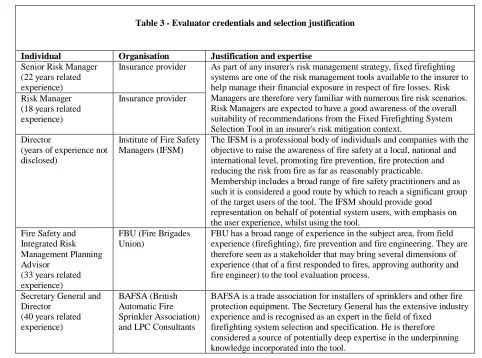
Previous work [5,6] has identified the groups who are either expected to benefit directly or indirectly from the tool (users, benefactors). In order to keep the evaluation activity to a manageable size, a limited number of „groups‟ considered likely to have well informed opinions from a range of perspectives were targeted as evaluators. The parties and the rationale behind the decision to include them in this active design review evaluation process are detailed in the following table.
Table 3 - Evaluator credentials and selection justification
Individual Organisation Justification and expertise
Senior Risk Manager (22 years related experience)
Insurance provider As part of any insurer's risk management strategy, fixed firefighting systems are one of the risk management tools available to the insurer to help manage their financial exposure in respect of fire losses. Risk Managers are therefore very familiar with numerous fire risk scenarios. Risk Managers are expected to have a good awareness of the overall suitability of recommendations from the Fixed Firefighting System Selection Tool in an insurer's risk mitigation context.
Risk Manager (18 years related experience)
Insurance provider
Director
(years of experience not disclosed)
Institute of Fire Safety Managers (IFSM)
The IFSM is a professional body of individuals and companies with the objective to raise the awareness of fire safety at a local, national and international level, promoting fire prevention, fire protection and reducing the risk from fire as far as reasonably practicable.
Membership includes a broad range of fire safety practitioners and as such it is considered a good route by which to reach a significant group of the target users of the tool. The IFSM should provide good
representation on behalf of potential system users, with emphasis on the user experience, whilst using the tool.
Fire Safety and Integrated Risk Management Planning Advisor
(33 years related experience)
FBU (Fire Brigades Union)
FBU has a broad range of experience in the subject area, from field experience (firefighting), fire prevention and fire engineering. They are therefore seen as a stakeholder that may bring several dimensions of experience (that of a first responded to fires, approving authority and fire engineer) to the tool evaluation process.
Secretary General and Director
(40 years related experience)
BAFSA (British Automatic Fire Sprinkler Association) and LPC Consultants
BAFSA is a trade association for installers of sprinklers and other fire protection equipment. The Secretary General has the extensive industry experience and is recognised as an expert in the field of fixed
3.2Evaluation analysis, discussion and findings
The evaluation was undertaken on version 1.09 of the tool. Once it had been established that the identified experts wished to participate in the research, informed consent was obtained, and they were given access to the FFSST (version 1.09) plus some guidance upon the intention of the evaluation process. The process was:
· Introductory correspondence
· Invitation to provide feedback (either by writing, meeting or telephone interview) based upon interaction with the tool
· Recorded feedback and tracking of actions arising (i.e. completed, to be completed or to be deferred to a future development cycle)
· Optionally, an interview (telephone or face to face) to allow exploration of points in more depth (two of the five participants elected to use this option to supplement their written submissions).
Examples of feedback received are summarised in Table 4. The feedback was analysed and grouped into three categories; validation (or comments in support of the work and progress achieved), critical feedback giving rise to improvements that have been implemented and critical feedback which is currently impractical to undertake and must be deferred beyond this phase of work.
Table 4 - Feedback received (summarised)
Feedback in support of the work:
· ―I would find it a useful tool, especially because it signposts me to the appropriate standards and guidance‖ · ―The tool is looking good and beginning to contribute to supporting the needs of the Industrial sponsor‖
· ―I found it easy to use, covered my scenarios well. I like the fact that once the input has gone in I get a number of solutions.‖
· It was reported that the tool loaded and operated correctly on various Microsoft Windows and Mac OS machines
Critique of the work and improvement actions arising:
· The fault with the logic associated with “Gaseous Halocarbon Systems” identified and rectified by alteration to the rule tree (see Figure 6 and Figure 7).
· Where possible (where copyrights and permissions permit), the external informative resources were obtained and placed in the „Assets‟ folder of the Tools website. From here they can be obtained by the user with a single click (rather than having to register or log-in to view external resources).
· Further explanation of „High Voltage equipment‟ (voltage thresholds) would be helpful. “IEE wiring regulations”[57] definition added.
· Note added to FFSST output to inform the user of the possibility of Hydrogen Fluoride production from the use of FK-5-1-12 [23] extinguishant media.
Critique of the work and deferred actions arising:
· Optimise user interface for multi device use (i.e. tablet devices in addition to personal computers).
· Further develop the meaning, explanation of and philosophy behind terms used: property protection, life safety and business continuity.
· One glitch with a graphic placeholder was reported, but this could not be replicated. No further action to be taken at this time.
· A new detailed case study (a radioactive sterilisation bunker) was offered for consideration and incorporation into the tool.
· The tool could seek to take over the function of the design and installation standards that it currently signposts to. The value in doing this would be that errors of interpretation (reported as frequently encountered) could be irradiated or reduced. Whilst this may be a valid ambition, it is a significantly different ambition to the scope of this work.
Figure 7: Compiler view (before Modification):
Figure 8: Compiler view (after Modification):
Table 5 - Input-output data capture in fault remediation
Question Response
What is the type of protection? Object
What is the protection target? IT installation
What level of protection are you seeking to achieve? Property protection Is the object to be protected in an enclosure with a sufficient level of integrity to maintain
firefighting or prevention media?
Yes
Does the protected space contain anything (such as people or equipment) sensitive to Hydrogen Fluoride?
Yes
Is there any reason why low oxygen levels might not be suitable? Yes
What is the firefighting objective? Extinguishing Is the space to be protected ever occupied by people? Yes
Are the contents of the building (or equipment to be protected) compatible with water? No
Are 'deep seated' fires expected? No
4. Conclusions and Recommendations
A tool and supporting resources have been developed which provide users with support in the potentially complex task of selecting a suitable Fixed Firefighting System for their circumstances. The tool incorporates knowledge, rules, logic and a variety of pre-existing and specially created supporting educational and informative resources. The tool has been evaluated at various stages from the initial proof of concept work [5] to the later stage evaluations reported in this paper, which validate the progress achieved to date. The feedback received has been useful in improving the quality and content of the tool and in obtaining confirmation that there is value in the tool and research. This should align well with the objective of the work to contribute to improved outcomes in the event of a fire.
The work has revealed the disparity in the maturity of knowledge between system types. It has allowed resources to be created to help to identify (and thus resolve) potential weaknesses of certain FFS technologies.
The tool lends itself well to continued development (and alteration as new resources and knowledge become available). As such it is expected it may prove to act as a catalyst to facilitate further discussion and study of the area of optimum fixed firefighting system selection.
Recommendations arising from this work:
· It is recommended that standards writers should be cognisant of the differing capabilities of fixed firefighting system and alert users to resources (such as the FFSST or other methods of risk and cost-benefit assessment)
· Whilst the outputs of this work represents a considerable improvement upon the information available to users in this subject domain, if it were ever possible to obtain comparative performance data on different types of FFS in different applications, this could be very useful data.
In summary, this work has been successful in advancing the accessibility of knowledge to users in this selection problem domain. It does so in a refreshing and innovative format. It is believed this format and novelty will encourage uptake and help to maximise the impact of the research; which seeks to achieve improved fire outcomes where FFS is a factor.
5. Acknowledgements
The project team would like to thank all those who gave their time and expertise to assist with the evaluation. In particular the participating members of the Association of British Insurers (ABI), Institute of Fire Safety Managers (IFSM), Fire Brigades Union (FBU) and British Automatic Fire Sprinkler Association (BAFSA). Posthumous recognition should be given to contribution made by Prof Dino Bouchlaghem at the inception and early stages of the research. He played an important formative and guiding role in the work.
This research is funded by the EPSRC (Engineering and Physical Sciences Research Council) and the FPA (Fire Protection Association). The EPSRC is the main UK government agency for funding research and training in engineering and the physical sciences [41]. The FPA is a not for profit organisation which aims to improve fire safety through loss prevention promotion activities [44].
6. References
[1] V.S. Alagar, K. Periyasamy, Specification of software systems, Springer, New York, 2011, 9780857292766 0857292765.
[2] D.E. Avison, G. Fitzgerald, Where now for development methodologies?, Commun. ACM 46 (1) (2003) 78-82, 10.1145/602421.602423.
[3] BAFSA, TGN1 - Technical Guidance Note - The Design and Installation of Residential and Domestic Sprinkler Systems, BAFSA, London, UK, 2012.
[4] T. Bennett, Leave those kids alone!, Vol. 219, 2013, pp. 26-27.
[5] S.N. Bird, N.M. Bouchlaghem, J. Glockling, S.G. Yeomans, Decision problem structuring method for the specification and selection of active fire protection systems, Proceedings of 7th International Conference on Innovation in Architecture, Engineering and Construction, Escola Politecnica, University of Sao Paulo Brazil, Sao Paulo, 2012.
[6] S.N. Bird, K. Ruikar, L. Bosher, N.M. Bouchlaghem, J. Glockling, Development of a Fixed Firefighting System Selection Tool for Improved Outcomes, ITcon 18 (2013) 353-371, Not available
[7] S.N. Bird, K. Ruikar, L. Bosher, J. Glockling, N.M. Bouchlaghem, Decision Structuring Method for Selection of Fixed Firefighting Systems: development and lessons learned from case studies, Proceedings of 9th International Conference on Risk Analysis and Hazard Mitigation, New Forest, 2014.
[8] BIS (Department for Business Innovation and Skills), Guidance: Accreditation and conformity assessment guidance for business and government departments, BIS, London, UK, 2014.
[9] BRE Global, An environmental impact and cost benefit analysis for fire sprinklers in warehouse buildings, Building Research Establishment, Watford, UK, 2013.
[10] BRE Global, Sprinkler systems explained. A guide to the sprinkler installation standards and rules, BRE IHS Press, Watford, UK, 2009.
[11] BSI, BS 0 A standard for standards - Principles of standardization, BSI Group, London, UK, 2011. [12] BSI, BS 5306-4 Fire extinguishing installations and equipment on premises. Specification for carbon dioxide systems (+A1), British Standards Institute, London, UK, 2012.
[13] BSI, BS 5760-0 Reliability of systems, equipment and components - Guide to reliability and maintainability BSI Group, London, UK, 2014.
[14] BSI, BS 5839 Fire detection and fire alarm systems for buildings - Part 1: Code of practice for design, installation, commissioning and maintenance of systems in non-domestic premises, British Standards Institution, London, UK, 2013.
[15] BSI, BS 9251 Sprinkler systems for residential and domestic occupancies. Code of practice, British Standards Institution, London, UK, 2005.
[16] BSI, BS EN 12094 - Fixed firefighting systems - Components for gas extinguishing systems (multiple parts), British Standards Institute, London, UK, 2003.
[17] BSI, BS EN 12259 series - Fixed firefighting systems. Components for sprinkler and water spray systems. , British Standards Institution, London, UK, 1999.
[18] BSI, BS EN 12416-2 Fixed firefighting systems. Powder systems. Design, construction and maintenance, British Standards Institute, London, UK, 2001.
[19] BSI, BS EN 12845 Fixed firefighting systems — Automatic sprinkler systems — Design, installation and maintenance, BSI Group, London, UK, 2003.
[20] BSI, BS EN 13478 (+ A1) Safety of machinery - Fire prevention and protection, BSI Group, London, UK, 2008.
[21] BSI, BS EN 13565-2 Fixed Firefighting Systems. Foam systems. Design, Construction And Maintenance, BSI, London, UK, 2009.
[23] BSI, BS EN 15004-2 Fixed firefighting systems. Gas extinguishing systems. Part 2: Physical properties and system design of gas extinguishing systems for FK-5-1-12 extinguishant, British Standards Institute, London, UK, 2008.
[24] BSI, BS EN ISO 12100 - Safety of machinery - General principles for design - Risk assessment and risk reduction, BSI Group, London, UK, 2010.
[25] BSI, DD 8458-1 Fixed fire protection systems. Residential and domestic watermist systems. Code of practice for design and installation, British Standards Institution, London, UK, 2010.
[26] BSI, DD 8489-1 Fixed fire protection systems – Industrial and commercial watermist systems – Part 1: Code of practice for design and installation, British Standards Institution, London, UK, 2011.
[27] BSI, DD 8489-4 Fixed fire protection systems – Industrial and commercial watermist systems – Part 4: Tests and requirements for watermist systems for local applications involving flammable liquid fires, British Standards Institution, London, UK, 2011.
[28] BSI, DD 8489-5 Fixed fire protection systems – Industrial and commercial watermist systems – Part 5: Tests and requirements for watermist systems for the protection of combustion turbines and machinery spaces with volumes up to and including 80 m3, British Standards Institution, London, UK, 2011.
[29] BSI, DD 8489-6 Fixed fire protection systems – Industrial and commercial watermist systems – Part 6: Tests and requirements for watermist systems for the protection of industrial oil cookers, British Standards Institution, London, UK, 2011.
[30] BSI, DD 8489-7 Fixed fire protection systems – Industrial and commercial watermist systems – Part 7: Tests and requirements for watermist systems for the protection of low hazard occupancies, British Standards Institution, London, UK, 2011.
[31] BSI, DD CEN/TS 14816 Fixed firefighting systems - Water Spray Systems - Design, Installation and maintenance, BSI, 2008.
[32] BSI, PAS 95 Hypoxic air fire prevention systems – Specification, London, UK, 2011.
[33] BSI, PD CEN/TR 15276-2 Fixed firefighting systems — Condensed aerosol extinguishing systems Part 2: Design, installation and maintenance, BSI, London, UK, 2009.
[34] R.W. Bukowski, E.K. Budnick, C.F. Schemel, Estimates of the Operational Reliability of Fire Protection Systems, in: Anon (Ed.), Society of Fire Protection Engineers and American Institute of Architects, NIST, 2002, pp. 111-124.
[35] CEBR, The financial and economic impact of warehouse fires, Centre for Economics and Business Research, London, UK, 2014.
[36] F. Coffield, Learning, S.R. Centre, D. Moseley, E. Hall, K. Ecclestone, Learning styles and pedagogy in post-16 learning: a systematic and critical review, Learning & Skills Research Centre, London, 2004.
[37] Collins, English Dictionary, 3rd ed., HarperCollins, Aylesbury, UK, 1994.
[38] DCLG, Fire safety risk assessment: Educational premises (Fire Safety Employers Guide), Department for Communities and Local Government, London, UK, 2006.
[39] J. Dreze, N. Stern, The theory of cost-benefit analysis. Handbook of Public Economics., Vol. 2, 1987, pp. 909-989, 978-0-444-87908-0.
[40] A.-M. Ejrup, Analysis of design options and trade-offs for road tunnels incorporating suppression systems, Lund University, Lund, Sweden, 2011.
[41] EPSRC, About us, EPSRC, UK, 2014.
[42] R. Fellows, A. Liu, Research methods for construction, Wiley-Blackwell, Oxford, 2008.
[43] N.D. Fleming, I'm different; not dumb. Modes of presentation (VARK) in the tertiary classroom, in: A. Zelmer (Ed.), Proceedings of the 1995 Annual Conference of Research and Development in Higher Education, Vol. 18, Higher Education and Research Development Society of Australasia (HERDSA), 1995.
[44] FPA, About us, FPA, Moreton-in-Marsh, UK, 2014.
[46] FPA, IQ2: Water Mist Questionnaire: Object Protection, The Fire Protection Association, Moreton in Marsh, Gloucestershire, UK, 2011.
[47] FPA, LPC Design Guide for the Fire Protection of Buildings, 2000 ed., The Fire Protection Association & ABI,, Moreton-in-Marsh, UK, 1999, 1-9022790-02-2.
[48] FPA, LPC Rules for Automatic Sprinkler Installations - Incorporating BS EN 12845, Fire Protection Association, Moreton-in-Marsh, UK, 2014.
[49] FPA, RC44 Risk Control - Recommendations for Fire Risk Assessment of Catering Extract Ventilation, The Fire Protection Association, Moreton in Marsh, Gloucestershire, UK, 2006.
[50] K. Frank, N. Gravestock, M. Spearpoint, C. Fleischmann, A review of sprinkler system effectiveness studies, Fire Science Reviews 2 (1) (2013) 6, 10.1186/2193-0414-2-6.
[51] M. Frappier, H. Habrias, P. Poizat, A Comparison of the Specification Methods, Software Specification Methods, ISTE, 2010, pp. 351-363, 9780470612514.
[52] J. Giarratano, Expert Systems Principles and Programming, PWS Publishing Company, Boston, MA, USA, 1998.
[53] D.J. Hackitt, Building a Safer Future, Independent Review of Building Regulations and Fire Safety: Final Report., London, UK, 2018, 978-1-5286-0293-8.
[54] J.R. Hall, U.S. Experience with sprinklers, NFPA, Quincy, MA, USA, 2013.
[55] J.R. Hall, U.S. Experience with sprinklers and other extinguishing equipment, NFPA, Quincy, MA., 2010.
[56] Institution of Civil Engineers, In plain sight: assuring the whole-life safety of infrastructure, Institution of Civil Engineers,, London, UK, 2018, p. 40.
[57] Institution of Electrical Engineers., 17th edition IEE wiring regulations : design and verification of electrical installations, 7th ed., Newnes, Oxford, 2011, 9780080969145 (pbk.)
0080969143 (pbk.).
[58] R. Kowalski, Software engineering and artificial intelligence in new generation computing, Future Generation Computer Systems 1 (1) (1984) 39-49, https://doi.org/10.1016/0167-739X(84)90020-7.
[59] R. Layard, S. Glaister, R. Layard, S. Glaister., Introduction: Cost-Benefit Analysis, Cambridge University Press, 1994, 9780521466745.
[60] LPCB, LPS 1223 Requirements and testing procedures for the LPCB certification and listing of fixed fire extinguishing systems for catering equipment, BRE Certification, Watford, UK, 2009.
[61] N.G. Mankiw, Principles of Economics, 5th edition, South-western Cengage Learning, 2011.
[62] S. Mannan, Chapter 23 - Transport, in: S. Mannan (Ed.), Lees' Loss Prevention in the Process Industries, 2012, pp. 1986-2080, 978-0-12-397189-0.
[63] E.J. Mishan, E. Quah, Cost-Benefit Analysis, Taylor and Francis, Hoboken, 2007.
[64] S.G. Naoum, Dissertation research and writing for construction students, Elsevier, Oxford, 2007.
[65] N.J. Nilsson, Knowledge based systems, in: M.B. Morgan, C. Palmer, A. Marilyn (Eds.), Artificial Intelligence: a new synthesis, Morgan Kaufmann Publishers, Inc., USA, 1998, pp. 269-316.
[66] Optimal Economics, Efficiency and Effectiveness of Sprinkler Systems in the United Kingdom: An Analysis from Fire Service Data, 2017.
[67] D.L. Parnas, D.M. Weiss, Active design reviews: principles and practices, Proceedings of the 8th international conference on Software engineering, IEEE Computer Society Press, London, England, 1985, pp. 132-136.
[68] RIBA, Concerns raised that Hackitt review will not deliver the changes needed, Vol. 2019, 2018.
[69] K. Ruikar, C.J. Anumba, P.M. Carrillo, VERDICT—An e-readiness assessment application for construction companies, Automation in Construction 15 (1) (2006) 98-110,
http://dx.doi.org/10.1016/j.autcon.2005.02.009.
[71] The Chartered Institution of Building Services Engineers, CIBSE Guide E - Fire safety engineering, The Charlesworth Group, London, UK, 2010.
[72] US Department of Defence, DoD Guide for Achieving Reliability, Availability, and Maintainability, Department of Defence, Washington, USA, 2005.
[73] Welsh Assembly, The Building Regulations Wales, The Stationery Office Limited, London, UK, 2018. [74] Y.K. Wong, Modern software review techniques and technologies, IRM Press, Hershey, PA, 2006. [75] XpertRule, What We Do, XpertRule, Manchester, UK, 2014.
[76] S. Xu, D. Fuller, Water Mist Fire Protection Reliability Analysis, FM Global Norwood, Massachusetts, USA, 2008.
![Figure 3 - A simple life-cycle model with specification phases [1]](https://thumb-us.123doks.com/thumbv2/123dok_us/9960677.1984218/7.612.59.524.44.262/figure-simple-life-cycle-model-specification-phases.webp)
![Table 2 – Rules and Knowledge tree in Loss Prevention Standard (LPS) 1223 [60]](https://thumb-us.123doks.com/thumbv2/123dok_us/9960677.1984218/10.612.63.526.151.717/table-rules-knowledge-tree-loss-prevention-standard-lps.webp)


![Short Form OMB No f] Application pending Foreign country name Foreign province/state/county Foreign postal code F Group Exemption](data:image/gif;base64,R0lGODlhAQABAIAAAP///wAAACH5BAEAAAAALAAAAAABAAEAAAICRAEAOw==)