Vol.7 (2017) No. 4-2
ISSN: 2088-5334
Multi-objective Optimization of Biochemical System Production
Using an Improve Newton Competitive Differential Evolution Method
Mohd Arfian Ismail
#, Vitaliy Mezhuyev
#, Safaai Deris
*, Mohd Saberi Mohamad
2, Shahreen Kasim
+,
Rd Rohmat Saedudin
^*1
Faculty of Computer Systems and Software Engineering, Universiti Malaysia Pahang, Pahang, Malaysia *
E-mail: [email protected]
*
Faculty of Creative Technology and Heritage, Universiti Malaysia Kelantan, Kelantan, Malaysia
+
Soft Computing and Data Mining Centre, Faculty of Computer Science and Information Technology, Universiti Tun Hussein Onn, Johor, Malaysia
^School of Industrial Engineering, Telkom University, 40257 Bandung, West Java, Indonesia
Abstract— In this paper, an improved method of multi-objective optimization for biochemical system production is presented and discussed in detail. The optimization process of biochemical system production become hard and difficult when involved a large biochemical system that contains many components. In addition, the multi-objective problem also needs to be considered. Due to that, this study proposed and improved a method that comprises with Newton method, differential evolution algorithm (DE) and competitive co-evolutionary algorithm(ComCA). The aim of the proposed method is to maximize the production and simultaneously minimize the total amount of chemical concentrations involves. The operation of the proposed method starts with Newton method by dealing with biochemical system production as a nonlinear equations system. Then DE and ComCA are used to represent the variables in nonlinear equation system and tune the variables in order to find the best solution. The used of DE is to maximize the production while ComCA is to minimize the total amount of chemical concentrations involves. The effectiveness of the proposed method is evaluated using two benchmark biochemical systems, and the experimental results show that the proposed method performs well compared to other works.
Keywords— Newton method; differential evolution algorithm; competitive co-evolutionary algorithm; biochemical system
I. INTRODUCTION
Solving a nonlinear equation system requires the process of finding all solutions for each equation in the system. It is
a hard task because the equations are usually
nondeterministic polynomial equations. In addition,
nonlinear equations system has a complex structure due to the number equations and variables, which makes it difficult to solve [1], [2]. Nowadays, many applications use nonlinear equations system such as in the chemistry domain [3], [4]. One example application in the chemistry domain that uses nonlinear equations system is multi-objective optimization of the production in a biochemical system. In the multi-objective optimization of the production in a biochemical system, many researchers use nonlinear equations system to represent the chemical reactions. This can be achieved by using the knowledge of biotechnology where the chemical
reactions can be represented by a mathematical model, known as ordinary differential equations (ODEs) model.
(4) (3) In order to improve the biochemical system production,
the variable value in nonlinear equations system needs to be altered and tuned. The tuning process of all variables in nonlinear equations system is performed to find the suitable value that able to produce the best result. The tuning is a process of changing the value of all variables in nonlinear equations system. The process becomes hard and difficult when involves a large and complex structure of biochemical system where a large and complex structure of biochemical system make nonlinear equations system become more complex. The large and complex biochemical system involves many chemical reactions and involves many interactions between them. Generally, a large biochemical system comprises with many variables where these variables represent the components and the interaction in the biochemical system [14]. Due to the involvement of many variables, the optimization process becomes a problem where it makes the optimization process become hard and complicated. Due to that, there is need an automated approach in tuning all variables in nonlinear equations system [15]. There are many methods available in automated tuning approaches such as genetic algorithm (GA), differential evolution (DE) algorithm, Particle Swarm Optimization (PSO) algorithm and Artificial Bee Colony (ABC) algorithm. Based on comparative studies, used DE is more suitable compared to others because DE is more robust [16] and only involved a few parameters control [17], [18]. In this work, the DE is used to represent the variables in nonlinear equations system in chromosome form. Then, the chromosome is tuned in order to search the best solution that can produce the best result in the optimization process.
In the multi-objective optimization of the production in a biochemical system, two objectives need to be considered. The first objective is to maximize the production while the second objective is to minimize the total amount of chemical
concentrations involves. Besides the multi-objective
optimization, several constraints are involved which contribute to the difficulty in optimization process [3]. The first constraint is a steady-state constraint. The purpose of this constraint is to ensure a continuous optimal operation of a biochemical system. The second constraint is the chemical reaction constraint. This constraint makes the biochemical concentration remains within a specific range to maintain the survival of the cell. Because the multi-objective optimization of the production in a biochemical system involves two objectives, the optimization process become hard. The two objectives make the evaluation process of the solution that represents by DE become hard. Moreover, it is time-consuming to evaluate the solution. Like other methods used in tuning approach, DE also suffers from long computational times because of their evolution/iteration process. Therefore, there is a method to embodied into DE to improve its performance. Apply competitive coevolutionary algorithm (ComCA) is a good choice. This is because of the nature of ComCA where ComCA decomposed a problem into multi sub-problems. The used of ComCA is used in handling the objective problem where ComCA breaks the multi-objective into sub-multi-objective by dividing the population of the chromosome into two part. The first population is for improving the biochemical objective while the second is for
minimizing the total amount of chemical concentrations involves.
In this study, an improved method that knowns as Newton Competitive DE (NComDE) are presented. The NComDE combine Newton method, DE, and ComCA. The Newton method is used in solving the nonlinear equations system, DE for tuning the variable in nonlinear equations system while ComCA for dealing with multi-objective optimization. In order to access the performance of the NComDE, two biochemical system are chosen which are ethanol production in Saccharomyces cerevisiae (S. cerevisiae) pathway and the optimization of tryptophan (trp) biosynthesis in Escherichia
coli (E. Coli) pathway. In the following section, the methods
that were used in this study are discussed in detail. It starts with the DE algorithm then followed by the ComCA. Then the proposed method is presented in detail. This is followed by a discussion of case studies before result and discussion are discussed and finally followed by a conclusion.
II. MATERIAL AND METHODS
A. Differential Evolution Algorithm
DE is one of the population-based algorithm used to solve many optimization problems. The advantages of using DE include for its ease of use, speed, a simple structure where it used the real number and its efficiency a robustness over many problems [19]–[22]. DE operates by maintaining a population of candidate solutions known as chromosome for an optimization problem. There are three operations in DE including mutation, crossover, and selection. The NComDE which combine Newton method, DE and ComCA began with a population of m candidate solutions and defined as follows:
1 2
{x , x , , x }
m m m mn
X = K
(1)
where m is the number of chromosomes while n is denoted as the number of variable in nonlinear equations system. The variables in nonlinear equations system are defined in a
specific range which is
x
mnl for upper range whilex
mnu for the lower range are as follows:{
l(
u l)}
mn mn mn mn
x
=
x
+
rand x
−
x
(2)where rand is random number in the range of 0 and 1 [23]. For expends the search/optimization space, DE use mutation operation where it creates a trivial chromosome as follows:
( )
(
1( ) 2( ))
m best g rand g rand g
V
=
X
+
F X
−
X
where Xbest g( ) is the current best chromosome, F is scaling factor while Xrand g1( ) and Xrand2( )g are randomly chosen chromosome in the current generation, g. Then, the trivial chromosome with a parent is mixed together to produce Ym
number of their offspring in crossover operation. The crossover operation used the following rule to produce offspring:
( ) 2
( )
( )
m g m g
m g
V if rand CR
Y
X Otherwise
<
(5) where CR is the rate of crossover. The rand2 is the random
number between 0 and 1 [23]. After the crossover operation is performed, then the Ym(g) is compared with its parent. This
is intended to determine which one has good quality and survive in the next generation using rule as follows:
( ) ( ) ( )
( 1)
( )
( ) ( )
m g m g m g
m g
m g
Y if f Y f X
X
X if Otherwise
+
≤
=
B. Competitive Coevolutionary Algorithm
The concept of the coevolutionary algorithm (CA) was proposed by Darwin in work entitled On the Origin of species [24]. The main objective of CA was to enhance the performance of the evolutionary algorithm method in solving the complex optimization problem especially in solving the multi-objective problem. The CA can be viewed as a collection if EAs where CA can simplify the complex problem into multiple sub-components of problem. By doing this, the sub-components will evolve separately to solve the optimization problem.
The ComCA is one type of CA where it refers to the competition of sub-components. It happens when the fitness of component is in competition with another sub-component. This lead to an arms race where the race tends to produce a new strategy in order make the solution to be improved. The fitness evaluation process (arms race) can be performed when a representative from every sub-components was chosen and being evaluated based on the optimization problem. Then, the winner from the evaluation process is chosen to go to the next step in solving the optimization problem.
C. An Improved Method of Newton Competitive Differential Evolution Algorithm
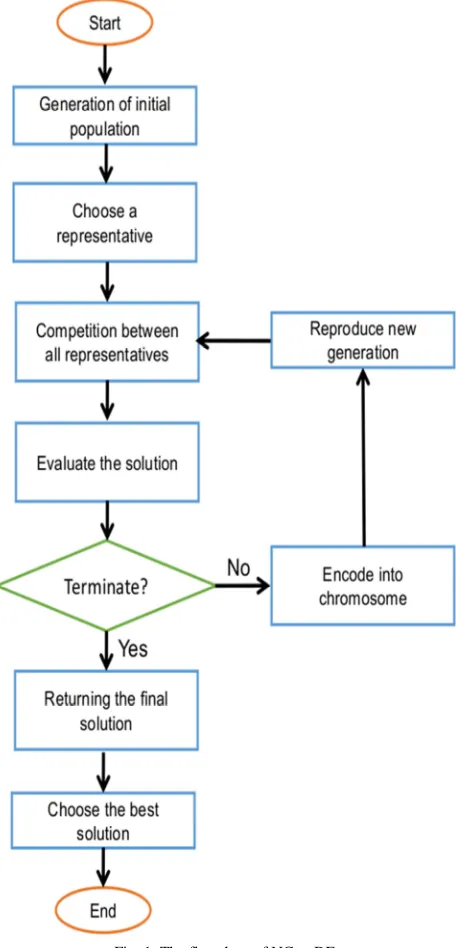
In this section, the proposed method that combines Newton method, ComCA and DE that known as NComDE is presented. In the NComDE, the Newton method is used in solving the nonlinear equations system, while the ComCA and DE is used for multi-objective problem where ComCA is for minimizing the total amount of chemical concentrations involves by populate the chromosome into two separate population and DE for maximize the biochemical system production by tuning the variable in nonlinear equations system. In NComDE, two populations of chromosomes are used to represent the variables in nonlinear equations system. The first population focus on maximizing the production while the second population is for minimizing the total amount of chemical concentrations involves. The number of chromosome in both populations is same. The flowchart of NComDE is given in Fig. 1. Next, are the steps involved in the NComDE.
Step 1: Generation of the initial population. This step is
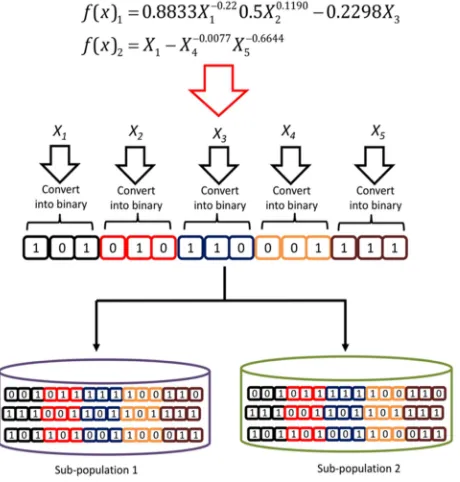
about the first generation of the chromosome in two separate population. The generation process is perform using equation 1. The first population is generated to improve the production while the second population is to minimize the total amount of chemical concentrations involves. The chromosomes in both population are in binary format. The representation of the variables in nonlinear equation system in chromosome form is given in Fig. 2.
Fig. 1 The flowchart of NComDE
1) Step 2: Choose a representative. This step about the
choosing process of a representative from all population. The selection process of representation is based on their fitness where it refers to the objective of each population. For the first population, the chromosome that has higher fitness value (denoted as F1) is chosen as a representative
due to this population is about improve the production. The
F1 is the fitness value where it comes from the production
rate. For the second population, the chromosome with lowest fitness value (denoted as F2) is selected as this population is
aiming to minimize the total amount of chemical concentrations involves. The F2 is the fitness value where it
(6)
(7)
(9) (8)
(10)
Fig. 2 The representation of the variables in chromosome form
2) Step 3: Competition between all representatives. This
step is about the selection of a winner between all population. In this step, all representatives compete with each other, and the winner is chosen based on the representative that has higher fitness function (denoted as F3). The F3 is formulated
in equation 6. Then, the representative that has higher of F3
is chose as a solution.
100
3) Step 4: Evaluate the solution. This step is about the
evaluation process of the representative that chosen from the previous step. The evaluation process starts with the decoding process of the solution into variables in nonlinear equations system. The Newton method is used to in solving the nonlinear equations system. At this stage, termination conditions occur, which is whether the steady-state constraint and chemical reaction constraint are fulfilled or not. If the solution meets the termination conditions, if move forward to Step 7, otherwise it enters the next step.
4) Step 5: Encode into the chromosome. In this stage,
the variables in nonlinear equations system are encoded back into chromosome form after being tested by Newton method. Then, the chromosome goes back into its population for reproduction process.
5) Step 6: Reproduce new generation. In this step, the selection, mutation, and crossover operations are applied to all populations to produce the new generation.
6) Step 7: Returning the final solution. In this step, the best set of solutions (variables in the nonlinear equations system) that obtained from the evolution process is given.
In order to show the performance of the proposed method, two benchmark case studies were used, namely the optimization of ethanol production in S. cerevisiae pathway and the optimization of trp biosynthesis in E. Coli. To run
the experiment, a Java program was developed that was based on jMetal [25] and JAMA version 1.0.3 were used.
The jMetal can be downloaded from
http://jmetal.sourceforge.net/ index.html while JAMA can be obtained from http://math.nist.gov/javanumerics/jama/.
A. Case Study 1: Optimization of Ethanol Production in Saccharomyces Cerevisiae Pathway
In S. cerevisiae pathway, the method that proposed in this study is used to optimize the ethanol production. The detail description of this pathway is discussed in the work that proposed in [26]. The ODEs model that represents this pathway is given by the equation 7 as follows:
1
2
3
4
5
0.5
2
2
in HK
HK PFK Carb
PFK GAPD Gro
GAPD PK
GAPD PK HK Carb PFK ATPase
dX
V V
dt dX
V V V
dt dX
V V V
dt dX
V V
dt dX
V V V V V V
dt
= −
= − −
= − −
= −
= + − − − −
All fluxes (denoted by V) has the following rates when it is in steady state condition:
0.2344
2 1
0.7464 0.0243
1 5 2
0.7318 0.3941
2 5 3
4 8.6107 2 6 2 0.6159 0.1308
3 5 4
2 0.05 0.533 0.0822
3 4 5 7
2 0.05 3
0.8122
2.8632
0.5232
8.904 10
7.6092 10
9.272 10
9.471 10
in HK PFK Carb GAPD Gro PK
V X Y
V X X Y
V X X Y
V X Y
V X X Y
V X X X Y
V X X
−
−
−
−
− −
−
= =
=
= ×
= ×
= ×
= × 0.533 0.0822
4 5 5
5 8
ATPase
X Y
V X X
−
=
The ethanol production that was tried to be improved in this pathway is given by the flux VPK thus it becomes the F1.
Therefore, the first objective (first population) of the multi-objective problem in this pathway is as follows:
1 PK
max F =V
For the second objective, F2 (second population), the
proposed method is trying to minimize the total amount of chemical concentrations involves and it can be formulated as follows:
5 6
2
1 6
j j
j j
min F X Y
= =
=
∑
+∑
(11) (12) (13) (14) (15) (17) (18) 0 0 0.5 0 2 0 2 0 in HK
HK PFK Carb PFK GAPD Gro
GAPD PK
GAPD PK HK Carb PFK ATPase
V V
V V V
V V V
V V
V V V V V V
− =
− − =
− − =
− =
+ − − − − =
Meanwhile, the chemical reaction constraint in this pathway is divided into two categories, metabolites constraint and enzymes constraint. For metabolites constraint, all metabolites were set in range 0.8 to 1.2 and given in equation 12, while enzymes constraint were in the range 0-50 and given in equation 12 [3], [4].
0.8 1.2
1, 2,3, 4,5
j j j
X ≤X ≤X j=
0 50
1,2,3,4,5,8
j j j
Y
≤ ≤
Y
Y
j
=
B. Case Study 2: Optimization of Tryptophan Production in Escherichia Coli Pathway
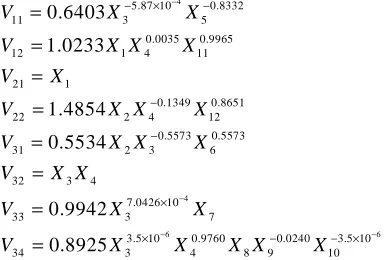
For case study 2, the proposed method was tried to optimize the end product of E.coli which is trp. Detail description of this pathway can be further read in works that performed by Xiu and co-workers [27]. The ODEs model of this pathway is given by equation 13.
1
11 12
2
21 22
3
31 32 33 34
dX V V dt dX V V dt dX
V V V V
dt
= −
= −
= − − −
At the steady state condition, the rate of all reactions (denoted by V) has the following value:
4
4
6
5.87 10 0.8332
11 3 5
0.0035 0.9965
12 1 4 11
21 1
0.1349 0.8651
22 2 4 12
0.5573 0.5573
31 2 3 6
32 3 4
7.0426 10
33 3 7
3.5 10 0.9760 0.0240
34 3 4 8 9 10
0.6403 1.0233 1.4854 0.5534 0.9942 0.8925
V X X
V X X X
V X
V X X X
V X X X
V X X
V X X
V X X X X X
− − − − × − − − × × − = = = = = = = = 6
3.5 10− − ×
The trp production was given by reaction V34 and become
the F1. Therefore, the first objective (first population) of the
multi-objective problem in case study two is given as follows:
34
max F =V
For the second objective, F2 (second population), the
proposed method is trying to minimize the total amount of chemical concentrations involves and it can be formulated as follows: 6 2 8 1 j j
min F X X
=
=
∑
+ (16)In the steady-state constraint, all the ODEs model are a force to be equal to 0 [28]. This makes equation 13 become as follows:
11 12
21 22
31 32 33 34 0
0
0
V V
V V
V V V V
− =
− =
− − − =
For the chemical reaction constraint of this pathway, only several involves in the fine-tuning process which was X1 to X6 and X8, while the other components used a fixed value.
The chemical reactions that involve were given as follows:
0.8 1.2 4 5 6 7 5 8 9 10 11 12 13 1, 2,3 0 0.00624 4 10 500 5000 0.0022 0 1000 7.5 0.005 0.9 0.02 0
j j j
X X X j
X X X X X X X X X X X ≤ ≤ = ≤ ≤ ≤ ≤ ≤ ≤ = ≤ ≤ = = = = =
III. RESULTS AND DISCUSSION
In accessing the performance of the proposed method, several experiments were performed. The Newton method use fixed parameters setting which are the number of iterations was fixed to 100, and the tolerance was set to 10-6. For the DE parameters, Table 1 list the DE parameters setting in obtaining the best result.
TABLEI
PARAMETERS SETTING IN PRODUCING THE BEST RESULT
Parameter S. cerevisiae pathway
E.coli
pathway
No of chromosomes 250 200
No of generations 300 300
Scaling factor 0.8 0.7
Crossover rate 0.2 0.2
Table 2 gives the result obtained by the NComDE when the NComDE uses on the S. cerevisiae pathway. The best result obtained by the NComDE is 52.93 compared to its steady-state value. This means that the NComDE is able to improve the ethanol production. Meanwhile, the NComDE able to reduce the total amount of chemical concentrations involves where the value is 294.8 compared to its steady-state value. In addition, it can be found that the performance of the NComDE outperforms the result from other works in terms of improving the ethanol production and at the same time reduce the total amount of chemical concentrations involves.
able to reduce it to 6015.01. For the detail result, Table 3 lists the results including the comparison with previous works. Like the previous pathway, the performance of the NComDE outperforms the other works and confirm that the proposed method able to simultaneously improve the production and reduce the total amount of chemical concentrations involves.
TABLEII
THE RESULT OBTAINED BY NCOMDE IN S.CEREVISIAE PATHWAY
TABLEIII
THE RESULT OBTAINED BY NCOMDE IN E.COLIPATHWAY
In addition, the NComDE is compared with the method that not apply the ComCA (Newton DE). The purpose in using ComCA is to reduce the total amount of chemical
concentrations involves. Several experiments were
conducted using parameters setting in Table 1, Fig. 3 and Fig. 4 give the comparison of NComDE and Newton DE in a line graph. From the graph, it can be observed that all NComDE results are lower compared to Newton DE thus confirm that using the ComCA able to reduce the total amount of chemical concentrations involves.
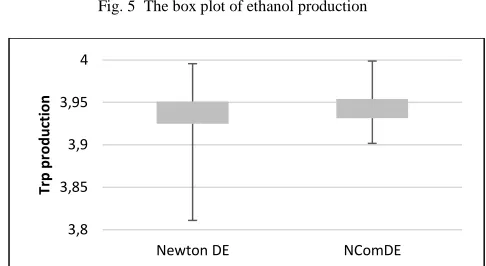
Besides that, the distribution result of ethanol production and trp production was given by the box plot in Fig.5 and Fig. 6. The results of these figures were collected from 100 independent runs and use parameters setting form Table 1. From both figures, it can be observed that the performance of NComDE outperformed the performance of Newton DE where the distribution of results produced by NComDE was not too wide compared to the results produced by Newton DE. This point out that the performance of NComDE was consistent. It can be suggested that NComDE could produce better results if the experiment runs several times.
Fig. 3 The comparison of the total amount of chemical concentrations between NComDE and Newton DE in S. cerevisiae pathway
Fig. 4 The comparison of the total amount of chemical concentrations between NComDE and Newton DE in E.coli pathway
Fig. 5 The box plot of ethanol production
Fig. 6 The box plot of trp production
51,8 52 52,2 52,4 52,6 52,8 53 53,2
Newton DE NComDE
E
th
a
n
ol
p
rod
u
ct
ion
3,8 3,85 3,9 3,95 4
Newton DE NComDE
T
rp
p
rod
u
ct
ion
Best Solution
Work by [29]
Work by [4]
Work by [30]
Work by [15]
X1 0.9590 1.14 1.102 1.11 1.11
X2 0.8087 1.05 1.046 1.03 1.03
X3 0.8479 1.15 1.141 1.13 1.19
X4 1.1524 1.17 1.171 1.18 1.17
X5 0.9033 1.12 1.113 1.14 0.91
Y1 49.9170 49.97 50 49.99 49.73
Y2 44.8006 44.77 45.953 45.83 45.81
Y3 49.6112 49.89 50 49.92 48.89
Y4 47.2629 47.26 47.772 47.97 48.13
Y5 48.7968 48 48.366 48.30 47.85
Y8 49.7482 49.75 50 49.79 48.98
F1 52.97 52.0843 52.5118 52.57 52.91 F2 294.80 295.28 297.664 297.384 294.80
Best Solution
Work by [31]
Work by [28]
Work by [4]
Work by [30]
X1 1.06 1.19 1.2 1.2 1.11
X2 1.11 1.15 1.15 1.12 1.114
X3 0.8 0.8 0.8 0.8 0.8
X4 0.0054 0.0041 0.004 0.0054 0.0054
X5 4.50 4 4 4.011 4.75
X6 5000 5000 5000 5000 5000
X8 1000 1000 1000 1000 1000
IV. CONCLUSION
As a conclusion, NComDE has a higher tendency in improving the biochemical system's production. In future development, this research could be enhanced by referring to various other works available such as [32]-[42].
ACKNOWLEDGMENT
The authors would like to express their appreciation for the support of the sponsors Grant Vot No. U558 from Universiti Tun Hussein Onn Malaysia and RDU Grant Vot No. RDU1603115 from Univerisiti Malaysia Pahang. Our gratitude also goes to the editor and anonymous reviewers who reviewed this paper.
REFERENCES
[1] C. Grosan and A. Abraham, “A New Approach for Solving Nonlinear Equations Systems,” Systems, Man and Cybernetics, Part A: Systems
and Humans, IEEE Transactions on, vol. 38, no. 3, pp. 698–714,
2008.
[2] M. H. Al-Towaiq and Y. S. A. Hour, “Two Improved Methods Based on Broyden’s Newton Methods for the Solution of Nonlinear System of Equations,” Journal of Engineering and Applied Sciences, vol. 11, pp. 2344–2348, 2016.
[3] H. Link, J. Vera, D. Weuster-Botz, N. T. Darias, and E. Franco-Lara, “Multi-objective steady state optimization of biochemical reaction networks using a constrained genetic algorithm,” Computers and
Chemical Engineering, vol. 32, no. 8, pp. 1707–1713, 2008.
[4] G. Xu, “Steady-state optimization of biochemical systems through geometric programming,” European Journal of Operational Reseach, vol. 225, no. 1, pp. 12–20, 2013.
[5] M. Dehghan and M. Hajarian, “Fourth‐order variants of Newton’s method without second derivatives for solving non‐linear equations,”
Engineering Computations, vol. 29, no. 4, pp. 356–365, 2012.
[6] L. Metivier, R. Brossier, J. Virieux, and S. Operto, “Full Waveform Inversion and the Truncated Newton Method,” SIAM Journal on
Scientific Computing, vol. 35, no. 2, pp. B401--B437, 2013.
[7] M. A. Hernández and M. J. Rubio, “The Secant method for nondifferentiable operators,” Applied Mathematics Letters, vol. 15, no. 4, pp. 395–399, 2002.
[8] I. K. Argyros, “New sufficient convergence conditions for the secant method,” Czechoslovak Mathematical Journal, vol. 55, no. 1, pp. 175–187, 2005.
[9] D. Bachrathy and G. Stepan, “Bisection method in higher dimensions and the efficiency number,” Periodica Polytechnica Mechanical
Engineering, vol. 56, no. 2, pp. 81–86, 2012.
[10] M.-C. Rivara, “Lepp-bisection algorithms, applications and mathematical properties,” Applied Numerical Mathematics, vol. 59, no. 9, pp. 2218–2235, Sep. 2009.
[11] C.-S. Liu and S. N. Atluri, “A novel time integration method for solving a large system of non-linear algebraic equations,” Computer
Modeling in Engineering and Sciences, vol. 31, no. 2, pp. 71–83, Jan.
2008.
[12] C.-S. Liu, “A modified Newton method for solving non-linear algebraic equations,” Journal of Marine Science and Technology, vol. 17, no. 3, pp. 238–247, Jun. 2009.
[13] M. Á. Fernández and M. Moubachir, “A Newton method using exact jacobians for solving fluid–structure coupling,” Computers {&}
Structures, vol. 83, no. 2–3, pp. 127–142, 2005.
[14] B. S. Adiwijaya, P. I. Barton, and B. Tidor, “Biological network design strategies: discovery through dynamic optimization,”
Molecular BioSystems, vol. 2, no. 12, pp. 650–659, 2006.
[15] M. A. Ismail, S. Deris, M. S. Mohamad, and A. Abdullah, “A Newton cooperative genetic algorithm method for in silico optimization of metabolic pathway production,” PloS one, vol. 10, no. 5, p. e0126199, 2015.
[16] S. T. Suganthi, D. Devaraj, and S. H. Thilagar, “An improved differential evolution algorithm for congestion management considering voltage stability,” Indian Journal of Science and
Technology, vol. 8, no. 24, 2015.
[17] S. Das, S. S. Mullick, and P. N. Suganthan, “Recent advances in differential evolution-An updated survey,” Swarm and Evolutionary
Computation, vol. 27, pp. 1–30, 2016.
[18] F. Peñuñuri, C. Cab, O. Carvente, M. A. Zambrano-Arjona, and J. A. Tapia, “A study of the Classical Differential Evolution control parameters,” Swarm and Evolutionary Computation, vol. 26, pp. 86– 96, 2016.
[19] C. K. Chong, M. S. Mohamad, S. Deris, M. S. Shamsir, L. E. Chai, and Y. W. Choon, “Parameter Estimation by Using an Improved Bee Memory Differential Evolution Algorithm (IBMDE) to Simulate Biochemical Pathways,” Current Bioinformatics, vol. 9, no. 1, pp. 65–75, 2014.
[20] M. Zainudin et al., “Feature Selection Optimization using Hybrid Relief-f with Self-adaptive Differential Evolution,” International
Journal of Intelligent Engineering and Systems, vol. 10, no. 3, pp.
21–29, 2017.
[21] D. M. Dhanalakshmy, P. Pranav, and G. Jeyakumar, “A Survey on Adaptation Strategies for Mutation and Crossover Rates of Differential Evolution Algorithm,” International Journal on
Advanced Science, Engineering and Information Technology, vol. 6,
no. 5, pp. 613–623, 2016.
[22] J. H. Ong and J. Teo, “A Time-Critical Investigation of Parameter Tuning in Differential Evolution for Non-Linear Global Optimization,” International Journal on Advanced Science,
Engineering and Information Technology, vol. 6, no. 4, pp. 426–436,
2016.
[23] R. Storn and K. Price, “Differential Evolution – A Simple and Efficient Heuristic for global Optimization over Continuous Spaces,”
Journal of Global Optimization, vol. 11, no. 4, pp. 341–359, 1997.
[24] C. Darwin, On the Origin of Species: By Means of Natural Selection
Or the Preservation of Favored Races in the Struggle for Life. (reprint). New York, USA: Cosimo, Inc, 2007.
[25] J. J. Durillo and A. J. Nebro, “jMetal: A Java framework for multi-objective optimization,” Advances in Engineering Software, vol. 42, no. 10, pp. 760–771, 2011.
[26] J. L. Galazzo and J. E. Bailey, “Fermentation pathway kinetics and metabolic flux control in suspended and immobilized Saccharomyces cerevisiae,” Enzyme and Microbial Technology, vol. 12, no. 3, pp. 162–172, 1990.
[27] Z.-L. Xiu, A.-P. Zeng, and W.-D. Deckwer, “Model analysis concerning the effects of growth rate and intracellular tryptophan level on the stability and dynamics of tryptophan biosynthesis in bacteria,” Journal of Biotechnology, vol. 58, no. 2, pp. 125–140, 1997.
[28] J. Vera, C. Gonzalez-Alcon, A. Marin-Sanguino, and N. Torres, “Optimization of biochemical systems through mathematical programming: Methods and applications,” Computers {&} Operations Research, vol. 37, no. 8, pp. 1427–1438, 2010.
[29] F. Rodriguez-Acosta, C. M. Regalado, and N. V Torres, “Non-linear optimization of biotechnological processes by stochastic algorithms: Application to the maximization of the production rate of ethanol, glycerol and carbohydrates by Saccharomyces cerevisiae,” Journal of
Biotechnology, vol. 65, no. 1, pp. 15–28, 1999.
[30] M. A. Ismail, S. Deris, M. S. Mohamad, and A. Abdullah, “A Hybrid of Newton Method and Genetic Algorithm for Constrained Optimization method of the Production of Metabolic Pathway,” Life
Science Journal 11, vol. 11, no. 9s, pp. 409–414, 2014.
[31] A. Marin-Sanguino, E. O. Voit, C. Gonzalez-Alcon, and N. V Torres, “Optimization of biotechnological systems through geometric programming,” Theoretical Biology and Medical Modelling, vol. 4, pp. 38–54, 2007.
[32] U. K. Hassan, N. M. Nawi, and S. Kasim, “Classify a protein domain using sigmoid support vector machine,” in Information Science and
Applications (ICISA), 2014 International Conference, IEEE, May.
2014. pp. 1-4.
[33] U. K. Hassan, N. M. Nawi, and S. Kasim, A. A, Ramli, M. F. M., Fudzee, and M. A. Salamat,”Classify a Protein Domain Using SVM Sigmoid Kernel”. In Recent Advances on Soft Computing and Data
Mining, pp. 143-151, Springer, Cham.
[34] R., Hassan, R. M., Othman, P., Saad, and S., Kasim, “A compact hybrid feature vector for an accurate secondary structure prediction” Information Sciences, 181(23), 5267-5277.
[35] S., Ismail, R. M., Othman, S., Kasim, R., Hassan, H., Asmuni, and J., Taliba, “Pairwise protein substring alignment with latent semantic analysis and support vector machines to detect remote protein homology”, International Journal of Bio-Science and Bio-Technology, Volume 3, Issue 3, 2011, Pages 17-34.
Protein Homology Detection”, Communications in Computer and
Information Science, Volume 151 CCIS, Issue PART 2, 2011, Pages
471-497.
[37] S., Ismail, R. M., Othman, S., Kasim, R., Hassan, H., Asmuni, and J., Taliba, “Pairwise protein substring alignment with latent semantic analysis and support vector machines to detect remote protein homology” Communications in Computer and Information Science,Volume 151 CCIS, Issue PART 2, 2011, Pages 526-546.
[38] F. M., Abdullah, R. M., Othman, S., Kasim, R., Hashim, R., Hassan, H., Asmuni, and J., Taliba, “An Optimal Mesh Algorithm for Remote Protein Homology Detection”, International Journal of Bio-Science
and Bio-Technology, Volume 3, Issue 2, June 2011, Pages 13-38.
[39] U. K. Hassan, N. M. Nawi, and S. Kasim, "A computational method for protein domain prediction by using double stage neural network",
ARPN Journal of Engineering and Applied Sciences, Volume 10,
Issue 23, 2015, Pages 17528-17532.
[40] S., Kasim, M. F. M., Fudzee, S., Deris, S., and R. M., Othman, “Gene Function Prediction Using Improved Fuzzy c-Means Algorithm”, In Information Science and Applications (ICISA), 2014 International
Conference on (pp. 1-4). IEEE.
[41] S., Kasim, S., Deris, S., and R. M., Othman, “Multi-stage filtering for improving confidence level and determining dominant clusters in clustering algorithms of gene expression data”, Computers in biology
and medicine, 43(9), 1120-1133, 2013.
[42] S., Kasim, S., Deris, S., and R. M., Othman, “A new computational framework for gene expression clustering”, In International
Conference on Advanced Data Mining and Applications (pp.