TRANS Asian Research Journals
http://www.tarj.in 1
P u b l i s h e d b y : T R A N S A s i a n R e s e a r c h J o u r n a l s
TAJMMR:
T R A N S
A s i a n J o u r n a l o f
M a r k e t i n g & M a n a g e m e n t
R e s e a r c h
( A D o u b l e B l i n d R e f e r e e d & R e v i e we d I n t e r n a t i o n a l J o u r n a l )
EXAMINING THE PROFESSIONAL COMMITMENT OF
ACADEMICIANS ACROSS MEYER AND ALLEN’S 3D MODEL
Ms. H. Shamina*; Dr.Vijila E Kennedy**
*Assistant Professor, Wisdom School of Management, Gomangalampudur, Pollachi (T.K).
** Director, KCT Business School,
Kumaraguru College of Technology, Coimbatore
ABSTRACT
Teachers in higher education play a vital role in molding the future leaders of a nation. India has the third largest higher education system in the world. Various researches have thrown light into the areas of the commitment of teachers in higher education. This study attempts to study the professional commitment of teachers in higher education institutions, affiliated to Bharathiar University, Coimbatore. It also aims to find out the influence of personal variables like Age, Education, Designation, Gender and Total years of service in the institution on PC. Meyer and Allen’s (1993) model of Professional commitment advocates the APC,CPC and NPC dimensions of PC across which this study measures the PC of teachers. Data was collected from 536 teachers in Arts and science colleges. Multiple regression and F test are used to analyze the data. It was found that the personal variables have an influence on the Professional commitment of teachers in Higher education.
KEYWORDS: (APC-Affective Professional Commitment, CPC- Continuance Professional Commitment, Dimensions, NPC-Normative Professional Commitment, PC-Professional Commitment.)
____________________________________________________________________________
TRANS Asian Research Journals
http://www.tarj.in 2
While India has shown impressive growth in the number of institutes and enrollment in the country, it still faces challenges on several fronts including low and inequitable access to higher education, shortage of faculty, deficient infrastructure as well as low-quality and inadequate research. Today, a key concern for India is the creation of an employable workforce to harness its demographic dividend to the maximum extent. To achieve this, the country needs an education system that can deliver quality in terms of a skilled, committed and industry-ready workforce, without diluting focus on world-class research and innovation.
Our university system is, in many parts, in a state of disrepair...In almost half the districts in the country, higher education enrollments are abysmally low, almost two-third of our universities and 90 per cent of our colleges are rated as below average on quality parameters... I am concerned that in many states university appointments, including that of vice-chancellors, have been politicized and have become subject to caste and communal considerations, there are complaints of favoritism and corruption.
- Prime Minister Manmohan Singh in 2007
TEACHING AS A PROFESSION
Teaching is a complex and demanding profession. It is observed that, with the expansion of higher education over the years in terms of number of universities and colleges and the student strength, its quality and standards have fallen. This issue has engaged the attention of educationists for several years and various committees and commissions have suggested measures for improving the quality of higher education.
Among all the factors responsible, for the deteriorating standards in higher education, the “teacher” has been identified as the key factor. His characteristics, qualifications, his attitude towards the profession, his competency, his professional skills, his capacity for leadership and motivation to work affect the quality of education. The modern society very badly needs teachers who are not only knowledgeable but also highly motivated and committed to their profession and sincere in their efforts for doing well to the society. Unprecedented changes have been forced upon many colleges within the past ten years in higher education. Many faculty members committed to their organizations and professions prior to the changes, no longer hold values that match those of their professions and institutions. If faculty members no longer believe that there is a congruence of values between themselves and their professions, their behaviors may be affected.
PROFESSIONAL COMMITMENT OF TEACHERS IN HIGHER EDUCATION
TRANS Asian Research Journals
http://www.tarj.in 3
Commitment has received a great deal of attention in business and organizational studies for important reasons ( Kacmar, Carlson, &Brymer, 1999; Keller, 1997). Organizational instability is causing some employees to shift their commitment from increasingly transient work organizations to the relative stability of their occupations (Johnson, 1996; Reilly, Brett, &Stroh, 1993). It seems that a deeper knowledge of professional commitment is needed to better understand the attitudes and behaviors of the modern workforce. The outcomes of commitment are fairly clear. Committed people are more likely to remain with the organization, work toward organizational goals, and invest more effort in their job ( Mayer&Schoorman, 1992; Yousef, 2000).
Commitment is significantly and negatively associated with turnover and, to a lesser extent, other withdrawal behaviours such as decreased performance and increased absenteeism (Ostroff, 1997). Relatively little research, however, has addressed commitment among teachers (e.g., Billingsley & Cross, 1992; Grady, 1989). Moreover, although recently there have been attempts to trace the diverse construct of commitment (Firestone&Rosenblum, 1988), most research on teachers‟ commitment examined it as a generic construct (e.g., Niehoff, 1997; Reames& Spencer, 1998). According to Salancik (1977), an individual will tend to adhere to the norms and conform to the values and expectations of those to whom are he committed.
PERSONAL FACTORS AND PROFESSIONAL COMMITMENT
Very few research studies have been conducted on teacher educators and their characteristics. A brief account of these studies is provided here. Goyal (1980) indicated that a large majority of teacher educators were favorably inclined towards their profession, satisfied in their job but not well adjusted as well as had low professional interest. For personal factors, they include age, tenure, gender and education level (Fink 1992). Baugh & Roberts (1994) studied professional and organizational commitment among engineers in relation to job performance and satisfaction and revealed that individuals high on both forms of commitment were also high on level of satisfaction and performance.
Hung & Liu (1999) depicted that stay-back is the factor which is most highly and significantly related to commitment. Apart from this, the other factors like marital status, age and tenure were also found to be significantly related to commitment. Bogler&Somech (2004) examined the distinctive relationship of teachers‟ professional and organizational commitment with participation in decision making and with organizational citizenship behaviour. It was inferred that participation in managerial domain was positively associated with both the professional and organizational commitment, whereas; participation in the technical domain was positively related with only teachers‟ professional commitment.
TRANS Asian Research Journals
http://www.tarj.in 4
positively very low for most of the dimensions and for some of the dimensions, negative relation was observed. Sylvester (2010) held that the factors like gender, location of institute, educational qualification and years of teaching experience of teacher educators have no impact on their attitude towards teaching profession as well as level of job satisfaction.
Age
Classification No. of respondents Percentage
Less than 25 Years 4 02
25 – 35 Years 154 28
35 - 45 Years 225 42
45-55 Years 147 27
Above 55 years 06 01
Total 536 100
Gender
Classification No. of respondents Percentage
Male 327 61
Female 209 39
Total 536 100
Educational Quln
Classification No. of respondents Percentage
P.G 96 18
M. Phil 249 47
NET/SLET 79 14
Ph. D 112 21
Total 536 100
Designation
Classification No. of respondents Percentage
Assistant professor 436 81
TRANS Asian Research Journals
http://www.tarj.in 5
REVIEW OF LITERATURE
It has been a decade since Mathieu and Zajac (1990) conducted meta-analyses of the antecedents, correlates, and consequences of organizational commitment. At that time, researchers were making a distinction between two forms of commitment: attitudinal (e.g., Mowday, Steers, & Porter, 1979) and calculative (e.g., Becker, 1960). Mathieu and Zajac (1990) included form of commitment as a potential moderator in their analyses and found some differences.
Meyer and Allen (1991) offer a further distinction, identifying three components of commitment: „continuance‟, „normative‟ and „affective‟ commitment. These they describe as „have to‟, „ought to‟ and „want to‟. Each component of commitment has different behavioural outcomes, though an individual may reflect varying degrees of all three components of commitment to a particular focus (Meyer and Allen 1997).
Continuance commitment involves “profit associated with continued participation and a „cost‟ associated with leaving “(Kanter 1968, p 507). A key predictor of desire to stay or leave is commitment to the organisation (Wong, Hui and Law 1995). Normative commitment is “the internalised normative pressure to act in a way which meets organisational goals and interests” (Wiener, 1982, p 421). This has been studied extensively, especially in the “psychological contract” between an employer and employee (Levinson, Price, Munden, Mandl and Solley 1962; Schein 1965; Rousseau 1990).
Affective commitment is described as “the relative strength of an individual‟s identification with and involvement in a particular organisation” (Mowday, Porter and Steers 1982, p27). This is
Professors 24 05
Total 536 100
Total service (yrs)
Classification No. of respondents Percentage
Less than 10 years 215 40
10-15 years 233 43
15-20 years 46 09
20-25 years 30 06
25- 30 years 06 01
Above 30 years 06 01
TRANS Asian Research Journals
http://www.tarj.in 6
probably the most beneficial component of commitment for an organisation to engender within its employees as it is associated with productive behavior aimed at contributing meaningfully to the organisation (Meyer and Allen 1997). Behaviour associated with affective commitment includes those defined as organizational citizenship behavior (Bateman and Organ 1983). These are behaviors that are “discretionary, not directly or explicitly recognized by the formal reward system, and that in the aggregate promotes the effective functioning of the organisation “(Organ 1988, p4) Those employees with strong affective commitment appear more willing to engage in organizational citizenship behavior than those with weak affective commitment (Meyer and Allen 1986; Shore and Wayne 1993).
THE THREE-COMPONENT MODEL OF PROFESSIONAL COMMITMENT
The multidimensionality of professional commitment is well established in organizational behavior literature. (Allen & Meyer, 1990; Meyer, Allen, &Gellatly, 1990).The three component model of Meyer and Allen (1993) on professional commitment explains the multidimensions of PC viz Affectiveprofessional commitment, Normative professional Commitment and Continuance professionalCommitment. Their results also indicated that there were differential relationships between each of the three components of professional commitment and other variables (see Meyer et al., 1993).
They contended that a multidimensional understanding of professional commitment could have important implications for understanding the psychological bond between a professional and their particular profession. Meyer et al. (1993) argued that examining multiple dimensions of PC might provide a more complete understanding of an individual‟s commitment to their profession. Although all three dimensions may influence the likelihood of an individual remaining in the profession, each dimension of PC may develop differently.
Affective professional commitment (APC) refers to identification with, involvement in, and emotional attachment to the profession. It is based on identification with the profession‟s goals and a willingness to assist the profession in achieving those goals. Thus, employees with strong affective professional commitment remain members of their profession because they want to do so. For example, professionals with a strong sense of affective commitment to their profession will keep up with developments in their profession, subscribe to trade journals, attend professional meetings, and participate in their professional association. A person with high APC will more strongly identify with, and experience more positive feelings about, their profession compared to a person with low APC (Lee et al. 2000). It develops through positive professiona l experiences or the development of professional skills.
TRANS Asian Research Journals
http://www.tarj.in 7
market conditions, the development of nontransferable skills, and the costs of retraining may limit comparable alternatives, and thus increase CPC.
Normative professional commitment (NPC) refers to commitment based on a sense of obligation to the profession. Employees with strong normative professional commitment remain members of their profession because they feel they ought to do so. Normative professional commitment may develop because of effective professional socialization or the sacrifices involved in becoming a member of a particular profession (Meyer et al., 1993). NPC may arise as a result of experiencing significant benefits from working in the profession, or pressure from colleagues or family that emphasizes the importance of remaining in the profession.(Bagraim, 2003; Ware &Kitsantas, 2007).
Meyer et al. (1993) argue that each dimension of PC may have different implications for the extent of an individual‟s involvement in a profession. Individuals with high APC and high NPC may be more likely to be involved in activities within the profession and to keep up to date with professional developments, over and above meeting the minimum requirement for maintaining membership. However, individuals with high CPC are less likely to engage such extra-role behavior. Empirical research supports the existence of affective, continuance, and normative PC. Meyer et al. (1993) studied nurses to determine the discriminant validity of each dimension of PC and demonstrated that the three dimensions correlated differently with various antecedents and outcomes. For example, both APC and NPC were positively correlated with job satisfaction. However, CPC was negatively correlated. A sense of obligation to others was positively correlated with NPC and CPC, but not with APC.
All three components of professional commitment have implications for an employee‟s staying with (or leaving) their profession. Common to the three components is the understanding that commitment is a psychological state that (a) characterizes the employee‟s relationship with their profession and (b) has implications for the employee‟s decision to continue or discontinue membership of their profession.
SIGNIFICANCE OF THE STUDY
An educational institution greatly depend upon the teachers for its growth and improvement. Even though educational institutions recruit teachers with more qualifications, skills and academic records, the teacher turnover is a serious issue seen in most of the colleges and the institution has to face a huge loss in terms of quality. This is because experienced teachers when quit, carry their research experience, skills and abilities along with them which cannot be replaced easily. Hence, some other reason should be there for the deteriorating standards and turnover of the teachers. Previous studies reveal that Professionally committed individuals are usually more responsive to making efforts to advance the profession's values as well as improving their own job performance (Larson (1977)). Hence, this study attempts to study the professional commitment of teachers across the three dimensions, APC, CPC and NPC.
TRANS Asian Research Journals
http://www.tarj.in 8
1. To study the individual variables influencing the Affective Professional Commitment, Continuance Professional Commitment and Normative Professional Commitment of teachers in Higher Education Institutions.
2. To compare the extent of Affective Professional Commitment, Continuance Professional Commitment and Normative Professional Commitment of teachers in Aided Versus Self-financing colleges.
3. To suggest measures from the outcomes of the findings.
RESEARCH METHODOLOGY
The study was conducted in Arts and science colleges and Aided colleges affiliated to Bharathiar University, Coimbatore. Sample size of 536 teachers working in Aided as well as Self-financing colleges affiliated to Bharathiar University was drawn as samples. Selected colleges were chosen in Coimbatore district for the study and data collection was done with the help of a structured questionnaire. Stratified proportionate random sampling was used to collect the data. The study was a descriptive one.
RESULTS AND DISCUSSION
TABLE 1 REGRESSION MODEL FOR Y-AFFECTIVE PROFESSIONAL COMMITMENT
Variables Regression
Coefficient
Standard Error
t- value
(d.f = 528) R
2
Constant 4.000 0.130 30.852 .174
EDUC-X1 -0.132 0.028 -4.634**
TSERVICE-X2 0.040 0.006 6.449**
AGE-X3 -0.017 0.004 -4.042**
DESIG-X4 -0.201 0.055 -3.682**
**-: Significant at 1 % .
Regression Fitted Y1 = 4.000 - 0.132 X1 + 0.040 X2 – 0.017 X3 – 0.201 X4
TABLE 1.1 ANALYSIS OF VARIANCE FOR REGRESSION
Source S S D F M S F
TRANS Asian Research Journals
http://www.tarj.in 9
Residual 140.2663 528 0.265656
**- Significant at 1 % level
The multiple regression models indicated that out of the explanatory variables ( personal variables) , four variables namely, Educational qualification(X1), Total service in years( X2), Age (X3) and Designation (X4) have significantly contributing to Affective Professional Commitment (Y). The analysis of variance of multiple regression models for APC (Y) indicates the overall significance of the model fitted. The coefficient of determination R2 value showed that these variables put together explained the variations of APC (Y) to the extent of 17.4 %
TABLE 2 REGRESSION MODEL FOR Y-CONTINUANCE PROFESSIONAL COMMITMENT
Variables Regression
Coefficient
Standard Error
t- value
(d.f = 533) R
2
(Constant) 3.795 0.096 39.531 .107
EDUC-X1 -0.084 0.020 -4.270**
AGE-X3 -0.011 0.003 -4.189**
**-: Significant at 1 % .
Regression Fitted Y1 = 3.795 - 0.084 X3 - 0.011 X1
TABLE 2.1 ANALYSIS OF VARIANCE FOR REGRESSION
Source S S D F M S F
Regression 11.45569 2 5.727847 31.99**
Residual 95.40812 533 0.179002
**- Significant at 1 % level
The multiple regression model indicated that out of the explanatory variables ( personal variables) , two variables namely, Age (X3) , and Educational qualification (X1) have significantly contributing to Continuance Professional commitment (Y). The analysis of variance of multiple regression models for CPC (Y) indicates the overall significance of the model fitted. The coefficient of determination R2 value showed that these variables put together explained the variations of CPC (Y) to the extent of 10.7 %
TRANS Asian Research Journals
http://www.tarj.in 10
Variables Regression
Coefficient
Standard Error
t- value
(d.f = 532) R
2
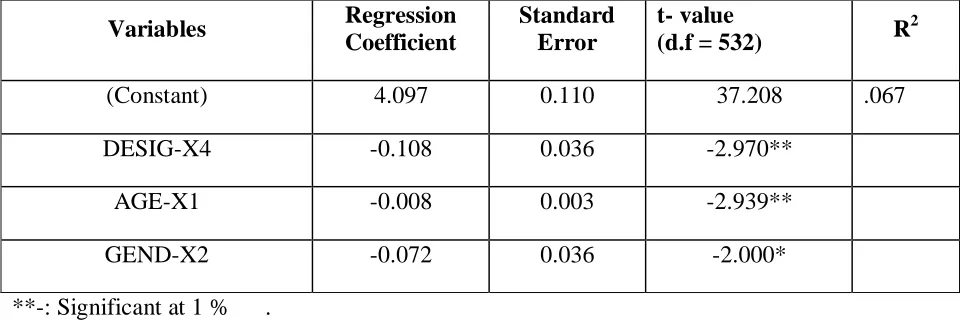
(Constant) 4.097 0.110 37.208 .067
DESIG-X4 -0.108 0.036 -2.970**
AGE-X1 -0.008 0.003 -2.939**
GEND-X2 -0.072 0.036 -2.000*
**-: Significant at 1 % .
Regression Fitted Y1 = 4.097 - 0.108 X4 - 0.008 X1 – 0.072 X2
TABLE 3.1 ANALYSIS OF VARIANCE FOR REGRESSION
Source S S D F M S F
Regression 6.187341 3 2.062447 12.68**
Residual 86.49615 532 0.162587
**- Significant at 1 % level
The multiple regression model indicated that out of the explanatory variables (personal variables) , three variables namely, Age (X1), Gender(X2), and Designation (X4) have significantly contributing to Normative professional Commitment ( Y). The analysis of variance of multiple regression models for NPC (Y) indicates the overall significance of the model fitted. The coefficient of determination R2 value showed that these variables put together explained the variations of NPC (Y) to the extent of 6.7 %.
Analysis of the extent of APC,CPC and NPC by F-test.
TABLE 4. PROFESSIONAL COMMITMENT
Professional Commitment
Institution Mean
difference
Standard error of
mean difference
‘F’ value
Aided Mean Self-finance Mean
Affective 2.86 3.10 -.24 .048 -4.87**
Continuance 2.42 3.10 -.68 .048 -14.25**
TRANS Asian Research Journals
http://www.tarj.in 11
**-Significant at 1 % level ns-non significant at 5 % level
TRANS Asian Research Journals
http://www.tarj.in 12
Personal Variables Dimensions of PC
FINDINGS AND RECOMMENDATIONS
1. The personal variables viz Age, Gender, Educational Qualification, Designation and Total years of service have an influence on the Professional commitment of teachers in Higher education.
2. Affective professional commitment is influenced by Age, Educational Qualification, Designation and Total years of service of teachers in higher education.
3. Continuance professional commitment is influenced by Age and Educational Qualification of teachers in higher education.
4. Normative professional commitment is influenced by Age, Designation and Gender of teachers in higher education.
5. Both Affective Professional commitment as well as Continuance Professional commitment are higher in self-financing college teachers than in aided college teachers and the normative commitment is same in both institutions.
CONCLUSION
The commitment towards profession is a vital and crucial phenomenon in today‟s education scenario. Teachers when provided with good working environment, motivation, growth opportunities will develop professional commitment which will make them sculpt a civilized and a socially responsible citizen for future India. Hence educational institutions should understand the individual variable which influence professional commitment among teachers and try to motivate them to minimize turnover and maximize organizational citizenship behaviours of the teachers in higher educational institutions.
GENDER AGE
EDUCATION
DESIGNATION
TOT YRS SERV SER
APC
CPC
TRANS Asian Research Journals
http://www.tarj.in 13
REFERENCES
Allen, N. J. & Meyer, J.P. (1990). The measurement and antecedents of affective, continuance and normative commitment to the organisation. Journal of Occupational Psychology, 63, 1-18.
Aranya, J. Pollock, and J. Amernic( 1981)An examination of professional commitment in public accounting, Accounting, Organizations and Society 6 (4): 271- 280.
Aranya, N. & Ferris, K.R. (1983) Organizational-professional conflict among US and Israeli Professional Accountants. Journal of Social Psychology 119: 153-161.
Billingsley, B. S.,& Cross, L.H. (1992). Predictors of commitment, job satisfaction and intent to stay in teaching. A comparision of general and special educators. Journal of Special Education, 25(4), 453-472.
Firestone,W. A.,&Rosenblum, S. (1988). Building commitment in urban high schools. Educational Evaluation and Policy Analysis, 10, 285-299.
Lee, V. E., Dedrick, R. F., & Smith, J. B. (1991). The effect of the social organization of schools on teachers‟ efficacy and satisfaction. Sociology of Education, 4, 190-208.
Mathieu, J. E. and D. Zajac (1990). "A Review and Meta-Analysis of the Antecedents, Correlates, and Consequences of Organizational Commitment." Psychological Bulletin 108(2): 171-194.
Mayer, R. C., &Schoorman, F. D. (1992). Predicting participation and production outcomes through a two-dimensional model of organizational commitment. Academy of Management Journal, 35, 671-684.
Meyer, J. P. & Allen, N. J. (1991) A three-part conceptualisation of organisational commitment. Human Resources Management Review, 1. pp. 61-89.
Meyer, J. P. Allen, N. J. & Smith, C. A. (1993). Commitment to organizations and occupations: Extension and test of a three component conceptualization. Journal of Applied Psychology, 78 (4), 538-551.
Nazari, K. &Emami, M. (2012). Analysis of relation between organizational commitment and professional commitment. Elixir Human Res. Mgmt. 51pp. 10661-10664.
TRANS Asian Research Journals
http://www.tarj.in 14