The Thirty-Third AAAI Conference on Artificial Intelligence (AAAI-19)
Counting Complexity for Reasoning in Abstract Argumentation
∗Johannes K. Fichte
TU Dresden 01062 Dresden, Germany [email protected]Markus Hecher
TU WienInstitute of Logic and Computation Favoritenstraße 9-11 / E192
1040 Vienna, Austria [email protected]
Arne Meier
Leibniz Universit¨at Hannover Institut f¨ur Theoretische InformatikAppelstraße 4 30167 Hannover, Germany [email protected]
Abstract
In this paper, we consider counting and projected model count-ing of extensions in abstract argumentation for various se-mantics. When asking for projected counts we are interested in counting the number of extensions of a given argumen-tation framework while multiple extensions that are identi-cal when restricted to the projected arguments count as only one projected extension. We establish classical complexity re-sults and parameterized complexity rere-sults when the problems are parameterized by treewidth of the undirected argumen-tation graph. To obtain upper bounds for counting projected extensions, we introduce novel algorithms that exploit small treewidth of the undirected argumentation graph of the in-put instance by dynamic programming (DP). Our algorithms run in time double or triple exponential in the treewidth de-pending on the considered semantics. Finally, we take the exponential time hypothesis (ETH) into account and establish lower bounds of bounded treewidth algorithms for counting extensions and projected extension.
Introduction
Abstract argumentation (Dung 1995; Rahwan 2007) is a central framework for modeling and the evaluation of guments and its reasoning with applications to various ar-eas in artificial intelligence (AI) (Amgoud and Prade 2009; Rago, Cocarascu, and Toni 2018). The semantics of argumen-tation is described in terms of arguments that are acceptable with respect to an abstract framework, such as stable or ad-missible. Such arguments are then called extensions of a framework. In argumentation, one is particularly interested in the credulous or skeptical reasoning problem, which asks, given an argumentation framework and an argument, whether the argument is contained in some or all extension(s) of the framework, respectively. A very interesting, but yet entirely unstudied question in abstract argumentation is the compu-tation and the compucompu-tational complexity of counting, which asks for outputting the number of extensions with respect to a certain semantics. By counting extensions, we can answer
∗
Funded by Austrian Science Fund FWF grants I2854, Y698, and P30168-N31, as well as the German Research Fund DFG grants HO 1294/11-1 and ME 4279/1-2. The second author is also affiliated with the University of Potsdam, Germany.
Copyright c2019, Association for the Advancement of Artificial Intelligence (www.aaai.org). All rights reserved.
questions such as how many extensions are available con-taining certain arguments. An even more interesting question is how many extensions containing certain arguments exist when restricted to a certain subset of the arguments which asks for outputting the number of projected extensions.
Interestingly, the computational complexity of the deci-sion problem is already quite hard. More precisely, the prob-lem of credulous acceptance, which asks whether a given argument is contained in at least one extension, is NP -complete for the stable semantics and evenΣp2-complete for the semi-stable semantics (Dunne and Bench-Capon 2002; Dvoˇr´ak and Woltran 2010; Dvoˇr´ak 2012). The high worst-case complexity is often a major issue to establish algorithms for frameworks of abstract argumentation. A classical way in parameterized complexity and algorithmics is to identify structural properties of an instance and establish efficient algorithms under certain structural restrictions (Cygan et al. 2015). Usually, we aim for algorithms that run in time poly-nomial in the input size and exponential in a measure of the structure, so-calledfixed-parameter tractablealgorithms. Such runtime results require more fine-grained runtime analy-ses and more evolved reductions than in classical complexity theory where one considers only the size of the input. Here, we take a graph-theoretical measure of the undirected graph of the given argumentation framework into account. As mea-sure we take treewidth, which is arguably the most prominent graph invariant in combinatorics of graph theory and renders various graph problems easier if the input graph is of bounded treewidth.
Our results are as follows:
• We establish the classical complexity of counting exten-sions and counting projected extenexten-sions for various seman-tics in abstract argumentation.
• We present an algorithm that solves counting projected extensions by exploiting treewidth in runtime double ex-ponential in the treewidth or triple exex-ponential in the treewidth depending on the considered semantics.
Related work. Baroni, Dunne, and Giacomin (2010) considered general extension counting and show #P-completeness and identify tractable cases. We generalize these results to the reasoning problems. Lampis, Mengel, and Mitsou (2018) considered bounded treewidth algorithms and established lower bounds for the runtime of an algorithm that solves reasoning in abstract argumentation under the admis-sible and preferred semantics. These results do not trivially extend to counting and are based on reductions to QBF. They yield asymptotically tight bounds, but still involve a constant factor. Unfortunately, already a small increase even by one can amount to one order of magnitude in inference time with dynamic programming (DP)algorithms for QBF. As a result, a factor of just two can already render it impractical. Fichte et al. (2018) gave DP algorithms for projected #SAT and estab-lished that it cannot be solved in runtime double exponential in the treewidth under ETH using results by Lampis and Mit-sou (2017), who established lower bounds for the problem ∃∀-SAT. Dvoˇr´ak, Pichler, and Woltran (2012) introduced DP algorithms that exploit treewidth to solve decision problems of various semantics in abstract argumentation. We employ these results and lift them to projected counting. Further, DP algorithms for projected counting in answer set programming (ASP) were recently presented (Fichte and Hecher 2018a).
Formal Background
We use graphs and digraphs as usually defined (Bondy and Murty 2008) and follow standard terminology in computa-tional complexity (Papadimitriou 1994) and parameterized complexity (Cygan et al. 2015). LetΣandΣ0be some finite alphabets andL⊆Σ∗×Nbe a parameterized problem. For
(I, k)∈L, we callI∈Σ∗aninstanceand k the parameter. For a setX, let2Xconsist of all subsets ofX. Later we use the generalized combinatorial inclusion-exclusion principle, which allows to compute the number of elements in the union over all subsets (Graham, Gr¨otschel, and Lov´asz 1995).
Counting Complexity. We follow standard terminology in this area (Toda and Watanabe 1992; Hemaspaandra and Vollmer 1995; Durand, Hermann, and Kolaitis 2005). In par-ticular, we will make use of complexity classes preceded with the sharp-dot operator ‘#·’. (Note the difference to Valiant’s classes (Valiant 1979).) A witnessfunction is a functionw: Σ∗→ P<ω(Γ∗), whereΣandΓare alphabets,
mapping to a finite subset ofΓ∗. Such functions associate with the counting problem “givenx∈Σ∗, find|w(x)|”. If C is a decision complexity class then#· Cis the class of all counting problems whose witness functionwsatisfies (1.)∃polynomial psuch that for ally ∈ w(x), we have that|y| 6 p(|x|), and (2.) the decision problem “givenx
and y, is y ∈ w(x)?” is inC. A parsimoniousreduction between two counting problems#A,#Bpreserves the car-dinality between the corresponding witness sets and is com-putable in polynomial time. Asubtractivereduction between two counting problems #A and#B is composed of two functionsf, gbetween the instances ofAandBsuch that
B(f(x))⊆B(g(x))and|A(x)|=|B(g(x))| − |B(f(x))|, whereAandBare respective witness functions.
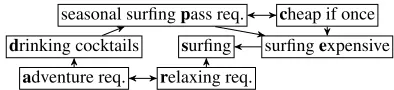
drinking cocktails surfing surfingexpensive seasonal surfingpass req. cheap if once
adventure req. relaxing req.
Figure 1: Argumentation frameworkF: surfing vs. cocktails.
Abstract Argumentation. We consider the Argumenta-tion Framework by Dung (1995). Anargumentation frame-work (AF), or framework for short, is a directed graphF= (A, R)whereAis a non-empty and finite set of arguments, andR⊆A×Aa pair arguments representing direct attacks1
of arguments. In argumentation, we are interested in com-puting so-calledextensions, which are subsetsS⊆Aof the arguments that meet certain properties according to certain semantics as given below. An arguments∈S, is called de-fended bySinFif for every(s0, s)∈R, there existss00∈S
such that(s00, s0) ∈ R. The familydefF(S)is defined by
defF(S) :={s|s∈A, sis defended bySinF}. We say
S⊆Aisconflict-free inSif(S×S)∩R=∅;Sis admis-sible inFif (i)Sisconflict-free inF, and (ii) everys∈S
isdefended bySinF. Assume an admissible setS. Then, (iiia)Siscomplete inFifdefF(S) =S; (iiib)Sispreferred inF, if there is noS0⊃Sthat isadmissible inF; (iiic)Sis
semi-stable inF if there is no admissible setS0 ⊆AinF
withSR+((S0)+RwhereSR+:=S∪{a|(b, a)∈R, b∈S}; (iiid) S is stable inF if everys ∈ A\S isattacked by some s0 ∈ S. A conflict-free set S isstage in F if there is no conflict-free setS0 ⊆AinF withSR+ ((S0)+R. Let
ALL abbreviate the set{admissible, complete, preferred, semi-stable, stable, stage}. For a semantics S ∈ ALL, S(F)denotes the set ofall extensionsof semanticsSinF. In general stable(F) ⊆ semi-stable(F) ⊆ preferred(F)
⊆ complete(F) ⊆ admissible(F) ⊆ conflict-free(F)
andstable(F)⊆stage(F)⊆conflict-free(F).
Problems of Interest. In argumentation one is usually in-terested in credulous and skeptical reasoning problems. In this paper, we are in addition interested in counting ver-sions of these problems. Therefore, let S ∈ ALL be an abstract argumentation semantic, F = (A, R) be an ar-gumentation framework, and a ∈ A an argument. The credulous reasoning problemCredSasks to decide whether
there is anS-extension ofF that contains the (credulous) argument a. Theskeptical reasoning problemSkepS asks to decide whether allS-extensions ofF contain the argu-ment a. Thecredulous counting problem#CredS asks to output the number ofS-extensions ofF that containa, i.e., |{S |S∈ S(F), a∈S}|. Theprojected credulous count-ing problem (#PCredS) asks to output the number ofS -extensions restricted to the projection arguments P, i.e., |{S∩P |S∈ S(F), a∈S}|.
Example 1. Consider frameworkF from Figure 1, which depicts a framework for deciding between surfing and drinking cocktails. Framework F admits three stable
1
extensions stable(F) = {{d, r, c},{s, a, c},{s, a, p}}.
#Credstablefor argumentsequals2, whereas#PCredstable for argumentsrestricted toP :={a, r}equals1.
Tree Decompositions (TDs). For a treeT = (N, A, n)
with rootnand a nodet∈N, we letchildren(t, T)be the sequence of all nodest0in arbitrarily but fixed order, which have an edge(t, t0)∈A. LetG= (V, E)be a graph. Atree decomposition (TD)of graphGis a pairT = (T, χ), where
T = (N, A, n)is a rooted tree,n ∈ N the root, and χa mapping that assigns to each nodet ∈ N a setχ(t) ⊆V, called abag, such that the following conditions hold: (i)V =
S
t∈Nχ(t)andE ⊆
S
t∈N{ {u, v} | u, v ∈χ(t)}; and (ii) for eachr, s, t, such thatslies on the path fromrtot, we have
χ(r)∩χ(t)⊆χ(s). Then,width(T) := maxt∈N|χ(t)|−1. Thetreewidthtw(G)ofGis the minimumwidth(T)over all tree decompositionsT ofG. For arbitrary but fixedw≥1, it is feasible in linear time to decide if a graph has treewidth at mostwand, if so, to compute a TD of widthw(Bodlaender 1996). However, in practice, heuristics (Abseher, Musliu, and Woltran 2017; Fichte, Lodha, and Szeider 2017) to compute a tree decomposition are often sufficient. In order to simplify case distinctions in the algorithms, we assume nice TDs, which can be computed in linear time without increasing the width (Kloks 1994) and are defined as follows. For a nodet∈
N, we say thattype(t)isleafifchildren(t, T) =hi;joinif
children(t, T) =ht0, t00iwhereχ(t) =χ(t0) =χ(t00)6=∅; int(“introduce”) ifchildren(t, T) =ht0i,χ(t0)⊆χ(t)and |χ(t)|=|χ(t0)|+1;rem(“remove”) ifchildren(t, T) =ht0i,
χ(t0) ⊇ χ(t)and|χ(t0)| = |χ(t)|+ 1. If for every node
t∈N,type(t)∈ {leaf,join,int,rem}and bags of leaf nodes and the root are empty, then the TD is callednice.
Classical Counting Complexity
In this section, we investigate the classical counting complex-ity of the credulous reasoning problem. Proofs of marked statements (“?”) are omitted or shortened. For full details, see the technical report (Fichte et al. 2018).
Lemma 2 (?). #CredS is in#·Pif S ∈ {conflict-free, stable, admissible, complete}, and in #·coNP if S ∈ {preferred, semi-stable, stage}.
The next lemma does neither consider conflict-free nor preferred extensions.
Lemma 3(?). #CredS is #·P-hard under parsi. reduc-tions ifS ∈ {stable, admissible, complete}, and#·coNP -hard under subtr. reductions ifS ∈ {semi-stable, stage}.
Proof (Sketch). (1) Start with the case of stable or complete extensions. Following the construction of Dunne and Bench-Capon (2002), we parsimoniously reduce from#SAT. For the case of admissible extensions, to count correctly, it is crucial that for eachxieither argumentxiorx¯iis part of the extension. To ensure this, we introduce argumentss1, . . . , sn attackingtthat can only be defended by one ofxiorx¯i.
(2) The formalism of circumscription is well-established in the area of AI (McCarthy 1980). Formally, one consid-ers assignments of Boolean formulas that areminimal re-garding the partially ordered set of truth assignments: if
s = (s1, . . . , sn), s0 = (s10, . . . , s0n) ∈ {0,1}n, then write
s < s0ifs6=s0andsi6s0ifor everyi6n. Then, we define the problem#Circumscriptionwhich asks given a Boolean formulaϕin CNF to output the number of minimal models ofϕ. Durand, Hermann, and Kolaitis (2005) showed that
#Circumscriptionis#·coNP-complete via subtractive re-ductions (a generalization of parsimonious rere-ductions). The crux is, that choosing negative literals is more valuable than selecting positive ones. This is achieved by adding addition-ally attacked arguments to each negative literal.
Lemma 2 and 3 together show the following theorem. Theorem 4. #CredSis#·P-complete under parsimonious reductions if S ∈ {stable, admissible, complete}, and
#·coNP-complete under subtractive reductions if S ∈ {semi-stable, stage}.
Now, consider the case of projected counting.
Lemma 5 (?). #PCredS is (1) in#·NPifS ∈ {stable, admissible, complete}, and (2) in#·ΣP
2 ifS ∈ {semi-stable, stage}.
Proof (Sketch). Given a framework, a projection set, and an argumenta. We non-deterministically branch on a possible projected extension S. Accordingly, we have S ⊆ P. If
a∈SandSis of the respective semantics, then we accept. Otherwise we make a non-deterministic guessS0 ⊇S, verify ifP∩S0 =S,a∈S0, andS0 is of the desired semantics.
Extension verification is for (1) inP, and for (2) incoNP. Concluding, we get anNPoracle call for the first case, and an
NPcoNP= NPNP= ΣP2 oracle call in the second case.
Consider the problem #ΣkSAT, which asks, given
ϕ(Y) = ∃x1∀x2· · ·Qkxkψ(X1, . . . , Xk, Y), where ψ is a propositional DNF ifkis even (and CNF ifkis odd),Xi, for eachi, andY are sets of variables, to output the number of truth assignments to the variables fromY that satisfyϕ. Durand, Hermann, and Kolaitis (2005) have shown that the problem is#·ΣP
k-complete via parsimonious reductions. Lemma 6 (?). #PCredS is (1) # · ΣP
2-hard w.r.t. parsimonious reductions if S ∈ {stage, semi-stable}, and (2) # · NP-hard w.r.t. parsimonious reductions if S ∈ {admissible, stable, complete}.
Proof (Sketch). (1) We state a parsimonious reduction from
#Σ2SATto#PCredS. We use an extended version of the
construction of Dvoˇr´ak and Woltran (2010). Given a for-mula ϕ(X) = ∃Y∀Z ψ(X, Y, Z), whereX, Y, Z are sets of variables, andψis a DNF. Consider now the negation of
ϕ(X), i.e.,ϕ0(X) = ¬ϕ(X) ≡ ∀Y∃Z ¬ψ(X, Y, Z). Let
ψ0(X, Y, Z)be¬ψ(X, Y, Z)in NNF. Accordingly,ψ0 is a CNF,ψ0(X, Y, Z) =Vm
i=1CiandCiis a disjunction of lit-erals for1 6 i 6 m. Note that, the formulaϕ0(X)is of the same kind as the formula in the construction of Dvoˇr´ak and Woltran (2010). Now define an argumentation frame-workAF = (A, R), whereA={x,x, y,¯ y, y¯ 0,y¯0, z,z¯|x∈
X, y∈Y, z∈Z} ∪ {t,¯t, b}and
Note that, by construction, they0,y¯0variables make the ex-tensions with respect to the universally quantified variablesy
incomparable. Further observe that choosingtis superior to selecting¯t, astincreases the range by one more. If for every assignment over theY-variables there exists an assignment to theZ-variables, then, each time, when there is a possible solution toψ0(X, Y, Z), so semantically¬ψ(X, Y, Z), w.r.t. the freeX-variables, the extension will containt. As a result, the extensions containingtcorrespond to the unsatisfying as-signments. LetA(ϕ(X))be the set of assignments of a given
#Σ2SAT-formula, andB(AF, P, a)be the set of stage/semi-stable extensions which containaand are projected toP. Then, one can show that|A(ϕ(X))|=|B(AF, X,¯t)| prov-ing the desired reduction (as ¯ttogether with the negation ofϕ(X)in the beginning, intuitively, is a double negation yielding a reduction from#Σ2SAT).
(2) Now turn to the case of admissible, stable, or com-plete extensions. Again, we provide a similar parsimonious reduction, but this time, from#Σ1SATto#PCredS.
Theorem 7. #PCredSis#·NP-complete via parsi. reduc-tions if S ∈ {stable, admissible, complete}, and#·ΣP2 -complete via parsi. reductions ifS ∈ {stage, semi-stable}.
Similarly, one can introduce problems of the form#SkepS and#PSkepScorresponding to the counting versions of the skeptical reasoning problem. As skeptical is dual to credulous reasoning, one easily obtains completeness results for the dual counting classes.
DP for Abstract Argumentation
In this section, we recall DP techniques from the literature to solve skeptical and credulous reasoning in abstract ar-gumentation. Additionally, we establish lower bounds for exploiting treewidth in algorithms that solve these problems for the most common semantics. Therefore, letF = (A, R)
be a given argumentation framework andSbe an argumen-tation semantics. While an abstract argumenargumen-tation frame-work can already be seen as a digraph, treewidth is a mea-sure for undirected graphs. Consequently, we consider for frameworkF theunderlying graphGF, where we simply drop the direction of every edge, i.e.,GF = (A, R0)where
R0 := { {u, v} | (u, v) ∈ R}. LetT = (T, χ)be a TD of the underlying graph ofF. Further, we need some aux-iliary definitions. Let T = (N,·, n) and t ∈ N. Then,
post-order(T, n) defines a sequence of nodes for tree T
rooted atninpost-ordertraversal. Thebag-frameworkis de-fined asFt := (At, Rt), whereAt :=A∩χ(t)andRt :=
(At×At)∩R, theframework belowtasF6t := (A6t, R6t), where A6t := {a | a ∈ χ(t), t0 ∈ post-order(T, t)}, andR6t := (A6t×A6t)∩R. It holds thatFn=F6n=F. A standard approach (Bodlaender and Kloks 1996) to ben-efit algorithmically from small treewidth is to design DP algorithms, which traverse a given TD and run at each node a so-calledlocal algorithm A. The local algorithm does a case distinctions based on the typestype(t)of a nice TD and stores information in a table, which is a set of rows where a row~uis a sequence of fixed length (and the length is bounded by the treewidth). Later, we traverse the TD multiple times. We access also information in tables computed in previous
Listing 1: Local algorithmADM(t, χt,·,(Ft, c,·),hτ1, τ2i), c.f., (Dvoˇr´ak, Pichler, and Woltran 2012).
In:Nodet, bagχt, bag-frameworkFt= (At, Rt), credulous argumentc, andhτ1, τ2iis the sequence of tables of children oft.
Out: Tableτt.
1 iftype(t) =leafthenτt← {h∅,∅,∅i}
2 else iftype(t) =int anda∈χtis introduced argum.then 3 τt← {hJ, OA]tRtJ, D
]
JRtAti | hI, O, Di ∈τ1, J∈ {I, Ia+}, JRt J=∅, J∩ {c}=χ(t)∩ {c}} 4 else iftype(t) =remanda6∈χtis removed argum.then
5 τt← {hIa−, O−a, Da−i | hI, O, Di ∈τ1, a6∈O\D} 6 else iftype(t) =jointhen
7 τt← {hI, O1]O2, D1 ]
D2i | hI, O1, D1i∈τ1,hI, O2, D2i∈τ2}
8 returnτt
S]S0:=S∪S0,S+e :=S∪ {e}, andSe−:=S\ {e}.
traversals and formalize access to previously computed tables intabled tree decomposition (TTD)by taking in addition to the TDT = (T, χ)a mappingτthat assigns to a nodetofT
also a table. Then, the TTD is the tripleT = (T, χ, τ). Later, for simple use in algorithms, we assumeτ(t)is initialized by the empty set for every nodetofT. To solve the considered problem, we run the following steps:
1. Compute a TDT = (T, χ)of the underlying graph ofF.
2. Run algorithmDPA, which takes a TTDT = (T, χ, ι)
withT = (N,·, n) and traverses T in post-order. At each node t ∈ N it stores the result of algorithm A in table o(t). Algorithm A can access only informa-tion that is restricted to the currently considered bag, namely, the type of the nodet, the atoms in the bagχ(t), the bag-framework Ft, and every table o(t0) for any childt0oft.
3. Print the solution by interpreting tableo(n)for rootnof the resulting TTD(T, χ, o).
position consists of a setO⊆χ(t)\Ithat represents argu-ments that attack any other argument of the extension part. Finally, the third position is the setD⊆χ(t)of arguments in the current bag that are already defeated (counterattacked) by any argument in the extension, and therefore in a sense compensate the setO of attacking arguments. The idea of the algorithm is as follows. For nodes withtype(t) =leaf, Line 1 initially sets the extension partI, setOof attackers, and setDof defeated arguments to the empty set. Intuitively, in Line 3 whenever we encounter an argument a for the first time while traversing the TD (type(t) =int), we guess whethera∈Iora6∈I. Further, we ensure thatIis conflict-free and that we construct only rows wherec∈Iifa=c. Since ultimately every argument has to be defended by the extension, we keep track of attacking arguments inO and defeated argumentsD. In Line 5, whenever we remove an argumenta(type(t) =rem), we are not allowed to storea
in the table any more as the length of a row~uin the tableo(t)
depends on the arguments that occur in the bagχ(t); oth-erwise we would exceed the length and loose the bound on the treewidth. However, we have to ensure that eitherais not an attacking argument (a6∈O), or thatawas defeated at some point (a ∈ D). In the end, Condition (ii) of a TD ensures that whenever an argument does not occur in the bag any more, we encountered its entire involvement in the attack relation. Finally, Line 7 ensures that we only combine rows that agree on the extension and combine information concern-ing attacks and defeats accordconcern-ingly. This case can be seen as a combination of database joins (type(t) =join).ADM can vacuously be extended to an algorithmSTABfor stable semantics. There one simply drops the setO and ensures in Line 5 that the removed atomais either in the extension partIor defeated (ina∈D). An algorithmCOMPfor the complete semantics requires some additional technical ef-fort. There one can distinguish five states, namely elements that are in the extension, defeated “candidates”, already de-feated, candidates for not being in the extension (unrelated), or actually proven to be unrelated.
In the following proposition, we give more precise run-time upper bounds for the algorithms presented in the litera-ture (Dvoˇr´ak, Pichler, and Woltran 2012) that can be obtained by employing sophisticated data structures, especially for handling nodestwithtype(t) =join.
Proposition 8(?). AlgorithmDPSTABruns in timeO(3k·k·g), DPADMinO(4k·k·g), andDPCOMPinO(5k·k·g)where
kis the width andgthe number of nodes of the TD.
The definitions of preferred, semi-stable, and stage se-mantics involve subset-maximization. Therefore, one often introduces a concept of witness (extension part) and counter-witness in the rows in DP, where the counter-counter-witness tries to invalidate subset-maximality of the corresponding wit-ness (Jakl, Pichler, and Woltran 2009). In the counter-witwit-ness one stores sets of arguments that are supersets of the consid-ered extension, such that, in the end, at the root there was no superset of an extension in the counter-witness while travers-ing the TD. In other words, for a witness the counter-witness failed to invalidate maximality and accordingly the witness is subset-maximal. In the literature, algorithms that involving
Listing 2:Local algorithmSTAG(t, χt,·,(Ft, c,·),hτ1, τ2i).
In:Nodet, bagχt, bag-frameworkFt= (At, Rt), credulous argumentc, andhτ1, τ2iis the sequence of tables of children oft.
Out: Tableτt.
1 iftype(t) =leafthenτt← {h∅,∅,∅,∅i}
2 else iftype(t) =int anda∈χtis introduced argum.then 3 τt← {hJ,A]J
RtAt, AC,C ⊕
hJ,A,ACi(a)i | hI,A,AC,Ci ∈τ1,(J, AC)∈Statesa(I,AC), J∩ {c}=χ(t)∩ {c}}
4 else iftype(t) =remanda6∈χtis removed argum.then 5 τt← {hIa−,A−a,AC−a,Ca∼i | hI,A,AC,Ci ∈τ1, a∈I∪ A} 6 else iftype(t) =jointhen
7 τt← {hI,A1]A2,AC,(C1./C2)∪
(C1./{hu2,⊥i})∪({hu,⊥i}./C2)i |u1∈τ1, u2∈τ2,
u1=hI,A1,AC1,C1i, u2=hI,A2,AC2,C2i}
8 returnτt
Statesa(I,AC) :=
(J, AC)|
J∈ {I, I+
a}, AC∈ {AC,AC+a}, J∩AC=∅,
[JRt J] =∅,[AtRt J]⊆AC , C⊕hJ0,A0,AC0i(a) :=
hhJ,A]
JRtAt, ACi,(J ]
AC (J0]AC0)∨si
hhI,A,ACi, si ∈ C+
hJ,A,ACi,⊥i,(J, AC)∈Statesa(I,AC), J∩{c}=χ(t)∩{c}},
C∼a :={ hhI
−
a,A
−
a,AC
−
ai, σi | hhI,A,ACi, σi ∈ C, a∈I∪ A},
C1./C2:=hhI,A1]A2,ACi, σ1∨σ2i |
hhI,A1,ACi, σ1i ∈ C1,hhI,A2,ACi, σ2i ∈ C2 .
such an interplay between witnesses and counter-witnesses have been defined for preferred and semi-stable semantics, we simply refer to them asDPPREFandDPSEMI. For the stage semantics, we provide the algorithm in Listing 2. Intuitively, we compute conflict-free extensions during the TD traversal and additionally guess candidatesACthat ultimately have to be attacked (A) by the extension partJ. This allows us then to subset-maximize upon the range partJ∪ AC, by trying to find counter-witnessesCto subset-maximality. Again a more detailed runtime analysis yields the following result.
Proposition 9(?). AlgorithmsDPPREF,DPSEMI, andDPSTAG run in timeO(224k+1 ·g)wherek is the width andg the number of nodes of the TD.
Lower Bounds. A natural question is whether we can sig-nificantly improve the algorithms stated in Propositions 8 and 9. In other words, we are interested in lower bounds on the runtime of an algorithm that exploits treewidth for credu-lous reasoning. A common method in complexity theory is to assume that theexponential time hypothesis (ETH)holds and establish reductions. The ETH states that there is some reals >0such that we cannot decide satisfiability of a given 3-CNF formulaϕin time2s·|ϕ|· kϕkO(1)(Cygan et al. 2015, Ch.14). Subsequently, we establish lower bounds, assum-ing ETH employassum-ing known reductions from the literature, showing that there is no hope for a better algorithm.
Theorem 10(?). LetS ∈ {admissible, complete, stable},
time2o(k)· kFko(k) and forS = semi-stable,Cred
S and
SkepScannotbe solved in time22o(k)
· kFko(k).
Proof (Idea). The existing reductions by Dunne and Bench-Capon (2002) increase the treewidth only linearly and are hence sufficient. For semi-stable statements the reductions by Dvoˇr´ak and Woltran (2010) can be applied, since preferred and semi-stable extensions of the constructed argumentation framework coincide.
Algorithms for Projected Credulous Counting
by Exploiting Bounded Treewidth
In the previous section, we presented algorithms to solve the reasoning problems for abstract argumentation. These algorithms can be extended relatively straightforward to also count extensions without projection by adding counters to each row at a quadratic runtime instead of linear in the size of the input instance. One can even reconstruct extensions (Pich-ler, R¨ummele, and Woltran 2010). However, things are more complicated for projected credulous counting.In this section, we present an algorithmPCNTSthat solves the projected credulous counting problem (#PCredS) for semantics S ∈ ALL. Our algorithm lifts results for pro-jected model counting in the computationally and conceptu-ally much easier setting of propositional satisfiability (Fichte et al. 2018) to abstract argumentation. Our algorithm is based on dynamic programming and traverses a TD three times. To this end, we employ algorithmsS ∈ {ADM,COMP, PREF,STAG,SEMI,STAB}as presented in the previous section according to the considered semanticsS. The first traversal consists ofDPS, whereSis a local algorithm for credulous reasoning of the chosen semantics, which results in TTDTS-Cred= (T, χ, τ).
In the following, let again F = (A, R) be the given framework,a ∈ Aan argument,(T, χ)a TD ofGF with
T = (N,·, n)and the rootn, andTS-Cred= (T, χ, τ)be the
TTD that has been computed by the respective algorithms as described in the previous section. Then, we intermedi-ately traverseTS-Credin pre-order andprune irrelevant rows,
thereby we remove all rows that cannot be extended to a credulous extension of the corresponding semanticsS. We call the resulting TTDTS-Pruned= (T, χ, ν). Note that
prun-ing does not affect correctness, as only rows are removed where already the count without even considering projection is0. However, pruning serves as a technical trick for the last traversal to avoid corner cases, which result in correcting counters and backtracking.
In the final traversal, we count the projected credulous ex-tensions. Therefore, we compute a TTDTS-Proj= (T, χ, π)
using algorithm DPPROJ using local algorithm PROJ as given in Listing 3. AlgorithmPROJstores for each node a pairhσ, ci ∈π(t), whereσ⊆ν(t)is a tableν(t)from the previous traversal andc≥0is an integer representing what we call theintersection projected count (ipc).
Before we start with explaining how to obtain theseipc
valuesc, we require auxiliary notations from the literature. First, we require a notion to reconstruct extensions fromT, more precisely, for a given row to define its predecessor
rows in the corresponding child tables. Therefore, lettbe a node ofT with childrent1 andt2, if it exists. Since se-quences used in the following depend on number of the children assume for simplicity of the presentation that se-quences are implicitly of corresponding length even if they are given as of length 2. For sequence~s = hs1, s2i, let h{~s}i := h{s1},{s2}i. For a given row~u ∈ τ(t), we de-fine the originating rows of~uin nodetbyorigins(t, ~u) :=
{~s|~s∈τ(t1)×τ(t2), ~u∈S(t, χ(t),·,(Ft,·),h{~s}i)}and for a tableσas the union over the origins for all rows~u∈σ. Next, letσ⊆ν(t). In order to combine rows and solve pro-jection accordingly, we need equivalence classes of rows. Let therefore relation =P ⊆ σ×σ consider equivalent rows with respect to the projection of its extension part by
=P := {(~u, ~v) | ~u, ~v ∈ σ, E(~u)∩P = E(~v)∩P}.Let
bucketsP(σ)be the set of equivalence classes induced by=P onσ, i.e.,bucketsP(σ) := (σ/=P) = {[~u]P | ~u ∈ σ}, where[~u]P ={~v|~v=P~u, ~v∈σ}(Wilder 1965).
When computing theipcvaluescstored in each row~u
of π(t), we compute a so-called projected count (pc) as follows. First, we define the stored ipc of σ ⊆ ν(t) in table π(t) by s-ipc(π(t), σ) := P
hσ,ci∈π(t)c. We use the ipc value in the context of “accessing” ipc values in table π(ti) for a child ti of t. This can be general-ized to a sequence s = hπ(t1), π(t2)i of tables and a setO ={hσ1, σ2i,hσ01, σ02i, . . .}of sequences of tables by
s-ipc(s, O) = s-ipc(s(1), O(1))·s-ipc(s(2), O(2)). Then, the projected countpc of rowsσ ⊆ ν(t)is the application of the inclusion-exclusion principle to the stored intersection projected counts, i.e.,ipcvalues of children oft. Therefore,
pc determines the origins of table σ, and uses the stored counts (s-ipc) in thePROJ-tables of the childrentioftfor all subsets of these origins. Formally, we define
pc(t, σ,hπ(t1), π(t2)i) :=
P
∅(O⊆origins(t,σ)(−1)
(|O|−1)·s-ipc(hπ(t
1), π(t2)i, O). Intuitively,pcdefines the number of distinct projected ex-tensions in framework F6t to which any row in σ can be extended. Finally, theintersection projected count ipc
forσ is the result of another application of the inclusion-exclusion principle. It describes the number of common projectedS-extensions which the rows inσ have in com-mon in framework F6t. We define ipc(t, σ, s) := 1 if
type(t) = leaf and otherwiseipc(t, σ, s) :=pc(t, σ, s)
+P
∅(ϕ(σ(−1)
|ϕ|·ipc(t, ϕ, s)
, wheres=hπ(t1), π(t2)i. In other words, if a node is of typeleaf,ipcis one, since bags of leaf nodes are empty. Observe that since bagsχ(n)
for root nodenare empty, there is only one entry inπ(n)
andpc(n, ν(n), s) = ipc(n, ν(n), s), which corresponds to the number of projected credulous extensions. In the end, we collectpc-values for all subsets ofν(t).
Theorem 11(?). Algorithm PCNTS is correct and solves
#PCredS for local algorithms S ∈ {ADM, COMP, PREF,STAG,SEMI,STAB}, i.e., s-ipc(π(n),∅) returns the proj. credulous count at the rootnfor resp. semanticsS.
Listing 3: Local algorithm PROJ(t,·, νt,(·,·, P),hπ1, π2i) for projected counting, c.f., (Fichte et al. 2018).
In:Nodet, tableνtafter purging, setPof projection atoms, hπ1, π2iis the sequence of tables at the children oft.
Out:Tableπtof pairshσ, ci, whereσ⊆νt, andc∈N.
1 πt←hσ,ipc(t, σ,hπ1, π2i)i
∅(σ⊆bucketsP(νt)
2 returnπt
structural induction on pc and ipc starting at the leaf nodes and stepping until the root. This yields that the intersection projected count for the empty root corresponds to#PCredS for the semanticsS. For completeness, we demonstrate by induction from root to leaves that a well-defined row of one table, which can indeed be obtained by the corresponding table algorithm, always has some preceding row in the re-spective child nodes.
Runtime Bounds (Upper and Lower). In the following, we present upper bounds on algorithmPROJthat immedi-ately result in runtime results forPCNTS. Let thereforeγ(n)
be the number of operations required to multiply twon-bit integers. Note thatγ(n)∈O(n·log(n)·log(log(n)))(Knuth 1998). Note that in the following propositionmdepends on the treewidthk. However, the actual order depends on the semantics.
Proposition 12(?, Fichte and Hecher, 2018a). DPPROJruns in timeO(24m·g·γ(kFk)), wheregis the number of nodes of the given TD of the underlying graphGF of the considered frameworkF andm := max{|ν(t)| | t ∈ N}for input TTDTpurged= (T, χ, ν)ofDPPROJ.
Corollary 13. For S ∈ {ADM, COMP, STAB}, PCNTS runs in timeO(224k·g·γ(kFk)). For
S∈ {PREF,SEMI,
STAG}, runs in timeO(22 24k
·g·γ(kFk))wherekis the treewidth of the underlying graphGF of the given AFF.
Next, we take again the exponential time hypothesis (ETH) into account to establish lower bounds for counting projected extensions. In particular, we obtain that under reasonable assumptions, we cannot expect to improve the presented algorithms significantly.
Theorem 14(?). Let S ∈ {admissible, complete, stable}. Unless ETH fails, we cannot solve the problem#PCredSin time22o(k)
·kFko(k)wherekis the treewidth of the underlying graphGF of the considered frameworkF.
Proof (Sketch). We establish the lower bound by reducing an instance of∀∃-SATto an instance of a version ofCredS
where the extension is of size exactly`. Note that under ETH the problem∀∃-SATcannot be solved (Lampis and Mitsou 2017) in time22o(k)
· kFko(k)in the worst case. We follow the reduction from the proof of Statement 2 in Lemma 6. Let`=|X|, and observe that we can compute reduction in polynomial-time and the treewidth of the projected credulous counting instance is increased only linearly. It is easy to see that the reduction is correct since|B(AF, X, t)|=`=|X|
if and only ifϕ(X) =∃Y ψ(X, Y)holds for all assignments usingX. Consequently, the claim follows.
For semi-stable, preferred and stage semantics, we believe that this lower bound is not tight. Hence, we apply a stronger version (3ETH) of the ETH for quantified Boolean formulas (QBF). However, it is open whether also ETH implies 3ETH.
Hypothesis 15(3ETH). The problem∃∀∃-SATfor a QBFΦ
of treewidthkcan not be decided in time222
o(k)
· kΦko(k).
Using this hypothesis, we establish the following result.
Theorem 16 (?). Let S ∈ {preferred, semi-stable, stage semantics}. Unless 3ETH fails, we cannot solve the
prob-lem #PCredS in time 222o(k) · kFko(k) where k is the treewidth of the underlying graph ofF.
Proof (Idea). Assuming Hypothesis 15 we cannot solve an
instance of ∀∃∀-SAT in time222o(k) · kFko(k), otherwise we could solve an instanceΦof∃∀∃-SAT, using a decision procedure for∀∃∀-SATwith the inverse ofΦand inverting
the result, in time222o(k)
· kFko(k). Towards the lower bound, we finally establish a reduction from∀∃∀-SATto projected credulous count exactly`(c.f., Theorem 14). Thereby, we apply the reduction provided in Statement 1 of Lemma 6, set` :=|X|and proceed analogously to Theorem 14.
Conclusion and Outlook
We established the classical complexity of counting problems in abstract argumentation and by present an algorithm that solves counting projected credulous extensions when exploit-ing treewidth in runtime double exponential in the treewidth or triple exponential in the treewidth depending on the con-sidered semantics. Further, assuming ETH or a version for 3QBF, we establish that the runtime of the algorithms are asymptotically tight. While the upper bounds in Lemma 2 can be easily transferred to counting the number of extensions of a specific kind, the corresponding lower bounds cannot be immediately adopted from Lemma 3.
References
Abseher, M.; Musliu, N.; and Woltran, S. 2017. htd – a free, open-source framework for (customized) tree decompositions and beyond. InCPAIOR’17.
Amgoud, L., and Prade, H. 2009. Using arguments for making and explaining decisions.AIJ173(3-4):413–436.
Baroni, P., Dunne P. E., Giacomin M. 2010. COMMA’10. Bliem, B.; Hecher, M.; and Woltran, S. 2016. On efficiently enumerating semi-stable extensions via dynamic programming on tree decompositions. InCOMMA’16.
Bodlaender, H. L., and Kloks, T. 1996. Efficient and construc-tive algorithms for the pathwidth and treewidth of graphs. J. Algorithms21(2):358–402.
Bodlaender, H. L. 1996. A linear-time algorithm for find-ing tree-decompositions of small treewidth. SIAM J. Comput. 25(6):1305–1317.
Bondy, J. A., and Murty, U. S. R. 2008.Graph theory, volume 244 ofGraduate Texts in Mathematics. Springer.
Hemaspaandra, L. A., and Vollmer, H. 1995. The satanic no-tations: Counting classes beyond #P and other definitional ad-ventures.SIGACT News26(1):2–13.
Charwat, G., and Woltran, S. 2016. Dynamic programming-based QBF solving. QBF’16@SAT.
Creignou, N.; Ktari, R.; Meier, A.; M¨uller, J.; Olive, F.; and Vollmer, H. 2015. Parameterized enumeration for modification problems.LATA 2015, 524–536.
Creignou, N.; Meier, A.; M¨uller, J.; Schmidt, J.; and Vollmer, H. 2017. Paradigms for parameterized enumeration. TCS. 60(4):737–758.
Cygan, M.; Fomin, F. V.; Kowalik, Ł.; Lokshtanov, D.; D´aniel Marx, M. P.; Pilipczuk, M.; and Saurabh, S. 2015. Pa-rameterized Algorithms. Springer.
Dung, P. M. 1995. On the acceptability of arguments and its fundamental role in nonmonotonic reasoning, logic program-ming and n-person games. AIJ77(2):321–357.
Dunne, P. E., and Bench-Capon, T. J. M. 2002. Coherence in finite argument systems.AIJ141(1/2):187–203.
Dunne, P. E., and Bench-Capon, T. J. M. 2005. Argumentation in ai and law: Editors’ introduction.AI Law13(1):1–8. Durand, A.; Hermann, M.; and Kolaitis, P. G. 2005. Subtrac-tive reductions and complete problems for counting complexity classes. TCS340(3):496–513.
Dvoˇr´ak, W.; Morak, M.; Nopp, C.; and Woltran, S. 2013. dyn-partix - a dynamic programming reasoner for abstract argumen-tation. InINAP and WLP, 259–268.
Dvoˇr´ak, W. 2012.Computational aspects of abstract argumen-tation. Ph.D. Dissertation, TU Wien.
Dvoˇr´ak, W., and Woltran, S. 2010. Complexity of semi-stable and stage semantics in argumentation frameworks. IPL 110(11):425 – 430.
Dvoˇr´ak, W.; Pichler, R.; and Woltran, S. 2012. Towards fixed-parameter tractable algorithms for abstract argumentation.AIJ 186:1–37.
Knuth, D. E. 1998. How fast can we multiply? InThe Art of Computer Programming, volume 2 ofSeminumerical Algo-rithms. Addison-Wesley. chapter 4.3.3, 294–318.
Fichte, J. K., and Hecher, M. 2018a. Exploiting Treewidth for Counting Projected Answer Sets. Extended abstract. KR’18. Extended workshop version available at NMR’18.
Fichte, J. K.; Hecher, M.; Lodha, N.; and Szeider, S. 2018a. An smt approach to fractional hypertree width. InCP’18. Fichte, J. K.; Hecher, M.; and Meier, A. 2018. Counting Complexity for Reasoning in Abstract Argumentation. CoRR, abs/1811.11501.
Fichte, J. K.; Hecher, M.; Morak, M.; and Woltran, S. 2018. Exploiting treewidth for projected model counting and its lim-its. InSAT’18.
Fichte, J. K.; Hecher, M.; and Schindler, I. 2018. Default Logic and Bounded Treewidth. InLATA’18.
Fichte, J. K.; Hecher, M.; Woltran, S.; and Zisser, M. 2018b. Weighted Model Counting on the GPU by Exploiting Small Treewidth.ESA’18.
Fichte, J. K.; Lodha, N.; and Szeider, S. 2017. SAT-based local improvement for finding tree decompositions of small width. InSAT’17.
Graham, R. L.; Gr¨otschel, M.; and Lov´asz, L. 1995.Handbook of combinatorics, volume I. Elsevier.
Jakl, M.; Pichler, R.; and Woltran, S. 2009. Answer-set pro-gramming with bounded treewidth. InIJCAI’09.
Johnson, D. S.; Papadimitriou, C. H.; and Yannakakis, M. 1988. On generating all maximal independent sets. IPL27(3):119– 123.
Kloks, T. 1994.Treewidth. Computations and Approximations. Springer.
Lampis, M., and Mitsou, V. 2017. Treewidth with a quantifier alternation revisited.IPEC’17.
Lampis, M.; Mengel, S.; and Mitsou, V. 2018. QBF as an Alternative to Courcelle’s Theorem. InSAT’18.
Maher, M. J. 2016. Resistance to corruption of strategic argu-mentation. InAAAI’16.
McBurney, P.; Parsons, S.; and Rahwan, I., eds. 2011. Proceed-ings of ArgMAS’11.
McCarthy, J. 1980. Circumscription - A form of non-monotonic reasoning. AIJ13(1-2):27–39.
Papadimitriou, C. H. 1994. Computational Complexity. Addi-son Wesley.
Pichler, R.; R¨ummele, S.; and Woltran, S. 2010. Counting and enumeration problems with bounded treewidth. InLPAR’10. Rago, A.; Cocarascu, O.; and Toni, F. 2018. Argumentation-based recommendations: Fantastic explanations and how to find them. InIJCAI’18.
Rahwan, I. 2007.Argumentation in Artificial Intelligence, vol-ume 171. Elsevier Science Publishers, North-Holland. Toda, S., and Watanabe, O. 1992. Polynomial-time 1-Turing reductions from #PH to #PTCS, 100:205–221, Elsevier. Valiant, L. 1979. The complexity of computing the permanent. TCS, 8:189–201, Elsevier.