Chapter XXI
METRIC CONVERSION
ENGLISH SYSTEM1
Weights and measures were among the earliest tools invented by man. The measurement system commonly used in the United States today is nearly the same as that brought by the colonists from Enland. These measures had their origins in a variety of cultures - Babylonian, Egyptian, Roman, Anglo-Saxon, and Norman-French. England, by the
18th century, had achieved a greater degree of weights and measures standardization than the Continental countries. Through colonization and dominance of world commerce during the 17th, 18th, and 19th centuries, the English system of weights and measures was spread to and established in many parts of the world. In the United States, the need for greater standards uniformity led to clauses being ratified in the Articles of Confederation and the Constitution giving power to Congress to fix uniform standards for weights and measures. Today, the National Bureau of Standards supplies these standards to all states to assure uniformity throughout the country.
METRIC SYSTEM
The
Flemish
mathematician, Simon Stevin proposed a universal dec-imal system of measurement in 1585 but his efforts for adoption were unsuccessful. In 1790, the National Assembly of France requested the French Academy of Sciences to "deduce an invariable standard for all the measures and all the weights". The commission appointed by the Academy created the Metric system.Use of the Metric system was made compulsory in France in 1840. The standardized character and decimal features of the system made it well suited to scientific and engineering work.
During 1875, an international treaty, the "Treaty of the Meter", signed by 17 countries and the United States, set up well defined met-ric standards for length and mass, and the procedures to recommend and adopt further refinements to this system. The General Conference of Weights and Measures, the diplomatic organization made up of adherents to the Treaty, meets periodically to ratify improvements in the system and standards.
'This chapter written by: R. A. Kohl, Associate Professor, Plant Science Department, South Dakota State University, Brookings, South Dakota (formerly Soil Scientist, USDA-ARS; Snake Itiv,.!r Conservation Research Center, Kimberly, Idaho.)
In 1960. the General Conference adopted an extensive revision and simplification of the Metric system. This revision was named Le Sys-teme International d'Unites, with the international abbreviation SI being adopted.
Further improvements were made by the General Conference in 1964, 1968, and 1971. All of the major industrialized nations of the world except the United States have converted to the International System of Units (SI). Some manufacturing plants in the United States are now using or converting to the SI units.
The following material is presented as a guide for uniformly incor-porating the International Systems of Units (SI) and English units where it is desired to communicate in units of both measurement sys-tems. More information on SI units are contained in a book by LeMaraic and Ciaramella_2
INTERNATIONAL SYSTEM OF UNITS (Si)
The International System of Units, SI (Systeme International
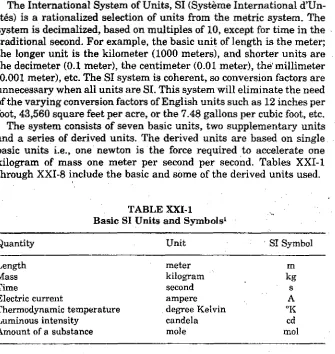
d'Un-ites) is a rationalized selection of units from the metric system. The system is decimalized, based on multiples of 10, except for time in the traditional second. For example, the basic unit of length is the meter; the longer unit is the kilometer (1000 meters), and shorter units are the decimeter (0.1 meter), the centimeter (0.01 meter), the millimeter (0.001 meter), etc. The SI system is coherent, so conversion factors are unnecessary when all units are SI. This system will eliminate the need of the varying conversion factors of English units such as 12 inches per foot, 43,560 square feet per acre, or the 7.48 gallons per cubic foot, etc. The system consists of seven basic units, two supplementary units and a series of derived units. The derived units are based on single basic units i.e., one newton is the force required to accelerate one kilogram of mass one meter per second per second. Tables XXI-1 through XXI-8 include the basic and some of the derived units used.
TABLE XXI-1
Basic SI Units and Symbols'
Quantity Unit SI Symbol
Length meter m
Mass kilogram kg
Time second
Electric current ampere A
Thermodynamic temperature degree Kelvin °K
Luminous intensity candela cd
METRIC CONVERSION 523
The basic unit of length is the meter. The strictest use of SI would discourage multiple and sub-multiple unit prefixes other than those divisible by 3 (i.e., 103, 10-6, etc.). The centimeter will probably re-main in common use because it is a convenient dimension relative to the visible world. Therefore, it is included in the English/SI Conversion Factors Table for length, area, and pressure (Table XXI-6).
The strict and correct use of mass (kilogram) and force (newton) should avoid much confusion associated with the use of pound force, pound mass, kilogram force, and kilogram mass systems. It will re-move the use of force units for density.
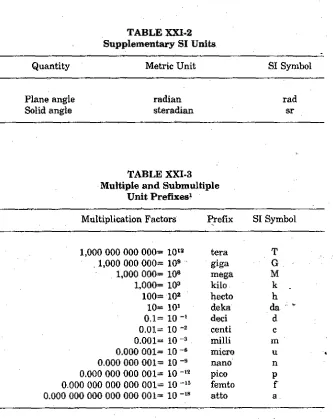
TABLE XXI-2 Supplementary SI Units.
Quantity Metric Unit SI Symbol
rad sr Plane angle
Solid angle
radian steradian
TABLE XXI-3 Multiple and Submultiple
Unit Prefixes'
Multiplication Factors Prefix SI Symbol
1,000 000 000 000= 10" tera T 1,000 000 000= 108 giga G
1,000 000= 106 mega M
1,000= 102 kilo k
100= 102 hecto h
10= 101 deka da
0.1= 10 - t deci d 0.01= 10 -2 centi
0.001= 10 -3 milli m 0.000 001= 10 -° micro
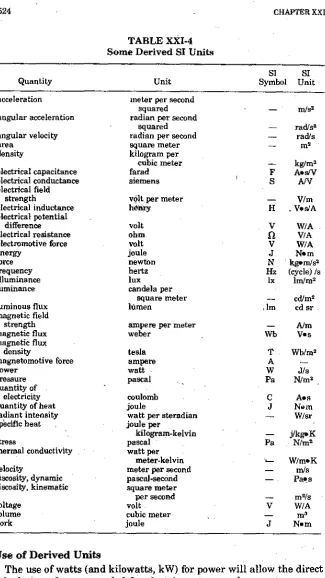
TABLE XXI-4
Some Derived SI Units
51 SI
Quantity Unit Symbol Unit
acceleration meter per second squared angular acceleration radian per second
squared angular velocity radian per second
area square meter
density kilogram per
cubic meter electrical capacitance farad electrical conductance siemens electrical field
strength volt per meter
electrical inductance hero electrical potential
difference volt
electrical resistance ohm electromotive force volt
energy joule
force newton
frequency hertz
illuminance lux
luminance candela per
square meter
luminous flux ltmen
magnetic field
strength ampere per meter
magnetic flux weber
magnetic flux
density tesla
magnetomotive force ampere
power watt
-pressure pascal
quantity of
electricity coulomb
quantity of heat joule
radiant intensity watt per steradian
specific heat joule per
kilogram-kelvin
stress pascal
thermal conductivity watt per meter-kelvin
velocity meter per second
viscosity, dynamic pascal-second viscosity, kinematic square meter per second
voltage volt
volume cubic meter
work joule
- mls2
- radls2 - rad/s
ms
kg,/m2
F Aos/V
S ACV
- V/m
H Vn a/A
3 W/A
f/ VIA
3 W/A
J Ne m
N kgern/s2 Hz (cycle) Is lx 1m/rn2
- cd/m2
lm cd sr
— Alm
Wb Vs s
T Wb/m2 A
J/s Pa N/m2
C Ass
J Nem
- W/sr
- j/kg.K Pa N/rn2
W/in•K - m/s - Pass - m2/s 3 W/A - m3
J N• m
Use of Derived Units
conve-METRIC CONVERSION 525
nient comparison between electrical motors and combustion engines. Since 1 kW 1.34 HP the actual magnitude of the numbers used to represent power will not change drastically.
The customary temperature scale when dealing with water is in degrees Celsius (°C), where 0° C is the freezing temperature and 100° C the boiling point of water at sea level (°C = K - 273.15).
While the recommended unit of pressure is the Pascal, sprinkler pressures may be more conveniently expressed in newtons per square centimeter (1 psi af 0.69 N cm-2, 6.89 kN m -2). Thus, a recommended sprinkler pressure of 58 psi would be 40 N cm2 . A bar (equal to 10 N cm-2), which is approximately equal to one atmosphere, will continue to be used in soil moisture tension or potential measurements.
It is often necessary to relate differences in elevation and pressure when considering pumping plants. In this case, the mass (kg) of water above an area (cm2) is multiplied by the acceleration due to gravity (about 9.8 m s-2) to obtain the pressure (N cm-2). This results in 1 meter of water equalling about 0.98 N cm-2 or roughly 1 m water
1N cm-2, a very convenient relationship.
TABLE :SCI-5
Units Used in Conjunction with SI
Quantity Metric Unit SI Symbol SI Unit
Area hectare ha 104m2
dekare daa 103 m2
Volume liter 1 10-3m3 dm3
Pressure bar bar 105N m-2 = 10 N cm-2
Mass ton t 103 kg = Megagrams
Crop yields are reported as mass per unit area. The customary sys-tem for expressing yield on a volume basis necessitates knowing the unit weight (pounds per bushel) for each crop considered. Actually, the mass is measured and converted to volume (bushels) via the unit weight standard and then converted back to a mass unit (pounds mass) when the crop is sold, consumed, or used to form rations. A uniform reporting of all yields in mass per unit area (kg daa-I, kg ha-' or t ha-1) would greatly simplify many calculations concerning the production and disposal of the crop.
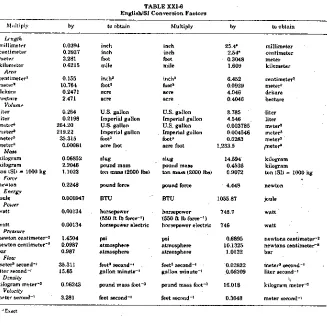
TABLE MA EnglishilS1 Conversion Factors by to obtain Multiply by
0.0394 inch inch 25.40 0.3937 inch inch 2.54. 3.281 foot foot 0.3048 0.6215 mile mile 1.609 0.155 inch , nulls 0.452 10.764 foot' foots 0.0939
0.2471 acre Mere 4.046 2.471 acre acre 0.4046 0-264 U.S. gallon U.S. gallon 3.785 0.2198 Imperial gallon Imperial gallon 4 546 264.20 U.S. gallon U.S. gallon 0.003785 219.22 imperial gallon Imperial gallon 6.004546 35.315 foot. foots 0.0283
0.00081 acre foot acre foot 1,233.5 0-06852 slug slug 14.694 2.2046 pound mass pound mane 0.4536 1.1023 ton masa 12000 lbs1 ton maim (2000 /be) 0 9072 0.2248 pound force pound farce 4.448 0.000947 EiTu BTU 1055 87 0.00134 horsepower horsepower 745.7
(550 it lb forte- . ) 1560 ft lb force') 0.00134 horsepower electric horsepower electric 746 1.4504 Psi psi 0.8895 0.0987 atmosphere atmosphere 10.1325 0.987 atmosphere atmosphere 1.0132 35.311 feet . second" . . feet' second- . • .0.02832 15.86 gallon minute- . gallon minute , 0.08309 0.06243 pound mass foot-' s pound mass feat", 16.018 3.281 feet second" . feet second- . 0.3049
15141.1ciply
Length millimeter centi me ter meter k Ionic ter
Area centimeter. meter° flekiirp hectare Volarne liter liter meter+ meter' meter' meter' Mew kilogram kilogram ton in.. 1000 kg
Falre newton Energy jock PO/cYr watt watt Preerure newton cent imeter=
newton centimeter' bar
Flow meter' second ,' liter second-.
11.2naLty kilogram meters
Veloci0 meter second- .
to obtain millimeter centimeter meter kilometer centimeter? meter' dekare hectare liter liter meters meter' meter' peters kilogram kilogram ton 1311 1060 kg newton joule watt watt newtons rentimetee-z newtons centimeter". bar
Meters eecond- . liter second- . kilogrant meter-, meter second- 1
Notation and Conversion
SI symbols of units are in lower case Roman type except for those derived from proper names in which case capital Roman type is used: Unit symbols do not change in the plural. Because the lower case symbol for liter (1) could sometimes be confused with the number 1 in typed Or printed matter, it has been recommended that a "script 1 " be used for this purpose?
SI symbols are never followed by a dot as is used in contractions as sq., in., etc.
A solidus (oblique stroke, /), a horizontal line, or negative powers may be used to express a derived unit formed from two others by division. For example:
in/s, or or m • s--1
Only one solidus should be used in a combination of units unless parentheses are used to avoid ambiguity.
- METRIC CONVERSION 527
Numbers may be divided into groups of three by means of spaces counting from the decimal indicator as in Table XXI-3. Commas are never inserted in the spaces between the groups.
Conversion Factors
Caution should be exercised when converting to SI values. The preci-sion of the original value must be maintained as closely as possible. However, excessive precision should not be implied by using more sig-nificant figures than are warranted by the original value.
The following table of conversion factors (XXI-6) is included for the convenience of those who must convert customary to SI values or vice versa.
The following tables are included to provide a convenient conversion for nozzle size and pressure between SI and English units.
TABLE XXI-7
SI to English Pressure Equivalents
Newton centimeter2 Pound inch2
10 14.5
15 21.8
20 29.0
25 36.3
30 43.5
35 50.8
40 58.0
45 65.3
50 72.5
55 79.8
60 87.0
65 95.3
70 101.5
Miscellaneous Quantities
Acceleration due to gravity (g) 9.806 m s-2 Kinematic Viscosity (water, 20° C) 15.29 x 10 -6M2S-1
TABLE XXI-8
Inch to Millimeter Equivalents for Sprinkler Nozzles
8ths
Inch
16ths 32nds 64ths Millimeters
1 0.3969
1 2 0.7938
3 1.1906
1 2 4 1.5875
5 1.9844
3 6 2.3813
7 2.7781.
1 2 4 8 3.1750*
9 3.5719
5 10 3.9688
11 4.3656
3 6 12 4.7625
13 5.1594
T 14 5.5563
15 6.9531
2 4 8 16 6.3500*
3 6 12 24 9.6250*
4 .8 16 32 12.7000*