COMPARATIVE STUDY OF DIFFERENT GROWTH REGULATORS FOR EFFICIENT PLANT REGENERATION IN GRAPES
Sadia Tehrim*, M. Yasin Mirza** and G. Mustafa Sajid*
ABSTRACT:- The grape (Vitis vinifera L.) is the most valuable and
widely cultivated horticultural crop worldwide. In the present study, different hormonal combinations in regeneration media were studied to determine the best combination for in vitro morphogenesis of grapevine accessions viz., 4494(1) Kowar Sufaid, 4472(12) Harker Agoon and 4492(1) Kowar Naray. When levels of benzylaminopurine (BAP) were increased in the basal MS media for culturing the grape plantlets, there was a corresponding increase in the number of shoots and root mass. Additionally, the shoot proliferation response to increasing level of BAP was found genotype dependent. Naphthaleneacetic acid (NAA) also showed a positive effect on in vitro growth responses (shoot proliferation and root induction) when combined with BAP. The media containing NAA, BAP and kinetin accelerated the growth in terms of shoot mass in two accessions, 4494(1) Kowar Sufaid and 4472(12) Harker Agoon and again the culture response was genotype dependent. There was a difference in the growth responses of the three accessions studied. The best rooting response was
-1
obtained on 75% MS media containing 0.7 mgl , NAA.
Key Words: Vitis vinifera; Induction Media; Regeneration; Growth Hormones; Micropropagation; Shoot Proliferation; Root Induction;
Pakistan.
*Institute of Agri-Biotechnology and Genetic Resources, National Agricultural Research Centre, Islamabad, Pakistan. ** Oilseed Research Programme, Crop Sciences Institute, National Agricultural Research Centre, Islamabad, Pakistan.
Corresponding author: [email protected]
INTRODUCTION
The grape (Vitis vinifera L.) is one of the earliest domesticated and widely grown fruit crop in world which can be eaten raw and also used for making juice, wine, jam, jelly and raisins. According to the historical records, the cultivation of grapevine,
Vitis vinifera subsp. vinifera (which was evolved from its wild relative,
Vitis vinifera subsp. sylvestris) was started 6,000-8,000 years ago in the Near East (McGovern, 2003). In the beginning, grapes have been propa-gated through both sexual (seed) and
asexual means where seed was the most common form of propagation because of its trouble-free transport.
V. vinifera exhibits tremendous level of genetic diversity which is due to its long cultivation history and by inten-tionally and uninteninten-tionally made crosses (Riaz et al., 2013).
SADIA TEHRIM ET AL. areas of the province. In the country,
almost all grape varieties (scion or rootstock) are conventionally propa-gated through stem cutting, layering and grafting. However, these conven-tional techniques are looking no more efficient due to some major problems including seedling heterozygosity, long space and time requirement, seed dormancy and limited yield. Moreover, many fungal and bacterial diseases also affect the crop pro-duction (Jaskani et al., 2008). In Pakistan, some of the grape varieties are facing risk of extinction due to genetic drift, bad agronomic practices and deficiency of conservation strategies. High mortality and low rooting response make this crop very difficult to grow vegetatively (Sajid et al., 2003). In this regard, good quality and increased production in grapes can be obtained through tissue culture practices (such as micro-propagation) to provide true to type, rapid multiplication and disease free plants (Stern, 1943; Lewandowski, 1991 and Sajid et al., 2003).
Plant tissue culture is a well established technique in plant science to grow and study the cells, tissues and organs on an artificial medium, static or liquid, under controlled environment. Recently plant tissue culture has gained significant importance in various fields like clonal propagation, conservation of germplasm, phyto-pathology, haploid and triploid production, embryo rescue, in vitro pollination and fertilization, somatic hybridization and cybridization, somaclonal and gametoclonal variant selection, genetic manipulation and industrial production of plant metabolites (McCown, 2000). In vitro micropropagation is a practice in the
plant tissue culture to reproduce asexually a large number of identical plant genotypes. In the world, almost hundreds of millions of plants including 50,000 plant varieties are micro propagated annually (Vasil, 1994). For the propagation of woody plant species, the micropropagation method is very practical and its efficiency relies on shoot multiplica-tion rate and their rooting percentage. In grapes, rapid and efficient micro-propagation practices need to combine both shoot multiplication and their rooting (Beauchesne, 1982; Jaskani et al., 2008). For grape in vitro cultivation, various micropropa-gation protocols using different growth hormones and explants were reported by many researchers (Jiang and Jin, 1995; Compton and Gray, 1995; Meyerson et al., 1995; Doroshenko, 1996; Gok et al., 1997; Sajid et al., 2008; Jaskani et al., 2008). Axillary buds are considered as most successful explant source for angiospermic plants like grape (Vasil and Thorpe, 1994).
The purpose of this study is to employ the combinations of different growth hormones for grape micro-propagation and to find out the best possible conditions for successful in vitro shoot proliferation and root induction.
MATERIALS AND METHOD Plant Materials and Explants Source
Islamabad. These cultures were derived from the buds taken from the Grape Clonal Repository located at the Centre. The nodal segments of 0.5 to 1.0cm were excised aseptically from in vitro established cultures and transferred on to defined media con-taining specific growth hormone regimes for in vitro morphogenesis and root induction. Six in vitro esta-blished grape accession viz., 4492(1) Kowar Naray, 4472(12) Harker Agoon, 4494(1) Kowar Sufaid, 4472(1) Gang Agoon Sufaid, 4489(1) Kowar Jangli and 4472(18) Singh Lok Agoon were used in the study.
Media and Culture Incubation Conditions
All the six grape germplasm accessions were grown on 75% MS medium supplemented with 3% sucrose, vitamins and varying levels of hormonal regimes (Murashige and Skoog, 1962). The pH of media was adjusted at 5.8 and then sterilized by autoclaving at 121ºC for 17 min. For proliferation, the glass jars were used because cultures initiated in larger flasks grow and develop better than those in small flasks. The larger flasks offer enough space for dilution of toxic gases like ethylene and carbon dioxide evolved during incubation and more amounts of nutrient media are available to the explants per unit area (Pierik, 1987). After transferring the cultures on specified media, they were incubated in the growth room maintained at 25 + 2ºC and illuminated with 1000-2000 lux of light under 16hL/8hD periods.
Sub Culturing
Plant cultures were multiplied for the culture maintenance and
pro-liferation to generate adequate cultures for further experiments. Single isolated shoots were excised aseptically from the cultures of five in vitro established accessions namely 4492 (1) Kowar Naray, 4472 (12) Harker Agoon, 4489 (1) Kowar Jangli, 4472 (18) Singh Lok Agoon and 4494 (1) Kowar Sufaid. These shoots cul-tured on the 75% media containing
-1
MS salts, sucrose (30gl ), myo--1
inositol (0.1 gl ), vitamins, BAP (0.5
-1 -1
mgl ) and agar (8 gl ).
Hormonal Combinations used for Grape Growth Rate and
Proliferation
In this study, different combi-nations of benzylaminopurine (BAP) (0.05, 0.20, 0.25, 0.50, 0.75, 1.0, 2.0
-1
mgl ); naphthaleneacetic acid (NAA) -1
(0.0, 0.1, 0.2, 0.3 mgl ); indolebutyric -1
acid (IBA) (0.2 mgl ) and kinetin (0.5, -1
1.0, 2.0 mgl ) were employed for three grape accessions [4492 (1) Kowar Naray, 4494 (1) Kowar Sufaid and 4 4 7 2 ( 1 2 ) H a r k e r A g o o n ] i n combination with MS medium to find their effect on grape growth rate and proliferation.
Root Induction
Twelve combinations of IAA, NAA and IBA were also tested to study their effect on root induction. Media was enriched either with 5 different levels
-1 of IAA (0, 0.1, 0.3, 0.7, 1.0 mgl ), 5 different levels of NAA (0, 0.1, 0.3, 0.7,
-1
1.0 mgl ) or 5 different levels of IBA (0, -1
0.2, 0.5, 1.0, 2.0 mgl ) for one grape accession 4472(1) Gang Agoon Sufaid tested in this study.
Plant Growth Parameters
SADIA TEHRIM ET AL. -1
shoot number explants , shoot -1 length (cm), number of nodes plant , shoot mass (g) and root mass (g) were used to analyze the growth rate, proliferation and root induction.
Growth responses were compar-ed between accessions and hormonal regimes in all the experiments. The experiment was designed as comple-tely randomized design with four replications in each experiment. The data collected were subjected to statistical analysis (Steel and Torrie, 1984).
RESULTS AND DISCUSSION Culture Multiplication
Two cycles of sub-cultures were carried out for shoot proliferation. In first cycle of subculture, culture multiplication was conducted on MS media supplemented with BAP (0.5
-1
mgl ) to generate adequate plant cultures for further experimentation. The sprouting from nodal segments was started after 4-5 days of culture initiation. In first cycle, the highest shoot number (2.28) and shoot length (2.9 cm) was achieved in 4494(1). Whereas, maximum number of nodes were recorded in 4472(12) and highest shoot mass (1.51 g) was harvested in 4492(1). Maximum root mass (4.52 g) was recorded in 4494(1) accession. In second subculture, maximum shoot length (2.30 cm) was gained in 4489(1). While maximum shoot number (2.66), number of nodes (3.87) and shoot mass (5.27 g) were observed in 4492(1). Therefore on the basis of exceptional growth responses, three grape accessions viz., 4492 (1) Kowar Naray, 4494 (1) Kowar Sufaid and 4472 (12) Harker Agoon were selected for use in further experiments.
Effect of BAP on Growth Rate and Proliferation
When BAP was increased from -1
0.05 to 2.0 mgl , maximum shoot number (4.66), number of nodes
-1
plant (6.71), shoot mass (3.51g) and root mass (1.04 g) were obtained in 4494 (1) on MS media. However, maximum shoot length (4.97 cm) was
-1
achieved with 0.05 mgl concen-tration of BAP. In accession 4472 (12), maximum shoot number and shoot mass was achieved with 2.0
-1
mgl of BAP, maximum shoot length and root mass was achieved with 0.05
-1
mgl of BAP and maximum number of -1 nodes were obtained with 0.75 mgl of BAP. Accession 4492 (1) showed highest shoot length (8.0 cm),
-1
number of nodes plant (11.0) and root mass (0.95 g) on MS media
-1
containing 0.05 mgl of BAP (Table 1).
Combined Effect of NAA and BAP on Growth Rate and Proliferation
Combined effect of NAA and BAP was studied putting the two growth regulators in the same media.
-1 A constant level of NAA (0.1 mgl ) and different concentrations of BAP
-1
(0.05, 0.20, 0.75, 2.0 mgl ) were employed in MS medium to determine their combined effect on grape growth rate. In the accession 4492 (1), 33.3% mortality was observed in the -1 medium containing 0.1 and 0.2 mgl of NAA and BAP, respectively while the accession 4472 (12) showed 100% viability response with all NAA + BAP combinations. In 4492 (1) and 4472 (12), no contamination was observed except one combination in 4492 (1). Maximum shoot number of 3.66 was achieved in 4472 (12) on medium
-1
containing 0.1 mgl of NAA and 2.0 -1
T a b le 1 . In v it ro g ro w th r e s p o n s e s o f g ra p e a c c e s s io n s a ff e c te d b y d if fe re n t c o n c e n tr a ti o n s o f B A P i n M S m e d ia M e a n s f o ll o w e d b y s a m e l e tt e rs d o n o t d if fe r s ig n if ic a n tl y a t 5 % l e v e l A c c e s s io n 4 4 9 4 (1 ) K o w a r S u fa id 4 4 7 2 (1 2 ) H a rk e r A g o o n 4 4 9 2 (1 ) K o w a r N a ra y T re a tm e n t ( -1 m g ) l M o rt a li ty (% ) V ia b il it y (% ) S h o o t n u m b e r e x p la n t -1 S h o o t le n g th ( c m ) N o . o f n o d e s p la n t -1 S h o o t m a s s ( g ) 0 .0 5 0 .2 0 0 .7 5 2 .0 0 M e a n R a n g e
0 0 0 0 0 0
7 5 5 0 1 0 0 7 5 7 5 b 5 0 -1 0 0 1 .3 3 1 .5 4 .0 4 .6 6 2 .8 6 a 1 .5 -4 .6 6 4 .9 7 4 .4 0 3 .1 6 3 .8 1 4 .0 9 b 3 .1 6 -4 .9 7 4 .5 5 .0 6 .0 6 6 .7 1 5 .5 8 b 4 .5 -6 .7 0 .5 5 0 .2 8 2 .4 1 3 .5 1 1 .6 8 b 0 .2 8 -3 .5 1 2 5 5 0 0 2 5 2 5 a 0 -5 0 0 .0 5 0 .2 0 0 .7 5 2 .0 0 M e a n R a n g e
0 0 0 0 0 0
1 0 0 6 6 .6 1 0 0 1 0 0 9 1 .6 a 6 6 .6 -1 0 0 1 .5 1 .0 4 .0 4 .3 3 2 .7 0 a 1 .0 -4 .3 3 8 .5 0 2 .4 5 2 .2 4 2 .7 2 3 .9 7 b 2 .2 4 -8 .5 0 5 .6 7 4 .5 6 .1 7 4 .8 5 5 .2 9 b 4 .5 -6 .1 7 1 .0 7 0 .4 2 2 .0 3 3 .6 0 1 .7 8 b 0 .4 2 -3 .6 0 0 3 3
.3 0 0 8.3
b 0 -3 3 .3 0 .0 5 0 .2 0 0 .7 5 2 .0 0 M e a n R a n g e
0 0 0 0 0 0
3 3 .3 1 0 0 6 6 .6 3 3 .3 5 8 .3 b 3 3 .3 -1 0 0 1 .0 1 .6 6 2 .0 3 .0 1 .9 2 b 1 .0 -3 .0 8 .0 4 .5 3 .2 3 3 .1 3 4 .7 2 a 3 .1 3 -8 .0 1 1 .0 4 .8 6 .2 5 6 .3 3 7 .0 9 a 4 .8 -1 1 .0 1 .9 0 1 .2 5 1 .4 9 9 .7 8 3 .6 1 a 1 .2 5 -9 .7 8 R o o t m a s s ( g ) 0 .3 4
0 0.2
4 1 .0 4 0 .4 1 a 0 -1 .0 4 0 .6 1
0 0 0 0.1
SADIA TEHRIM ET AL. T a b le 2 . In v it ro g ro w th r e s p o n s e s o f g ra p e a c c e s s io n s a ff e c te d b y d if fe re n t c o n c e n tr a ti o n s o f B A P a n d c o n s ta n t -1 le v e l (0 .1 m g l ) o f N A A i n M S m e d ia M e a n s f o ll o w e d b y s a m e l e tt e rs d o n o t d if fe r s ig n if ic a n tl y a t 5 % l e v e l A c c e s s io n 4 4 9 4 (1 ) K o w a r S u fa id 4 4 7 2 (1 2 ) H a rk e r A g o o n 4 4 9 2 (1 ) K o w a r N a ra y T re a tm e n t ( -1 m g ) l 0 .1 :0 .0 5 0 .1 :0 .2 0 0 .1 :0 .7 5 0 .1 :2 .0 0 M e a n R a n g e 0 .1 :0 .0 5 0 .1 :0 .2 0 0 .1 :0 .7 5 0 .1 :2 .0 0 M e a n R a n g e 0 .1 :0 .0 5 0 .1 :0 .2 0 0 .1 :0 .7 5 0 .1 :2 .0 0 M e a n R a n g e M o rt a li ty (% ) 0 0 2 5 0 b 6 .2 5 0 -2 5
0 0 0 0 0 0 0
3 3 .3 0 0 a 8 .3 2 0 -3 3 .3 V ia b il it y (% ) 7 5 7 5 5 0 1 0 0 b 4 1 .2 5 5 0 -1 0 0 1 0 0 1 0 0 1 0 0 1 0 0 1 0 0 a 1 0 0 3 3 .3 6 6 .6 1 0 0 1 0 0 a 7 4 .9 7 3 3 .3 -1 0 0 S h o o t n u m b e r e x p la n t -1 1 .0 1 .6 6 3 .0 3 .5 a 2 .2 9 1 .0 -3 .5 1 .0 1 .3 3 3 .0 3 .6 6 a 2 .2 4 1 .0 -3 .6 6 1 .0 1 .5 1 .3 3 3 .0 b 1 .7 2 1 .0 -3 .0 S h o o t le n g th ( c m ) 1 0 .3 0 2 .6 8 2 .9 2 3 .1 9 a 4 .7 7 2 .6 8 -1 0 .3 2 .1 6 2 .3 0 2 .9 0 2 .8 9 b 2 .5 6 2 .1 6 -2 .9 0 1 .5 0 2 .4 3 3 .9 8 3 .4 3 b 2 .8 3 1 .5 -3 .9 8 N o . o f n o d e s p la n t -1 8 .0 4 .6 0 4 .8 3 7 .0 7 a 6 .1 2 4 .6 0 -8 .0 3 .3 3 3 .2 5 5 .5 0 5 .9 1 b 4 .4 9 3 .2 5 -5 .9 1 1 .0 2 .3 3 6 .0 5 .0 c 3 .5 6 1 .0 -6 .0 S h o o t m a s s ( g ) 1 .2 2 0 .6 9 0 .7 2 1 .6 7 b 1 .0 7 0 .6 9 -1 .6 7 0 .8 9 2 .1 3 2 .0 4 3 .3 5 a 2 .1 0 0 .8 9 -3 .3 5 0 .6 1 0 .8 3 1 .3 2 4 .0 6 a 1 .7 1 0 .6 1 -4 .0 6 R o o t m a s s ( g ) 1 .0 7
0 0 0.0 1 b 0 .2 7 0 -1 .0 7 0 .1 9 0 .0 9 1 .1 0 0 a 0 .3 5 0 -1 .1 0
0 0.0
1 0 .9 5 0 .6 1 a 0 .3 9 0 -0 .9 5 2 5 2 5 2 5 0 a 1 8 .7 5 0 -2 5
0 0 0 0 0 0
6
6
.6
0 0 0
T a b le 3 . In v it ro g ro w th r e s p o n s e s o f g ra p e a c c e s s io n s a ff e c te d b y d if fe re n t c o n c e n tr a ti o n s o f B A P a n d c o n s ta n t -1 le v e l (0 .3 m g l ) o f N A A i n M S m e d ia A c c e s s io n 4 4 9 4 (1 ) K o w a r S u fa id 4 4 7 2 (1 2 ) H a rk e r A g o o n 4 4 9 2 (1 ) K o w a r N a ra y T re a tm e n t ( -1 m g ) l 0 .3 :0 .0 5 0 .3 :0 .2 0 0 .3 :0 .7 5 0 .3 :2 .0 0 M e a n R a n g e 0 .3 :0 .0 5 0 .3 :0 .2 0 0 .3 :0 .7 5 0 .3 :2 .0 0 M e a n R a n g e 0 .3 :0 .0 5 0 .3 :0 .2 0 0 .3 :0 .7 5 0 .3 :2 .0 0 M e a n R a n g e M o rt a li ty (% ) 2
5 0 0 0
a 6 .2 5 0 -2 5
0 0 0 0 0 0 0 0 0 0 0 0
V ia b il it y (% ) 7 5 7 5 5 0 1 0 0 b 6 3 .7 5 5 0 -1 0 0 3 3 .3 5 0 1 0 0 1 0 0 3 3 .3 -1 0 0 7 0 .8 2 a 3 3 .3 6 6 .6 1 0 0 1 0 0 7 4 .9 7 a 3 3 .3 -1 0 0 S h o o t n u m b e r e x p la n t -1 1 .0 2 .0 3 .0 4 .2 5 1 .8 1 b 1 .0 -4 .2 5 1 .0 1 .5 3 .0 2 .5 2 .0 b 1 .0 -3 .0 1 .0 2 .5 3 .3 3 5 .3 3 3 .0 4 a 1 .0 -5 .3 3 S h o o t le n g th ( c m ) 8 .5 0 7 .2 5 4 .3 3 2 .6 1 5 .6 7 a 2 .6 1 -8 .5 1 .2 0 7 .0 3 2 .2 8 3 .0 6 3 .3 9 b 1 .2 -7 .0 3 8 .5 0 2 .8 0 4 .1 4 3 .1 7 4 .6 5 a 2 .8 -8 .5 N o . o f n o d e s p la n t -1 1 0 .0 0 5 .5 0 4 .0 0 5 .1 2 6 .1 5 a 4 .0 -1 0 .0 1 .0 0 6 .3 3 5 .1 6 4 .2 0 4 .1 7 b 1 .0 -6 .3 3 8 .0 0 4 .0 0 5 .6 0 4 .1 8 5 .4 4 a 4 .0 -8 .0 S h o o t m a s s ( g ) 1 .6 3 1 .5 4 3 .9 9 5 .3 5 3 .1 2 a 1 .5 4 -5 .3 5 0 .2 6 3 .3 5 1 .7 4 0 .6 9 1 .5 1 b 0 .2 6 -3 .3 5 1 .9 8 1 .3 6 3 .6 3 9 .0 1 3 .9 9 a 1 .3 6 -9 .0 1 R o o t m a s s ( g ) 3 .0 4 3 .9 2 1 3 .0 6 0 .0 0 5 .0 0 a 0 -1 3 .0 6 0 .0 0 0 .5 7 0 .0 0 0 .0 0 0 .1 4 b 0 -0 .5 7 1 .0 0 0 .2 2 3 .0 0 1 .0 1 1 .0 6 b 0 .2 2 -3 .0 0 0 2 5 5 0 0 1 8 .7 5 b 0 -5 0 6 6 .6 5
0 0 0
-1
containing 0.1 mgl of NAA and 0.05 -1
mgl of BAP in accession 4494 (1) was the best combination to obtain high-est shoot length and number of nodes per plant with mean values of 10.3 cm and 8.0, respectively. However, maxi-mum shoot mass with mean value of 4.06 g was obtained in accession 4492(1) on the media containing 2.0
-1 -1
mgl of BAP and 0.1 mgl of NAA (Table 2).
A second constant level, of NAA -1
(0.3mgl ) and different concen-trations of BAP (0.05, 0.20, 0.75, 2.0
-1
mgl ) were studied. A 100% viability, highest shoot number/explant (5.33) and shoot mass (9.01g) was obtained in 4492(1) with the medium
contain--1 -1
ing NAA (0.3mgl ) and BAP (2.0mgl ). In all the accessions, no contami-nation was observed when grown on
-1 media containing NAA 0.3 mgl and
-1
BAP 2.0 mgl . Highest root mass (13.06g) was observed in accession 4494 (1) on the medium containing
-1 -1
NAA (0.3mgl ) and BAP (0.75mgl ). Maximum shoot length (8.5 cm) was
obtained in accessions 4492(1) and 4494(1) on media containing NAA (0.3
-1 -1
mgl ) and BAP (0.05 mgl ) (Table 3). In another study BAP level was increased from 0.25, 0.50, 0.75 and
-1
1.0 mgl either without NAA or with -1
0.3 mgl of NAA in the MS media. It was observed that BAP affected the growth of cultures depending upon whether or not NAA was present (Table 4). In the presence of NAA (0.3
-1 -1
mgl ), with (0.25 mgl ) BAP in the media resulted in the decline of shoot number in grape accession 4492 (1). Similarly, 100% viability and no con-tamination were observed in this genotype. In 4492 (1), maximum shoot length (2.98 cm) was obtained
-1
when 0.25 mgl BAP was used with no NAA. Among all accessions stu-died maximum shoot mass (12.6 g) was noted in 4492 (1) on media
con--1
taining BAP 0.50 mgl without NAA. Maximum root mass (3.09g) was ob-tained in 4492 (1) on media
contain--1 -1
ing 0.75 mgl BAP with 0.3 mgl NAA. In present study, when a single hormone BAP was increased from
-1
0.05 to 2.0 mgl , there was a pro-gressive increase in culture response. A similar finding was observed in another study where a very low level
-1
of benzyladenine (0.05 mgl ) had a stimulating effect on shoot growth and development, and the viability of regenerants (Doroshenko, 1996). Jaskani et al. (2008) reported that better shooting (80%) was observed
-1 on MS medium with 0.05 mgl BAP whereas Chen et al. (2000) have found that BAP in the medium at a
-1
concentration of 1mgl favors shoot differentiation and improves the quality of plants. The accumulative effect of two growth regulators on the morphogenesis of grape accessions in
SADIA TEHRIM ET AL. present study was found excellent in
accession 4494(1) to obtain highest shoot length and number of nodes per
-1 -1
plant using 0.1mgl and 0.05mgl of NAA and BAP, respectively. Tapia and Read (1998) also observed that varia-tion in growth responses of grapes accessions was highly genotype dependent and BAP levels at (0.5 or
-1 -1
1.0 mgl ) combined with 0.01 mgl of NAA proved to be the best medium for shoot proliferation.
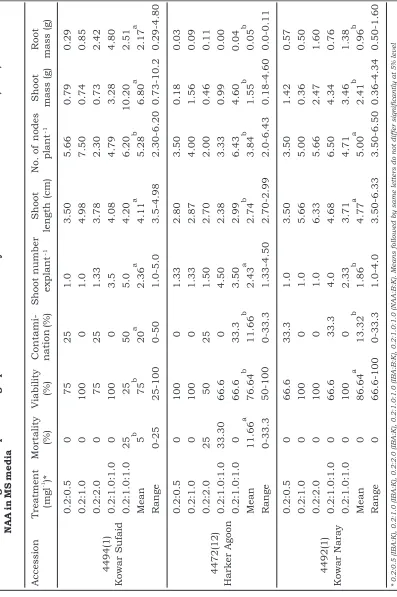
Effect of BAP, NAA, IBA and Kinetin on Growth Rate and Shoot Proliferation
Different combinations of four -1 hormones containing IBA (0.2 mgl ),
-1 -1
BAP (1.0 mgl ), NAA (0.2 mgl ) and -1
kinetin (0.5, 1.0 and 2.0 mgl ) were tested to find out the response of three accessions. Maximum shoot number per plant (5.0) and shoot mass (10.2 g) were obtained with the accession 4494(1) on media con-taining the NAA 0.2, BAP, 1.0 and K
-1
1.0 mgl , and the media containing -1
0.2 mg of IBA and 2.0 mgl of Kinetin was found suitable for obtaining maximum shoot length (6.33 cm) and 100% viability in 4492(1). Maximum nodes (7.5) and shoot length (4.98 cm) with 100% viability was obtained -1 on the MS media containing 0.2 mgl
-1
of IBA and 1.0 mgl of kinetin in 4494(1). Maximum root mass (4.8 g) was obtained with the MS media
-1 containing 0.2, 1.0 and 1.0 mgl of IBA, BAP and kinetin, respectively in 4494 (1) (Table 5).
In present study, when NAA was used in combination with BAP and kinetin, it stimulated the growth of cultures and maximum shoot mass of 10.2 g and 4.6 g was obtained from 4494 (1) and 4472 (12), respectively.
In another study, the presence of IAA or NAA in the media promoted shoot length even in the presence of BAP and NAA was more effective in pro-moting shoot length of accession viz., Sundar Khani (Sajid et al., 2006). The cultures in present studies did not show such kind of responses. This may be credited to genotypic diffe-rences. In other study of grape esta-blishment, half strength MS media was more suitable for meristem establishment as reported by Choi et al. (1992). However, they recommen-ded the full strength MS media supplemented with BAP and IAA for maximizing the shoot proliferation. They also used kinetin to study the effect on shoot multiplication and no notable effect was found. In sugar-cane cultures. Saira et al. (2005) reported that BAP affects the shoot mass as its concentration is increa-sed along with the auxin in the media. Responses among banana cultivars are influenced by hormone type, con-centration and cultivar as recommen-ded by Hamide and Pekmezei (2004) and Shirani et al. (2009). Moreover, Buah et al. (2010) observed that
-1 media supplemented with 4.5 mgl of BAP induced the highest number of shoots after eight weeks of culture in two banana cultivars and BAP had the highest shoot induction response in both cultivars, followed by kinetin and 2ip. Furthermore the degree of efficiency of shooting was dependent on the type of hormone and the plant cultivar.
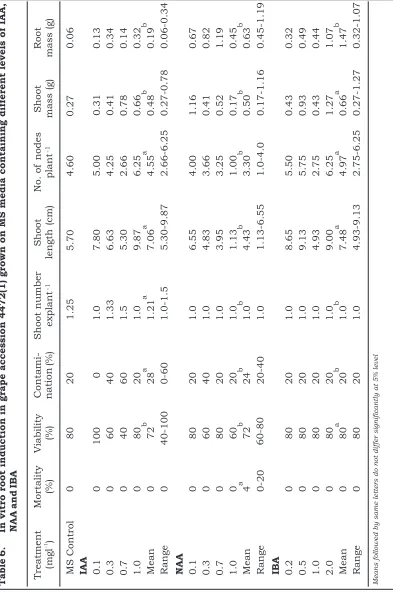
Effect of IAA, NAA and IBA on Root Induction
T a b le 6 . In v it ro r o o t in d u c ti o n i n g ra p e a c c e s s io n 4 4 7 2 (1 ) g ro w n o n M S m e d ia c o n ta in in g d if fe re n t le v e ls o f IA A , N A A a n d I B A
SADIA TEHRIM ET AL.
observed that there was an increase from 0.06 to 0.34g in root mass by increasing the concentrations of IAA. The maximum root mass (0.34g) was
-1
obtained with the 0.3 mgl . With NAA -1
(0, 0.1, 0.3, 0.7, 1.0 mgl ) best rooting was obtained at the concentration of
-1
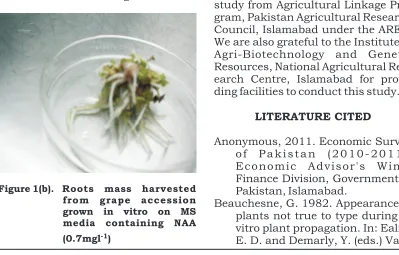
0.7 mgl of NAA. Root mass was in-creased from 0.06 to 1.19g by increa-sing the concentrations of NAA. The highest rooting response (1.07 g) was obtained at the highest level of IBA
-1
(2.0 mgl ) (Table 6 and Figure 1b). There was a strong linear rela-tionship between rooting response and IBA levels. As the concentration of IBA was increased, the rooting response improved accordingly. Jiang and Jin (1995) also reported that IAA was a suitable additive for the rooting of plantlets with the optimum concentrations being
0.5-- 1
1.0 mgl . Choi et al. (1992) documented that the best media for -1 rooting contained 0.5 and 1.0 mgl NAA. Similarly, Lewandowski (1991) obtained 95% rooting of
micro-cuttings on MS having a combination of IBA and NAA. Compton and Gray (1995) have observed that the root production was 76-83% when trans-ferred to medium with 1mg NAA or IBA, respectively. On the contrary, Gok et al. (1997) have reported root induction on hormone free media or the media containing IBA. The find-ings of Jaskani et al. (2008) also indicated that media having 10 ìM IBA proved the best for root formation in grapes micro shoots.
This is a comprehensive study as it covers the influence of different hormonal combinations along with the type of media which contribute well in the micropropagation of grape fruit crop. The media optimized in the present study is applicable on a commercial scale production of true to type grape plants.
ACKNOWLEDGEMENT
The authors thankfully acknow-ledge the financial support for this study from Agricultural Linkage Pro-gram, Pakistan Agricultural Research Council, Islamabad under the AREP. We are also grateful to the Institute of Agri-Biotechnology and Genetic Resources, National Agricultural Res-earch Centre, Islamabad for provi-ding facilities to conduct this study.
LITERATURE CITED
Anonymous, 2011. Economic Survey o f P a k i s t a n ( 2 0 1 0 - 2 0 1 1 ) . E c o n o m i c A d v i s o r ' s W i n g , Finance Division, Government of Pakistan, Islamabad.
Beauchesne, G. 1982. Appearance of plants not true to type during in vitro plant propagation. In: Ealre, E. D. and Demarly, Y. (eds.)
Vari-Figure 1(b). Roots mass harvested from grape accession grown in vitro on MS media containing NAA
-1
SADIA TEHRIM ET AL. ability in plants regenerated from
tissue culture. Praeger Publica-tion, New York. p. 268-272.
Buah, J.N., E. Danso, K.J. Taah, E.A. Abole, E.A. Bediako, J. Asiedu, and R. Baidoo. 2010. The effects of different concentrations of cytokinins on the in vitro multi-plication of plantain (Musa sp.). Biotechnol. 9: 343-347.
Chen, B., J. Liang, W. Chen, R. Wang, B. Chen, J. X. Liang, and R. H. Wang. 2000. The effect of diffe-rent hormones in sugarcane. J. South China Agric. Univ. 7: 60-62.
Choi, S.Y., J.Y. Oh, J.S. Kim, D. M. Pak, S.B. Lee, and D.U. Choi. 1992. Studies on the grape meri-stem cultures in vitro. Research Reports Rural Development Administration, Biotechnol. 34 (2): 10-17.
Compton, M. E., and D.J. Gray. 1995. Micropropagation of 'Southern Home' hybrid grape. Proc. Florida State Hort. Soc. 107:308-310. Doroshenko, N.P. 1996. Optimization
of the conditions for clonal micro-propagation in grape vine. Sel Shokhozyaistvennya Biologiya, 5:76- 81.
Gok, S., F. Ergenoglu, A.B. Kuden, and F.G.J. Dennis. 1997. Propa-gation of several grape varieties and rootstocks by meristem culture. Acta Hort. 441: 245-250. Hamide, G., and M. Pekmezci. 2004.
In vitro propagation of some new banana types (Musa spp). Turk. J. Agric. 28: 355-361.
Jaskani, M.J., H. Abbas, R. Sultana, M. M. Khan, M. Qasim, and I.A. Khan. 2008. Effect of growth hormones on micropropagation of Vitis vinifera L. cv.Perlette. Pakistan J. Bot. 40(1): 105-109.
Jiang, A.L., and P.F. Jin. 1995. Effects of some plant growth regulators on the growth of plant-lets of several wild grape species in test tubes. Acta Agriculturae Shanghai, 11(4):87- 89.
Lewandowski, V.T. 1991. Rooting and acclimatization of micro propa-gated Vitis labrusca Delaware. HortScience. 26: 586-589.
McGovern, P.E. 2003. Ancient Wine: The search for the origins of Viniculture. Princeton Univ. Press, Princeton.
McCown, B.H. 2000. Recalcitrance of woody and herbaceous perennial plants: Dealing with genetic predetermination. In Vitro Cell. Dev. Biol. Plant. 36: 149-154. Meyerson, M.E., C.M. Benton, and
D.J. Gray. 1995. A comparison of shoot micropropagation among bunch and muscadine grape species and cultivars. Proc. Florida State Hort. Soc.107: 311-312.
Murashige, T., and F. Skoog. 1962. A revised medium for rapid growth and bio assays with tobacco cultures. Physiol. Plant. 15: 473-497.
Pierik, R.L.M. 1987. In vitro culture of higher plants. Murtinus Nijhoff Publishers, Dordrecht, Nether-lands. p.344.
Riaz, S., J.M. Boursiquot, G.S. Dangl, T. Lacombe, V. Laucou, A.C. Tenscher, and M. A. Walker. 2013. Identification of mildew resistance in wild and cultivated Central Asian grape germplasm. BMC Plant Biol. 13:149.
publication. p.1.
Sajid, G. M., M.K. Ilyas, and R. Anwar. 2006. Effect of diverse hormonal regimes on in vitro growth of grape germplasm. Pakistan J. Bot. 38(2): 385-391. Sajid, G.M., and Z. Ahmed. 2008.
Evaluation of various levels of mineral nutrients and plant growth regulators for in vitro culture of grape. Pakistan J. Bot. 40(1): 329-336.
Saira, P., G.M. Sajid, R. Anwar, and H.U. Rehman. 2005. Growth promotion and growth retar-dation of sugarcane tissue cul-tures for germplasm con-servation. J. Biol. Sci. 5(3):339-346.
Shirani, S., M. Fatemeh, and M. Maziah. 2009. Morphological abnormality among regenerated shoots of banana and plantain (Musa spp.) after in vitro
multi-plication with TDZ and BAP from excised shoot-tips. Afr. J. Biotechnol. 8: 5755-5761.
Steel, R.G.D., and J.H. Torrie. 1984. Principles and procedures of statistics. 2nd edn. McGraw Hill Book Co. Inc., UK.
Stern, W.T. 1943. The use of term 'clone'. J.Roy. Hort. Soc. 74: 41-47.
Tapia, N.I., and P. F. Read. 1998. Propagation of grape hybrids by in vitro culture of auxiliary buds. Agro-Clencia, 14(1): 35-41, Chillan, Chile (CAB Abstr. 1998/08-2000/04).
Vasil, I. K. 1994. Automation of plant propagation. Plant Cell Tiss. Org. Cult. 39: 105 - 108.