© Strojniški vestnik (43) št. 3-4, str. 153-159, 1997 Tiskano v Sloveniji. Vse pravice pridržane.
UDK 621.9.022:621.914:513.43
© Journal o f Mechanical Engineering (43) No. 3-4, pp. 153-159, 1997 Printed in Slovenia. All rights reserved. SV 0039-2480(97)2-R6 UDC 621.9.022:621.914:513.43
Analiza suhega rezanja pri postopku čelnega frezanja
Analysis of Dry Cutting in the Process of Face Milling
FRANCI ČUŠ
Postopek freza n ja spada p o standardu D IN 8580 v tretjo glavno skupino, p o nadrobnejši vrstni delitvi p a v podskupino odrezovanje z orodji, katerih rezala so določene geometrične oblike. Rezilo opisuje cikloido, rez j e prekinjan, debelina odrezka p a j e odvisna od kota rezanja.
Za prakso j e obvladovanje procesa odrezovanja zelo pom em bno. Z uvajanjem zahtevnih obdelovalnih sistemov se je povečala zahteva po zanesljivih tehnoloških informacijah [1 j. To terja seveda zanesljivo analizo razmer v coni rezanja (sistem rezilo - obdelovanec - odrezek). V tem območju se pojavljajo napetosti, trenje, temperature in deformacije. Ker je potek mehanike reza v tem področju zelo zapleten, to pomeni, da prihaja do nenehnega prepletanja različnih zakonitosti, in ni mogoče podati nobenih natančnih trditev o njihovih m edsebojnih vplivih. Uporaba hladiv in maziv p ri odrezovanju se mora zmanjšati zaradi ekonomskih in ekoloških vzrokov. Tudi iz tehnoloških razlogov je zaželena odpoved uporabe hladiv in maziv, ker pri prekinjanem rezu prihaja do učinkov toplotnega
udara in s tem nastanka mikrorazpok.
Ključne besede: procesi odrezovanja, frezanje čelno, obdelave suhe, analize rezanja
According to standard DIN 8580 the milling process is classified into the third main group and, according to more detailed classification, into the subgroup “cutting-off with to o ls” whose cutters have a certain geometrical shape. The cutter describes a cycloid, the cut is interrupted and the thick ness o f cutting depends on the cutting angle.
Control by the cutting-off process is very important fo r practice. With the introduction o f de manding machining systems the requirement fo r reliable technological information [1] has been in creased. This requires reliable analysis o f conditions in the cutting zone (system o f cutter - workpiece - chip). In this zone stresses, friction, high temperatures and deformations occur. Since the mechanics o f the cut in this area are very complicated, this results in continuous intermingling o f various techni cal laws, and so it is not possible to make any precise assumptions about their mutual influences. The use o f coolants agents and lubricants during the cutting-off must be reduced fo r economical and ecological reasons. Also fo r technological reasons the abandoning o f the use o f coolants and lubri cants is desirable, because in the case o f interrupted cut, there is thermal shock and, as a result, microcracks occur.
Keywords: cutting process, face milling, dry cutting, analysis of cutting
1 VPLIV HLADIVA IN MAZIVA
Teorija obstojnosti orodja je izredno zapletena, saj je potrebno poznavanje številnih znanstvenih panog. Po standardu DIN 50320 je obraba rezila definirana kot prisilno odnašanje rezalnega m ateriala, ki je posledica stika rezila z odrezkom in relativnega gibanja orodja proti obdelovancu.
Hladiva in maziva naj bi:
1. z m a n jš e v a la te m p e ra tu ro re z ila in podaljševala čas obstojnoti,
2. preprečevala neposredni stik med rezalnim in obdelovalnim materialom, zaradi česar se pojavlja jo manjše toplotne obremenitve.
Pri orodjih iz karbidnih trdin bo prva točka
uspešna le, če bo rezilo zaščiteno pred toplotnim
udarom. Druga točka prinese uspeh, če pride
mazivo v dotikalno cono rezila in odrezka.
N astanek o ljnega filma je pri velikih hitrostih vprašljiv, saj so vplivni časi zelo kratki.
1 INFLUENCE OF COOLANT AND LUBRICANT
The theory o f tool resistance to wear is very complicated, since knowledge o f various scientific dis ciplines is necessary. The DIN 50320 standard de fines the cutter wear as forced abrasion o f the cutter material resulting from contact between cutter and cutting and the relative motion o f the tool towards the workpiece.
Coolants and lubricants are expected:
1. to reduce heating o f cutter and increase the lifetime,
2. to prevent direct contact between the cut ter and workpiece material; in this way the thermal loadings are reduced.
Sodobni rezalni m ateriali, kakršne so pre vlečene karbidne trdine, keimet ali rezalna keramika, dosegajo zelo dobre rezultate obdelave brez uporabe hladiva in maziva. Treba pa je prilagoditi razmere pri rezanju, tako da se zm anjša čas dotika orodja in obdelovanca. To pomeni v praksi povečanje minutne prostornine odrezkov Q
kjer pom enijo: ap = globina rezanja v mm, / = podajalna hitrosti v m m/vrt. in vc = rezalna hitrosti v m/min.
Za preprečitev ogrevanja stroja in obdelovanca je nujno potrebno z mesta obdelave odstraniti nastale odrezke. To se naredi z zrakom in posebnimi napravami za odstranjevanje.
2 POM ANJKLJIVOSTI UPORABE HLADIV IN MAZIV
Uporaba hladiv in maziv pri odrezovanju se m ora zm anjšati zaradi ekonom skih in ekoloških vzrokov po ustreznih predpisih. V avtom obilski industriji je npr. delež stroškov tehnike hladiv in maziv od 7,5 do 17 odstotkov stroškov obdelovanca in s tem daleč večji od deleža stroškov orodja.
Stroški odstranitve porabljenih maziv in hladiv naraščajo progresivno in postajajo vedno pomembnejši dejavnik. Trenutno so stroški nabave hladilnega olja 3 000 DEM/m3 in emulzij 270 DEM/m3. Stroški odstranitve hladilnih olj so 110 DEM/m3 in emulzij 280 DEM/m3. Stroški odstranitve emulzije so torej že danes večji od stroškov nabave [2],
Hladiva in maziva vplivajo v okolju na zemljo, vodo in zrak. Javnost v ZDA, Japonski, Avstraliji in Nemčiji je že vplivala na pospešeno sprejetje ustrezne zaščitne zakonodaje. V sami proizvodnji prihaja do zdravstvenih težav osebja. Predvsem z neposrednim stikom s kožo, vdihavanjem ali mikroorganizmi. V skrajnih prim erih prizad ev ajo pljuča, kožo ali povzročajo različne oblike raka.
Tudi iz tehnoloških razlogov je zaželena odpoved uporabi hladiv in m aziv, predvsem pri frezanju, ker pri prekinjanem rezu prihaja do učinkov toplotnega udara in s tem nastanka mikrorazpok.
3 IZHODIŠČA RAZISKAV SUHEGA REZANJA
Pri suhi obdelavi se morajo funkcije hladiva in m aziva, torej hlajenje, m azanje, odstranjevanje odrezkov in čiščenje, izvesti na popolnoma drugačen način [6],
Modern cutting materials such as coated me tallic carbide material, cermet or cutter ceramic as sure very good machining results without the use of coolant and lubricant. However, it is necessary to adapt the cutting conditions so that the time o f con tact between the tool and workpiece is reduced. In practice, this involves an increase in the minute vol ume o f cuttings Q ’.
(1), where: a p = depth o f cutting in m m , / = feeding speed in mm/rev. and vc = cutting speed in m/min.
In order to prevent heating o f the machine and workpiece it is necessary to remove cuttings from the point o f machining. This can be done by air-jets or by special removal devices.
2 DISADVANTAGES OF USE
OF COOLANTS AND LUBRICANTS
The use o f coolants and lubricants must be re duced for economical and ecological reasons on the basis o f relevant rules and regulations. For example, in the car industry the portion o f costs o f the cooling agents and lubricants amounts to 7.5 to 17 percent o f costs o f the workpiece and is thus far higher then the portion o f costs o f tools.
The costs o f removal o f lubricants and cool ants are progressively increasing and are becoming a more and more important factor. At present, the purchase price o f cooling oil is 3000 DEM/m3 , and the purchase price o f emulsions is 270 DEM/m3. The costs o f removal o f cooling oil are 110 DEM/m3 and 280 DEM/m3 for emulsions. The costs o f removal of the emulsion are today even higher than their pur chase price [2].
Ecologically, the cooling agents and lubricants affect the ground, water and air. The public in the U.S.A., Japan, Australia and Germany has already influenced accelerated adoption o f the relevant pro tective legislation. The production process itself is dangerous to the personnel’s health. The particular, direct contact with skin, inhalation and microorgan isms are dangerous. In extreme cases the affected persons develop lung and skin diseases or various types o f cancer.
Also for technological reasons the abandoning o f the use o f cooling agents and lubricants is desir able, particularly in milling, because in the case of interrupted cut there is thermal shock and, as a re sult, microcracks occur.
3 ASSUMPTIONS FOR RESEARCH INTO DRY CUTTING
Z aradi p o m an jk a n ja h la je n ja p rih a ja do povišanja temperature rezanja, notranjih napetosti v obdelovancu, merskih pogreškov in oblikovnih napak, mehčanju odrezka, lepljenju odrezka na rezilo itn. Te toplotne obremenitve lahko zmanjšamo z različnimi ukrepi: večja globina rezanja in večje podajanje na zob povzročajo manjšo toploto zaradi trenja in s tem odvaja odrezek več toplote. Večje rezalne hitrosti pa preprečujejo prestop toplote na obdelovanec. Z optimalno geometrično obliko rezila se rezalna sila in s tem nastala toplota zmanjšata [3].
S tehnologijo približane oblike se zmanjšata prostornina rezanja in nastala temperatura. Z uporabo visoko temperaturno odpornih prevlek rezil se zmanjša vpliv temperature na orodje. Pri čelnem frezanju je zaradi izjem no velikih m ehanskih in toplotnih obremenitev zelo pomembno poznavanje dotikalnih razmer pri vteku in izteku rezalne ploščice.
Odločilen je prvi dotik rezila z obdelovanim materialom in s tem povezane udarne obremenitve, ki so primarno odvisne od geometrične oblike rezila in lege osi frezala glede na vstopno ravnino.
4 MODEL IZRAČUNA REZALNIH SIL
Pri procesu odrezovanja vdira rezilo zaradi relativnega gibanja med obdelovancem in orodjem v material. Komponente odrezovalne sile so merjene na merilni plošči v koordinatnem sistemu (x, y, z),
prirejeno po DIN 6584.
Za praktično uporabo rezultatov je primerno iz izmerkov posameznih kom ponent Fx (0 ), F (0 ), Fz(0 ) izračunati tangencialne komponente, tj. rezalno siloF(cP), podajalno silo Ff( 0 ) in odrivno silo v smeri osi vretena F (<Z>), če vzam em o, d a je
0 c= 0.
Lack o f cooling results in an increase in cut ting temperature, internal workpiece stresses, dimen sional and shape defects, softening o f cuttings, gluing o f cuttings to cutter etc. These tem perature loadings can be reduced by the following measures: greater depth o f cutting and greater feeding to tooth cause less heat due to friction and the cuttings to remove more heat. Higher cutting speeds prevent heat trans mission to the workpiece. W ith optimum cutter ge ometry the cutting force and, consequently, the heat created are reduced [3].
The N ear-net-shape technology reduces the volume o f cutting and the resulting heat. The use of high temperature resistant coatings on the cutter re duces the effect o f heat on the tool. Because o f the very high mechanical and therm al loadings in face milling, it is most important to be fam iliarized with contact condition during the run-in and run-out of cutting plate.
The first contact o f cutter with material being machined and the resulting impact loadings-depend- ing primarily on the cutter geometrical shape and po sition o f milling cutter axis with respect to the entry plane are decisive.
4 CALCULATION MODEL OF CUTTING FORCES
During the cutting-off process the cutter pen etrates into the material because o f relative motion between the workpiece and tool. The cutting-off force components measured on the m easuring plate form the coordinate system (x,y, z), adapted according to DIN 6584.
For practical application o f the results it is ap propriate to calculate tangential components from m easurem ent o f p articular com ponents F ( 0 ) , Fy(0 ), Fz(0 ), the cutting force F (0), the feeding force Ff ( 0) and the pushing-off force in direction o f the spindle axis F ( 0 ) , by assuming that <Z> = 0.
Fc(0 ) = Fx(0 ) cos 0 + F (0 ) sin 0 (2),
Ff ( 0 ) = Fx(0 ) sin 0 - Fy(0 ) cos 0 (3),
Fp( 0 ) = -Fz(0 ) (4).
Odrezovalna sila je tako: Hence, the cutting-off force is:
F { 0 ) = J Fc( 0 ) 2 + F {( 0 ) 2 + Fp( 0 ) 2 (5). Natančen izračun komponent odrezovalne sile
je odvisen od kota rezanja. To je izredno pomembno za poznavanje dinam ičnih obrem enitev stroja in računske k o n tro le posam ezn ih delov stro ja in vpenjalnih naprav [4],
Prva naloga je določitev kota rezanja. Zato je bil izdelan poseben podprogram KOTRE. Ko je določen začetni kot rezanja 0 . za prvo rezilo, ki leži med 0 t in 0 2, je mogoče določiti lego drugih rezil v ubiranju.
Precise calculation o f the cutting-off force components depends on the cutting angle. This is very important for familiarization with the dynamic load ings o f the machine and computational checking o f the individual parts o f the machine and clamping de vices [4],
First, it is necessary to determine the cutting angle. To this end, a special subprogram KOTRE has been worked out. Once the initial cutting angle 0
has been determined for the first cutter lying between
0 X < &■ - m O z - ( m - \ ) 0 z , . . . 0 j - 0 z , 0 . ] + 0 z. . . 0 i + ( n - \ ) 0 z , 0 . + n 0 Z < 0 2 (6),
pri čemer je: where:
3 6 0 °
0 , (7 ),
kjer je m število zob pred 0 , in « število zob do while m is the number o f teeth before 0 . and n is the
izstopa d>,: number o f teeth up to the output o f 0 2:
0 2 0 1 !
n = — --- L + 1
0 .
(8).
Celotna odrezovalna sila je: The online cutting-off force is:
F,,l = i , F ]( 0 l ) ^ b ' Ž [ h ( 0 l ) k :(h(<Pi ))} (9) H
ali
j= i
or
j= l j= l
1 - m ,
(10),
pri čemer je i = c, f, p. where / = c, f , p.
Postopek izračunaje naslednji: - določitev začetnega kota rezanja 0 ,
- izračun ustrezne debeline odrezka h{ CP.), - izračun komponent odrezovalne sile F 0., - seštevanje komponent odrezovalne sile F.(<S), - simuliranje vrtenja orodja za A0.
Nato se postopek ponovi, vendar z novimi začetnimi pogoji:
The calculation process is as follows: - determination o f initial cutting angle <P„ - calculation o f proper thickness o f cutting h( 0) ,
- calculation o f cutting-off force components F10., - summing up cutting off force components i r.((P), - simulation o f tool rotation for A0.
Then, the procedure is repeated, but with new initial conditions:
<^;n+l = 0y,n + (11).
This is repeated until the condition for milling To se ponavlja toliko časa, dokler ni izpolnjen cutters with an even number o f cutters has been ful- pogoj za frezala s sodim številom rezil: filled:
0 j;n+l —, > 3 6 0 ° (12)
in lihim številom rezil: and with an odd number o f cutters:
0 J;„+1 * 3 6 0 ° (13).
5 REZULTATI MERITEV SUHEGA REZANJA
Vpliva spreminjanja rezalne hitrosti in cepilnega kota na komponente odrezovalne sile sta razvidna s slike 1. Pri povečani rezalni hitrosti in povečanem cepilnem kotu se rezalni in podajalni sili zmanjšujeta. P ovečanje c e p iln eg a kota j e o dvisno od vrste obdelovanega materiala in postopka obdelave. Ker je frezan je p o stopek s prek in jan im rezom , so
5 RESULTS OF M EASUREMENT FOR DRY CUTTING
obremenitve rezila zelo velike. Pri grobi obdelavi se zaradi stabilnosti konice rezila najpogosteje reže z negativnim cepilnim kotom. Obdelovanec se bistveno ni bolj zagrel, obraba orodja je bila normalna.
are very great. In the case o f rough machining cut ting is most frequently effected by the negative true rake angle because it provides cutter tip stability. The workpiece was not considerably more heated, and tool wear was normal.
3000
N
t 2800
£
Ü 2600
in a) c o
Q. E
o
o 2400
CD CD c E
CD o
O O)
£ • £ 2200 o a
^ o
2000
80 100 120 140 160 160 m/min 200
rezalna hitrost - cutting speed vo
—-S l.l. Vpliv rezalne hitrosti v, in cepilnega kota y na rezalno silo F in podaj alno silo F
Fig. 1. Influence o f cutting speed vc and true rake angle y on cutting force Fc and feeding force F
V zadnjih dvajsetih letih ponujajo raziskovalci različne enačbe, v katerih skušajo zajeti čim več posameznih vplivov. Doslej jim še ni uspelo postaviti splošne enačbe, ki bi pri posam eznih postopkih odrezovanja zajela vse vplivne veličine. V naših raziskavah postopka čelnega frezanja smo se omejili na enačbo s petimi vplivnimi veličinami [5].
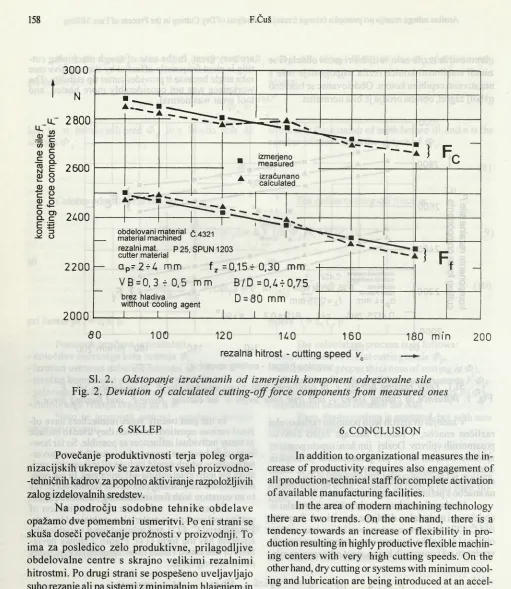
Vrednosti preizkusov za kombinacijo rezalni in obdelovani material so dobljene s preizkusi. Za mate rial Č.4321 in izbrane vstopne veličine ima enačba obliko (14). S slike 2 so razvidni odstopki izračunanih vrednosti od izmerjenih komponent odrezovalne sile.
F = 1,4 1013 v -5-7 f
c 7 C J z
kjer pomenijo: vc - rezalno hitrost v m/min, f
-podajanje na zob v mm/zob, VB - širino obrabe na prosti ploskvi v mm, a - globino rezanja v mm, B - širino ubiranja v mm,
b
- premer frezala v mmVse vrednosti so izračunane z regresijsko a n a liz o in v e lja jo za š irš e o b m o č je g la v n ih spremenljivk. Iz raziskav je mogoče ugotoviti, da so vrednosti specifičnih rezalnih sil pri manjši debelini odrezka za približno 25 do 30 odstotkov večje od vrednosti, dobljenih po enačbi. Pri debelini odrezka 1 mm je največji odstopek komaj 5 odstotkov.
In the past twenty years researchers have of fered various equations in which they tried to include as many individual influences as possible. So far how ever, they have not managed to establish an univer sal equation which would include all influencing vari ables for individual cutting-off processes. In our rese arch into the face milling process we limited ourselves to an equation with five influencing variables [5],
Experimental values for the combination o f cutting and workpiece materials are obtained by tests. For material Č. 4321 and selected input variables the equation has the form (14). Figure 2 shows devia tions o f calculated values from measured components o f the cutting force.
-2,6 j/ß-3,8 ^ (B/D)-51 (14),
where: v - cutting speed in m /m in ,/ - feeding into tooth inm m /tooth, VB - width o f wear on free face in mm, a - depth o f cutting in mm, B - width o f en- gagemenl in mm, D - milling cutter diam eter in mm.
3000
obdelovani material * 4 3 9 1 material machined
rezalni mat. P 25, SPUN 1203 cutter material
2200 — a p- 2 m m f z =0,15f 0,30 mm VB = 0, 3 T 0,5 mm
brez hladiva witthout cooling agent
B/D =0,£r0,75 D = 80 mm
2000
F,
8 0 100 120 U 0 160 180 min
rezalna hitrost - cutting speed t/
200
Sl. 2. Odstopanje izračunanih od izmerjenih komponent odrezovalne sile
Fig. 2. Deviation o f calculated cutting-off force components from measured ones
6 SKLEP
Povečanje produktivnosti terja poleg orga nizacijskih ukrepov še zavzetost vseh proizvodno- -tehničnih kadrov za popolno aktiviranje razpoložljivih zalog izdelovalnih sredstev.
N a p o d ro čju sod o b n e te h n ik e o b d e la v e opažamo dve pomembni usmeritvi. Po eni strani se skuša doseči povečanje prožnosti v proizvodnji. To ima za posledico zelo produktivne, prilagodljive obdelovalne centre s skrajno velikim i rezalnim i hitrostmi. Po drugi strani se pospešeno uveljavljajo suho rezanje ali pa sistemi z minimalnim hlajenjem in mazanjem. Tem ciljem sledi sodobni razvoj rezalnih m aterialov. Predvsem se uveljavljajo tanki sloji umetnih diamantov, silicijevega nitrida ali silicijevega karbida, kubičnega borovega nitrida, kermeta itn.
Z uvajanjem vse zahtevnejših obdelovalnih sistemov in rezalnih materialov se je povečala tudi potreba po bolj zanesljivih tehnoloških informacijah. To terja tem eljito analizo razm er v coni rezanja (sistem rezilo - obdelovanec - odrezek). V tem območju se pojavljajo napetosti, trenje, toplota in deformacije.
6 CONCLUSION
In addition to organizational measures the in crease o f productivity requires also engagement of all production-technical staff for complete activation o f available manufacturing facilities.
In the area o f modern machining technology there are two trends. On the one hand, there is a tendency towards an increase o f flexibility in pro duction resulting in highly productive flexible machin ing centers with very high cutting speeds. On the other hand, dry cutting or systems with minimum cool ing and lubrication are being introduced at an accel erated rate. These processes are accompanied by modern development o f cutting materials. In particu lar, thin layers o f synthetic diamonds, silicon nitride or silicon carbide, cubic boron nitride, cermet etc. are being introduced.
Za izhodiščno veličino pri procesu suhega rezanja je definiran funkcionalno dober obdelovanec ob obvladovanju o d rezovalne sile in obrabe v odvisnosti od vstopnih veličin in struktur sistema. To zahteva popolnoma nov način raziskovanja. Da bi se optimalno uskladile vse zahteve, je bil zasnovan in tudi uresničen sistem za avtomatizirano preizkušanje postopka čelnega frezanja. Sodobna avtomobilska industrija zahteva vedno večjo produktivnost, kar se prenaša tudi na druga področja.
Proizvajalci orodij računajo, da bodo iz sedanjih 18 milijard USD prometa že leta 2005 zaslužili 25 milijard USD. To pa sproža razvoj novih strojev in raziskav, ki bodo ustrezale načrtovanim ekonom skim in ekološkim zahtevam.
The starting variable in the dry cutting process is a well-defined functionally good workpiece, com bined with the control o f the cutting force and wear depending on input variables and system structures. This requires a completely new type o f research. In order to coordinate optimally all the requirements, the system o f automated testing o f the face milling pro cess has been conceived. The modern car industry as well as other industrial branches require an in crease in productivity.
The tool makers estimate that their turnover will be increased from the present 18 billion USD to 25 billion USD in 2005. This will lead to the develop ment o f new machines and new research which will comply with the planned economic and ecological re quirements.
7 LITERATURA 7 REFERENCES
[1] Čuš, F.: Automatisches Daten-Erfassungssystem für Zerspanungen. W erkstatt und Betrieb, München, Carl Hanser Verlag, (120) 1987/11,923-926.
[2] Schulz, H., E. Kalhöfer:: Aluminium-Knetlegierungen trocken bearbeiten. Werkstatt und Betrieb, München, Carl Hanser Verlag, (129) 1996/7-8,707-710.
[3] Čuš, F., J. Kopač, M. Sokovič: QM and costs optimization in m achining o f Al-alloys. Total quality, New Delhi, 1996,150-156.
[4] Čuš, F., J.Balič: Face milling and the influence of various geometrical shapes of cutters on cutting conditions. Advanced manufacturing systems and technology AMST ’93, 1993, Udine, 1/279-285.
[5] Čuš, F.: Rechnerunterstützte Optimierungsstrategie beim Fräsen und Rationalisierung des Werkzeugwesens, E & I, Wien, (12) 1995/4,165-169.
[6] Kopač, J.: Influence o f Cutting Material and Coating on Tool Quality and Tool Life. Proceed, ofthe 5th Intern. Seien. Conf. AMME '96, Poland.
Avtorjev naslov: prof. dr. Franci Čuš, dipl. inž. Univerza v Mariboru Fakulteta za strojništvo Smetanova 17
2000 Maribor
Author's Address: Prof. Dr. Franci Čuš, Dipl. Ing. University o f Maribor
Faculty of Mechanical Engineering Smetanova 17
2000 Maribor, Slovenia
Prejeto:
Received: 17.2.1997
Sprejeto: