Available Online at www.ijpret.com
258
INTERNATIONAL JOURNAL OF PURE AND
APPLIED RESEARCH IN ENGINEERING AND
TECHNOLOGY
A PATH FOR HORIZING YOUR INNOVATIVE WORK
TRANSFORMATION BASED METHODOLOGY FOR PALMPRINT
S. S. PATIL, A. V. DEORANKAR, P. N. CHATUR
Department of Computer Science and Engineering, Government College of Engineering,
Amravati , Maharashtra, India.
Accepted Date: 27/02/2014 ; Published Date: 01/05/2014
\
Abstract: Biometrics means life measurement. But nowadays it is directly associated with the use physiological characteristics to identify an individual next connection is security and verification. In interaction culture with whom we are communicating is important, we expecting same from the machines. In this paper we discussed Transformation methodology of Identification of a person. The different transformations used now a days are DCT, Haar
Transform, Eigen Transform etc.
Keywords: Put your keywords here, keywords are separated by comma.
Corresponding Author: MR. S. S. PATIL
Access Online On:
www.ijpret.com
How to Cite This Article:
SS Patil, IJPRET, 2014; Volume 2 (9): 258-263
Available Online at www.ijpret.com
259
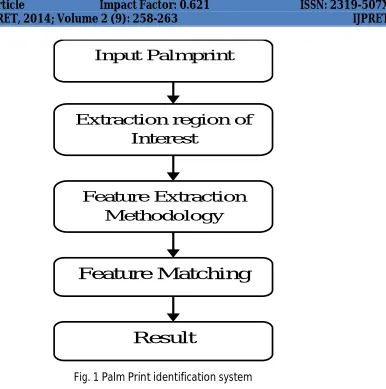
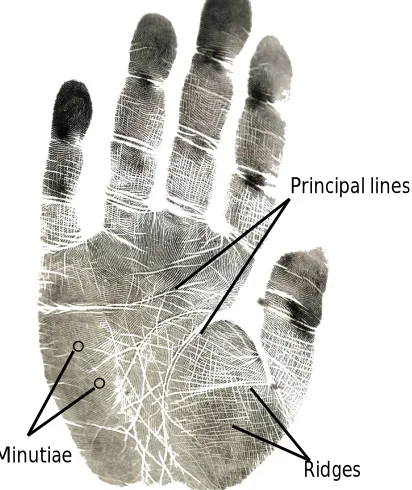
Human palm is the inner surface of the hand from the wrist to the base of the fingers. Figure1 shows a palm print with its features. The inner surface of the palm normally contains three flexion creases, secondary creases and ridges. The flexion creases are also called principal lines and the secondary creases are called wrinkles. The flexion and the major secondary creases are formed between the third and fifth months of pregnancy [4]. The principal lines are major crease or flexion crease formed due to folding of hand, these are the permanent feature of palm and can be reliably used for recognition or identification methodologies. Since the palm has larger skin area , more distinctive features can be captured compared to fingerprints. The general identification system has three main basic stapes pre-processing, feature extraction and feature matching. The figure1 shows the general identification technique stages. The flow of system goes like this. The different transformation we are discussing are broadly used in feature extraction stage. The feature extraction stage in which we apply the different algorithm to extract the palm line details. The transformation can be used according to which feature we want for our system. As we know the palm identification system can rely on
II. METHODOLOGIES
Transformation methods for palmprint feature extraction are discussed in this section.
A. Discrete Cosine Transform
A discrete cosine Transform (DCT) is an extension of the fast Fourier Transform that works in the real domain. It represents a sequence of finitely arranged data points in terms of cosine functions oscillating at different frequencies. The DCT is found to be symmetric, orthogonal and separable [7]. The DCT transforms a signal from a spatial representation into a frequency representation which maps an n-dimensional vector to set of n coefficients.
One-dimensional DCT is derived by the equation (1):
( ) = ( )∑ ( ) cos ( ) (1)
Where u=0,1,...N-1
( ) = 1
Available Online at www.ijpret.com
260 ( ) = 2
Where u≠0
Two dimension DCT is given by
( , ) = ( ) ( )∑ ∑ ( , ) cos ( ) cos ( ) (2)
( ), ( ) = 1
Where u,v=0
( ), ( ) = 2
Where u,v≠0
In an image, most of the energy will be centralized in the lower frequencies, so if the image is transformed into its frequency components and the higher frequency coefficients are discarded, the amount of data needed to describe the image can be reduced. DCT‟s energy
compaction efficiency is so great that can reduce the amount of data needed to describe the image without sacrificing too much image quality [6]
B. Haar Transform
The Haar transform is the oldest and possibly the simplest wavelet basis, as seen in Equation 3 [2][3]. A Haar Wavelet used high-pass filtering and low-pass both filtering and works by incorporating image decomposition on first rows of image and then the columns of image. It provides us with a representation of the frequency as well as the location of an image’s pixels.
( ) =
1, 0≤ <
−1, ≤ ≤1
0, ℎ
Available Online at www.ijpret.com
261
Fig. 1 Palm Print identification system
C. Wavelet transform
For wavelets transform, wavelet transform matrix can be obtained of size N2xN2 general PxP wavelet matrix can be generated from NxN orthogonal matrix by putting P=N2. To yield wavelet transform matrix from NxN orthogonal transform matrix perform the following steps [1].
•First N number of rows of Wavelet transform matrix is generated by repeating every column of transform T, N times.
•Second row of transform T is translated to generate next (N+ I) to 2N rows. To generate next (2N+ I) to 3N rows, third row of transform T is translated
•Similarly to generate last ((N-I) N + 1) to N2 rows, Nth row of transform T is used. Note that by repeating every column of the basic transform N times, Mother Wave is obtained
Extraction region of
Interest
Input Palmprint
Feature Extraction
Methodology
Feature Matching
Available Online at www.ijpret.com
262
Fig. 2 Human palmprint with line features
D. Eigen Transform
The Eigen transform is a transform that is used as an integral component of Principal Component Analysis (P.C.A.). The Eigen Transform is unique as in it provides a measure of roughness calculated from a pixels surrounding a particular pixel. The magnitude specified which each such measure provides us with details related to the frequency of the information. All this helps us to obtain a clearer picture of the texture contained in an image. The Eigen transform is generally given by following equation[5].
( , ) = × sin (4)
III. CONCLUSIONS
In this paper we have discussed different transformation methodologies for palmprint identification systems. The different transformation can be used for feature extraction. According to which feature like principal lines, wrinkles, ridges, minutia one can determine the transformation to be used for identification.
Principal lines
Available Online at www.ijpret.com
263
1. Dr. H. B. Kekre, Archana Athawale, Dipali Sadavarti," Algorithm to Generate Wavelet Transform from an Orthogonal Transfonn", International Journal Of Image Processing (lJlP), Volume (4): Issue (4).
2. Dr. H.B. Kekre, Archana Athawale, Dipali Sadavarti “Algorithm to Generate Wavelet Transform from an Orthogonal Transform” IJIP Volume (4), Issue(4)
3. Mohammed Alwakeel, Zyad Shaahban, “Face Recognition Based on Haar Wavelet Transform and Principal Component Analysis via Levenberg- Marquardt Backpropagation Neural Network.” European Journal of Scientific Research. ISSN 1450- 216X Vol.42 No.1 (2010), pp.25-31
4. M. Cannon, M. Byrne, D. Cotter, P. Sham, C. Larkin, E. O'Callaghan, Further evidence for anomalies in the hand-prints of patients with schizophrenia: a study of secondary creases, Schizophrenia Research 13 (1994) 179–184.
5. Abdu Rahiman, V. Gigi C.V.“Face Hallucination using Eigen Transformation in Transform Domain” International Journal of Image Processing (IJIP) Volume(3), Issue(6)].
6. K. R. Rao and P.Yip, “Discrete Cosine Transform; Algorithms, Advantages and Applications”, Academic press Inc., 1990
7. Syed Ali Khayam., “The Discrete Cosine Transform (DCT): Theory and Application.” ECE 802-602: Information Theory and Coding. Seminar 1.