Available Online at www.ijpret.com
187
INTERNATIONAL JOURNAL OF PURE AND
APPLIED RESEARCH IN ENGINEERING AND
TECHNOLOGY
A PATH FOR HORIZING YOUR INNOVATIVE WORK
COMPOSITE MATERIALS IN AEROSPACE: A REVIEW
AJINKYA S. DEHANKAR, PRITY V. WARWADE, DHANRAJ C. DEHANKAR, PROF. RAVIKANT PAROPATE
Dept. Mech Engg, JDIET, Ytml.
Accepted Date: 27/02/2014 ; Published Date: 01/05/2014
\
Abstract: Composite materials are used to make aircraft and in aerospace industry. For construction of the aircraft isotropic materials are used such as aluminum ,steel , titanium due to their structural properties of high strength , low weight , corrosion resistance, stiffness , dimensional ability. Composite material is a combination of two or more materials having compositional variations and depicting properties distinctively different from those of the individual materials of the composite. Aluminum is energy absorption, has good heat transfer properties, electromagnetic shielding properties, has smooth, thin cell walls, is machinable, and has a relatively low cost so that there are minimum chances of cracking and try to avoid damage of jet in aerospace. Aircraft were constructed of aluminum tubes and Mylar wings supported by steel cable. The aerodynamic drag of the cabling proved to be the factor limiting flight endurance. This paper gives idea about the various material applications in aerospace parts manufacturing.
Keywords: Composite materials, Aluminum, Structural properties
Corresponding Author: MR. AJINKYA S. DEHANKAR
Access Online On:
www.ijpret.com
How to Cite This Article:
Available Online at www.ijpret.com
188 INTRODUCTION
Al-Mosawi et al., 2012[1] state that Composite material is a material consisting of two or more physically and (or) chemically distinct phase, suitably arranged or distributed. A composite material usually has characteristics that are not depicted by any of its components in isolation. Using this definition, it can be determined that a wide range of engineering materials fall into this category.
Composite materials are becoming more important in the construction of aerospace structures. Aircraft parts made from composite materials, such as fairings, spoilers, and flight controls, were developed during the 1960s for their weight savings over aluminum parts. New generation large aircraft are designed with all composite fuselage and wing structures, and the repair of these advanced composite materials requires an in-depth knowledge of composite structures, materials, and tooling. The primary advantages of composite materials are their high strength, relatively low weight, and corrosion resistance. [1]
David Roylance introduces the basic concept Of stiffness and strength underlying the mechanics of Advanced composite materials. This aspects of composite materials deals with the mechanical properties like strength , weight, shielding effect, corrosion resistance.[6] [7]
As we know all demands in day to day life increases our availability should also be increasing . the increased availability of light , stiff, strong materials has made it possible to achieve number of milestones in Aerospace technology. These composite materials have been advantageously used in construction of satellites , missiles , aircraft , launchers and other space vehicles . For example : For construction of aircraft containing 30-40% volume of spherical particles of carbon with 20-50 micrometer in vulcanized rubber which improves the tensile strength, toughness and resistance against corrosion.
Alloy like aluminum is specially used in aerospace industry , because of their high strength -to- weight ratio. [2] [8]
1.1 BACKGROUND
Available Online at www.ijpret.com
189 WOOD: Used in the wings. It is light, flexible and easy to shape into parts. They originally chose pine instead of spruce, but it cracked easily under pressure. Spruce was far more flexible which was especially important to consider when landing. Wood is also cheap and readily available.
STEEL: Used in numerous locations to hold parts together. Steel is easy to shape, very hard and is well suited for making bolts. It does however rust easily if untreated. It has a good heat transfer properties, electromagnetic Shielding properties and heat resistant.
CLOTH: Used to cover the wings. It is extremely light and easy to shape but very easy to tear.
ALUMINUM: Used to make the engine. Aluminum can be heated and molded easily which still today makes it popular for engine construction. It has corrosion resistance , high electromagnetic shielding properties , high strength to weight ratio, etc. [3]
Fig.1. The Wright Brothers’ First Flight – December 17th, 1903
2. LITERATURE REVIEW
By using aluminum as compared to carbon fiber to determining the density ratio to prove that carbon fiber is as dense as aluminum because Manufacturing engineers are, similarly, wrestling with unfamiliar difficulties. Problems with wrinkling of the fibers in the fabrication process, resulting in a loss of stiffness and strength in the finished component.[5]
Density of carbon iber
Density of Aluminum = Density Ratio
0.00158g mm
0.0027g mm = 0.5852
0.5852 ∙ 100 = 58. 52%
Available Online at www.ijpret.com
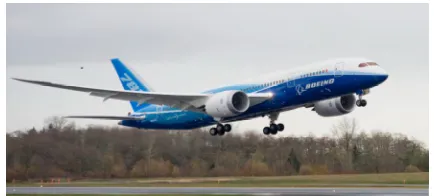
190 According to NASA in Boeing 787-400ER as shown in Fig. 2 is made predominantly of aluminum and has a mass of184,000kg.
If Boeing replaced 10% of the aluminum with carbon fiber, then its new mass be first, determine how much mass equates to 10% of the plane’s total mass.
184,000kg • 10% = 18,400kg
To find the mass of the portion of the plane that will be made of carbon fiber, multiply the difference by the density ratio found in the previous problem. would be made of carbon fiber.
18,400kg • 0.5852 = 10,767.68kg
Now, determine how much of the plane is still made of aluminum.
Airplane’s Original Mass - Amount changed to carbon fiber = Total Aluminum Required
184,000kg – 18,400kg = 165,600kg
Add the aluminum and carbon fiber components to determine the plane’s new mass.
165,600kg + 10,767.68kg = 176,367.68kg
As a percentage how much lighter is the new aircraft
∙100 = percentage of original mass
,, . ∙100 = 95.852%
100% - 95.85% = 4.15%
Hence, the aircraft is 4.15% lighter . [5]
Available Online at www.ijpret.com
191 Aerospace engineering is changing. Airplanes have traditionally been made out of metal – usually alloys of aluminum; now however, engineers are increasingly working with carbon fiber composites. Tim Edwards, a structural engineer at Atkins, describes the making of composite wings and the take-up of them across the aerospace industry. But according to structural properties of aluminum ; it is the best composite material for aerospace uses.
Carbon fibers embedded in an epoxy matrix. By way of comparison, the ultimate strength of aerospace grade aluminum alloys is typically 450 megapascals (MPa – a unit of stress or pressure, one MPa being about 10 times atmospheric pressure). [4]
AIRCRAFT COMPOSITE MATERIALS USAGE SURVEYED
• Fighter Aircraft (US): F-16, F-14, F-18,YF-23, F-22, JSF, UCAV
• Fighter Aircraft (Europe): Gripen JAS-39, Mirage 2000, Rafael, Eurofighter Typhoon, Lavi, DASA Mako
• Fighter Aircraft (Russia): MiG-29, Su series
• Boober (US): B-2
• Transport (US): KC-135, C-17
• Transport (US- Commercial): B -777, B-767, MD-11
• Transport (Airbus, European): A-320, A-340, A380, Tu-204, ATR42, Falcon 900, A300-600ST
• General Aviation: Piaggio, Starship, Premier 1
Available Online at www.ijpret.com
192
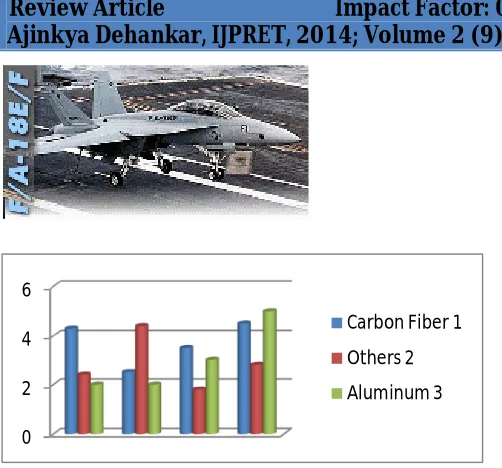
Fig : Graphical arrangement to show diff. between composites
In 1987 used of composite material as carbon fiber is more ,but only carbon fiber is not a composite material so in next year used of carbon fiber the weight and density is more so it was rejected then composite materials as aluminum is used and mixture of titanium , steel , alumium by adding create a new aircraft which is fly in aerospace successfully. Hence the aluminum is best against other metals.
Advantages of Composite Materials
1. Composite material gives excellent strength -to- weight ratio and stiffness -to-weight ratio.
2. As composite are made by wide range of processes, production cost is reduced.
3. Composites offer excellent resistance to corrosion, chemical attack, outdoor weathering and
smooth surface finish.
4. It gives fatigue resistance, high performance, tailorable mechanical properties.
5. It reduces the weight.
Disadvantages of Composite Materials
1. It has high rate of cost and higher nonrecurring costs.
0 2 4 6
Carbon Fiber 1
Others 2
Available Online at www.ijpret.com
193
2. Composites are more brittle than wrought metals and thus are easily damaged.
3. Repairing introduces new problem.
4. Hot curing is necessary in many cases, requiring special equipment.
5. Materials require refrigerated transport and storage and have limited shelf lives.
CONCLUSION
1. The strength – weight ratio between aluminum and carbon fiber has been carried out so the
aluminum is best composite material, which has high strength and low density so aircraft can flight in aerospace easily.
2. Mixture of many composites play important role in human life and it benefit for us.
3. Composites of Mechanical properties improve the design of aircraft.
RECOMMENDATION
For become more perfect aircrafts following things may increase to improve .
1. Materials should not be dense, due to that property their strength to weight ratio become
weak.
2. Weight of that composite materials reduced by adding low density materials.
3. Composite materials formed from such materials whose mechanical properties are strong in
nature.
REFERENCES
1. Al-Mosawi, A. I., Ammash, H.K. and Salaman, A.J. (2012). Properties of Composite Materials
Data book. 2nd edition, Lambert Academic Publishing LAP. ISSN-L: 2223-9553, ISSN:2223-9944 ,vol . 3 No.3 , Nov 2012.
2. G. E. Dieter, “Mechanical Metallurgy”, Tata Mc-Graw Hill International Publication , London
3rd Edn 1999.
3. “Adobe Acrobat document” Anon, “ A Brief Look at Composite Materials in Airbus
Commercial Aircraft”, High Performance Composites March/April 1999.
Available Online at www.ijpret.com
194
5. “National Aeronautics and Space Administration (NASA)”, A broacher of Composite Materials
of Grade K-12, NASA.
6. David Roylance , “ Introduction to composite materials” Department of materials science and
engineering, Massachusetts Institute of Technology Cambridge, MA 02139 , March 24 , 2000
7. Hull, D. and T. W. Clyne, “ An Introduction to composite Materials” , Cambridge University
Press, 1996.
8. V.D. Kodgire, and C. Daniel Yesudian, “Everest Publishing House” and “ Scitech Publishing”,