Available Online at www.ijpret.com
59
INTERNATIONAL JOURNAL OF PURE AND
APPLIED RESEARCH IN ENGINEERING AND
TECHNOLOGY
A PATH FOR HORIZING YOUR INNOVATIVE WORK
LOW COST MICROCONTROLLER BASED AUTONOMOUS HUMAN LIFE
DETECTION ROBOT WITH IMAGE AND MESSAGE TRANSMISSION USING CELL
PHONE
NARESH P. JAWARKAR, VASIF AHMED
Department of Electronics & Telecommunication Engineering, Babasaheb Naik College
of Engineering, PUSAD (MS)
Accepted Date: 15/02/2014 ; Published Date: 01/04/2014
\
Abstract:Many lives can be saved during natural and man-made disasters like earthquakes, airplane crashes, landslides, floods, etc. if rescue operations to detect human life are carried out at the earliest. This paper proposes a low cost system using autonomous robot prototype for human life detection to aid rescue operations in hostile conditions with capability to take images and inform rescue personnel immediately. The robot scans predefined area strip by strip and detects human life. Two DC geared motors are used for movement of robot under control of microcontroller system. Living Human beings in comatose conditions are identified using passive infra-red sensor. The robot has capability to avoid obstacles through inputs from LED sensor module. A novel feature of automatic transmission of image to user cell phone on human life detection is incorporated. The usage of Multi-media Messaging Service (MMS) feature of cellular networks eliminates the constraint of range for message transmission. The system is based on AVR ATMega16 microcontroller. Any cell phone (even obsolete or discarded model) with camera and MMS facility can be used with the system. The system is provided with accelerometer sensors to detect any abrupt slopes, etc. The usage of old cell phone model drastically reduces cost of the system apart from preventing environmental hazards due to unsafe dumping of old cell phones. The proposed system has tremendous potential to reduce fatalities due to its capability to inform emergency services for timely help after detection of human survivors. The other applications which can be developed based on similar concepts are also discussed.
Keywords: Remote scanning, micro-controller, human life detection, MMS, cell phone
Corresponding Author: Mr. NARESH P. JAWARKAR
Access Online On:
www.ijpret.com
How to Cite This Article:
Available Online at www.ijpret.com
60
INTRODUCTION
Disasters like earthquakes, typhoon, Tsunami, landslides, floods, airplane crashes, bomb blasts, etc cause massive tragic loss of lives and property. India with its huge population has to bear brunt of these incidents frequently. These events also result in huge strain on staff involved in rescue operations. Many sophisticated rescue systems have been developed in advanced countries[1,2]. However, the cost is too prohibitive to be applied in Indian conditions. In many cases, the affected regions are very large and results in great delay in evacuation process resulting in increase in death toll.
For detection of human lives during disasters, many approaches have been proposed. Microwave based Radar sensing is popular for sensing human bodies buried under debris of buildings and other structures. This approach detects life sign symptoms like heart rate, pulse rate, etc and is very useful for disasters covering urban regions. However cost and size of system will reduce its effectiveness for covering large areas. Ultrasonic sensors along with wireless cameras have also been used to detect live humans. Traditional Pyroelectric Infra-red (PIR) sensors used in automatic light control, burglar security systems can also be applied for sensing human lives. A major disadvantage associated with existing systems is limited range of communication between autonomous robot and operator (rescue volunteer).
Due to widespread coverage of cellular network and availability of cheap cell phone models, it was decided to use appropriate cell phone model with camera and MMS facility to capture image at suitable time and send it to the operator cell phone.
System Description
Available Online at www.ijpret.com
61 Fig. 1 System Block Diagram.
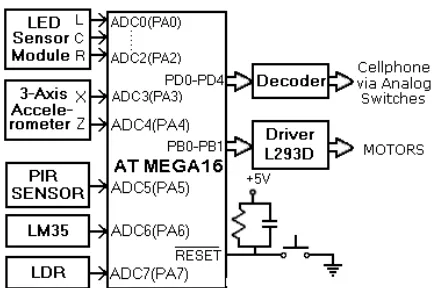
The Block diagram of the system is shown in Fig. 1. Nokia C1-01 model (Series 40 5th Edition Feature Pack 2 device) is used as system cell phone. Four port bits of microcontroller are used to control the soft and command keys of cell phone through decoder and analog controlled switches to send images and messages to user cell phone based on certain conditions. LED sensor module is used to detect obstacles in left, right and front regions of the robot. PIR sensor circuit is used to detect human life. Additional sensors are provided to improve reliability of the system. LM35 temperature sensor is used to measure ambient temperature of the environment. Light Dependent Resistor (LDR) is used to measure ambient light conditions. The knowledge of ambient values of temperature and light helps to improve sensitivity of PIR sensor. 3-axis accelerometer sensor is used to determine any sudden variations in speed of robotic vehicle due to terrain or other factors. The microcontroller controls the selection of DC motors through L293D driver IC and direction of movement of robot depends on motor's state. If both motors are in ON state, the robot moves straight in forward or reverse direction depending on connections. However, if only one motor is ON, the robot takes right or left turn depending on position of motor which is ON. The field coil presets are provided in series with dc motors which are adjusted to balance out differences in the speed of the two motors to ensure that robot moves in straight path whenever both motors are in ON states.
Mechanical Aspects
Available Online at www.ijpret.com
62 Fig. 2 Chassis Dimensions
Available Online at www.ijpret.com
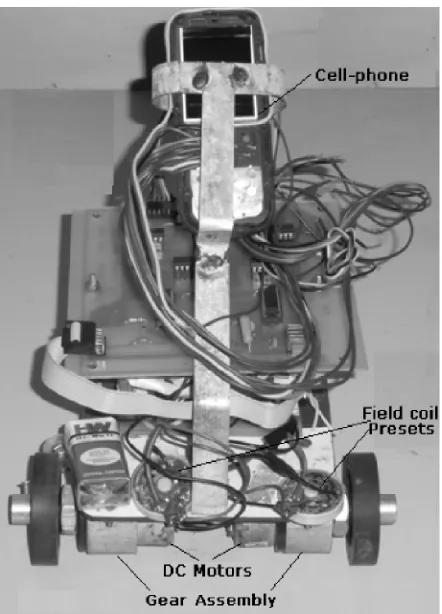
63 Figure 2 shows the basic dimensions of the chassis of the prototype robot. LED sensor is mounted on bottom side of robot near front wheel to detect obstacles. PIR sensor is mounted at the top in front side with slight inclination towards ground to detect human beings in comatose positions also. Temperature sensor LM 35 was mounted below microcontroller PCB to avoid interference from direct sunlight while LDR sensor is placed at the top to measure light intensity. The accelerometer sensor is placed inside solid box to allow free motion to capture sudden variations in speed. Figure 3 show the back side image of entire robot prototype with cell phone, circuit PCB, sensors and DC motors.
LED Sensor Module
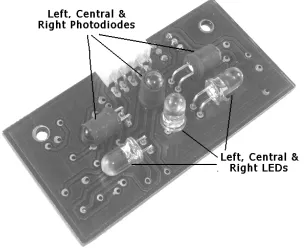
Fig. 4 LED Sensor Module
The sensor has a compact size with front, left and right LEDs along with its photodiode pair. The LED sensor is modulated at 10 kHz. It has active filter to protect against ambient light. Whenever there is no obstacle, the light emitted by LED is not reflected and hence the outputs corresponding to current state of photodiode are at relatively high voltage. However if any obstacle is present, the reflecting light from obstacle changes the corresponding photodiode current resulting in lower output voltage depending on direction of obstacle. The intensity of light reflected is proportional to distance between obstacle and emitting LED. Sensor produces analog output in the range of 0.5V to 1.3V. The sensor module is shown in Figure 4. It has sensitive output for distance range between 3 cm to 15 cm.
PIR Sensor
PIR sensor basically measures the Infra-red radiations emitted from objects in its range of view. The infra-red radiations emitted by an object are related to its temperature. A normal human
being’s body temperature is regulated to 960F. However, after death temperature regulating
Available Online at www.ijpret.com
64 Fig. 5 PIR Sensor Module
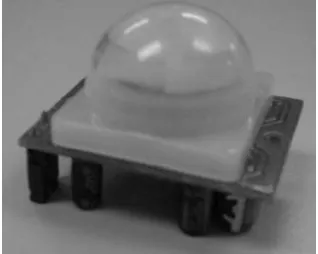
Fig. 5 shows image of PIR Sensor Module. This device contains special filter Fresnel Lens for focusing the infrared signals onto the pyroelectric element. The changes in the amount of infrared radiations striking change the voltages generated which are measured by on-board amplifier as shown in Fig. 6. This sensor can measure presence of human beings in the range 5-20ft. Since our application requires placement of this module on robot with varying environment conditions, it was decided to improve sensitivity by providing ambient temperature and light conditions using LM35 and LDR sensors.
Fig. 6 Human Body Detection using PIR Sensor[3]
Accelerometer Sensor
There is wide range of accelerometers available to measure variations in accelerating force. Freescale's 3-axis MMA7260QT capacitive micro-machined accelerometer was chosen for its selectable sensitivity, low power dissipation and low cost [4]. It has capability to withstand
shocks up to 5000 g. It provides onboard low pass 1-pole filter using switched capacitor along
Available Online at www.ijpret.com
65 readings exceed specified limits, text and multimedia messages are sent to operator cell phone. The major functions of this module in our application is to detect sudden gradients in the path, forced intrusion by animals or similar other factors.
Microcontroller System
AT Mega16 microcontroller has RISC architecture with 16 Kb of in-system programmable Flash, 1k E2PROM, 2k SRAM, 32-bit multi-function General purpose I/O, 8 channel 10-bit ADC, TWI, USART, SPI, JTAG interface support, etc. [5, 6] Ponyprog software was used for flash programming [7]. The software was developed in C language using GCC compiler.
A. Interfacing Diagram
Fig. 7 Microcontroller System Interfacing
Available Online at www.ijpret.com
66
Algorithm
The prototype system sends message to user cell phone indicating start of scanning through sequence of commands to system cell phone. The analog inputs are continuously scanned and both the motors are switched ON to move in straight path. Whenever non-human obstacle is detected through change in input magnitude of central output of LED sensor, the prototype system gradually turns itself around the obstacle by controlling the selection of motors and continues in straight path. When it reaches boundary of scanned region, it makes gradual U turn and start scanning the next strip. Whenever live human being is detected during scanning, the robot stops and captures the image through system cell phone and transmits MMS to user cell phone and continues its scanning process. When it reaches the end of predefined area, the robot prototype stops and sends message indicating end of scanning process. The operator is able to estimate position of human survivor from start time, the speed of robot prototype and number of obstacles it had to cross during its path.
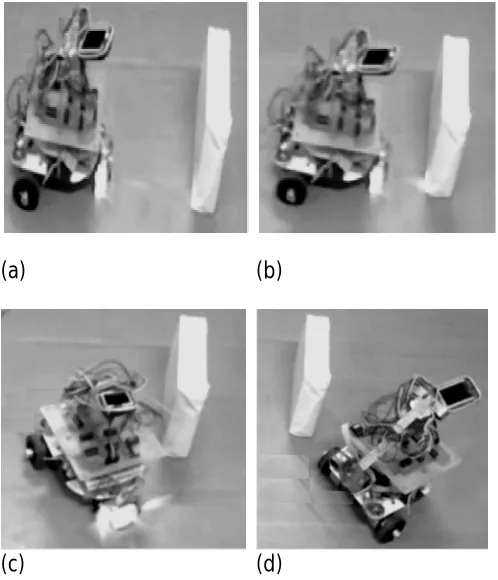
(a) (b)
(c) (d)
Available Online at www.ijpret.com
67 Fig. 8(a) to (d) show screenshots of robot prototype maneuvering past the non-human obstacles while Fig. 9 shows screenshots of some processes involved during encounter of human being. The image capturing facility provides insight of state of human survivor to the rescue operator to carry out necessary emergency services. It also helps to operator to decide the priority of services when number of human survivors is detected.
Fig. 9 (a): Capturing of image completed by system cell phone
Fig. 9 (b): Stored Image file being sent through MMS
Image and Message Transmission
Available Online at www.ijpret.com
68 phone. The alternate options of USB to serial converters or Bluetooth Serial adapters are costly to implement [8]. Moreover, even if these adapters were used, there is another difficulty of obviating the access permission levels for connectivity in Java ME as cell phone are basically designed for human interaction using key pads and touch screens and cannot be directly automated. Any discarded cell phone with image capturing and communication capability can be used in the application. It was observed that even cell phone with damaged screens or non-working key pads can be utilized in the application.
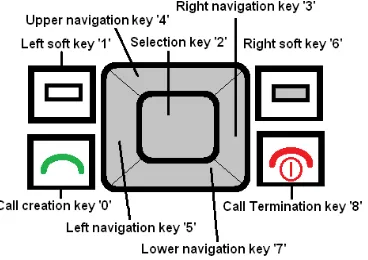
Cell phone operation is done by activating the key presses of right soft key, left soft key, 5-way navigation (4 arrows and selection key), call creation and termination keys (control keys) through ports of µc system using analog controlled switch.
Fig. 10(a): Nokia C1-10 Model with control keys
Fig. 10(b): Nokia Model C1-01 control keys with assigned codes
Available Online at www.ijpret.com
69 microcontroller [9,11]. There is also set of short-cut keys provided by cell phone manufacturers to speed up the tasks e.g. pressing top scroll key after call termination key directly opens camera application in Nokia Models.
Four output port bits are connected to control pins of analog controlled switches through Hexadecimal decoder IC to ensure activation of single control key press. An additional port bit is used to enable/disable the decoder.
CONCLUSIONS & FURTHER RECOMMENDATIONS
Thus robot prototype has been developed for human life detection during occurrence of disasters in remote areas. This system is able to detect human life and informs rescue operator with image transmission whenever human survivor is detected. The usage of cellular networks reduces the cost of establishment of wireless network and removes the constraints of range of the system. Any obsolete or unused cell phone model with camera and MMS facility can work as system cell phone. The concept can easily be extended for range of applications from security systems, automatic car parking to fire and gas leakage detection systems for unmanned or hazardous regions by choice of appropriate sensors.
Presently unidirectional communication from system cell phone to user cell phone is supported. However, it is also possible to modify the system with use of serial port adaptors to provide facility to receive commands from cell phone by microcontroller system [10].
ACKNOWLEDGMENT
We are grateful to Prof. Dr. K. Ravi, Principal, Babasaheb Naik College of Engineering, Pusad for providing necessary facilities in the institute towards carrying out this work. We acknowledge the diligent efforts of our students, Shubangi Jarande, Himanshu Chavan and Rashmi Dhabale in assisting us towards implementation of this idea. We also thank Subodh Pathe and Janusing Chavan for their wholehearted support during the experimentation work.
REFERENCES
1. Pissokas, John and Malcolm, Chris (2001) “Experiments with Sensors for Urban Search and
Rescue Robots”, Dept. of Computer Science, University of Essex and Division of Informatics,
University of Edinburgh, Scotland UK.
2. Burion, Steve (2004), Casper, J. (2002), Amerada, Yams, Igarashit, & Matsunos, (2004) and
Available Online at www.ijpret.com
70 Mellon University, Institute of Production Robotique (IPR) LSRO2 –VRAI-Group, Microtechnique, February 2004.
3. Pyroelectric Infrared Radial Sensor, Sensor Manual, Model:D203B, PIR Sensor Co., Ltd
4. Freescale MMA7260QT - XYZ axis Accelerometer Datasheet available online
http://www.freescale.com/support.
5. ATMEL AVR AT Mega32 Datasheet, available online:
http://www.atmel.com/dyn/resources/prod_documents/2503S.pdf
6. Richard Barnett, Larry O’Cull and Sarah Cox, Embedded C Programming and Atmel AVR,
Delmar-Cengage Learning India Pvt. Ltd., 2007 Edition (India).
7. Ponyprog software, available online: http://www.lancos.com/
8. Vasif Ahmed and S. A. Ladhake, “Innovative Cost Effective Approach for Cell Phone based
Remote Controlled Embedded System for Irrigation”, Proc. Of Intl Conference on
Communication Systems and Network Technologies CSNT 2011, Jammu, India, 3-5th June 2011, pp 419-422.
9. Ahmed Vasif and Charniya N. N., 2005. Automated Shutdown of Computer During Power
Failure. IETE Journal of Research, Vol 51, No. 5, (Sept. – Oct. 2005), 335-338
10.Vasif Ahmed and S. A. Ladhake, 2011, "Novel Ultra Low Cost Remote Monitoring System for
Home Automation using Cell Phone", Proceedings of International Conference CICN 2011, pp 569-573.
11.Naresh P. Jawarkar and Vasif Ahmed, “Implementation of Autonomous Metal Detection
Robot with Image and Message Transmission using Cell Phone”, Journal of Instrument Society