STATIC ANALYSIS FOR JAVA WITH ALIAS REPRESENTATION REFERENCE-SET IN HIGH-PERFORMANCE COMPUTING
JONGWOOK WOO∗
Abstract. Static Analysis of aliases is needed for High-Performance Computing in Java. However, existing alias analyses regarding∗operator for C/C++ have difficulties in applying to Java and are even imprecise and unsafe. In this paper, we propose
an alias analysis in Java that is more efficient, at least equivalent, and precise than previous analyses in C++. In the beginning, the differences between C/C++ and Java are explained and a reference-set alias representation is proposed. Second, we present
flow-sensitiveintraprocedural and context-insensitive interprocedural rules for the reference-set alias representation. Third, for the type determination, we build the type table with reference variables and all possible types of the reference variables. Fourth, a static alias analysis algorithm is proposed with a popular iterative loop method with a structural traverse of a CFG. Fifth, we show that our reference-set representation has better performance for the alias analysis algorithm than the existingobject-pair
representation. Finally, we analyze the experimental results.
Key words. Static Analysis, Alias Analysis, Java, Compiler, Parallel and Distributed Computing, Reference-Set, Flow-Sensitive, Context-Insensitive
1. Introduction. Java has become a popular language in distributed and parallel computing because it is platform independent and object-oriented. More specifically, in Java, objects are accessed by references, consequently, there might be many aliases in a piece of Java code. An alias situation occurs when an object is bound by more than two names. Thus, alias information is very useful to avoid side effects from the object bound and codes with alias information are better candidates for high performance computing such as parallelizing compiler as well as compiler optimization. Recent studies [1, 2, 3, 4, 5, 6, 8, 9, 13, 14, 15] have analyzed aliases to avoid side effects statically. With detected aliases information, we may avoid race conditions, context switch and communication overhead for parallelizing computing environment.
Previous studies [2, 3, 4, 5, 6, 8, 9, 18] proposed alias analyses for C/C++ by representing the alias relation with objects because of the concepts of pointers and pointer-to-pointer in C/C++. This research aims at improving the efficiency and the accuracy based on the safety of the alias information detected. However, the representation of alias relations based on * operator is not sufficiently optimized to apply to Java. Thus, we have proposed referred-set representation [1] that makes a more efficient and precise analysis for Java theoretically than previous methods. We can define theprecisionas the metric when all possible data are predicted statically and remove redundant data as possible. However, it might have a large time complexity in the usage of the computed alias set. Thus, in this paper, we propose an alternative alias relation,reference-setrepresentation by extending our reference-pair representation which is a pair of reference variables [13]. Within a procedure, flow-sensitive analysis is applied. In aflow-sensitiveintraprocedural analysis, each statement includes all the alias information at the point. The information is propagated to the next statement and subsequently computed in the
CF Gof a method. Among procedures, context-insensitive call graph is built. Each procedure is represented by a single node in a call graph and analyzed the node even for different calling contexts. Thus, data information is computed efficiently in context-insensitivity graph and the computed data are safe. The context-sensitive
approach is characterized by a data flow analysis based on path-sensitivity, so each procedure may be analyzed separately for different calling contexts. Thus, we use context-insensitivity calling graph. We also can define the
saf etyas the metric when all possible data are predicted statically and collected so that any possible aliased element is not removed. At a procedure p, M ay Aliases may refer to the same storage location, that is, in some execution instances of the pon some path through a flow-graph. For example, in a procedure p, when one path of p containsx=y and another pathx=z, we can say thatxmay refer toy orz. At a procedurep,
M ust Aliasesmust refer to the same storage location, that is, in all execution instances of the pon all paths through a flow-graph. For example, in a procedurep, when every path ofpcontain onlyx=y, we can say that
xmust refer toy.
We analyze the existing alias representations and propagation rules in C++ [2, 3, 4, 6] in order to build much better solution in Java. Our alias analysis in Java presents three contributions for the efficiency and preciseness without losing its safety. First, we introduce the reference-set representation to present an alias information in Java. Second, we propose more precise data propagation rules of aliases for the reference-set ∗Computer Information Systems Department, Simpson Tower Room 604, California State University, Los Angeles, CA 90032-8530 ([email protected]).
Fig. 1.1.Relation between a pointer and an object in C++
Fig. 1.2.Relation between a reference and an object in Java
representation. These rules are based on flow-sensitive and context-insensitive analysis. Finally, converting existing algorithms [1, 6, 13] to thereference-set representation and the rules, our calling graph (CG), control flow graphs (CF G) and a type table (T T), we propose a more precise and efficientflow-sensitivealias analysis algorithm.
In this paper, §2 presents the differences between pointer in C++ and reference in Java. §3 explains the existing studies for aliases. §4 introduces the reference-set alias representation for Java. §5 describes the structures to build our algorithm. §6 explains our propagation rules for Flow-Sensitive intraprocedural and Context-Insensitive interprocedural analyses. §7 shows the alias analysis algorithm and compares the complexities of our and existing algorithms. §8 shows the experimental results of thereference-setand existing
object-pairrepresentations. Finally, the conclusion is presented.
2. Pointer in C/C++ and Reference in Java. In static analysis of an object-oriented language, naming of an object has been used as data representation for data flow analysis. The object naming is considered to represent aliases in C++ and Java. In C++, static objects declare object names. Also, dynamic objects and pointer-valued objects have their own names for an alias analysis. A pointer variable name is a name to point an object that contains the address of a pointed-to object. In Fig 1.1 (a), pointer variable namepis naming a pointer-valued object that contains its address value. Dereferenced pointerpis naming the object that is pointed to byp. A variable namepthat is not a pointer is naming an object that contains the address of the variable. There exist alias relations among pointer-valued objects because of pointer-to-pointer relationships. Therefore, in the previous studies [5, 6, 7], when pointer p points to an object of v, the alias relation is represented as < ∗p, v >. Fig 1.1 (b) shows that a pointer points to another pointer variable that complicates the alias analysis, where a box depicts a pointer-valued object and a circle is a non-pointer object. Those alias relations are represented ash∗p, qiandh∗q, ri.
However, There are no pointer-to-pointer concepts and no pointer operations in Java. An object in Java is created dynamically so that the object becomes an anonymous object that does not have its own name. Thus, each object needs its own naming by binding a reference name and an object name in an alias relation. A reference is a variable that refers to an object as a pointer in C++. Fig 1.2 represents the same structure of objects and variables in Java as the Fig 1.1 in C++. In Fig 1.1, variablevcan exists as an object and its object can be represented as∗v with the pointer operator∗. But, in Fig 1.2 (a), the object o1 is referred to by the reference variable p; In Fig 1.2 (b), the object o1 is referred to by the variable pand the objecto2 is referred to by the fieldqof the objecto1.
Fig. 2.1.Difference between a pointer in C++ and a reference in Java
the value of the address valued object bound byz. Therefore,<∗x, y >can be killed and a new alias relation
< x,∗z >is generated through the compact representation rule [5, 6, 7] as follows.
object-pairsAIN before∗x=z:
AIN ={<∗p, x >, <∗q, x >, <∗x, y >}
(2.1)
object-pairs after ∗x=zthat impliesx= &z:
Kill:AIN(∗x) ={h∗x, yi}
(2.2)
Gen: [
h∗x,ui∈AIN,AR∈AIN(∗z)
{AR(∗u/∗z)}={hx, xi} ⊗ {hz, zi}={h∗x, zi} (2.3)
finally,object-pairs AOU T
AOU T = (AIN−Kill)∪Gen= ({h∗p, xi,h∗q, xi,h∗x, yi}
−{h∗x, yi})∪ {h∗x, zi}={h∗p, xi,h∗q, xi,h∗x, zi} (2.4)
In Fig 2.1 (b), an alias relation via compact representation in Java is shown. If there is an assignment statementp.x=zwhen the variablez refers to an objecto3, we can compute alias relations with thecompact representationrule as follows: object-pairs AIN beforep.x = z:
AIN ={< p, o1>, < q, o1>, < z, o3>, < y, o2>, < p.x, o2>, < q.x, o2>} (2.5)
object-pairs after p.x = z:
Kill:AIN(p.x) ={hp.x, o2i}
(2.6)
Gen: [
<p.x,u>∈AIN,AR∈AIN(z)
finally,object-pairsAOU T is
AOU T = (AIN−Kill)∪Gen
(2.7)
= ({hp, o1i,hq, o1i,hz, o3i,hy, o2i,hp.x, o2i,hq.x, o2i} − {hp.x, o2i})∪ {hp.x, zi}
= ({hp, o1i,hq, o1i,hz, o3i,hy, o2i,hq.x, o2i,hp.x, zi}
However, for the correct relation, < q.x, o2 >of AOU T should be killed. The incorrect result comes from
the fact that, in Java, a reference name is used for naming an object without a dereferencing operator such as ∗ in C++. Therefore, we believe that the traditional rule is not applicable to Java to detect precise alias relations as well as compact representation may have more aliased elements in Java as shown in Fig 2.1 (b). To obtain the correct result in this example, p.x should be recognized not only as a memory location that contains its addressed value in < p.x, o2 >but also as an object that is referred to by the referencep.x. To solve this problem, an alias relation for an address-valued object should be presented by extending acompact representation. Otherwise, a data flow equation for aliases should recognize the difference. Therefore, reference names for an alias relation should be meant as dereferencing and the < p.x, o2 > alias relation for the alias computation should be analyzed differently.
3. Related Works. P ande [2, 3] presented the first algorithm which simultaneously solved type deter-minations and pointer aliases withpoints-toalias set representation in C++ programs. points-tohas the form
< loc, obj >whereobj is an object andlocis a memory location of the objectobj. points-topair is essentially
points-torelation as introduced byEmami [9]. Emamiproposed it to reduce extraneous alias pairs generated in certain cases with alias pairs ofLandi[18].
Carini[6] proposed aflow-sensitivealias analysis in C++ withcompact representation. Thecompact rep-resentationis an alias relation that has a name object or one level of dereferencing. Thecompact representation
of alias relation was introduced byChoi[5] to eliminate redundant alias pairs.
Chatterjee[4] presented aflow-sensitivealias analysis in object-oriented languages withpoints-toalias set representation in C++. It improves the efficiency and safety ofpoints-toalias set representation comparing to
P ande’s method.
The compact andpoints-toalias representation are highly similar. However, thepoints-toalias representa-tion containsmay ormust alias information [5].
W oo[1] introduced a flow-sensitive alias analysis in Java with ref erred−set alias representation, which is alternate to this paper. Referred-set is a set of objects that may be pointed by a reference variable and an alias set is a collection of referred-set. It is used to reduce extraneous alias pairs while applying the compact
andpoints-toalias representations in C/C++ to Java.
4. Reference-Set: Alias Relation Representation. For a more precise alias analysis in object-oriented languages, the type information of the objects accessed are needed and this information can be collected more safely via alias information [2, 3]. It is known as a type inference. The type information can be used for overridden methods resolution in Java. The more precise the type information, the more precise alias analysis becomes. As shown in§2, to find a correct alias information in Java, we should present an alias representation that does not consider∗operator. Otherwise, we have to extend or renewal existing alias computation rules for Java. The second is not easy to implement the rules without∗ operator. Thus, in this section, we propose the
reference-setrepresentation and later, we show that it improves the efficiency of the alias computation and the type inference.
Definition 4.1. Reference-set is a set of alias references that consist of more than two references which refer to an object; Ri =r1, r2, . . . , rj: for each j, initially j >2 and rj is a reference for an object; when rj
andrk are in the same path and qualified expressions with a field f, rj and rk can be represented with aRi.f
with a reference-set Ri for an object i; During data flow computing in an alias analysis, j > 1 when passing
and passing back an object at a call site.
The alias set contains the entire alias information at the statement.
Definition 4.2. Alias set is a set ofreference-sets at a statements;As=R1, R2, ..., Ri
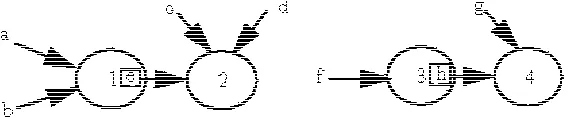
In a statementsof a program, eachreference-setand alias set for the alias relation in Fig 4.1 are represented as follows.
Fig. 4.1.The relationships between reference and objects
An alias analysis algorithm computes the alias sets in a program. Each statement collects an alias set from its predecessor and updates it with the statement itself and passes the resulting alias set to its successor(s). Since the alias computation should be iteratively done until the alias sets and a calling graph have converged for the program, it affects the efficiency of the whole algorithms. For example, there is an assignment statement
a=gin Fig 4.1. It means that the referencearefers to an object that the referenceg refers to. Therefore, the elementaof thereference-setR1is killed and the elementsashould be copied to thereference-setR4. The time
complexity of this computation depends on the space complexity of each representation. Thus, the efficiency of whole algorithms is improved viareference-setrepresentation.
5. Data-Flow Structures. Aliases can be computed with data-flow equations. For the computation of the aliases, we define our data-flow equations, calling graph (CG), and control flow graph (CF G) in this section. Atype table contains all possible types of reference variables.
A CG is needed to compute the alias set of an interprocedural analysis between a calling and a called methods at a call statement. OurCG is a directed graph defined as hNCG, ECG, nmaini, where NCGis a set
of nodes and each node is a method shown one time in aCG even though it may be called many times; where
ECG is a set of directed edges connected from caller(s) to callee(s) and one edge is connected even though a
caller may invoke the callee many times and all edges are connected when many callers invoke one callee;nmain
is the main method that executes initially in a Java program. During our algorithm proceeds, our CG grows as in the previous works [4, 5, 6, 7] by adding nodes.
CF Gs can be used to compute the alias sets of theintraproceduralpropagations. OurCF Gis a directed graph defined for each method ashNCF G, ECF G, nentry, nexiti, whereNCF Gis a set of nodes withnentry,nexit,
and each statement of the method; ECF G is the set of directed edges that represent the control and alias set
information between a predecessor and a successor statements;nentry represents the entry node of the method; nexit represents the exit node of the method.
In ourCF G, seven node types are proposed based on their purposes: Entrythat is thenentry of theCF G, Exitthat is thenexit node,Assignment statement, Call statement, Return Statement, Flow construct node (if,
while etc.), andMerging nodes.
Theflow construct nodeis a node which signifies the start of the if or whileclause. In anIf node, each clause is branched from the node. All the branched clauses are merged into a merging node. In awhilenode, a
merging nodeis not necessary and a directed edge is connected from the last node of the while loop to theflow construct node.
Reference variables dynamically refer to objects in Java. Thus, the types of a reference variable are deter-mined statically at the type declaration and dynamically during the processing of the algorithm. Atype tableis built during the process and it contains three columns: the reference variable, its declared type, and its overrid-den method types. Type inference can be processed with atype tablewhich contains the declared and dynamic types of each reference variable. The declared type represents static and shadowed variable type information of a reference variable. The dynamic types represent possible overridden method types of the reference variable. Types of each reference variable can be given in a constant time.
6. Flow-SensitiveContext-Insensitive Rules forReference-Set. The propagation and computation of alias information is made through the nodes in aCF Gof each method. Letin(n) andout(n) be the input alias set of a nodentransferred from predecessor nodes and output alias set held onexitfrom a nodenrespectively.
in(n) =[out(pred(n))
out(n) =T rans(in(n)) =M odgen[M odkill(in(n))]
In this equation, pred(n) represents a predecessor node of the node n. M odkill denotes the alias set
modified after killing some reference-sets ofin(n) and M odgen is the subsequent alias set after generating the
newreference-sets onM odkill.
6.1. Flow-Sensitive Intraprocedural Analysis. The propagation rules for intraprocedural analysis are described below for every CF G node type except an entry and a call statement node type. The rule consists of premises and conclusions divided by a horizontal line. The premise can have the form of conditional implication that is interpreted as follows: when a given condition holds, the implied equation has a meaning and can be solved. When all premises hold, the equations in the conclusions are solved forout(n).
First, we define aflow constructand merging nodetype rule in (6.2): npred is a predecessor set of noden.
Givennpred,out(n) of nodenis the union of all predecessor node sets. in(n) = [
p∈npred
out(p)
npred:predecessor node of n out(n) =in(n) (6.2)
The next rule (6.3) concerns the node type of anassignment statement.
in(n) =out(npred)
npred:predecessor node of n
x=LHS,
y=RHS,
∀i, j Ri, Rj∈in(n)→[M odkill(in(n)) ={Ri|kill x∈Ri}
∪ {Ri| kill Rj.f ∈Riwhen q∈Rjand x=q.f}]...1
∧[in(n) =in(n)−M odkill(in(n))]∧[KILL(in(n)) ={x, Rj.f}], ...2
∀k Rk ∈in(n)→[M odgen(in(n)) ={Rk|Rk=Rk∪KILL(in(n))when y∈Rk}]
∧[in(n) =in(n)−M odgen(in(n))], ...3 out(n) =M odkill(in(n))∪M odgen(in(n))∪in(n)
(6.3)
LHSandRHSrespectively stand for the left hand side and the right hand side of an assignment statement.
KILL(in(n)) is areference-set of references killed byM odkill(in(n)). At a statement 1, {Ri|kill x∈Ri} is
to remove the element xfrom the set Ri. out(n) of the noden is a union ofM odkill(in(n)),M odgen(in(n)),
andin(n).
In order to show how the above rule can be applied to alias analysis, we analyze anassignment statement a.e = f.hin a statement of Fig 4.1. Initially,reference-setR1,R2,R3and alias setin(n) are expressed as follows
for the statement:
R1 ={a, b} R2 ={R1.e, c, d} R3 ={f.h, g} in(n) ={R1, R2, R3}
BecauseLHSis a qualified expression related to bothR1andR2,M odkill(in(n)),in(n), andKILL(in(n))
are computed based on 1and 2as follows:
R1={a, b}and R2={R1.e, c, d} then R2={c, d}
M odkill(in(n)) ={R2}, in(n) ={R1, R3}, KILL(in(n)) ={R1.e}
SinceR3 includesRHS,M odgen(in(n)) andin(n) are computed based on 3as follows:
out(n) =M odkill(in(n))∪M odgen(in(n))∪in(n) ={R2, R3, R1} when R1={a, b}, R2={c, d}, R3={R1.e, f.h, g}
The following is the another example to detectreference-setof Fig 2.1 (b) by assuming the current node as
nwith the assignment statementp.x=z:
R1=o1 ={p, q}, R2=o2 ={p.x, q.x, y}={R1.x, y}, R3=o3 ={z} in(n) ={R1, R2, R3}
BecauseLHSis a qualified expression related toR1,M odkill(in(n)),in(n), andKILL(in(n)) are computed
based on 1and 2ofAssignment N oderule (6.3) as follows:
R1={p, q} and R2={R1.x, y}then R2={y}
M odkill(in(n)) ={R2}in(n) ={R1}KILL( in(n)) ={R1.x}
SinceR3includesRHS,M odgen(in(n)) andin(n) are computed based on 3ofAssignment N oderule (6.3)
as follows:
M odgen(in(n)) ={R3|R3=R3∪ {R1.x}}={z, R1.x}=R3, in(n) ={R1}
Thus,out(n) is the union set ofM odkill(in(n)),M odgen(in(n)), andin(n) as follows: out(n) =M odkill(in(n))∪M odgen(in(n))∪in(n) ={R2, R3, R1}
when R1={p, q}, R2={y}, R3={z, R1.x}
Finally,out(n) has the followingref erenceset, which has the correct aliased elements:
out(n) ={R1, R2, R3} when R1={p, q}, R2={y}, R3={z, R1.x}
With this example for Fig 2.1 (b), we have shown that our reference set ofout(n) is more precise than the aliased elementsAOU T of thecompact representationshown in the§2.
The rule (6.4) for thereturn statement nodetype is presented as follows with thereference-setof a return variabler. In the rule,LOCALstands for a local variable set defined in a methodM such as local variable and formal parameter variables.
in(n) =out(npred)
npred:predecessor node of n
M :callee, LOCAL(M) ={v|v is a local variable of M} ∀i Ri ∈in(n)f or r: return ref erence
→[M odkill(in(n)) ={Ri|kill x∈Ri f or x∈LOCAL(M)}]∧
[Rr={Rr|kill x∈Rr f or x∈LOCAL(M)when r∈Rr}], out(n) =M odkill(in(n))
(6.4)
The next is the rule (6.5) for anexit nodetype.
in(n) = [
p∈npred
M :callee, LOCAL(M) ={v|v is a local variable of M},
∀i Ri∈in(n)
→[M odkill(in(n)) ={Ri|kill x∈Ri f or x∈LOCAL(M)}]
∧[in(n) =in(n)−M odkill(in(n))] out(n) =M odkill(in(n))∪in(n)
(6.5)
6.2. Context-Insensitive Interprocedural Analysis. Interprocedural propagation rules
should be considered for a call statement node and an entry node. The data flow of an alias set in a call statementdenotes that an alias information of the statement is propagated to a called method and it affects an alias information of the called method. The affected information are passed back to the call statement of the calling method after computing the alias set of the called method. The alias set from the called method modifies the alias set of thecall statementwhen the return alias set includes non-local variables and actual parameters. We virtually divide a call node into aprecall nodeand apostcall nodeto simplify the computation of a call statement. Aprecall nodecollects an alias set from apredecessor nodeof a current call node and computes its own alias setout(n) with the collected set. This alias set is propagated to theentry nodeof the called method. During the propagation, theref erence−sets for references which are inaccessible from the called method are killed. Since this set is an input of thepostcallnode and is not modified, it does not need to propagate to the called method. Theout(n) of theprecallnode is not propagated to thepostcallnode because the called method might modify the set. As in previous approaches [2, 3, 4], if we do not kill the alias relations affected by the called method for the subsequent analysis, it might build nonexistent call relations and cause the subsequent analysis to become inefficient.
A postcall node collects the modified kill set of the precall node and exit nodes alias set of all possible called methods. The following rule (6.6) computes an out set of aprecallnode.
in(n) =out(npred), npred:predecessor node of n
RHS=Ec.Mc, RHS =Mc,
∀i, ai=the ith actual parameter of the callee M c,
∀i, fi=the ith f ormal parameter of the callee Mc,
∀i, R(ai)∈in(n)→[Rpass(ai) ={ai, fi}]∧[R(ai) =R(ai)−Rpass(ai)], RHS=Mc, ∀i, R(ai)∈in(n), v is a non local variable in the callee, Mc→[R(v) =R(v)− {v}]∧[Rpass(v) ={v}]∧[P ASS(Mc) =∪{Rpass(ai), Rpass(v)}],
RHS=Ec.Mc,∀i, R(ai)∈in(n)∀f,
R(Ec.f)∈in(n)→[R(Ec.f) =R(Ec.f)− {Ec.f}]∧
[Rpass(Ec.f) ={Ec.f}]∧[P ASS(Mc) =∪{Rpass(ai), Rpass(Ec.f)}] out(n) =in(n)
(6.6)
P ASS(Mc) represents the set of actual, formal parameters and non-local variables in a called method Mc.Rpass(ai) is a set of reference variables accessible by a called method when passing from a caller to the
called methodMc.Rpass(v) is a set of non-local variables accessible by a called method in the called method Mc.
In the following propagation rule (6.7) of an entry node, the propagated set can be computed as in an
assignment statement node. P RECALL(Mc) is aprecall nodeofcall statement nodes that invoke this called
method node. This set can be computed by considering ingoing edges of the called methodMc in a CG. An
entry node merges alias sets from theprecallnodes and then propagates the merged set to its subsequent node.
in(n) = [
p∈P RECALL(Mc)
P ASS(p),
P RECALL(Mc) :a precall node of the callee Mc out(n) =in(n)
in(n) =
p∈nprecall
out(nprecall) nprecall: a precall node of n
RHS=Ec.Mc
→F IELD(Ec) ={f | f is a f ield name in an object ref erred by Ec}, RHS =Mc→F IELD(Ec) =φ,
RHS=new Mc→F IELD(Ec) =φ∧A(r),
EXIT(Mc) ={e|e is an exit alias set f rom a possible callee method Mc}, LHS=φ,∀Rpassb ∈EXIT(Mc)
→[Rpassb=Rpassb− {v|v is a local variable in the callee Mc}]
∧[EXIT(Mc) =
[
f or all Mc
Rpassb], LHS6=φ, ∀Rpassb∈out(return node)
→[Rpassb=Rpassb− {v|v is a local variable in the callee Mc}]
∧[EXIT(Mc) =
[
f or all Mc
Rpassb],
∀i Ri∈EXIT(Mc),∀jRj ∈in(n)→[Ri |Ri=Ri∪Rj when i=j]
∧[EXIT(Mc) =EXIT(Mc)−Ri]∧[in(n) =in(n)−Rj],
exit(RHS) = [
e∈EXIT(M c)
out(e)∪ [
p∈nprecall
out(precall node)∪ [
f or all i Ri,
LHS=φ→out=exit(RHS),
LHS=x,∀i, j Ri, Rj ∈exit(RHS), R(RHS)∈exit(RHS)
→[M odkill(exit(RHS)) ={Ri|kill x∈Ri}
∪ {Ri|kill Rj.f ∈Ri when q∈Rj and x=q.f}]∧[KILL(exit(RHS)) ={x, Rj.f}]
∧[exit(RHS) =exit(RHS)−M odkill(exit(RHS))], R(RHS)∈exit(RHS)→[M odgen(exit(RHS))
={R(RHS)|R(RHS) =R(RHS)∪KILL(exit(RHS))] ∧[exit(RHS) =exit(RHS)−M odgen(exit(RHS))]
∧[out=M odkill(exit(RHS))∪M odgen(exit(RHS))∪exit(RHS)] out(n) =out
(6.8)
Exit(RHS) is a set of exit nodes of all possible called methods as explained before. We can compute
exit(RHS) in aCG by integrating allout(precall node) and outgoing edges from callers and their exit nodes.
Out is an alias set of the exit node of a callee. If we assume the Fig 6.1 (a) as a status after executing a statements, the alias set Asof the statementsis:
As=R2, R3
where R2={a.f, b, c, R3.f}and R3={R2.f, c}
After executing the call statementtin Fig 6.1 (b), the result alias set of its precall nodecan be computed in the following sequence of rule applications:
in(t) ={R2, R3}, RHS =a.update(c),
ai=c, fi=i,
Fig. 6.1.Example of an interprocedural analysis
or R(ai) =R3=R3− {c}={R2.f},
R(a.f) =R2=R2− {a.f}={b, R3.f} and Rpass(a.f) =a.f , P ASS(a.update) ={Rpass(ai), Rpass(a.f)},
out(t) ={R2, R3}
TheP ASS(a.update) of the precall node propagates to the entry nodeof the callee update(). The result alias set of theexit nodecan be computed as follows:
Rpass(ai) ={c, i}, Rpass(a.f) ={a.f},
Rpass(ai) =Rpass(a.f) ={c, i, a.f}=Rpass(R2)f or R2, Rpass(ai) ={c, i}=Rpass(R3)f or R3,
in(u) ={Rpass(R2), Rpass(R3)}, R(b) ={b, i.f, c.f},
out(u) =updateexit={R(b), Rpass(R2), Rpass(R3)}
The result set of the postcall node at the statementt is computed with the exit alias set of the update() and the propagation rule of the postcall node as follows:
in(t) =out(tprecall) ={R2, R3} where R2={b, c.f}, R3={c.f}, F IELD(a) ={a.f},
EXIT(update) =updateexit={R(b), Rpass(R2), Rpass(R3)}, where Rpass(R2) ={c, i, a.f}and Rpass(R3) ={c, i}, R(b) =Rpassb={b, c.f}, Rpassb(R2) ={c, a.f}, Rpassb(R3) ={c}
for the caller,
EXIT(update) ={R(b), Rpassb(R2), Rpassb(R3)}, R2=R2∪Rpassb∪Rpassb(R2) ={b, R3.f, c.f, c, a.f},
R3=R3∪Rpassb∪Rpassb(R3) ={R2.f, b, c.f, c},
Thus,out(t) =R2, R3
7. Static Analysis Algorithm for Aliases. Algorithm 7.1 represents our alias analysis algorithm. This algorithm is adapted on the interprocedural type analysis algorithm [6]. It is one of iterative methods for interprocedural data flow analysis based on a CG [10]. The iterative algorithm executes its computation by visiting all nodes of aCG in order until fixed point of the data status and nodes are achieved.
Our algorithm traverses each node of aCG in a topological order and a reverse topological order in order to possibly shorten the execution time for the fixed point [5, 6, 7]. The ending point in our algorithm means that the topology of aCGand alias setout(n) are not changed anymore.
The setT Y P ES represents the possible class types for a callee to build a safeCG.T Y P EStable(r)is a set
repeat
for allnoden∈Ncf g(T.M) in structural orderdo
for allnoden∈Ncf g(T.M) in structural orderdo
if n is a call statement nodethen if (RHS=Ec.Mc) then
compute the set of inferred types from the reference-set forEc.
compute the set TYPES resolved from the inferred types and class hierarchy.
else if (RHS =Mc)then T Y P ES:={T}
else if (RHS =newMc)then T Y P ES:={Mc}
end if
if LHS existsthen
{T Y P EStable(LHS) =T Y P EStable(RHS);}
end if
for alltypet∈T Y P ES do if t.Mc is not in CG then
create a CG node for Mc;
end if
if no edge fromT.M to t.Mc with a labelnthen
connect an edge fromT.M to t.M cwith a labeln;
end if end for
computeout(nprecall) for a precall nodenprecall;
computeout(npostcall) for a postcall nodenpostcall;
else
if n is an assignment statement nodethen T Y P EStable(LHS) =T Y P EStable(RHS);
end if
if n is a merging statement nodethen
T Y P EStable(LHS) =T Y P EStable(LHS) +T Y P EStable(RHS);
end if
computeout(n) using data-flow equation and propagation rule;
end if end for end for
untilCG and alias set for every CFG node converge
type table. Inner loop is forintraprocedural alias analysis for each method. While proceeding the inner loop, each node of theCF G of a method is traversed with computing an alias set of each node and the computed alias set is propagated to the next node. Each node in our algorithm is visited on structural order for this. Structural order is defined that while visiting nodes from an entry node to an exit node, for theifflow construct node, each branch is traversed first then finally its merging node is visited. We improve the efficiency with the structural order than the previous work [6].
When the method of a call statement node is an overridden method, its resolution should be considered for the safety of the alias set. It is not possible to precisely predict the dynamic overridden method statically. However, we can store all possible types of each reference into atype tableduring computation. Thus, we can safely predict all possible methods invoked with thetype table. If the method is defined in a type inferred by this type inference, the method defined is a resolved method. By adding all possible methods to the CG via the searching, we can update theCG.
Table 8.1
Characteristics of hosts
Kottos Ceng Asadal
Host Type RS6000 Sun4 Windows 2000
OS AIX4 SunOS5.6 Windows NT
Java VM JDK-1.1.1 JDK-1.2.1 02 JDK-1.2.2
data-flow equations of the propagation rules. Our algorithm has three outer loops. For the most outer loop,Rn
and Ar are the number of ref erence−sets and the maximum number of aliased reference variables for each
reference-set. We can estimate the worst time complexity of the loop asO(Rn×Ar×Ecg) -Ecg is the number
of edges in a CG. For the second outer loop, the time complexity becomes O(Ncg) ifNcg is the final number
of nodes in aCG. For the most inner loop, the time complexity isO(Ncf g) ifNcf g is the maximum number of
nodes in aCF Gthat consists of the maximum number of nodes.
The time complexity of a set of inferred types isO(Rm) whenRmis the number of reference variables in a
program code. The time complexity for the possible method resolution isO(Ti×H) whenTi is the maximum
number of subclasses for a superclass and H is the maximum number of the levels in its hierarchy. The time complexity for the resolution of overridden methods and the updating of a CG is O(Ti×(H +N cg+Cc))
when Cc is the maximum number of call statements to invoke same called methods in a calling method. The
worst time complexity of a precall and a postcall nodes is O(Rp ×R) when Rp is the maximum number of
reference-sets propagated andRis the maximum number of reference variables inRp on a call statement.
Therefore, the worst time complexity of the main algorithm isO(Rn×Ar×Ecg×Ncg×Ncf g×(Rp×R× Rm+Ti×(H+Ncg+Cc))).
181
256.75
185.375
403.25 396.375
248.875
0 50 100 150 200 250 300 350 400 450
m
s
e
c
OP (Kottos) RS (Kottos) OP (Ceng)
OP (Ceng) OP (Asadal) RS (Asadal)
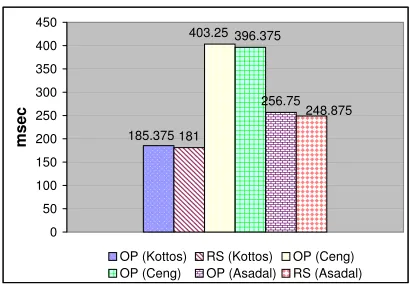
Fig. 8.1. Run Time of Overridden Methods
8. Experimental Results. We have executed benchmark codes on alias analysis algorithms with the
reference-setand the existingobject-pairrepresentations [2, 3, 4, 6, 7]. We only focus on time for the experiment because the alias detected for these two executions are implicitly the same—the benchmark does not have the indirect object relations that may generate imprecise aliases with the existing work. The algorithm is the part of a Java compiler. Thus, the execution time is to measure the compilation time of the codes. We believe that the theoretic approach of this paper is enough to show ourreference-setrepresentation is both safe and precise without losing the efficiency. However, we have the three benchmark codes executed, which are:
311.375 511.875
451.875
297.25 513.875
452.875
0 100 200 300 400 500 600
m
s
e
c
OP (Kottos) RS (Kottos) OP (Ceng)
RS (Ceng) OP (Asadal) RS (Asadal)
Fig. 8.2.Run Time of Ray Tracer
282.125 553.5
1868.625 13002.25
233.5
273 297.25
346.875
439.875
0 100 200 300 400 500 600
m
s
e
c
Object Pair Reference Set
Fig. 8.3.Run Time of Binary Tree at Kottos
is Sun4 Unix machine; Asadal is Windows machine. The alias analysis systems are built on JavaCC (Java Compiler Compiler) [11] and JTB (Java Tree Builder) [12]. JavaCC is the parser generator and JTB is a syntax tree builder to be used with the JavaCC parser generator. It automatically generates a JavaCC grammar with the proper annotations to build the syntax tree during parsing [12]. The syntax tree is extended by adding the data structures ofreference-setandobject-pairrepresentations with class structures ofT T andCF G[13].
Overridden M ethods is written in C++ initially byCarini [6] and adapted in Java by ourselves. It has conditional statements and overridden methods. Binary T reeis provided by Proactive group [14]. The binary tree contains many conditional statements and recursive calls that generate potential aliases dynamically. Both can be used to measure the safety, preciseness, and efficiency of the algorithms. RayT racer is one of Java Grande’s benchmarks to measure the performance of a 3D raytracer [15].
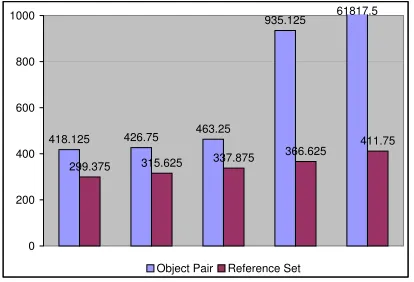
Fig 8.1 presents the execution times ofOverridden M ethods. For all hosts, the execution time of reference-set is faster than object-pair because our T ype T able has more efficient structure to search possible types of methods than Carini’s [6]. Fig 8.2 is the execution times of Ray T racer. It implies that the benchmark codes such asRay T racer, which do not contain many aliased references among objects and which is for JVM performance measurement, do not have any big difference in the execution time of alias analysis for any alias representation. ForBinary T ree, Fig 8.3, Fig 8.4, and Fig 8.5 show that the execution time of reference-set
588.75
1707.875 520456
421.125 457.875 459.75
668.25
823.25
429.75 461.375
0 100 200 300 400 500 600 700 800 900 1000
m
s
e
c
Object Pair Reference Set
Fig. 8.4.Run Time of Binary Tree at Ceng
418.125 426.75 463.25
935.125 61817.5
299.375 315.625 337.875
366.625 411.75
0 200 400 600 800 1000
Object Pair Reference Set
Fig. 8.5.Run Time of Binary Tree at Asadal
object-pairis not measurable because the execution time is too long. The result ofBinary T reefor each host is reasonable because the performance test shows that Windows and Sun hosts are much faster than IBM for Java benchmark [19, 20]. As a result, we can see thatreference-setis more efficient than object-pairfor benchmark which has many aliased objects such as Binary T ree. Besides, it does not negatively affect the performance for benchmark which does not have many aliased objects such asOverridden Methods andRay Tracer.
9. Conclusion. We propose theflow-sensitive context-insensitivestatic analysis algorithm for aliases with
reference-set alias representation in Java by adapting existing alias analyses [6, 7] in C or C++. We show theoretically that the algorithm is more precise, safe, and efficient than previous studies [2, 3, 4, 6, 7] by using the reference-set alias representation, the structural traverse of a CF G, and the data propagation rules for the representation. Finally, we show in the experimental results that our approach is more efficient, at least equivalent, comparing to the previous studies [2, 3, 4, 6, 7].
REFERENCES
[4] R. Chatterjee and B. G. Ryder, Scalable, flow-sensitive type inference for statically typed object-oriented languages, Technical Report DCS-TR-326, Rutgers Univ., Aug. 1997.
[5] Jong-Deok Choi, Michael Burke, and Paul Carini,Efficient Flow-Sensitive Interprocedural Computation of Pointer-Induced Aliases and Side Effects, The 20th ACM SIGACT-SIGPLAN Symposium on POPL, pp 232-245, January 1993. [6] Paul Carini and Harini Srinivasan,Flow-Sensitive Type Analysis for C++, Research Report RC 20267, IBM T. J. Watson
Research Center, November 1995.
[7] Michael Burke, Paul Carini, and Jong-Deok Choi,Interprocedural Pointer Alias Analysis, Research Report RC 21055, IBM T. J. Watson Research Center, December 1997.
[8] Barry K. Rosen,Data flow analysis for procedural languages, JACM, 26(2):322-344, April 1979.
[9] M. Emami, R. Ghiya, and L. J. Hendren,Context-sensitive interprocedural point-to analysis in the presence of function pointers, SIGPLAN ’94 Conference on Programming Language Design and Implementation, pp 242-256, 29(6), 1994 [10] S. S. Muchnick,Advanced Compiler Design and Implementation, Morgan Kaufmann Academic Press, July 1997. [11] Sun Micro Systems,JavaCC, The parser Generator, http://www.suntest.com/JavaCC/, V0.8pre2, 1998.
[12] Purdue University,West Lafayette, Indiana, USA, Java Tree Builder, http://www.cs.purdue.edu/jtb/index.html, 2000. [13] Jongwook Woo, Isabelle Attali, Denis Caromel, Jean-Luc Gaudiot, and Andrew L Wendelborn,Alias Analysis
On Type Inference For Class Hierarchy In Java, The 24th ACSC 2001, pp 206-214, Jan 29-Feb 2, 2001.
[14] Jongwook Woo, Jehak Woo, Isabelle Attali, Denis Caromel, Jean-Luc Gaudiot, and Andrew L Wendelborn,
Alias Analysis For Java with Reference-Set Representation, The 8th ICPADS 2001, pp 459-466, June, 2001.
[15] Jongwook Woo, Jehak Woo, Isabelle Attali, Denis Caromel, Jean-Luc Gaudiot, and Andrew L Wendelborn,
Alias Analysis For Exceptions In Java, The 25th ACSC 2002, pp 321-330, Jan, 2002. [16] Inria,ProActive, Sophia, http://www.inria.fr/oasis/ProActive
[17] Java Grande Forum, http://www.javagrande.org/
[18] W. Landi and B. G. Ryder, and S. Zhang,A Safe Approximating Algorithm for interprocedural Pointer Aliasing, in Proceed-ings of the ACM SIGPLAN ‘92 Conference on Programming Language Design and Implementation, pp 235-248, June 1992. [19] Pendragon SoftwareCaffeineMark 3.0, http://www.pendragon-software.com/pendragon/cm3/results.html
[20] National Institute Standards and Technology,SciMark 2.0,http://math.nist.gov/cgi-bin/ScimarkSummary
Edited by: Andrzej Goscinski
Received: December 17, 2002